Preparations for Moving In – August, September 2025

After returning from vacation, the plan was to turn my attention to the garage workshop. The idea was to prepare for the upcoming trim work that was facing me inside the house. A lot of thought went into it, but no real action. I was considering getting several new pieces of equipment, including an 8″ jointer, a cabinet saw, and something for dust collection. Some of these would require new 240 volt outlets. The table saw and jointer are both large machines. I have limited room in my garage so both would have to be mobile so they could be moved to the side to make room for the car. After considerable thought, I decided to not buy anything, yet. Instead I decided I would see if I could make do with what I have and only buy something when not doing so becomes painful.

While that was going on, I decided it would be best to focus on the things that would have to be ready in order for me to move in, which would be mid November. Some low hanging fruit was adding hardware to the master bathroom.
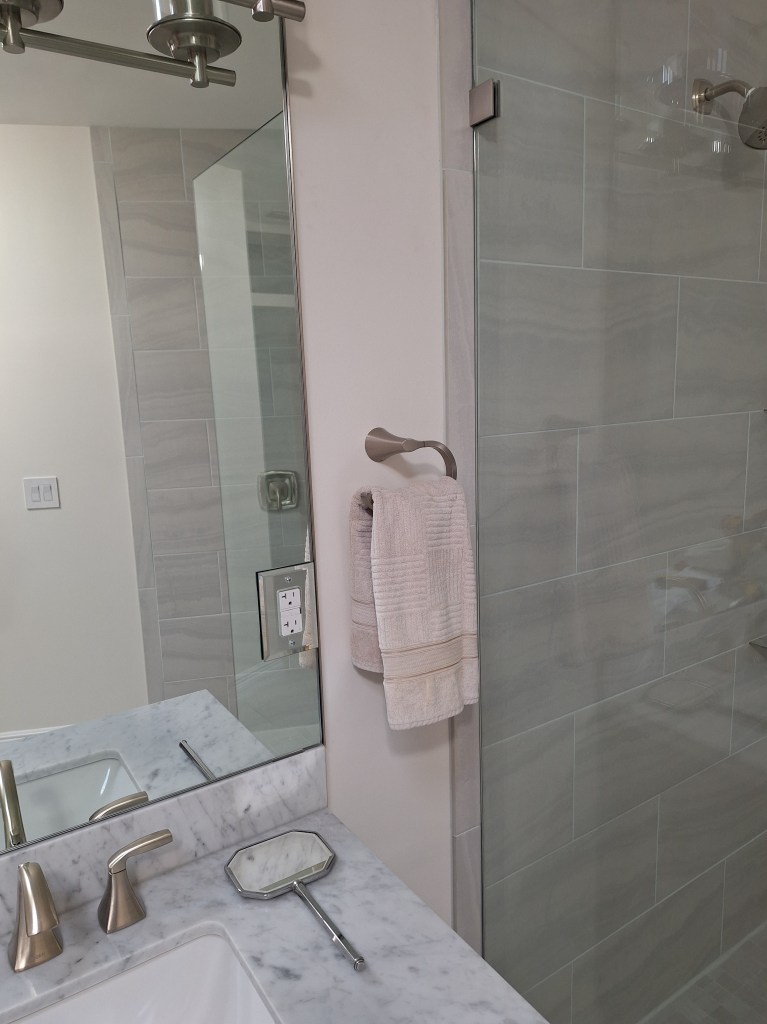
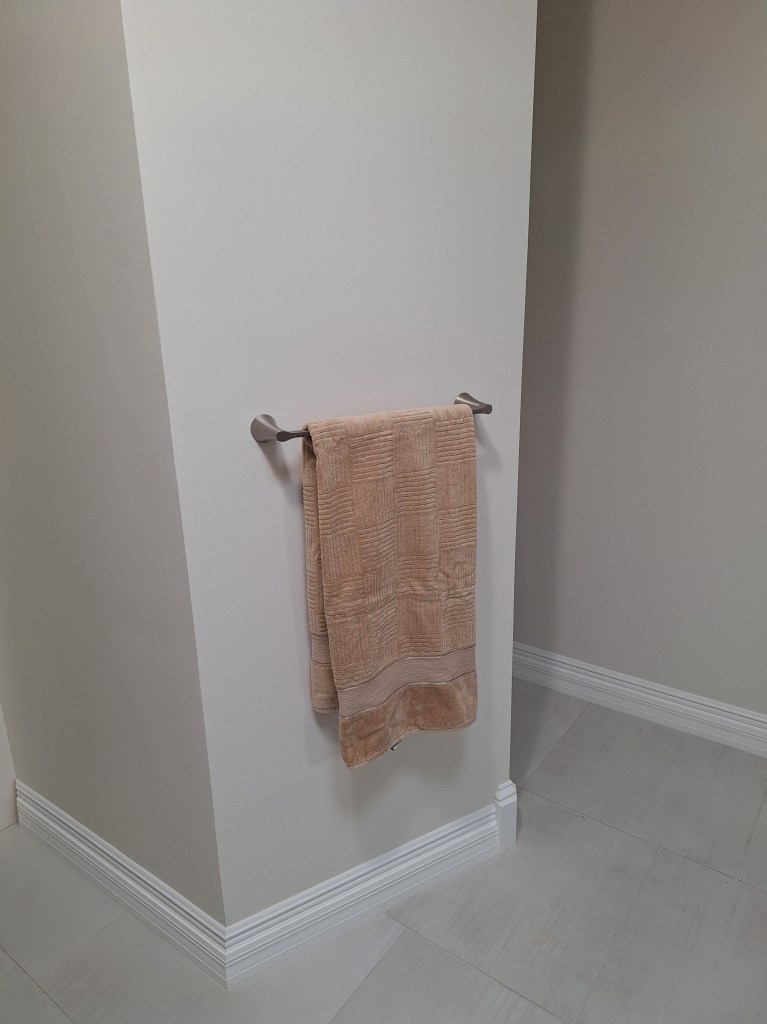
Towel Hook
Towel Rod
Toilet Paper Holder
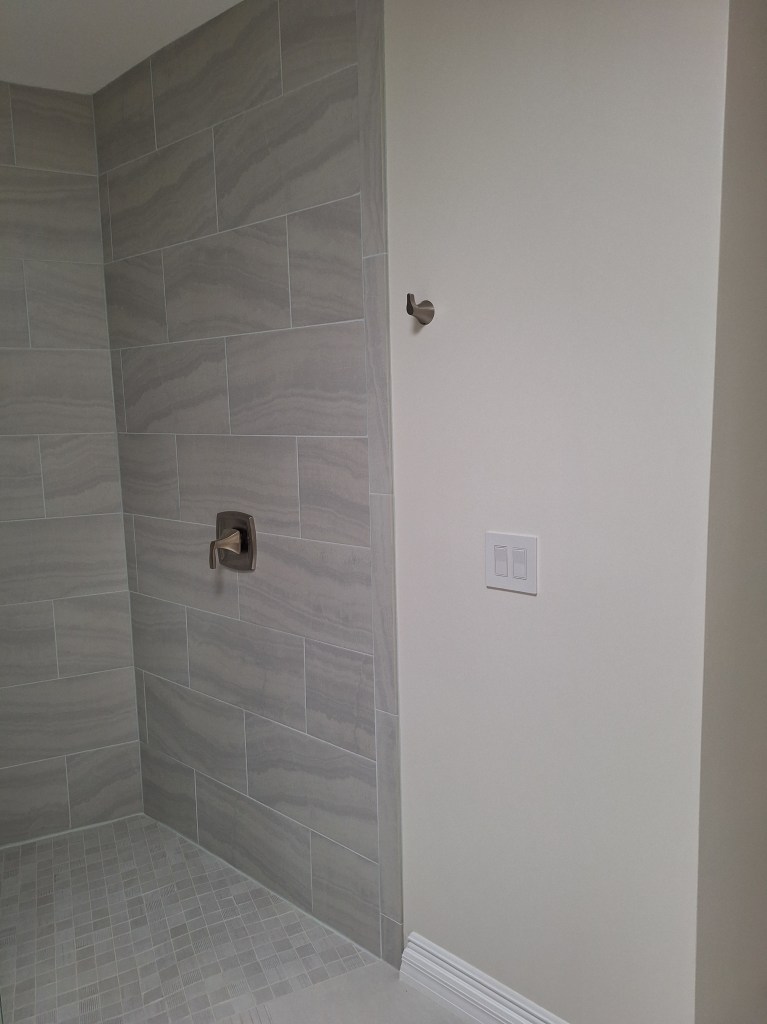
Shower Towel Hook

Since the towel rod is not right beside the shower, I added a hook to hold the towel while showering. I did not want to put a towel rod on the wall outside the shower because, if hung in the usual location, it would cover the switches.

Before moving in, I really needed to have the backsplash behind the cooktop installed. In the last post I mentioned that I planned to run the black granite up the wall. That was the plan, but the installers were really dragging their feet on this. I also asked them for an estimate for the vanity in the guest bathroom but, again, nothing. So while that was in limbo, I decided to have the tree in the front yard removed. It was something I figured I would do after I moved in, but given the limited activity, I decided to initiate that process. Fortunately, the company I contacted to do that was very prompt and responsive.

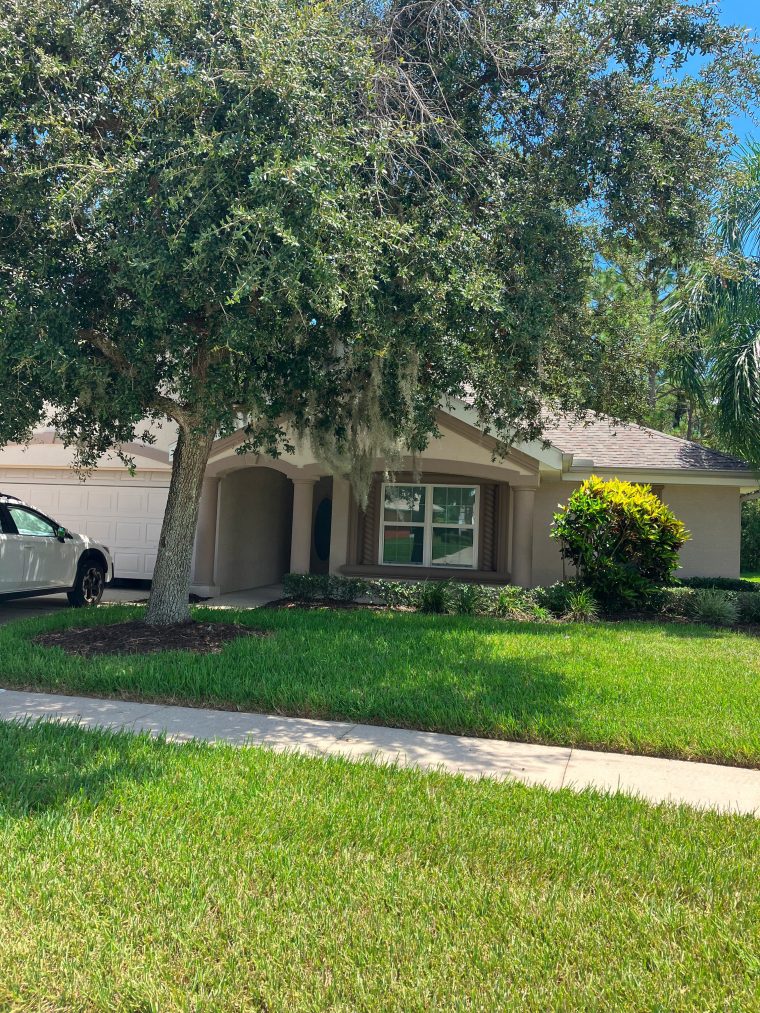
Tree Before Removal
Tree Before Removal

As you can see above, the tree was pretty ugly. Knowing it was going to be removed, I did not have it trimmed, so it was getting really crazy. It was a Live Oak, and was really not suited to this small a plot. The root system is extensive, so it would eventually mess up my driveway. Also, it sits atop the drain that leads from the house to the city sewer system, so that could be impacted too.
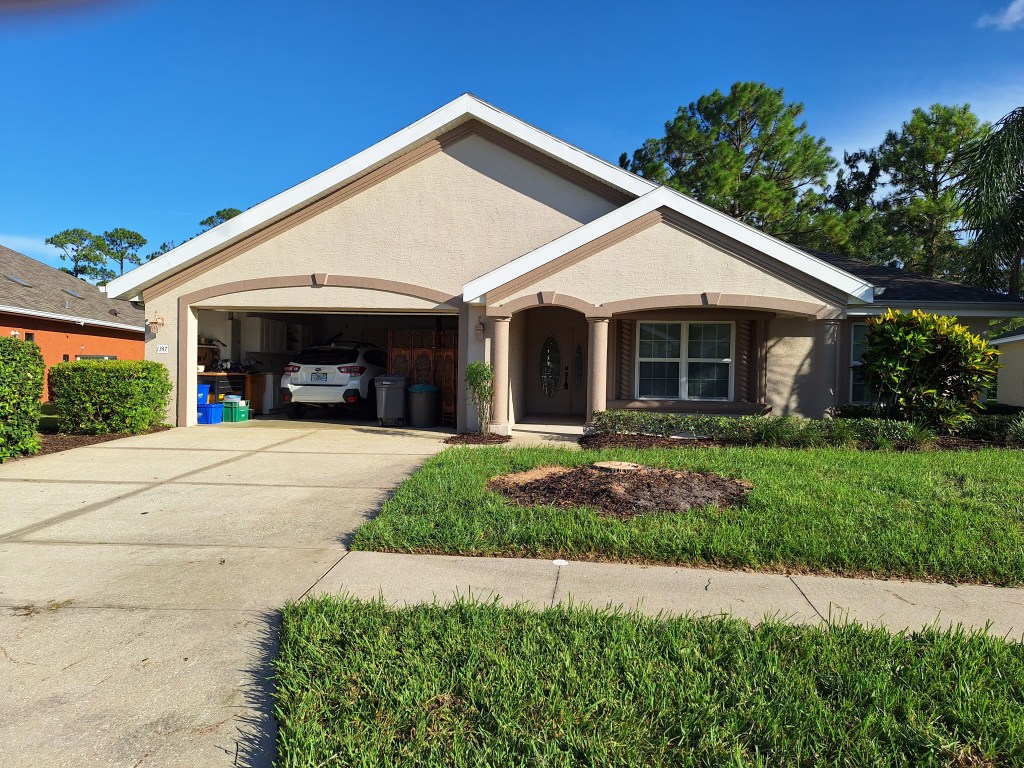
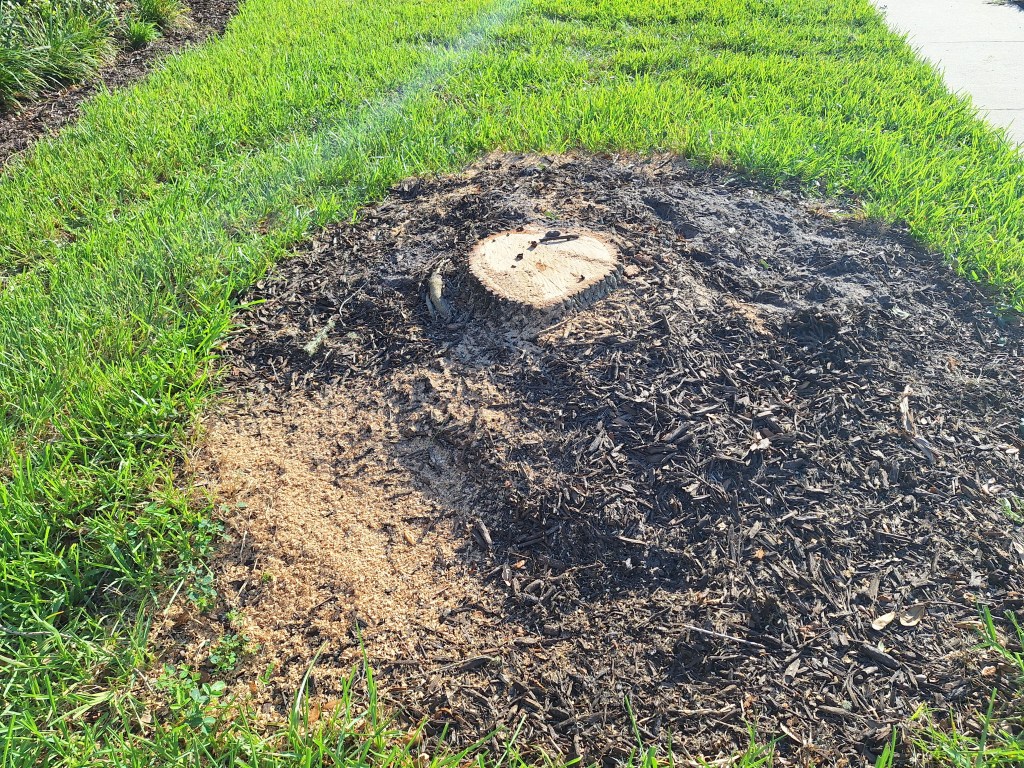
Tree Removed
Remaining Stump
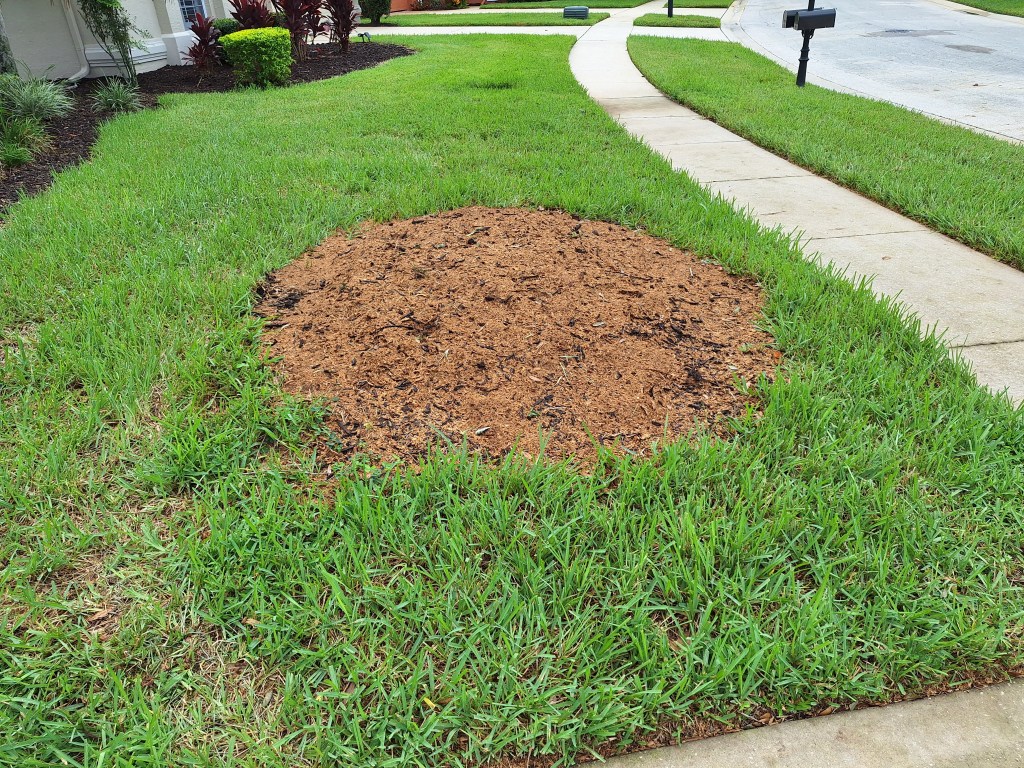
After Stump Ground Down

I will leave what you see above until the spring before sodding that area. It needs to settle for some time.

Returning to the cooktop backsplash, I contacted someone else to get an estimate, since my countertop installers still hadn’t responded. I got a much higher quote. Shortly after that, I did hear from my countertop guy, and he was expressing some concerns about the weight of the slab for the backsplash. It would be a very heavy slab. So that got me thinking of alternatives, and I decided to abandon the granite and instead opted for an embossed stainless steel backsplash with a diamond pattern. It would look really nice, be easy to clean, and would not introduce any weight issues. So I found someone to do that work and initiated the process.

While that was going on, I took care of a small but nagging issue that needed to be done before I moved in; mainly adding the remaining Ethernet keystones and faceplates. I wasn’t looking forward to this because it is fiddly work, but I was pleased to have it done. Here are some of them.
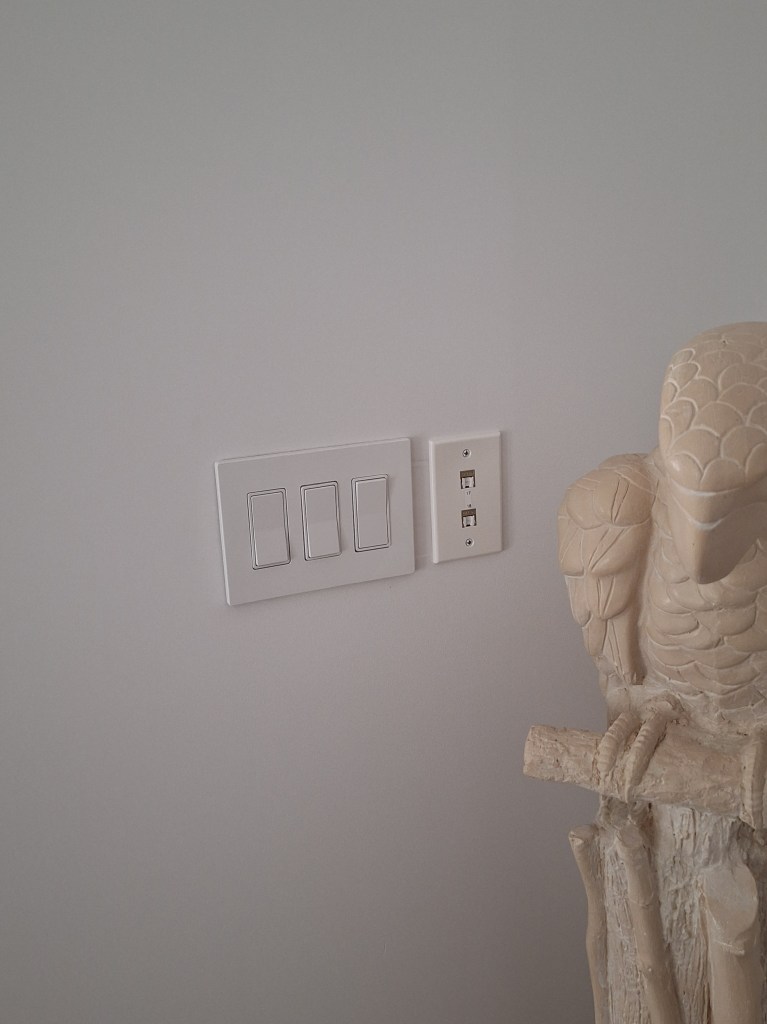
Keystones 17 and 18, in Kitchen.
Keystone 21, in Master Bathroom.

Once each of these is wired up, they have to be tested for connectivity (I have a special tool for that). If the connectivity is good, then I plug in my laptop and make sure it connects to the internet. Once that it confirmed, I insert the keystone(s) into the faceplate and attach the faceplate to the wall. After that is done, I verify again that the laptop can get online. I do this second test because, when attaching the faceplate, the keystone gets pushed into the junction box, which can disturb the connections. Fortunately, that did not happen on any of my installations.

With that done, I hooked up the washer and dryer. They certainly need to be working before I move in. I started with the dryer because it needed a couple of modifications before I could use it. The first was to simply reverse the door. In its current setup, the door would swing open toward the washing machine, making it awkward to transfer clothes from the the washer to the dryer. That was a pretty simple operation. The other thing I had to do was change the way the dryer vented. In its current configuration, it would vent to the left (toward the washer). That needed to change so it would vent out the back where it could connect up to the exterior vent. This proved to be quite an undertaking.
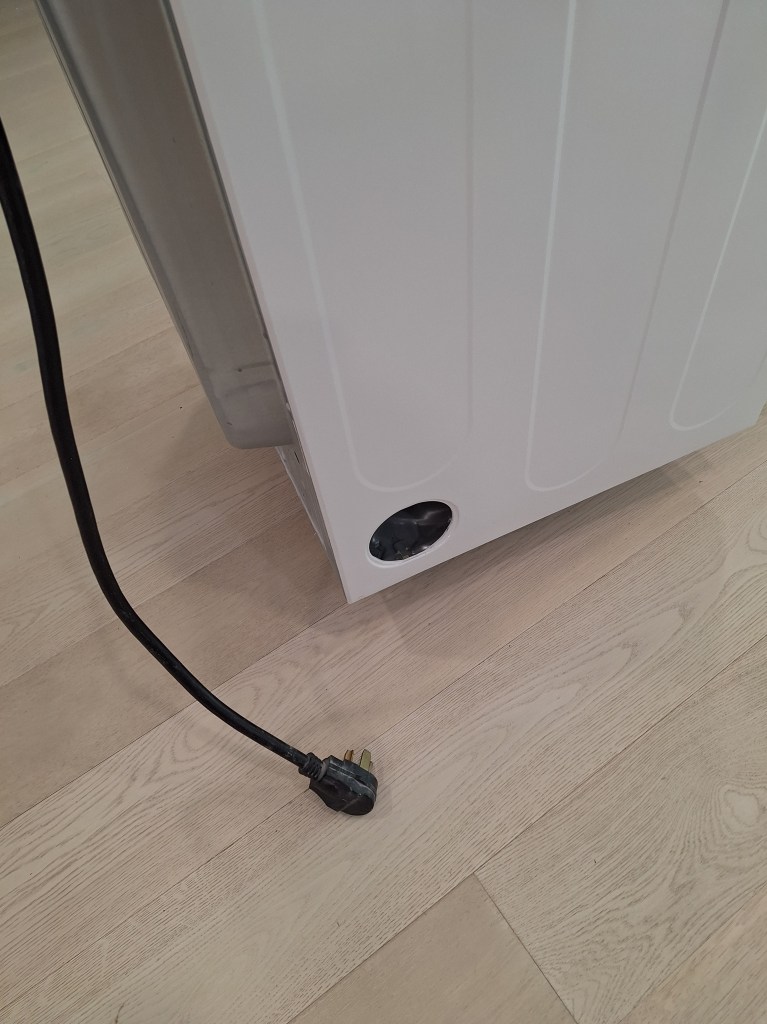
Original Vent Location

To move the dryer vent from the side to the back required that I disassemble the dryer (really!). I found a YouTube video that walked me through it, so that was great, but far more than I was expecting. So I moved the dryer into the living room where I had more space to work and started opening it up.
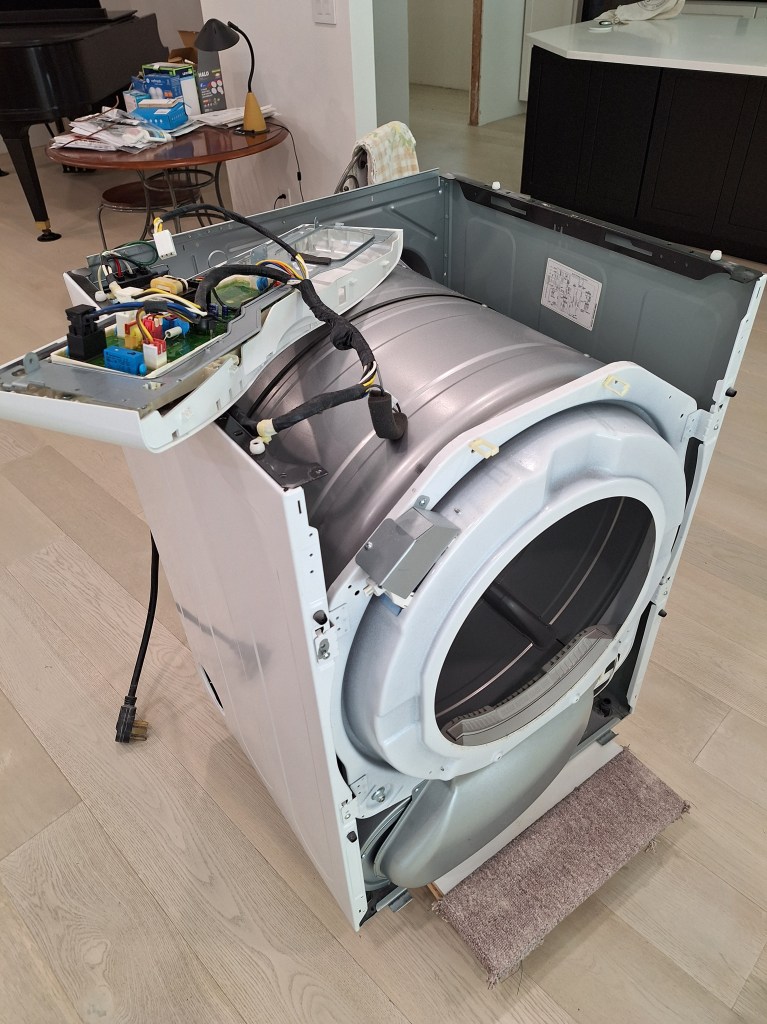
Disassembly Started

What you see above is the top and front door assembly removed. The control panel is resting on the frame and drum. That was just the start. To get access to the vent, the drum would have to be removed.
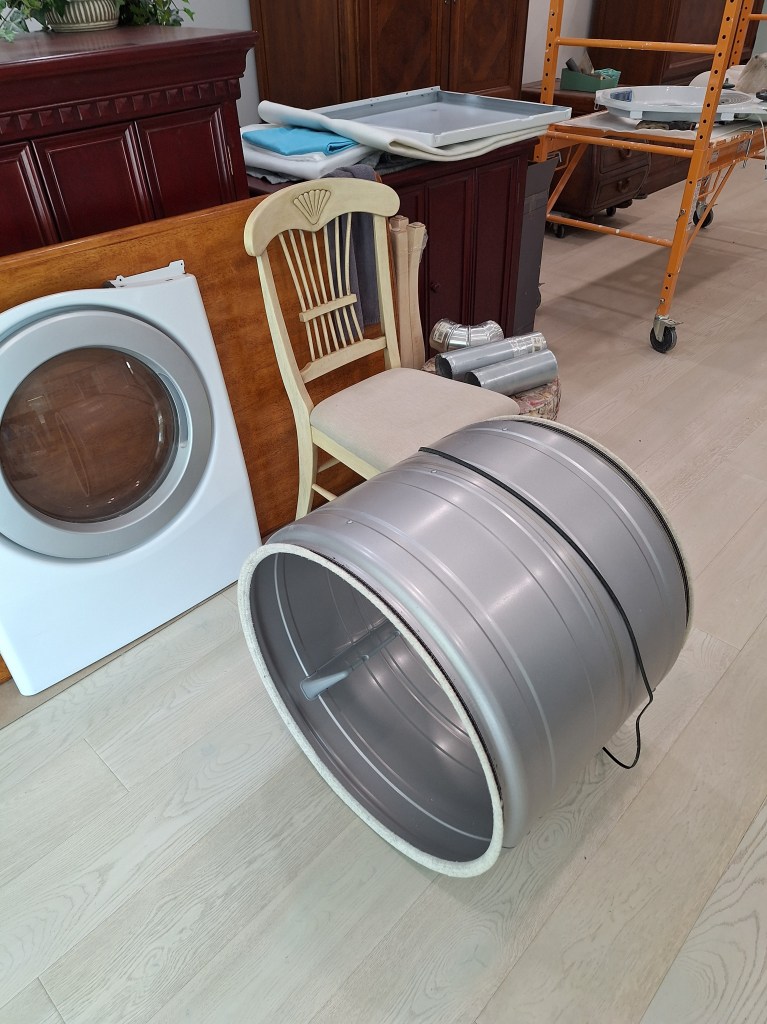
Dryer Door and Drum after Removal
Drum Removed

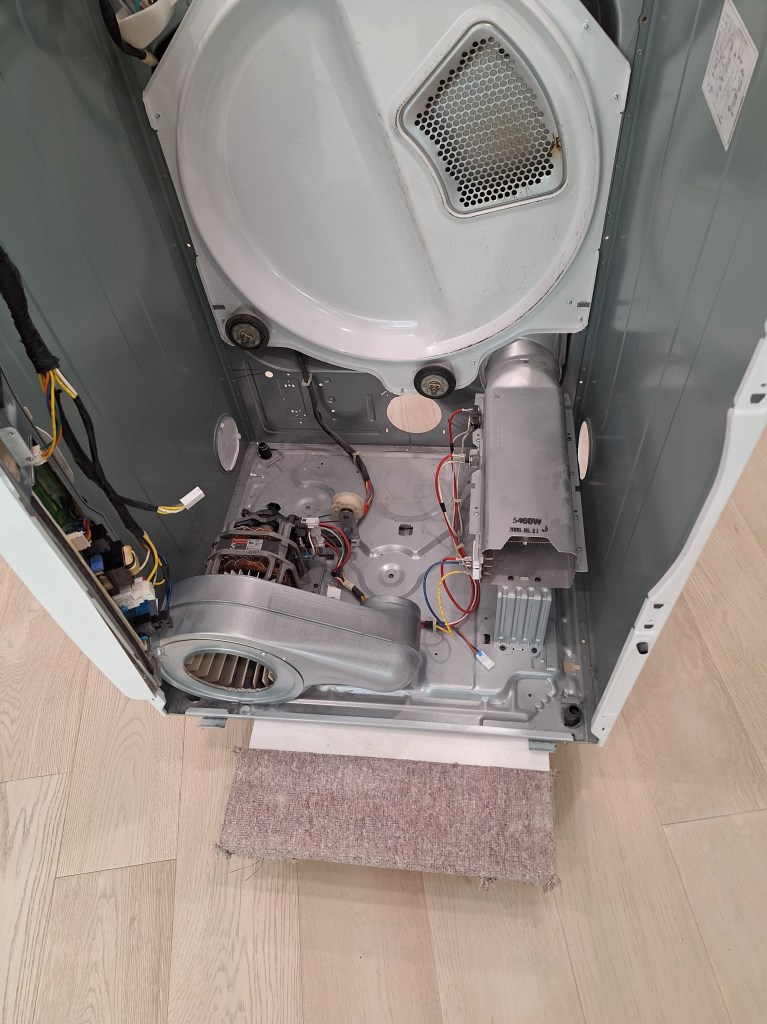
With the drum out of the way, I had access to the area where I would install the vent pipe. Below you can see it installed.
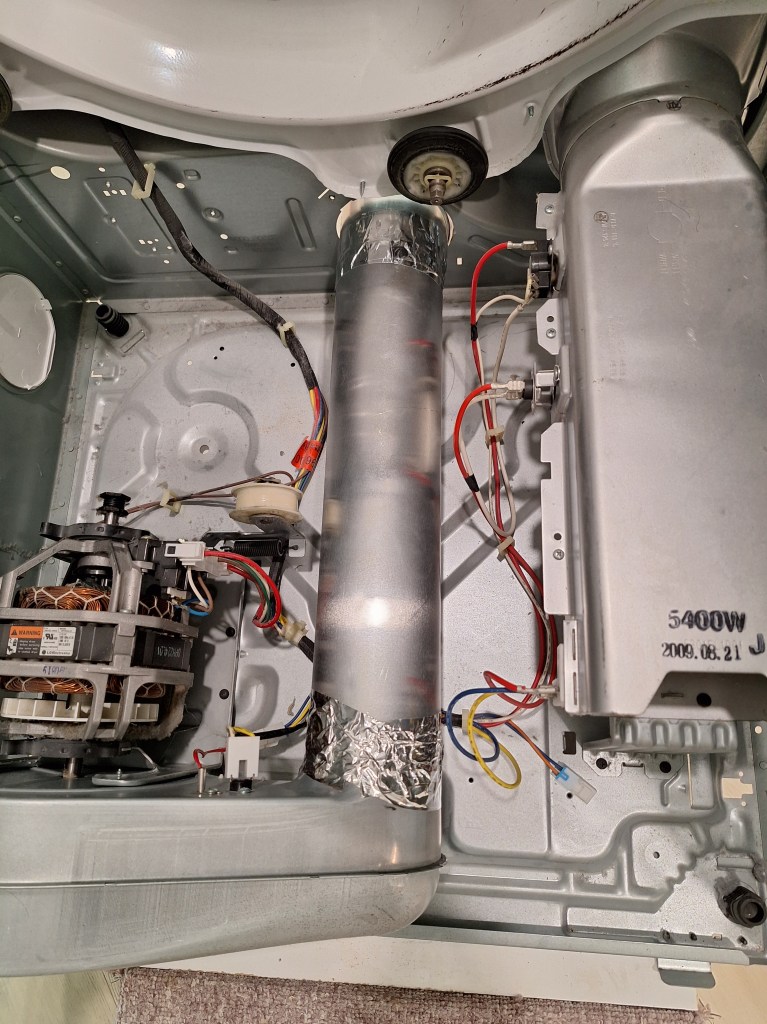
Straight run of Pipe out to the back of Dryer
The turn after Exiting the Dryer

Something of note here is that the pipe that was installed before (the one that vented out the side) was very poorly installed. When I pulled it out I noticed that it was not sealed with foil tape. Instead, the installers simply lined up the sections of pipe as best they could and used foil tape to keep them together. Because they did not take the dryer apart like I did, they had very limited access, so they would have simply reached in as far as the arm would allow and tape the pipe sections together as best they could. They would not have been able to wrap the foil tape fully around the pipe, which is what I saw. Having no experience with this, I was oblivious. It worked, for the most part, but would have leaked a lot, which would have heated up the room, making my A/C work extra.

With the new section of pipe in place, I reassembled the dryer and used a flexible foil pipe to tie it to the section of pipe in the wall that leads to the outside.
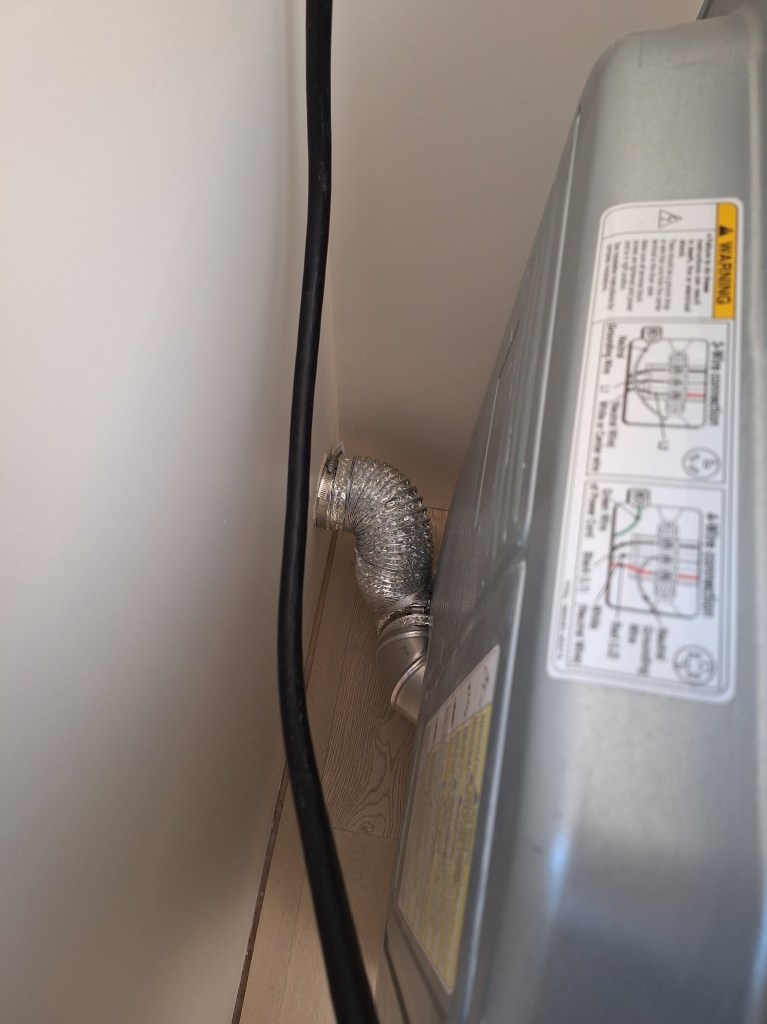
Flex Pipe to the Outside

Here it is installed (sort of).

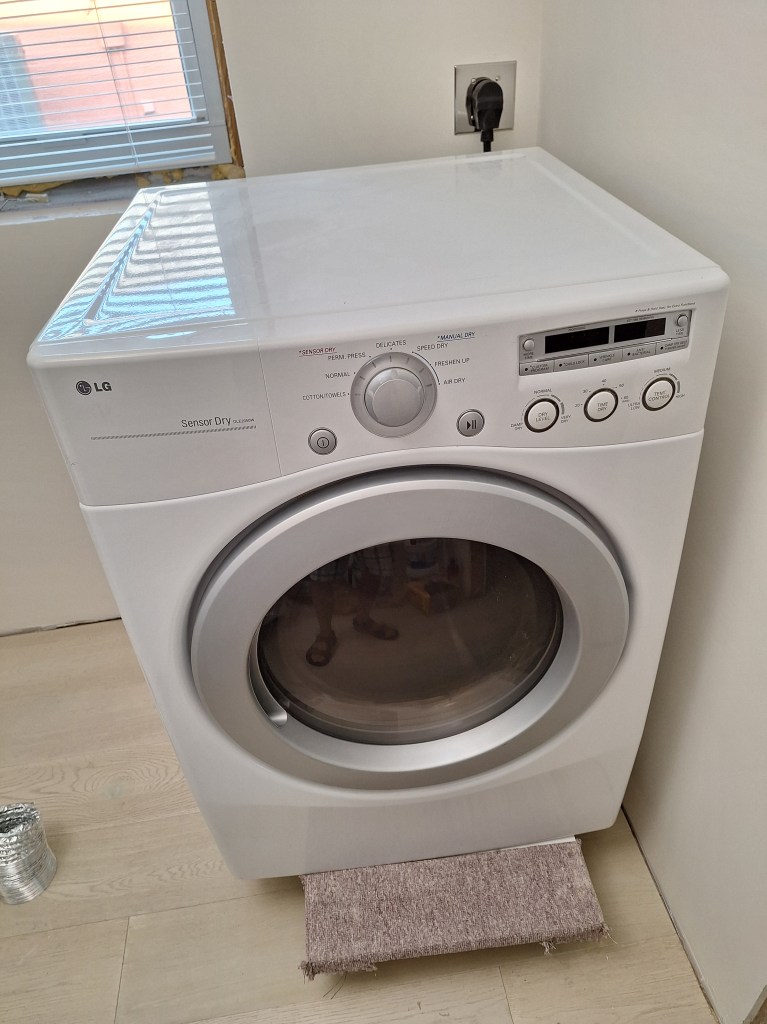
Dryer Installed (for now).

I turned it on, then went outside to verify that it was venting well, which it was. As you can see, I have kept it on the dolly. Since the dryer will have to be moved some day when I install baseboard, I decided to leave it on the dolly. A dryer doesn’t spin at a high rate of speed like a washing machine, so it doesn’t need to rest as securely on the floor. So this should be fine for the foreseeable future.

The installation of the washing machine was a much simpler matter. I did not need to make any modifications. I simply needed to remove the shipping bolts I installed before moving it from the other house, and then connected the water supply and lines put the drain pipe in place.

Washing Machine Installed and Running

Unlike the dryer, I could not leave this on the dolly. It needed to be on solid ground and level. To test it, I ran the “tub clean” program, which takes more than an hour. It was a good test and the tub was in need of a good cleaning. There were no leaks and it ran smoothly.

Another thing that needed to be sorted out before I could move in was having something on which to hang my clothes. The two closets in the master bedroom were blank slates. Eventually I will create a custom solution tailored to each closet, but for now, I just needed something that would do the job and not cost too much. I found a pretty inexpensive rack online and purchased it to see if it would work.
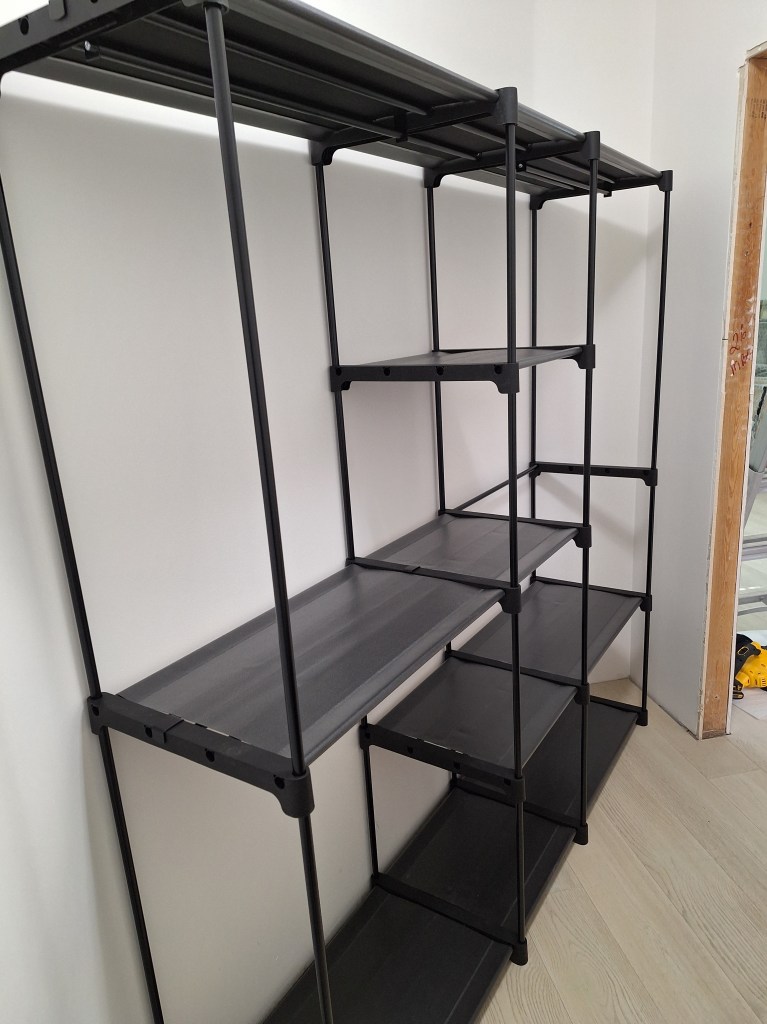
Large Rack in Large Master Closet
Large Rack with some Stuff added.

I was very pleased with this. It was easy to assemble and very light weight, yet was strong enough to hold anything I planned to put on it. It fit nicely along the long wall in the large closet, so I decided to purchase two additional racks from the same company, but just a bit smaller. One would also go in the large closet, and the other would fit nicely in the small closet.

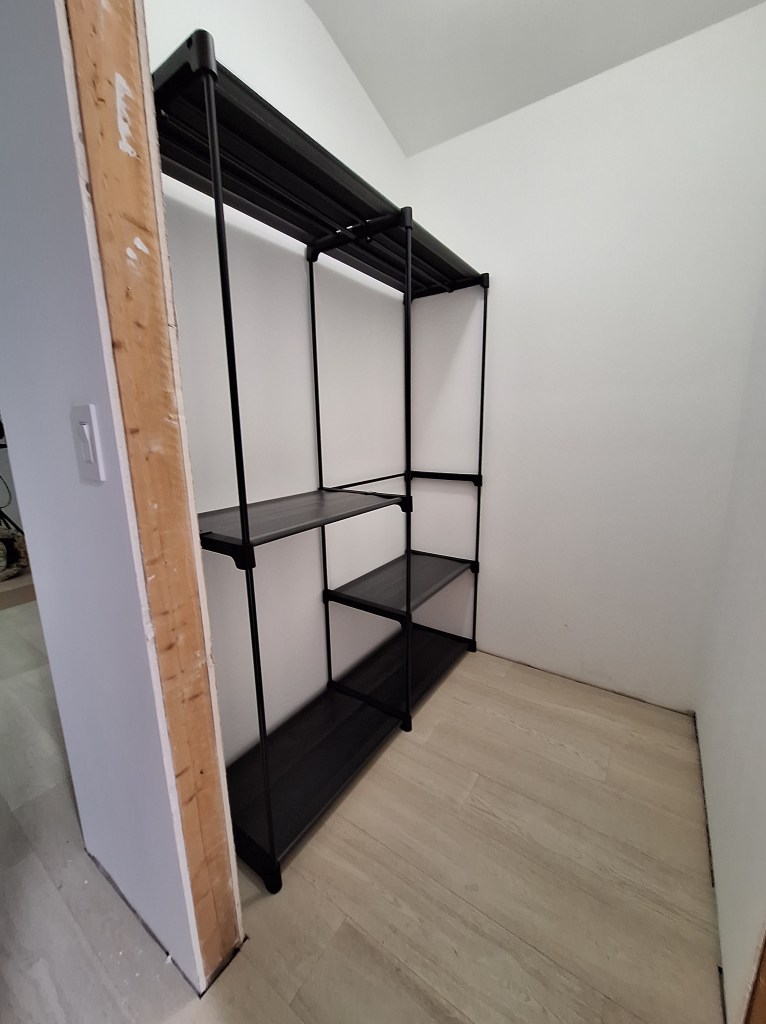
Small Rack in Large Master Closet
Small Rack in Small Master Closet

Look how well the smaller rack fits in the small master closet. I was pleased with that.

I also started moving some things from the apartment to the house; things that would fit in my car and would not be needed in my day to day life between now and November. One such item was a cube organizer, which fit nicely beside the piano.
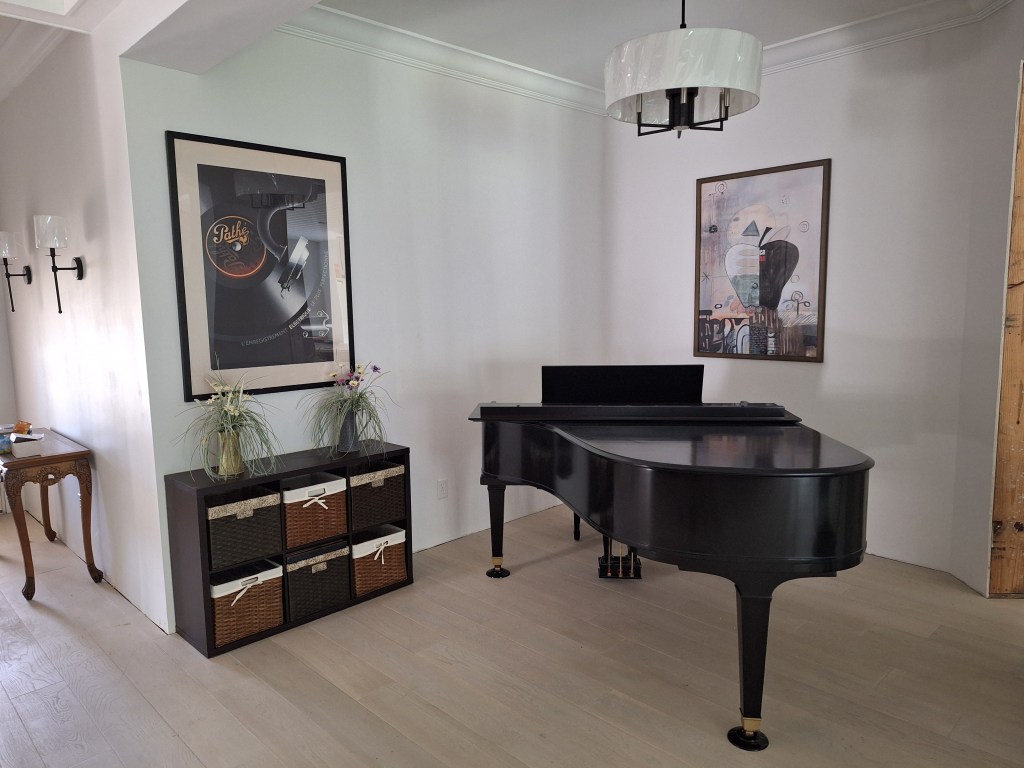
Cube Organizer moved in, and a couple of Pics added.

I got a bit carried away and even hung a couple of pictures. I like the look of this room. It is aligned with the style I am after (modern or transitional). Unfortunately, the furniture from my previous house is very traditional. Although it differs from the more modern style I want, I will not entertain replacing it until after the trim work is done. So it will be with me for quite some time. Here is a glimpse of what I mean.
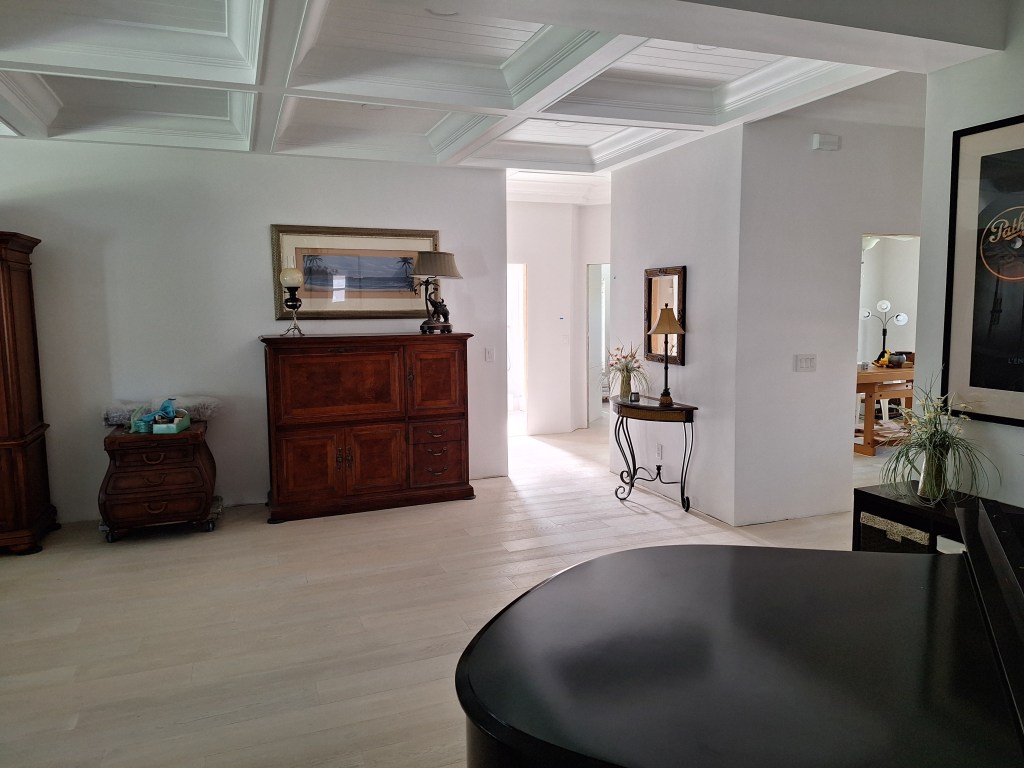
More Traditional furniture to Occupy Great Room for time being.

This contrast will become more pronounced once I move in.

I continued to do next to nothing with respect to construction work around the house. Instead, I just kept moving bits and pieces from the apartment to the house, sorting through boxes that had been packed for ages, and throwing out things I could no longer justify keeping. I also decided to start learning FreeCAD, which is 3D modeling software that I will use to design the various things I intend to build. I have a lot of projects I want to do around the house, such as building out the closets. Learning this software will allow me to fully flesh out the designs before I build a thing.

In the laundry room, opposite the washer/dryer, I imagine that I will introduce a “hall tree”, where there will be a bench where you can sit to put on shoes, above which will be hooks for coats and some cubbies for storage. I imagine flanking the hall tree with tall cabinets where I can store laundry supplies and an ironing board. All of that can be modeled in 3 dimensions using FreeCAD to make sure it is what I want. FreeCAD has a significant learning curve, so it’ll be a while before I am proficient, but I am on my way. In the meantime, I purchased a 5 tier rack to store laundry supplies and other such things.
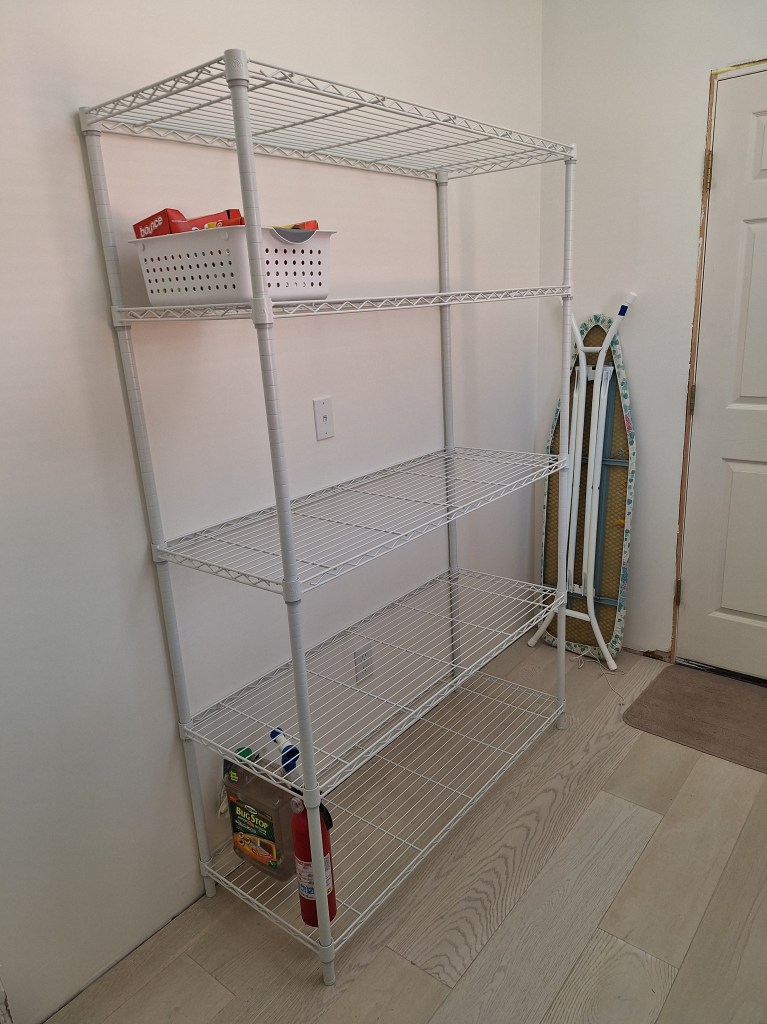
Temporary Storage Rack in Laundry Room

To close out this post, I am pleased to show you the backsplash behind the cooktop. It was just installed today and I am very pleased with it.

Embossed Stainless Steel Backsplash

Final Inspection – July 2025

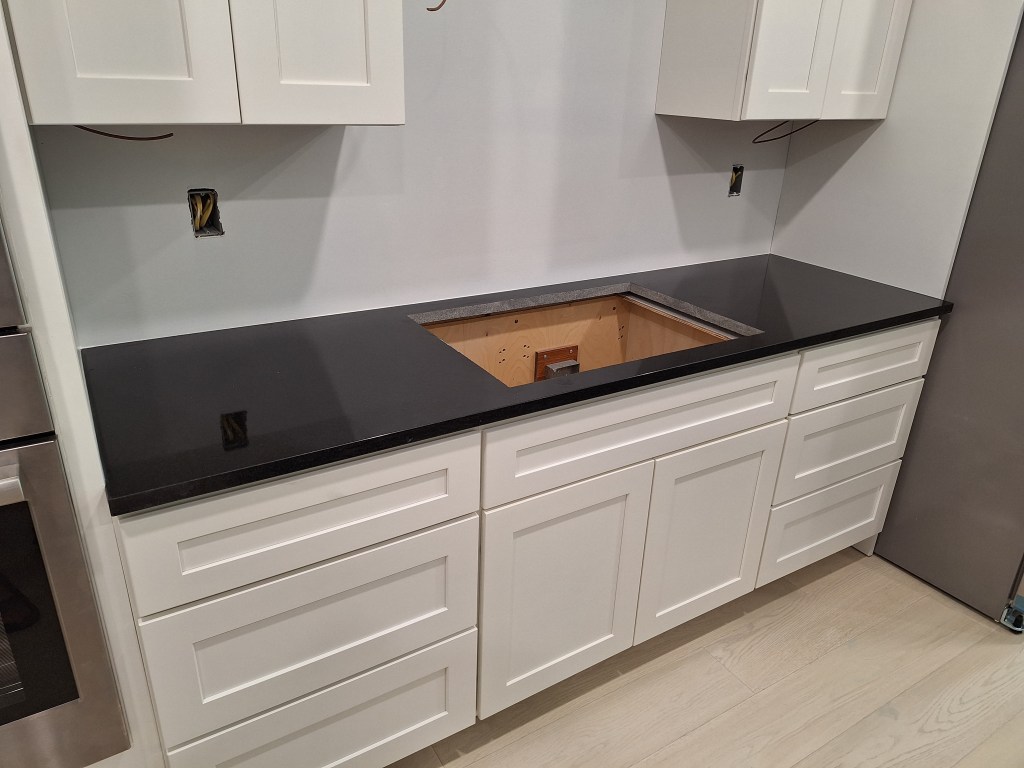
The countertop installers arrived on the first of the month. The started by placing the slabs on the base cabinets. The granite countertop, where the cooktop will be, was delivered with the opening for the cooktop not fully cutout in order to retain its integrity during transport. This can be seen if you look closely at the area the guys are facing in the image below, where they were preparing to cut that bit out to open up the space for the cooktop.

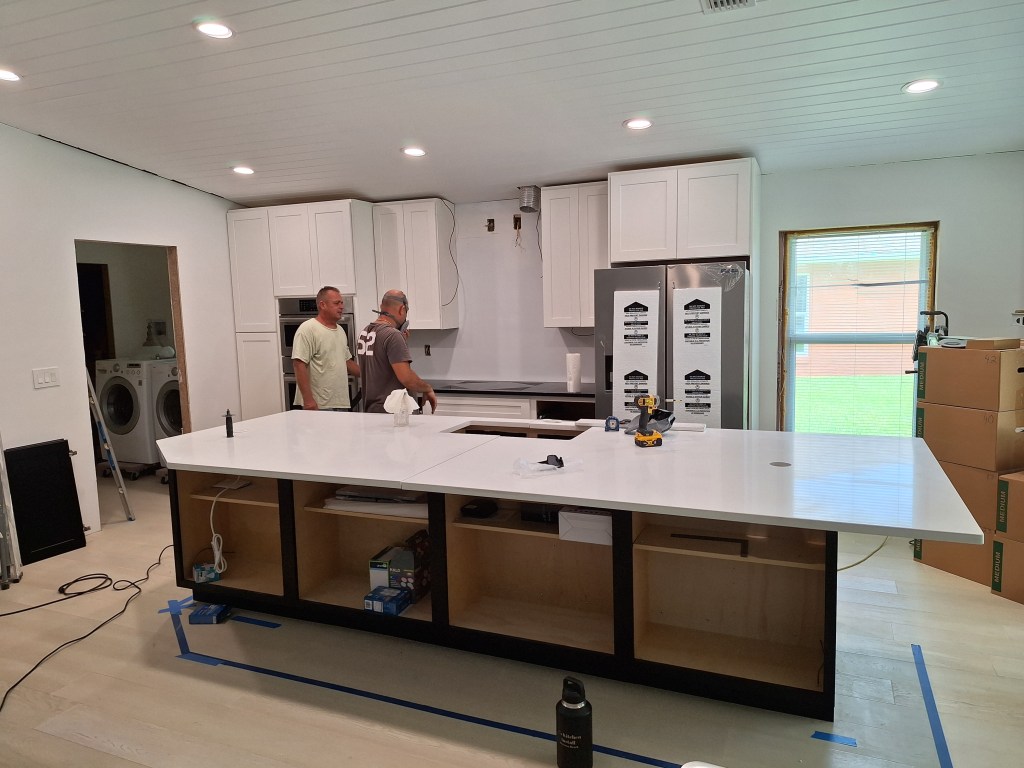
Slabs Placed on Base Cabinets

Here it is ready for the cooktop.

“Black Absolute” granite Installed

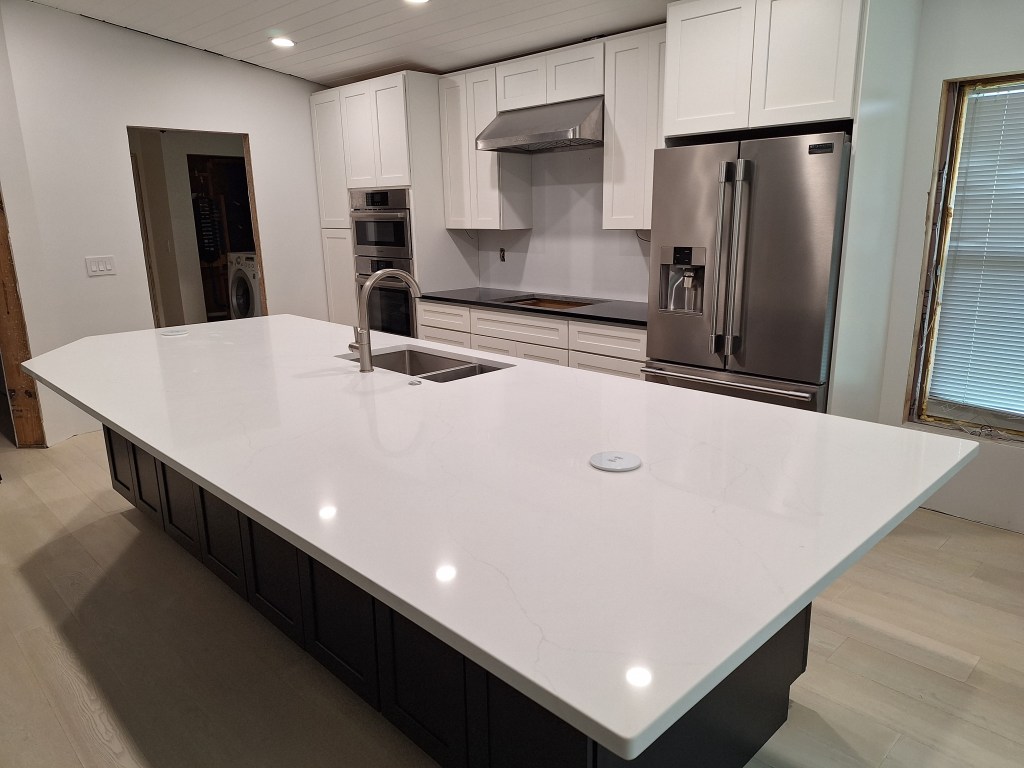
As for the island, there was a bit of a problem. At either end there is a hole for a 3″ popup outlet, (you can clearly see one of the holes in the first image above). While cutting one of the holes, they slipped, leaving a mark just outside the hole. They were hoping that, once installed, the part of the popup outlet that sits on the countertop would cover it up, but it did not. So this could have been a big deal, meaning the slab would have to be replaced. Before doing that, we decided to order a larger popup outlet (4″), expand the hole, and see if would cover the blemish. I was very skeptical that it would work because below the countertop there was very little room to expand the hole. That is, the hole was very close to the back of one of the cabinets, so I didn’t think there would be enough room to accommodate the collar that screws onto the outlet from below the countertop to secure it. Since the alternative was to scrap the blemished slab, there was no harm in trying. So we ordered a single larger popup outlet and waited for it to arrive.
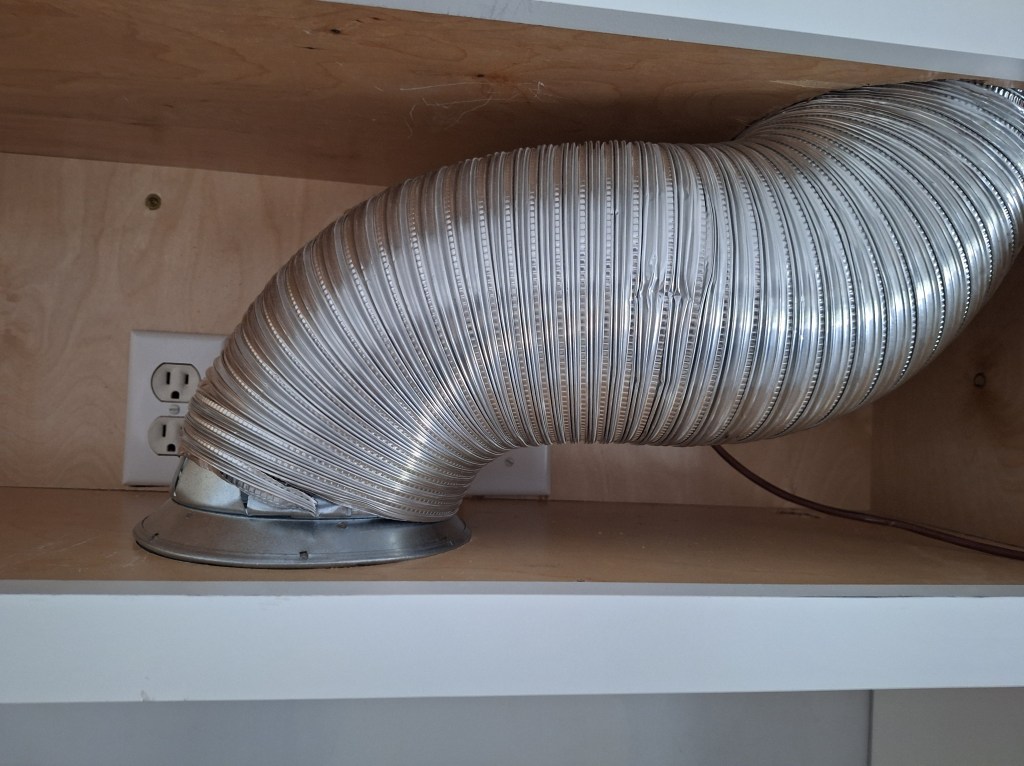
In the meantime, I returned my attention to the ducting that would vent the cooktop exhaust out of the house. In my last post, I had installed the small cabinet above the cooktop and originally planned to use flex pipe to connect it up, as shown below.

Flex Pipe Venting

Unfortunately, this wasn’t going to work as you can see from the image. Not only that, but you’re not supposed to use flex pipe in this situation because the ridges in the flex pipe increase resistance to airflow, providing a better opportunity for grease to accumulate. I learned this by accident during a conversation with the guy who installed the wall oven. Given this, I sought to have custom ducting created to replace most of the flex pipe, as mentioned in my last post. I would not be able to replace all of the flex pipe. The portion that is above the cabinet and extends to the roof is no longer accessible, so it would have to remain and the new ducting would have to connect to it at the top of the cabinet. That, I believe, should be fine because the primary area of air flow resistance will be in the bend within the cabinet. Once the air exits the ducting within the cabinet, it is a straight run to the roof and out of the house. Fortunately, the custom vent ducting was completed at the time we placed the order for the new popup outlets, so I could switch over to that task while I waited. Unfortunately it wasn’t quite right, requiring a trip back to the fabricator.

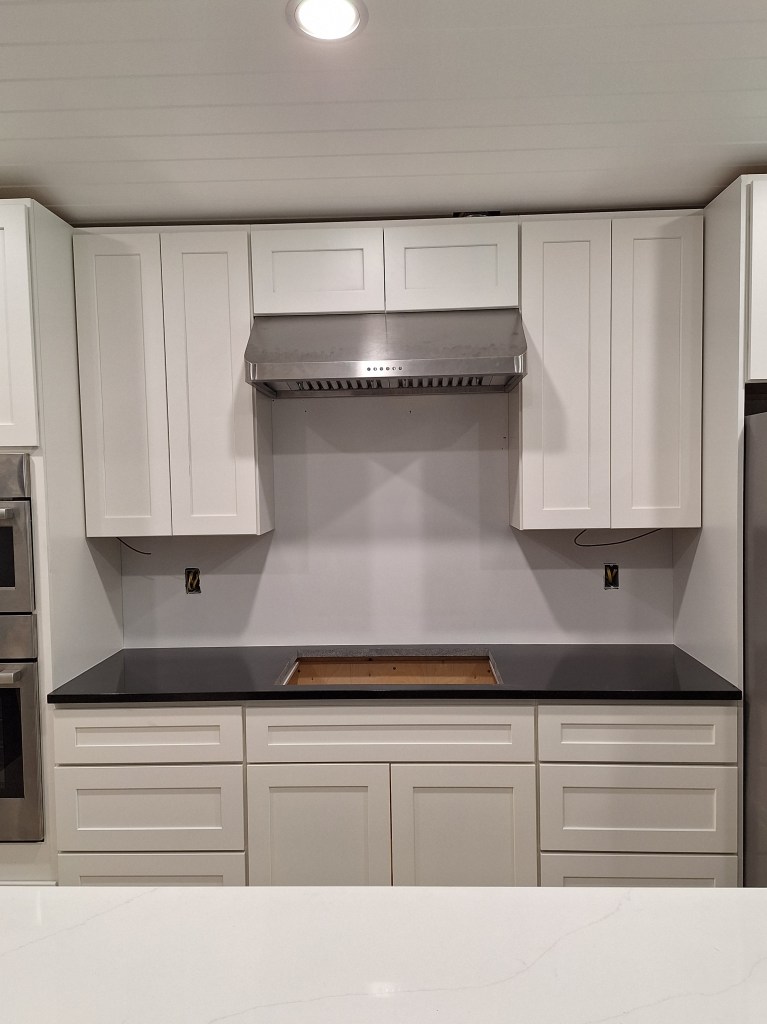
In the first image in this post, notice that there is no longer a cabinet above the cooktop countertop. I removed this because I needed to take it with me when I returned to the fabricator so they could see exactly what the ducting needed to fit into. I should have done this in the first place, but I hated to have to remove the cabinet. In the end, it was the right thing to do, and they got it right when I did.

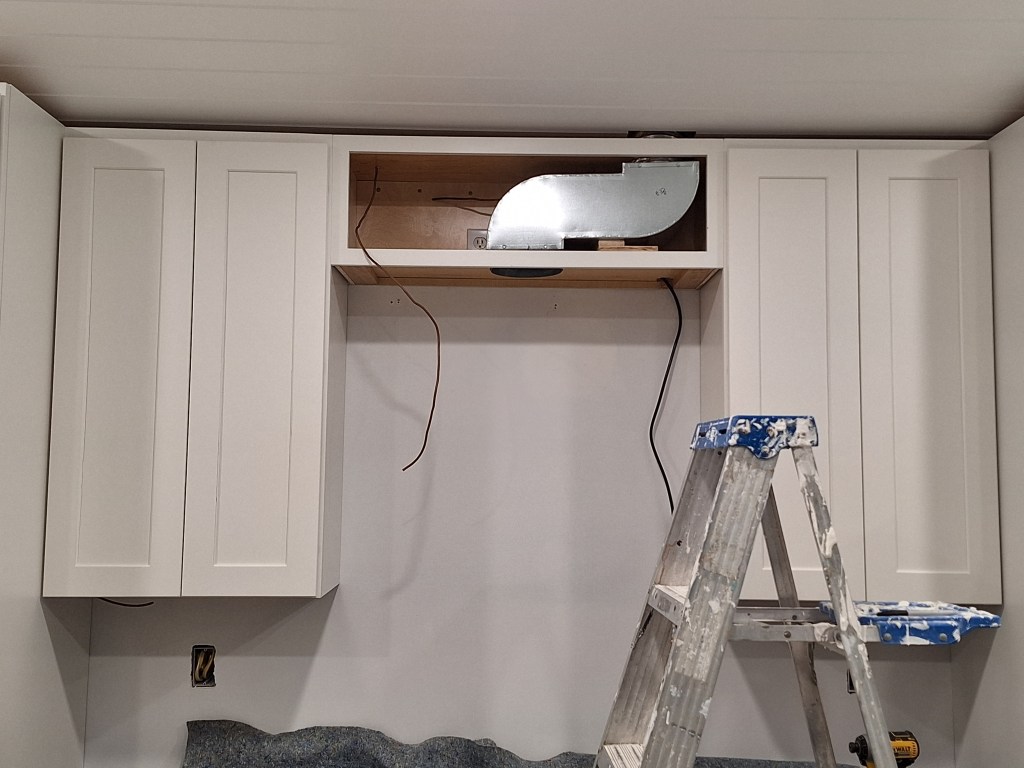
Exhaust Ducting In Place

Above you can see the cabinet back in place and the new custom ducting in position. Here it is after I secured it in place.

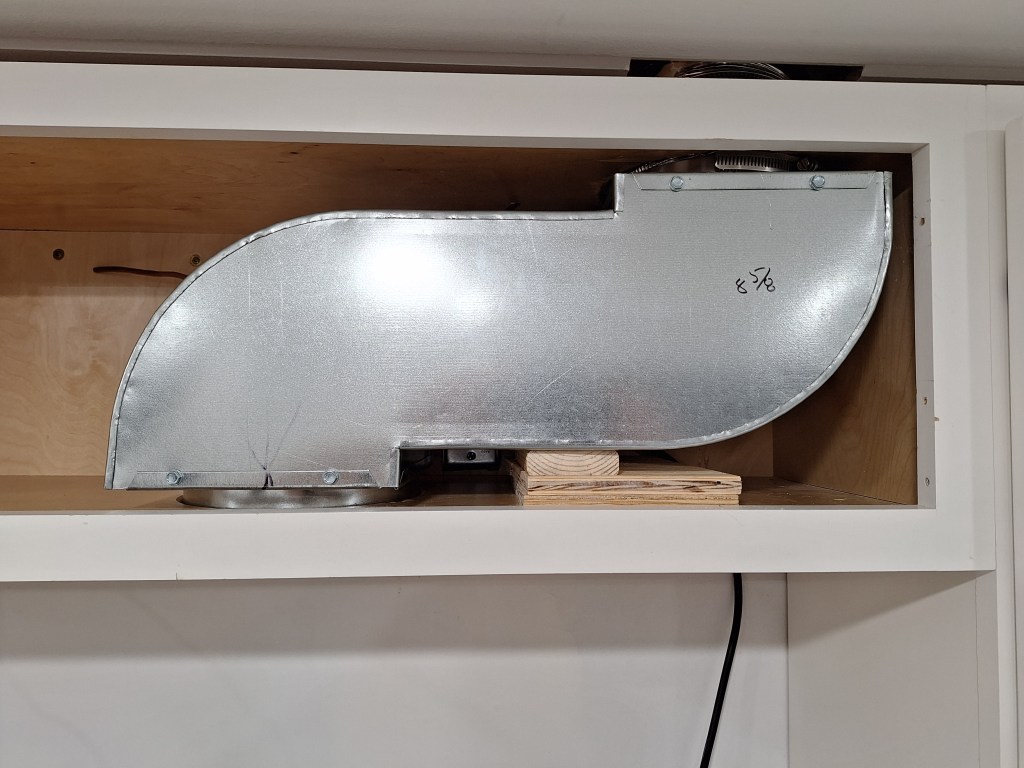
Exhaust Ducting Secured

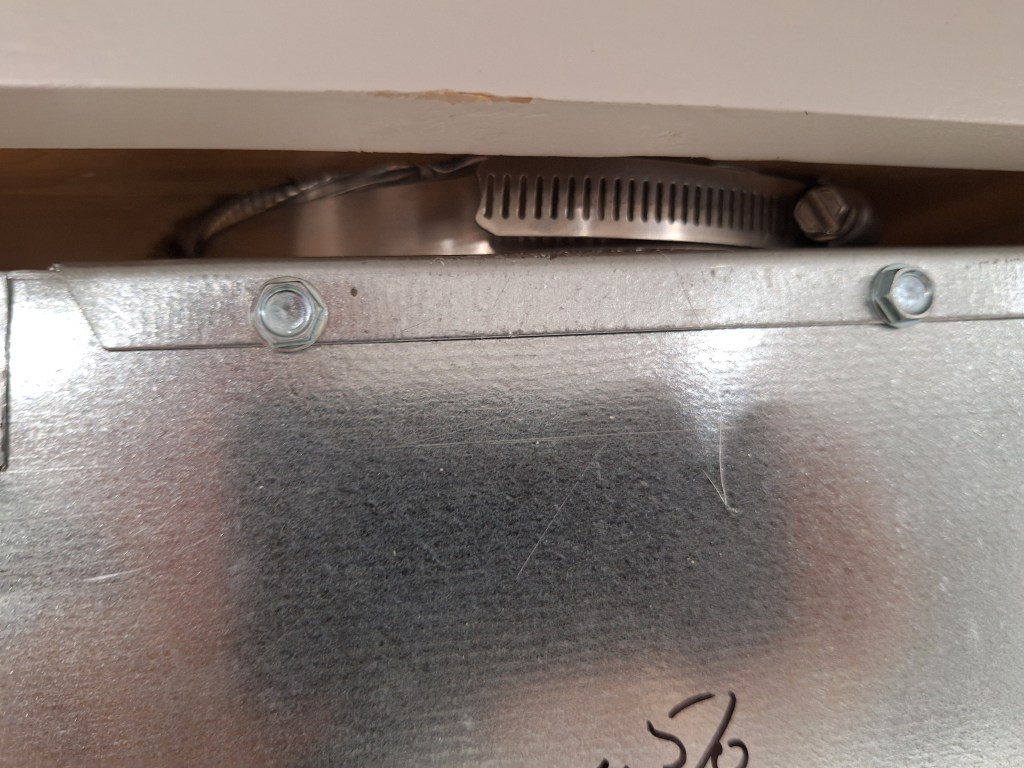
The wood underneath the ducting was placed there just for extra support. The outlet of the ducting is tied to the flexible pipe that extends out the top of the cabinet to the roof. It is secured using a metal hose clamp, as shown below.

Ducting Secured to Flex Pipe with Hose Clamp

This turned out to be a much bigger challenge than I ever imagined. It was a tight squeeze, so I was very relieved that it worked out.

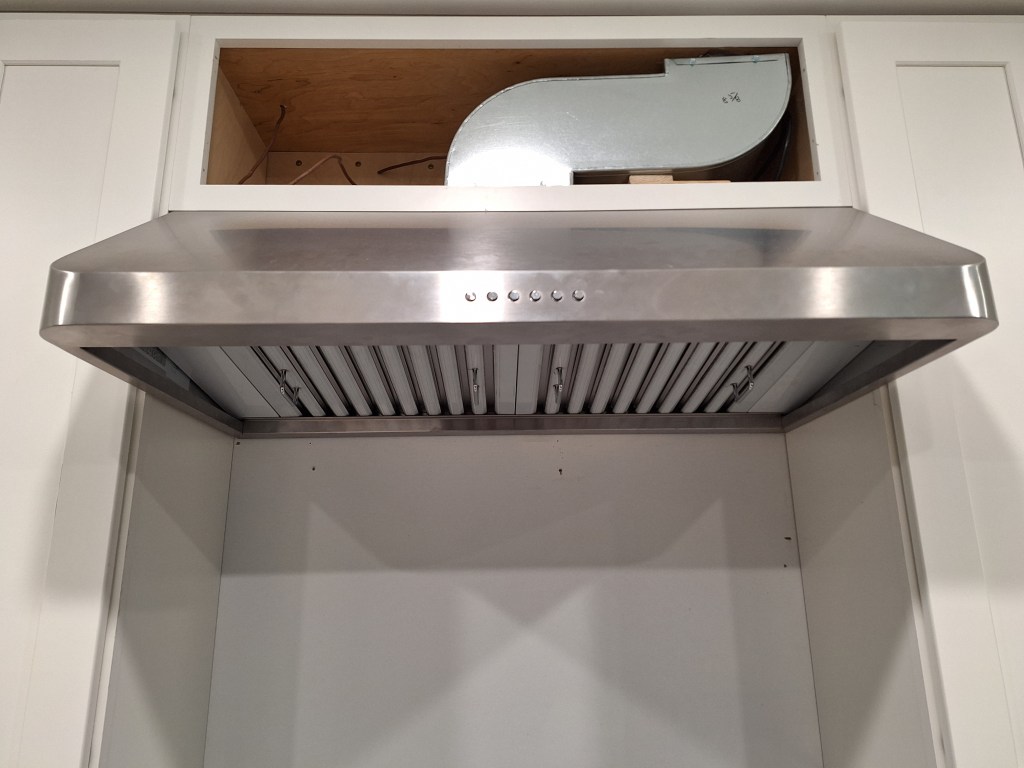
With the ducting secured, it was time to lift the exhaust vent into place and secure it to the bottom of the cabinet with four screws. I had a couple of friends help with this.

Exhaust Fan Installed
Exhaust Fan Installed and Cabinet Doors put back.

Getting that done was a big deal. I was so happy to have it checked off.

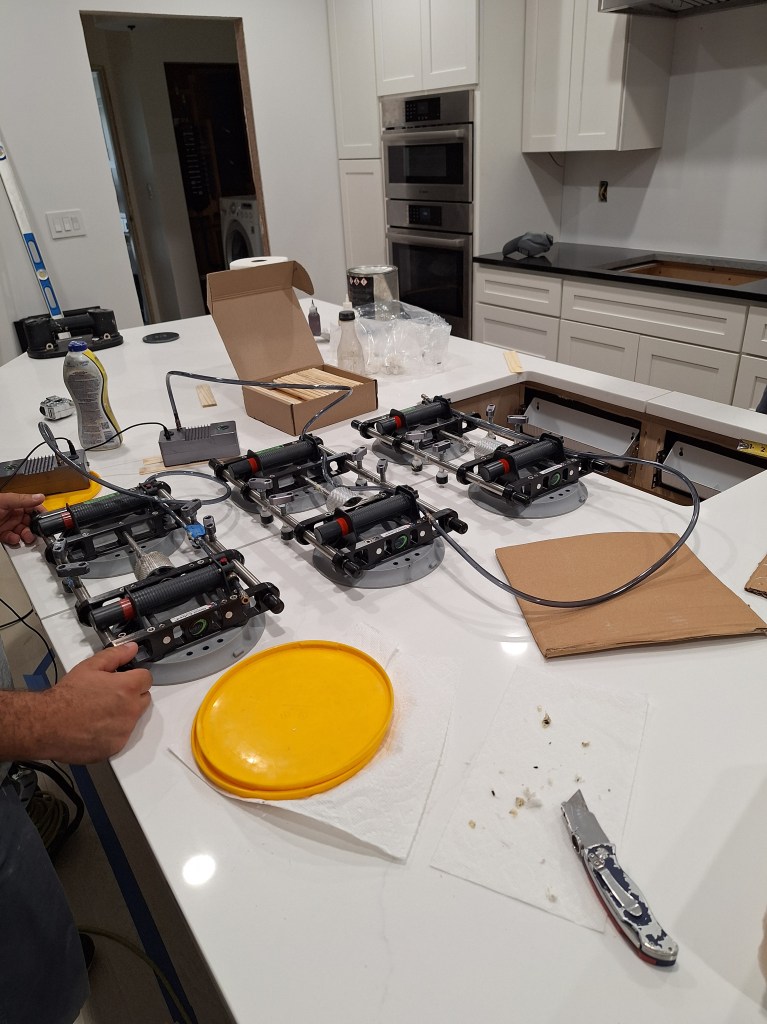
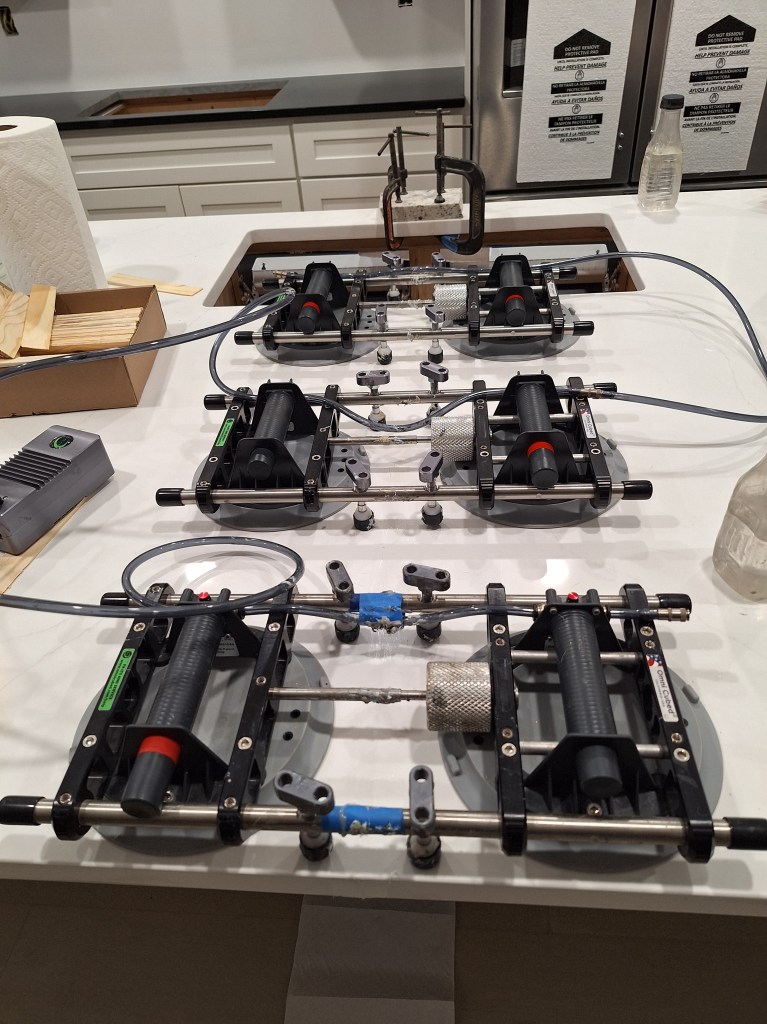
The next day the larger popup outlet arrived. They ordered a gray one because the white color, for some reason, would take longer to arrive. Since this was just to try it out, the color didn’t matter, so they ordered what would get here the fastest. They would return it once we’d determined if it would work. With the wider popup outlet in hand, the guys got to work widening the hole. To my pleasant surprise, it worked, and we did not have to replace the slab. So the guys could start setting the seam between the two slabs. In the image below you can see the equipment used to pull the slabs together. You can also see the gray popup outlet in place at the end of the slab.

Setting the Seam

Once aligned to their satisfaction, glue is applied and the two seams brought together and left overnight (Thursday, July 3rd).

Seam Set

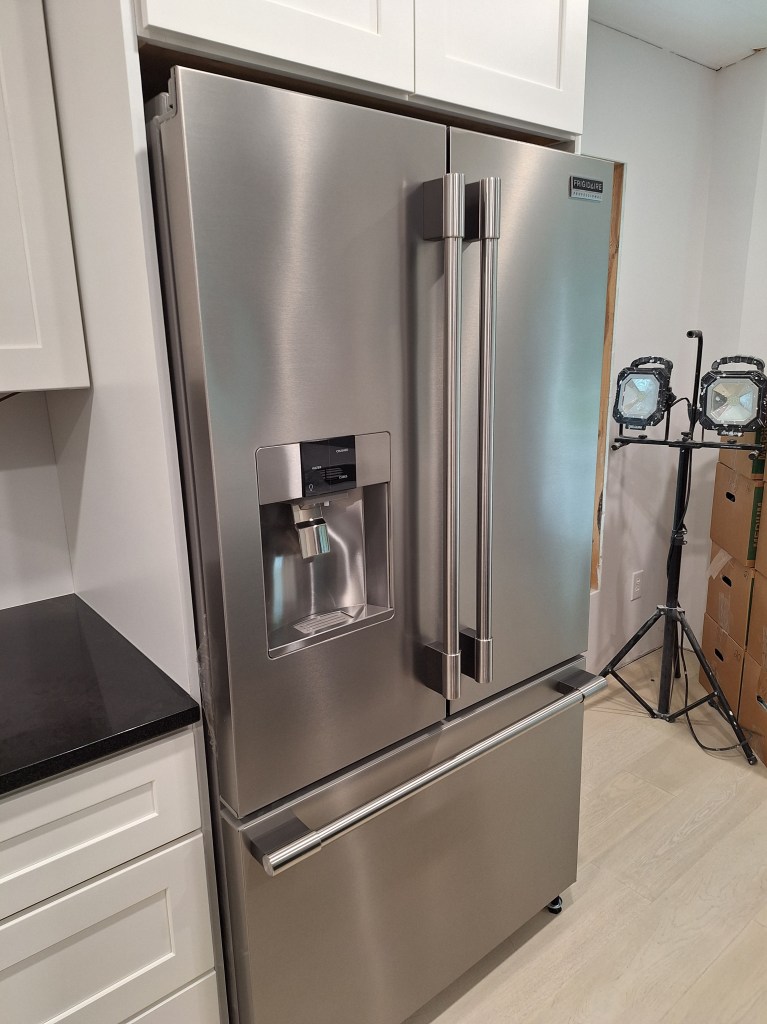
The two white popup outlets were expected to arrive on Saturday, July 5th, so there was a day in between, July 4th, that I used to install the refrigerator before I headed out to celebrate Independence Day.

Refrigerator Installed

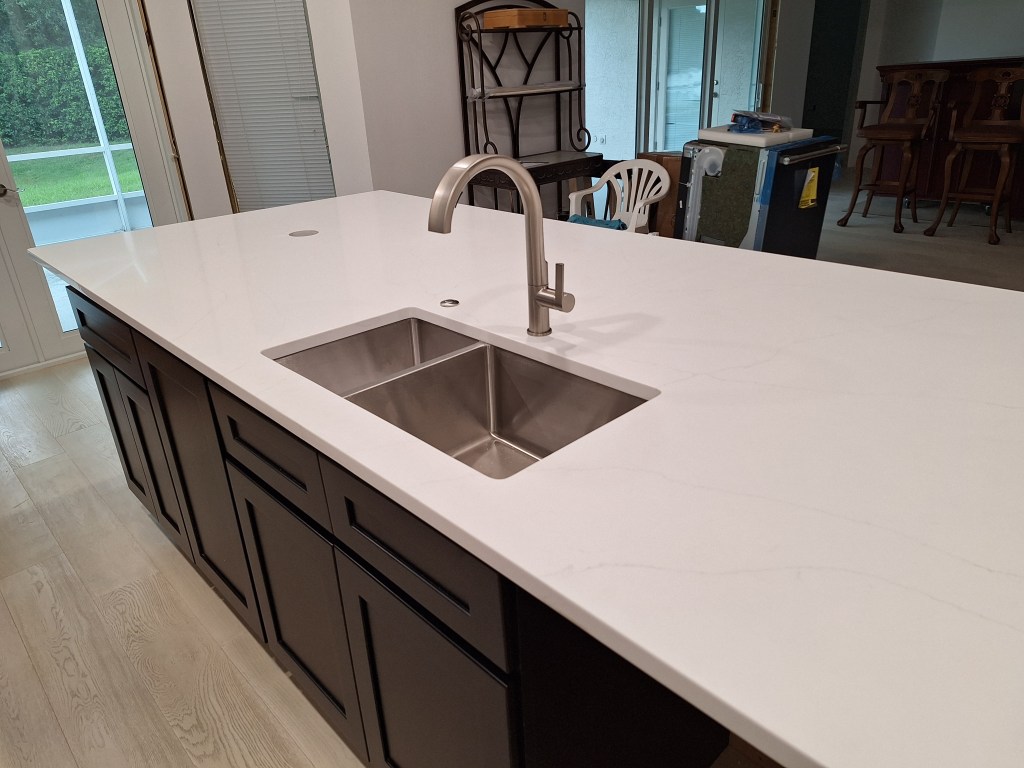
The next day the guys returned to finish the installation, which involved polishing the seams, installing the undermount sink, and cleaning it all up. After they left, I put in the faucet and the pressure switch (to the left of the faucet) that will control the in-sink garbage disposal.

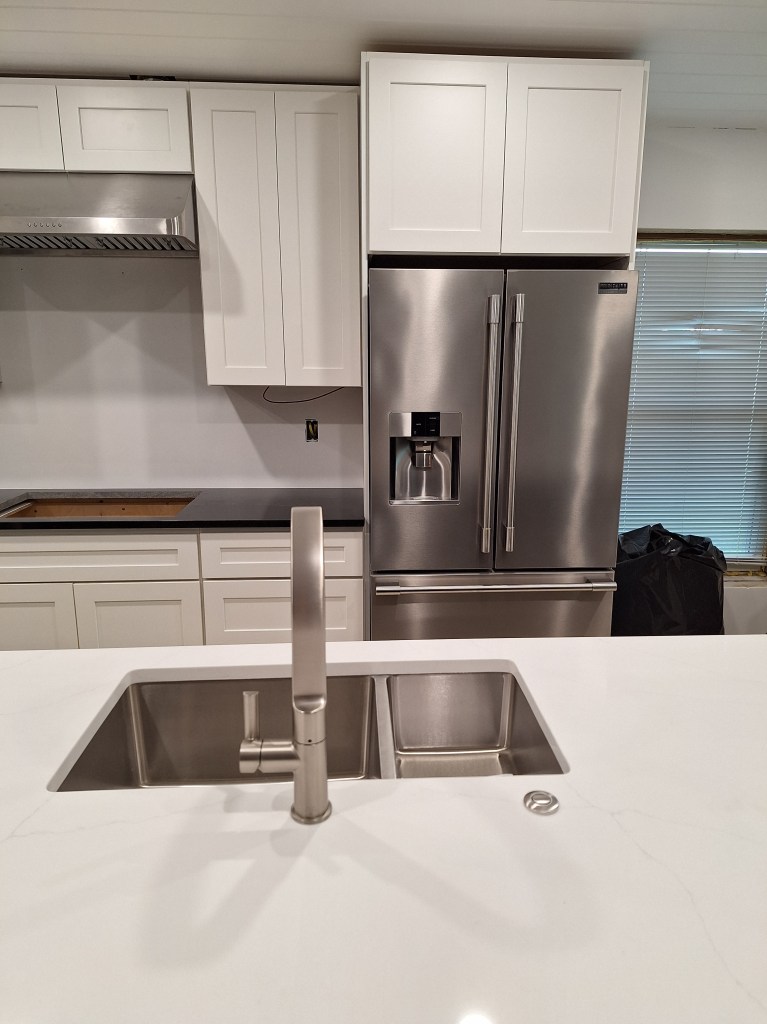
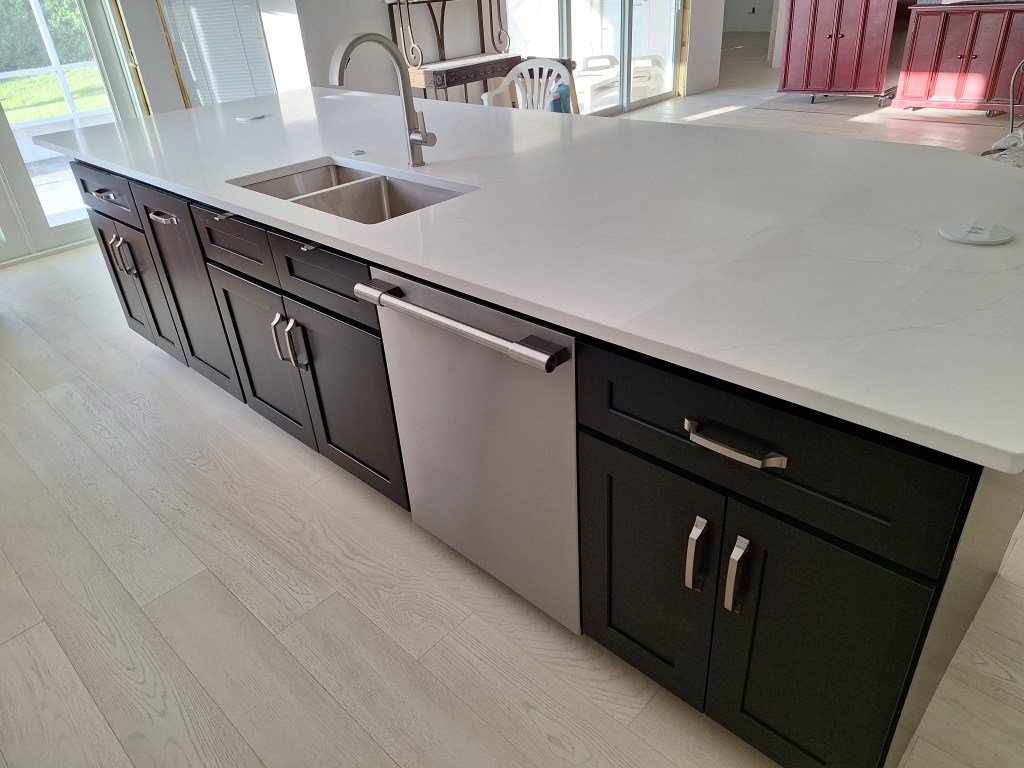
Countertop Installation Complete
Sink, Faucet, and Pressure Switch Installed

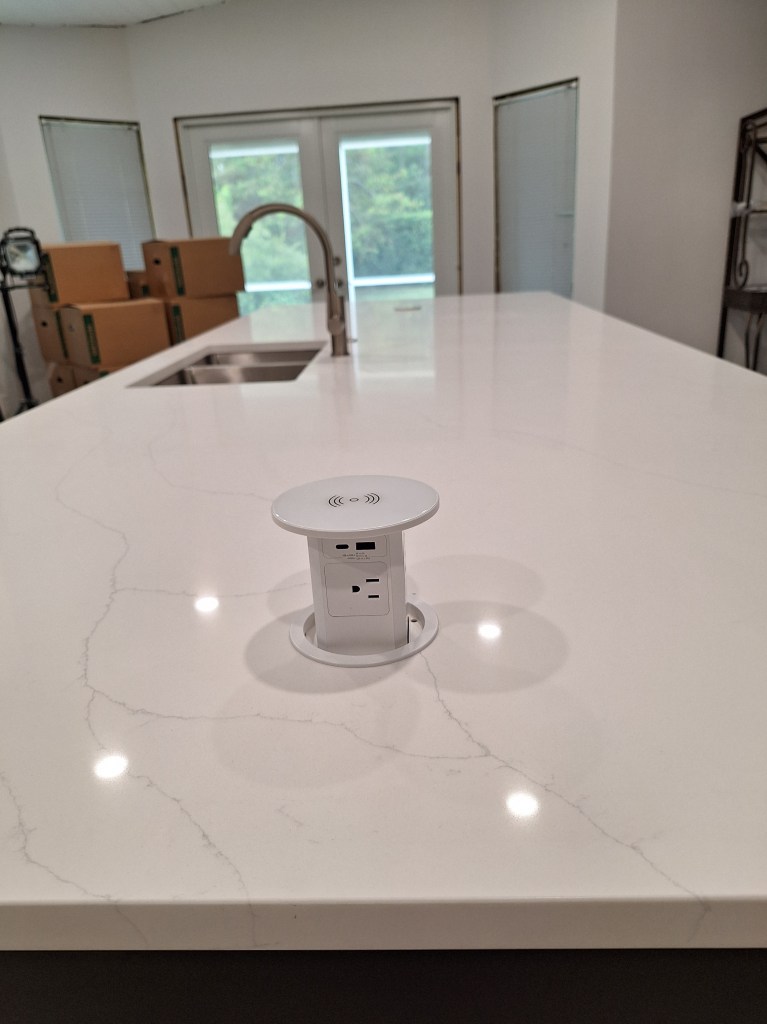
The two white popup outlets arrived the next day and I put them in place and plugged them into the outlets below the cabinets.

Popup Outlets Installed
Popup Outlet popped up

Note that these outlets also provide USB ports and can charge a phone by simply setting the phone on top of the outlet, whether popped up or not.

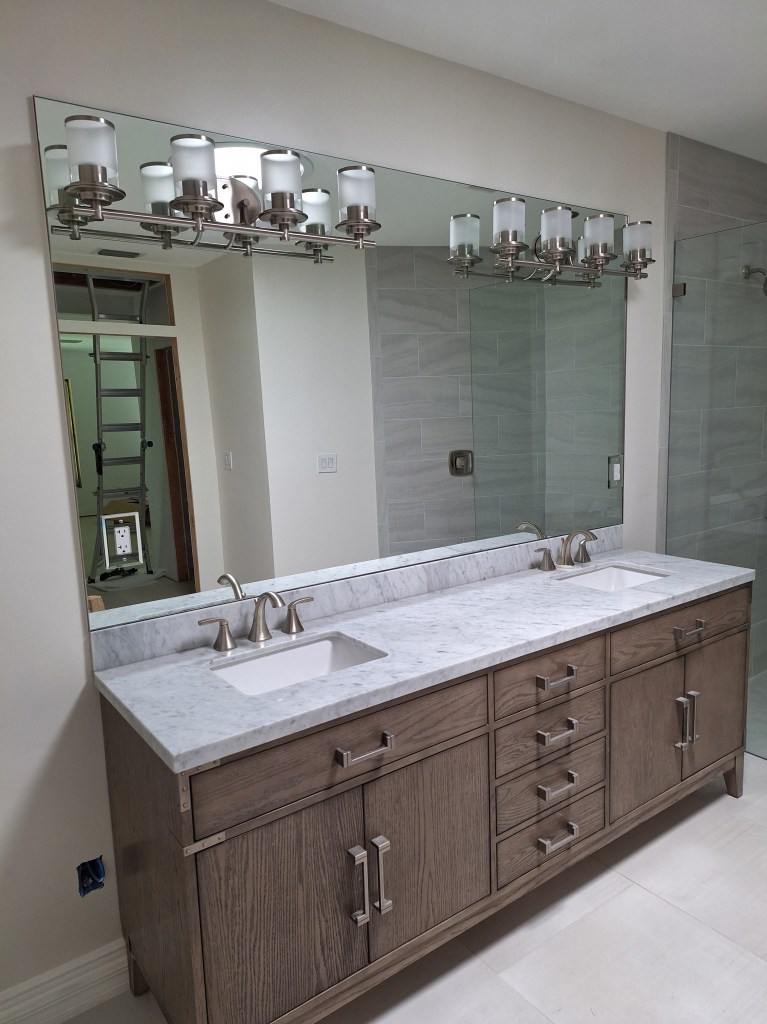
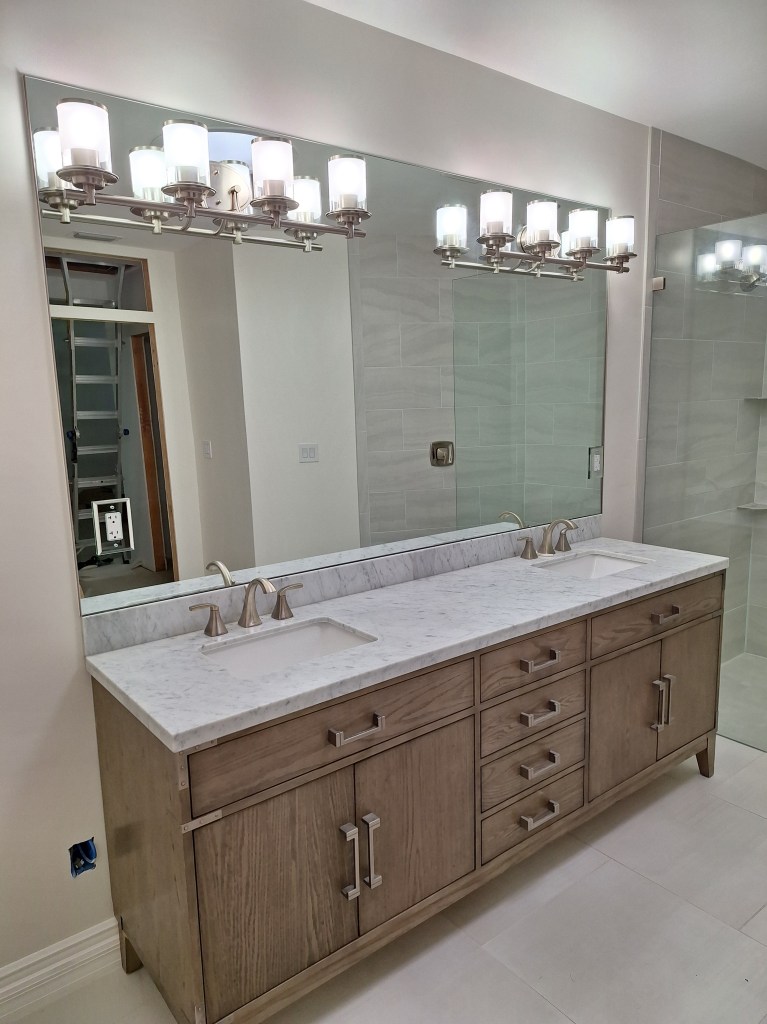
With the countertops and sink installed, I arranged to have a plumber install the plumbing for the sink and install the dishwasher. I entertained installing this by myself, but it would be a complicated install. As I later discovered, this was a good call, which you’ll see shortly. But before that happened, the mirror for the the master bathroom vanity arrived and was installed.

Vanity Mirror and Lights Installed
Vanity Mirror and Lights Installed – lights on

The interesting thing about this installation was that the company insisted that they install the vanity lights. Since the lights are on the mirror, they did not want the customer to mess with it for fear that if they over-tighten them, it could break the mirror. So I was completely hands off for this, which was fine by me. It was a two person job, as you’d expect, and took about two hours. I like it.
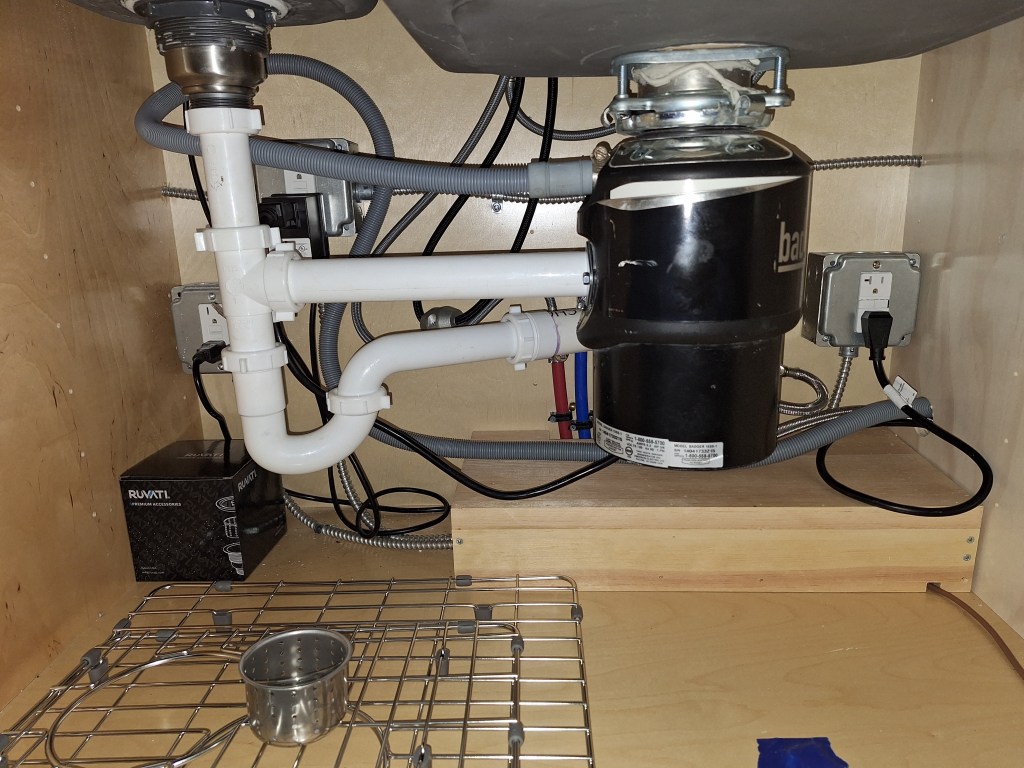
A couple of days after the vanity mirror was installed, the plumber arrived and hooked up the supply lines to the sink and dishwasher, the in-sink garbage disposal, and the drains for all of it.
Plumbing Under the Kitchen Sink

As you can see, there is a lot going on here. We decided to locate the garbage disposal under the large sink because installing it under the smaller one would have meant that the drain from it to the main drain would be too steep a slope. When too steep, the water separates from the solids too quickly, which can result in clogging.
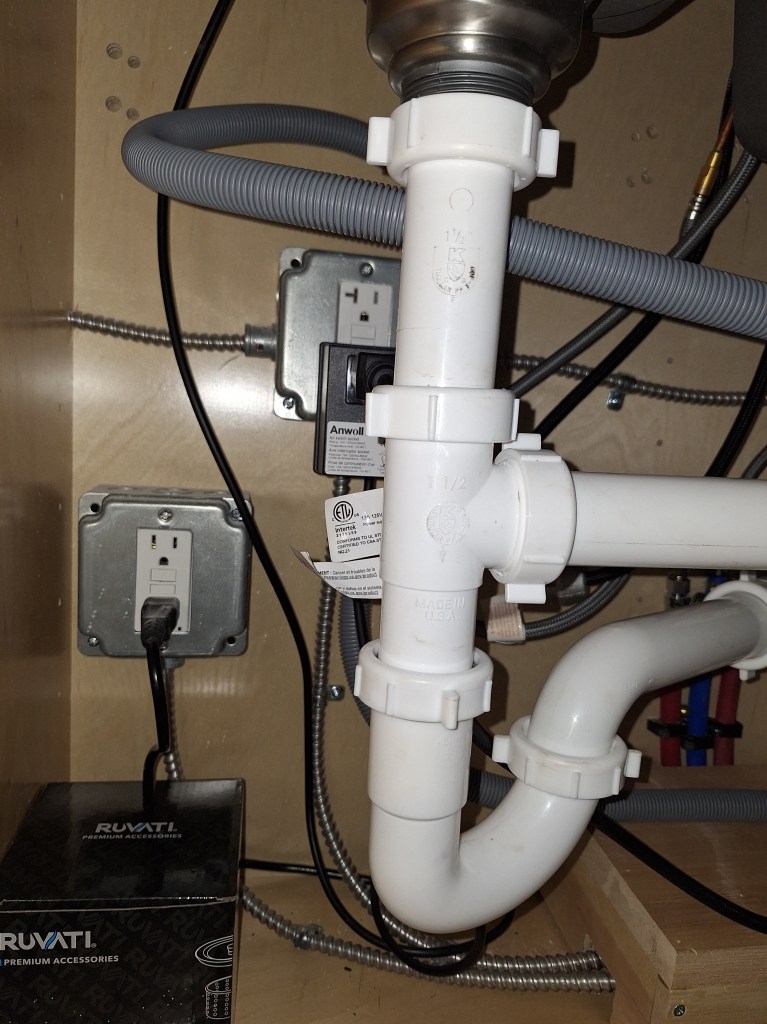
Below I am showing a closeup of the P-trap. The large sink drains through the garbage disposal into the drain under the small sink, where the P-trap resides. The output of the P-trap connects to the main drain that continues under the concrete slab and out to the street sewage system. Behind this you can see a black box plugged into the outlet. Into the black box is plugged the garbage disposal. This black box connects to the pressure switch above the countertop (shown in a previous image above), which, when pressed, switches the garbage disposal on/off. The plug below and to the left is for the kick plate lighting, which was discussed in a previous post.

P-trap Under Small Sink

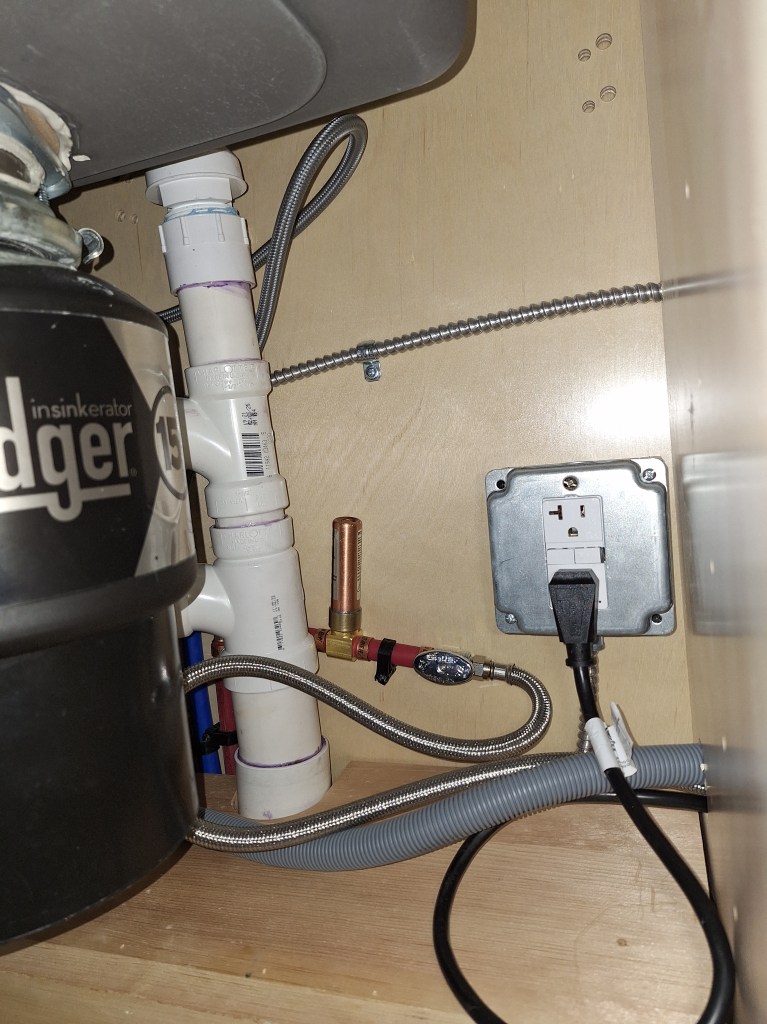
Below you can see the where the drain emerges from below the cabinet. At the top of it is a Studer Vent. Plumbing vents act as pathways for air to enter and exit the drainage system. This helps maintain balanced air pressure, preventing a vacuum from forming that could hinder water flow and cause drainage issues. They are normally inside a wall cavity and extend out through the roof of the house. Since this is not available in an island, the Studor vent comes to the rescue. It provides the venting function while preventing sewer gases from escaping.

You can also see below that a water hammer arrestor (the copper thing) is installed along the water supply like for the dishwasher. This is needed because the dishwasher will turn the water on and off suddenly, which can result in “water hammering”. So this device will prevent that.

Water Supply, Drain, and Power for Dishwasher

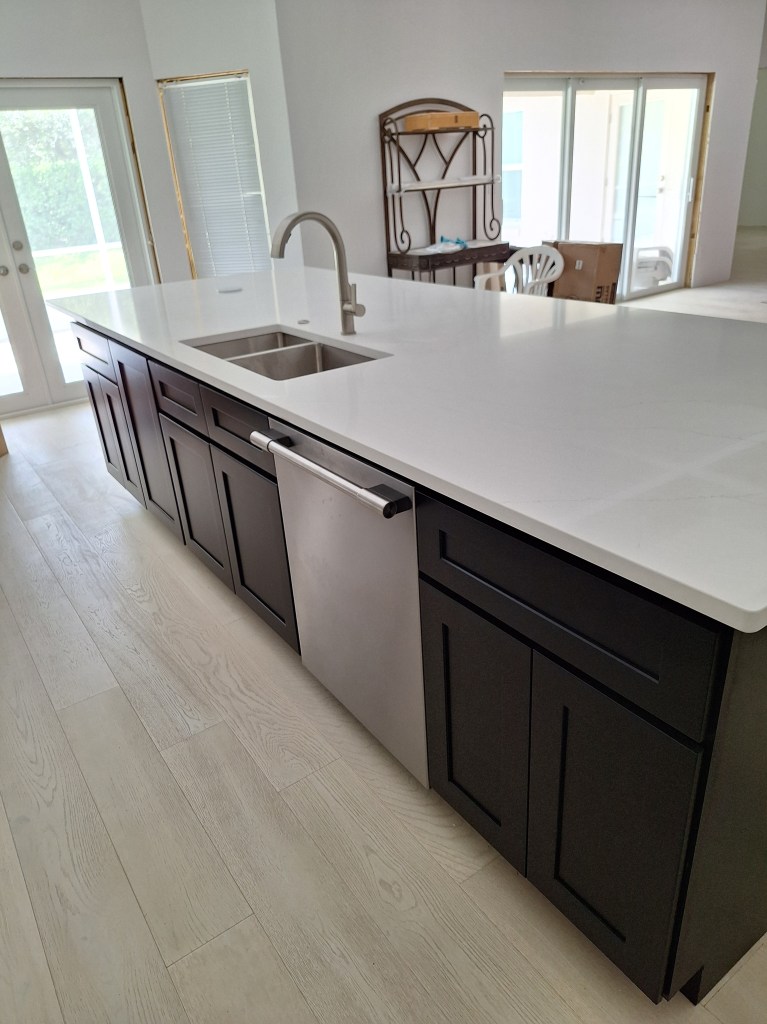
Finally, here is the thing everyone sees; the dishwasher.

Dishwasher Installed

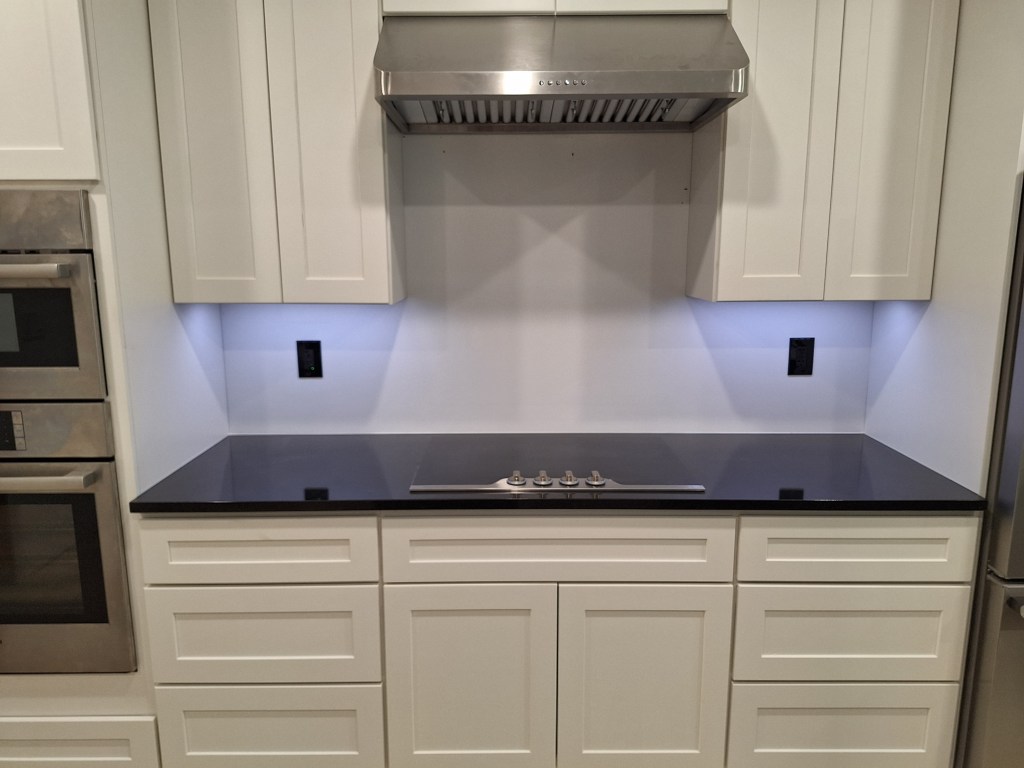
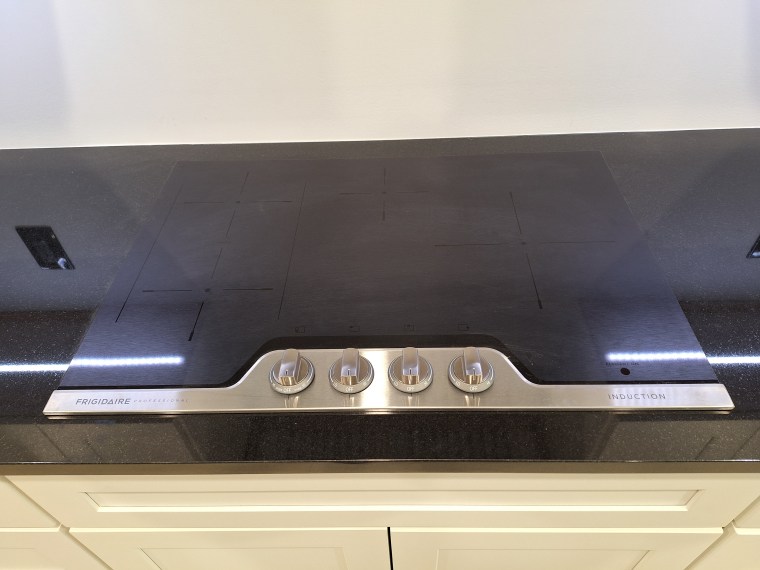
With this done, I have a functioning island. The last thing required to make the kitchen fully functional was the installation of the cooktop. However, before that could be done, I needed to add a backsplash on the wall behind where it will go. I intended to add white tile with black grout to that area, but after a warning from the tile supplier about how difficult it will be to keep clean I decided to abandon that plan and instead extend the black granite up the wall. There is likely to be a lot of splatter on that wall, and granite with no grout lines will be much easier to clean. That decision, however, meant that I would not be installing the backsplash anytime soon. The granite will have to be sourced, and the fabricators will have to do their thing, etc. The backsplash, however, is not something that requires an inspection, so I went ahead and installed the under counter lighting, cooktop, and outlets in that area so that I could schedule an inspection.

Cooktop, Outlets, and U/C Lights Installed.
Closeup of Cooktop

As you can see, the outlets are black, so they will blend in with the black granite once it is placed on that wall.

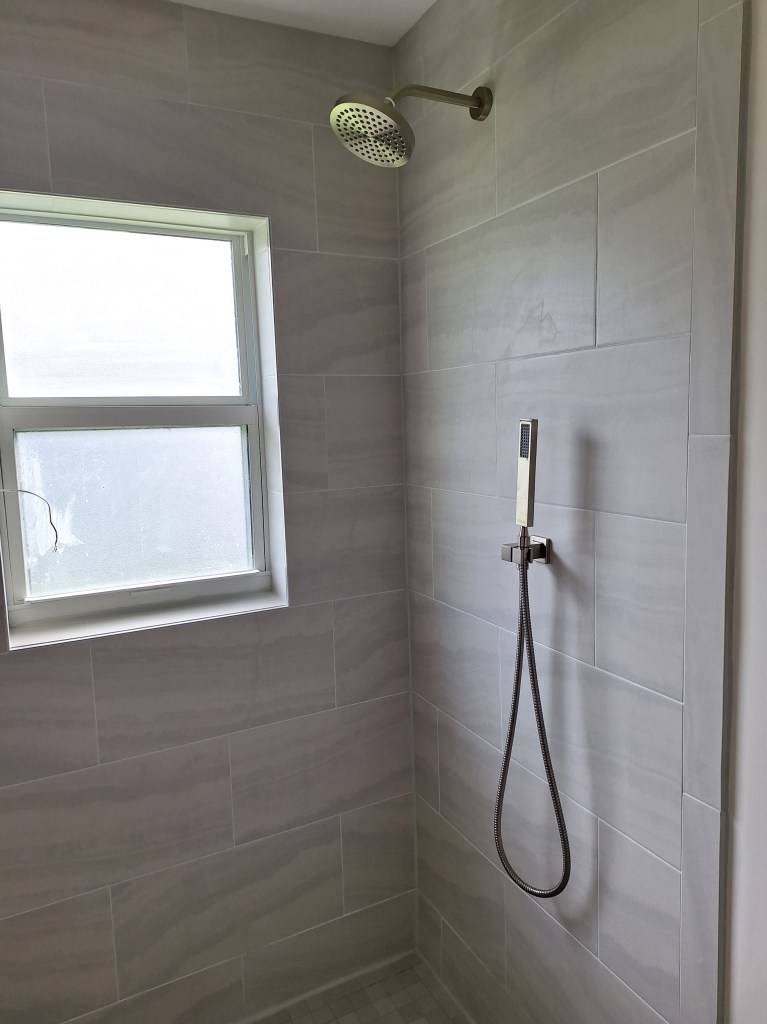
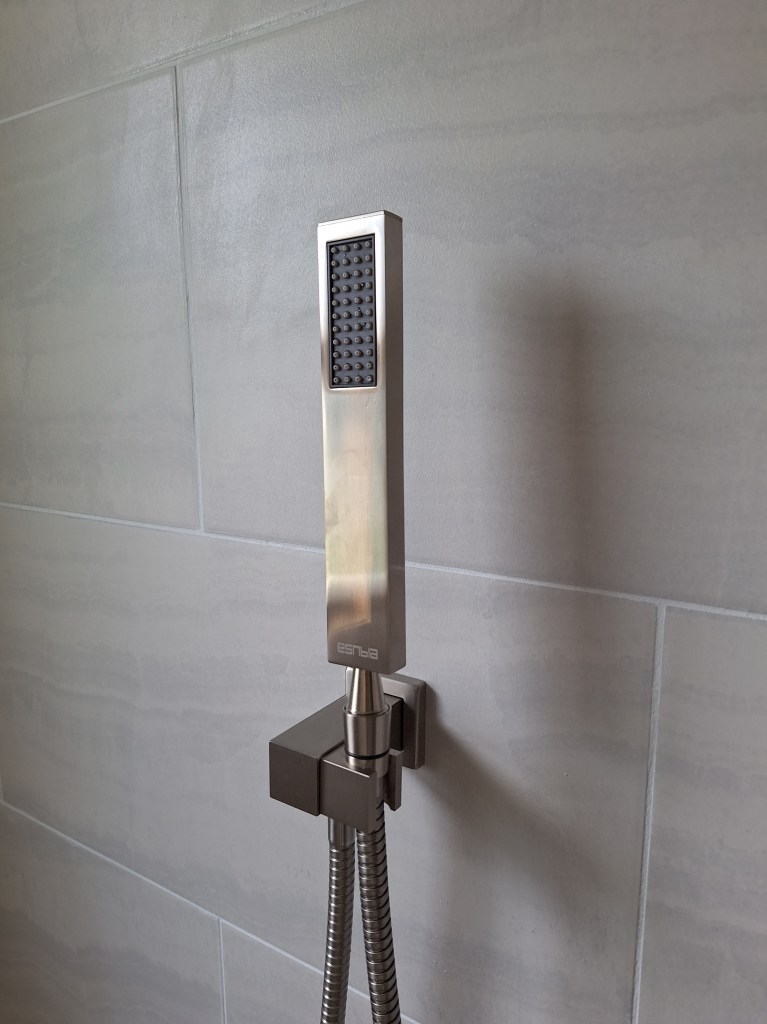
I ordered the cabinet pulls for the kitchen. The ones I liked were surprisingly expensive, but I got them anyway. Apart from installing the backsplash and cabinet pulls, my work in the kitchen was done, for now. My inspection was scheduled for Monday, a few days from now. So I turned my attention to the guest bathroom, installing the shower head and wand.

Shower Head and Wand Installed in Guest Shower

There is a bit of a story with this. Both the shower head and wand have separate water supply lines. Each line connects to a “bent ear elbow” behind the wall. When I positioned the two elbows, I estimated where they should go. Unfortunately, I set them back too far, meaning the threads for both the shower head and wand holder could not reach them. This was not an issue for the shower head because I was not keen on the rain shower head I had purchased. It was kind of fancy and attached to the wall with an extended version of the holder for the shower wand. More than that, though, I wanted a shower head that was not limited to just a rain head. So I decided to replace the one I had with one that had both a rain and a traditional stream (achieved by rotating the shower head). This also came with a traditional shower arm, which meant it would easily reach in and connect to the recessed elbow. It was not a perfect color match, but close enough.

Shower Head

However, there was no such option for the wand. The threads of the wand holder were not long enough to reach the threads you see in the image below.

Drop Ear Elbow Recessed behind the Tile

To fix this, I purchased an adapter to bring it out to the level of the tile. In the image below, you can see that it actually comes out just beyond the surface of the tile, but this is well within tolerance because the flange for the wand holder would cover it.

Adapter Added

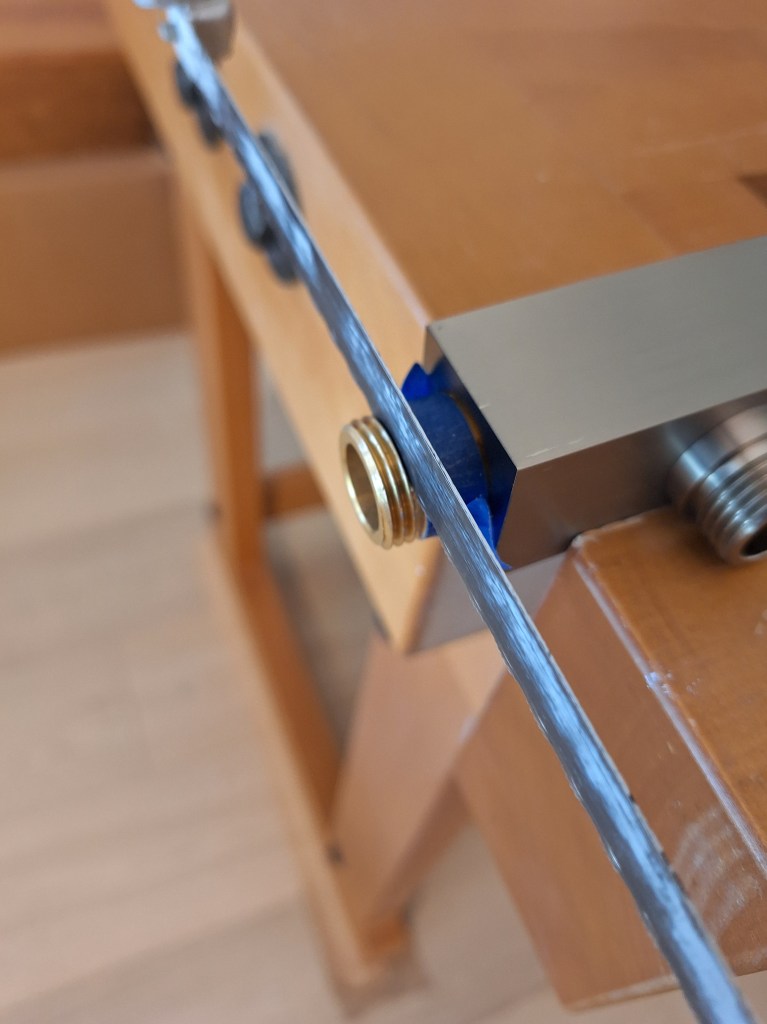
Unfortunately, the threads of the wand holder were too long and, when fully seated in the adapter, the holder extended too far to be covered by the flange.

Threads too Long

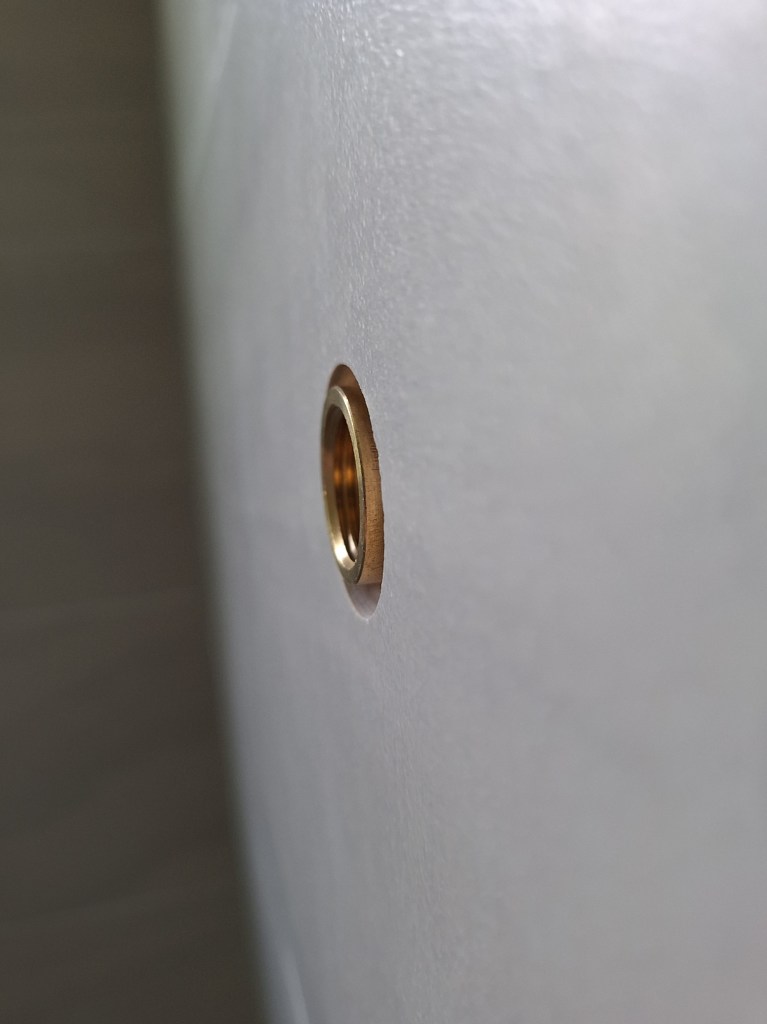
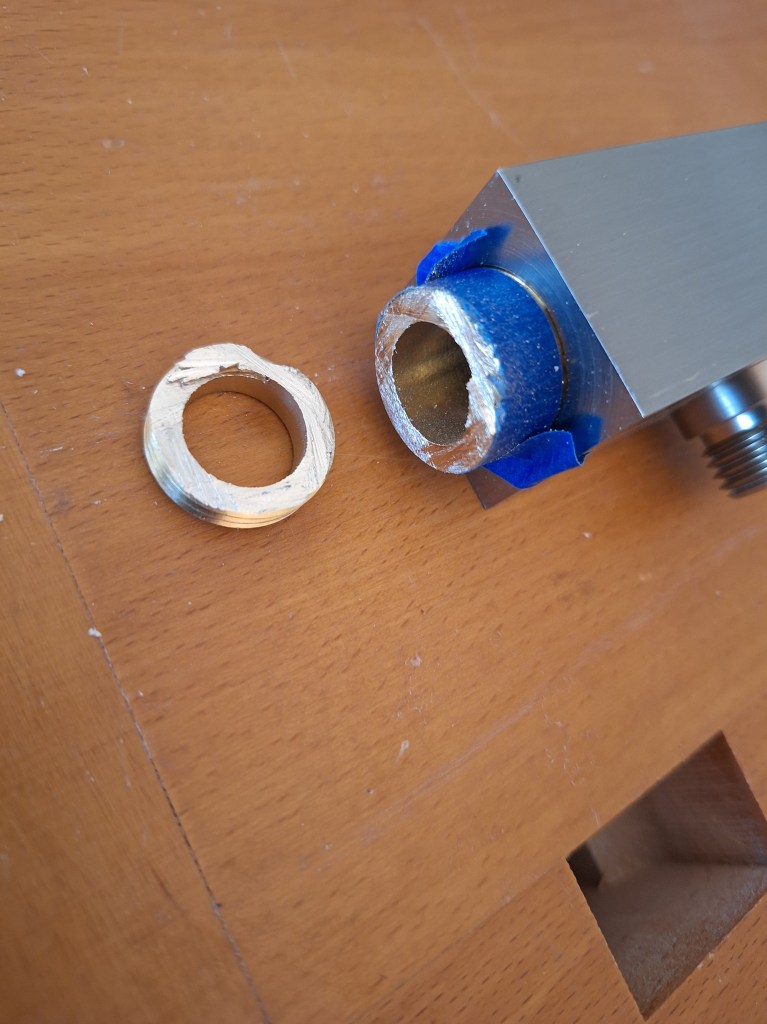
As it was, this was unusable and looked like I’d have to replace it. After some thinking, I decided to try cutting off some of the brass threads. Since I figured I was going to replace it, I might as well give it a shot. So I pulled out a hack saw and sawed off a section, careful to keep the threads in tact.

Cutting the Brass Threads
Section of Brass Threads Removed

Although it looks a bit messy, I didn’t have to do any work with a file to clean it up. The threads engaged nicely with the threads in the wall, resulting in a nice fit. It protruded just a bit, but that was easily covered by the flange, as you can see in the image below.

Shower Wand Installed

I was pretty happy about this. I thought this was going to be a major headache. To have it come together like that was very pleasing.

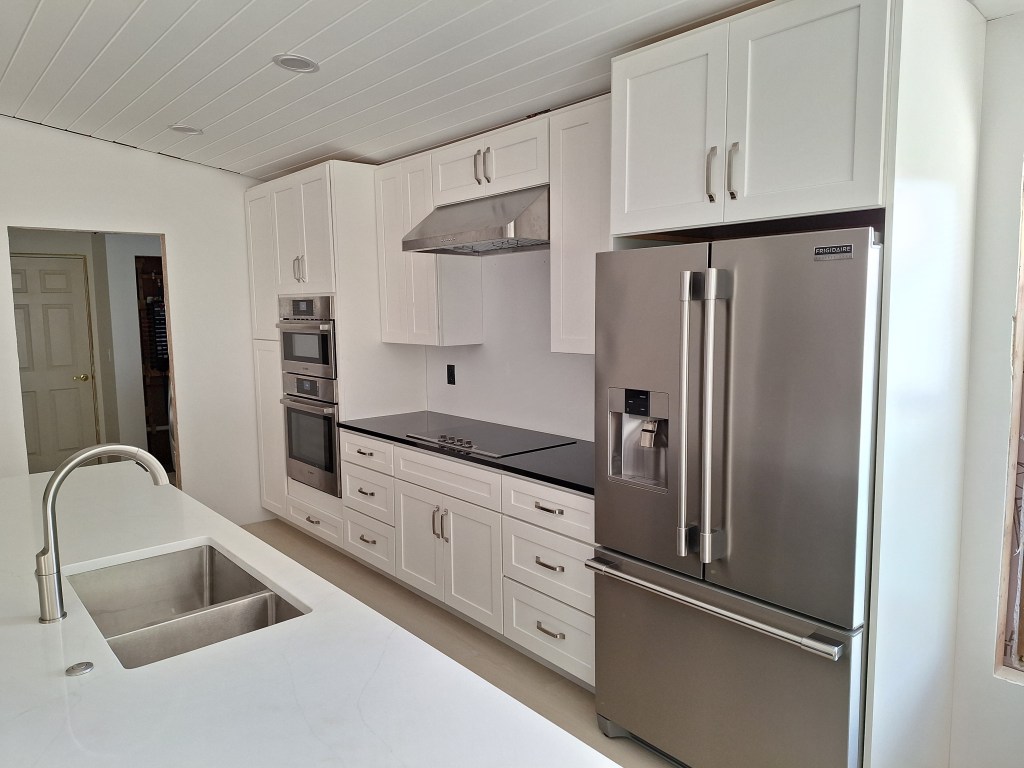
My cabinet handles arrived, so I got to work installing them. I installed all but the ones that will be going on the cabinet doors that I am having replaced. A few of the doors had defects. Given that there is a 5 year warranty, the company has been notified and they will eventually send me replacements. So in the images below where no handles are present, those are the doors that will be changed out once the new ones arrive.

Handles Installed
Handles Installed

Note that on the other side of the island there are also cabinet doors, but they will not be getting handles because those cabinets will rarely be used and adding handles might present an obstruction for ones knees while sitting at the counter. They can be opened by pulling on the bottom edge of the door, when needed. Also, from the vantage point of the living room, I think it looks better without them.

My inspection resulted in the approval of the electrical and mechanical. The plumbing and final inspection had to wait because the inspector had trouble finding the stamp on the glass wall of the master shower that shows it is tempered glass. That was resolved the next day, so I scheduled another inspection, which resulted in the approval of what was remaining. So I am finally done with inspections, which is a really big deal. I am free to move in when I’m ready and can proceed with whatever project suits me without regard to permit expiration dates.

The lease on my apartment ends mid November, so I will use the time between now and then to work on anything I feel I’d like done before I move it. However, I am at the point now where I could move in because the remaining projects are ones I can and will do while living in the house.

The timing of this worked out well, as I am going on vacation for about ten days. So it’s a nice way to start that. When I return, I think I’m going to focus on the garage and setting up the workshop I need to address the upcoming project. That will be fun.

Kitchen – May 2023

As I did in April 2023, I divided my time between work on the kitchen and master bathroom and, just like last month, I’ve created two separate posts. The work in May started in the kitchen, so it’s best to start with this post. Within it I’ll mention when I switched to working in the master bathroom, which you can choose to jump to if you wish to follow the sequence.

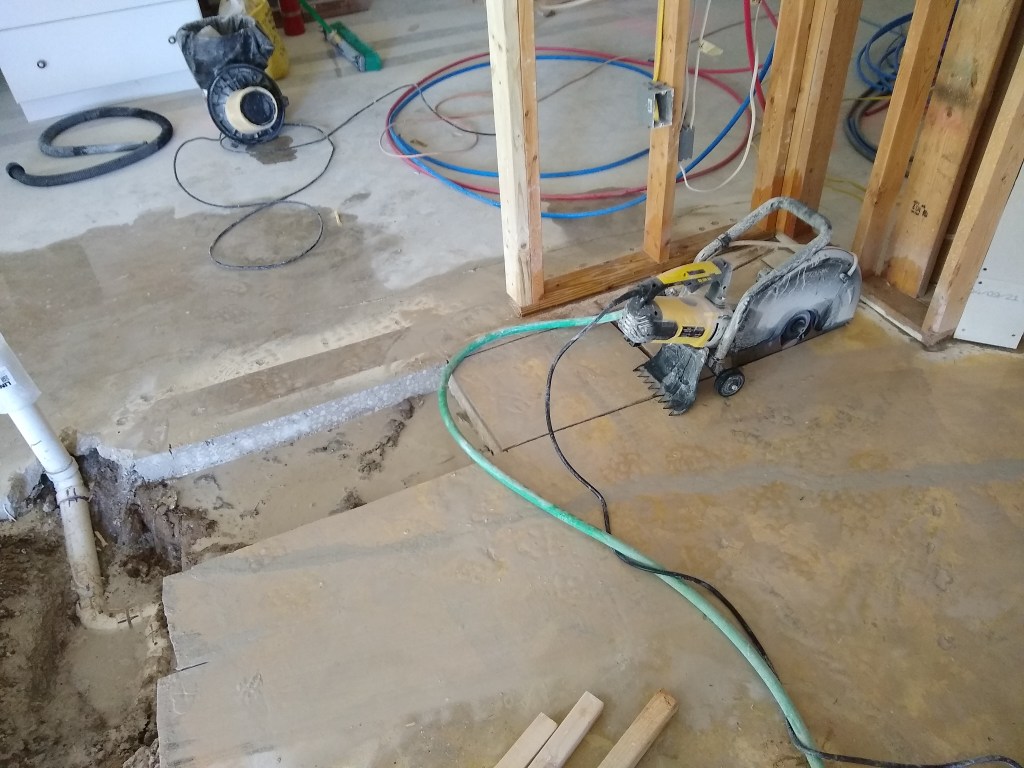
My concrete saw arrived right on time, but the blade took a week to arrive, which was frustrating. I was keen to get going. When the blade arrived I got right on it and started extending the existing trench at a 90 degree angle toward the small wall where the services would be. Below you can see that I removed half of the trench and am working on the second half.

Trench partially done.

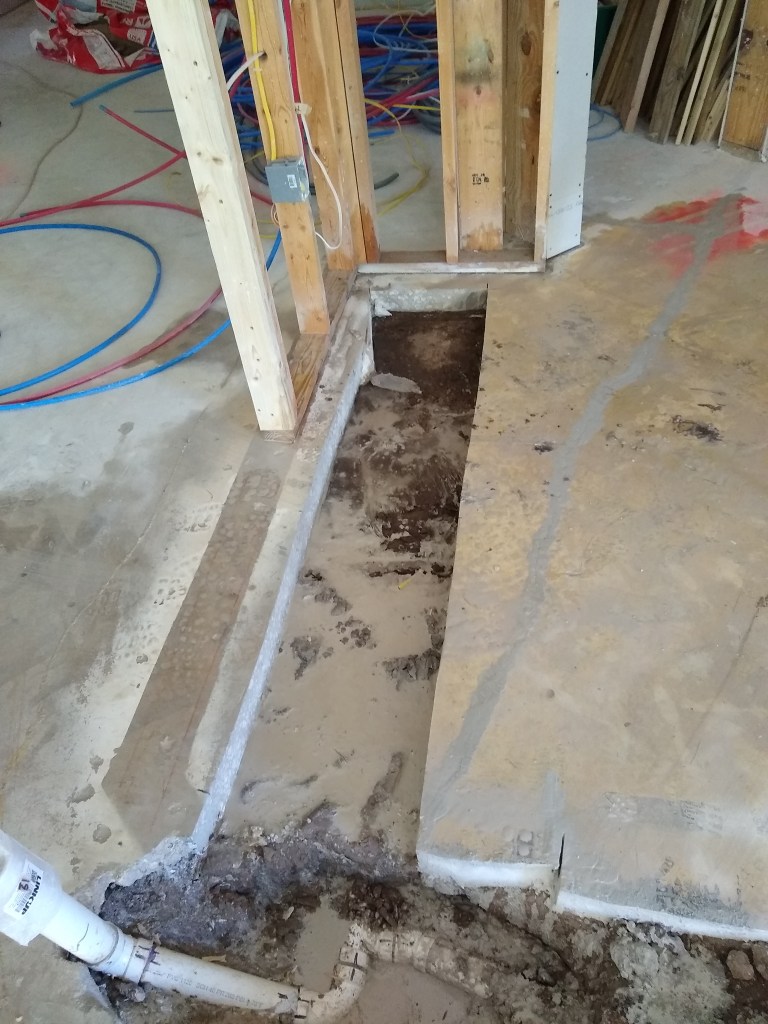
I was happy with the performance of the saw. It is rated at 15 amps and I had it plugged into a 15 amp circuit, so I had to go easy with it, which I discovered the first time I tripped the breaker. It was a bit tricky getting into that corner. I got as close as I could. Here’s as far as the saw would take me.

Trench cut.

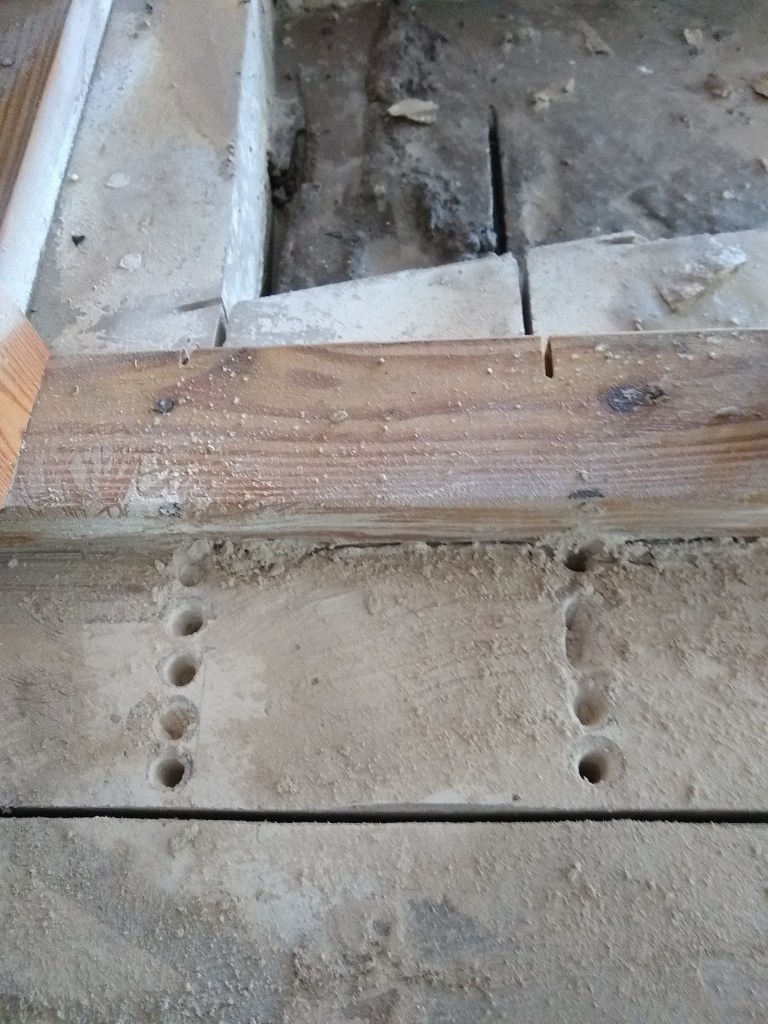
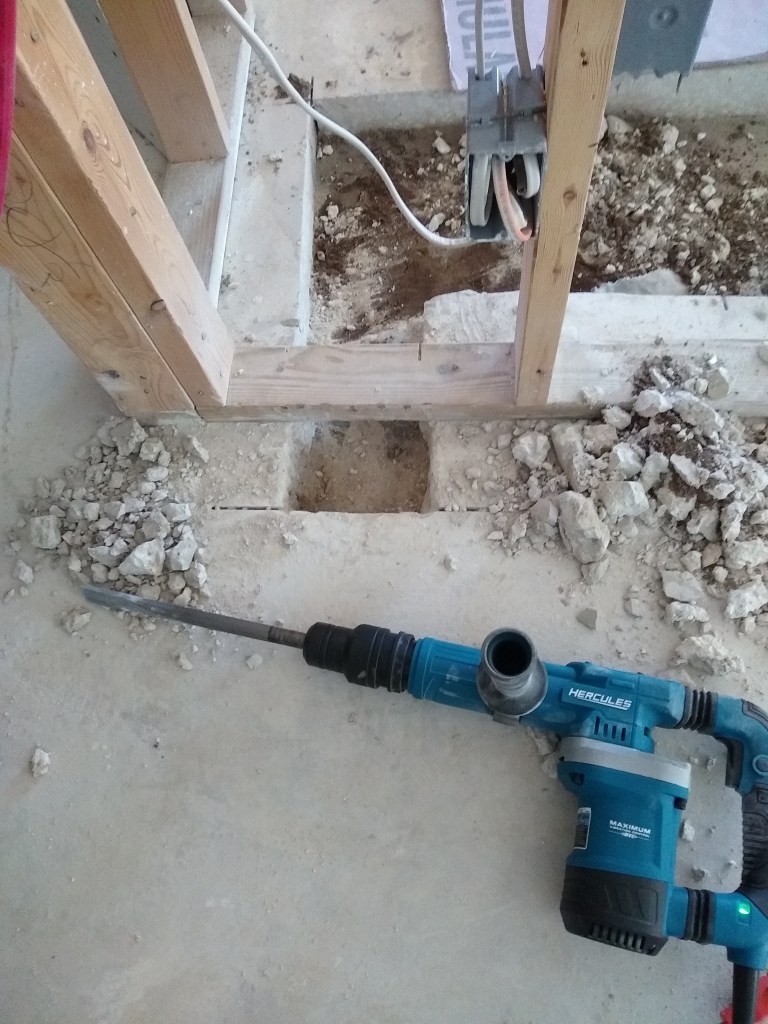
The next part would be tricky because I had to remove the concrete from under the bottom plate of the wall so I could feed the water and electrical lines down. I used my big honkin’ saw to get as close as I could, but resorted to a drill bit and cold chisel and hammer to get the rest of it.

Working on trench under Bottom Plate.

You can see how I used the saw to get as close to the bottom plate on the one side (cutting into the plate a bit) and how I used the saw again to give me a starting point on the other before resorting to the drill. I chipped away at this for some time using a hammer and cold chisel before giving up. So I went home to look into renting a small powered jack hammer. While exploring that option, I decided to buy one instead since I expect I’ll need it for the two showers too. So I picked one up from Harbor Freight and it made quick work of it.

Tench under Bottom Plate complete.
Trench under Bottom Plate complete.

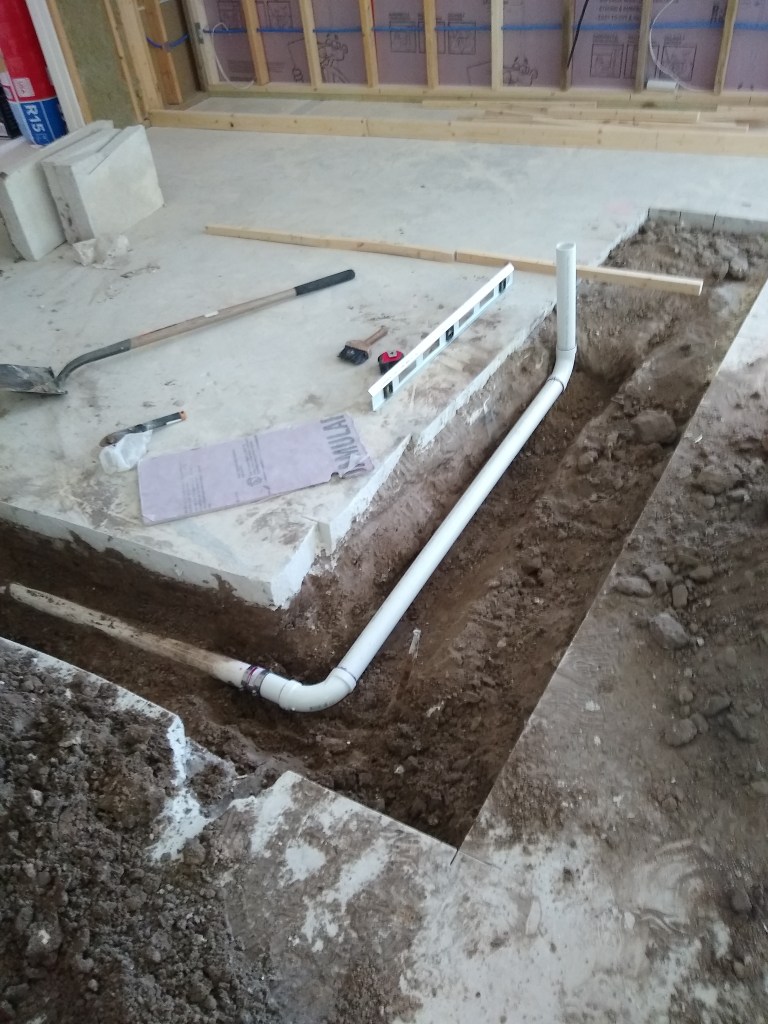
Next, I cleared away the dirt to get at the existing drain and connected the new section to it, as shown below. The new section will come up into the bottom of the cabinet that will house the sink. The dishwasher, which will be located next to the sink cabinet, will also tie into this drain.

New Drain Installed

I placed a hose in the drain and ran the water for a while, feeling under the joints for any sign of leakage. The joints were well sealed, so no evidence of water around them.

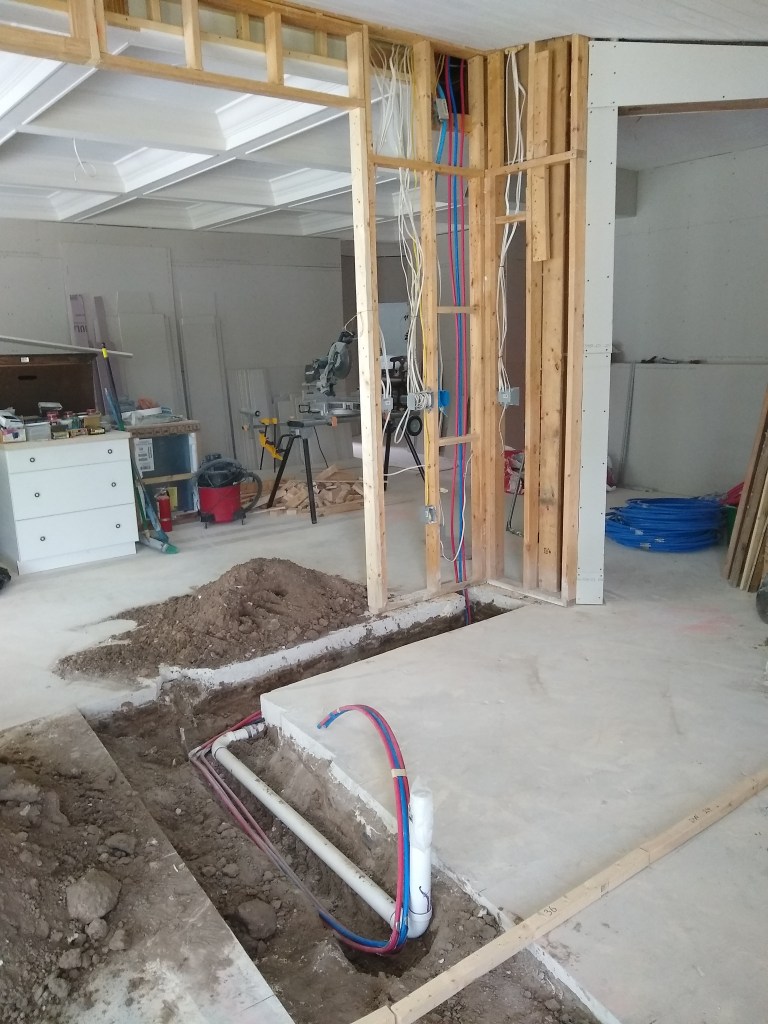
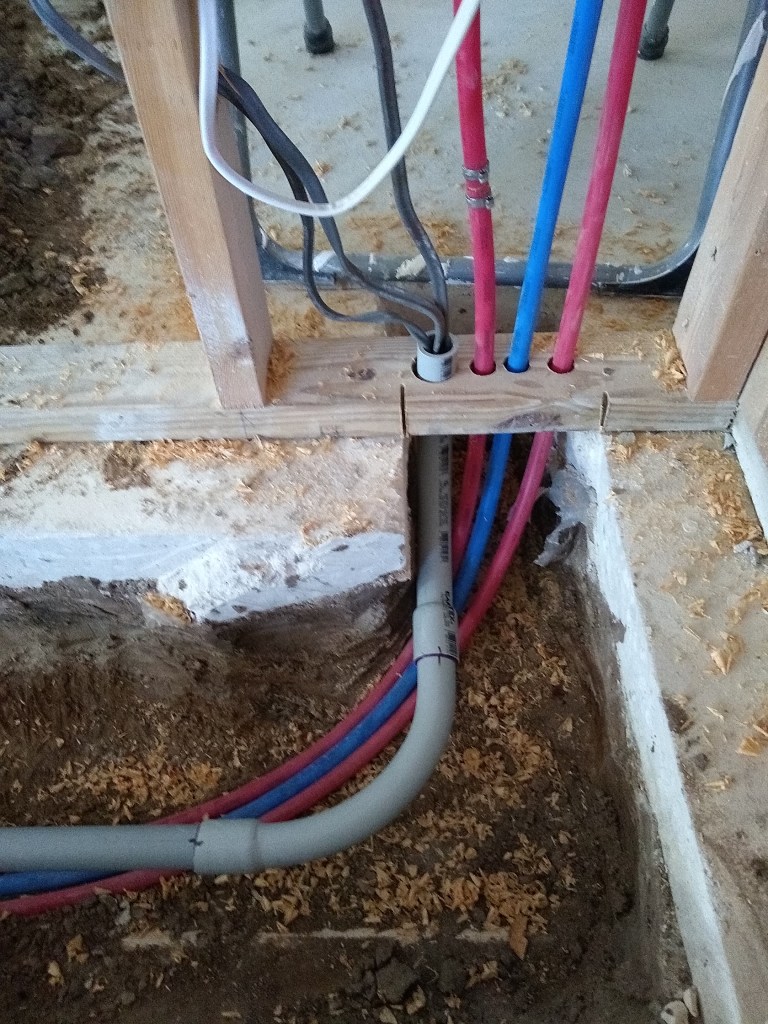
Running along side the drain are the water supply lines for the sink (red and blue) and dishwasher (red).

Water Lines in Trench

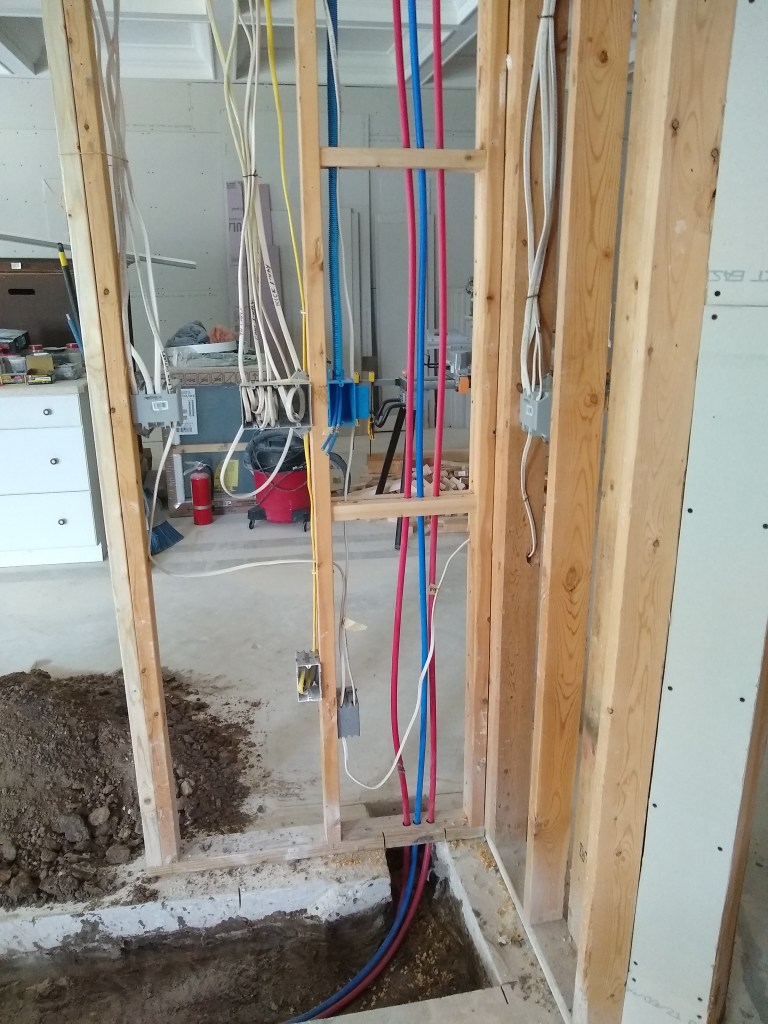
Here they are coming down from the ceiling entering the trench. Note the bracing I added to support the lines within the wall.

Water Lines entering Trench

Here is another angle.

Water Lines emerging at Island

With this done, it was time to call for a plumbing inspection. I had to wait a day because it was the weekend, so I shifted my attention back to the master bathroom (see that post).

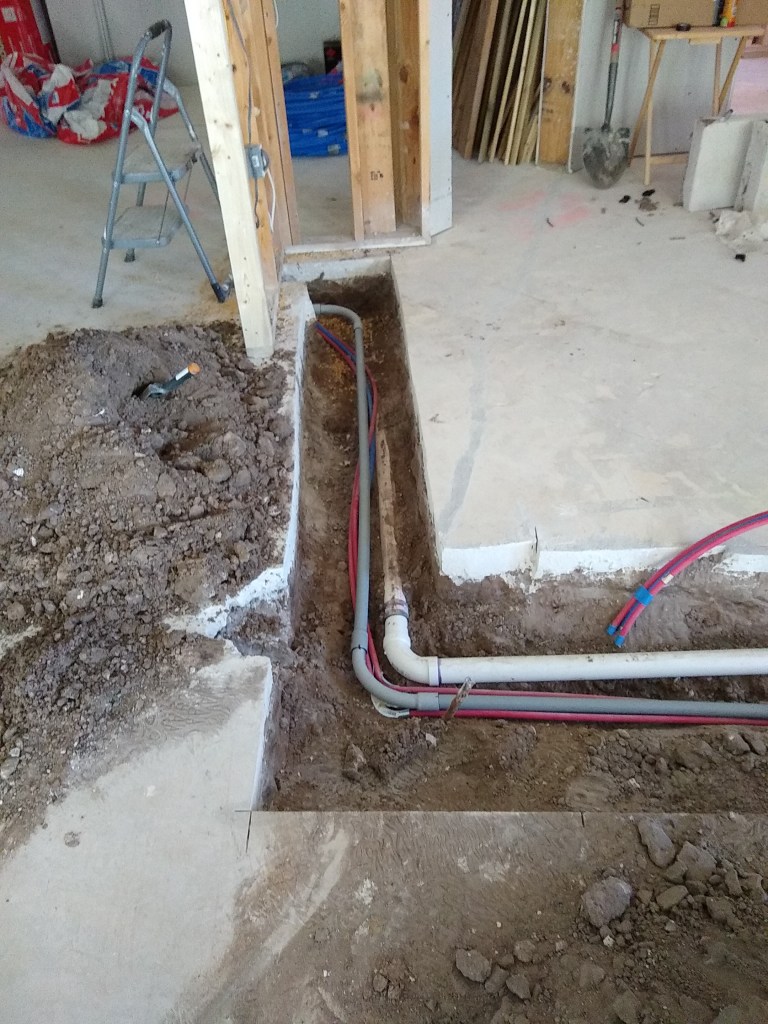
The inspection went well and I used the time to ask about how best to run the electrical lines to the island. Online there were differing opinions about whether one should use a conduit under a slab. After speaking with the inspector he said that no conduit was needed if you used underground feeder (UF) cable, which is what I was planning to use. This is considered fine for direct burial. However, he recommended I use a conduit anyway, so that’s what I did. So off to the store I went to pick up a 1″ conduit that would house 3 wires (two 12/2 wires – dishwasher and GFCIs, and one 14/2 for kick plate lighting).

A wire fishing line was required to pull the wires through the conduit. I pulled one at a time. The last one required a lot of effort because the space in there was getting limited. Here are the wires entering the conduit from the wall.

Wires entering Trench

Here they are en-route to the island.

Wiring En-route

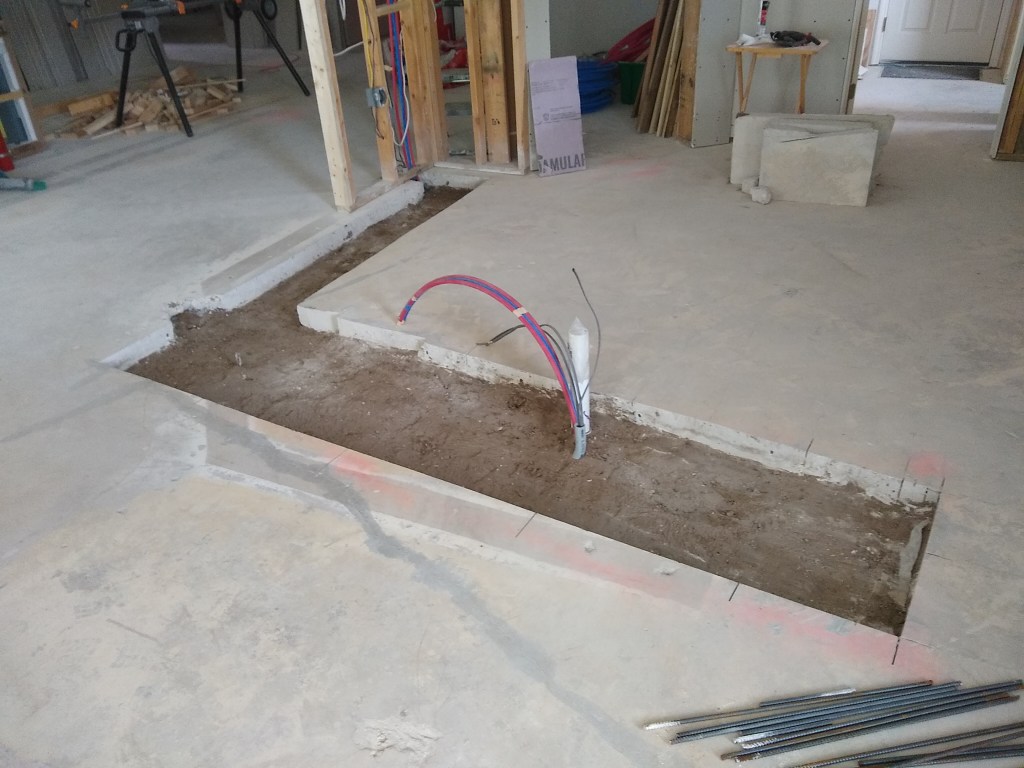
And here they are emerging at the the island location.

Wiring at Island

The conduit was made up of a single 10 foot section of PVC and four 90 degree bends. They are glued in the same was as the drains. Before entering the conduit, I put the wires in their respective junction boxes ready to be hooked up. The wire for the dishwasher was not long enough, so I introduced a junction box in the attic where I spliced in a new length of wire that would reach the island. I wired it up and tested it.

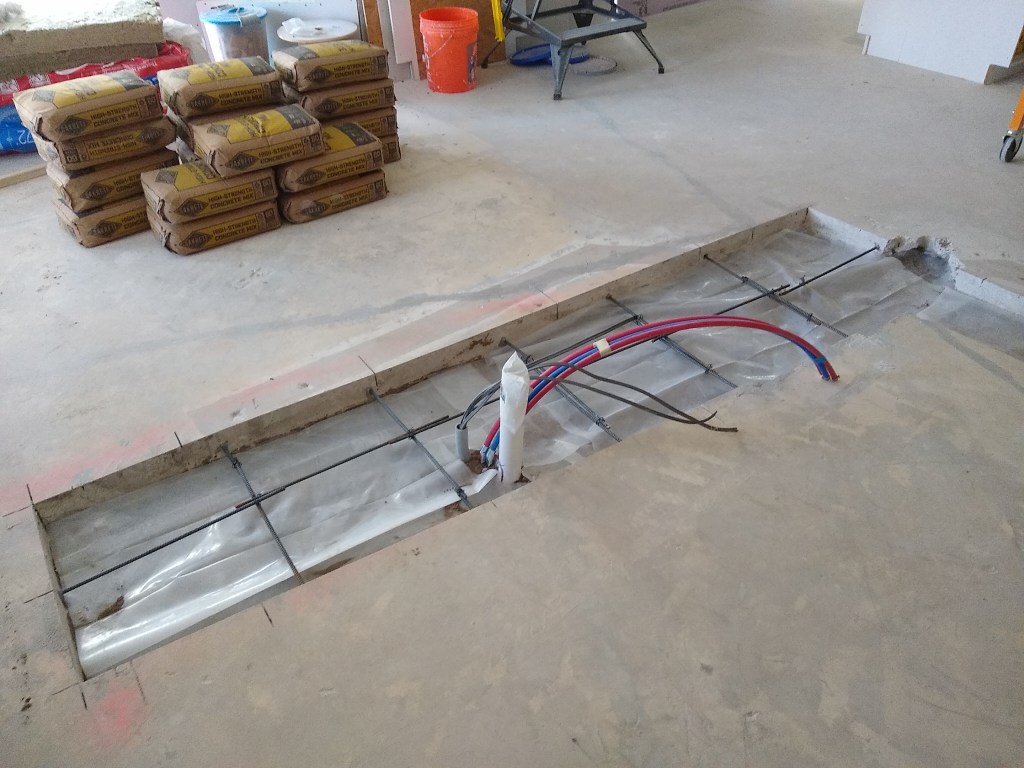
So it was time to get this inspected. While waiting for the inspection I drilled the holes for the rebar. Rebar is needed if the width of the trench is over 22 inches, so I only needed rebar along the wide section of the trench. The part of the trench that runs along the wall is only 15 inches, so that does not require reinforcement. Shortly after drilling the holes, the inspector arrived and gave me the okay to fill in the trench, as you can see below.

Dirt added back to Trench

I had a couple of days to wait the pest control guy to arrive and treat the soil for termites, so I returned to work on the master bathroom. I also made a run to the store to get all the concrete I would need. I estimated seventeen 60 lb bags based on what I used in the master bathroom, which, coincidentally, was about the same amount of area to fill.

After the soil was treated, I prepared the trench for the pre-pour inspection, which was scheduled for the next day.

Ready for Inspection

The inspection went without incident and I began the process of filling in the trench with concrete.

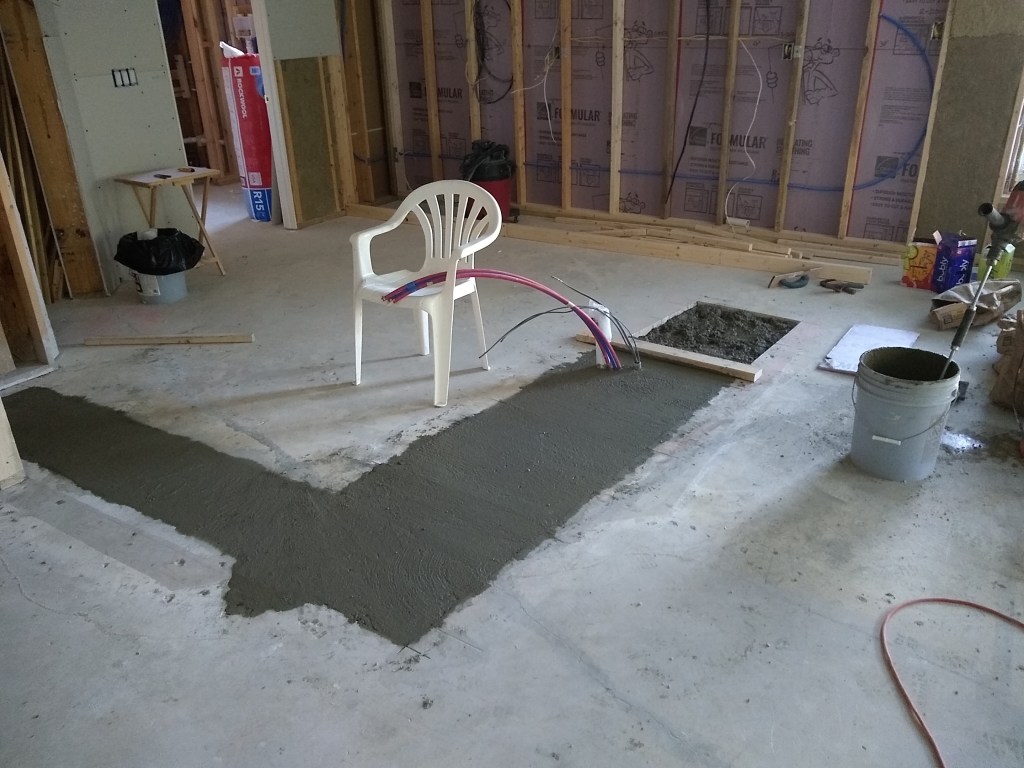
Trench Almost Filled
A closer look of Work in Progress

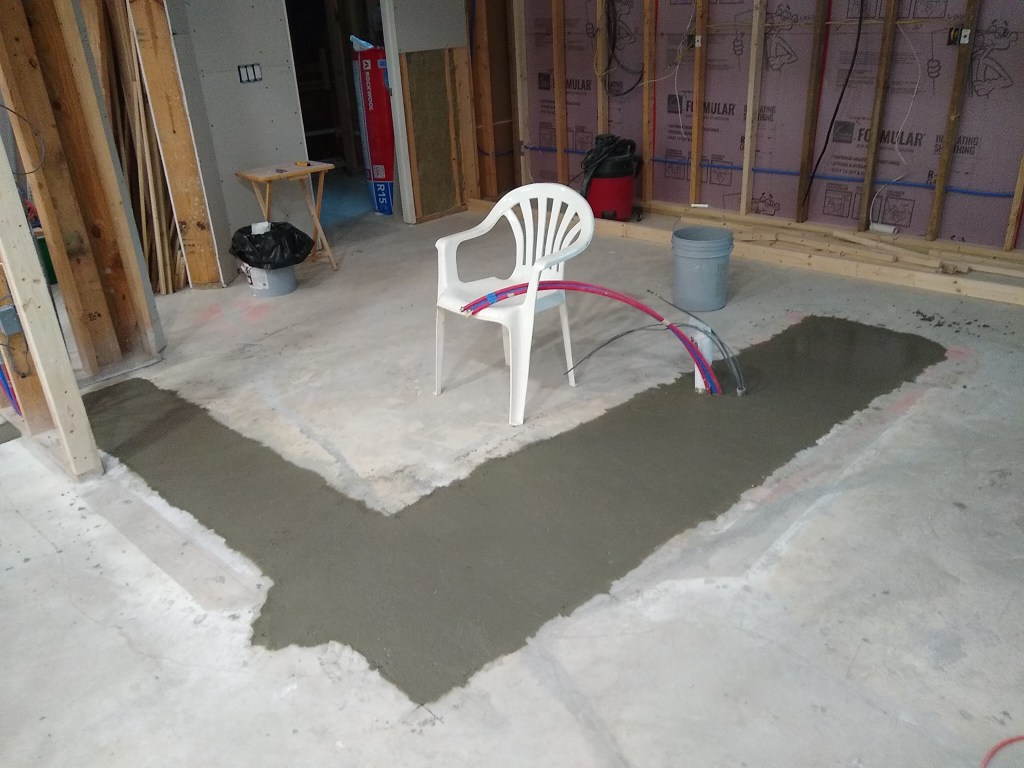
And here it is finished.

Trench Filled

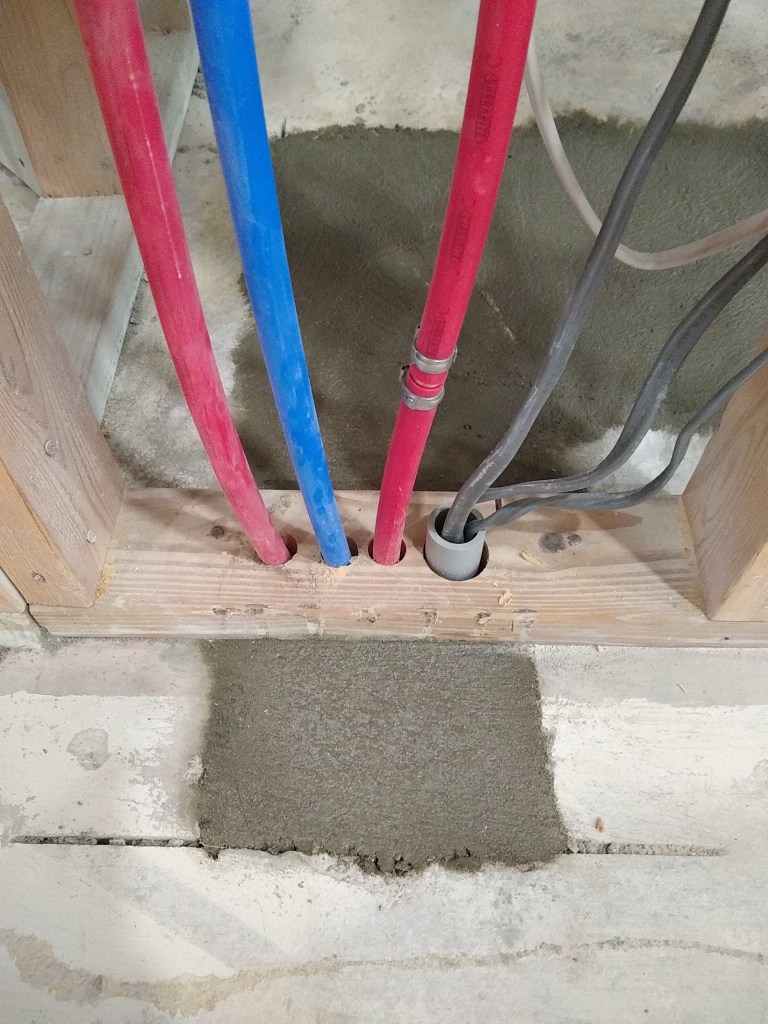
Here are a couple of closeups of the area where the services enter.

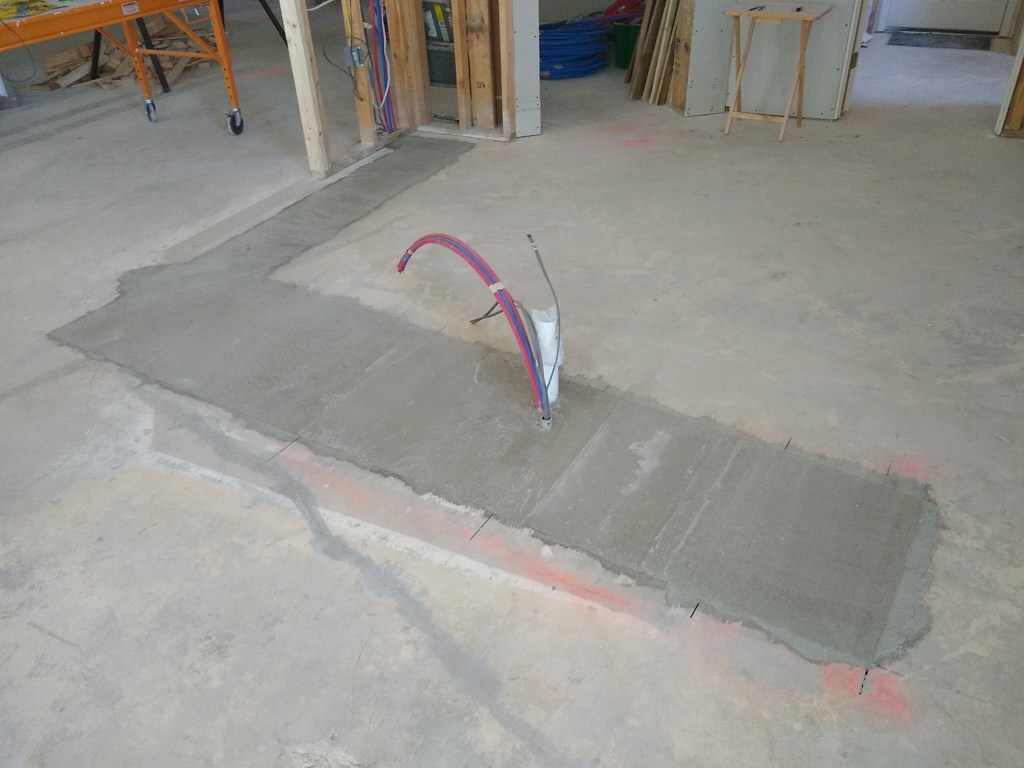
The next day it looked like this.

Trench Cured

You might be interested to learn that I used almost all of the seventeen bags I bought. There was very little waste, so I was pleased. After this I returned to the master bathroom to start removing the existing shower pan.

As mentioned in the post about the master bathroom for this month, I had a period where I had to wait on deliveries, so I decided to grind smooth the concrete I had poured in the master bathroom and kitchen. Here is an image of the trench in the kitchen after I smoothed it out.

Trench Ground Smooth

That’s all for the kitchen in the month of May.