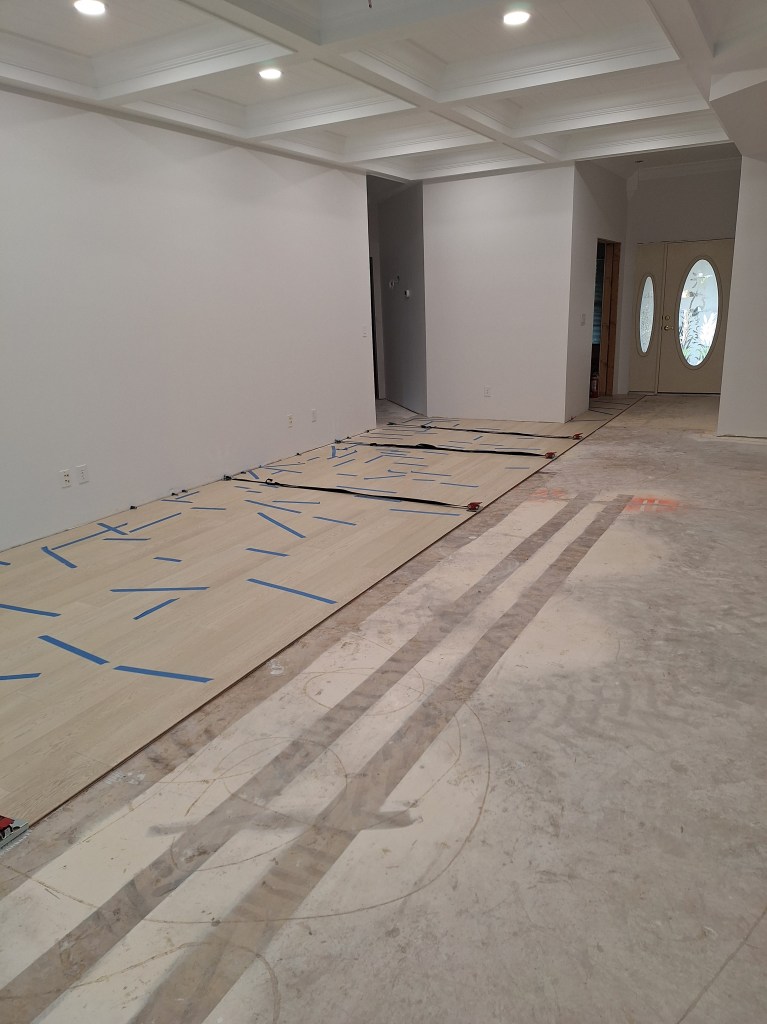
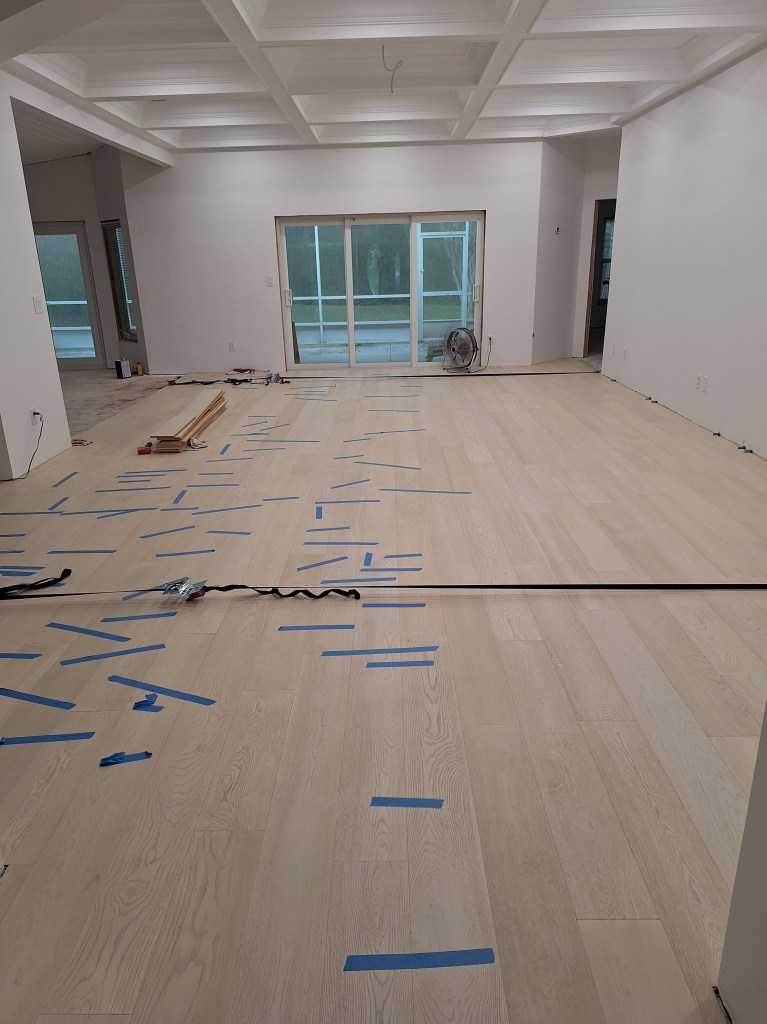
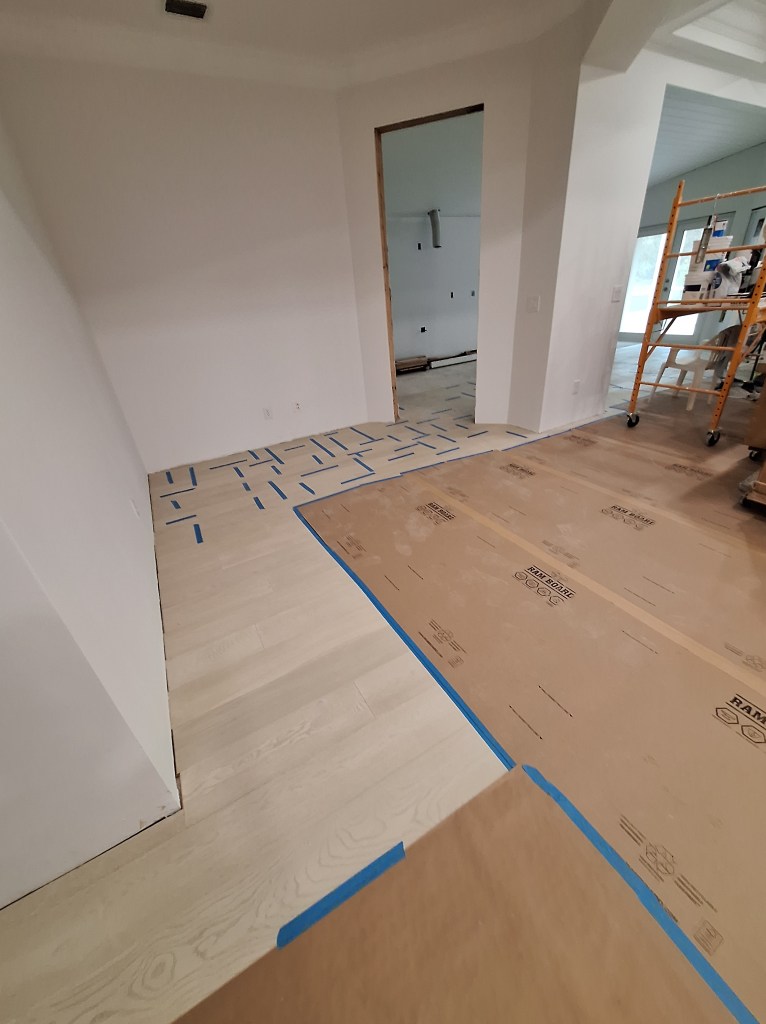
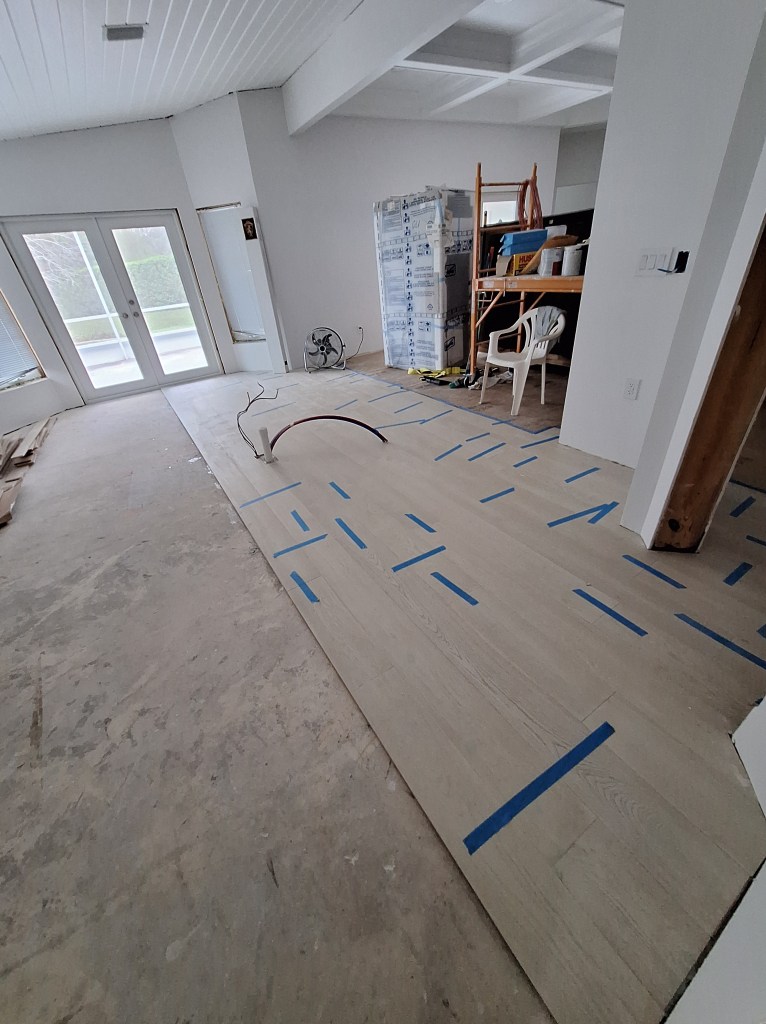
Flooring Continued, Kitchen Electrical Work, and Painting the Master Bedroom – March 2025

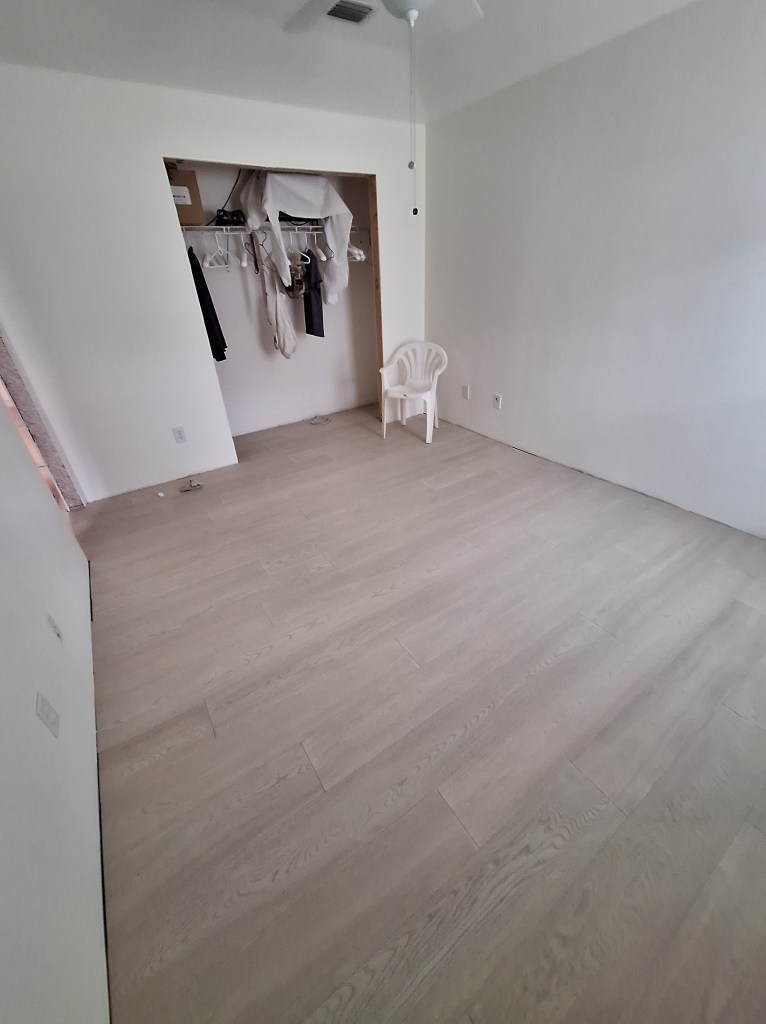
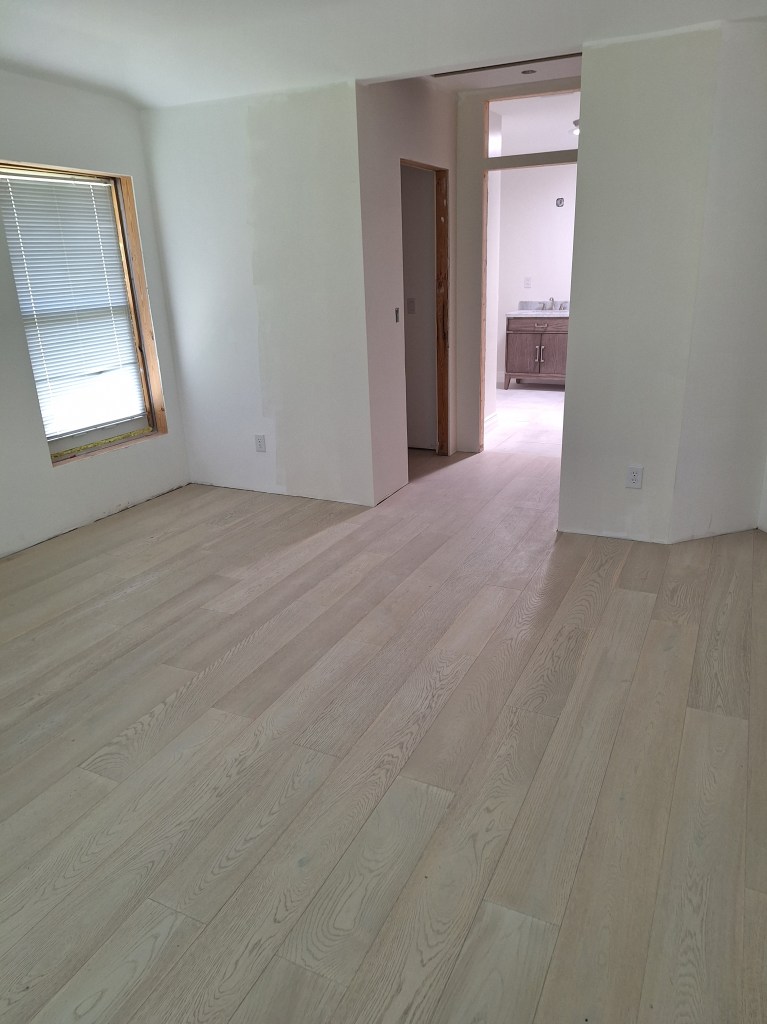
At the end of the last post, the flooring installation was paused as I waited for the extra material to arrive so they could finish the job. Before that, they finished the master bedroom, which took two days, and then started on the office. I forgot to show a picture of the master bedroom before the pause, so here it is now.
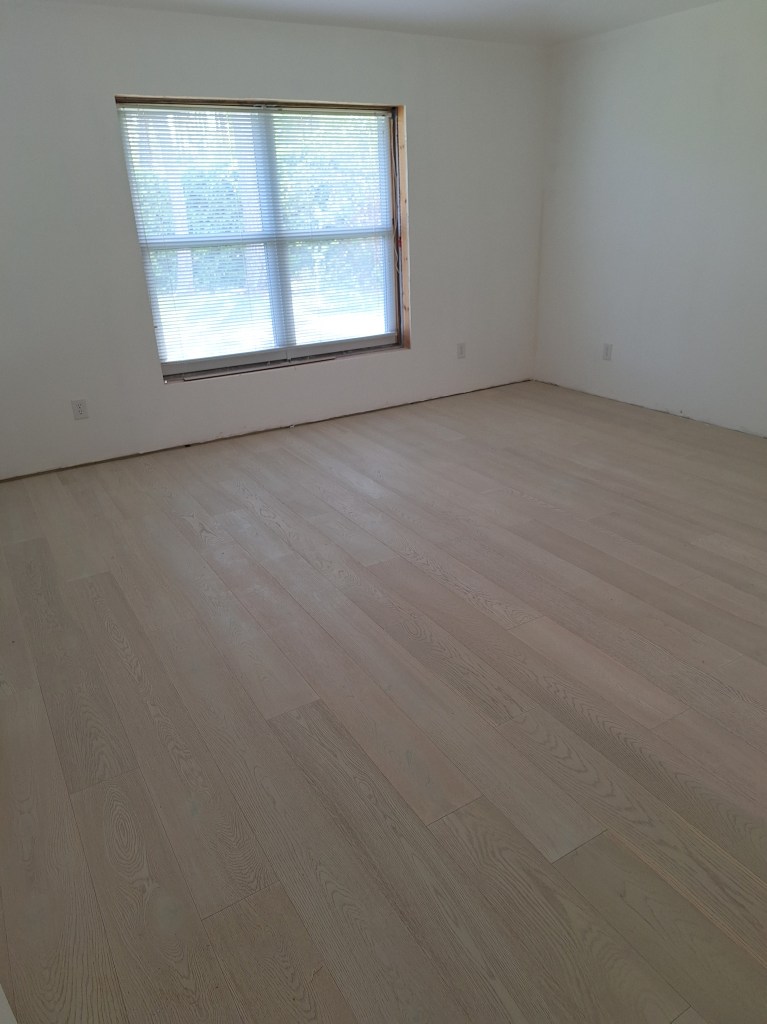
End of Day 7, Master Bedroom – from Entrance.
End of Day 7, Master Bedroom – toward Bathroom.

In the image above, notice how on the wall near the window I used two different primers, hence the color difference. I mention this because later I will show the bedroom after I painted it and it is hard to distinguish between the primer and the paint. This was just to provide evidence that the room wasn’t painted before the flooring was installed.

While I was waiting for the additional flooring to arrive, I started cleaning up and organizing the place. Now that most of the flooring was in, I could begin dusting the contents that had been moved out of the bedrooms into the great room. Most things were caked with dust from the many drywall sandings that had taken place. Since that part of the renovation was behind me, dusting the furniture and other items was no longer pointless. It would be nice to work in a relatively clean environment for a change. Also, since I had the time, I cleared the workshop of its contents and scraped the floor in preparation for the return of the installers.
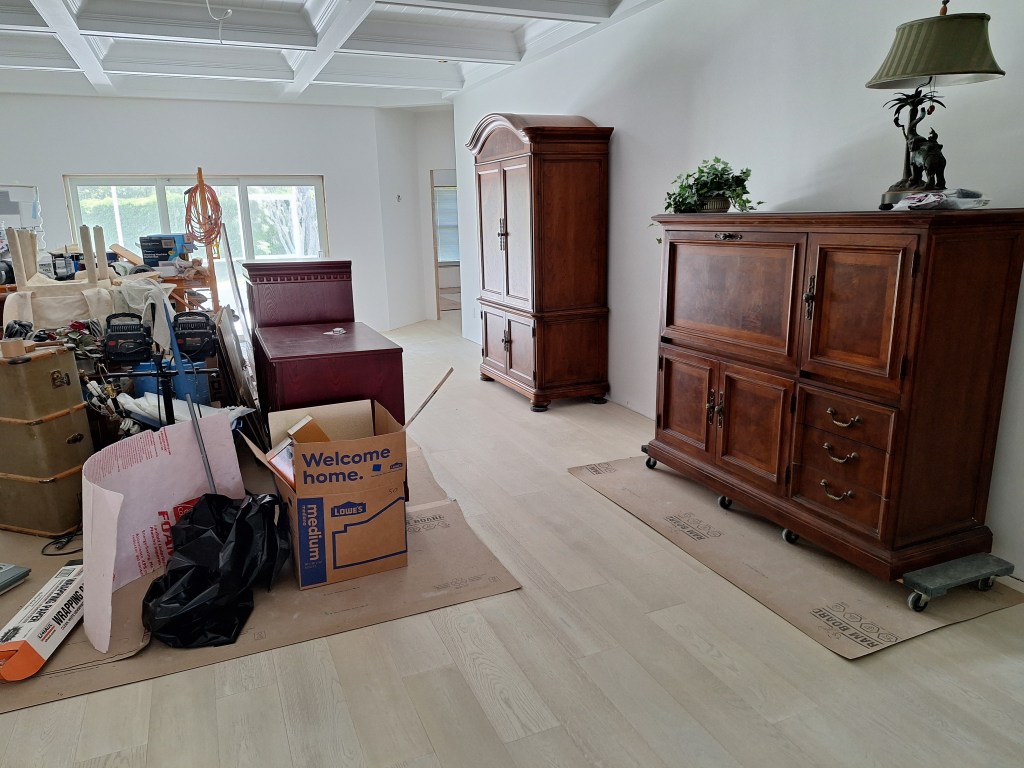
Great Room, after some dusting and reorganizing.

Once the wood arrived, I notified the installers and they showed up a couple of days later to finish the office and workshop.
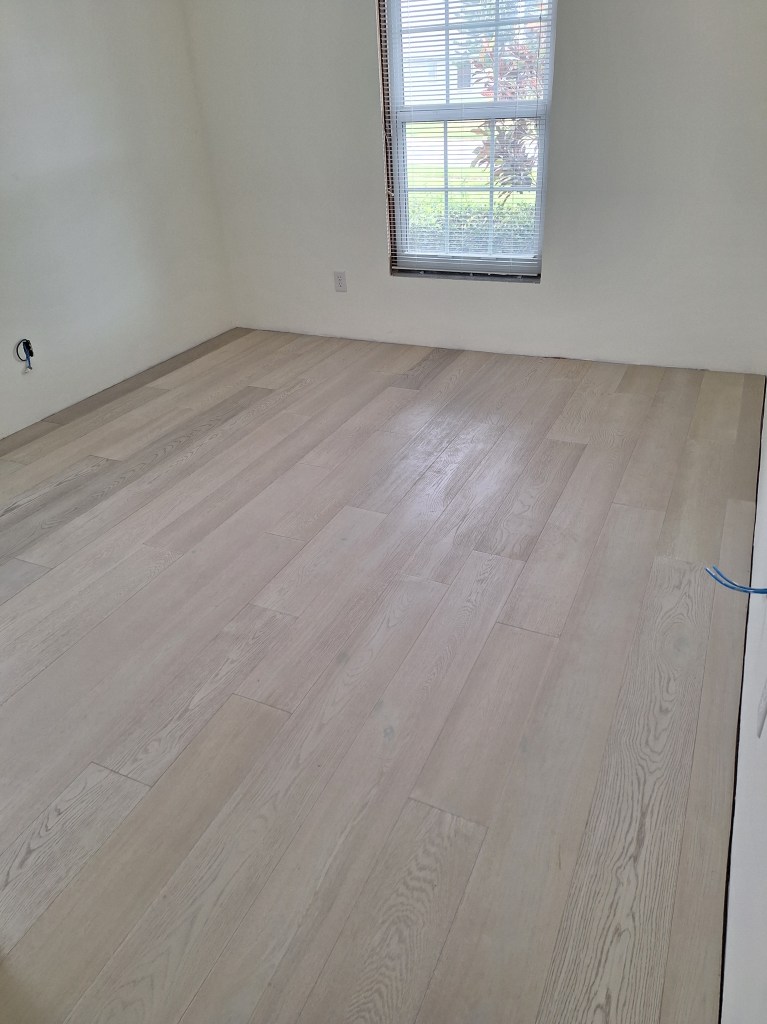
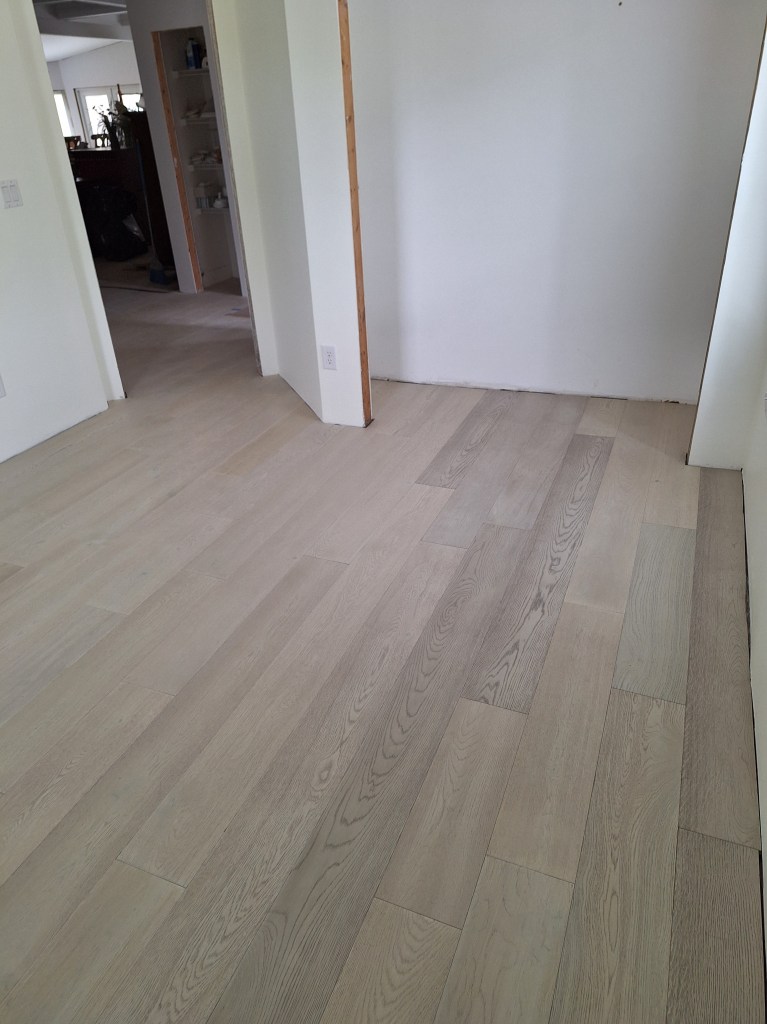
End of Day 8, Office – from Entrance.
End of Day 8, Office – toward Entrance.

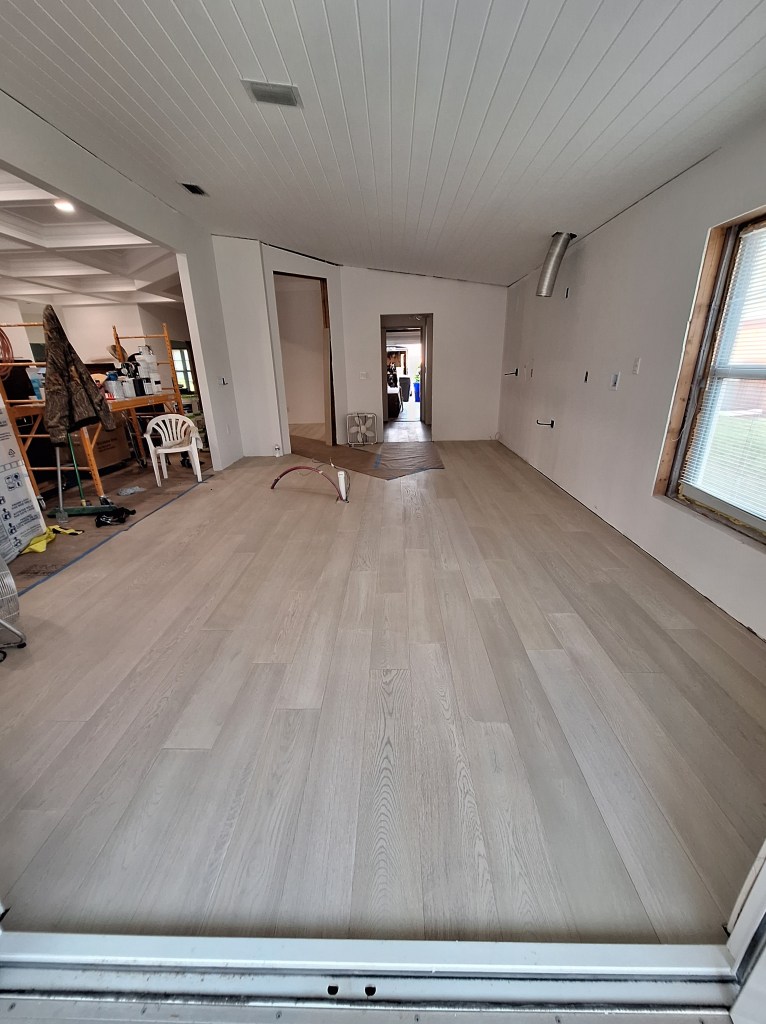
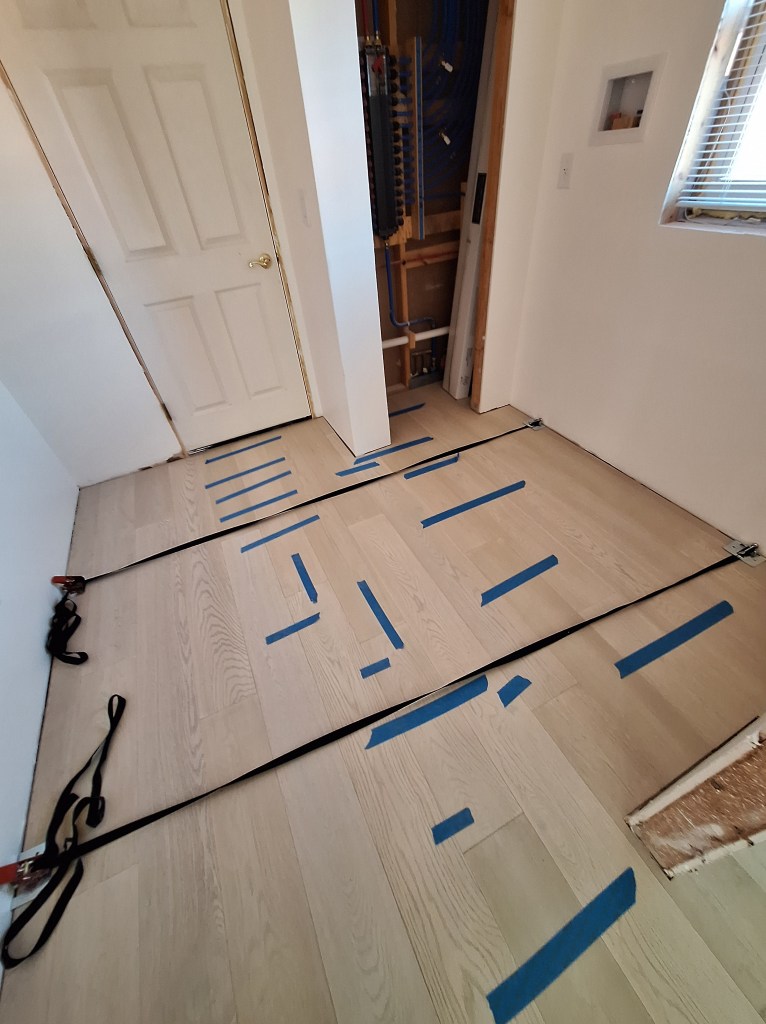
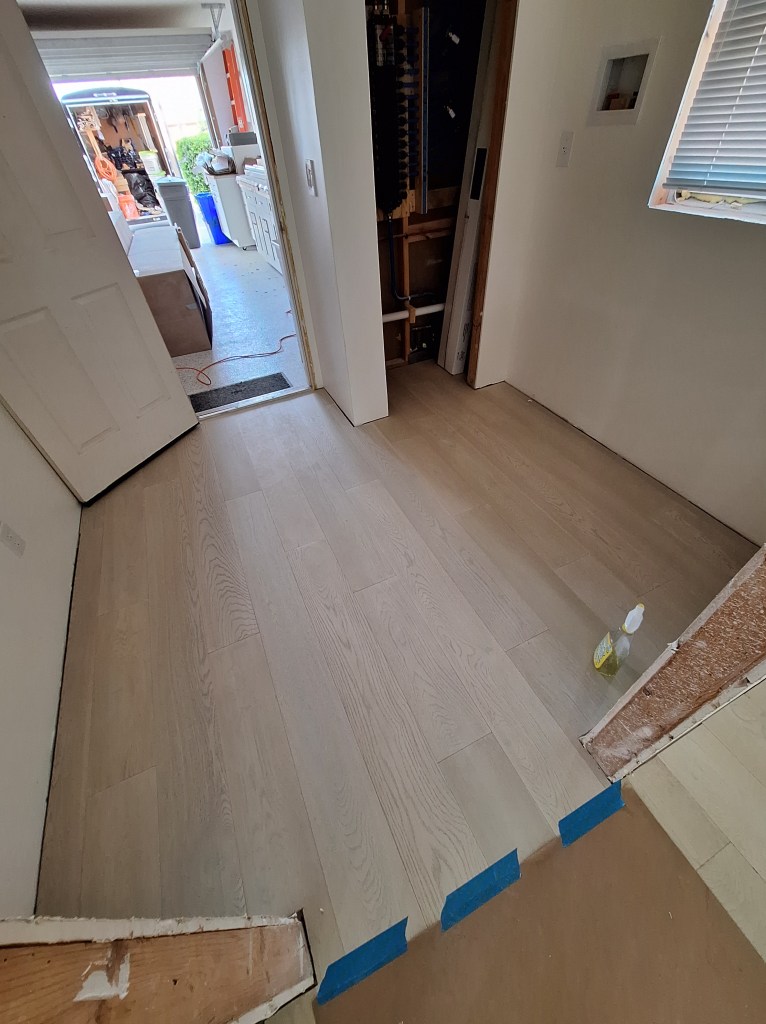
Notice how there is a bit of variation in the wood. The left side was done using the original order, and from about the middle of the room toward the right is where the newer flooring was introduced. This is even more evident when you look at the workshop, which was the last room they did.
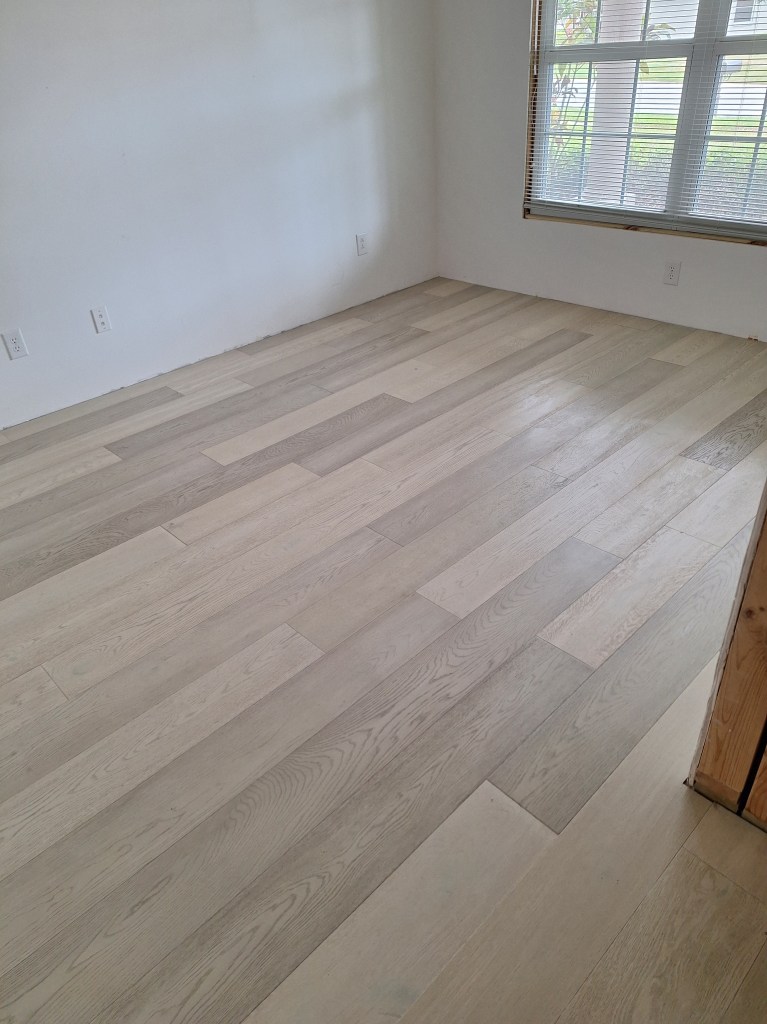
End of Day 9, Workshop – from Entrance.
End of Day 9, Workshop – toward Entrance.

The flooring in these two rooms is far more patchy than the rest of the house. This possibility was taken into account when it became clear that additional flooring would be needed, which is why I asked them to use the remaining material in the master bedroom. Under normal circumstances they would have continued from the guest bedroom and hallway into the office and then the workshop, finishing up in the master bedroom. Knowing that the new material may vary somewhat from the original, if there was going to be any variation, I wanted it to be in these two rooms.

With the flooring installed, I could start to move the things I had dusted back into the rooms, where they would remain dust free, apart from the usual dust one gets.
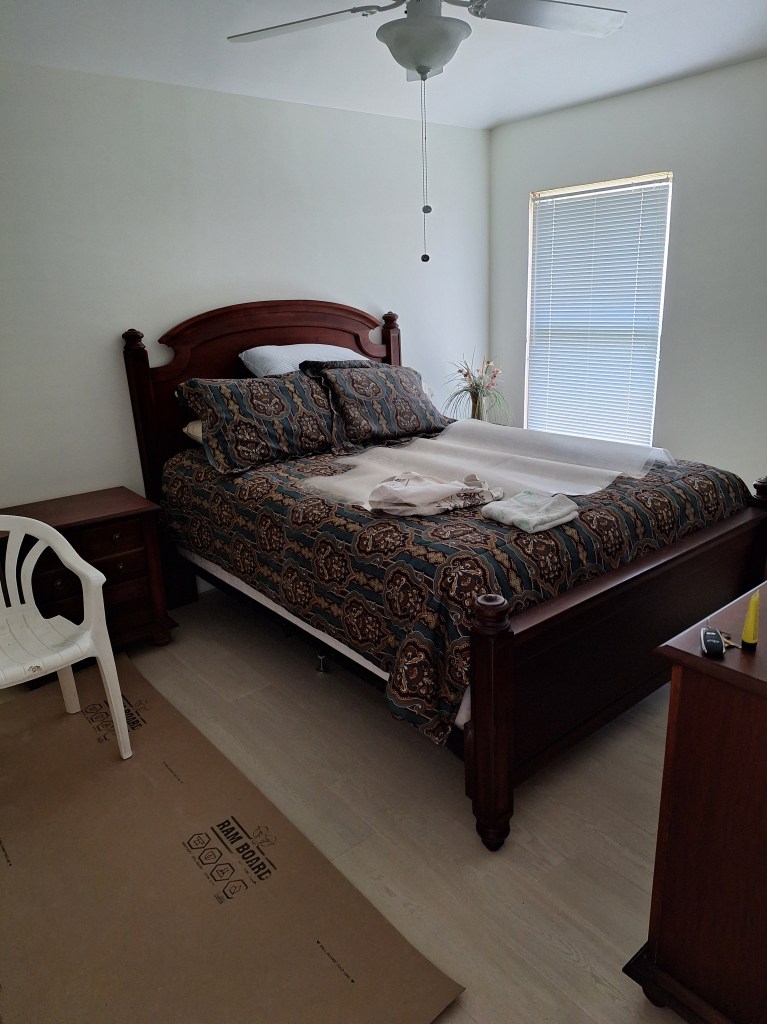
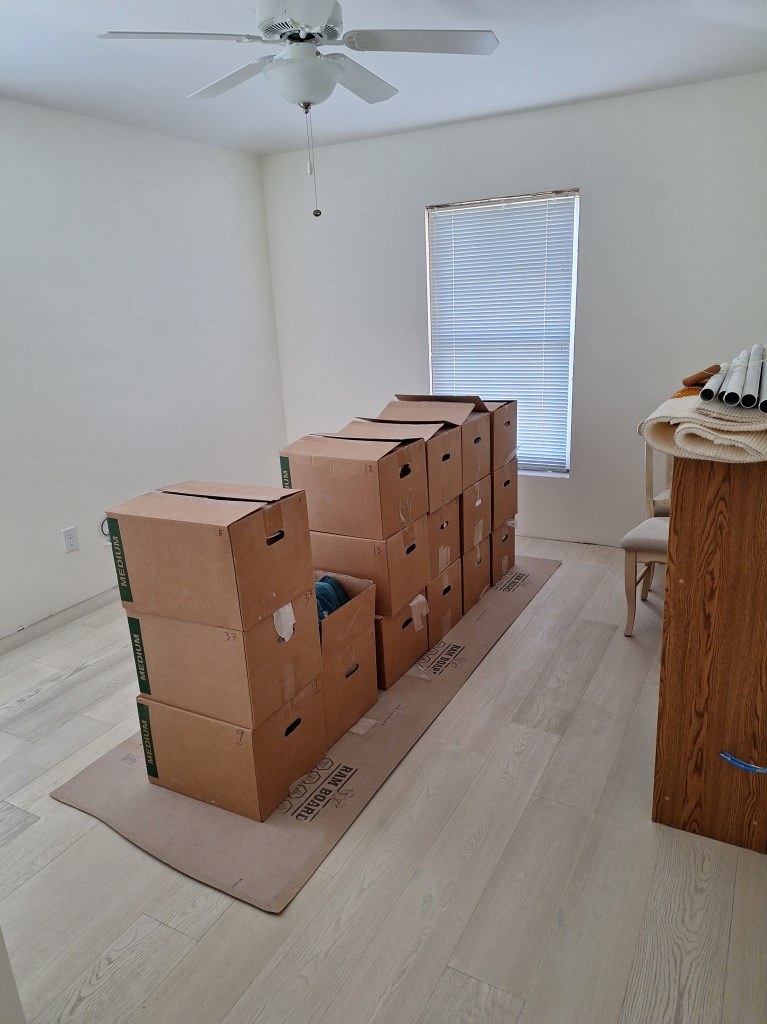
Guest Bedroom – adding furniture after flooring laid.
Office – returning contents after flooring laid.
Workshop – returning contents after flooring laid.

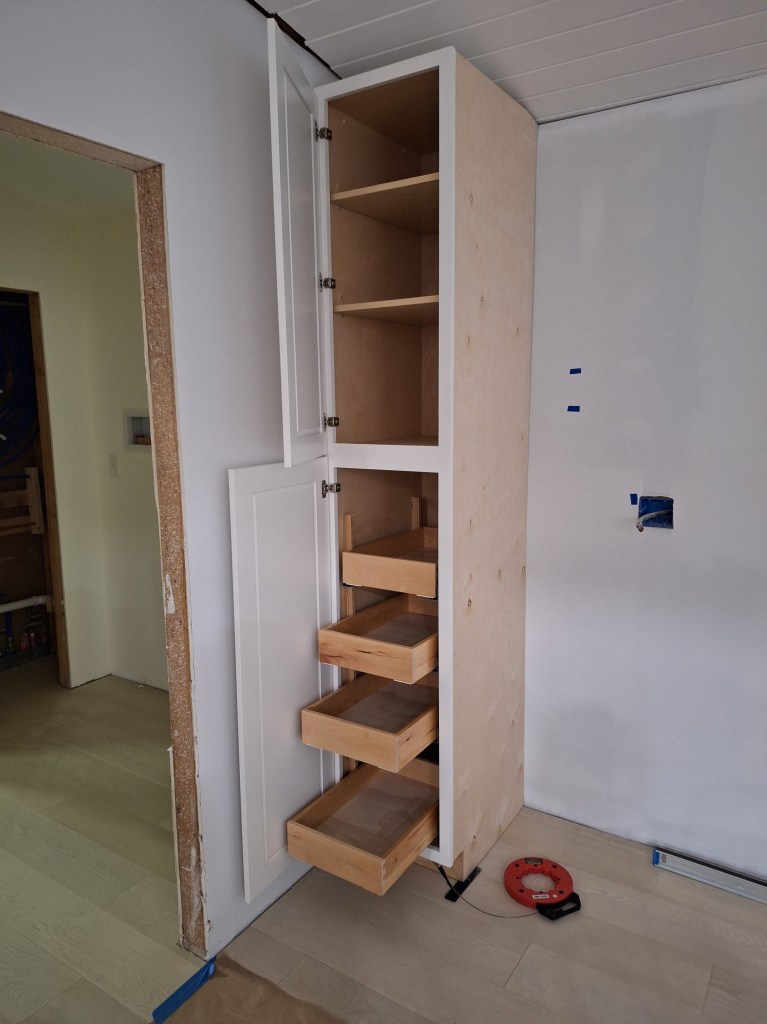
In the workshop, I decided to re-purpose the cabinet that was supposed to be placed on the far side of the refrigerator. Unfortunately, I miscalculated the room I had along the east wall of the kitchen, and this nice little cabinet would not fit. So here is its new home.

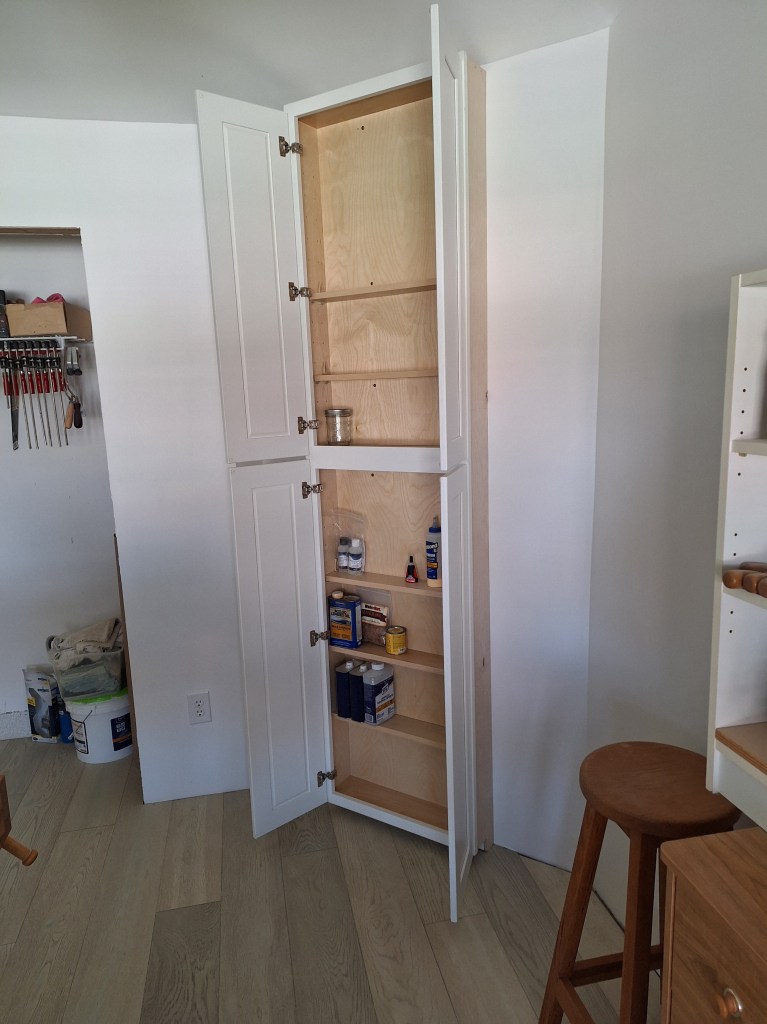
Cabinet added to Workshop
New Cabinet with Doors open.

In the kitchen, this would have been great for spices, but here it will serve nicely as a place to store glues, finishes, and maybe screws and other fasteners.

Wiring the kitchen island was my next priority. After completing this I would be able to request another inspection to trigger an extension of my permit expiration date.

The island has three lines coming into it from under the slab. In the picture below, the wire on the left is tied to the general 15 amp circuit for the kitchen, and will be used for kick lighting. The one in the middle is for the 20 amp GFCI outlets. The one on the right is on a dedicated 20 amp circuit for the dishwasher.
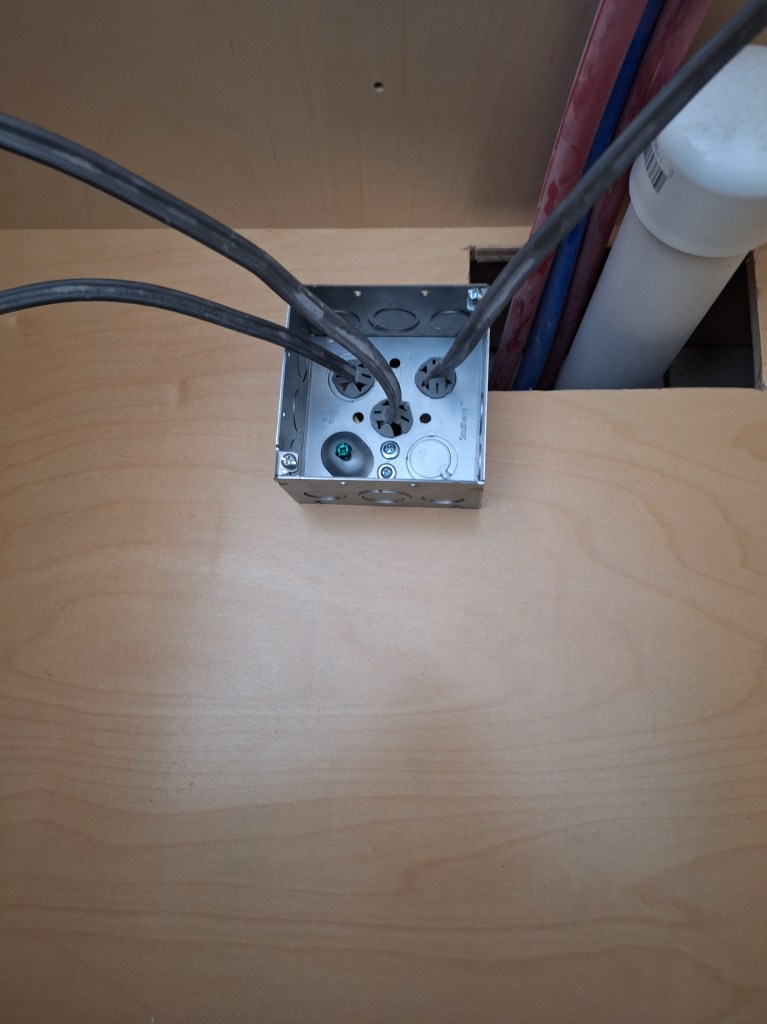
Junction Box in Sink Base Cabinet

Because these wires are located inside cabinets, they will be subject to damage as items will be moved in and out of them. Consequently, they need to be protected. This is done by using Metal Cased (MC) cable, instead of the usual Romex that is run behind the walls.

Wiring under Sink Base Cabinet

The outlet on the far left is where the power adapter for the kick lighting will plug into. The one just above it is the GFCI outlet. The in-sink garbage disposal will plug into this. It branches out on either side to the two ends of the island where counter top pop-up outlets will connect. The outlet on the right is where the dishwasher will connect. The inside of the junction box on the bottom of the cabinet looks like this inside:
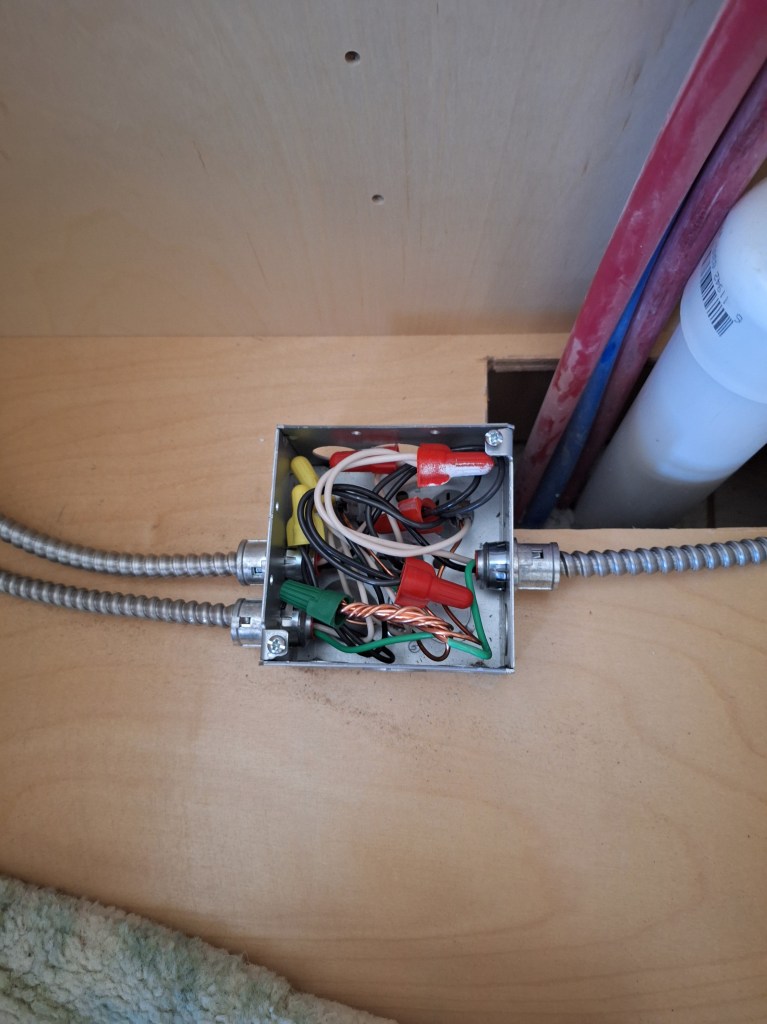
Junction Box Wiring

Below I provide a series of pics to show how it all fits together.

Outlet in North End Cabinet to supply power for Counter top Pop-Up Outlets

An MC cable extends from the outlet shown above heading south behind where the dishwasher will go and into the sink base cabinet, connecting to the GFCI wire inside the outlet box, shown below.

Sink Base Cabinet Outlets

At the other side of the GFCI outlet, another MC cable extends southward behind the cabinet where the garbage pales reside.
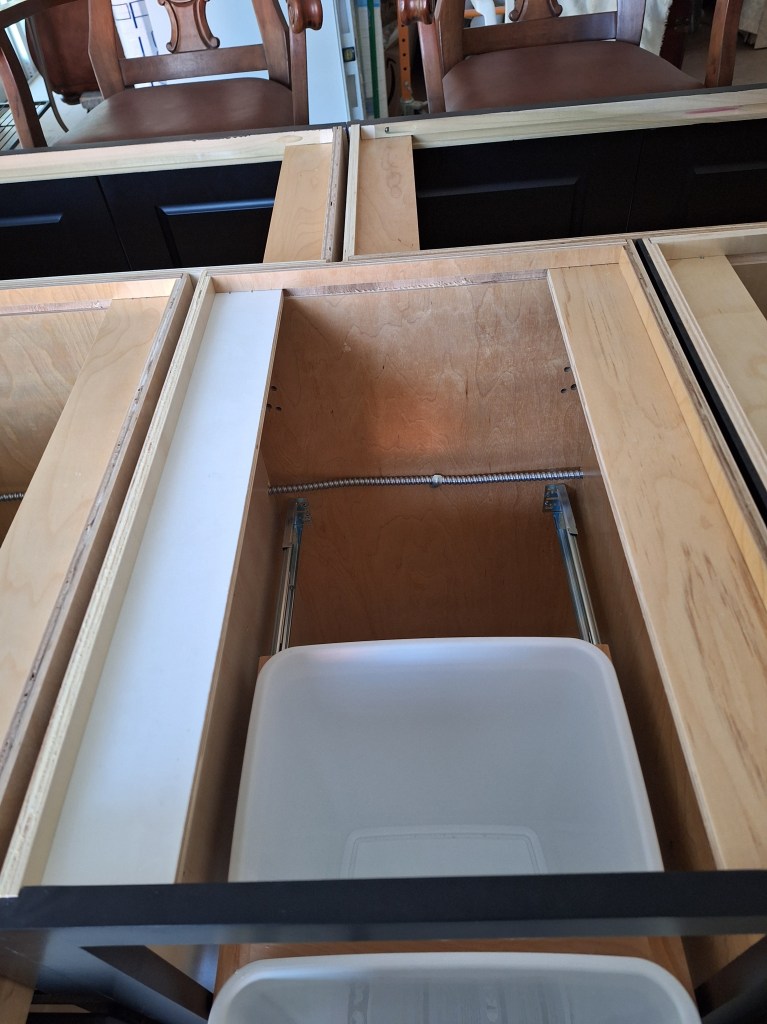
MC Cable running behind Garbage Cabinet

This cable terminates at the second outlet that is in the south end cabinet. It will provide power for another set of counter top pop-up outlets.

Outlet in South End Cabinet to supply power for Counter top Pop-Up Outlets

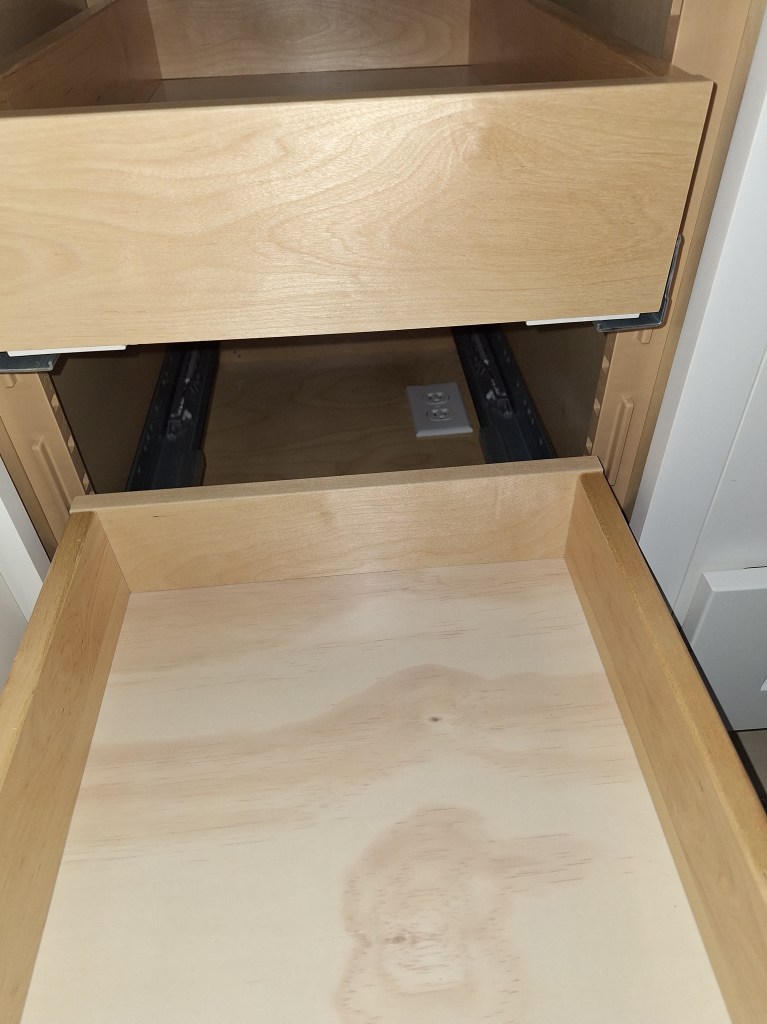
I also installed an outlet at the bottom of the pantry for the kick lighting along the east wall of cabinets.
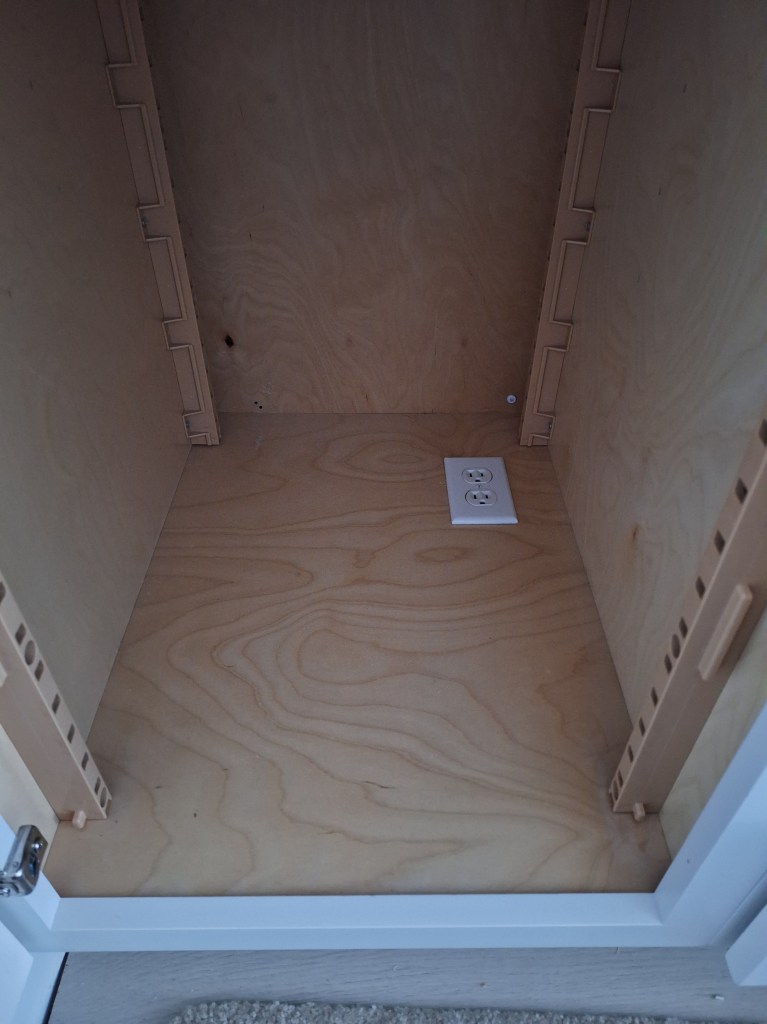
Pantry Cabinet with new Outlet for Kick lighting.
Pantry Cabinet – new Outlet for Kick lighting, with drawers re-installed.

The inspection was performed shortly after, and it was successful. Thus, my permit expiration date is now extended to September.

Since the ends of the island cabinets do not match the color of the cabinets, a 4’x8′ sheet of 1/4″ material is provided so that it can cover those areas. So I cut and shaped it and attached it to both ends. Here is one of the ends.
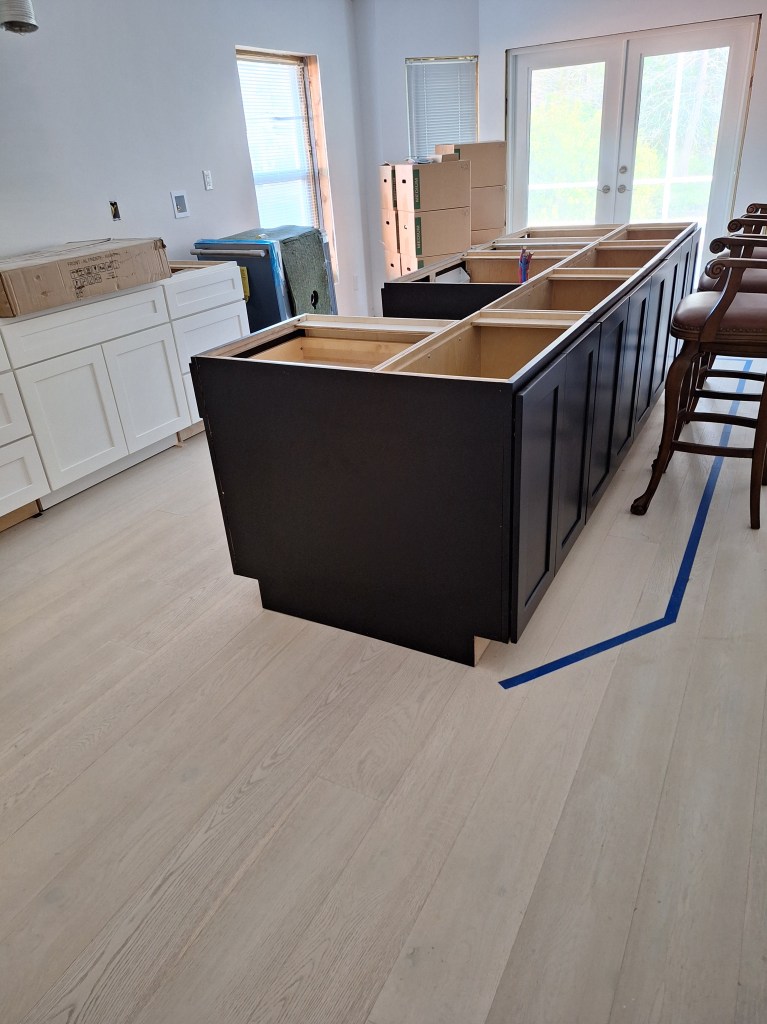
Kitchen Island – Side Panel added.

That looks much better. I’ll do the same for the kicks, but only after I understand how I will run the lighting for that area.

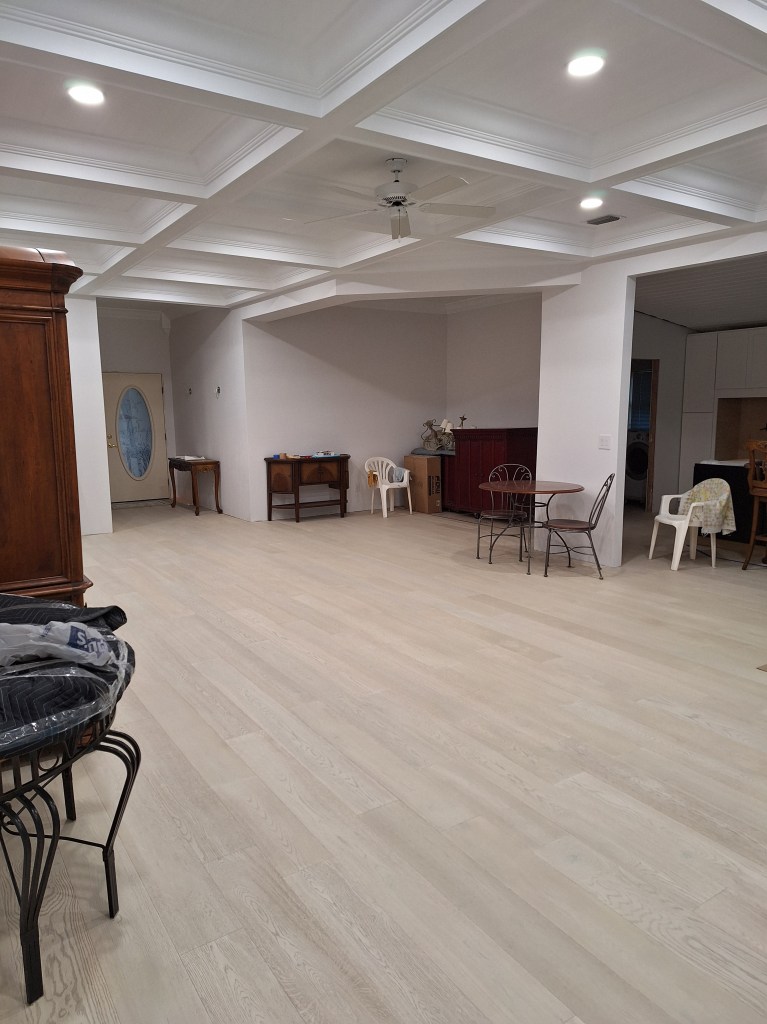
I spent some time researching how to install the kick lighting. After feeling like I understood it and deciding on the approach I would take, I ordered the various pieces. That would take some time to arrive, so I decided to clear out the contents of the great room, which had been holding the contents of the various bedrooms while the flooring was being installed. It was nice to clear that area. With the flooring in and the great room mostly cleared, it made the place look less like a constructions site.
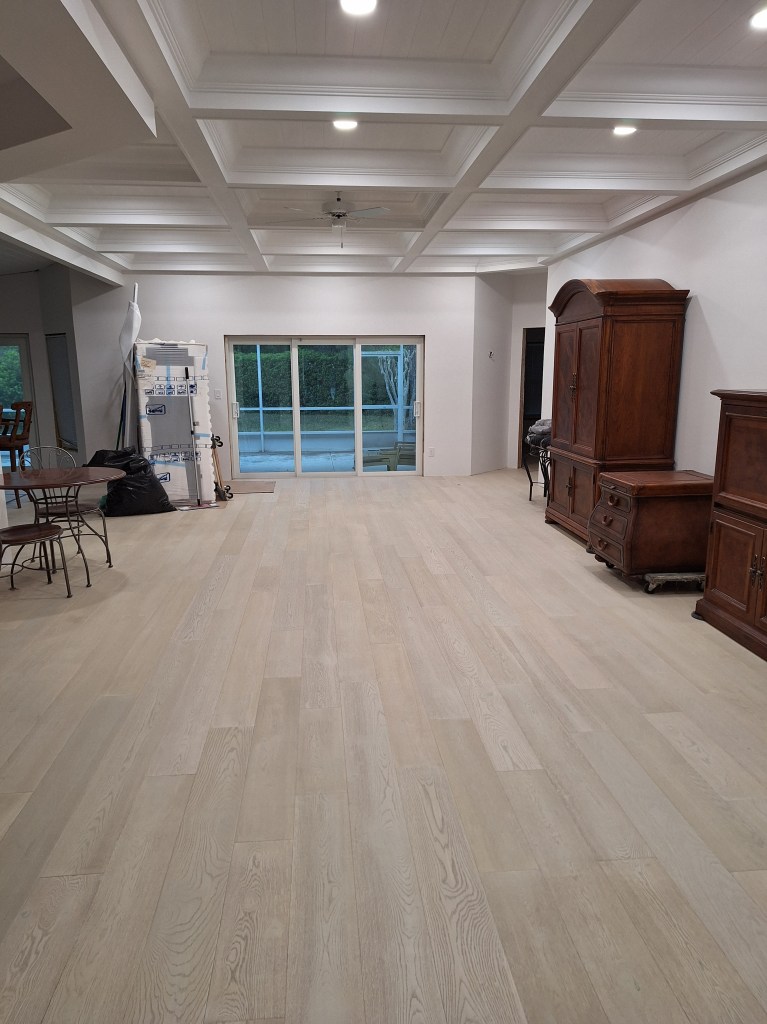
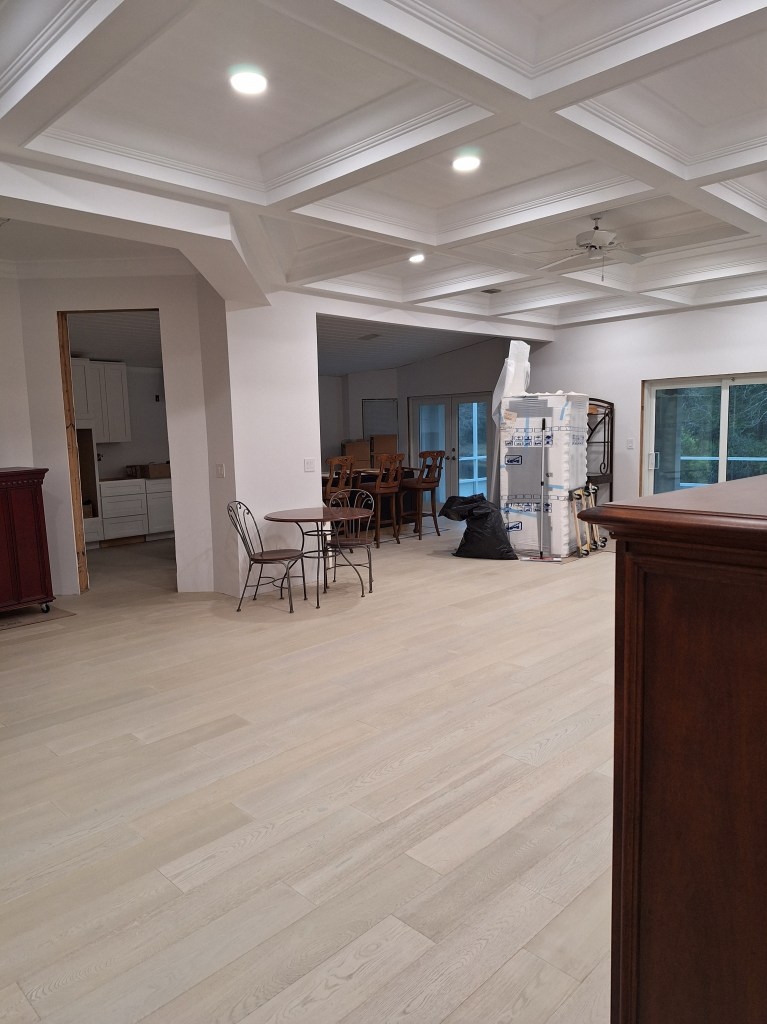
Great Room – from Foyer, after Clearing stored Contents.
Great Room – from Guest Hallway, after Clearing stored Contents.
Great Room – from entrance to Master Bedroom, after Clearing stored Contents.

I have a number of items I no longer need and will attempt to sell. I’ve temporarily stored them in the dining room area. The keen observer will notice that I installed the ceiling fan, too. That’s the original one. I think it looks pretty good, so I might just leave it. It will depend on how I intend to decorate the place, which will be a very long way off.

While still waiting for the kick lighting parts to arrive, I painted the master bedroom. The final room to be painted. The ceiling in that room was painted long ago, but the walls had only been primed, so I would give it two coats of the same paint I used for the great room.
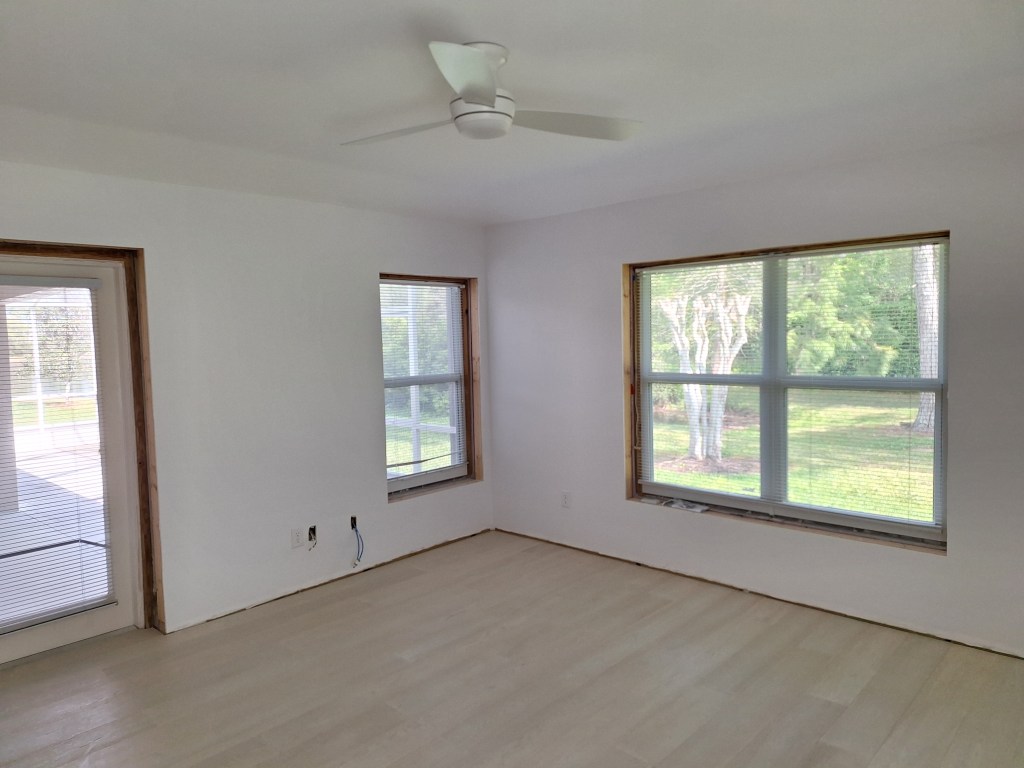
Master Bedroom Painting Complete – From Northwest Corner
Master Bedroom Painting Complete – From Entrance

I hope you noticed the new fan/light I installed. I was going to install the original fan, which didn’t have a light. I wanted to have an overhead light in this room, so I opted for this. I really like it. It is controlled by a remote control, which allows me to vary the fan speed and dim the light. Very nice! I may replace the others with this style, but that is a very low priority so it won’t happen anytime soon.

The parts for the kick lighting arrived around the time I finished painting the master bedroom, so I got to work on that. The first thing I did, was install the kick plates. Below I am showing the back of the island from the north side. The gap between the cabinets is where the dishwasher will go. Keep this in mind as I discuss the sequence of runs of kick lights I will install.
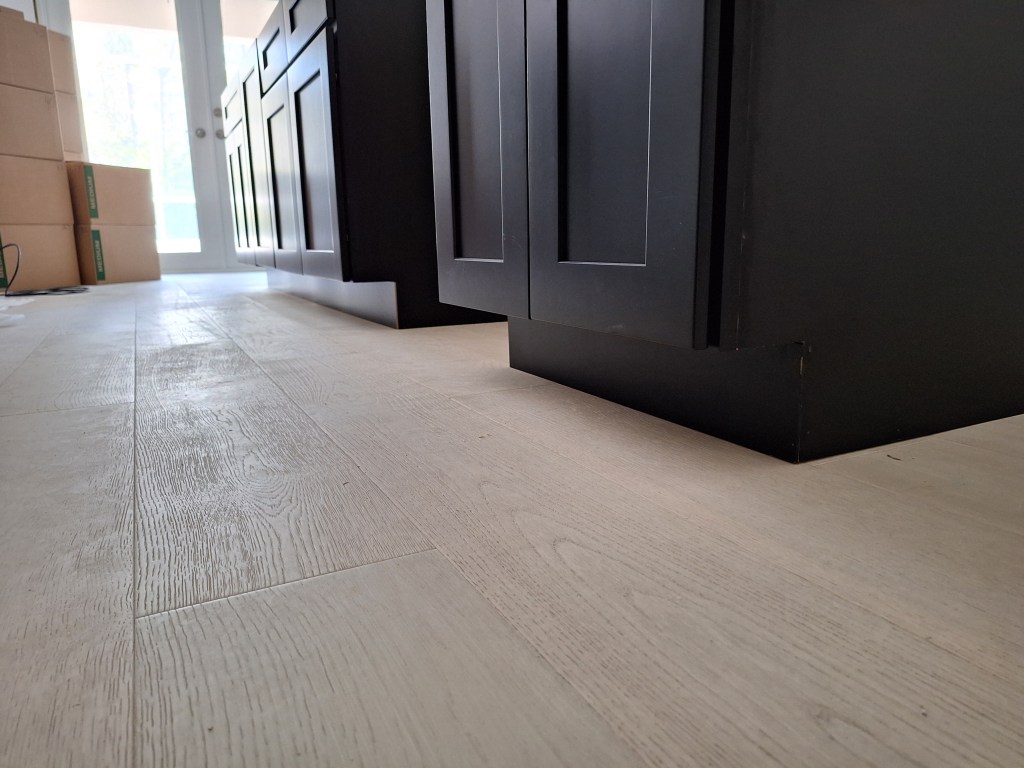
Kick Plates installed along Back of Island

Below I show the kick under the front of the island from the south end.
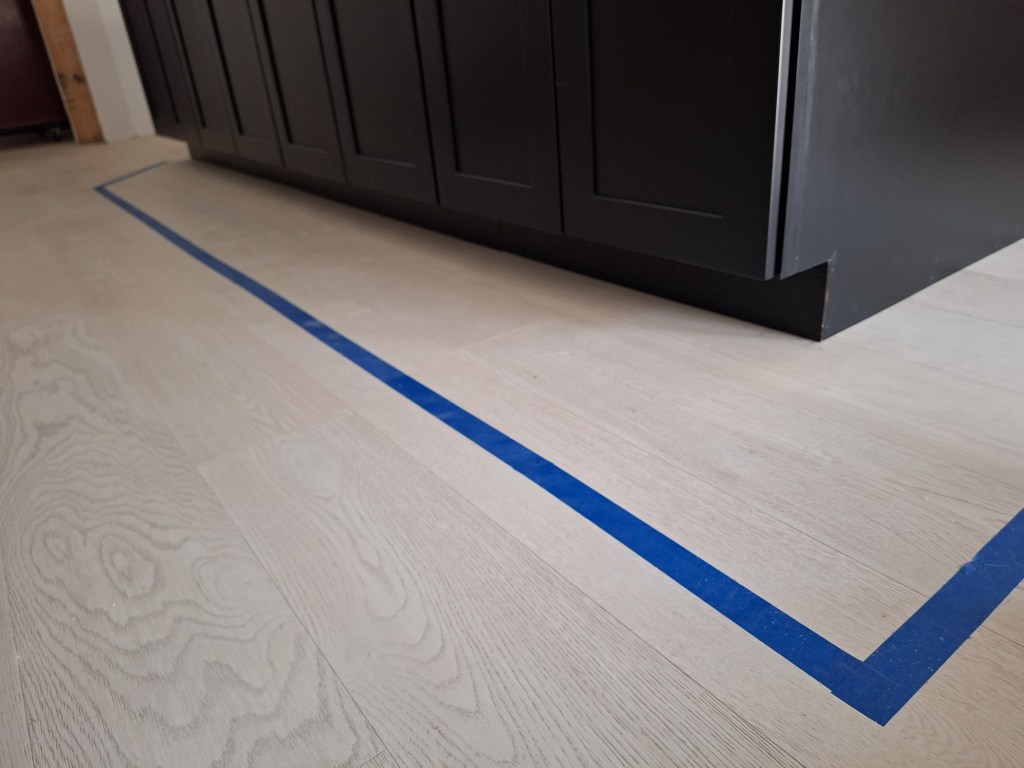
Kick Plates installed along Front of Island

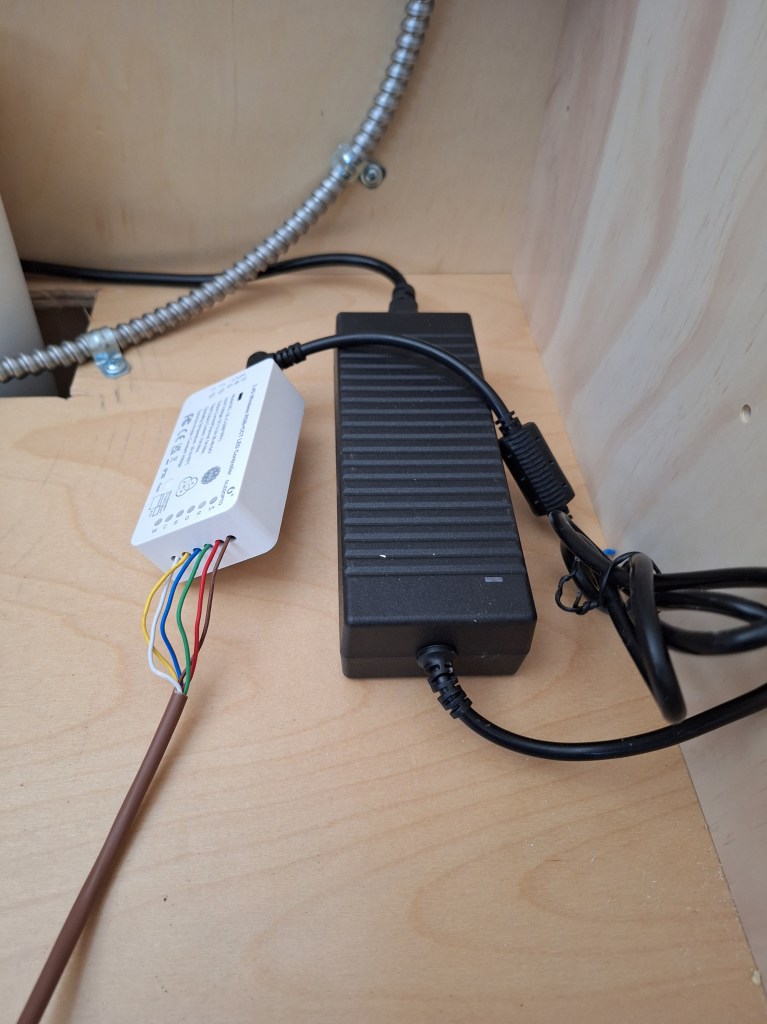
The kick lighting is controlled by a switched outlet under the sink. Since the LED lights require 12 volts DC, a power adapter (the black box) is required to convert from 120 volts AC to 12 volts DC. A controller (the little white box) is plugged into the power adapter to control the LED lights, which can produce a whole spectrum of colors. This controller is WiFi enabled, so at some point I will be able to modify the colors using an app on my phone. The power adapter and controller for the kick lights will be located in the sink cabinet, which is on the back side of the island to the left of where the dishwasher will go. I ran the wires from it to the front of the cabinet and down a hole I drilled to the kick area.
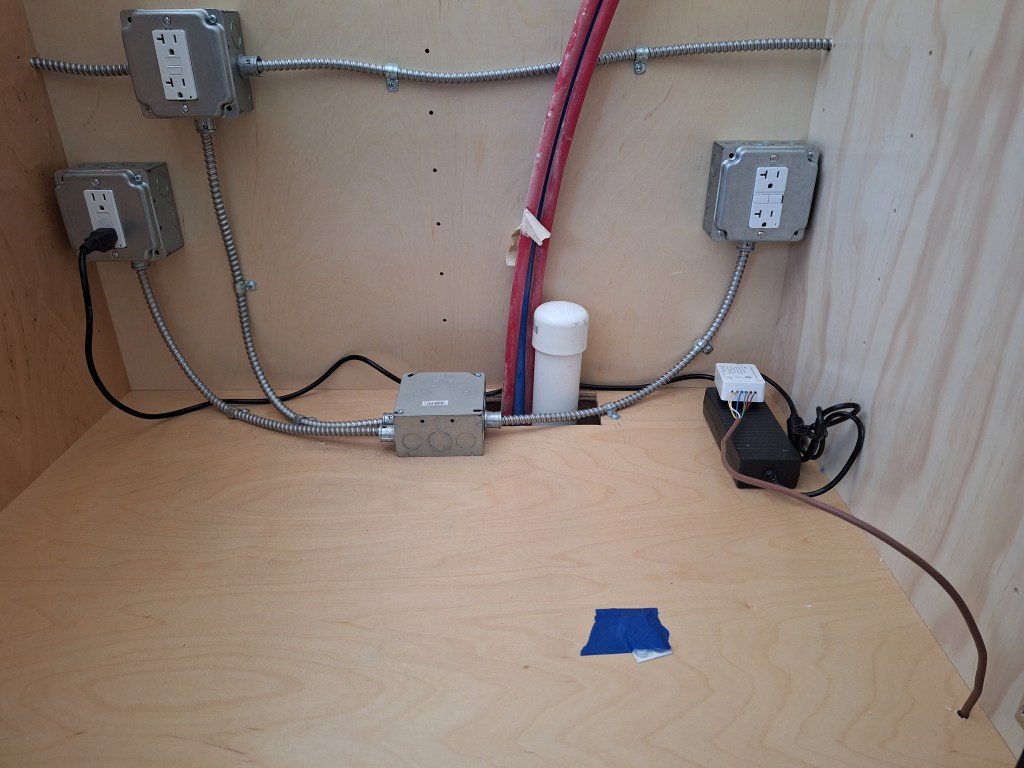
Kick Lighting Power Adapter and Controller in Sink Cabinet
Closeup of Power Adapter (black) and Controller (white).

The brown wire that is connected to the controller interfaces with the LED strip under the kick, which I will show later.

The LED lights come in a roll and can be cut at designated areas where it can be terminated or connected to other runs. The light strips have an adhesive backing and are inserted into channels I attach to the underside of the kick space.

Lights in Channel

The light strip is covered by a diffuser, as shown below.
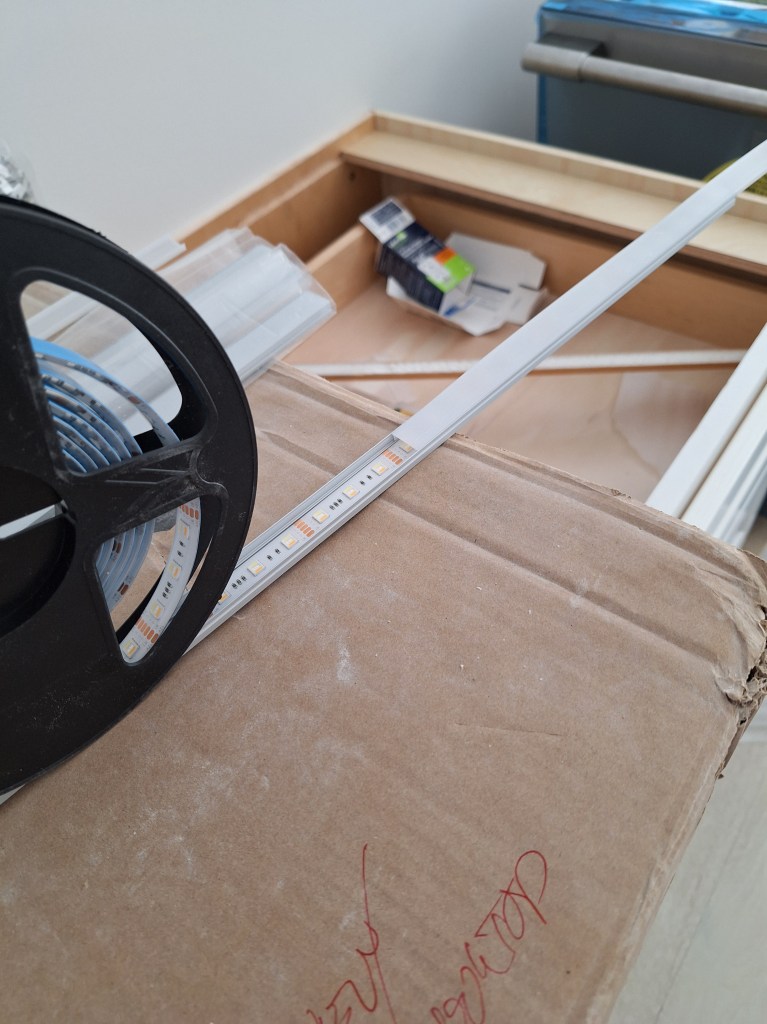
Diffuser that covers the Light Strip inside the Channel

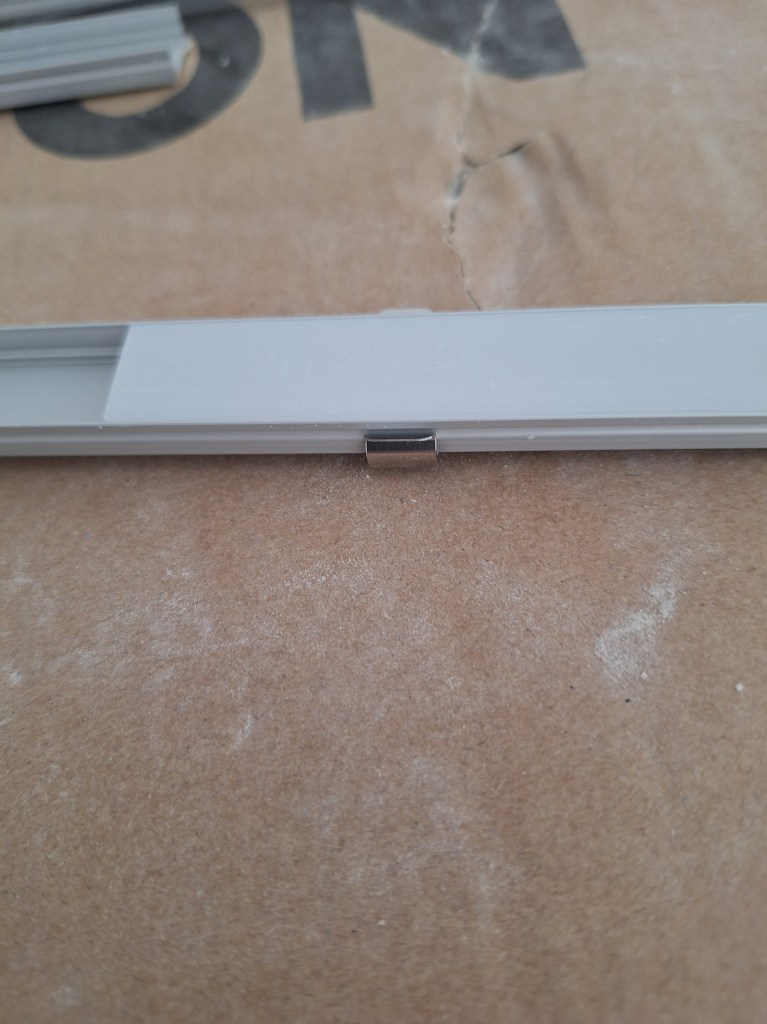
To support these channels, small clips are used.
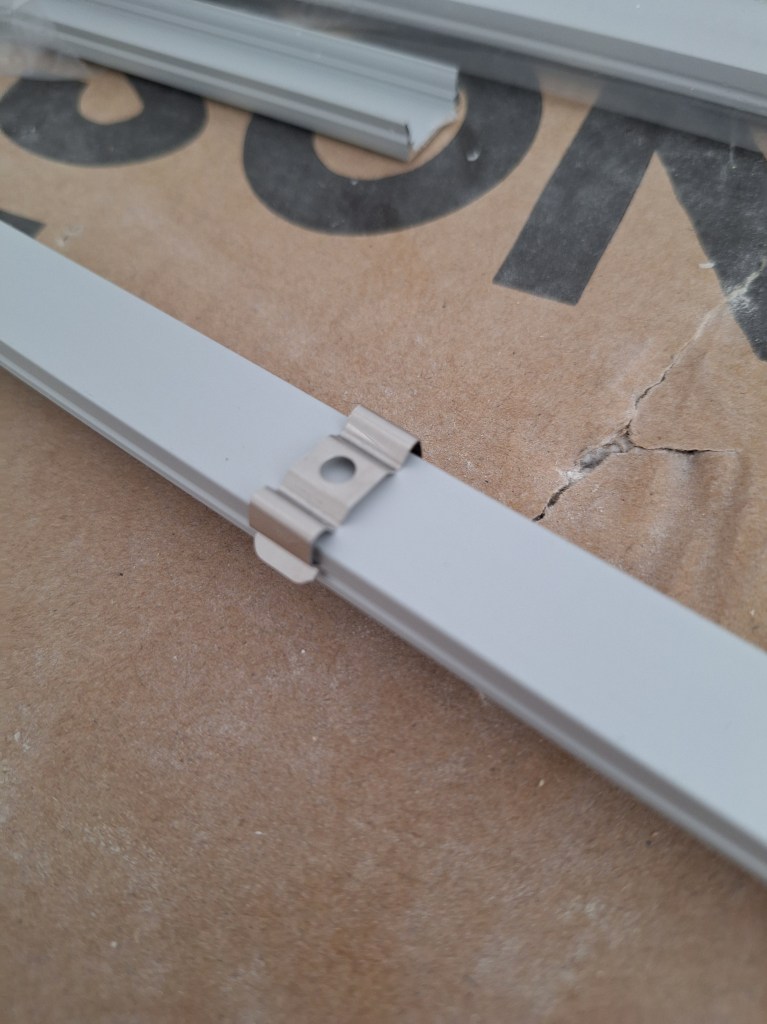
Mounting Clip on Back of Channel
Mounting Clip as it appears on Front of Channel

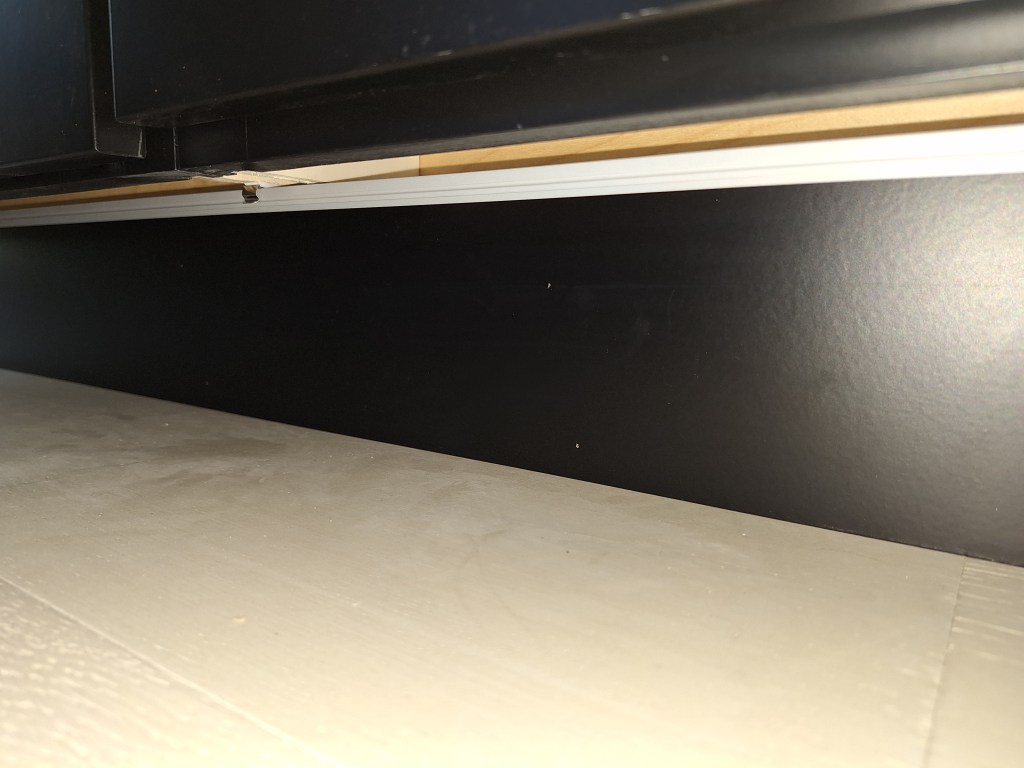
The mounting clips for the channel can be screwed into the bottom of the cabinet wall panels, but in order to hide the channels from sight when looking at the island from north and south ends, I added blocks a few inches in from each end.
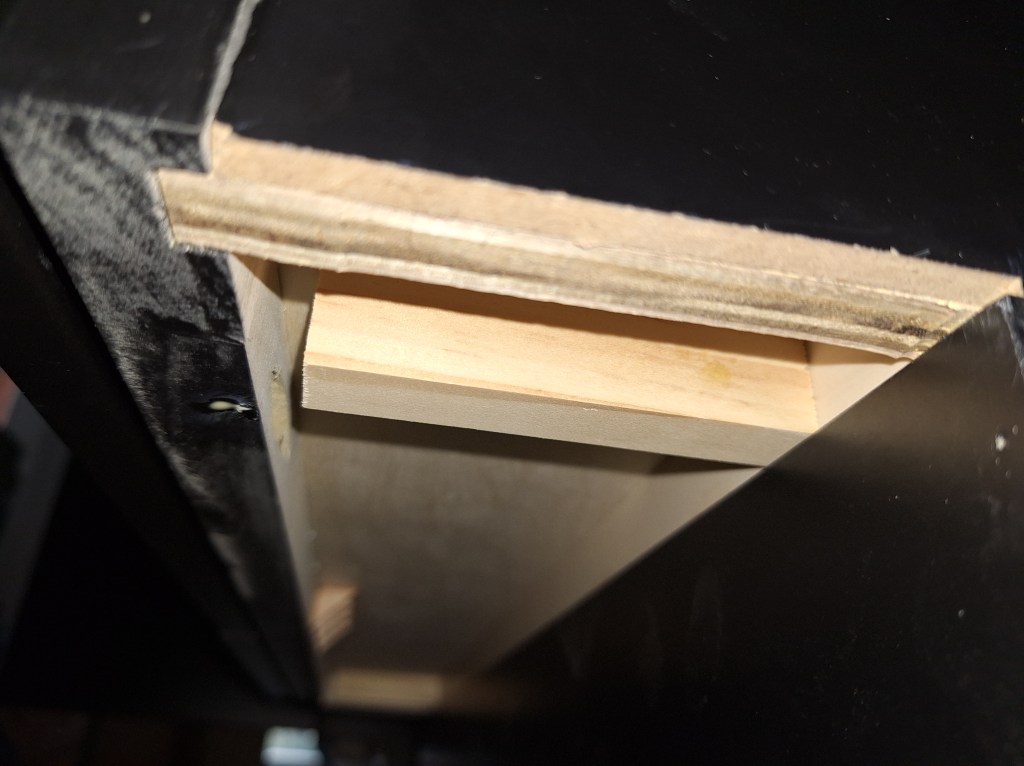
Additional Blocking for Channel Attachment

I attached these small blocks using a combination of super glue and wood glue. The wood glue provides the strongest hold, but takes some time to cure. So I used the super glue to get an immediate hold, serving as a clamp, so to speak, as the wood glue cures. Six of these blocks were required in total. Below I show one of the clips attached. I used double sided tape to put it in place before securing it with a screw. The small piece of wood you see on the floor was used as a spacer to make sure each clip was positioned the same distance from the kick plate. It was a chore installing these things. I had to use a very short screwdriver as I lay on my side trying to work the screw into the wood.
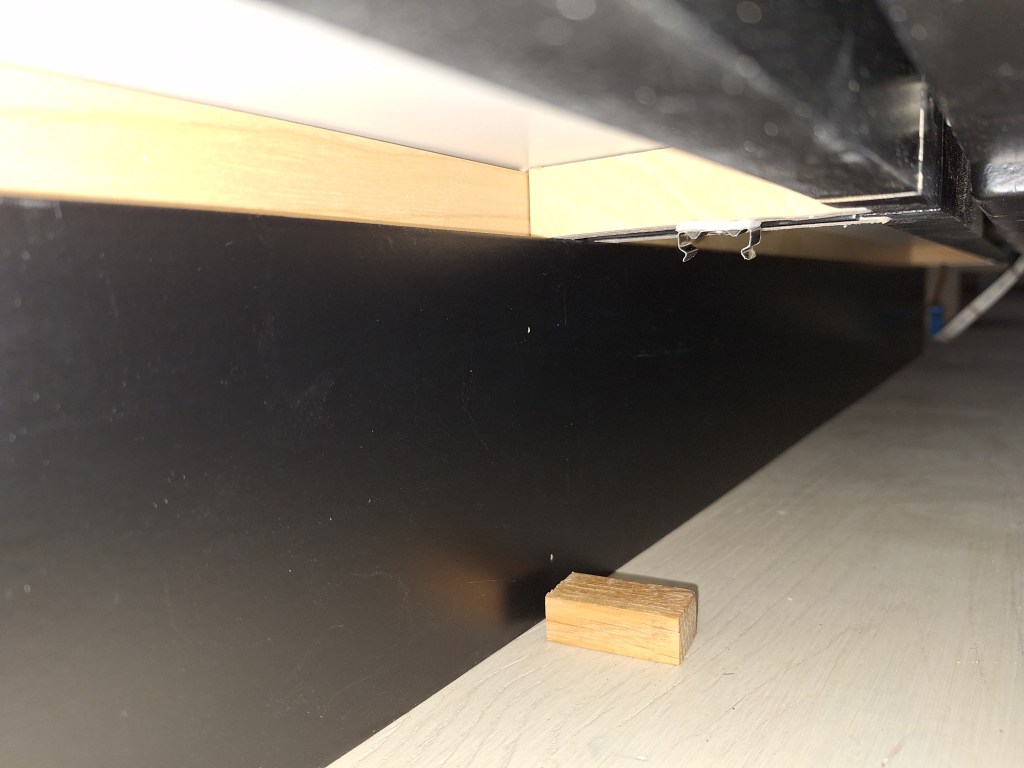
Channel Clip Secured

Here is the channel in place.

Channels Attached

And below is how the lights within the channel are connected to the controller under the sink.
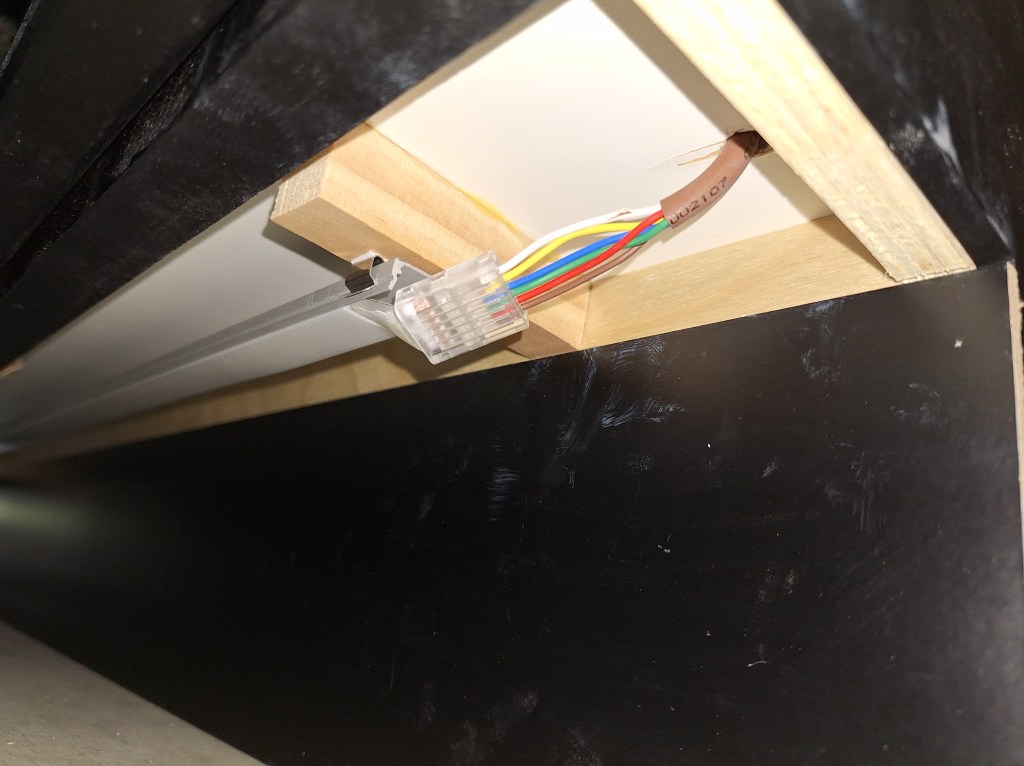
Connection Under Sink Cabinet

To add the lighting I wanted around the island would require three separate runs, each connected by wires I would feed through the cabinets connecting the runs on the back of the island to the front. The first run would start from the sink cabinet and terminate at the south end of the island. The second run would pick up from the first at the south end of the island, but on the other/front side (facing the great room) and run the entire span of the island. Below I show the wire that is connected to the end of the first run and through the back of the end cabinet.

Wire to connect First Run to Second Run

It emerges at the back of the end cabinet at the front of the island, where it dives down into the kick area underneath and is connected to the second run in the same way the first run was connected to the controller (shown above).
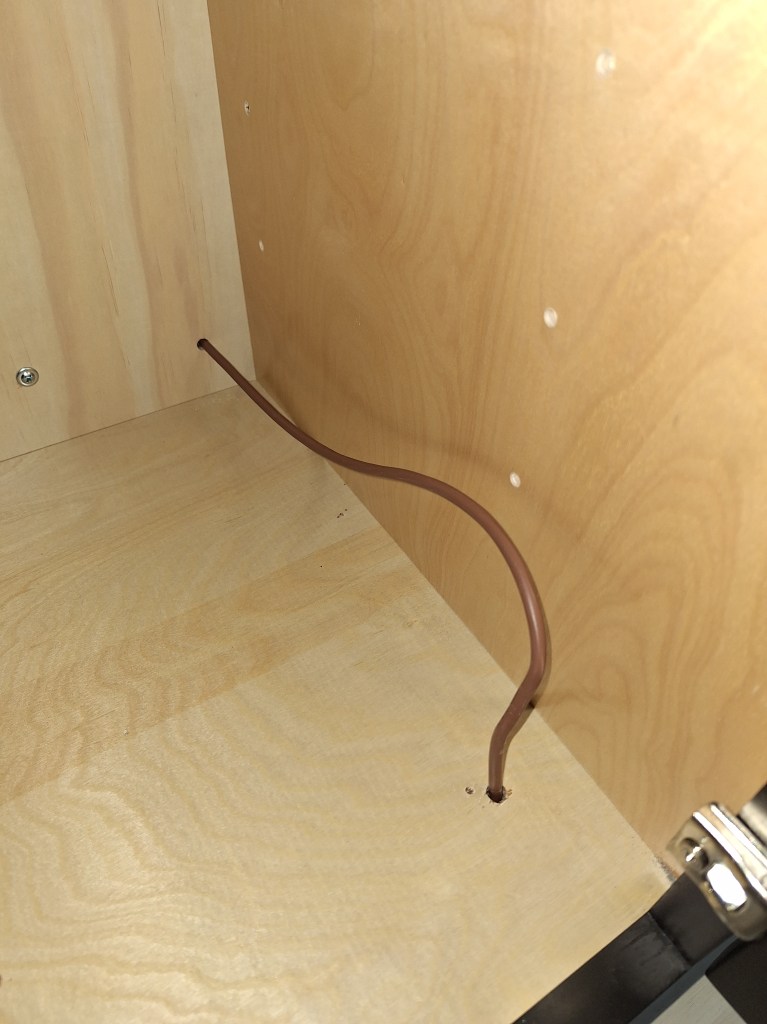
Wire from Back Cabinet to Front Cabinet

The third run would be a short one, starting on the north end and terminating where the dishwasher will go. The second run is connected to the third run in the same way we connected the first and second runs. Essentially, I am wrapping around the island from one side of the dishwasher and terminating on the other side of the dishwasher.

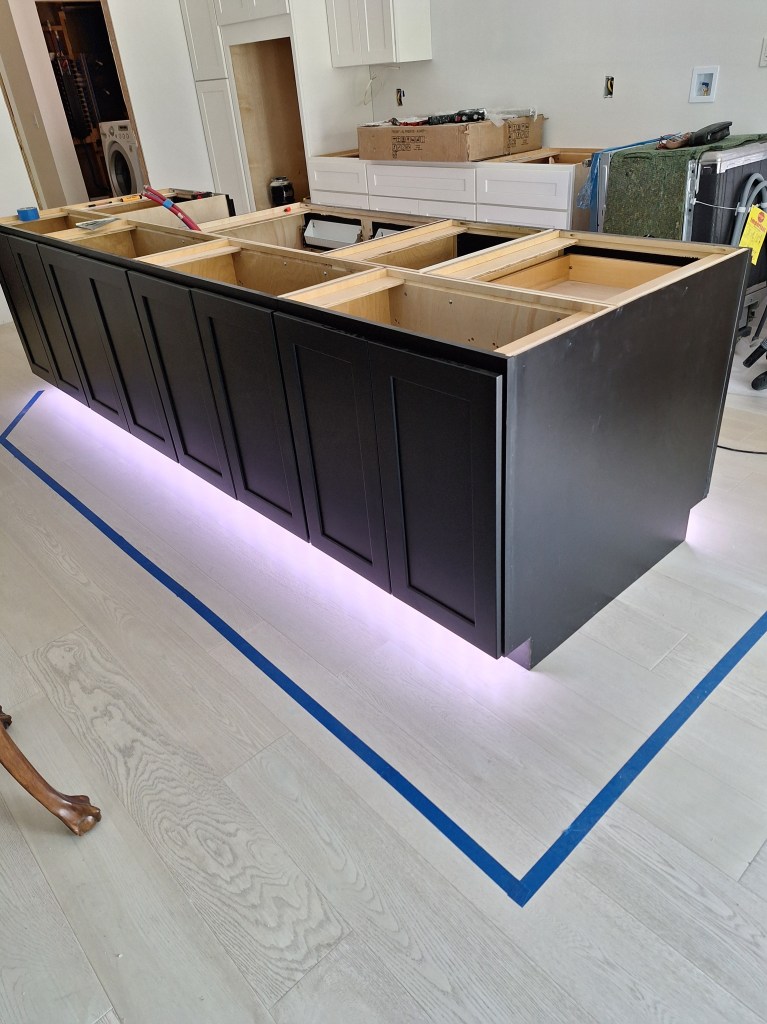
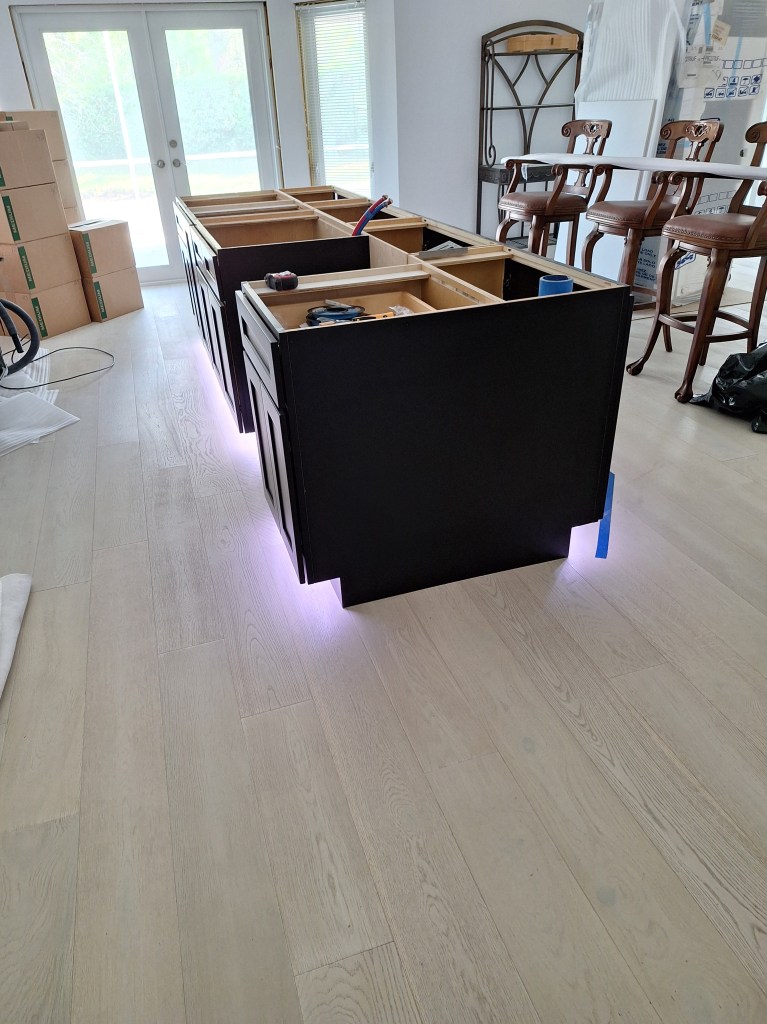
Here are the various runs illuminated.

First Run Complete
Second Run Complete
Third and Final Run Complete

I think this looks pretty good. I still have some work to do to secure and protect the wiring in the cabinets. I have some ideas about how to do that, but will get to it when it suits me. Next I tackled the kick lighting under the white cabinets.

The kick lighting for the cabinets along the east wall of the kitchen was much simpler, as it consisted of only a single straight run. The power adapter and controller were placed at the bottom of the pantry cabinet.

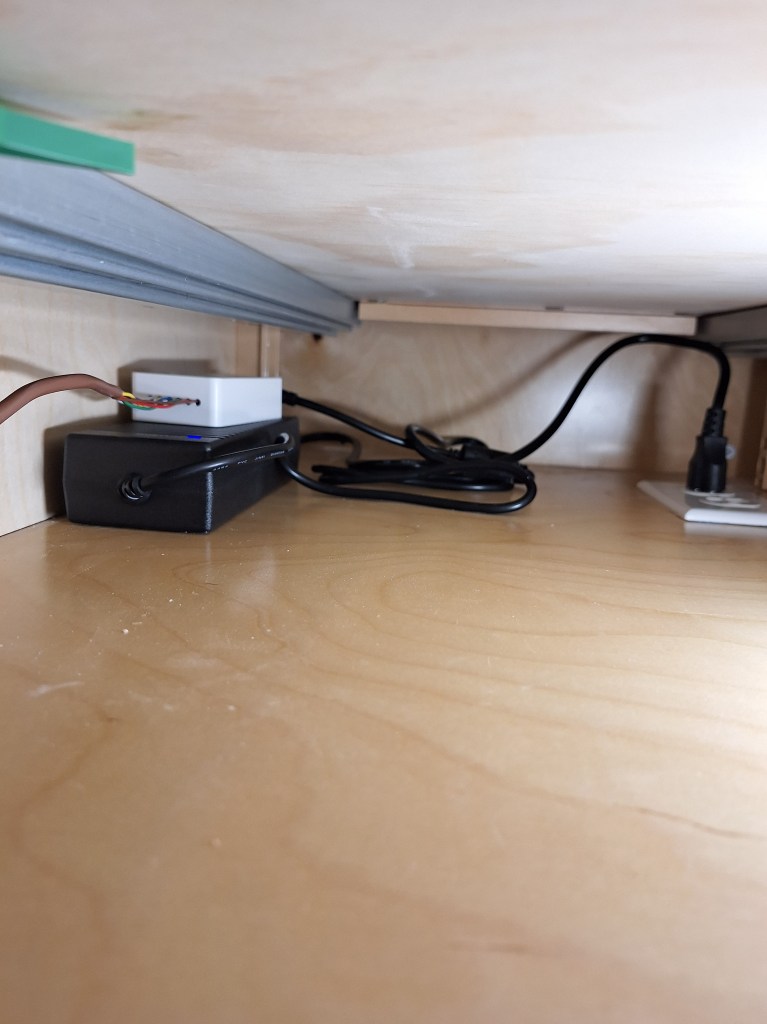
Adapter and Controller in Pantry Cabinet – Drawer Removed
Adapter and Controller in Pantry Cabinet – Drawer Returned

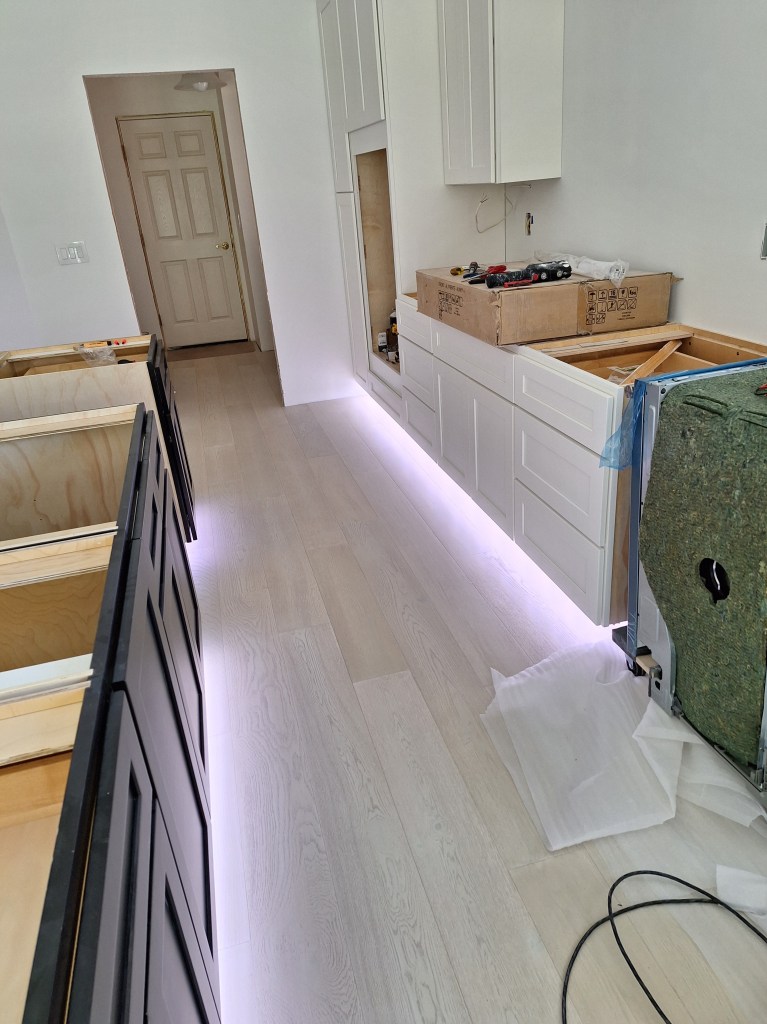
Here is the final result.

Kick Lights Illuminated along East Wall Cabinets

During this time, I ordered another cabinet that will go above the cook-top and support the exhaust fan. After some thought, that seemed to be the best approach, which I’ll discuss when I show it. I also ordered an additional refrigerator side panel since that nice little cabinet I put in the workshop would not fit. Those items are supposed to arrive in mid to late April. Once they are in, I can start to take steps toward getting the counter tops. More on that in the next post.
Wood Flooring and Kitchen Cabinets – February 2025

The work I’m doing on this house requires a permit, which has an expiration date. That expiration date is pushed out by six months after each inspection that has passed. My current expiration date is April 27th, so I have to keep this in mind when deciding what to work on. My next inspection will be either an electrical inspection or a plumbing inspection in the kitchen (or both) once the cabinets are installed. In order to install the kitchen cabinets, the wood floors have to be down. So I have quite a bit or work to do before April 27th.

To speed things up, I decided to hire out the wood floor installation. An experienced crew can accomplish this in a week or so, but it would take me at least a month to do it on my own, so in this case I am willing to hire out the job. With the wood floors done in February, I would have March to work on installing the cabinets and hook up the electrical and/or plumbing. So that is why I stopped work on the guest bathroom after the tiling was completed.

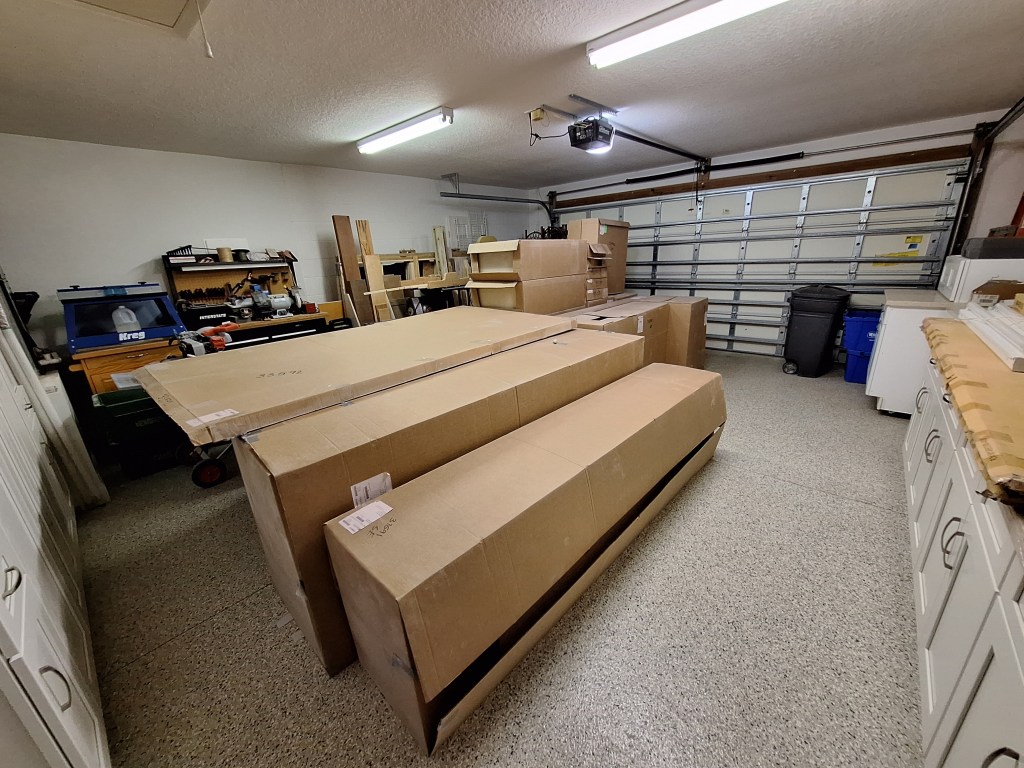
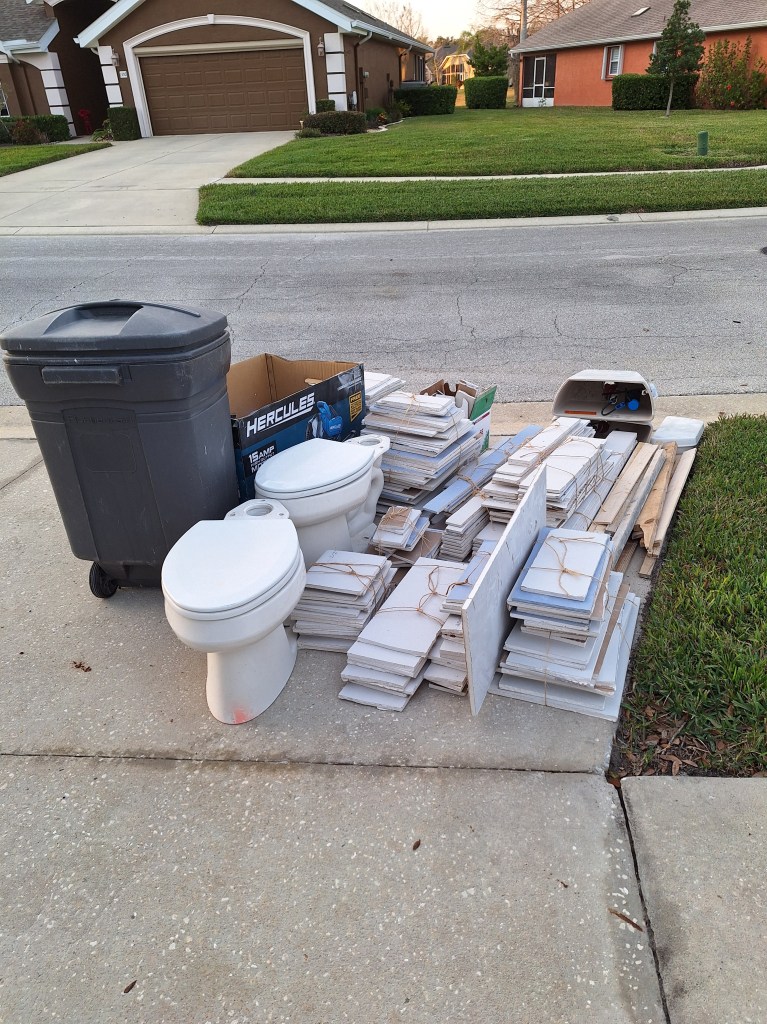
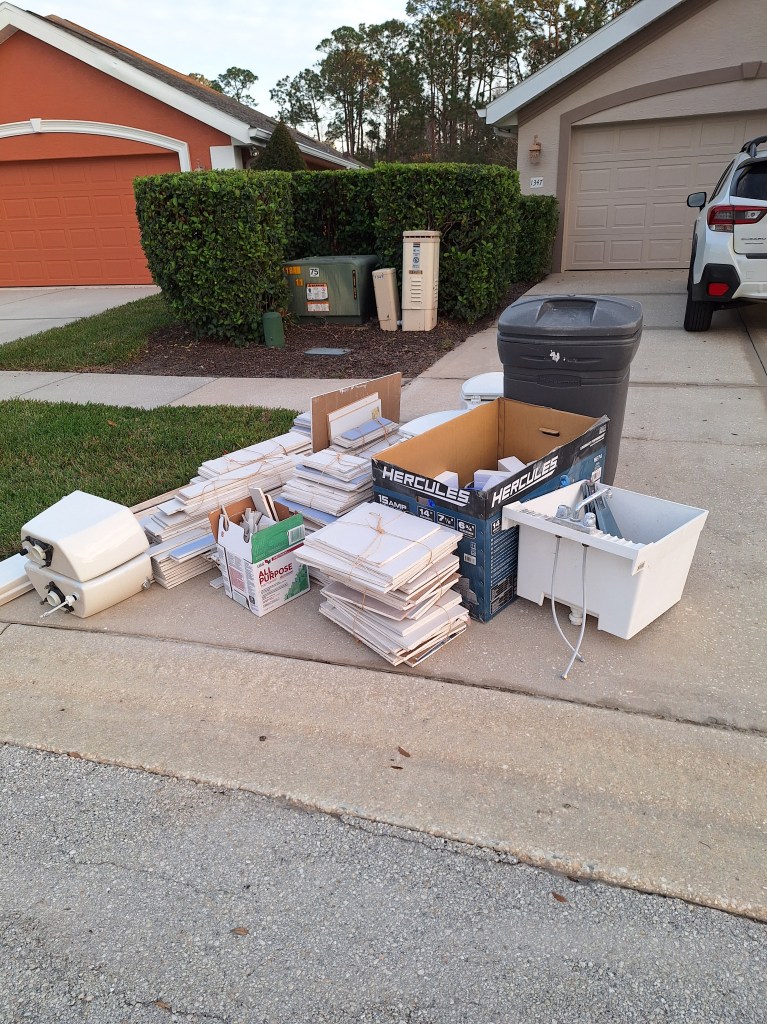
To prepare for installation of the wood floors, a lot of clearing out was required. I started by pulling out and cutting up the drywall cut-offs I had stored in the garage. This was necessary to make space for the large mobile storage unit I would move into that area. I placed these at the end of the driveway along with the two toilets and utility sink, and other bits and pieces.

First large Load of Trash

It’s difficult to throw out so much stuff, especially when much of it could still be of use. But I just do not have the room for it, so I had to do it.

The trash is picked up twice a week, so I placed things in the garage while waiting for the next pickup day. Notice the two cabinets to the right of the trash. Those were from the original kitchen. I added mobile bases to both of them and used them extensively inside the house to hold tools and supplies. They have now been relocated to the garage where they will continue to be useful.

Staging for the Next large Load of Trash

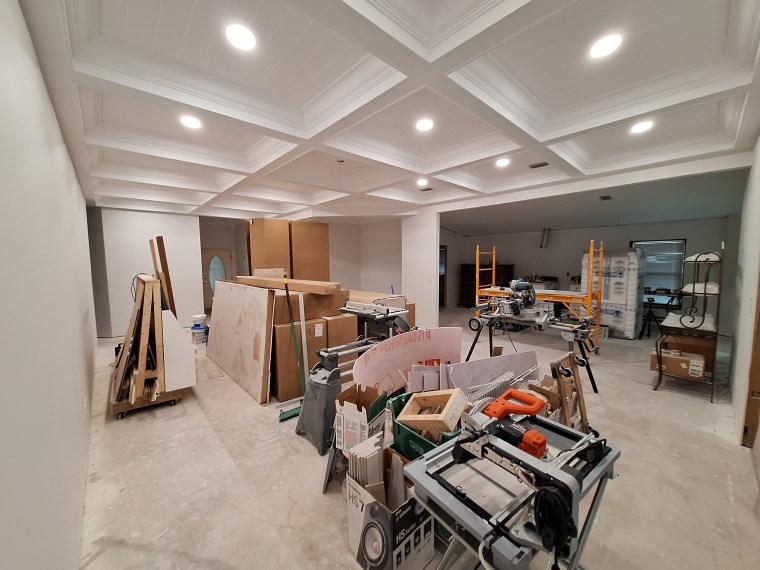
After the next garbage pickup I had room in the garage to store the kitchen cabinets, allowing me to clear out the great room and make it ready for the installers. Here is a “before” picture of the great room as seen from the entrance to the master bedroom:

Great Room before Clearout

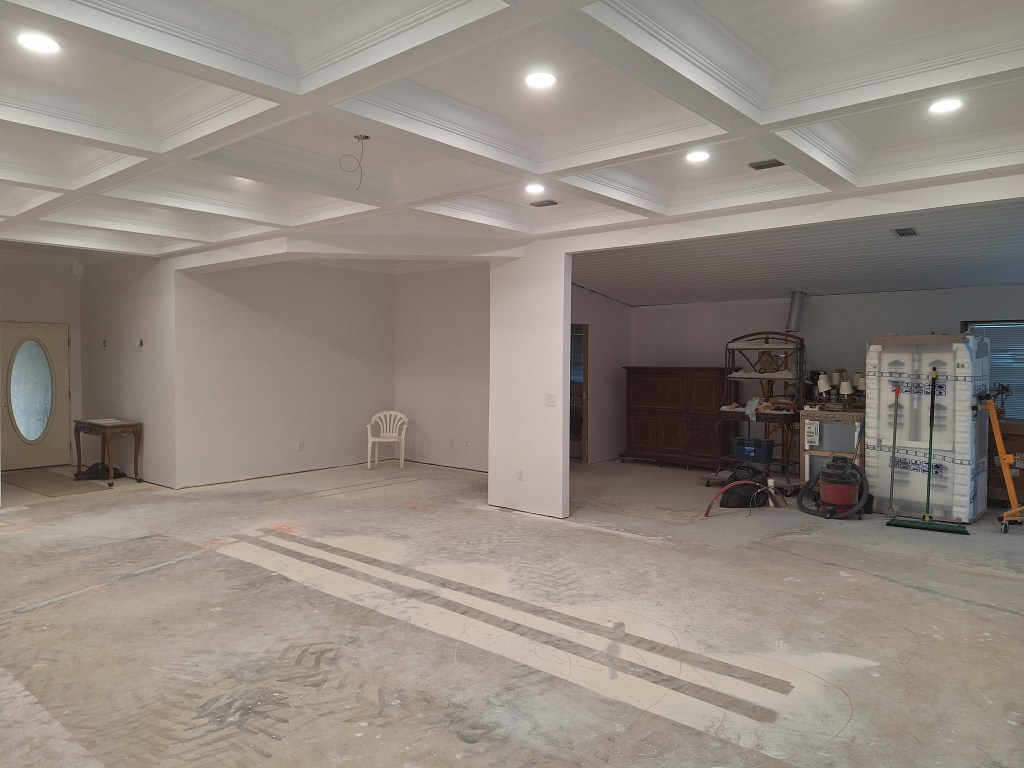
Here it is the “after” picture:

Great Room after Clearout

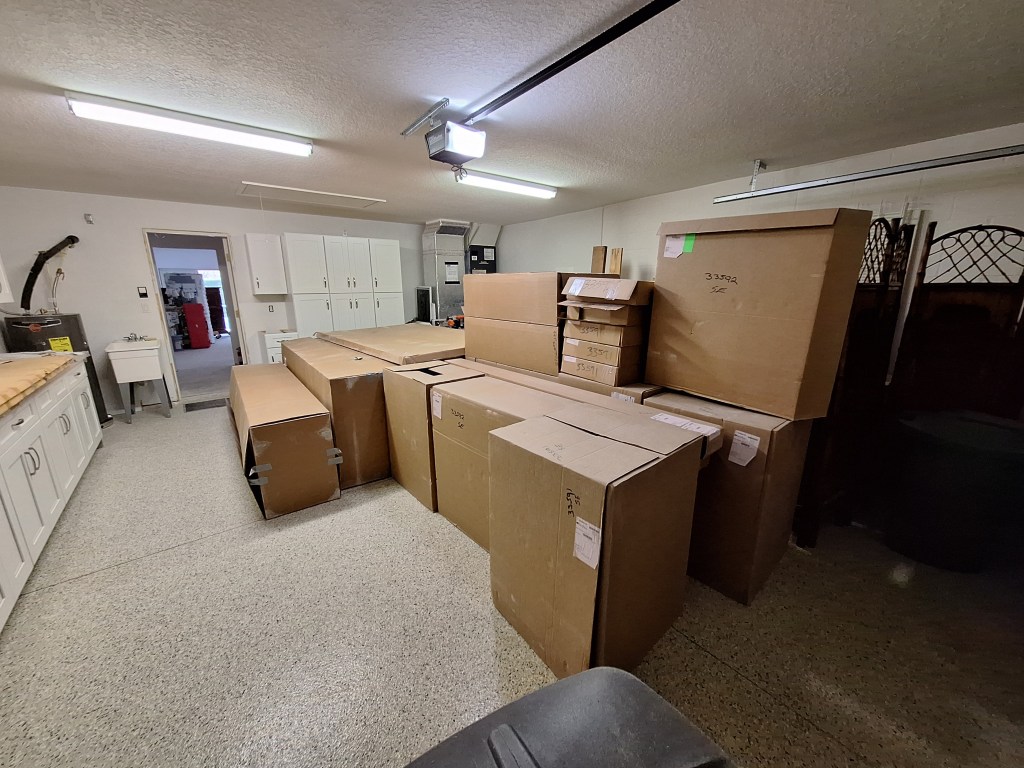
Most of the stuff I removed was put into the garage. In the image below, the kitchen cabinets are in the foreground, but behind them you can see the wood storage rack against the wall.

Garage after Clearing the Great Room
Kitchen Cabinets moved into Garage

The kitchen cabinets have been moved four separate times. They were originally placed in the garage when delivered. I moved them into the house and put them in the kitchen while I worked on the great room. After that I moved them to the dining room while I worked on the kitchen. I moved them a third time into the great room, as shown in the fifth picture above, in order to work on the dining room. The fourth, and final move, was to the garage, as shown above. From here I will move each of them into position once the floor is down. The reason I did not leave them in the garage all along was because I needed the space in the garage to use my power tools (i.e., band saw, planer, table saw, etc.), and I wanted to be able to pull my car in, too.

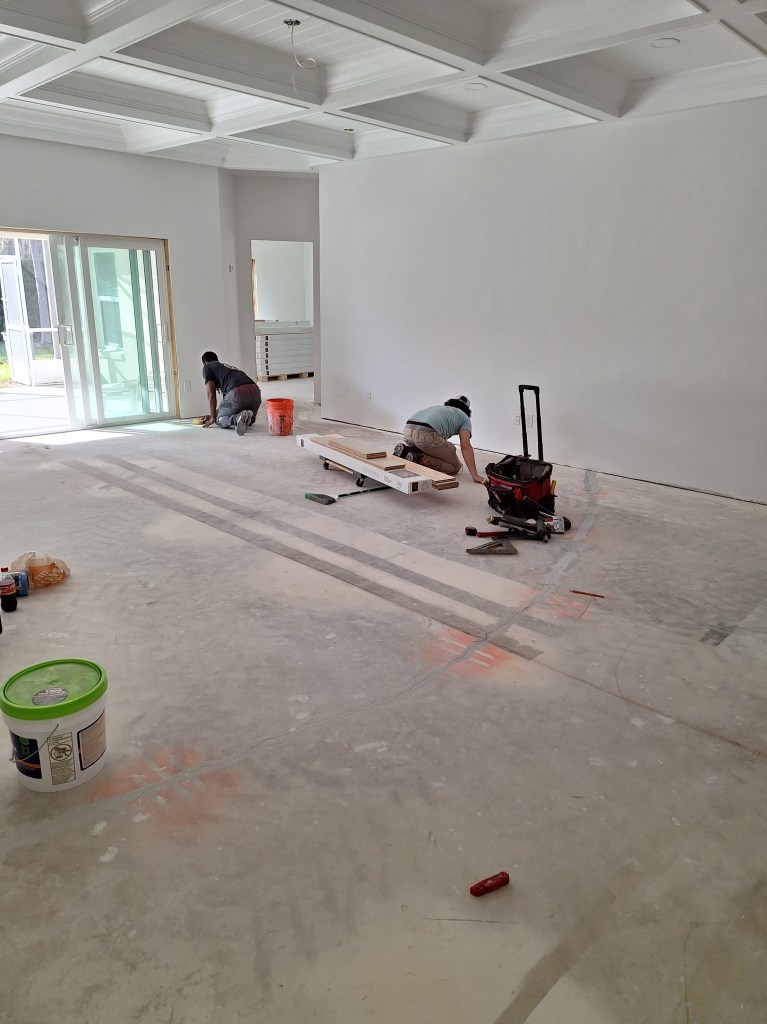
Prior to the installers arrival, I spent quite a bit of time scraping the floor to remove any bits and pieces that protruded, such as paint spills, dried thin-set from where I was mixing it, and the like. When the installers arrived they seemed fairly happy with the condition of the floor. They began by sweeping and wiping down the floor with a wet sponge to removed the dust.
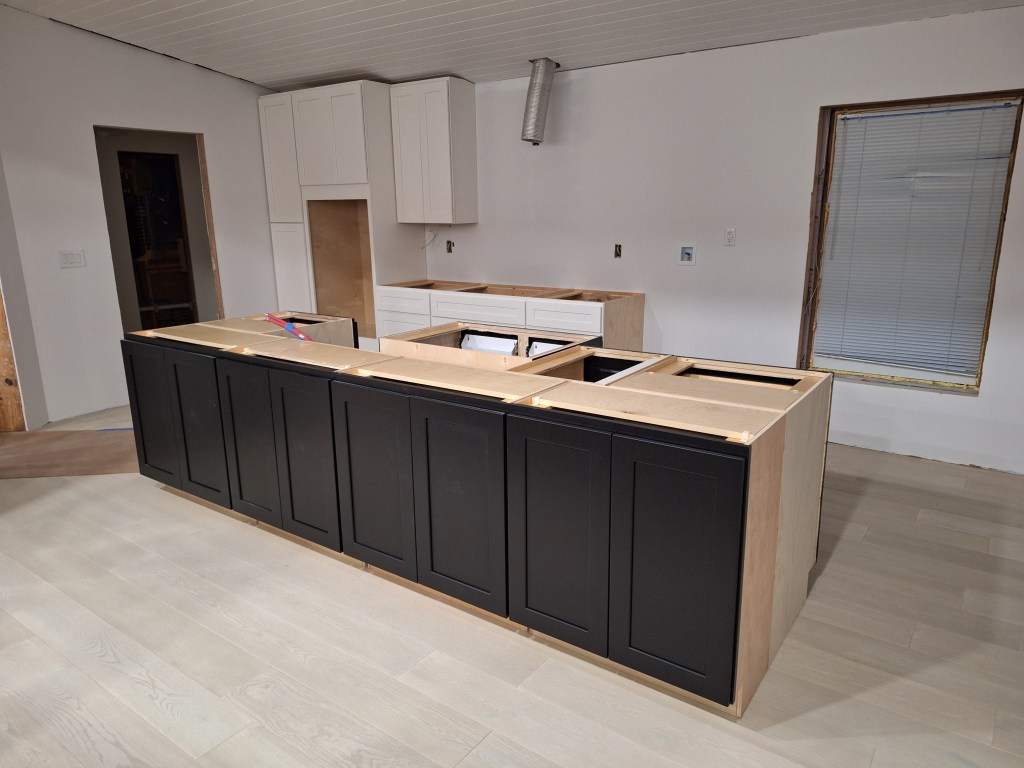
Wiping the Floor to remove Dust

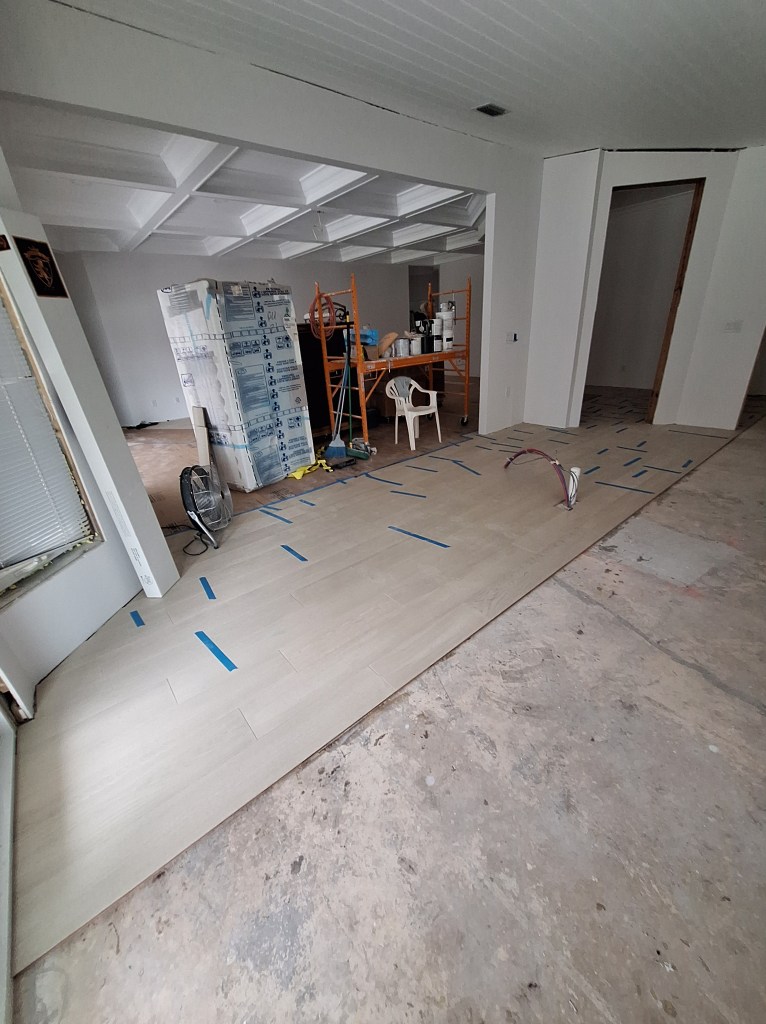
They also marked out and snapped a chalk line to establish a reference line toward which they would progress. The chalk line is the faint brown line shown above, in the middle of the room. That line is determined by measuring from the long wall on both ends to the opposite wall in the kitchen. Knowing the wall is unlikely to be perfectly straight and parallel to the opposing wall, they split the difference when marking out where the chalk line should be.

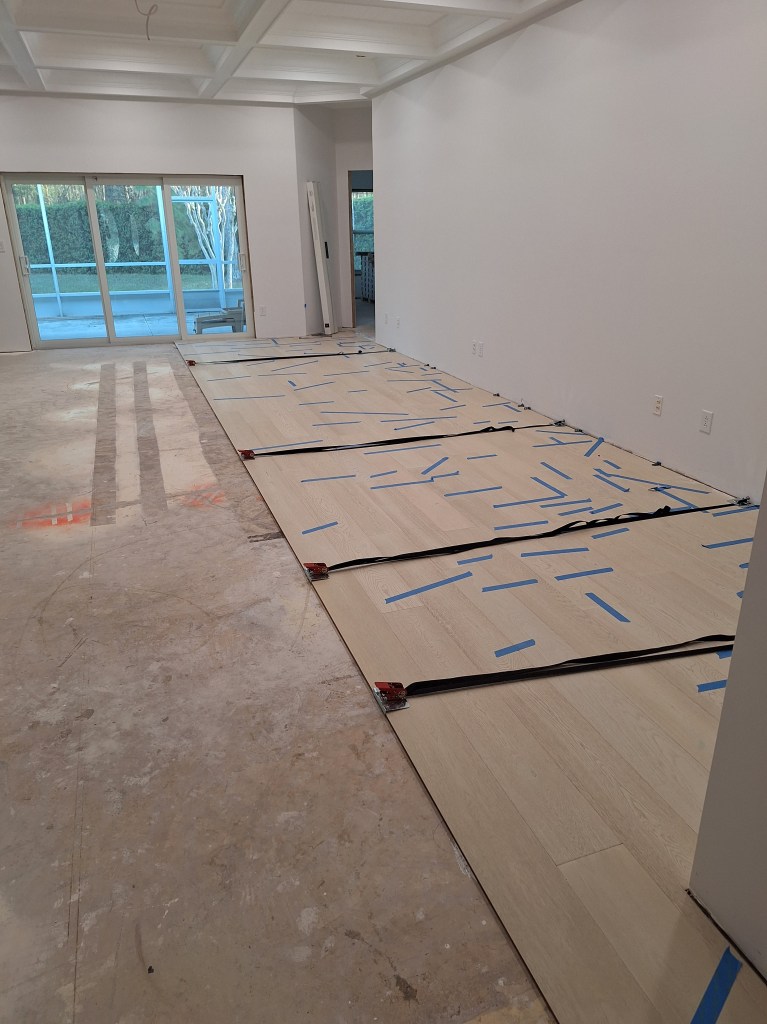
Next they dry fit the boards, moving from one wall to the other. In this case, from the great wall to the dining room and the short wall separating the great room from the kitchen.

Dry Fitting

This is done to understand how the last board will look on the opposing wall. Similar to setting tiles, we want to avoid ending up with thin slivers when we reach the opposing wall. By dry fitting we can determine how much room we have left at the end of the run and compensate for that by removing some of the width of the first board they place. In this case, they found they needed to remove about an inch from the first row of boards to end up with a board that was about 4 inches wide at the opposing walls, which is pretty good.

Dry Fitting

At this point, they were ready to start setting the first boards.

Setting First Boards

The glue is applied using a 1/4″ notched trowel. The boards along the long wall had been scribed and cut back by about an inch before they were set into the glue. At this point I left them alone and returned shortly before they were done for the day. At the end of the first day, the floor looked like this:

End of Day 1, from Foyer
End of Day 1, toward Foyer

At the end of day 2, the floor looked like this:

End of Day 2, from Foyer
End of Day 2, from Entrance to Master Bedroom
End of Day 2, Foyer

On day 3 they finished the dining room and moved into the kitchen.

End of Day 3, Dining Room
End of Day 3, into the Kitchen

At the end of day 3 began the weekend, so the crew would not be back until Monday. So I used that time to caulk the guest bathroom, install the corner shelves, and seal the caulking.

Caulking Complete
Shelves Installed

The next job I have in the guest bathroom is to install the hand wand and shower head, but that required a couple of extra bits, so I had to wait until they were delivered. Since trash day was on Monday, I spent the remainder of the weekend cleaning up and preparing the trash for pickup.

On Monday the guys returned and completed the kitchen area and laundry room.

End of Day 4, from Laundry Room
Kitchen, next day after Tape removed.
End of Day 4, toward Laundry Room
Kitchen, next day after Tape removed.
Laundry Room
Laundry Room, next day after Tape removed.

After that they moved onto the guest bedroom.

End of Day 5, Guest Bedroom – from Entrance.
End of Day 5, toward Closet.

While they were working on that, I decided to install my first kitchen cabinet; the pantry.
Pantry Cabinet Installed

That red thing you see on the floor is a fish line I used to pull the wire for the kick plate lighting through to the front of the cabinet.

This cabinet, and all the others that touch the ceiling, had to be modified slightly because the distance from the finished floor to where the ceiling meets the wall is just under 8 feet (the cabinet height). Below I show the modification I made to the pantry cabinet.

Modification to top of Pantry Cabinet

This change was not visible inside the cabinet, as there is about an inch of material that can be cut away before interfering with the insides. This change is required for all adjoining cabinets so they align properly, which includes the wall cabinets.

At this point it became clear to the installers that we would not have enough flooring to finish the remainder of the house. There would only be enough to finish the master and maybe a bit more. So I had to order more wood, which would take a while before it would arrive. This meant that the installers would have to come back to finish the job. That was unfortunate, but did not slow me down since the kitchen floor was done and I could continue with the cabinets.

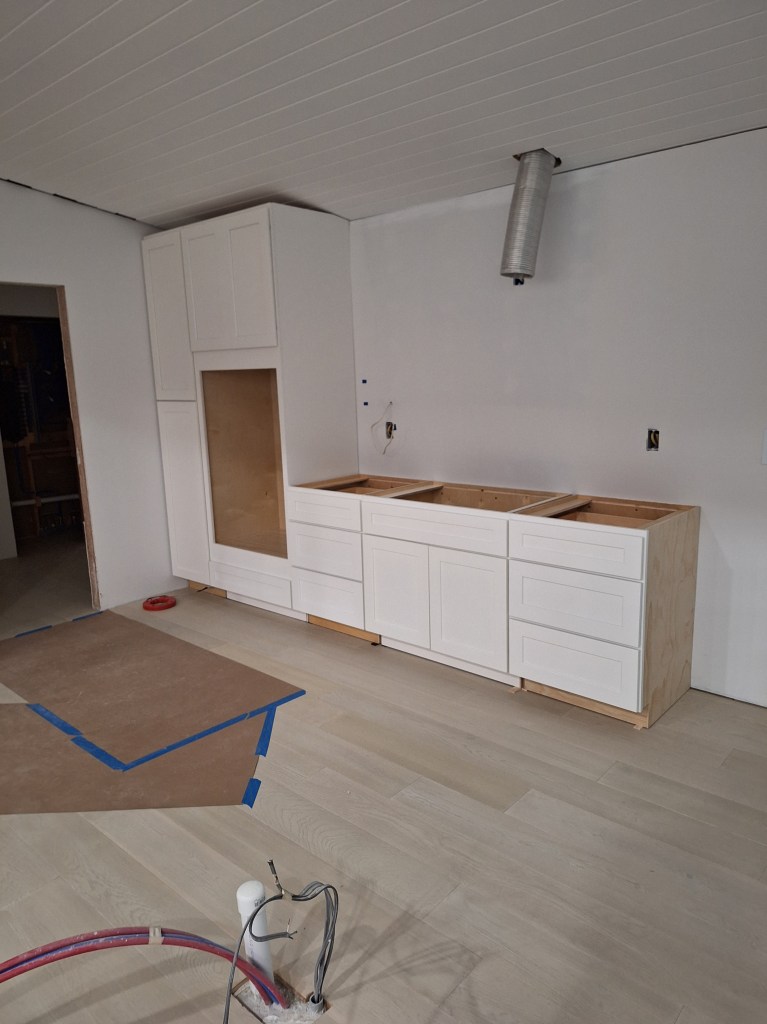
While the guys worked on the master bedroom, I installed the wall oven cabinet and the base cabinets along the wall. A couple of the installers helped me move the large wall oven cabinet into place, which was a big help.

Wall Oven and Base cabinets Installed

At the end of this day, the installers were out of wood, so they packed up and left until the additional wood was delivered. They completed the master bedroom and made a start on the office floor. I’m not including pictures of that yet, because they are still covered in tape. I’ll reveal that once they are completely finished (next post).

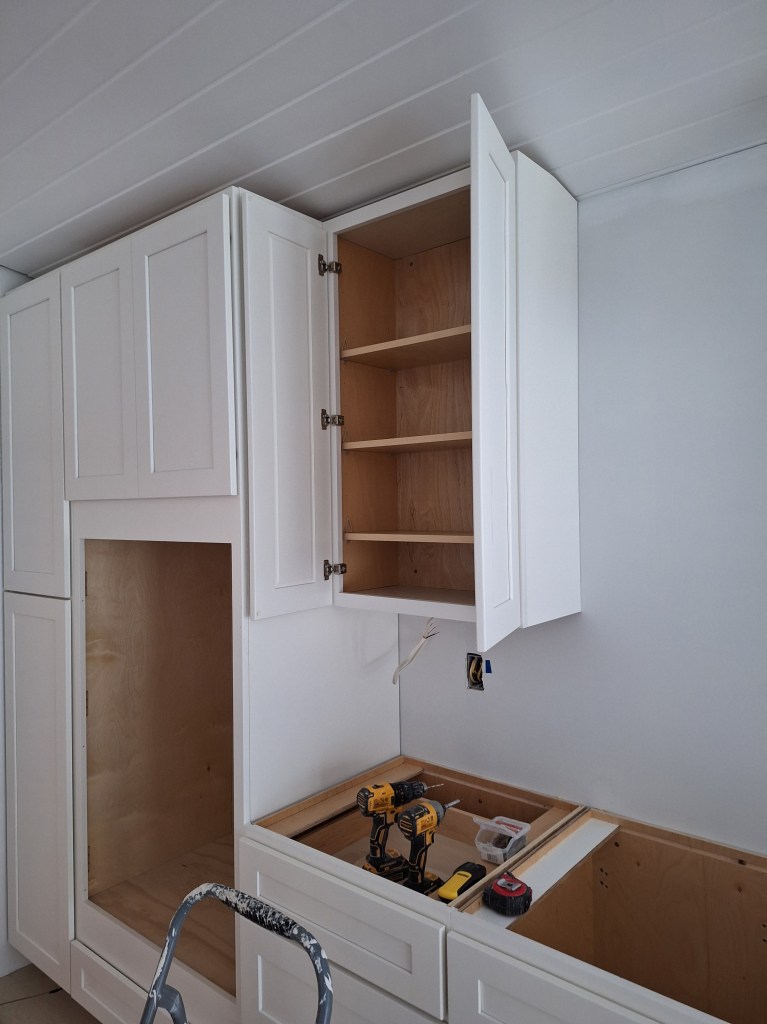
The following day I installed the first wall cabinet. I used the same structure I built when installing the wall cabinets in the garage. It sits on the base cabinet and serves as a shelf. It is high enough that shims are enough to push the wall cabinet to the height that’s needed.

Structure used to Install the Wall Cabinet

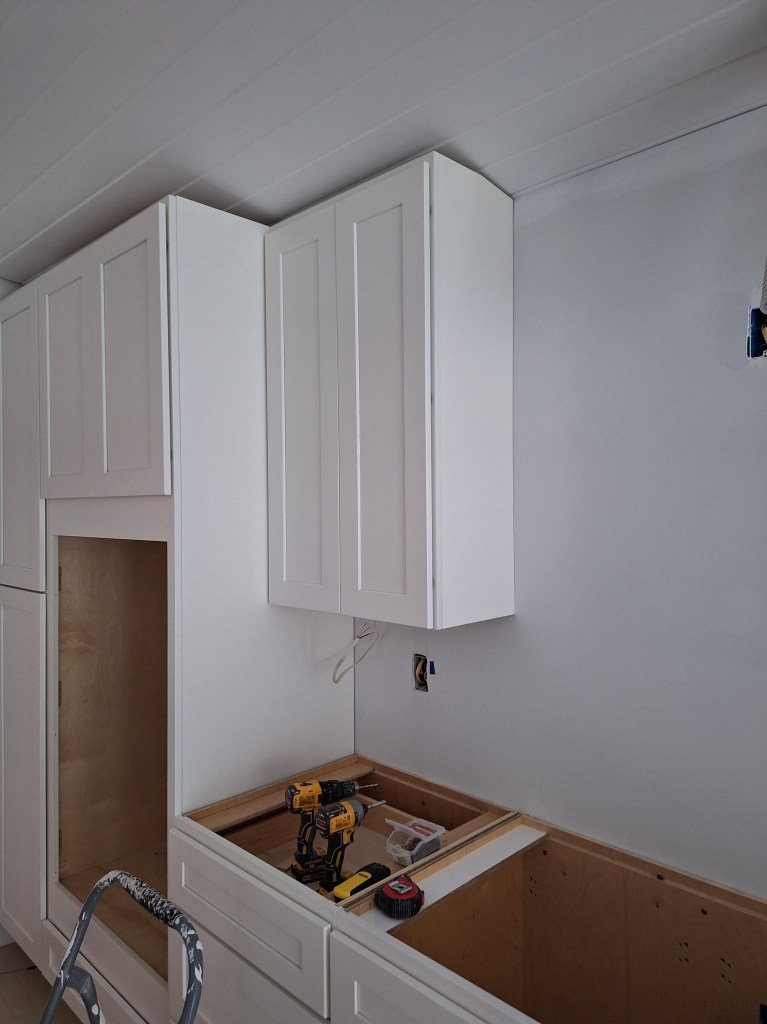
Here it is after securing it to the wall.

Next to this wall cabinet will be the range hood, but I haven’t purchased one yet. Depending on what I choose, it may attach to the wall cabinets that flank it, so I stopped with the wall cabinets until I’ve selected a range hood.

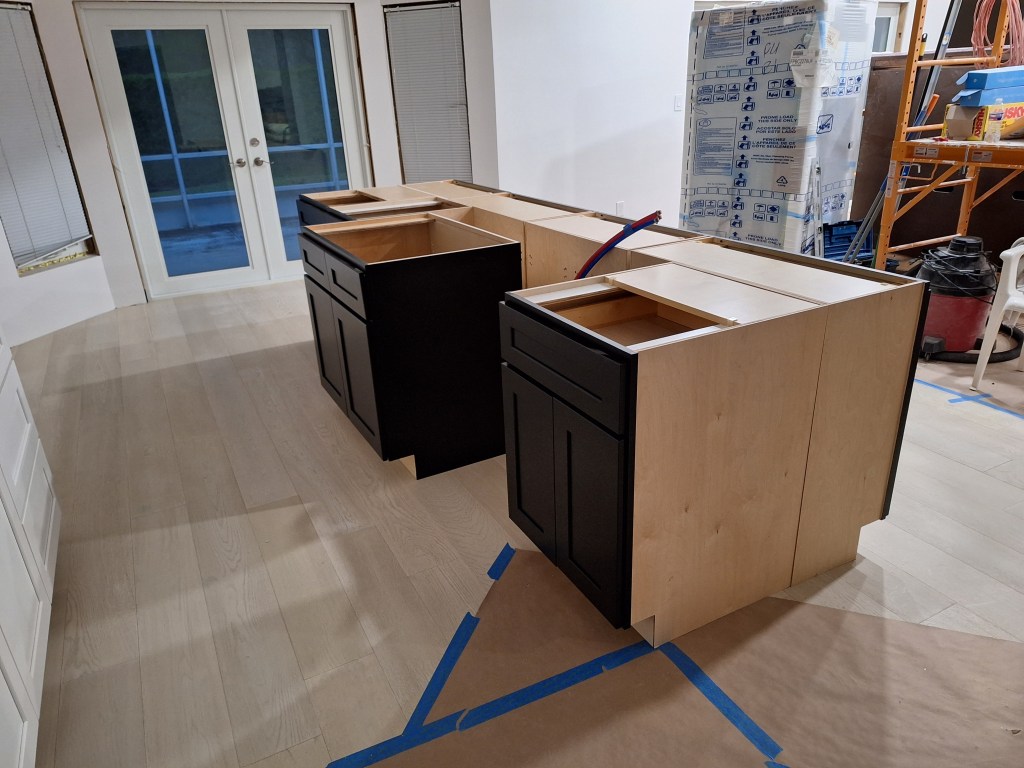
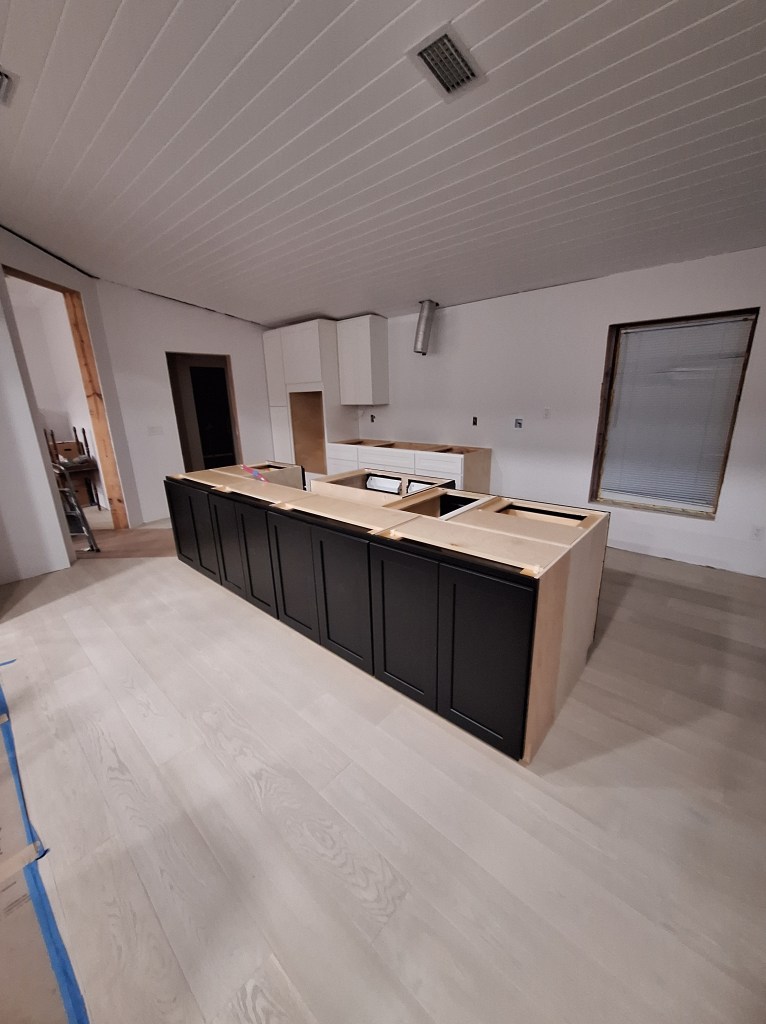
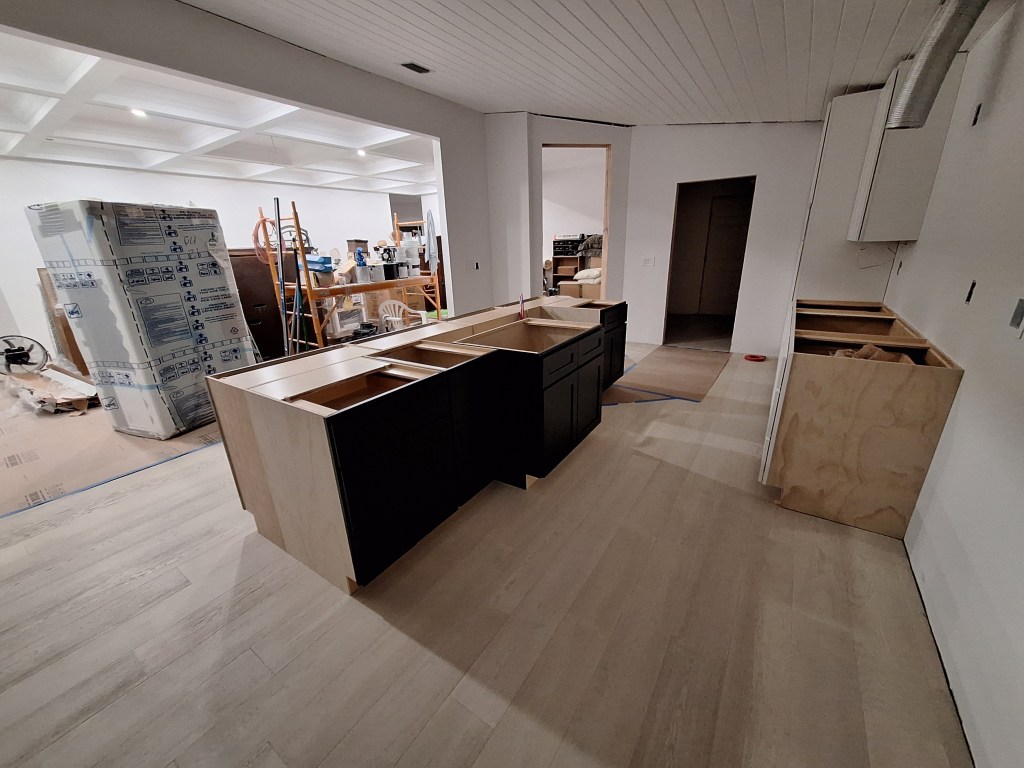
I turned my attention to the kitchen island cabinets, which needed to be unboxed and moved into the kitchen. I was still a bit uncertain about the placement, so I arranged them as best I could in an effort to get a better sense of where they needed to go. It was important to ensure there was enough room to move comfortably around the island, taking into account that the counter top would overhang the cabinets.

Front of Island
Island Back

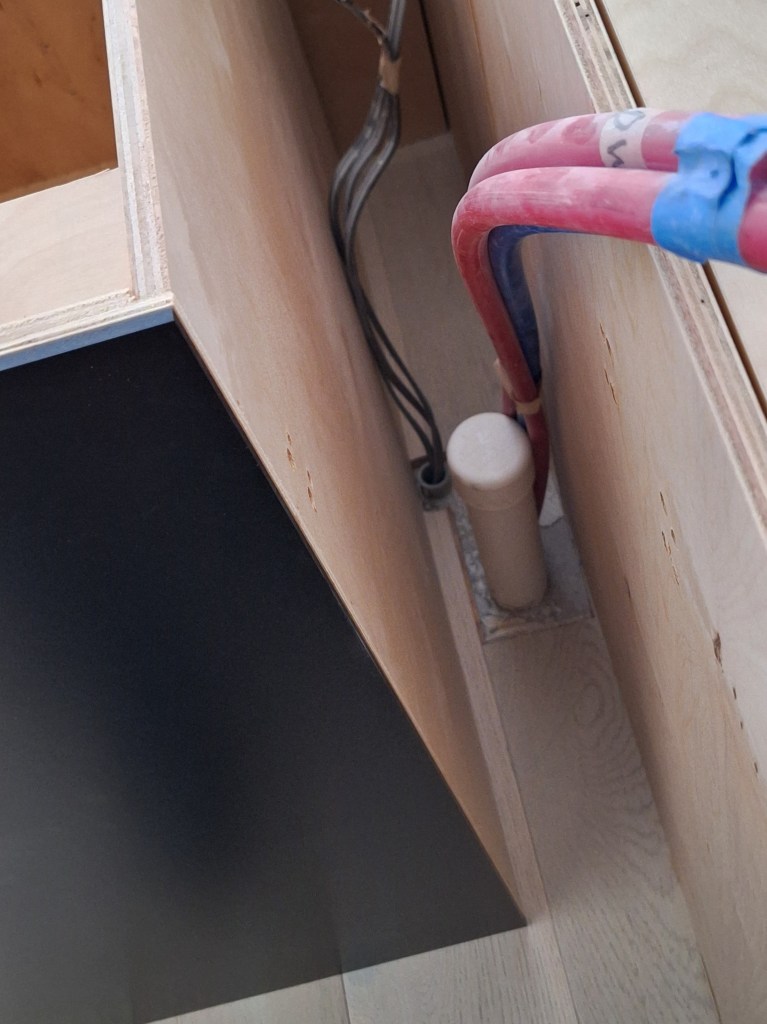
The cabinet sticking out in the image above is the where the sink will go. Notice how, unlike the other cabinets, the sides of the cabinet are finished (dark, like the front). This is so that it can protrude out a bit. A design aesthetic. I’m not sure how far I’ll have it stick out, if at all. At the moment, the pipes are preventing it from being aligned with the others. Once I know exactly where I want it, I will cut an opening in it to accommodate the drain and water supply lines. During that time I will decide if I want it to protrude or not.

Wires and Plumbing behind Sink Cabinet
Island Back, from Laundry Room

The gap between the sink cabinet and the one on the end (shown above) is where the dishwasher will go. Here are a few wide angle shots to help get a sense of the space.

Island Front – Wide Angle
Island Back – Wide Angle
Island Back from Laundry Room – Wide Angle

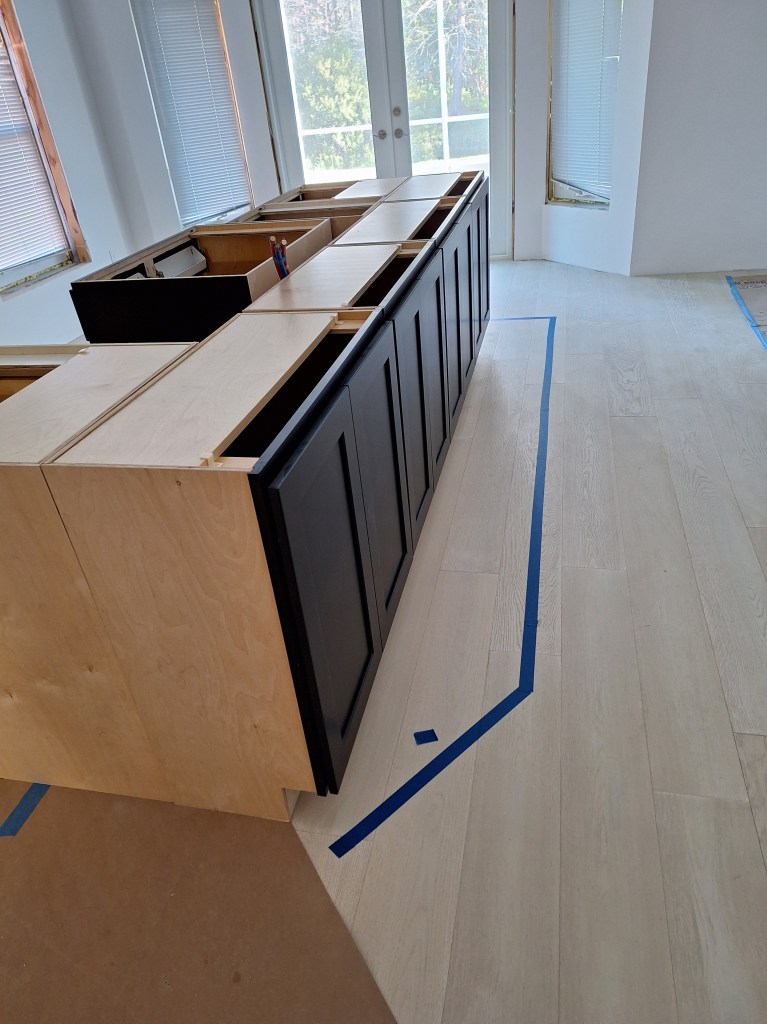
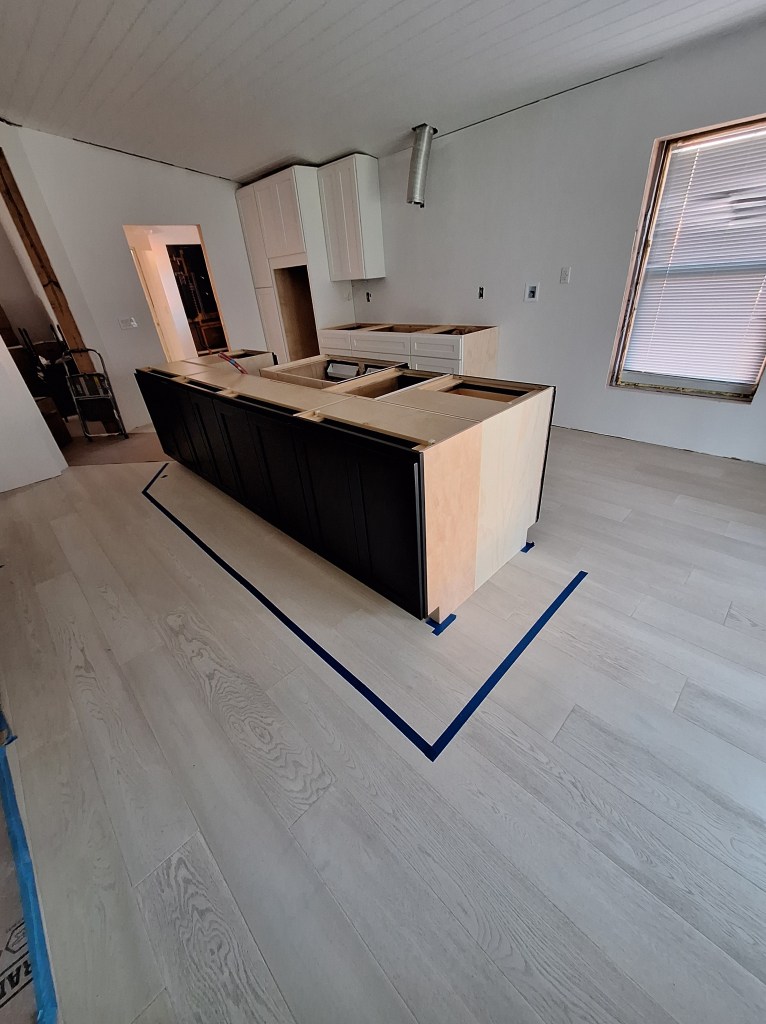
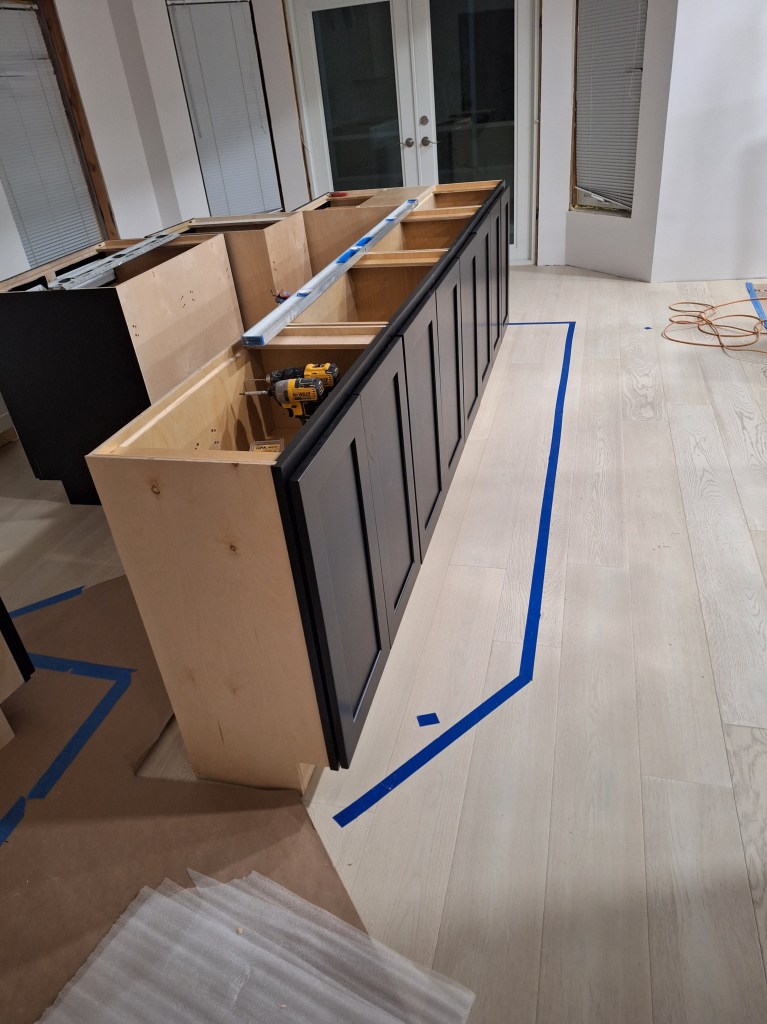
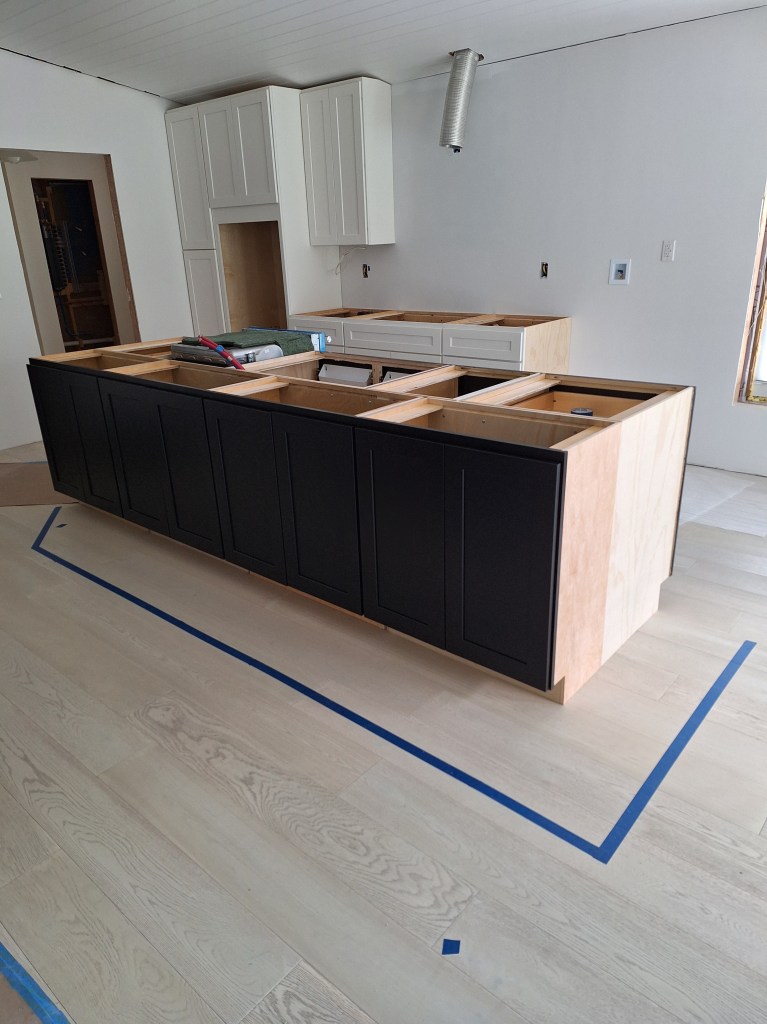
Before securing the island cabinets in place, I used blue tape to outline where the counter top will go. It will extend about 14″ beyond the front and far end to accommodate seating. Adding this outline was important so that I could get a real sense of the space before committing to their final location. It resulted in a small adjustment to the initial placement I showed above.

Final Location of Island, with Counter top Outlined.

The counter top at the front edge as you enter from the laundry room will be angled, as shown above, so that it is parallel with the imaginary hypotenuse line that is formed between the perpendicular walls opposite that corner of the island. This forms a small corridor, which provides proper access. It also feels right.

Final Location of Island, with Counter top Outlined – wide angle.

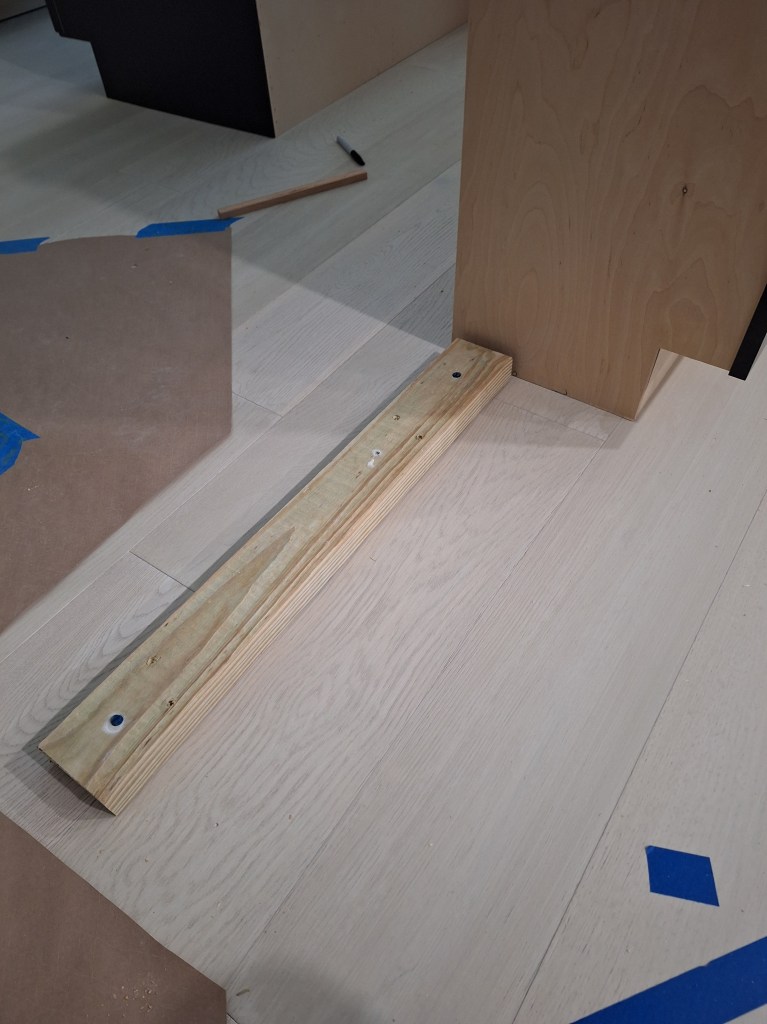
To secure the cabinets to the floor, I introduced a cleat that was screwed into the floor and the concrete slab.

Cleat for Securing Front Row of Cabinets

This was done for each of the four cabinets that face the great room.

Front Row of Island Cabinets Secured

With them secured to the cleats and each other, the cabinets that go on the back side benefit from this once they are screwed to these front cabinets, making the whole island secure. It’s a really big island, and once the quartz counter top is installed, this island is going no where.

Island Cabinets Secured – southeast corner.

Notice how I decided not to have the sink cabinet protrude. I pushed it all the way in because I wanted to provide as much room as possible between it and the refrigerator that will be behind you as you face the sink.

Island Cabinets Secured – southwest corner.

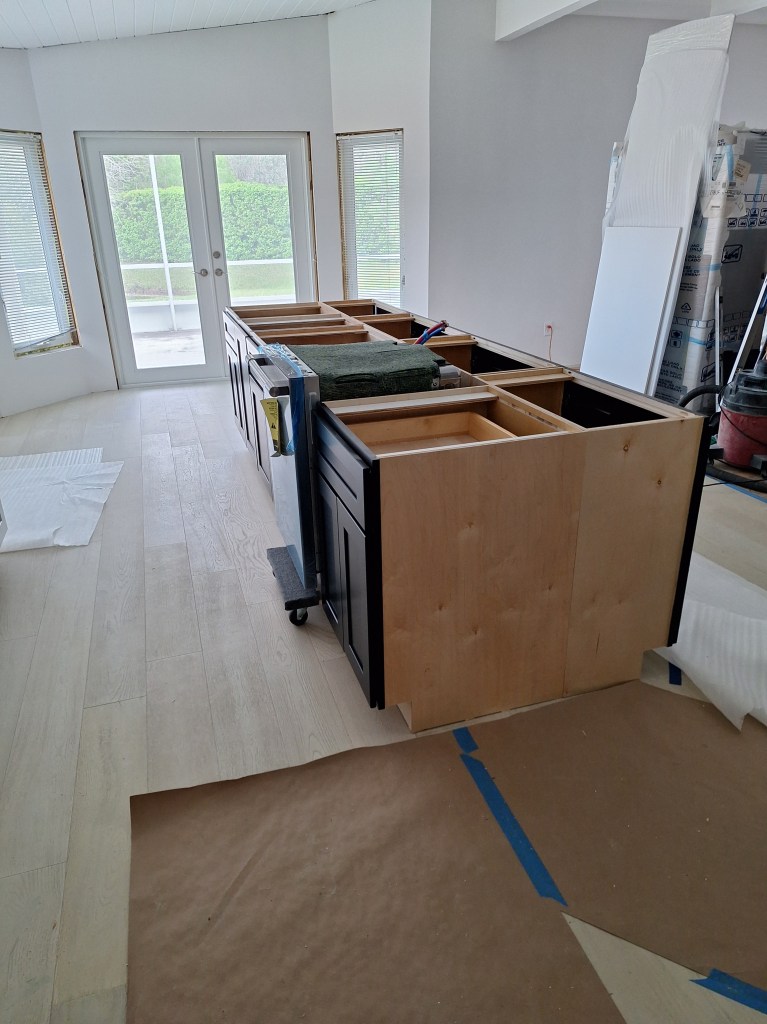
I unpacked the dishwasher an placed it on a dolly to make sure it fit in the opening I left. That opening is 24″, as required, so I wasn’t concerned about it not fitting, but I wanted to temporarily put it in position for verification.

Island Cabinets Secured – from laundry room.

End panels will be placed on either end of the island to match the color of the doors. The same will be true for the toe kick areas. I’ll get to that after the electrical wiring has been sorted out. Since this is the end of February, I’ll cover that and the continuation of the flooring installation in the next post.