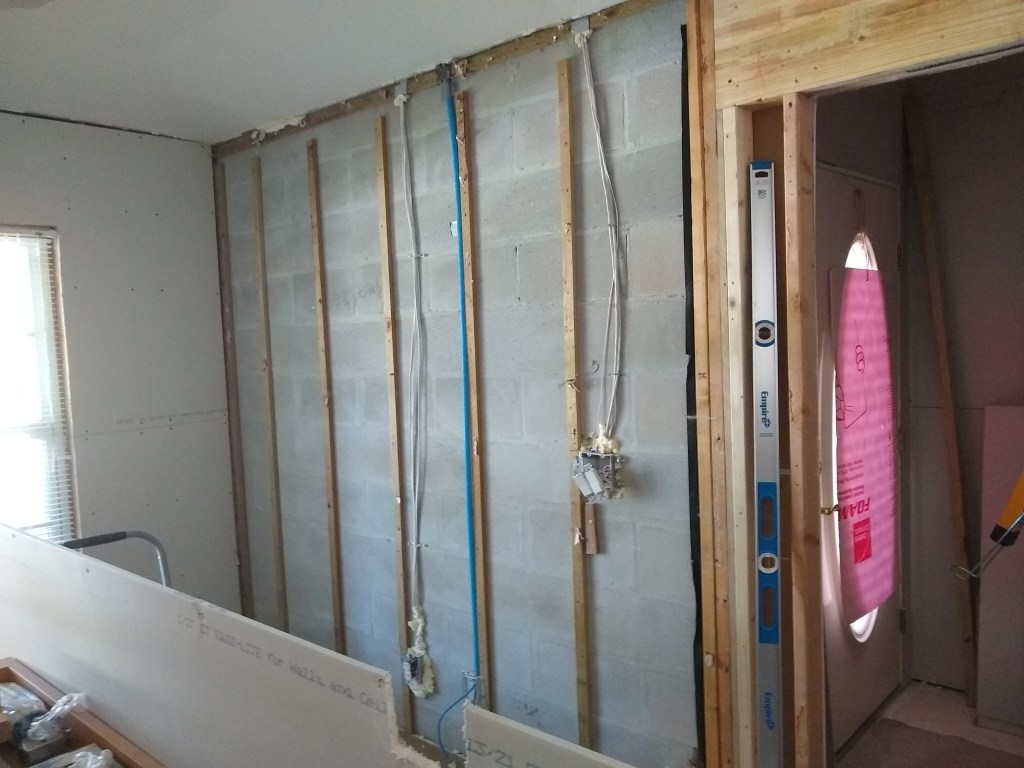
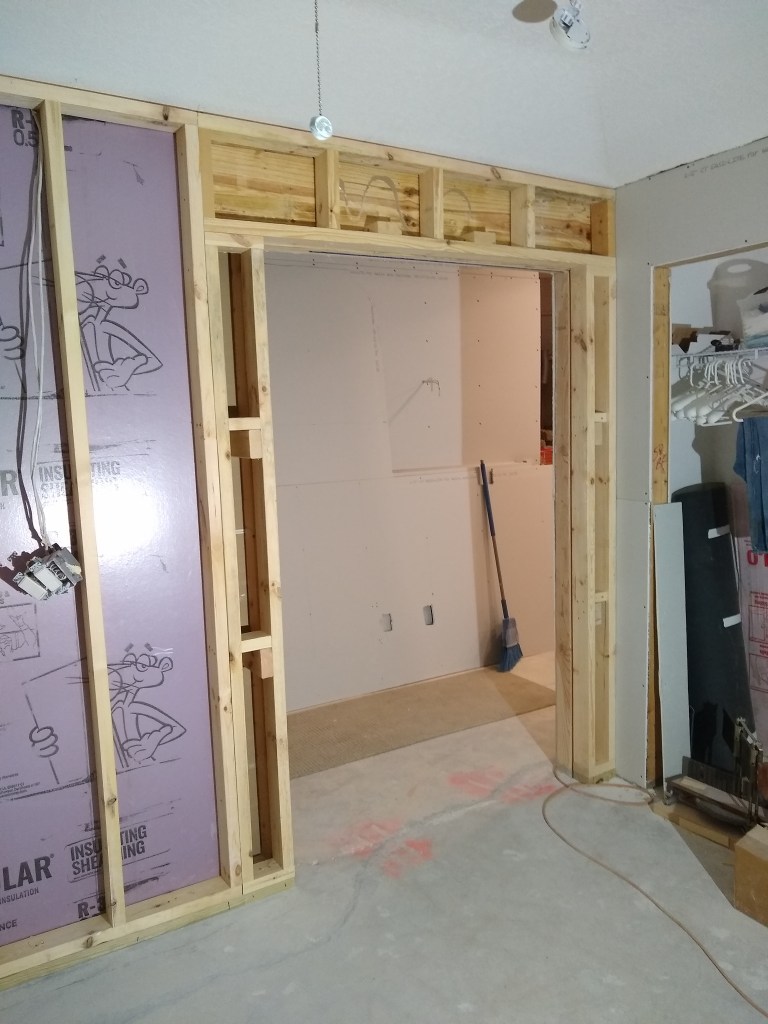
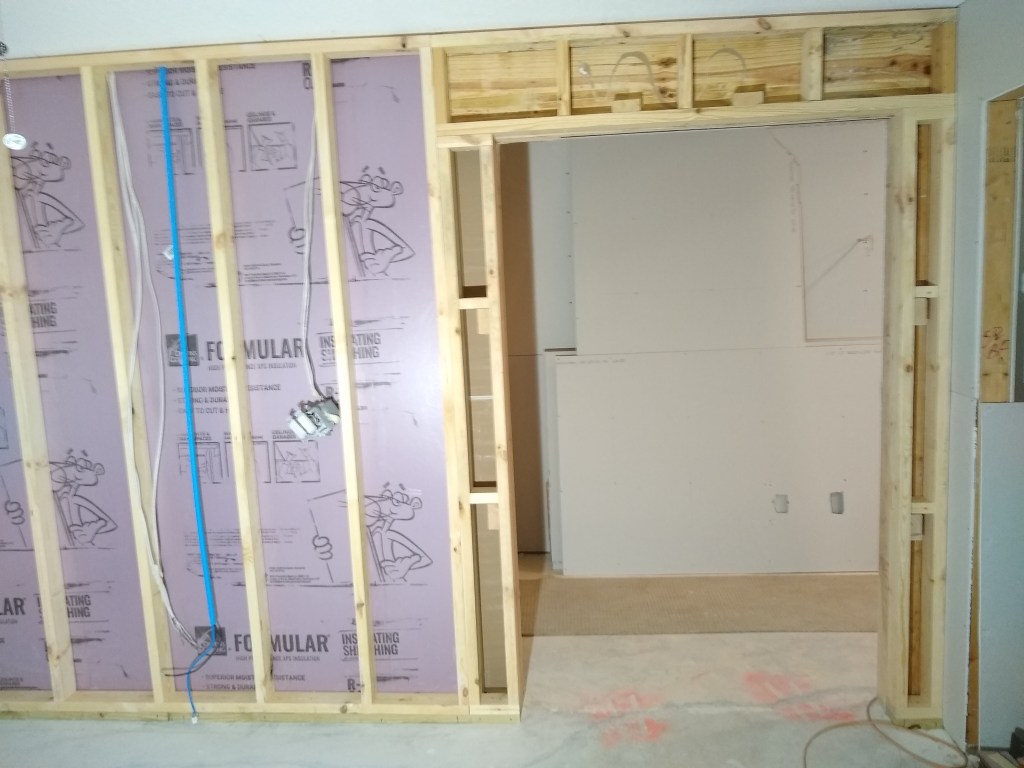
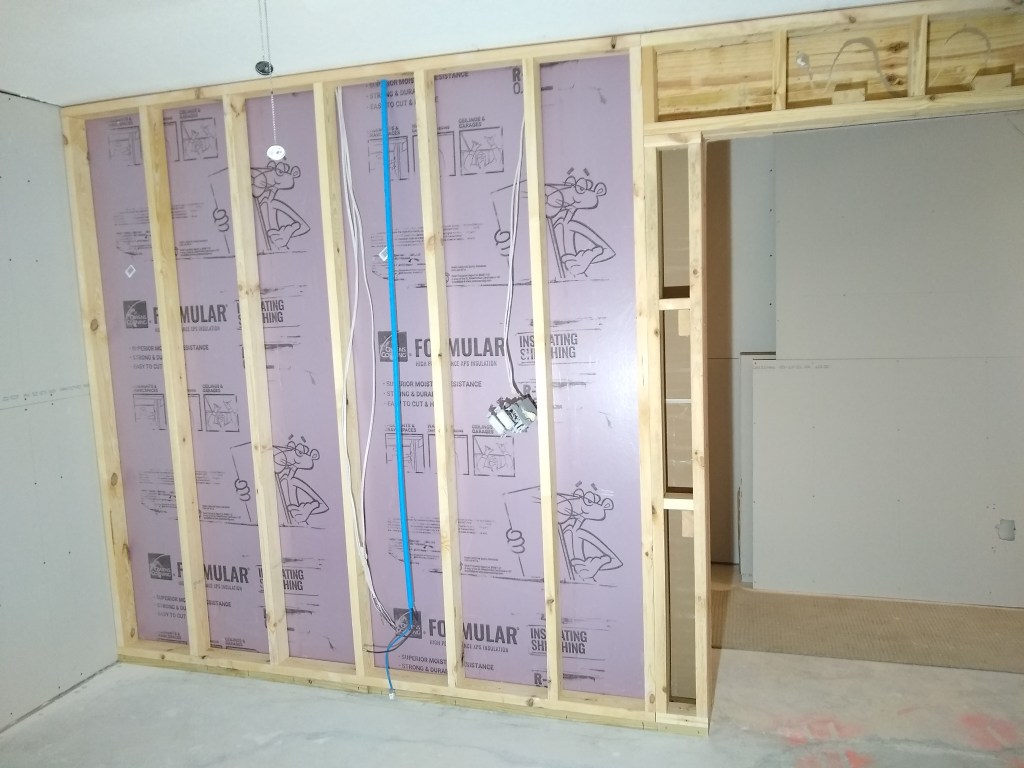
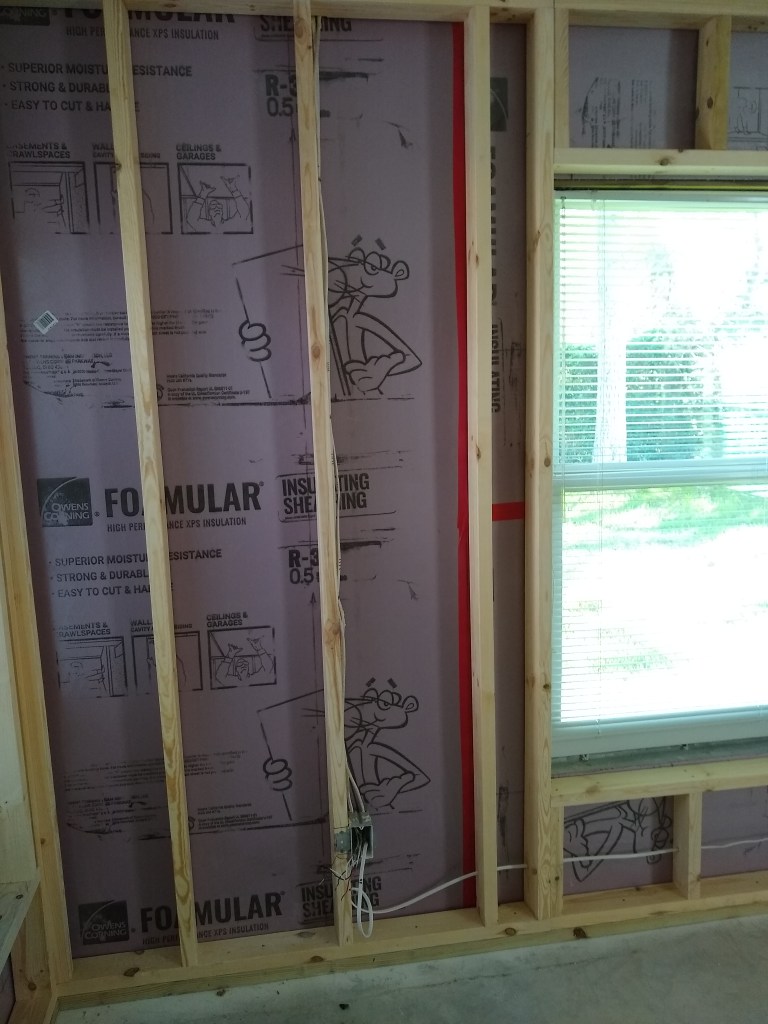
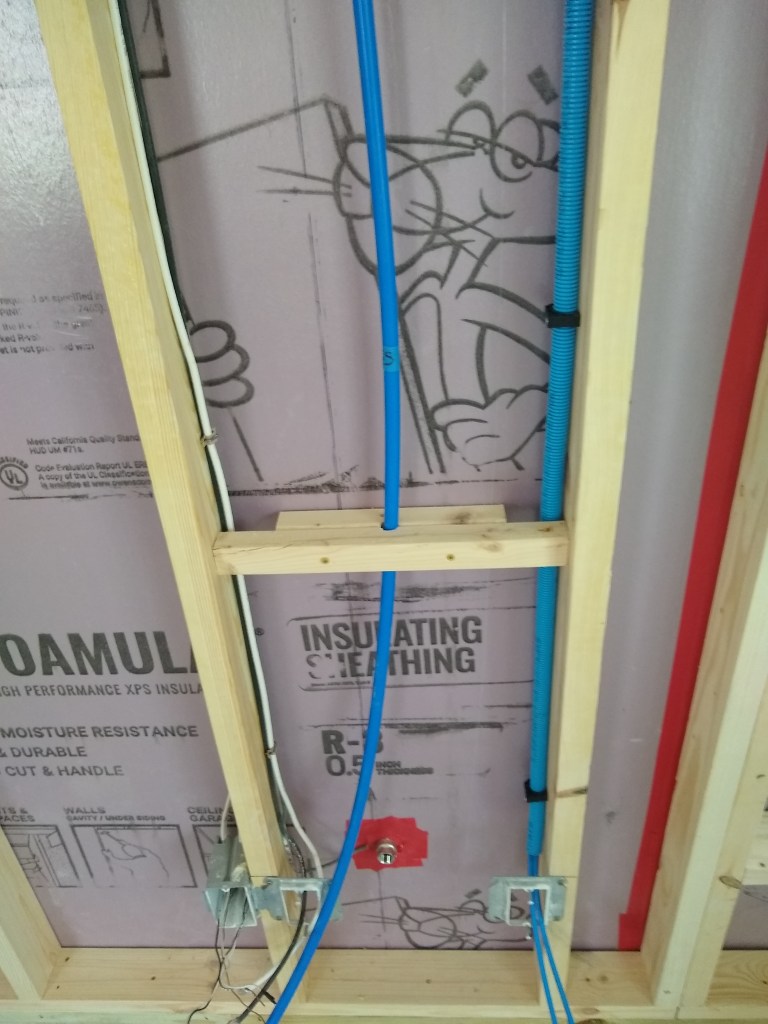
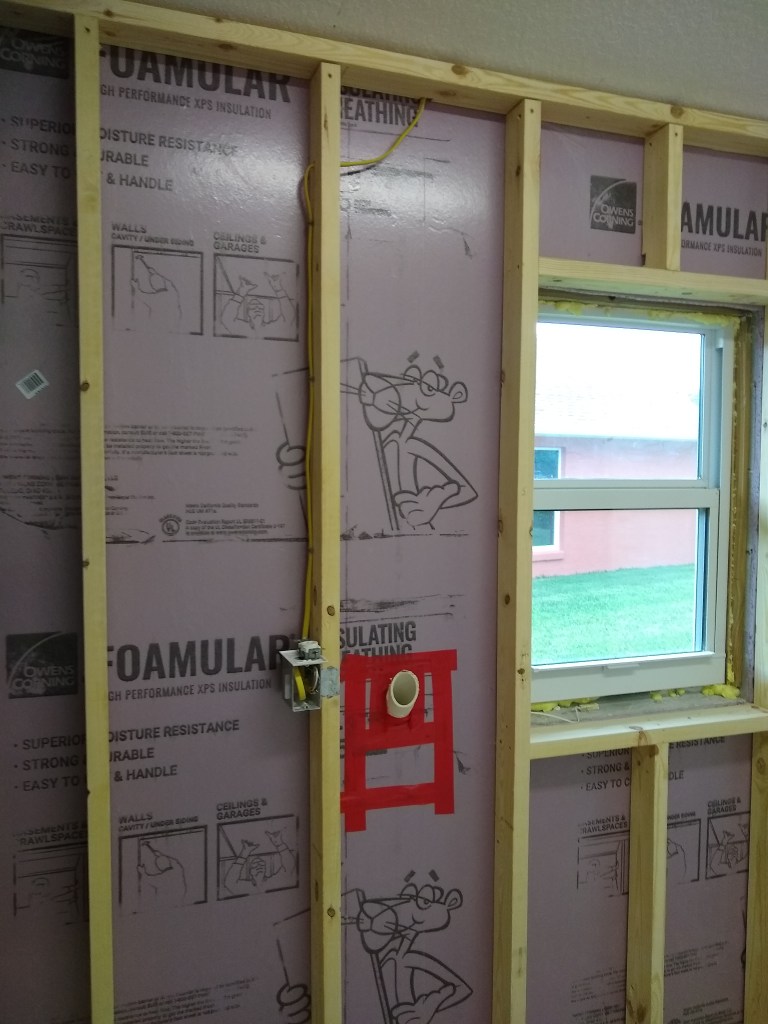
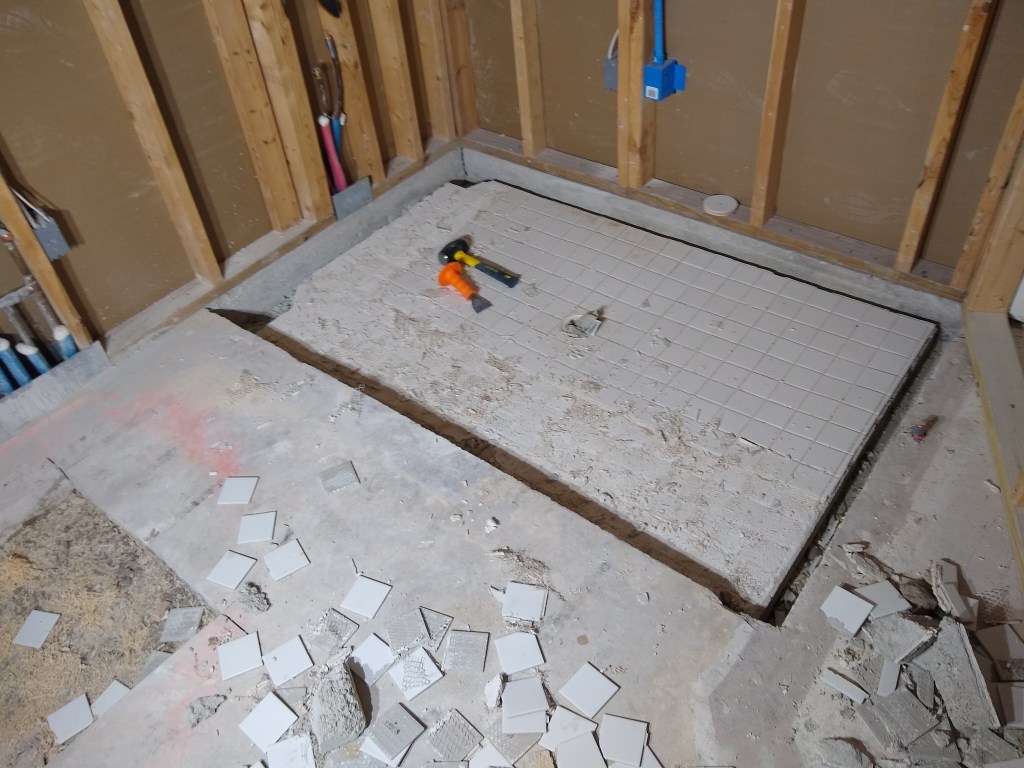
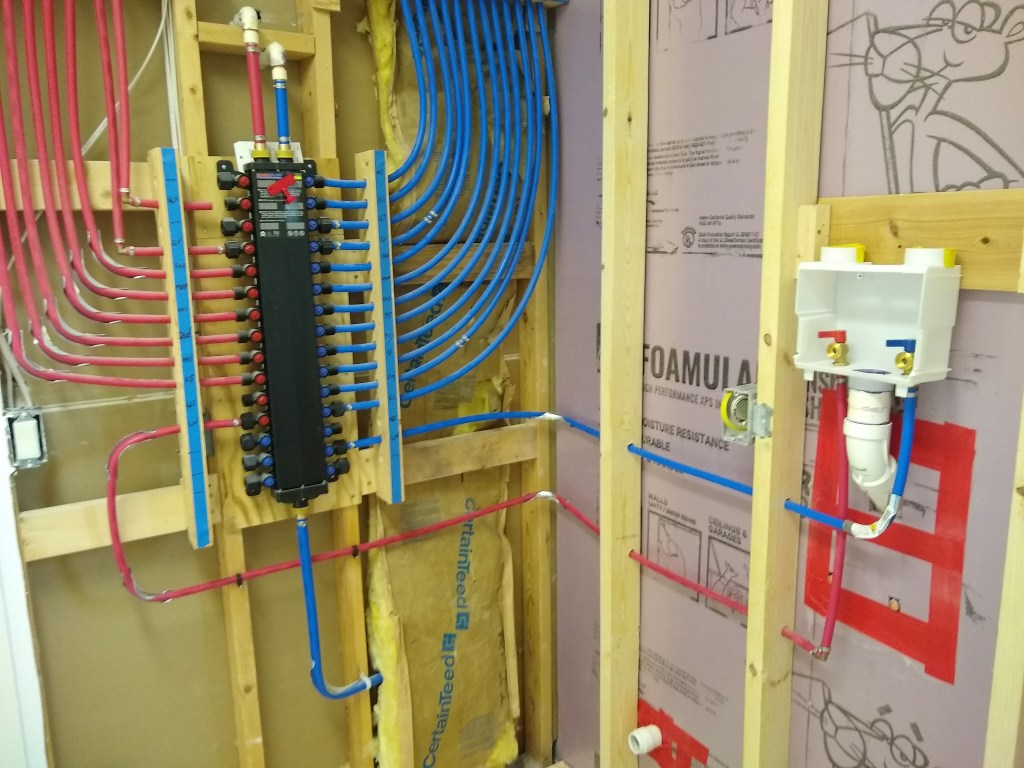
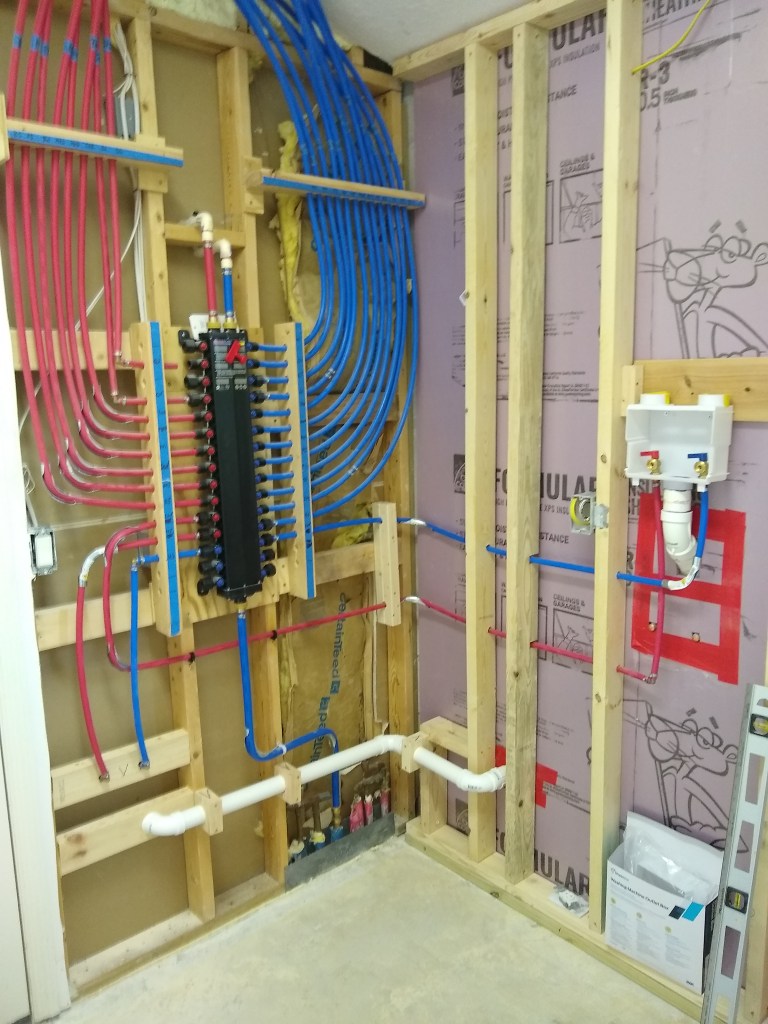
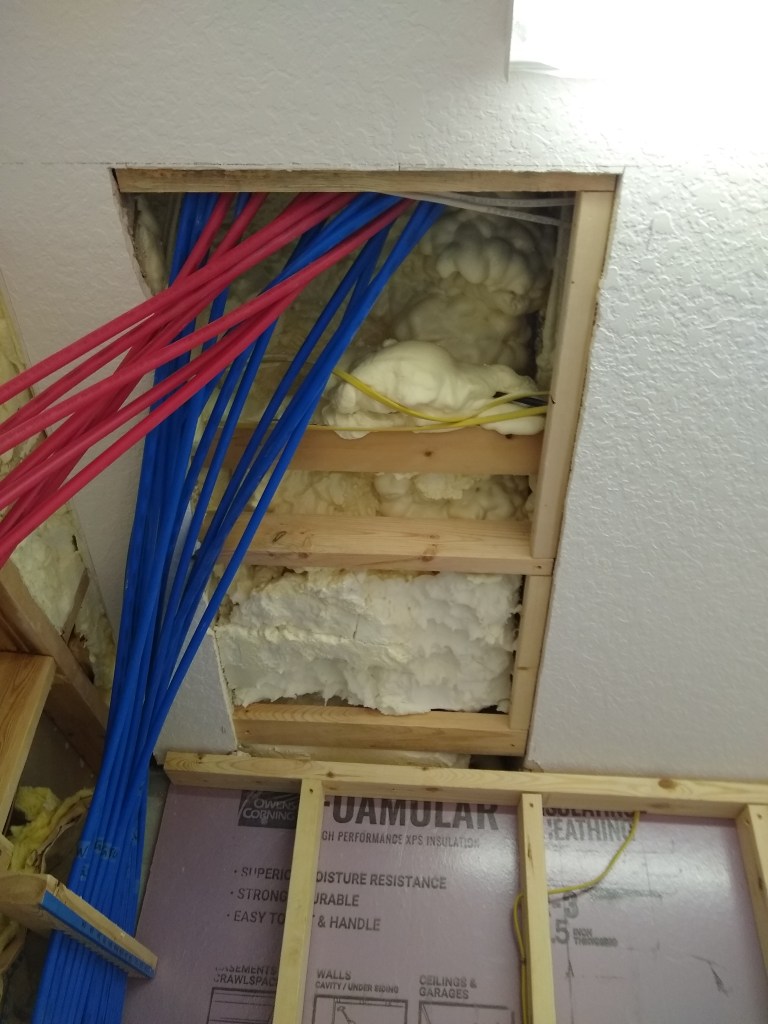
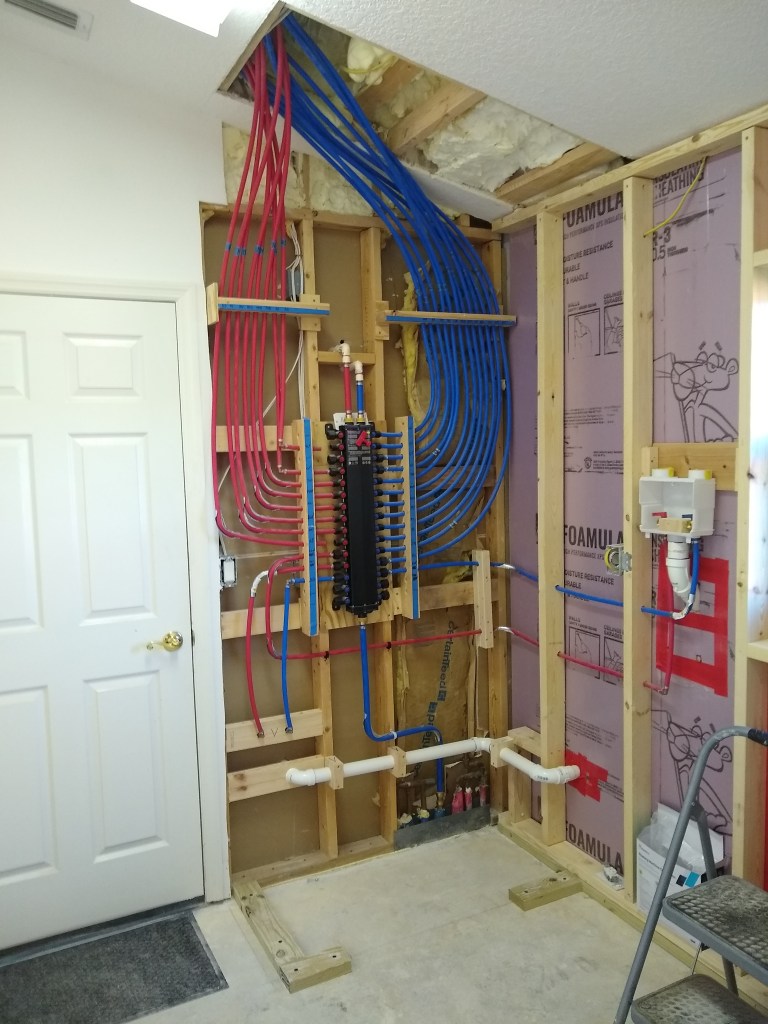
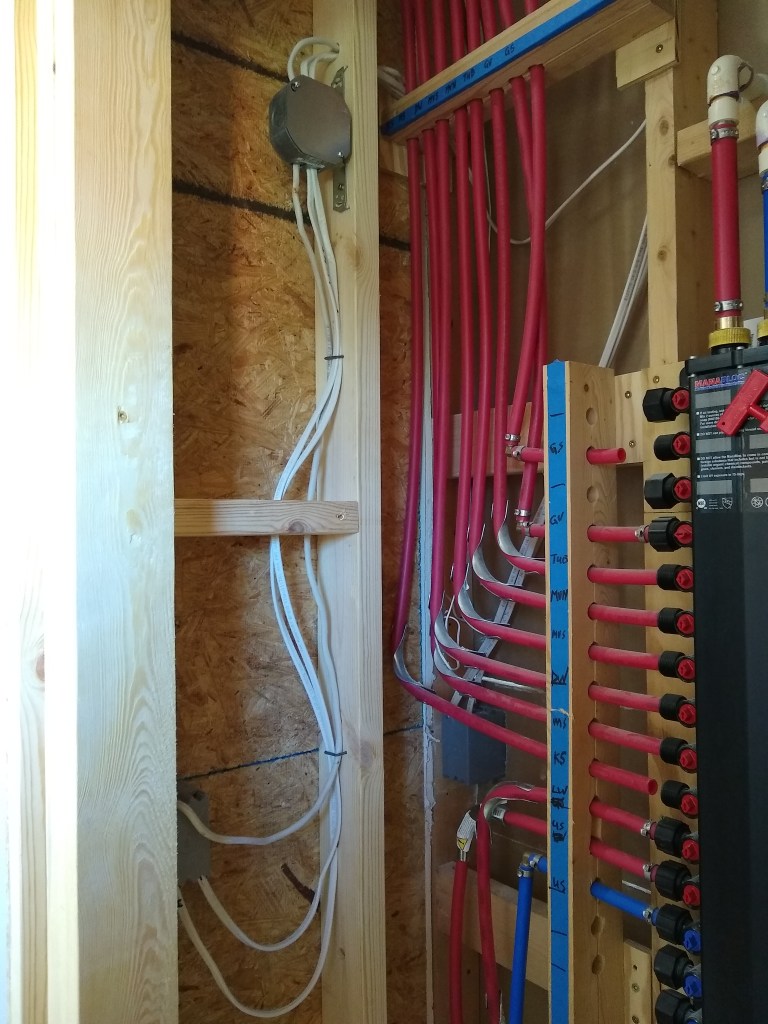
Guest Bathroom – November 2024

The last post finished with me having just finished taping the drywall in the guest bathroom. So we start this post with the various coatings of that taping job.
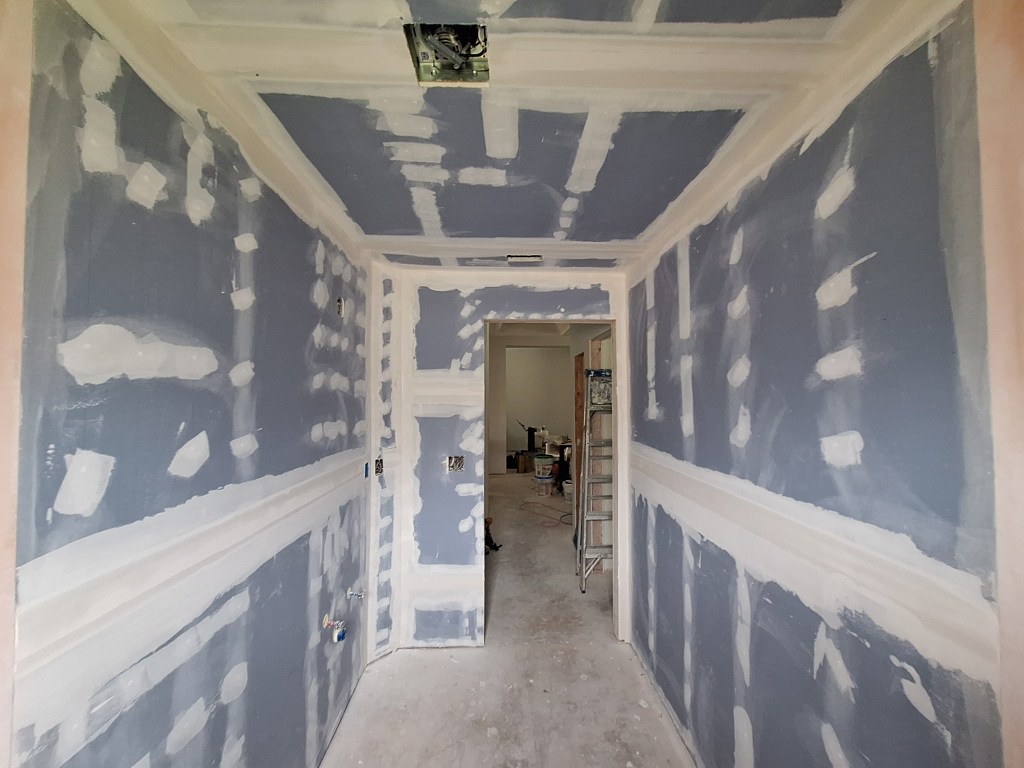
First Cover Coat of Tape

After the first cover coat of the tape, we apply a second to widen the coverage in order to flatten the seams. In between each coating, sanding is done to prepare for the next phase.

Second Cover Coat of Tape

After the second cover coat of the tape, a little more attention is paid to the sanding in preparation for the first skim coat. The idea of skim coating is to cover all the drywall surfaces with joint compound so that the texture is consistent. That is, we don’t want part of the wall covered in joint compound and other parts with none.

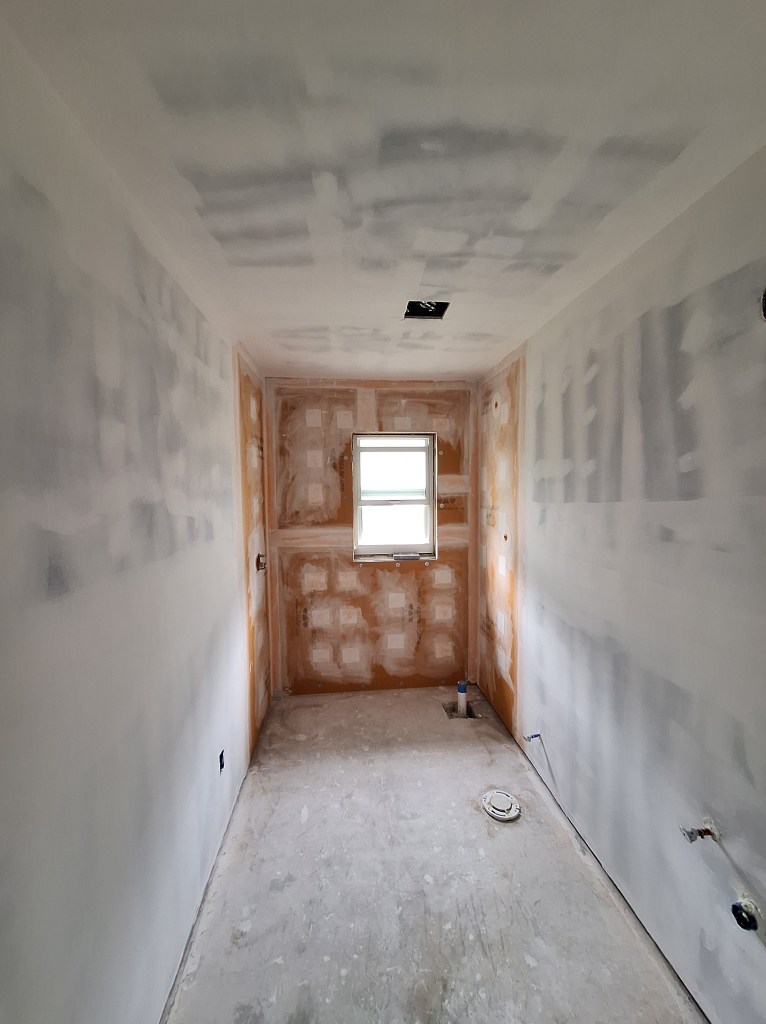
First Skim Coat
First Skim Coat

A single skim coat is normally enough, but I like to do a second to ensure there is enough joint compound on the walls (and ceiling) to make an even nicer surface. Before applying the second skim coat, the prep work becomes more important. The more attention I pay to the sanding, the less work I have to do on the second/final skim.
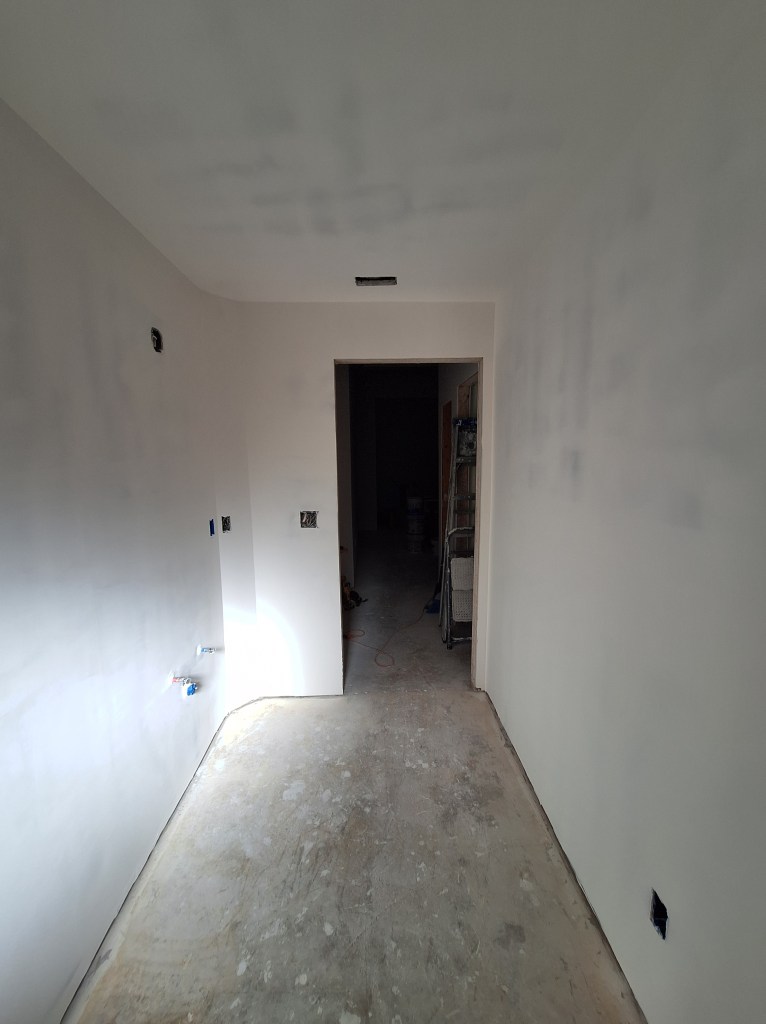
Second Skim Coat
Second Skim Coat

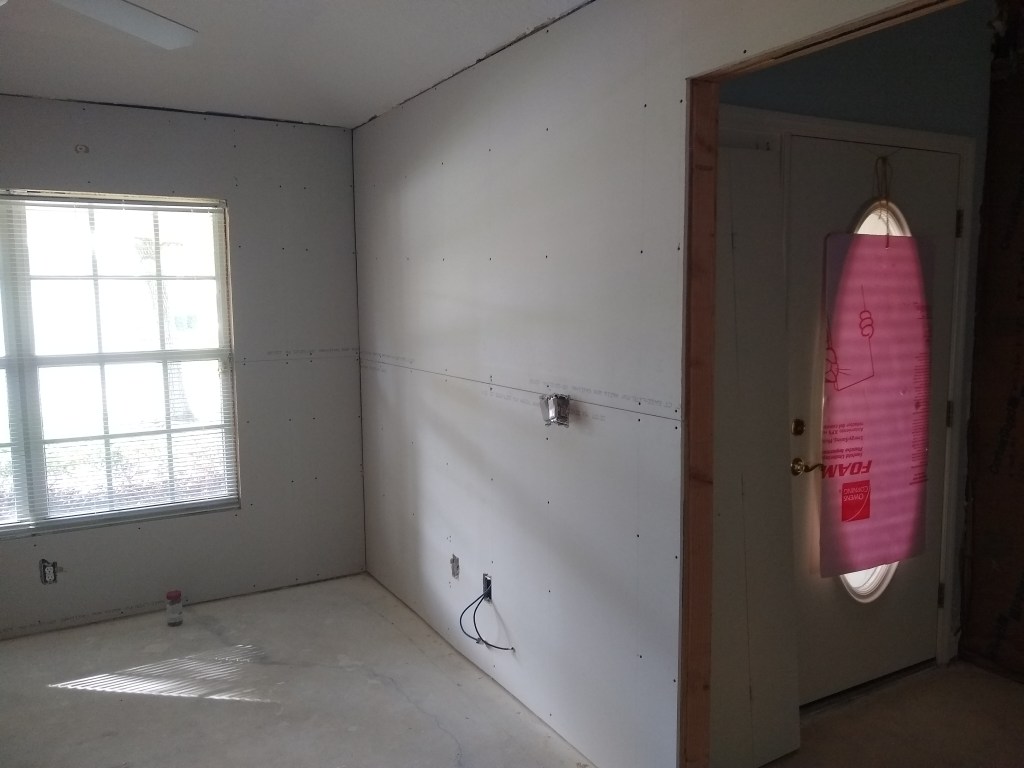
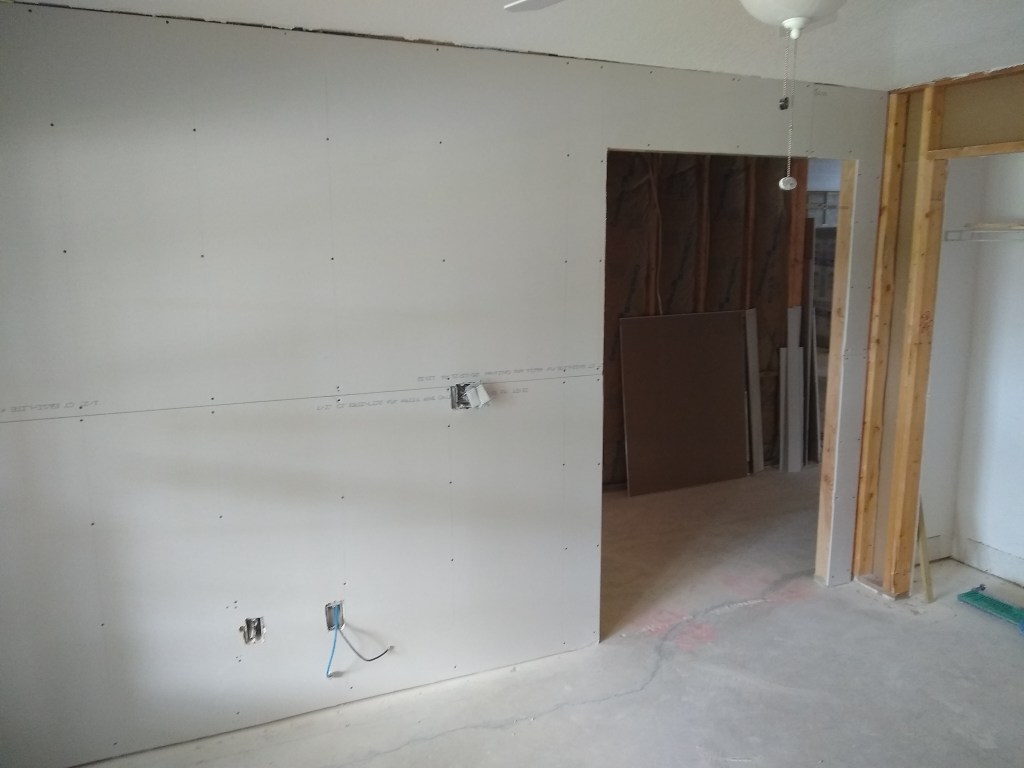
Some serious attention is paid to prep work before applying primer. I hand sand using a hand held light wand to ensure I remove as many imperfections as possible. It is inevitable that I will miss something since everything is white (snow blindness), but if I’m not able to see it with the wand, it is highly unlikely it will be noticed by anyone. Here is the room after applying a single coat of primer to the walls and ceiling.
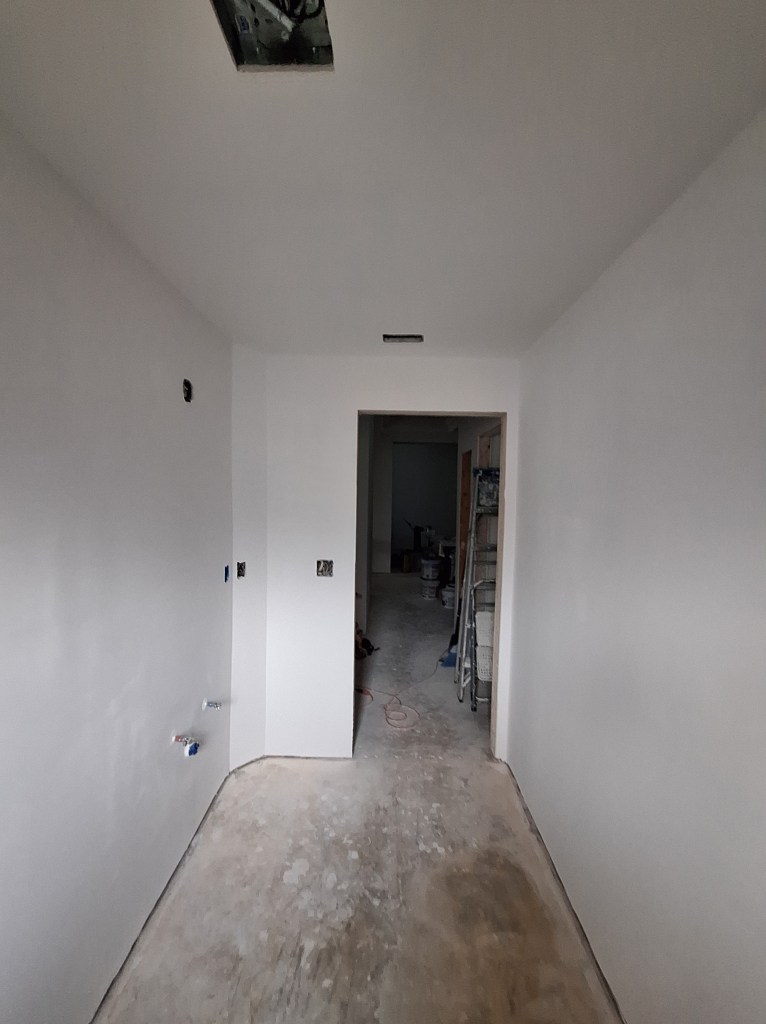
Primer Applied
Primer Applied

I left the walls with only a coat of primer, since I had yet to choose a wall color. The ceiling, however, would get two coats of white ceiling paint.
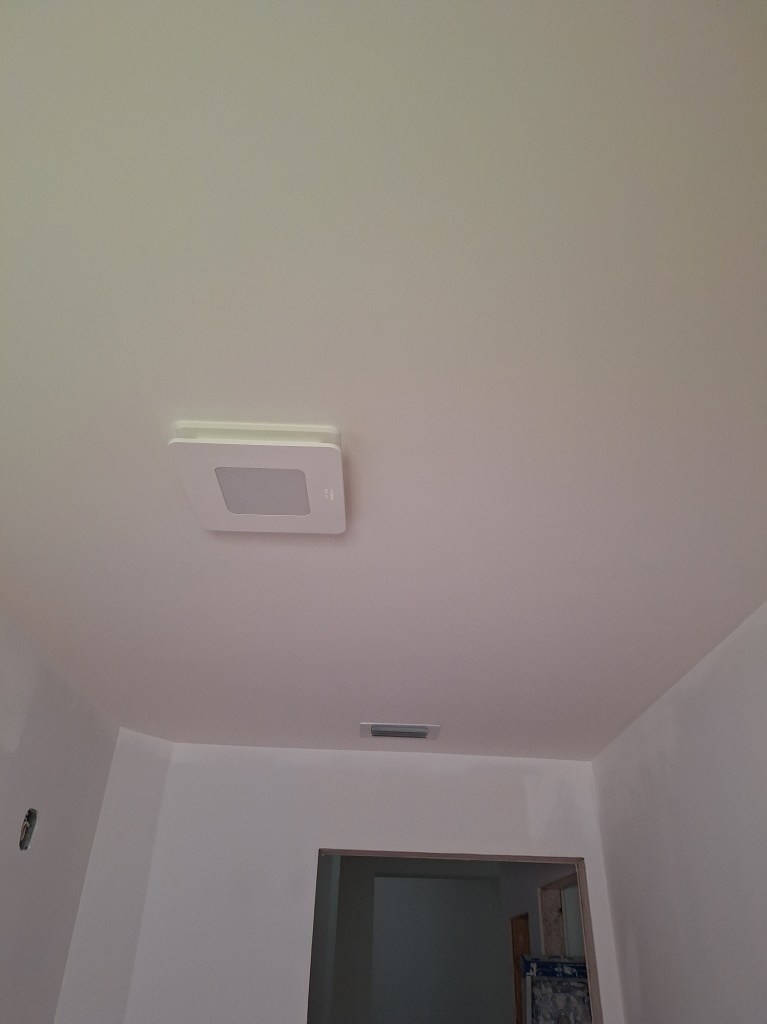
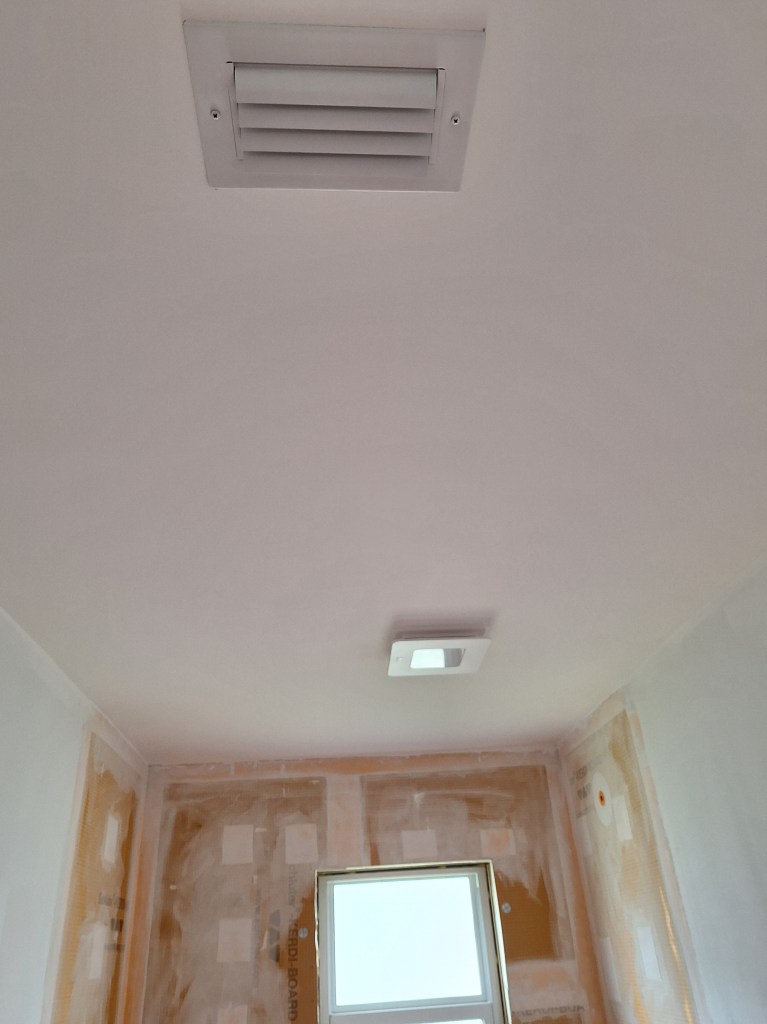
Ceiling Painted
Ceiling Painted

As you can see above, I put the A/C grate back in place after spray painting it to freshen it up, then put up the fan/light fixture. With the ceiling painted, I was ready to put down the DITRA underlayment for the tile.
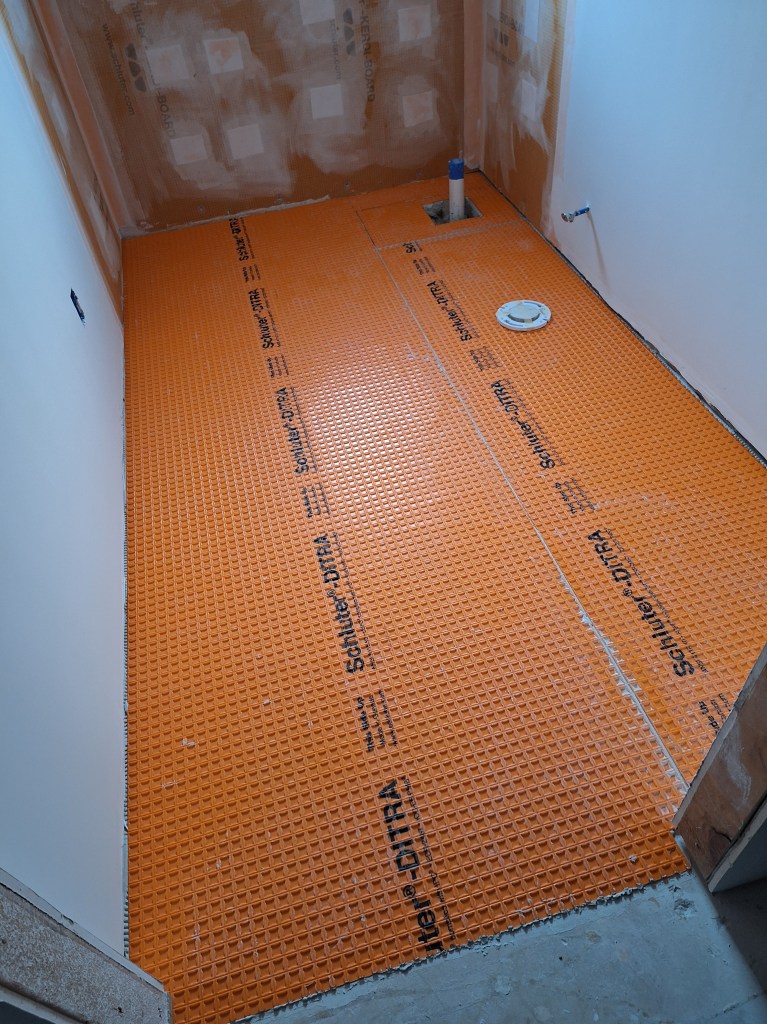
DITRA Installed

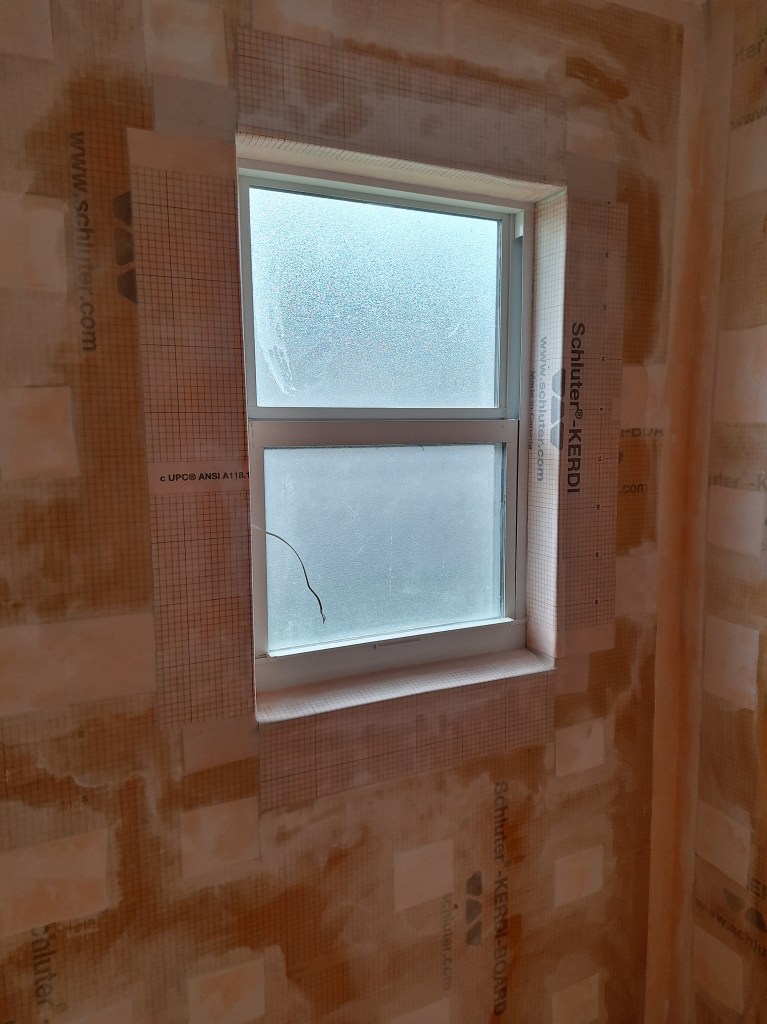
After that I returned to the shower area to waterproof around the window. I figured I would use Kerdi board around the window, but ran into the same problem I had when I put it up on that exterior wall; namely, I needed to build the area out to accommodate the 1-5/8″ screws. Unfortunately, I didn’t have the space around the window to do that, so I had to come up with an alternative solution. Rather than use Kerdi board, which would have added an extra 1/2″ of thickness, I used Kerdi membrane, which added virtually no extra thickness. Let me show you.

Preparing Window for Waterproofing

In the image above, you can see that I added drywall all around the window to provide a flat surface on which to attach the Kerdi membrane. At the bottom, I needed to add some wood so the drywall had something to screw into. Previously there was a marble slab attached directly to the concrete block. Here’s a closer look.

Preparing Stool for Waterproofing

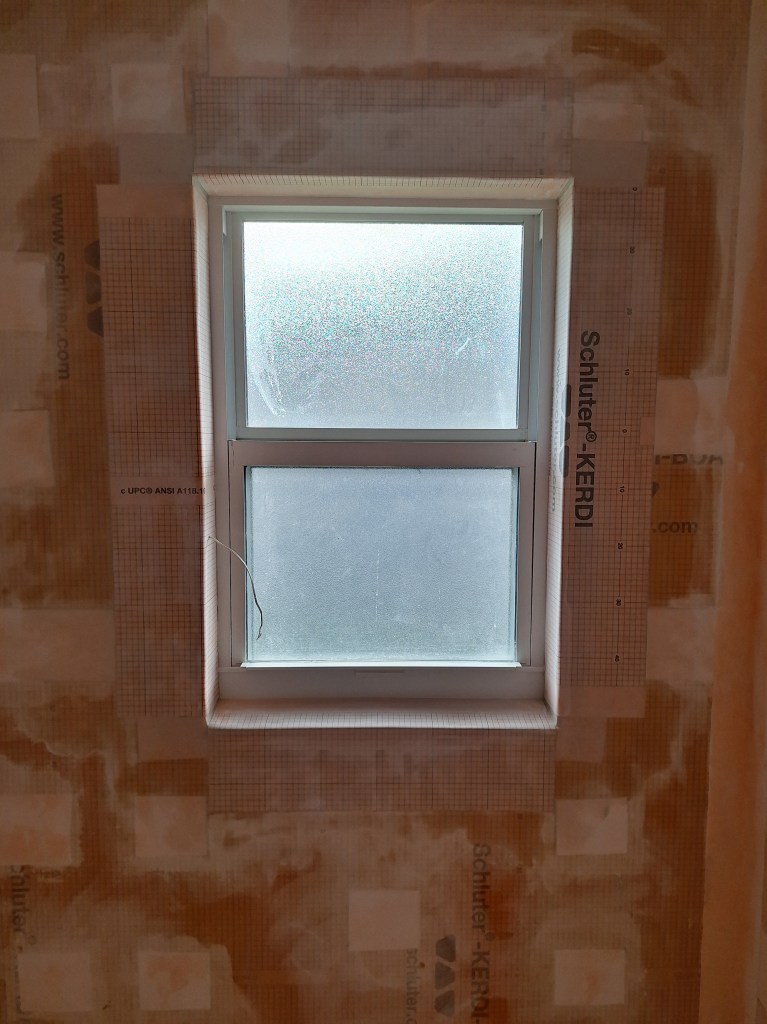
And here it is with the Kerdi membrane added.
Kerdi Membrane Installed

The wire you see sticking out on the left side is for the security system.

The thing to pay attention to is the space around the membrane and the window frame. It is sufficient to accommodate the thickness of the tile. Had I used Kerdi board, which would have added another 1/2″ of thickness (needed for the 1-5/8″ screw length), I would have had no room for the tile. So this worked well.

With the walls of the shower waterproofed, I turned my attention to the shower pan. I started by cutting the preformed shower pan and setting it in place with thin-set mortar. This served as a reference for putting the Schluter curb in place. Like the pan, it too was set in place using thin-set mortar. The curb did not come in a long enough single piece, so I had to buy two and butt them together. The seem between the two pieces will be wrapped with Kerdi band, as you’ll see shortly.
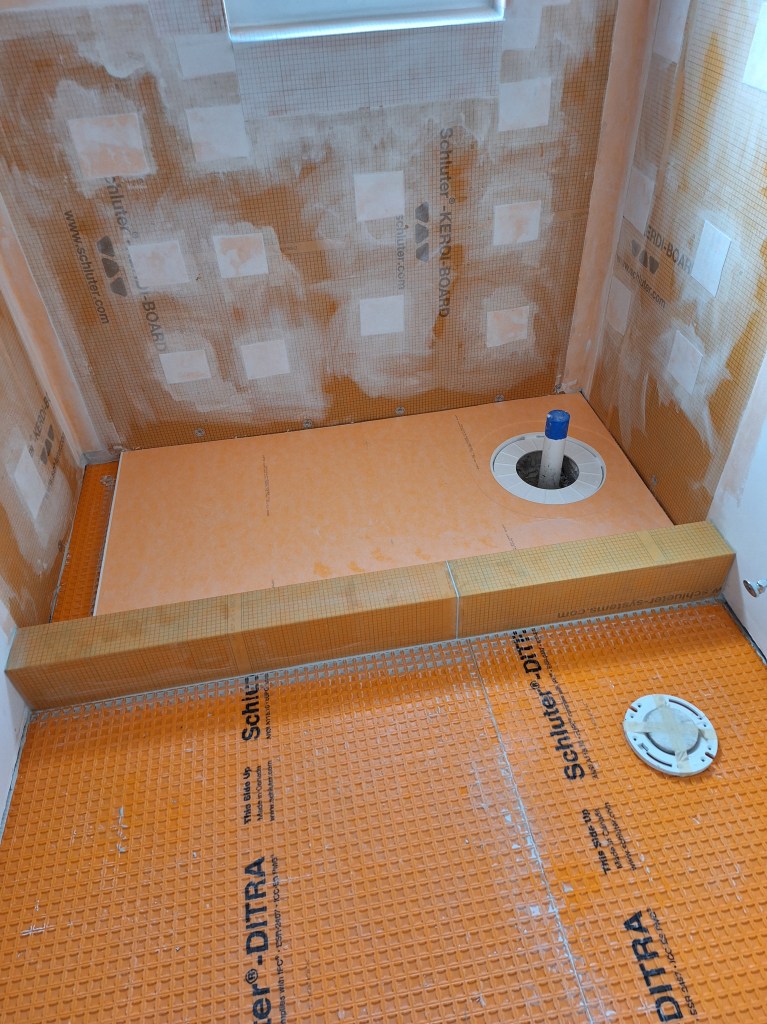
Pan and Curb Installed

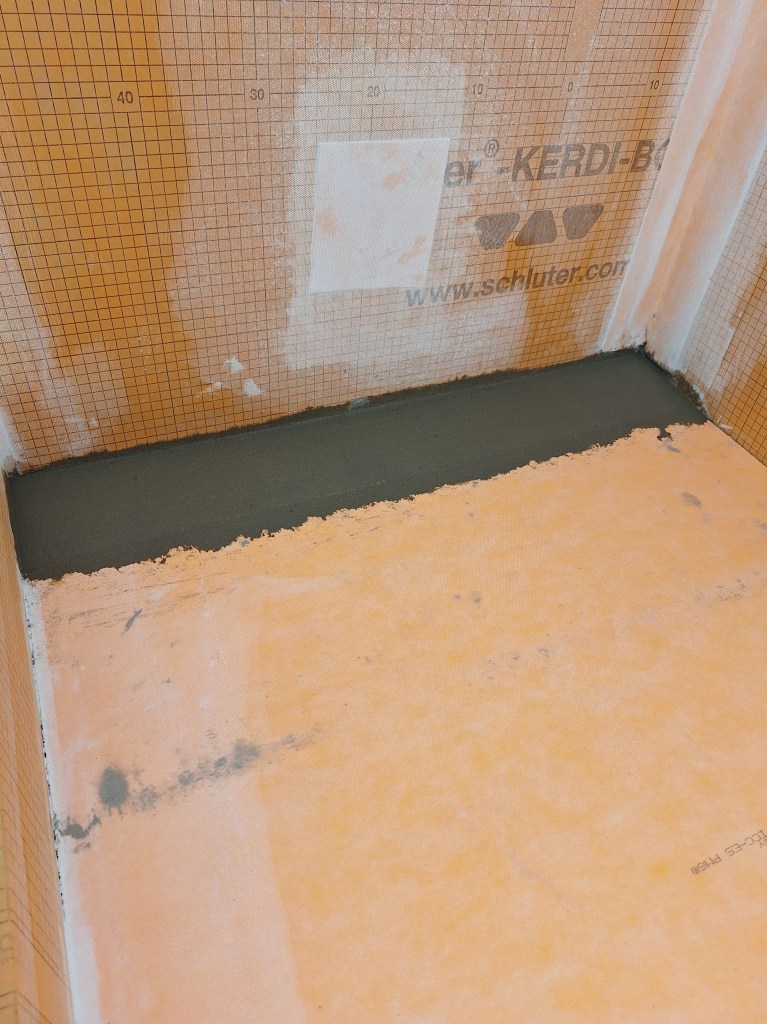
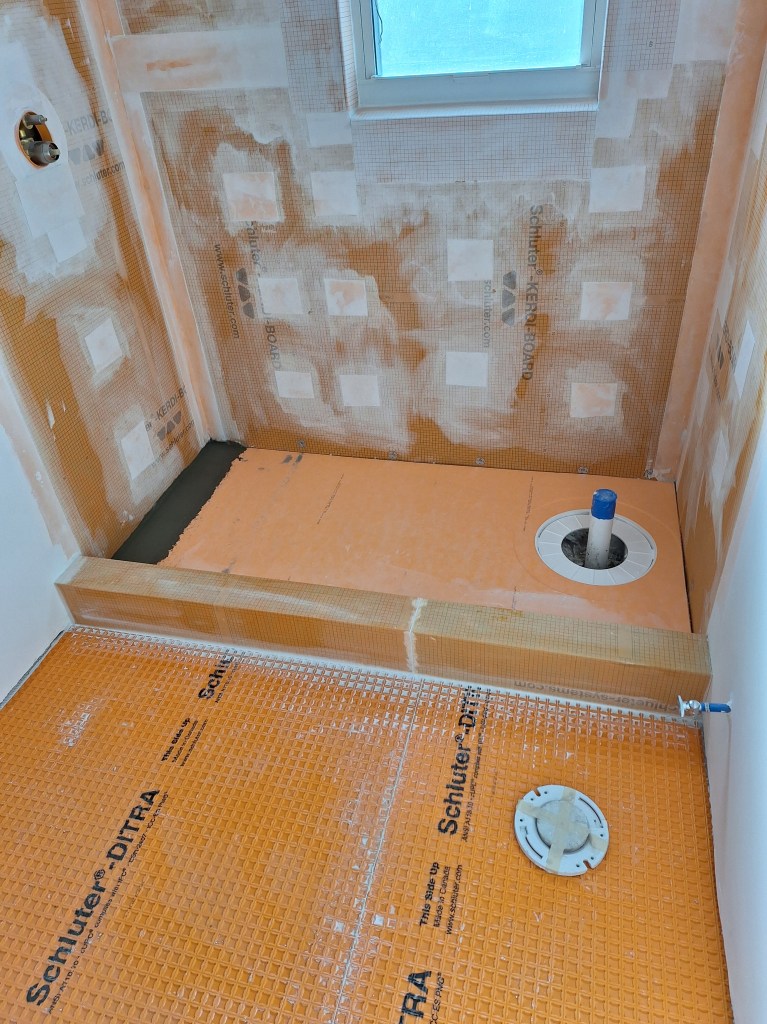
The pan was not long enough to fit the space, so I filled in the gap on the left with drypack mortar. Once dry, it will be covered with Kerdi membrane to make it waterproof.
Pan Extended using Drypack Mortar
Shower Pan before Drain Flange Installed

I actually made a mistake by putting the pan down first. What I should have done was set the drain flange in place before setting the pan. In the end it wasn’t a big deal, but it got in the way as I was setting the drain flange. When I did the master shower, I set the drain flange first. For this shower, I simply forgot the order of operations. Another thing that caused me some grief, was that the p-trap needed to be lower than it was. This was a rookie mistake. Although I did check the depth and was comfortable that it was low enough, I did not give myself enough room for error. Without intervention, it would have left the drain flange about 1/2″ above the shower pan. I should have placed the p-trap low enough that there would be no question of the drain flange sitting too high. To sort this out, I had to completely remove the riser pipe (the one with the blue tape covering the opening), then cut off some of the flange where it connects to the riser pipe to bring it down to where it needed to be. I used a 1″ length piece of 2″ diameter PVC to join the two. This was long enough to bring the two pieces together and still have sufficient “bite”, but I was lucky. Anything less, and I would have had to undergo a much more severe operation. This stressed me out. I was relieved to be able to sort it out without any major surgery. Here is the drain flange installed and waterproofed.
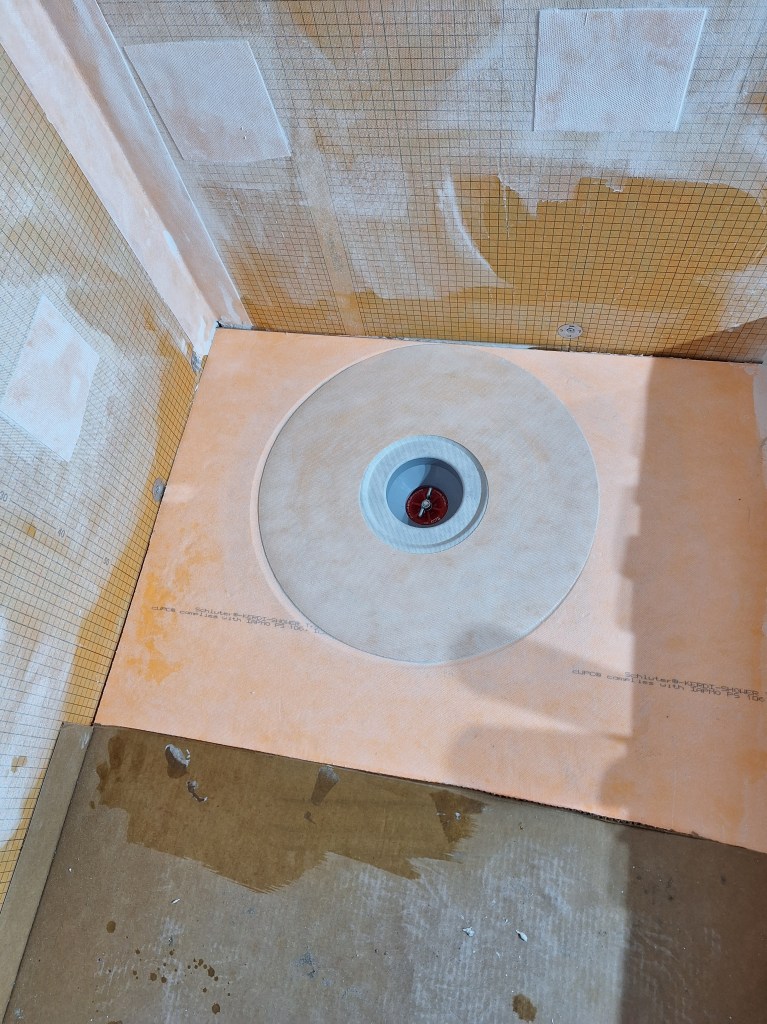
Drain Flange Installed and Waterproofed

After that, I added Kerdi membrane over the drypack extension and over the remaining seems.
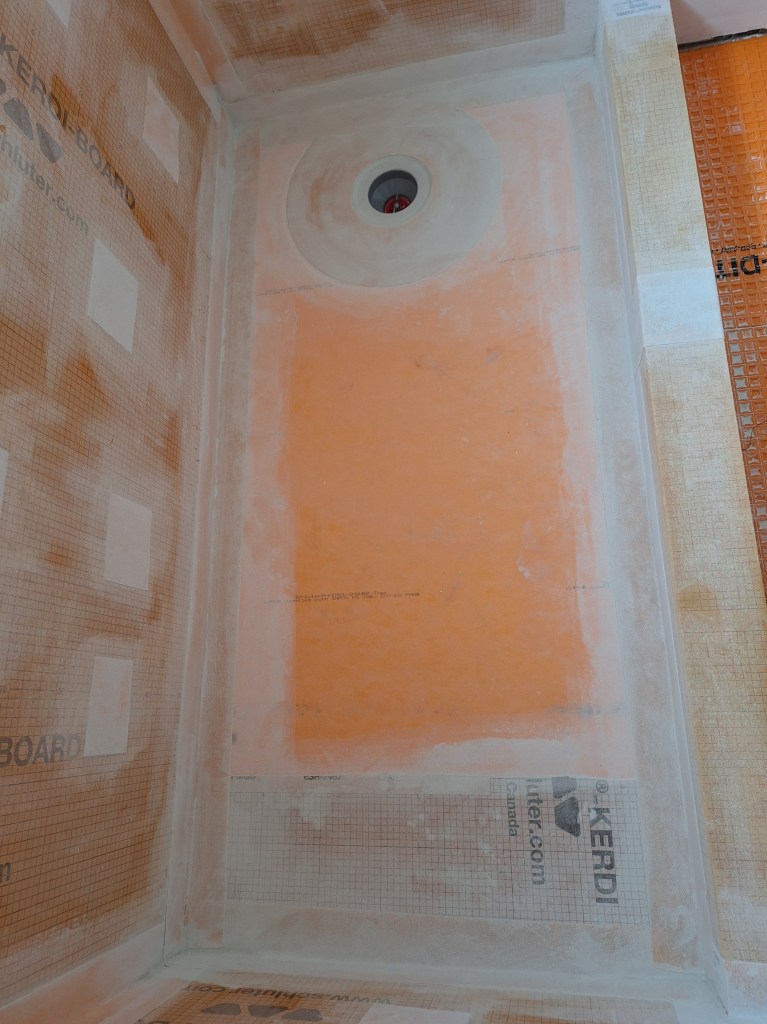
Shower Pan Waterproofed

The seem between the two sections of curb was also wrapped.
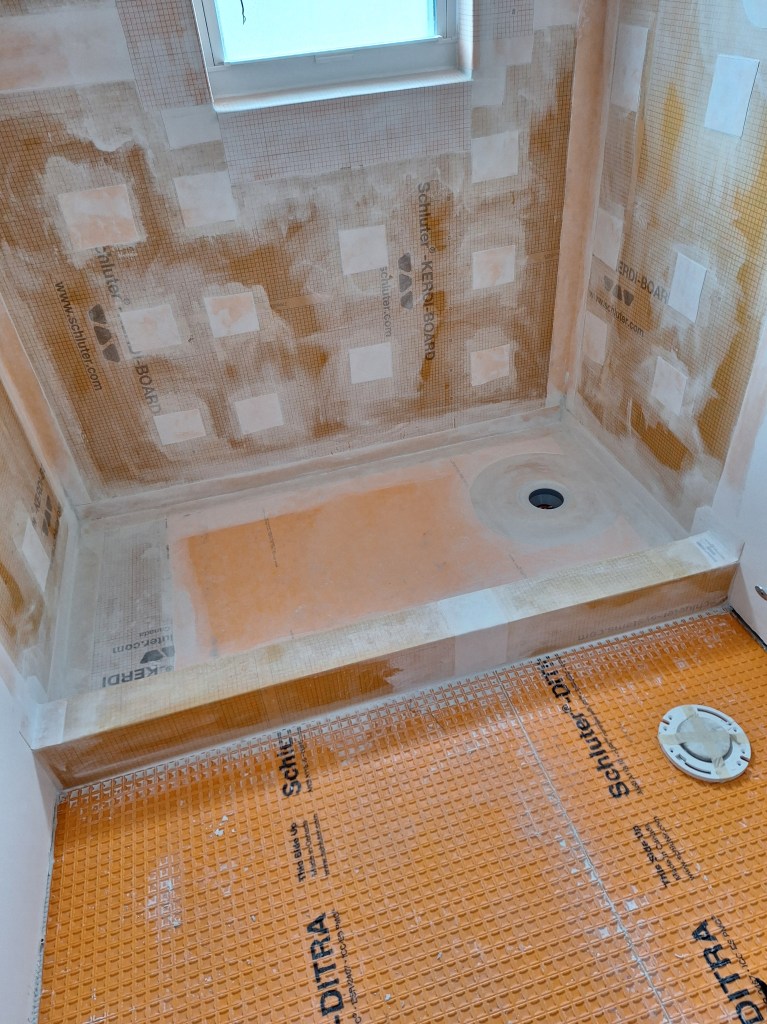
Shower Pan Waterproofed

Once the thin-set used to set the Kerdi band was dry, the shower should be waterproof. To ensure this is the case, I filled the shower pan with water and left it overnight.

Shower Pan filled with Water

After I was confident there were no leaks, I scheduled another inspection so the inspector could witness that this had been done, which went without issue.

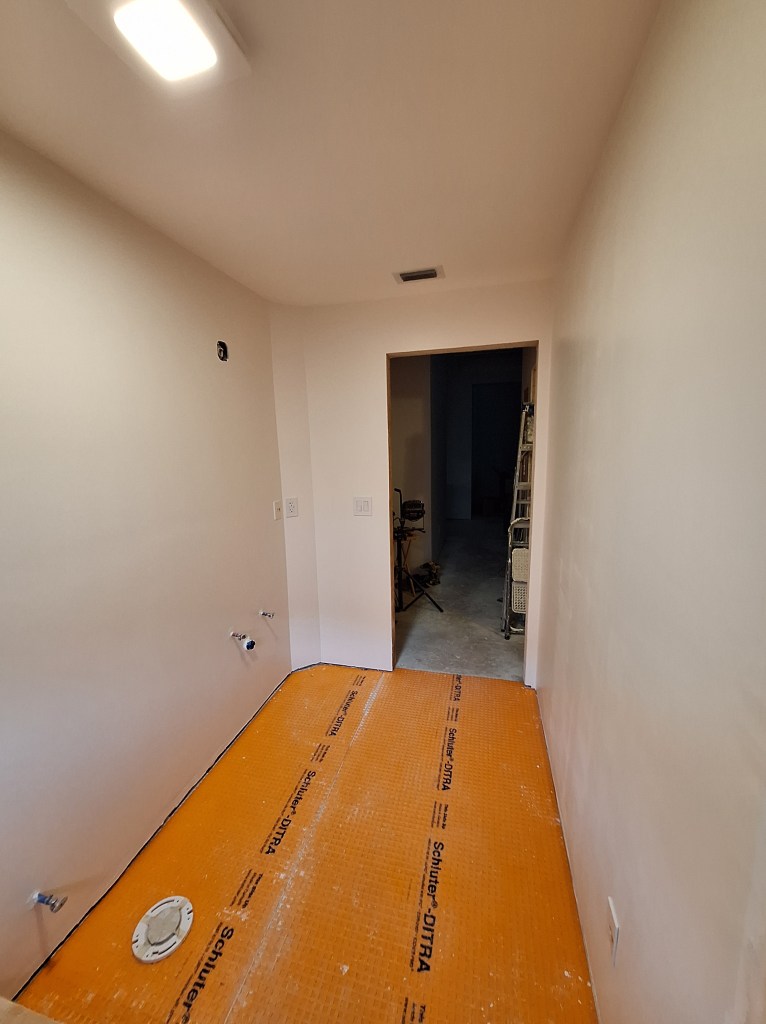
With the water test inspection done, I was free to tile away. However, I had yet to select the tile I would use. I spent some time exploring this, but in the end decided to use the same scheme I used in the master bathroom. I know that is not very adventurous, but I really liked that scheme and did not want to risk introducing something I might regret later. So I placed the order and then had to wait for them to arrive. In the meantime, I decided to paint the walls and install the switches and outlets. As in the master bathroom, I used the Behr equivalent of Sherwin Williams’ Alabaster with a satin sheen.
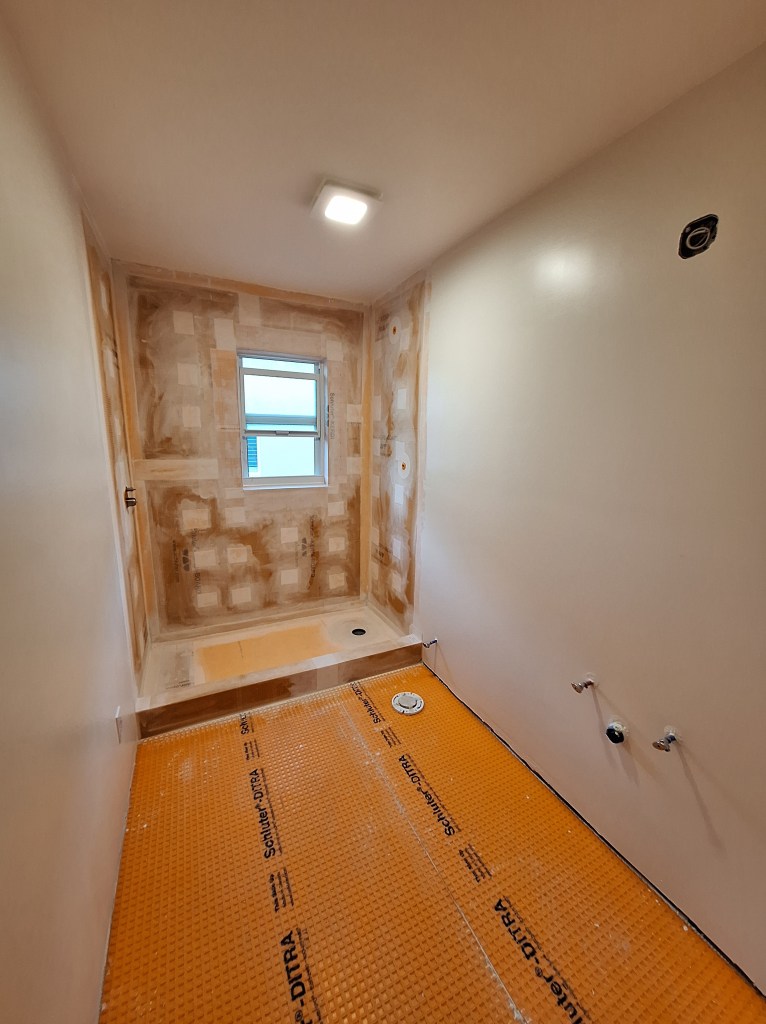
Walls Painted
Walls Painted

With the switches installed, I can now illuminate the room with the light from the vent fan. The vanity lights have yet to be chosen, so that junction box remains exposed. I also added the face-plates for the Ethernet cables.

I had intended to continue this post with at least the floor tile and shower floor tile installed before I stopped work for the holidays (mid-December), but tiles took longer than expected to arrive and I got extremely busy with social commitments. Fortunately, this down time worked to my advantage with respect to the social commitments, giving me the time I needed to attend to them. At the time of writing, I have just over a week before I go away for the rest of the month, returning after the first week of January. With more social commitments upcoming (it’s the holiday season, after all) I’m not confident I will be able to do anything more before I leave, so I will end the post here. If I do manage to do anything before I leave on vacation, it will appear in my next post.
Kitchen – May 2023

As I did in April 2023, I divided my time between work on the kitchen and master bathroom and, just like last month, I’ve created two separate posts. The work in May started in the kitchen, so it’s best to start with this post. Within it I’ll mention when I switched to working in the master bathroom, which you can choose to jump to if you wish to follow the sequence.
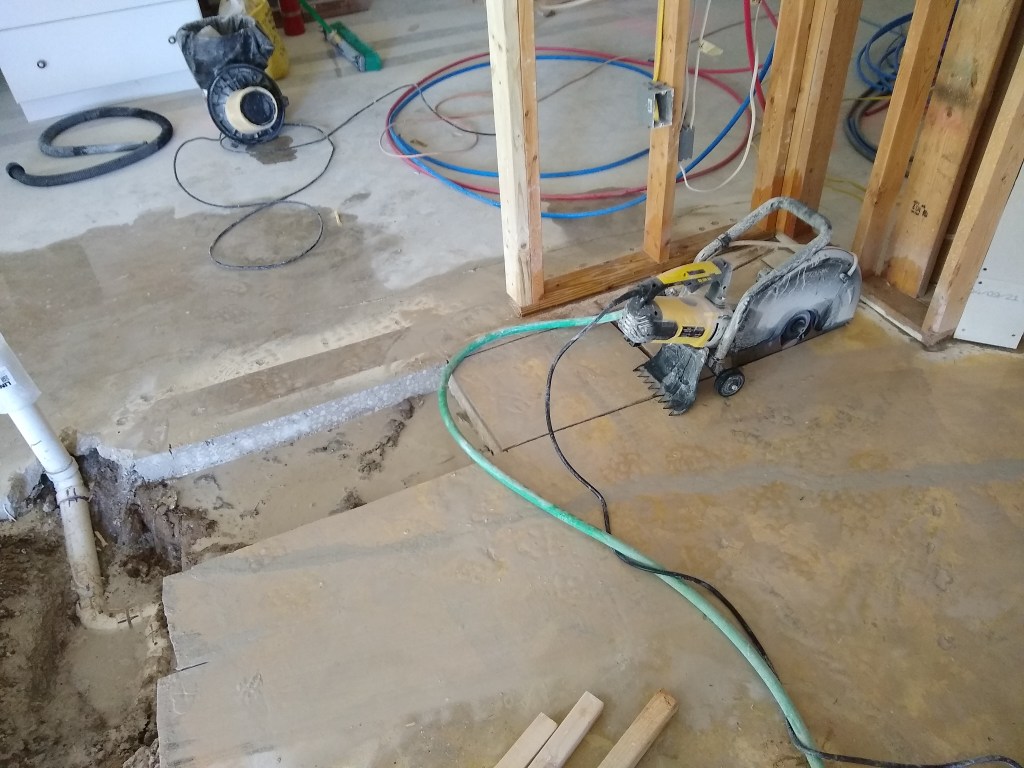
My concrete saw arrived right on time, but the blade took a week to arrive, which was frustrating. I was keen to get going. When the blade arrived I got right on it and started extending the existing trench at a 90 degree angle toward the small wall where the services would be. Below you can see that I removed half of the trench and am working on the second half.

Trench partially done.

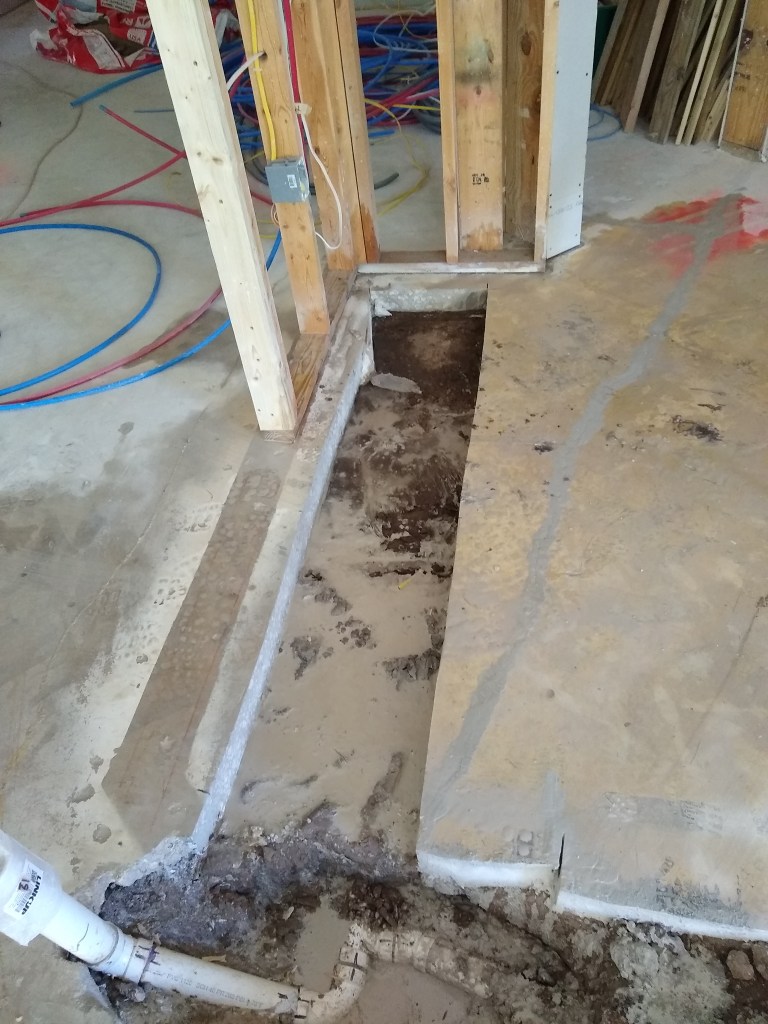
I was happy with the performance of the saw. It is rated at 15 amps and I had it plugged into a 15 amp circuit, so I had to go easy with it, which I discovered the first time I tripped the breaker. It was a bit tricky getting into that corner. I got as close as I could. Here’s as far as the saw would take me.

Trench cut.
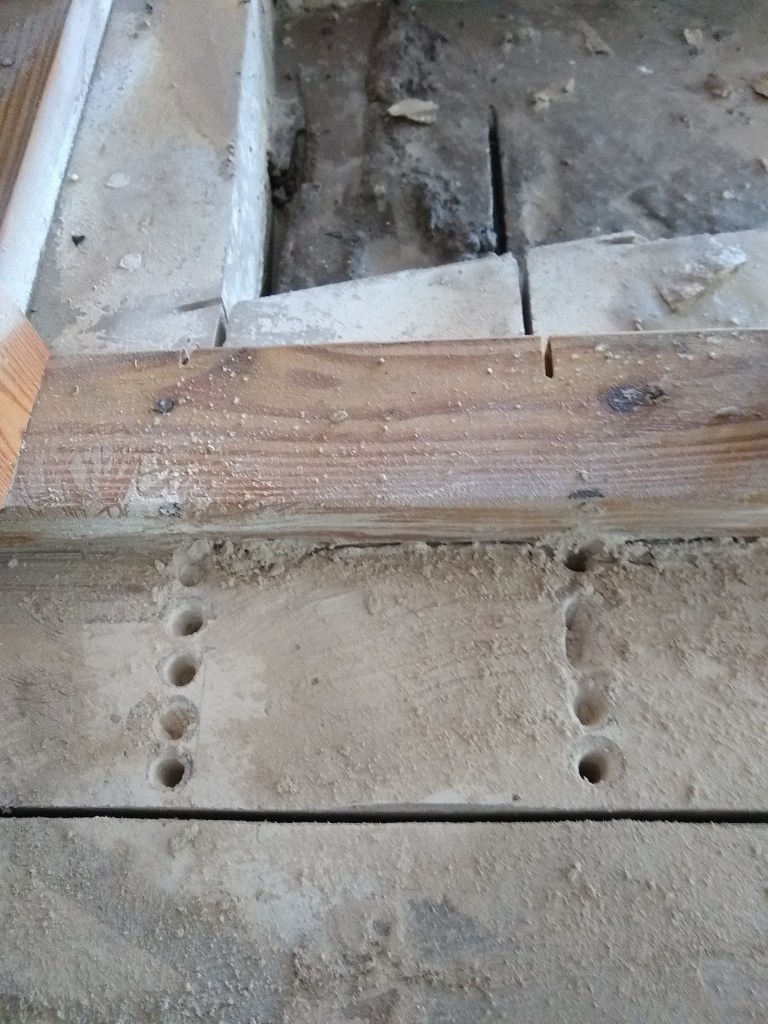
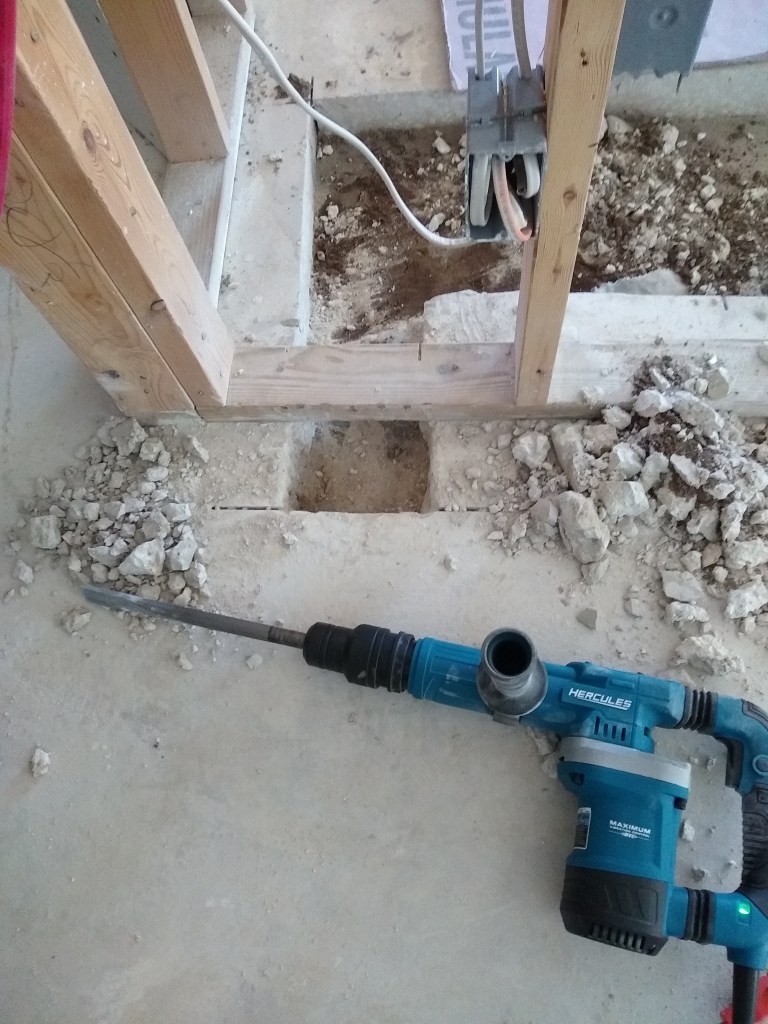
The next part would be tricky because I had to remove the concrete from under the bottom plate of the wall so I could feed the water and electrical lines down. I used my big honkin’ saw to get as close as I could, but resorted to a drill bit and cold chisel and hammer to get the rest of it.
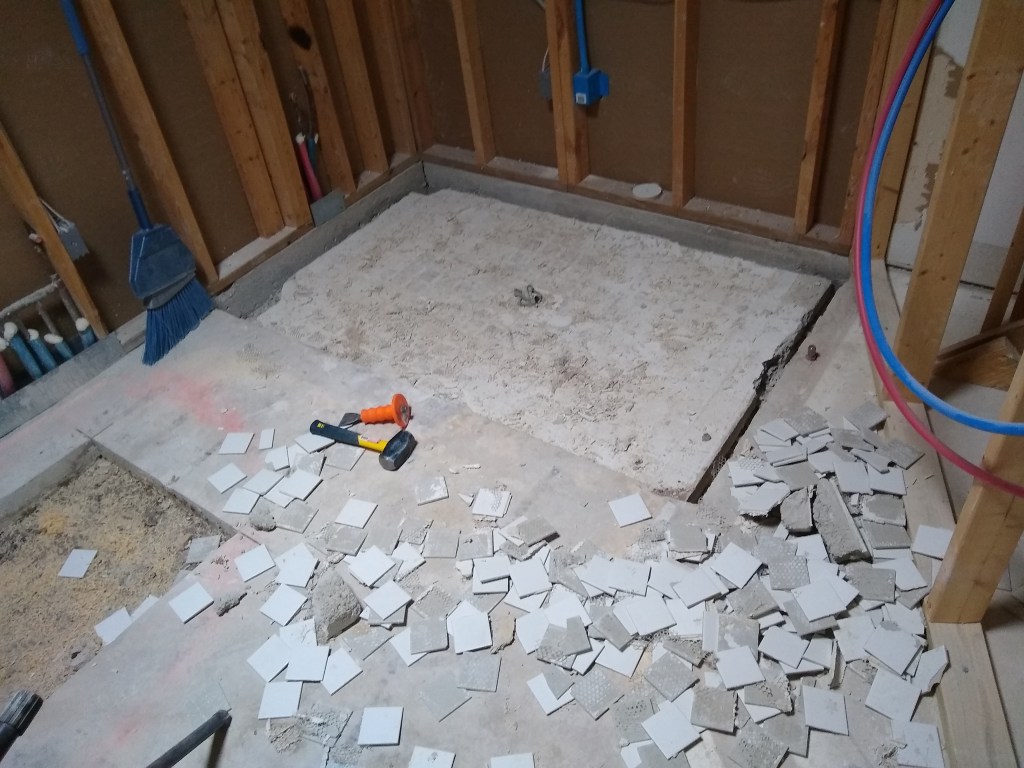
Working on trench under Bottom Plate.

You can see how I used the saw to get as close to the bottom plate on the one side (cutting into the plate a bit) and how I used the saw again to give me a starting point on the other before resorting to the drill. I chipped away at this for some time using a hammer and cold chisel before giving up. So I went home to look into renting a small powered jack hammer. While exploring that option, I decided to buy one instead since I expect I’ll need it for the two showers too. So I picked one up from Harbor Freight and it made quick work of it.

Tench under Bottom Plate complete.
Trench under Bottom Plate complete.

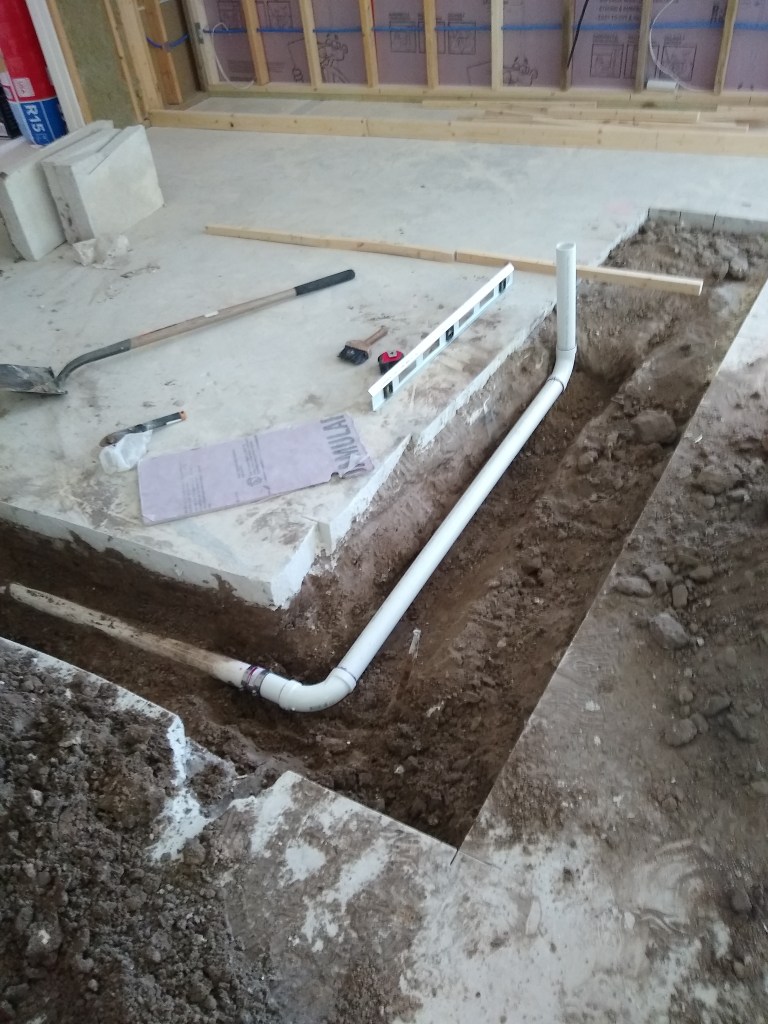
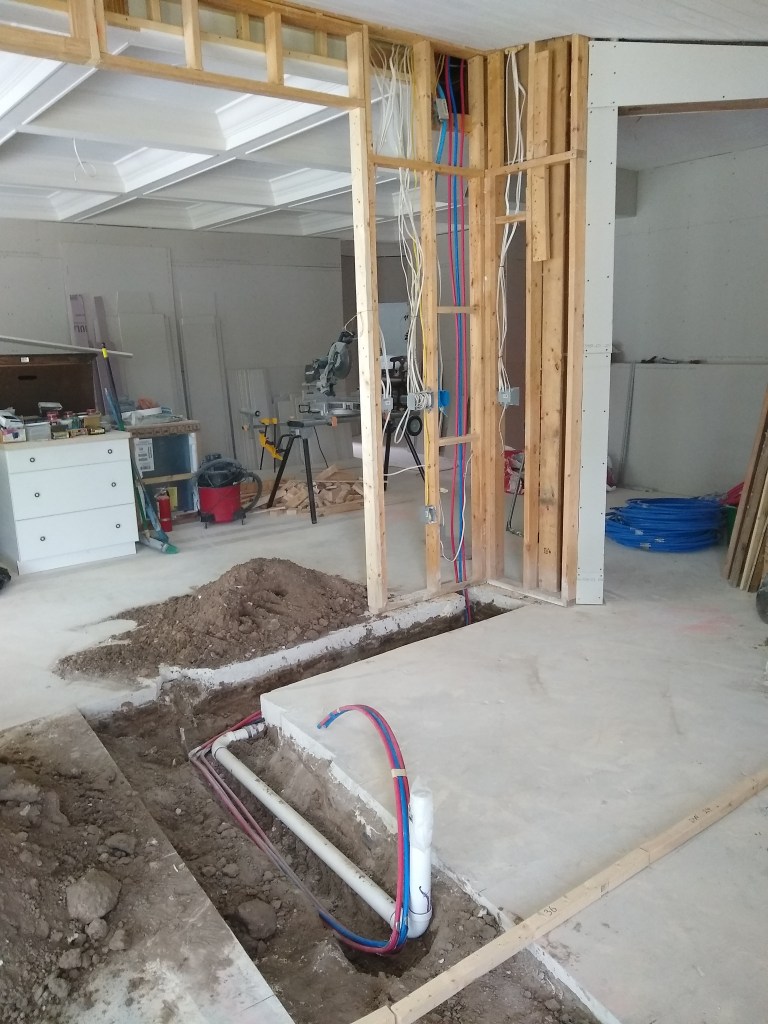
Next, I cleared away the dirt to get at the existing drain and connected the new section to it, as shown below. The new section will come up into the bottom of the cabinet that will house the sink. The dishwasher, which will be located next to the sink cabinet, will also tie into this drain.

New Drain Installed

I placed a hose in the drain and ran the water for a while, feeling under the joints for any sign of leakage. The joints were well sealed, so no evidence of water around them.

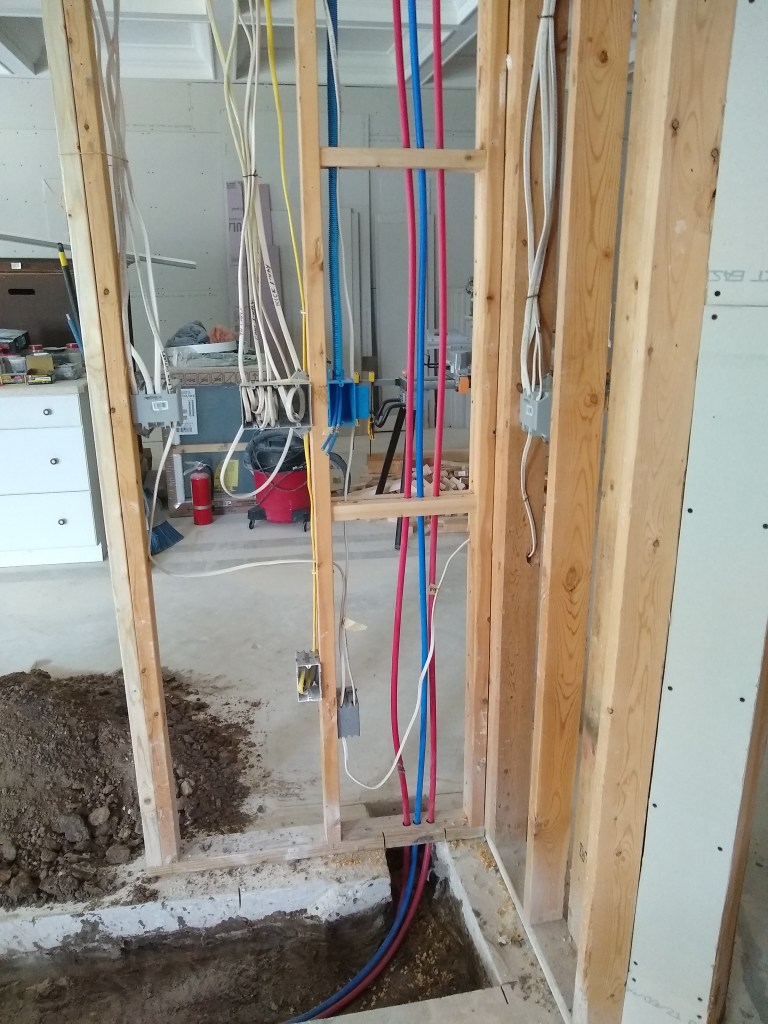
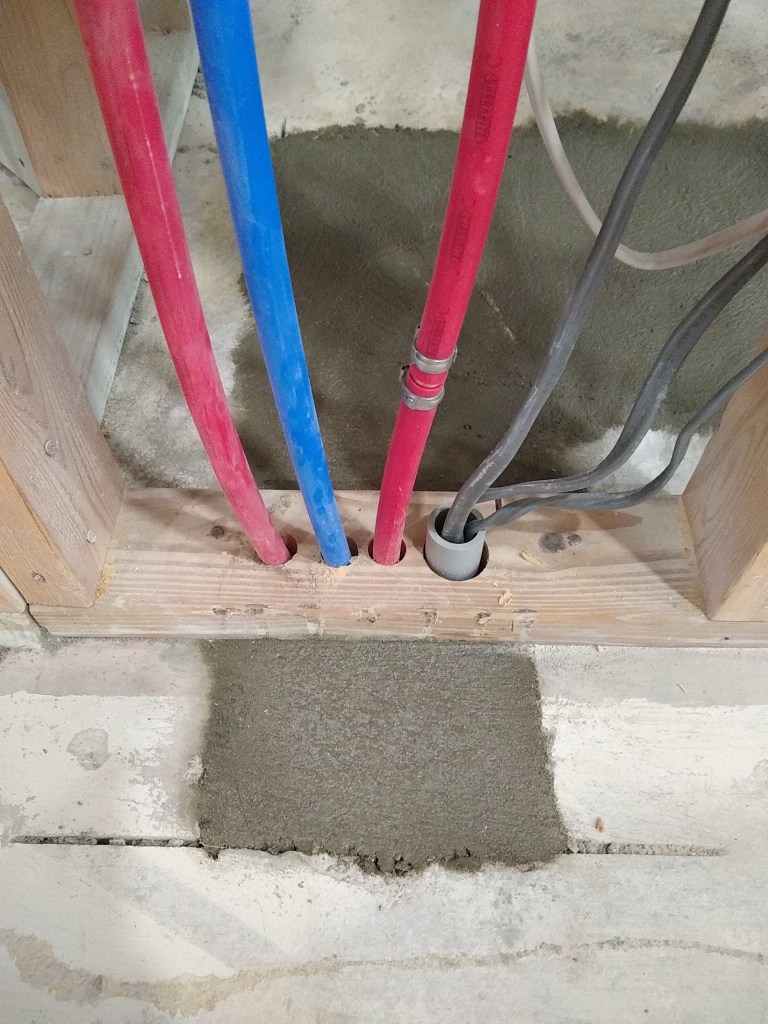
Running along side the drain are the water supply lines for the sink (red and blue) and dishwasher (red).

Water Lines in Trench

Here they are coming down from the ceiling entering the trench. Note the bracing I added to support the lines within the wall.

Water Lines entering Trench

Here is another angle.

Water Lines emerging at Island

With this done, it was time to call for a plumbing inspection. I had to wait a day because it was the weekend, so I shifted my attention back to the master bathroom (see that post).

The inspection went well and I used the time to ask about how best to run the electrical lines to the island. Online there were differing opinions about whether one should use a conduit under a slab. After speaking with the inspector he said that no conduit was needed if you used underground feeder (UF) cable, which is what I was planning to use. This is considered fine for direct burial. However, he recommended I use a conduit anyway, so that’s what I did. So off to the store I went to pick up a 1″ conduit that would house 3 wires (two 12/2 wires – dishwasher and GFCIs, and one 14/2 for kick plate lighting).

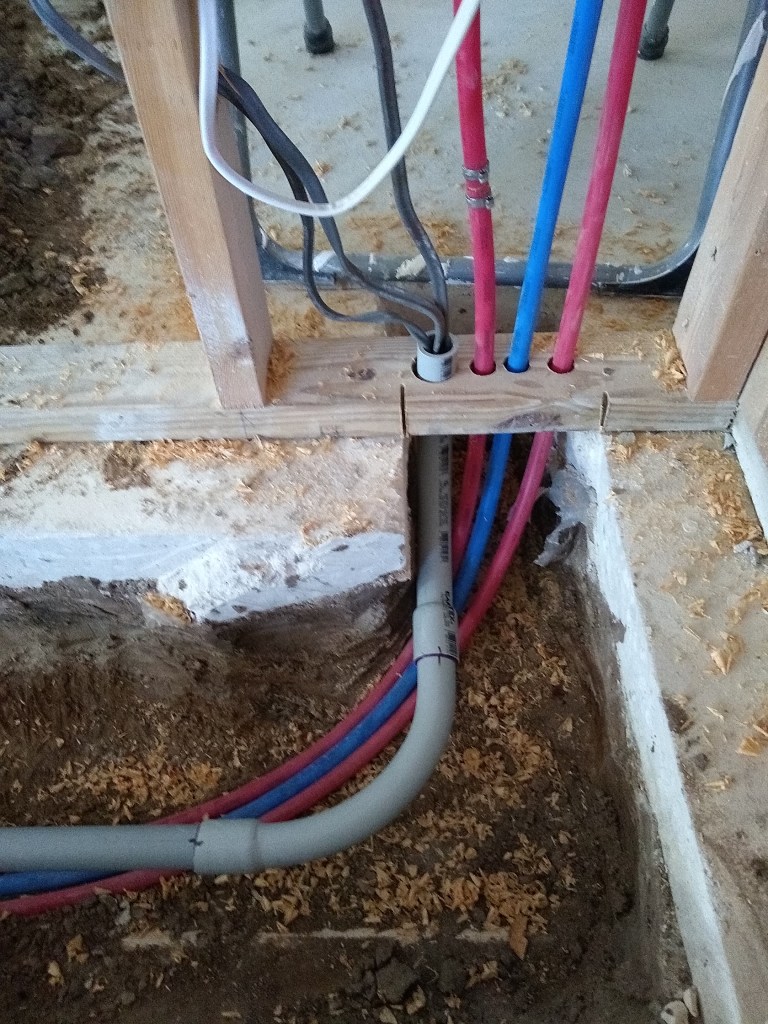
A wire fishing line was required to pull the wires through the conduit. I pulled one at a time. The last one required a lot of effort because the space in there was getting limited. Here are the wires entering the conduit from the wall.

Wires entering Trench

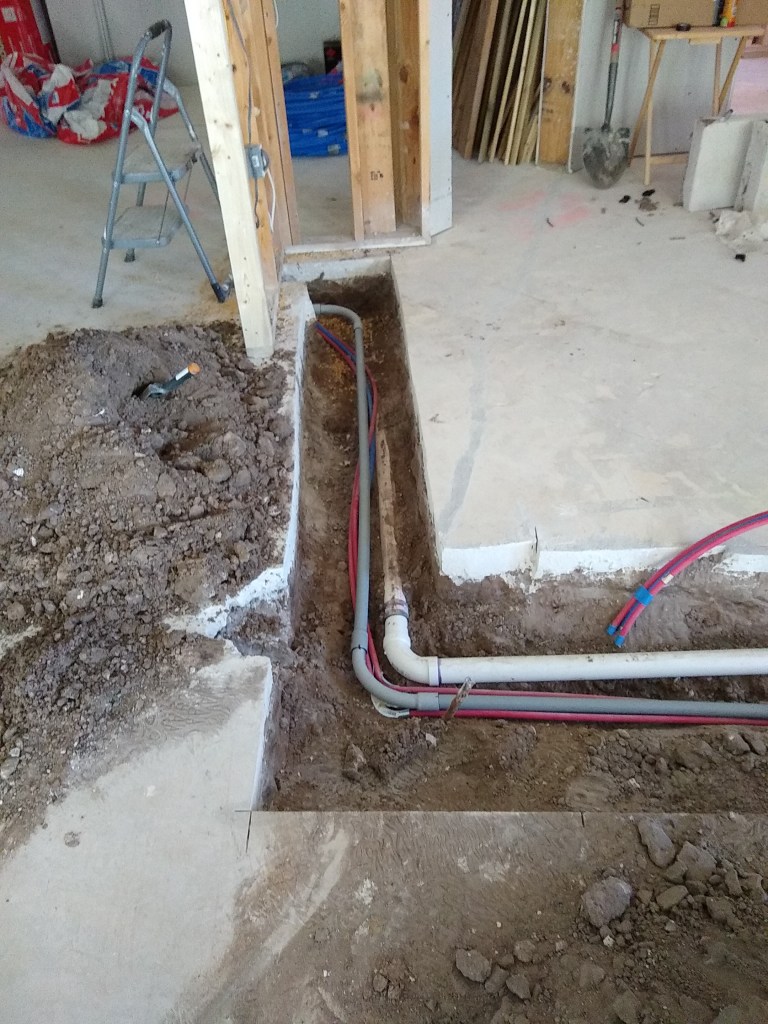
Here they are en-route to the island.

Wiring En-route

And here they are emerging at the the island location.

Wiring at Island

The conduit was made up of a single 10 foot section of PVC and four 90 degree bends. They are glued in the same was as the drains. Before entering the conduit, I put the wires in their respective junction boxes ready to be hooked up. The wire for the dishwasher was not long enough, so I introduced a junction box in the attic where I spliced in a new length of wire that would reach the island. I wired it up and tested it.

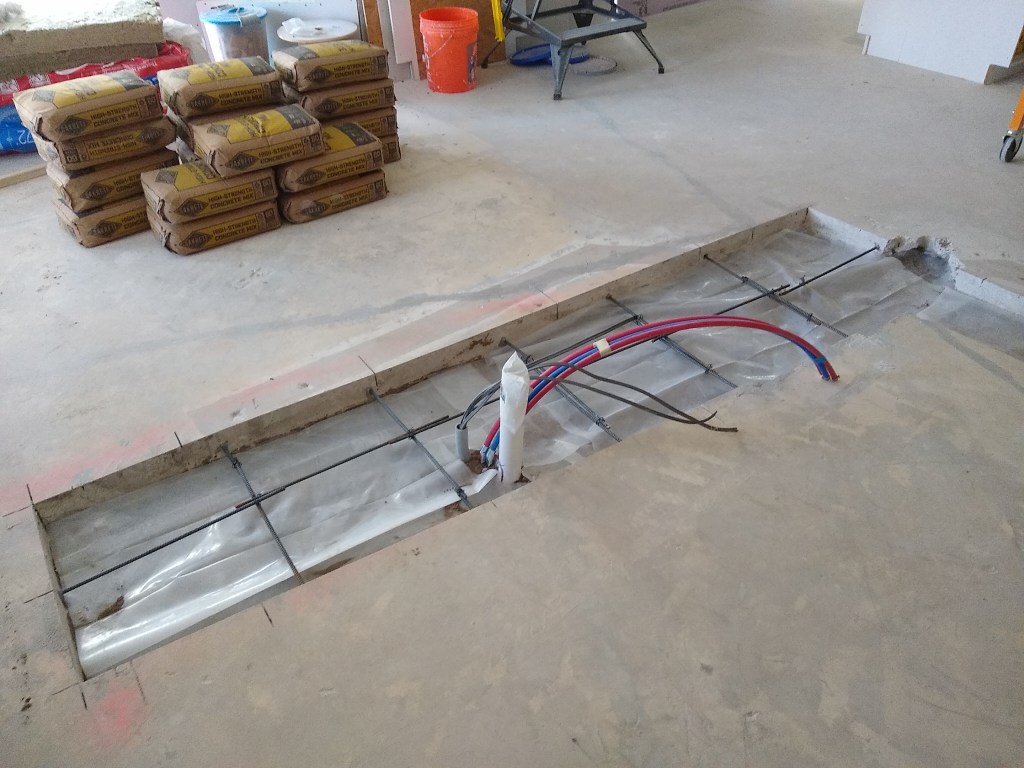
So it was time to get this inspected. While waiting for the inspection I drilled the holes for the rebar. Rebar is needed if the width of the trench is over 22 inches, so I only needed rebar along the wide section of the trench. The part of the trench that runs along the wall is only 15 inches, so that does not require reinforcement. Shortly after drilling the holes, the inspector arrived and gave me the okay to fill in the trench, as you can see below.

Dirt added back to Trench

I had a couple of days to wait the pest control guy to arrive and treat the soil for termites, so I returned to work on the master bathroom. I also made a run to the store to get all the concrete I would need. I estimated seventeen 60 lb bags based on what I used in the master bathroom, which, coincidentally, was about the same amount of area to fill.

After the soil was treated, I prepared the trench for the pre-pour inspection, which was scheduled for the next day.

Ready for Inspection

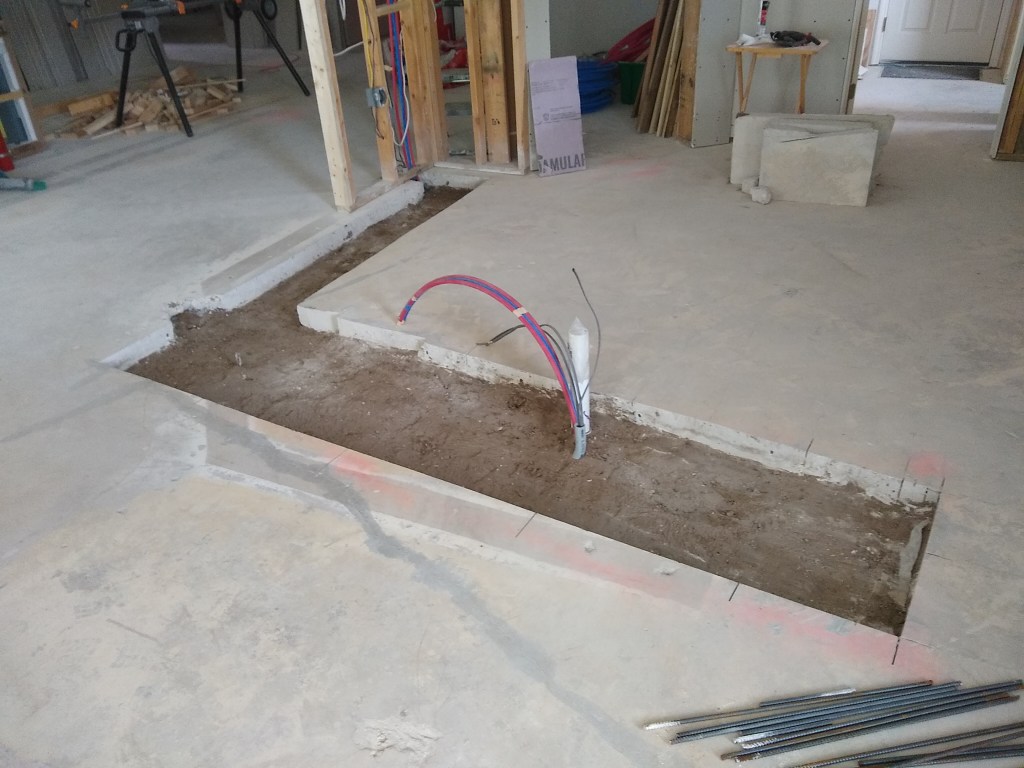
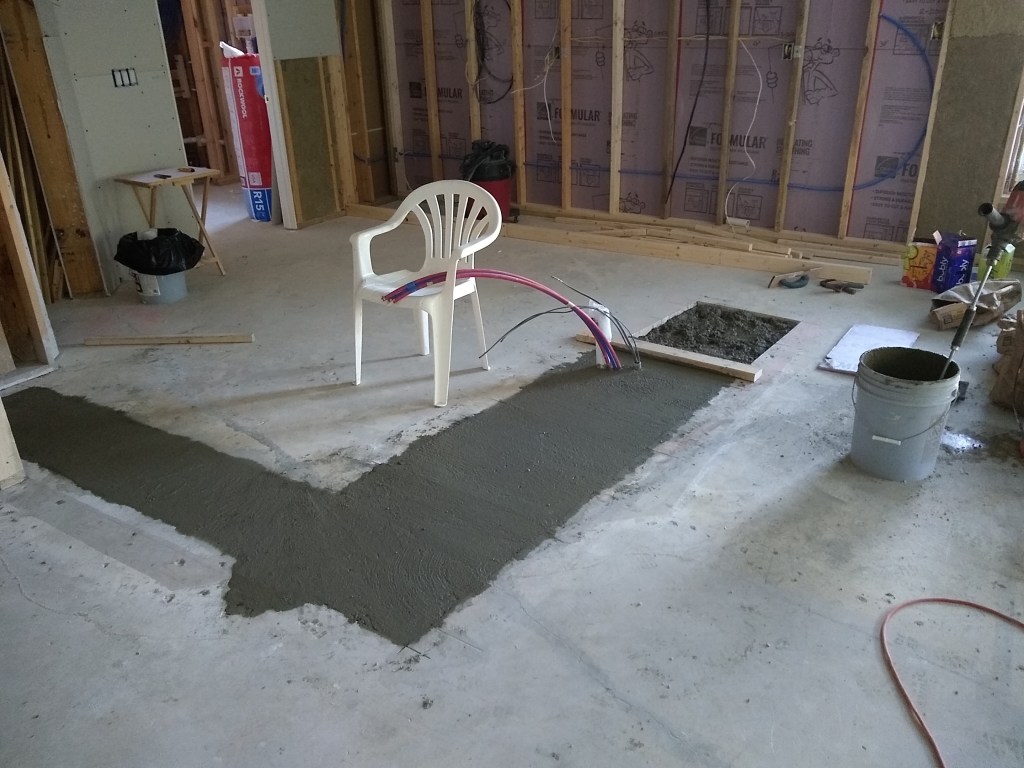
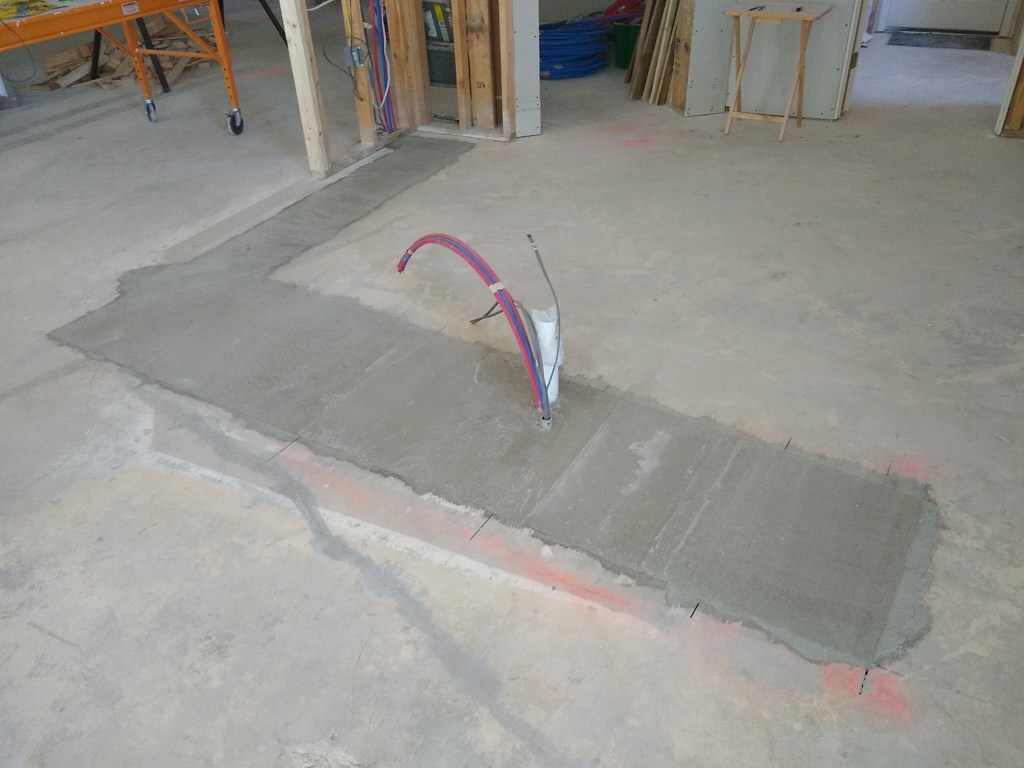
The inspection went without incident and I began the process of filling in the trench with concrete.

Trench Almost Filled
A closer look of Work in Progress

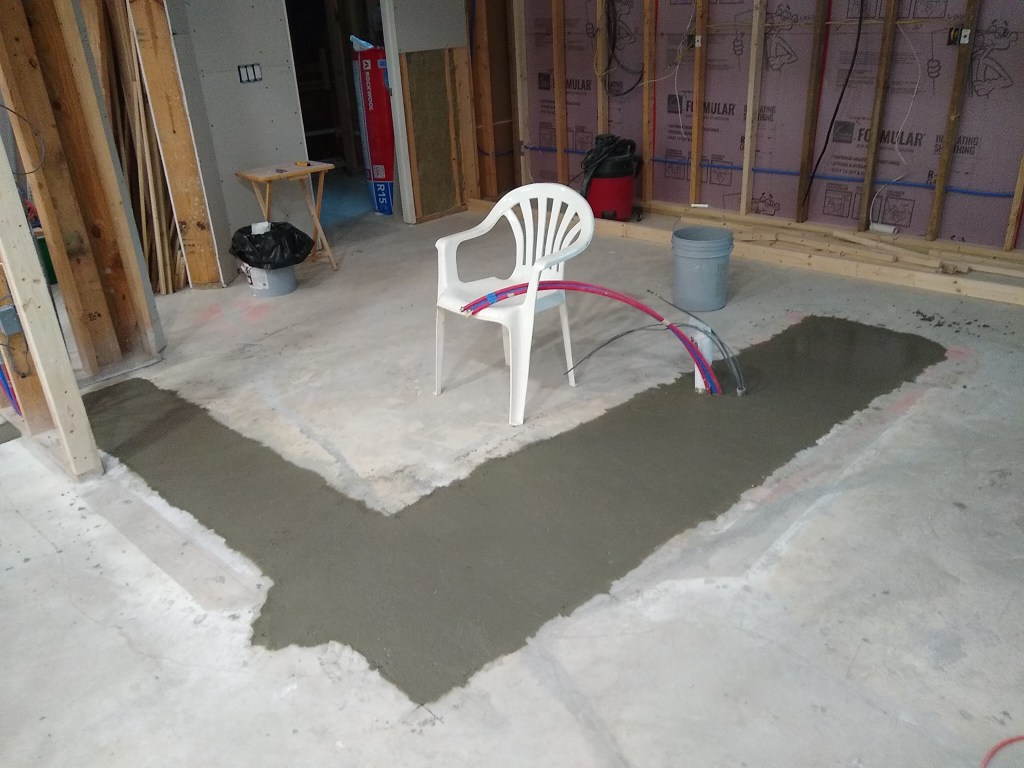
And here it is finished.

Trench Filled

Here are a couple of closeups of the area where the services enter.

The next day it looked like this.

Trench Cured

You might be interested to learn that I used almost all of the seventeen bags I bought. There was very little waste, so I was pleased. After this I returned to the master bathroom to start removing the existing shower pan.

As mentioned in the post about the master bathroom for this month, I had a period where I had to wait on deliveries, so I decided to grind smooth the concrete I had poured in the master bathroom and kitchen. Here is an image of the trench in the kitchen after I smoothed it out.

Trench Ground Smooth

That’s all for the kitchen in the month of May.

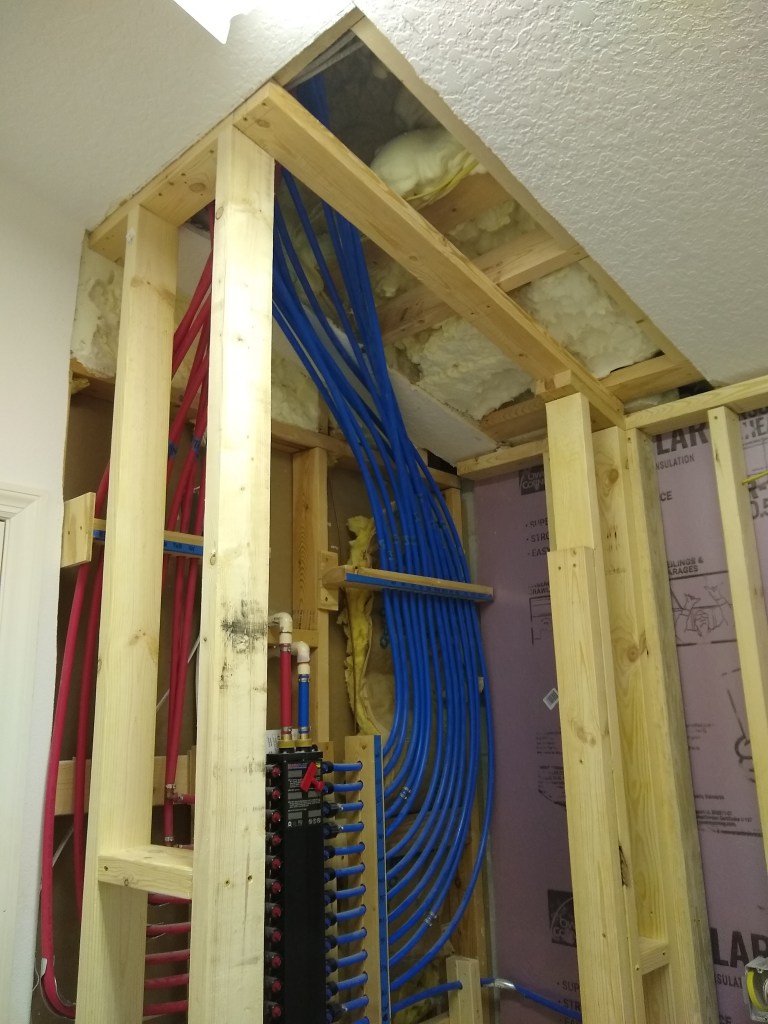
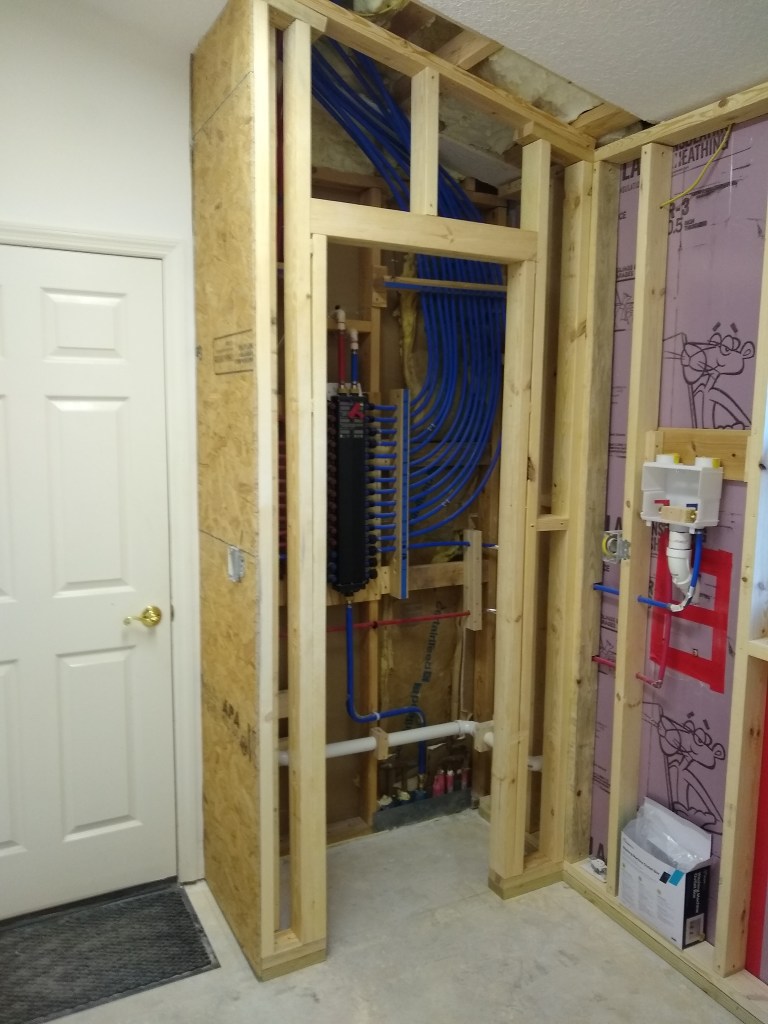
Plumbing Closet and Bits and Pieces – September/October 2022

In my last post I ended by stating I would call in an inspector for the framing. I did that and the inspector showed up, but unfortunately I was not ready for a framing inspection. The inspector informed me that, although I had completed (most) of the framing, it is not ready for inspection until the plumbing and electrical are done because they can impact the framing. So that was good to learn.

I also mentioned at the end of the last post that I had a problem to fix that was of my own creation. In the front bedroom that will become the workshop, the door opening was not right. The right side was wider than the left (as you enter). You can’t hang a door properly with that.

Although in the above shots it’s hard to see the problem, I show them so that you can get some idea of the repair that took place. I pulled down the drywall in order to get a better idea of what was going on.

From what I could tell, the furring strips where the problem. I had not accounted for the extra thickness they added on the other side of the door opening. But rather than adjust for that, I decided I would frame the entire wall as I had done with the master bedroom and the like. That would provide the same benefits and solve the alignment problem too. So that’s what I did.

Wall section Framed

With that issue fixed, I started working on the electrical and plumbing that would affect the framing. This involved adding new wiring and and securing the existing wiring to the new framing. I started by adding ample outlets to the east wall of the garage. These will be GFCI protected and required 12 gauge wire.

For the master bedroom I ran some new wire under the large window so that one of the outlets next to the bed will be controlled by a switch as you enter the bedroom. Another outlet in the master bedroom was already controlled by that switch, but it was in a place that was of no use to me, so I rerouted it.

Also in the master bedroom, I fashioned a couple of supports to secure the conduit for the Ethernet and the PEX pipe for the spigot.

PEX and Conduit Secured
A Closeup

I secured the laundry room outlets for the washer and dryer.

Although not required for the framing inspection, I removed the tiles from the floor of the master shower. I had been watching a lot of YouTube videos about how to create a shower pan, so while I was “in the neighborhood” I decided to take care of that task.

I then moved to the laundry room to hook up the drains for the washer and the utility sink (that will be relocated to the garage) and their respective supply lines.

Washing Machine Box with Drain and Supply Lines in place
Drain and Supply Lines in place for Utility Sink (to go on other side of wall).
Big Picture

With the laundry room plumbing hooked up, I could now start building the closet to enclose it. I started by opening the ceiling some more so that I could install nailers to support the framing that was to come.

After that I attached the bottom plates for the closet. The closet will have a 24″x80″ bi-fold door, so the opening you see below will accommodate that.

Ready for Framing the Closet

Although it is just a small closet, the sloped ceiling made it a bit tricky. I was only able to get two sections put up that afternoon. I was hoping to do it all in one day.

If you look closely at the section next to the garage door, you’ll notice that there is no vertical framing member up against the adjoining wall. This is because I did not have the room for it (the red PEX pipes are in the way. Because of that I will add OSB sheathing along that side to provide extra support for the drywall when it goes up. It will be tight, but there will be a small gap between the drywall and the garage door casing when it’s all done.

The next day I was able to finish the framing.

Plumbing Closet Framed

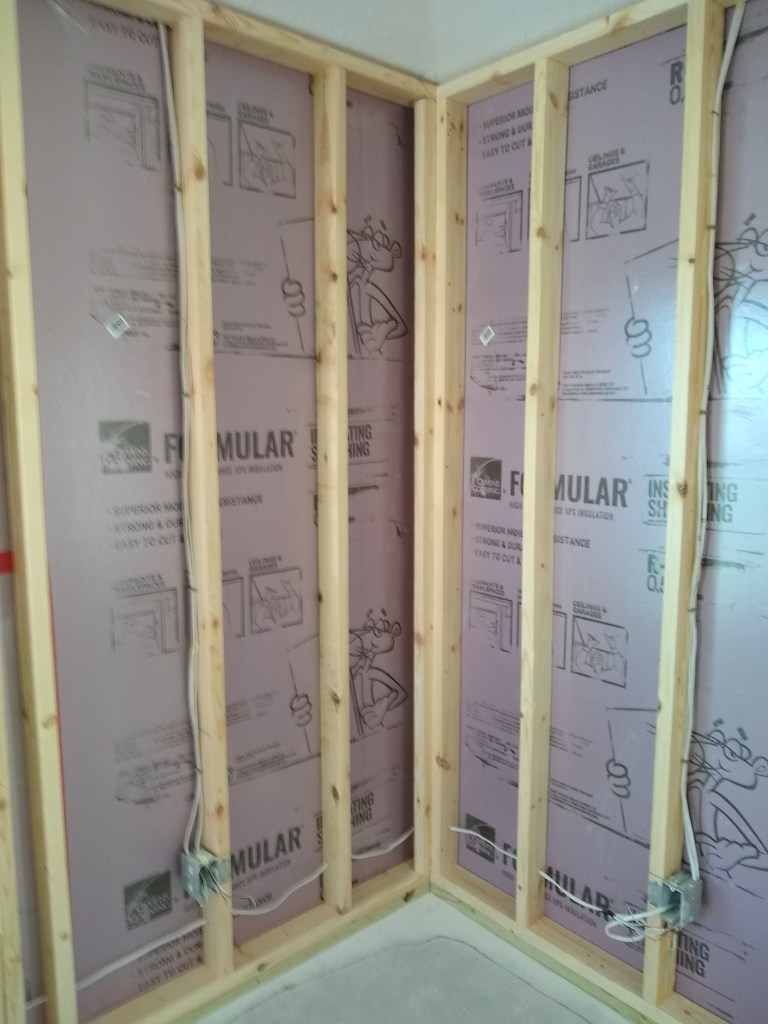
Here you can see the OSB sheathing I mentioned above. The opening in the ceiling outside the closet will be drywalled. I made sure there was sufficient nailing surface for that. I don’t think I will do anything inside the closet to pretty it up; only add insulation. There are places where I could add drywall, but I don’t think I want to close anything in. I want to be able to get full access to all the plumbing, so I think it will remain raw. I can always change my mind about that later. I also may find that I want a light in the closet some day, so keeping it unfinished makes that easy.

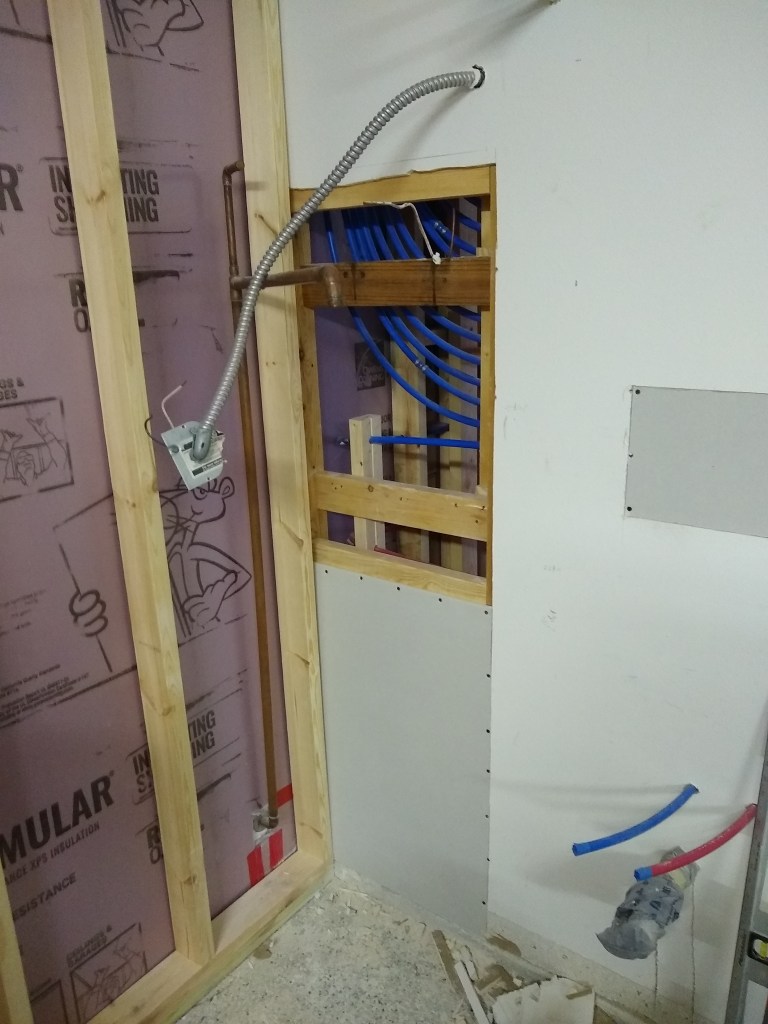
The remaining work related to the plumbing closet involved wiring up the 3-way switch, moving the switch in the garage for the garage light, and patching the opening I left when installing the PEX. Here’s a reminder of that big hole.

And here is the repair.

From the image on the right (above), you can see where I moved the switch for the garage light. In the original position it was a bit of a reach. Because the switch box for the 3-way switch for the laundry room light was occupying that space (nailed to that stud), the original builders used the next closest stud to attach the switch box for the garage light. Since I had to move the 3-way switch to the side of the plumbing closet, that space became available, allowing me to move the garage light switch to the more convenient location.

Above left is the newly hooked up 3-way light switch positioned on the side of the plumbing closet as you enter the laundry room from the garage. In the image on the right I’m showing the wiring behind it. Notice that I had to introduce a junction box to extend the existing wires. Even though the switch was only moved a foot or so from its previous location (just around the corner), there wasn’t enough slack to make up that small distance. Since I had to add extra wire, I decided to move the existing wires to a location within the closet that was less likely to interfere with the red plumbing lines, which is why you see them coming down from above.

I still have more plumbing and electrical work to do before I can re-request a framing inspection, but some of that is dependent on the design I’m waiting for. I’ll be meeting with Jennifer (the designer) this coming week, so I hope to have more information to guide my next set of tasks and the content of the next post.