After returning from vacation, the plan was to turn my attention to the garage workshop. The idea was to prepare for the upcoming trim work that was facing me inside the house. A lot of thought went into it, but no real action. I was considering getting several new pieces of equipment, including an 8″ jointer, a cabinet saw, and something for dust collection. Some of these would require new 240 volt outlets. The table saw and jointer are both large machines. I have limited room in my garage so both would have to be mobile so they could be moved to the side to make room for the car. After considerable thought, I decided to not buy anything, yet. Instead I decided I would see if I could make do with what I have and only buy something when not doing so becomes painful.
While that was going on, I decided it would be best to focus on the things that would have to be ready in order for me to move in, which would be mid November. Some low hanging fruit was adding hardware to the master bathroom.
Towel Hook
Towel Rod
Toilet Paper Holder
Shower Towel Hook
Since the towel rod is not right beside the shower, I added a hook to hold the towel while showering. I did not want to put a towel rod on the wall outside the shower because, if hung in the usual location, it would cover the switches.
Before moving in, I really needed to have the backsplash behind the cooktop installed. In the last post I mentioned that I planned to run the black granite up the wall. That was the plan, but the installers were really dragging their feet on this. I also asked them for an estimate for the vanity in the guest bathroom but, again, nothing. So while that was in limbo, I decided to have the tree in the front yard removed. It was something I figured I would do after I moved in, but given the limited activity, I decided to initiate that process. Fortunately, the company I contacted to do that was very prompt and responsive.
Tree Before Removal
Tree Before Removal
As you can see above, the tree was pretty ugly. Knowing it was going to be removed, I did not have it trimmed, so it was getting really crazy. It was a Live Oak, and was really not suited to this small a plot. The root system is extensive, so it would eventually mess up my driveway. Also, it sits atop the drain that leads from the house to the city sewer system, so that could be impacted too.
Tree Removed
Remaining Stump
After Stump Ground Down
I will leave what you see above until the spring before sodding that area. It needs to settle for some time.
Returning to the cooktop backsplash, I contacted someone else to get an estimate, since my countertop installers still hadn’t responded. I got a much higher quote. Shortly after that, I did hear from my countertop guy, and he was expressing some concerns about the weight of the slab for the backsplash. It would be a very heavy slab. So that got me thinking of alternatives, and I decided to abandon the granite and instead opted for an embossed stainless steel backsplash with a diamond pattern. It would look really nice, be easy to clean, and would not introduce any weight issues. So I found someone to do that work and initiated the process.
While that was going on, I took care of a small but nagging issue that needed to be done before I moved in; mainly adding the remaining Ethernet keystones and faceplates. I wasn’t looking forward to this because it is fiddly work, but I was pleased to have it done. Here are some of them.
Keystones 17 and 18, in Kitchen.
Keystone 21, in Master Bathroom.
Once each of these is wired up, they have to be tested for connectivity (I have a special tool for that). If the connectivity is good, then I plug in my laptop and make sure it connects to the internet. Once that it confirmed, I insert the keystone(s) into the faceplate and attach the faceplate to the wall. After that is done, I verify again that the laptop can get online. I do this second test because, when attaching the faceplate, the keystone gets pushed into the junction box, which can disturb the connections. Fortunately, that did not happen on any of my installations.
With that done, I hooked up the washer and dryer. They certainly need to be working before I move in. I started with the dryer because it needed a couple of modifications before I could use it. The first was to simply reverse the door. In its current setup, the door would swing open toward the washing machine, making it awkward to transfer clothes from the the washer to the dryer. That was a pretty simple operation. The other thing I had to do was change the way the dryer vented. In its current configuration, it would vent to the left (toward the washer). That needed to change so it would vent out the back where it could connect up to the exterior vent. This proved to be quite an undertaking.
Original Vent Location
To move the dryer vent from the side to the back required that I disassemble the dryer (really!). I found a YouTube video that walked me through it, so that was great, but far more than I was expecting. So I moved the dryer into the living room where I had more space to work and started opening it up.
Disassembly Started
What you see above is the top and front door assembly removed. The control panel is resting on the frame and drum. That was just the start. To get access to the vent, the drum would have to be removed.
Dryer Door and Drum after Removal
Drum Removed
With the drum out of the way, I had access to the area where I would install the vent pipe. Below you can see it installed.
Straight run of Pipe out to the back of Dryer
The turn after Exiting the Dryer
Something of note here is that the pipe that was installed before (the one that vented out the side) was very poorly installed. When I pulled it out I noticed that it was not sealed with foil tape. Instead, the installers simply lined up the sections of pipe as best they could and used foil tape to keep them together. Because they did not take the dryer apart like I did, they had very limited access, so they would have simply reached in as far as the arm would allow and tape the pipe sections together as best they could. They would not have been able to wrap the foil tape fully around the pipe, which is what I saw. Having no experience with this, I was oblivious. It worked, for the most part, but would have leaked a lot, which would have heated up the room, making my A/C work extra.
With the new section of pipe in place, I reassembled the dryer and used a flexible foil pipe to tie it to the section of pipe in the wall that leads to the outside.
Flex Pipe to the Outside
Here it is installed (sort of).
Dryer Installed (for now).
I turned it on, then went outside to verify that it was venting well, which it was. As you can see, I have kept it on the dolly. Since the dryer will have to be moved some day when I install baseboard, I decided to leave it on the dolly. A dryer doesn’t spin at a high rate of speed like a washing machine, so it doesn’t need to rest as securely on the floor. So this should be fine for the foreseeable future.
The installation of the washing machine was a much simpler matter. I did not need to make any modifications. I simply needed to remove the shipping bolts I installed before moving it from the other house, and then connected the water supply and lines put the drain pipe in place.
Washing Machine Installed and Running
Unlike the dryer, I could not leave this on the dolly. It needed to be on solid ground and level. To test it, I ran the “tub clean” program, which takes more than an hour. It was a good test and the tub was in need of a good cleaning. There were no leaks and it ran smoothly.
Another thing that needed to be sorted out before I could move in was having something on which to hang my clothes. The two closets in the master bedroom were blank slates. Eventually I will create a custom solution tailored to each closet, but for now, I just needed something that would do the job and not cost too much. I found a pretty inexpensive rack online and purchased it to see if it would work.
Large Rack in Large Master Closet
Large Rack with some Stuff added.
I was very pleased with this. It was easy to assemble and very light weight, yet was strong enough to hold anything I planned to put on it. It fit nicely along the long wall in the large closet, so I decided to purchase two additional racks from the same company, but just a bit smaller. One would also go in the large closet, and the other would fit nicely in the small closet.
Small Rack in Large Master Closet
Small Rack in Small Master Closet
Look how well the smaller rack fits in the small master closet. I was pleased with that.
I also started moving some things from the apartment to the house; things that would fit in my car and would not be needed in my day to day life between now and November. One such item was a cube organizer, which fit nicely beside the piano.
Cube Organizer moved in, and a couple of Pics added.
I got a bit carried away and even hung a couple of pictures. I like the look of this room. It is aligned with the style I am after (modern or transitional). Unfortunately, the furniture from my previous house is very traditional. Although it differs from the more modern style I want, I will not entertain replacing it until after the trim work is done. So it will be with me for quite some time. Here is a glimpse of what I mean.
More Traditional furniture to Occupy Great Room for time being.
This contrast will become more pronounced once I move in.
I continued to do next to nothing with respect to construction work around the house. Instead, I just kept moving bits and pieces from the apartment to the house, sorting through boxes that had been packed for ages, and throwing out things I could no longer justify keeping. I also decided to start learning FreeCAD, which is 3D modeling software that I will use to design the various things I intend to build. I have a lot of projects I want to do around the house, such as building out the closets. Learning this software will allow me to fully flesh out the designs before I build a thing.
In the laundry room, opposite the washer/dryer, I imagine that I will introduce a “hall tree”, where there will be a bench where you can sit to put on shoes, above which will be hooks for coats and some cubbies for storage. I imagine flanking the hall tree with tall cabinets where I can store laundry supplies and an ironing board. All of that can be modeled in 3 dimensions using FreeCAD to make sure it is what I want. FreeCAD has a significant learning curve, so it’ll be a while before I am proficient, but I am on my way. In the meantime, I purchased a 5 tier rack to store laundry supplies and other such things.
Temporary Storage Rack in Laundry Room
To close out this post, I am pleased to show you the backsplash behind the cooktop. It was just installed today and I am very pleased with it.
In my last post about the master bathroom, I had picked up the baseboards and glued together the two pieces that would form the whole. They were now ready to be installed. I did this along the long walls first, then went into the toilet alcove, where I had a bit of an issue that was a consequence of a poor job of tiling that area. Recall that I had to wait on new tiles to finish that area. When I got back to it, I focused my attention on making sure they aligned well enough with the existing tiles. I didn’t think about whether they were sloped or not. Unfortunately, there was a slope, and one that was too large to ignore. Even though the gaps were behind where the toilet would be, and therefore not especially obvious, I still wanted to see what I could do with them to make it less obvious. So I cut out and fashioned a couple of custom strips of wood and glued them in place to fill the gaps. Although I don’t have a “before” picture, you can see from the strip I put in, that it was not trivial.
Filler Piece Added to South Wall of Alcove
Filler Piece Added to East Wall of Alcove
Once the glue dries and they area caulked and painted, they will look much better and be virtually invisible.
As you come out of the alcove, the wall makes a turn that produces a rather sharp outside corner. The angle here is 68 degrees. Cutting the baseboard in the usual way would make this a very pointy outside corner, and one that would be susceptible to damage. So I explored creating a three piece outside corner, kind of like what you see below.
Baseboard – A three piece outside corner.
However, after many attempts and modeling in SketchUp, I could not get this to work. I believe this is because I have such a complicated profile, a more acute angle, and a sharp (not bull-nose) corner. The situation shown above is intended to deal with a bull-nose corner. It’s pretty simple because the angle is 90 degrees and most of the baseboard is flat. At least that is my sense of it. Perhaps one day I’ll figure it out. Unfortunately, I could not find anything online to show how to deal with such a situation, which made me feel like it wasn’t doable. So I needed an alternative. I decided to create an outside corner block. Kind of like this.
Baseboard – Example of an Outside Corner Block.
So I started building one. Here are the three pieces before gluing them together.
Baseboard – Outside Corner Block Pieces before glue-up.
Baseboard – Outside Corner Block ready for glue-up.
The two outside parts of the block are built up from two thinner pieces of stock in order to give them some heft. The middle piece ties them together as you can see below after I glued the three pieces together.
Baseboard – Outside Corner Block after glue-up.
With this arrangement, I can simply butt the baseboard to the ends of this corner block. The corner block presents a flat face as you round the corner, making it more resilient to knocks. To dress it up a little, I added a decorative top using basecap. Here it is in the raw.
Baseboard – Outside Corner Block with Basecap.
The block part is painted, but the basecap is not. In this image, I had just glued it together and placed it on top of the block. I then put it in position without fastening it to see how it looked.
Baseboard – Outside Corner Block test fit. View from inside alcove.
The short piece of baseboard that butts up to it in the image above is not fastened either. I just placed it there to see how it looked.
Baseboard – Outside Corner Block test fit. View from outside alcove.
The basecap is not as flush with the wall as I’d like, but it was very tricky to get those angles perfect. To get it to fit just right, I’d have to modify the angle of each of the four pieces by a small fraction of a degree. You can’t just modify one of them because the profiles won’t line up. I decided not to risk it and will let the caulking fill those gaps. It’ll look just fine.
After a bit of sanding and painting, the corner block was done and I could finally finish the baseboard installation. Here are several shots from different angles.
Baseboard – From Entrance.
One could question the value in putting baseboard along the entire length of the vanity wall, since most of it will be covered up by the vanity. My vanity has legs, so if you get down low enough you can see it. So I decided just to do it.
Baseboard – Toward Entrance.
Where the baseboard meets the tiled shower walls, I added a return to terminate it nicely. Here’s a closeup of one of them.
Baseboard – Closeup of Return.
Baseboard – Toward Toilet Alcove.
In the above image you can see the outside corner block and how the baseboard ties into it. Here are some closeups.
Baseboard – Outside Corner Block.
Baseboard – Outside Corner Block.
I think it looks pretty good and will stand up much better to knocks than if I’d mitered the two pieces at that corner. And here’s a look inside the toilet alcove.
Baseboard – Toilet Alcove.
In the image above you can also see the toilet flange I had just installed in preparation for the toilet, which I did next. Here it is.
Toilet Installed.
And here’s one with the seat up. Sorry, just clean water in there.
Toilet Installed.
This was my very first toilet installation. It was all new to me, and I got kind of lucky with it. The toilet only just fit. The center of the toilet flange is supposed to be 12″ from the finished wall. Mine was 11 1/2″, which was a mistake due to not taking the thickness of the drywall into account. Online, some people claimed they prefer to use 11 1/2″ to get a tighter fit, which gave me some relief back when I first realized my mistake. I was hopeful I would get away with it. In the end, I did, but 11 1/2″ was not appropriate here. I had no wiggle room at all. The back of the toilet is right against the wall, and with my rather beefy baseboards, there is only about 1/8″ of clearance between the baseboard and the base of the toilet. Another stroke of luck was that the tank lid is the same size around as the tank. In my experience, is not that common. I’m used to it being larger, like a lid of a jar. Consequently the lid fits on the tank as intended.
With the baseboard done and the toilet installed, I could now move the vanity into place. Upon doing so, I discovered that I could not push the vanity right up to the wall. The back legs were directly inline with the back of the cabinet rather than inset. Consequently, the thickness of the baseboard prevented it from lying flat against the wall. There was about an inch gap.
I turned the vanity upside down on the floor to explore my options. I was hoping the legs would come off and that I could reposition them, but wasn’t optimistic about that. Since the vanity is quite heavy and would require very sturdy legs, simple screw-in legs were unlikely, which was what I discovered. I also considered cutting the baseboard just enough to let the feet slide in, but I wasn’t keen on that. The baseboard should not need to accommodate the vanity. One day I may decide I want to change it out for another one. In the end I decided to modify the back legs of the vanity to accommodate the baseboard. So I marked out what I wanted to cut, and got started.
Modifying Vanity Back Legs – Start the Cut.
In the image above you can see how I traced out the baseboard profile in order to minimize what needed to be cut (keep in mind it is upside down). I wanted to preserve as much of the foot as possible, which wasn’t very much. I started my cut with a back saw, but had to complete it with a panel saw because the plate of the back saw could not take it all the way. The image below is of the other leg.
Modifying Vanity Back Legs – Panel Saw used to complete the Cut.
Once the cut was complete and cleaned up a bit with a chisel, it looked like this.
Modifying Vanity Back Legs – Cut Complete, side view.
Modifying Vanity Back Legs – Cut Complete, back view.
Here is a shot with a piece of baseboard held up to it so you can see how it fits.
Modifying Vanity Back Legs – Baseboard Test Fit.
There will be a screw-in pad under the leg, so there is plenty of room for the baseboard.
Although the back legs look like stiletto heals, they are quite strong. They are made of solid wood, so once the vanity is in place, it would be well supported with just that amount of wood. However, I would be less confident if it was moved around a lot. So I decided to use the off-cuts to bolster them. Each leg received the off-cut of the other in order to keep the finished side out. Although you have to go out of your way to see these legs, this makes them less conspicuous should you try.
Modifying Vanity Back Legs – Bolstering, show side.
Modifying Vanity Back Legs – Bolstering, hidden side.
These were attached with glue and brad nails, which was plenty. However, I decided to add a wedge to fill the gap, just to be extra careful.
Modifying Vanity Back Legs – Support Wedge.
Although the support wedge is a different color, it is set in a bit, so from above it is not visible.
I then plugged the hole at the bottom that would receive the plastic pad. I couldn’t simply reuse the existing hole because it was angled. So I glued a dowel in and let it sit overnight before drilling a new hole that would go straight down.
Modifying Vanity Back Legs – Plugging hole for Plastic Pad.
The new hole was then drilled and the threaded insert put into the hole, followed by the plastic pad.
Modifying Vanity Back Legs – Plastic Pad Added.
After both pads were added to the modified legs, I was able to move the vanity cabinet into its final location.
Vanity in Place
The blue tape on the wall marks the center between the where the vanity lights will go. It is now sitting flush with the wall, as you can see below. The vanity will not be fastened to the wall. It will simply sit against the wall like a dresser in the bedroom. It’s very heavy, especially with the marble top, so I am not concerned about it shifting if it is knocked.
Vanity now tight to the Wall
I also added the angle stops for the sink supply lines.
Angle Stops for Left Sink
I had to widen the opening in the shelf below the right sink to make room for the the drain.
Angle Stops for Right Sink
The next task with respect to the vanity, was to put the marble top in place. It is a massive thing and something I could not do on my own. With the help of a couple of neighbors, we managed to put it in place.
Marble top Installed
The backsplash came in two pieces that simply butt together. Unfortunately, one of them was not quite square, so when I pushed them together, there was a gap. I used my angle grinder to straighten it, after which they came together nicely. I used silicone to secure it to the marble top, then applied a bead of silicone at the seem between the top of the backsplash and the wall. That should hold it. I didn’t want to apply silicone to the back of the backsplash to adhere it to the wall because I wanted to minimize any damage to the wall should I choose to change out the vanity some day. If I ever did need to remove the backsplash, the bead of silicone between it and the wall would only require minimal repair to the drywall, if any.
The faucets were added next.
Faucets Installed.
Closeup of Faucet and East Sink
After that, the drain and supply lines needed to be hooked up.
West Sink Before Hookup
West Sink After Hookup
East Sink Before Hookup
East Sink After Hookup
With that done, I now have a functioning bathroom. The vanity lights and mirrors still need to be added, along with other bits and pieces (like towel rods, etc.). At the moment I’m not sure whether I want to have a single large mirror or two smaller ones. Decisions like this can be made much later, even when I’m living in the house, so I will put them off so that I can start work on the guest bathroom.
One more thing before we go. In the June/July post I talked about installing the hot water heater. At that time I had not yet had my work inspected. During this month I had the inspection done, but failed. I needed to add a pressure relief valve between the main supply line and the hot water heater. I was under the impression the relief valve that came with the tank was sufficient, but the inspector informed me that it was for relieving pressure when the temperature was too great. The valve I needed was to relieve pressure when the water pressure from the city fluctuates. That is, at different times of day it can change. An adjustable pressure relief valve is needed to keep the pressure consistent. So I have since installed it, as shown below.
PRV Installed
PRV Closeup
As you can see, I tee-ed off the main cold water line (purple primer everywhere). The PRV has a dial at the top of it (left in the image above since the valve is installed on its side) that is used to adjust the pressure to what you want. If the pressure exceeds that, the excess will flow out the line going down and out of the garage.
This was just inspected, and I passed. So on to the guest bathroom.
Having put on hold the work on the master bathroom while I waited for my shower wall tiles to arrive, I shifted my attention to the great room and adjoining areas, as described in the previous post. But now it was time to pick up where I left off in the master bathroom.
The shower wall tiles had been sitting untouched during most of the time I was painting the main areas of the house. However, I took the step of unboxing them as soon as they arrived to make sure they were intact before setting them aside. There were three broken tiles, and I communicated that to the distributor. However, I ordered a sufficient amount that I didn’t think replacements would be needed. Here is one of the pictures I sent to the distributor showing the broken tile, still in the box.
Broken Shower Wall Tile
The tiles are 22″ x 11″. To be precise, they are 22 1/4″ x 11 1/8″. The precision is needed when modeling the layout in SketchUp. In the model, I even account for the 1/8″ grout lines. I learned this lesson when I worked on the large floor tiles in the master bathroom, which I described a couple of posts ago.
Here is my first attempt at layout. This is a 2-D rendering, so you have to use your imagination.
Shower Wall Tile Layout – First Attempt in 2D.
In this image you can see three wall sections. The one on the left represents the wall with the shower head that is 90 degrees to the adjacent back wall. Note the small circle in the top portion of that section. It represents the shower arm that is currently in place. The back wall is the middle section, and the section to the right of it is the angled wall, approximately 45 degrees to the back wall. The rightmost section is where the shower valve control resides, and I’ve represented it with somewhat larger circle, depicting its location on the wall.
In this layout, I simply staggered the tiles, bisecting the ones below. They are centered on the back wall and extend out. What this revealed was that I would be left with a narrow strip on the right side, as you can see above. That won’t do, so I had to try something else.
My next attempt brought into consideration the location of the shower arm and the valve. In the first try, I made no attempt to account for them. Although they are close, they are not centered on their respective walls. That is due, somewhat, to the framing, but I was thinking more of utility when placing them. The shower arm is lined up with the drain, which I had no intention of moving, and I located the valve a bit closer to the entrance to make it easier to reach. Given that, I thought I would try laying out the tiles so that they were centered on these things. Here is the result.
Shower Wall Tile Layout – Centering on both Shower Head Wall and Valve Wall.
In this layout you can see two areas where we have slivers: the right side of both the shower head wall, and the valve wall. Note that I shifted the tiles up a row so that now the bottom row of the back wall starts with four tiles instead of three. I did that in order to reduce the number of slivers from five to four on the adjacent walls. I want to avoid introducing slivers as much as possible.
I can eliminate the slivers on the shower head wall by abandoning the notion of centering the tiles on the shower arm.
Shower Wall Tile Layout – Centering on Shower Head Wall Abandoned.
This is an improvement with respect to slivers, and I think it looks fine even though the tiles are no longer centered on the shower arm. However, I was unable to come up with a solution for the slivers on the valve wall. That wall is just a bit too wide to avoid them altogether. Below I show it in three dimensions. From this perspective, I feel the slivers become less noticeable since they’re in the corner. Consequently, I decided to go with this layout.
Shower Wall Tile Layout in 3D
The first step in bringing this to life was to protect the shower floor tiles with a cardboard covering and to install ledger boards above the bottom row of tile to set a reference.
Ledger Boards Installed
The reason one installs ledger boards is to create a perfectly level reference surface from which to start. I used a laser level to mark the walls before screwing these boards in place. The screws do puncture the waterproof membrane, but once the ledger boards are removed, I will fill them with a product called Kerdi-Fix, which is meant to seal such punctures. Another reason you start putting down the row of tiles above the bottom row, is because the bottom row (and, usually the top row) are unlikely to be perfectly level. When you return to place the bottom row of tiles, they will likely have to be scribed to ensure they fit well with the shower floor tiles.
I began the process by placing tiles on the back row. Here are the first tiles I placed before running out of thin-set.
Shower Wall Tiling – First three rows.
Good thing I put that cardboard down to protect the shower floor tiles. What a mess I made! Below is a closer look.
Shower Wall Tiling – Closer look at First three Rows.
All those red things are tile levelers. They screw onto plastic clips that are placed behind the tiles to pull them to the same level. After the thin-set dries, you knock them off will a rubber mallet and the plastic clips are supposed to break along a perforation. Unfortunately, it often doesn’t break cleanly, so there is usually some tedious cleanup work to remove the bits that remain.
In the closeup above you can see that for the row sitting on the ledger board, there is a wider gap between the center tile and the tile to its right versus that of the one to its left. When placing the tile to the right, I couldn’t figure out why it was not lining up correctly. Something was off. When I pushed it toward the center tile, the gap on the top closed before the bottom. This suggested that the ledger board was not level, even though it sat exactly on the laser line over its entire length when I installed it the day before. Could the tile edge not be flat? I doubt it. Perhaps the wood moved overnight. I brought it in from an unconditioned garage into a conditioned house, which could have resulted in some movement. With the thin-set on the wall, I did not have time to mess with it, so what I ended up doing was opening the gap wider than I wanted in order to make it look as straight as I could. If you look closely, you can see that the bottom is a touch wider than the top. Once the grout is applied, this will be barely noticeable, but I mention it because it was an unexpected anomaly.
I finished the back wall up to, but not including, the top row, then started on the shower head wall. I will do any scribing (top and bottom) when all the other tiles are in place.
Shower Wall Tile – Starting Shower Head Wall.
Although I had a ledger board, I still needed some shims to ensure the bottom row aligned perfectly with the row on the adjacent wall. I suspect some thin-set got onto the edge of the ledger board along the back wall, pushing the tiles up just a bit. Not a big deal.
The next few rows on the shower head wall would encounter the shower arm, so I would have to cut a hole for the first time. I picked up a special diamond drill bit for this. The bit I was 1-1/4″ in diameter, and when cutting a hole with such a bit you are supposed to start at about a 45 degree angle then slowly bring the bit to vertical. As usual, I’d never done this before so I practiced on a scrap piece of tile. It was a little awkward, but after trying it out I felt I was ready for the real deal. Of course, it doesn’t matter how well you drill the hole if it isn’t in the right location, so that was another challenge. I was prepared to take more than one shot at it, but fortunately, I got the location right on the first go! However, as you can see below, I messed up a bit when starting the hole.
Closeup of Hole for Shower Arm
Look at how well located that hole is. I was very pleased, and surprised. You can see where I messed up, but fortunately, those marks will be easily covered by the escutcheon that will slide over the shower arm to cover the hole. Here is it is zoomed out.
Shower Wall Tile – Covering the Shower Arm
Next, I moved on to the valve wall. Again, I had to cut a circle to accommodate the valve, but this time I would have to make a larger circle consisting a three partial circles. To do this I would use my angle grinder to trace out quarter circles on two separate tiles, followed by a half circle (sort of) on a third tile. This was not very pretty.
Shower Wall Tile – Valve Cutout
As you can see, I went a bit wide. This was not what I wanted but, again, the escutcheon will cover it. For the row above it, I did a better job.
Shower Wall Tile – Valve Cutout
It could still be tighter, but that is more to my liking. I’ll have another opportunity when I work on the guest bathroom, so I hope to improve. In future, anyone other than me who removes the escutcheon will probably have a laugh, as this is pretty ugly. You might also note that in the image above I have removed the ledger boards. Here is a zoomed out shot.
Shower Wall Tile – Finishing the Valve Wall
The blue tape you see in the corner between the back wall and shower head wall mark where I will be placing two corner shelves. The areas between the two blue tape markers on adjacent walls must remain grout free. The shelves will insert between the tiles and be secured in place using silicone.
The next step was to place the tiles the meet the floor and ceiling, followed by the bull nose tiles to finish the edges where they meet the finished wall.
Shower Wall Tiling – All Tiles Placed
Shower Wall Tile – Shower Head Wall and Back Wall
Shower Wall Tile – Shower Valve Wall and Back Wall
I think it looks pretty good, even before the grout. To prepare for grouting the shower walls, I masked off all adjacent surfaces.
Shower Wall Tile – Preparing for Grout
Having never grouted before, I decided to just do the shower head wall and then leave it for the day. If, for some reason, it looked really bad the next day, I’d have just one wall to correct rather than all of them. Here it is just before I left for the day.
Shower Wall Tile – Grouting Shower Head Wall.
You can see where I did not grout between the tiles where the corner shelves will go. Here is a closeup so you can get a better sense of the color.
Shower Wall Tile – Closeup of Grout.
It looked pretty good, so I didn’t expect to see any major change the next day; perhaps some haze to wipe off. Indeed, it looked just fine the next day, so I pushed on with the other walls. Here are some images after I removed most of the masking.
Shower Wall Tile – Back and Valve Wall Grouted.
Shower Wall Tile – All Walls Grouted.
Before installing the shelves and caulking the corners, I grouted the shower floor.
Shower Floor Tile – Grouted.
Then I caulked the seems and installed the shelves and shower hardware.
Shower – Corners Caulked and Hardware Installed.
The caulking was a real nuisance. Because this is a wet area, a silicone based caulk is required. I used one that matched the wall grout color. It was really messy and required I redo the area between the walls and the floor to get it looking decent. Unlike regular caulk you use for dry areas, the silicone stuff is not user friendly.
A glass wall will be installed, but I decided to hire that out. It is a two person job, so I didn’t want to mess with it. Also, from the image above you can see that I grouted the main floor of the bathroom. It, and the shower floor, look a bit hazy in the image. It has since been cleaned up, which you’ll see later.
In addition to ordering the glass wall for the shower, I also ordered the toilet and the light that will go on the ceiling in the shower. Before the toilet goes in, the baseboards need to be in place. I didn’t want to have to do that with a toilet in the way. However, before purchasing the baseboards, I had a bit of a diversion.
When I’ve purchased material that did not fit inside my vehicle, I either rented a truck or arranged for their delivery. To avoid this extra expense and inconvenience, I purchased a couple of crossbars for my existing roof rack and then decided to build some additional things to aid in securing both sheet goods (i.e., plywood or drywall) and long boards (i.e., baseboards). To do this, I recycled the many furring strips I had lying around in the garage, much like I did at the beginning of the year to build the mobile wood storage unit.
To support sheet goods, I made two rails that would run the length of the car roof and secure to the crossbars. In the image below, you can see one of the rails and the laminated pieces that it’s made of. You can also see the mounting brackets I made to secure it to the front and rear crossbars. BTW, I’ve since replaced the bolts for shorter ones, so they don’t protrude down so far.
Roof Rack Apparatus – Mounting Brackets.
Below you can see that I fastened a metal bar at the front of each rail to prevent sheet goods from shifting forward. Here, the two rails are positioned quite close to each other. For sheet goods, you would spread them further apart, but this configuration was done (with a longer board between them, which I’ll mention in a moment) in preparation for transporting 12′ baseboards.
Roof Rack Apparatus – Front View.
The back of the boards were rounded to make loading sheet goods easier.
Roof Rack Apparatus – Rear View.
When loading long boards, like the 12′ long baseboards, some additional support is needed so the baseboards don’t flop around during transit. To achieve this, I created an additional board, approximately 12′ in length, again using laminated furring strips. The glue-up is shown below.
Roof Rack Apparatus – 12′ Board Glue-up.
This board, like the others, was subsequently run through the thickness planer to clean it up. That is what you see in the images above. Below you can see how well it worked to support the baseboards I purchased.
Roof Rack Apparatus – Baseboards Loaded.
Once the delivery was complete, I disassembled the entire thing. Here you can see the three pieces on the floor in the garage. I’m pretty pleased with how this turned out, and especially pleased that I was able to recycle the furring strips.
Roof Rack Apparatus – Disassembled.
With that little project out of the way, it’s time to discuss the baseboards in more detail. My intention was to purchase relatively beefy baseboards. I wanted them to be about 5″ high and 3/4″ thick. Unfortunately, it was very difficult to find them in the desired thickness. Most were about 9/16″ thick. I left gaps between the tile and wall in the master bathroom that were a bit larger than that, so I needed the 3/4″ thickness. Although baseboards come in thicknesses of 3/4″, I couldn’t find them at the big box stores and it was difficult to get them elsewhere unless I ordered in bulk, and I only needed three 12′ lengths for the master bathroom. After some thought, I came up with what I thought was a clever solution. Historically, trimwork like cornices and even baseboards were made up of multiple pieces. So I decided to do the same and build my baseboards using two pieces. I purchased a 5 1/4″ piece and a 3 1/4″ piece and glued them together, as you can see below.
Master Bath Baseboards – Glue-up.
You can see the profile details below. Since this is just for the master bathroom, I figured I could experiment a bit. If I decided I didn’t like the look, it was just one room, and one where the baseboard are isolated from the rest of the house, so they did not have to tie into another scheme.
Master Bath Baseboards – Two Piece Construction.
Here they are painted and ready to be installed.
Master Bath Baseboards – Painted.
I purchased lengths of 12′ so that I would not have any joints along the straight runs. The longest run in the master bathroom is just over 11 feet.
While installing the baseboards, I learned the value of having flat walls and floors. Since my baseboards were made up of two boards glued together, they were particularly stiff. Normally they are somewhat flexible, giving you some wiggle room when it comes to closing gaps between it and the walls, and to some extent that is also true of the floors, although not to the same degree. Since my baseboards were not flexible, any areas where the floor or walls were not flat would be noticeable. One area in particular was the wall to your right when you first enter the master bathroom. When I put down a piece of baseboard to mark it for cutting, I became aware of a significant bow in the wall, which would leave a gap I was not comfortable with. You can get away with small gaps. The caulk will fill them and they will not be very noticeable. But this one was too big for that. So I decided I needed to break out the joint compound and attempt to bring the wall to something much flatter than it was. This was a shame, because that wall was finished. So I got to work building up the area.
Building up a Bowed Wall
In the image above, you’re actually seeing the second coat of mud I applied. The first coat was very thick and I tapered it to just above the light switches. I didn’t take a picture of that because I was not sure it was going to work, and thought I might have to pull out a section of drywall and replace it (adding shims in the back). The coat you see above is what I applied after sanding the first coat. Here it was starting to look promising, and I was hopeful that I could continue with this approach.
After that section dried, I put a straight edge across it, and it was looking pretty good. So I sanded it and started a skim coat, which you can see below.
First Skim Coat of Bowed Area
I continued to skim coat until it was looking good and I was happy with the level of flatness.
Final Skim Coat of Bowed Area
This is now ready for priming and painting. I’m not going to show you that in this post since we’re nearing the end of the month and I’d like to wrap up this post. Instead I’ll show you the result after all the baseboards are down.
While I was attending to this, the glass installers arrived and put in the glass enclosure to the shower. Here it is:
Glass Shower Enclosure – front view.
I think it looks pretty good. You’ll also notice that I installed the overhead light, which I show off in the next image.
Glass Shower Enclosure – entrance view.
You’ll notice that the vanity is in place. This is where it will go relative to the shower, but it is only there temporarily, for reasons I’ll discuss in another post when we speak more about the baseboards. It was my intention to finish this post by showing you the glass enclosure and the baseboards in place, but due to the wall repair shown above, the baseboard installation was interrupted. So that will be discussed another time.
Before ending this post, I want to mention a decision I made as a result of what I learned from working on the shower. With the time it took me to get the master bathroom to its current state, it became clear to me that I was not going to be able to get the other bathroom (the “guest bathroom”) done as soon as I had hoped. The lease on my apartment would expire in mid November, and in order to move into the house I needed to have at least one bathroom done, the floors down, and the kitchen installed. All of that was doable, but from my experience with the master bathroom so far, I was not willing to work on the guest bathroom while my finished floors were in place. It is a pretty messy process, and would require that I carry buckets of thin-set mortar, drywall mud, and other such things over my finished floors. I would, of course, cover the floors to avoid any damage, but with all that is involved (not to mention the dust from sanding the drywall in that room), I thought it was better to work on the guest bathroom before the floors go down. Consequently, I was not going to make the November date and decided to renew my lease on the apartment, which I’ve done.
I’ve actually extended my lease for another year, rather than simply going month to month. By doing this, I should be able to make the house far more habitable than what it would be if I were to move in November of this year. So that was a big decision, but one I am comfortable with. When I decided to take this project on by myself, the plan was to treat it as a hobby and a learning experience. I was not willing to sideline my life and devote full days to it. Instead, I only wanted to work on it in the afternoons, and only as much as suits me. Should it become a “job”, it would lose its appeal, and I would look to hire out most of the work. So that is where we are as of the end of August, 2024.
Returning my attention to the master bathroom, the objective was to make it a functioning bathroom. This did not mean it would be fully finished; only finished enough that I could use it if I was living in the house. So I did not intend to go so far as have the baseboard done and entrance door installed.
I began by painting the previously primed walls. I used the paint recommended by my designer and was very happy with the choice. It was a color match of Sherwin Williams Alabaster. I got it at Home Depot under Behr Dynasty with a satin finish.
Painting Complete – from Entrance.
Painting Complete – from Shower.
Painting Complete – from NW Corner (a bit fuzzy – sorry).
Painting Complete – Toilet Alcove.
You’ll also notice from the pictures above that I installed the outlets, switches, lights, fans (toilet and shower), and A/C grates. All are new, except the light in the toilet alcove and the A/C grates. They just needed a bit of cleaning. I thought the original light fixture I installed in the toilet alcove was perfectly fine for that location.
Another thing I did was reinstall the sun tunnel. This took a bit of work. In an older post I mentioned that I wanted to relocate the sun tunnel to be centered on the entrance hall. After making the required changes for that, I just left it dangling, to deal with another day. To be perfectly honest, I was not looking forward to putting it back together in the new location. In the new location, the tunnel part only just reached, leaving some gaps in the reflective foil part on the inside of the tunnel. So I was going to have to come up with a way to patch it. Furthermore, the face-place (the part that surrounds the diffuser) was a bit yellowed, so that would have to be addressed. After scuffing up the surface of the face-plate with some sand paper to prepare it for primer, I gave it two coats, followed by two coats of clear satin. I was very pleased the result. It looked brand new. In between coats, I worked on the diffuser, cleaning it up.
With the faceplate dry, I installed it. That went better than expected. A little widening of the existing opening and it went into place nicely. I then pulled the tunnel part into it and fastened it in place. I used heavy aluminum foil and some foil tape to patch the gaps, which worked like a charm. You’d never know it was patched. I then put the diffuser in place and it looked just great – as if it had always been there. Sadly, I didn’t take any pictures of the process. I was too focused on solving the problem to think about documenting it, so you’ll have to settle for this description and the final result you see in the pictures above.
I originally thought I’d set the shower pan next, but after some thought I decided it would be better to first put down the underlayment for the tile flooring in the main part of the bathroom. The plan was to create a curbless shower, which meant that the shower pan would have to align with the surface of the main flooring. By putting the underlayment material down first, I would have an actual target to shoot for rather than a theoretical target where I’d have to calculate the height of the shower pan including the additional height of the underlayment and thickness of the thin-set mortar. So I started on that.
The underlayment material is a product by the company Schluter, and is called DITRA. It is a polyethylene membrane with a fleece on the bottom. It serves to separate the tile that will go on top from the concrete slab beneath. By separating the tile from the slab in this way, you reduce the likelihood of the tile cracking as a result of minor slab movement. The DITRA membrane is installed directly to the slab using thin-set mortar.
Before mixing up the mortar, I unrolled sections of DITRA and used scissors to cut it to fit the floor.
DITRA Installation – Cutting and Fitting.
I cut two large sections first before tackling the more fiddly bits. Here are a couple of shots after the dry fit was complete.
DITRA Installation – Dry Fit Complete.
DITRA Installation – Dry Fit in Alcove.
With that done, I mixed up the thin-set and adhered it to the floor. Here are the results.
DITRA Installation – Complete
DITRA Installation – Complete
DITRA Installation – Complete
With that done, I turned my attention to the shower pan. The shower area is recessed about 4-1/2″ below the bathroom floor. I will be using a Schluter preformed shower pan that provides a consistent slope from the edge to the drain. The preformed shower pan is 1-1/4″ thick and is to be placed on top of a flat surface. This means that I must raise the recessed shower area by about 3-1/4″ so that when the preformed pan is placed on top of it, it aligns with the bathroom floor. To do that I used dry-pack mortar, which is a 4:1 mix of sand to cement. It is mixed with just enough water to make it like wet sand you would play with at the beach when building a sand castle.
I mixed the dry-pack in buckets and dumped them into the shower area one at a time.
Dry-pack Mixing
I ended up using 13 55lb bags. When I started this, I was using a single bucket, but switched to using two buckets and dividing the contents of a single bag between them. The contents of the bag almost completely filled a single bucket, making the mixing precarious. It was difficult to avoid spilling some of it onto the floor. Also, that full bucket was really heavy. By using two buckets, I was able to mix the contents more aggressively and each bucket was easier to lift. I used a dolly to move the two buckets from where I did the mixing to the bathroom, so I only had to carry each bucket from the entrance of the bathroom to the dumping area. Still, at the end of the day, I was feeling it.
Dry-pack – Building up the Base.
After dumping the contents of the buckets, I used a small garden hand trowel and concrete float to spread it out. After 13 trips, I brought it up to this level.
Dry-pack – Complete.
I used a 2×4 as a screed, a level (of course), and the concrete float to smooth it out. It is just shy of the desired height, but it is pretty flat. Once cured I thought I’d use a self leveling compound to bring it up just a bit more, but after thinking it over I decided not to do that. The bed was pretty flat and level and I only needed to bring it up a tiny bit, so I decided to use the left over DITRA I had to cover it. Also, note the 4″ collar I have around the drain, that proved to be a mistake, which I’ll discuss shortly.
DITRA over Mud Bed
The next day, after the thin-set used to set the DITRA membrane had cured, I placed the preformed shower pan in place just to see how it looked and lined up with the edges of the bathroom floor.
Shower Pan – Dry Fit
This is about as tight a fit as you want, so I was happy with that. It remains a bit lower than the bathroom floor, but better that than high. Also, I think I know how I’m going to transition from the floor tile to the shower floor tile, so having the shower pan a little lower should be okay.
Back to the 4″ collar issue I mentioned. I made a silly mistake when I put that in place. Instead, I should have used 5″ PVC pipe as the collar. This is because the Schluter drain widens from the 2″ opening that connects to the drain pipe to just over 4″ near the drain opening. This means that it will not fit into the space I created around the drain pipe you see above. Fortunately, if I remove the 4″ collar, I should have just enough room to make it fit. The issue then became, how do I remove the collar. It is well secured within the dry pack mud bed. After some thought I realized that once I cut the drain pipe down to its final level, it will be below the collar by enough to allow me to use my inside pipe cutter to take off just enough of the collar to make room for the drain. So that was how I proceeded.
To cut the drain to the desired height, I purchased a new inside pipe cutter specifically for 2″ PVC. Unlike my current cutter, which is like a mini saw blade that you slowly move within the pipe, this one removes the section of pipe in one swift motion. More importantly though, it makes a straight cut, which is helpful when trying to ensure the drain is level. Before cutting the drain down to final height, I tried it out by first removing a section to make sure it worked as expected.
Test Cut to try out my new Inside Pipe Cutter
Test Cut Successful – Cutter works well.
After that I did it again, but this time to the final height, which was a couple of inches below the floor. The entire drain installation was dicey and had my full attention, consequently I forgot to take pictures of the intermediate stages. So my description will have to suffice.
After cutting the drain down to final height, I cut away the outer collar to about the same height as the drain pipe. This worked, but was not as simple as that. The drain pipe was not perfectly centered in the middle of the collar. Because I was not expecting it to be a tight fit, I didn’t give that much thought when I put in the mud bed. Although cutting away the collar provided most of the room I needed, one side was still too tight, so I had to grind away at the hardened mud to open it up a bit. This was very time consuming and frustrating. I managed to get the drain level, but it’s not perfect. I’m sure it will be fine, but this is why experience is so important. It shouldn’t have been this difficult. I’ll do better next time. Here is the drain after it was glued into place.
Drain Installed
The drain flange is supported by a Styrofoam ring that is placed under the flange and packed with thin-set.
Drain Secured
This was left to cure overnight. To complete the waterproofing, I put down the preformed pan and sealed all remaining gaps and seems using Kerdi Band.
Waterproofing Complete
Waterproofing Complete
The drain flange is completely surrounded by the preformed pan, but the interface between it and the pan only becomes water tight once the donut shaped Kerdi membrane is fixed in place using thin-set.
Closeup of Drain with Kerdi Membrane
Once all the thin-set is cured, the shower pan was filled with water to make sure there are no leaks. You can see the red plug in the drain that will be used for that. The pan was filled as high as it could be without water flowing onto the bathroom floor, as shown below. Although hard to see, there is water in the pan.
Water Test
It was left for 24 hours and the water level checked to make sure it remains the same. I scheduled an inspection and it was approved.
With the shower waterproofed, it was time to start putting down the floor tile in the main bathroom area. Before doing this, a lot of thought needed to go into how to lay it out. I used SketchUp to try several approaches. The first attempt was to simply lay them out right beside each other, as you see below. I thought it looked pretty good, so it remained a contender.
Simple Grid
In the first try I made no attempt to clean up the layout to match the floor plan, which is why there are tiles extending outside it. In my next few attempts I played around with shifting the columns. I tried a 50% offset (not shown), followed by a 1/3 offset, shown below.
1/3rd Offset, Stepping Up to the Left
In this layout, I have a full tile at the entrance and the tiles are offset by 1/3rd with a stair step pattern from right to left. I didn’t go with this because it introduced too many small tiles as you can see at the top and by the entrance.
So I modified it slightly to have the stepping go up from the center row to the left and also go up from the center row to the right. Look closely and you’ll see what I mean.
1/3rd Offset, Stepping Up from Center Row on Both Sides
Also notice that I flipped the center row so that the full tile is now on top. This made better use of the tiles, reducing the number of small tiles. I played around with several other layouts, but liked this one, so I decided to dry fit it to make sure it worked as modeled. Unfortunately, it did not.
First Dry Fit Attempt
As you can see, this would lead to a 2″ sliver along the west (left) wall. That would not do. The reason for this discrepancy between the dry fit and the model was that the model assumed the tiles were 24″ square. In reality they were 23 3/16″ square, which over several columns produced the gap at the west wall. I thought about simply shifting the entire thing over to close the gap, but then I’d lose the nice centering of the center column on the entrance. So I went home and updated my model to account for the true tile size. I also accounted for the 1/8″ grout lines. This is shown below.
Final Layout
In the model shown above, I abandoned the step up pattern and instead used an alternating 1/3rd offset. This made even better use of the tiles, with virtually no small tiles. I also shifted it over a bit to close the gap, and to my surprise it didn’t look bad. So I decided to try dry fitting this layout.
Final Dry Fit
Final Dry Fit
Yes, the center row is not perfectly centered on the entrance the way I wanted, but it is pretty darn close, and perfectly acceptable as far as I am concerned. There will be a door on the left side as you enter, so this will make it even less of an issue. Laying out tiles often requires compromises, and this is one of them. Another that came about during the dry fit was that the column against the west wall that leads into the alcove did not quite reach the wall inside the alcove, leaving a gap. To account for this, I changed the offset from 1/3″ (essentially 8″) to 7″, which is what you see above. I think it looks fine, so I decided to use this layout.
I began setting the tiles by establishing the center row, using 1/8″ spacers.
First Tiles Set
I then continued by setting only the full tiles after that. Only after most of the full tiles were set (all but a couple to go down in the alcove) did I start making cuts.
Setting – In progress.
In the image above, the full tiles are actually set and the others that required cuts (those surrounded with with the spacers) were just dry fitted. I used both a wet saw and a score and snap tile cutter to make the various cuts. In this shot, I had not yet gotten to the area around the entrance to the toilet alcove. Before this I realized that I would not have enough tiles to finish the entire area and would have to order another box of tiles. There are 4 tiles per box, and I was shy about 2 tiles. Since one cannot guarantee a perfect color match when placing a subsequent order, I made sure that the tiles from the new order would be in the area surrounding the toilet, making them less conspicuous if there was a noticeable color difference.
Here are the tiles set before I ordered the ones required to finish in the toilet alcove.
Tiles Set – Except in Alcove.
In the image above you can see I have one tile that extends into the toilet alcove. I actually have another from the original order that will take it right up to the wall, but I did not set it because I ran out of thin-set. Rather than mix up a small batch of thin-set for one tile, I would set it when I had some left over thin-set while setting the shower floor tiles. So the only area that will receive the new tiles will be left of that row – not very much!
Tiles Set – From Shower.
Tiles Set – From Entrance.
You can also see in the images above that I started arranging the mosaic tiles for the shower floor. Since I would have to wait for the additional floor tiles to arrive, I began working on that area next.
I started by cutting and dry fitting the tiles.
Dry Fit
The dry fitting process helps me decide exactly where I will start my tiles. Originally I had the tiles starting right up against the left wall (no partial tiles). With this arrangement, when I encountered the drain grate (covered in blue tape in the image above to protect it) I would have to cut the tiles on all sides to accommodate it. By moving the tiles over a bit (what you see above) to align with the grate, I’d only have to cut the tiles approaching from the top and bottom. Unfortunately, it meant I’d have only partial tiles against the left wall. Another compromise.
With that decided, I cut out the tiles to complete the dry fit and was pretty satisfied with the look. However, before I could set them in place, I had to build up the transition areas so that they would meet up with the bathroom tile and provide a more gentle slope down to the shower pan. I did this by building up those areas with some left over DITRA.
Adding DITRA to Ease the Transitions
I then started setting the tiles, beginning with the front edge. Normally one would start from the back and work forward, but the most critical part of this process was the transition from the bathroom floor to the curbless shower floor, so I decided to set that first and let it cure over night before pressing on.
First Row Set (and a bit more).
I kept the dry fitted tiles in place where possible as I was setting the front row to use as a visual guide to ensure I remained on course. The added DITRA was very necessary and it, along with the thin-set, allowed me to get the mosaic tile to meet up nicely with the large format tile. That was the biggest challenge met. The next would be getting the grate set to the same level as the tiles that would surround it.
I was a bit nervous about setting the grate and tiles that surround it. I really needed to get this right, otherwise I’d be dealing with drainage issues forever. The grate itself needed to be set first (using thin-set), then the tiles after. Once the tiles were placed and while the mortar was still malleable, I could press down on the grate to ease it into alignment with the tiles. After that, I could add the four smaller tiles (two above, and two below in image below).
Setting the Grate and Surrounding Tiles
I was happy with the way it turned out. I had intended to continue setting tiles, but decided to stop and let it set up overnight before proceeding, to ensure this area would not be disturbed. I used the remaining thin-set I’d mixed up to set the remaining large format tile in the toilet alcove.
I then pushed on to complete the setting of the mosaic tiles for the shower floor. It’s not perfect, but I think it’ll be fine. From what I understand, grouting helps disguise many of the minor issues. I hope I’m pleasantly surprised.
I learned a lot from this, my inaugural tile installation. Tiling is a real skill. This took me way way longer than someone with experience, and many lessons were learned. I hope to improve in my future attempts.
Mosaic Tiles Set
I removed the blue tape from the grate just so I could see how it looked. I’ll cover it again when it’s time to grout.
Following are images of both the floor and shower tiles set. I will not grout until the walls tiles in the shower and the remaining floor tiles in the toilet alcove are set. I don’t want to be standing and working on a freshly grouted surface. Those tiles have been ordered and I await delivery at the time of writing. I had intended to post this only after the grouting was done, but since I may be waiting a few days and it is the end of the month, I figured this was a good place to end this post.
Before any shower walls go up, there is some preparatory work required. I added a nailer to the left side of the wall and, of course, the sound insulation had to go in.
Sound Insulation on Back Wall
Before putting up the Kerdi board, and in order to make tiling easier, I spent some time locating the high and low spots in the framing so that they can be compensated for. The idea is to make the walls as flat as I can so that I don’t have to struggle with undulating surfaces during tiling. To do this I employed a technique known as wet shimming. I discovered this online and thought it made good sense, so I gave it a go. The idea is to identify the parts of the studs that need to be brought out a bit and put thinset mud on them. Then, when applying the boards, you use a straight edge (my longest level) to press it into place. The thinset should collapse a bit under the pressure applied by the straight edge. I used the screws and washers to keep it in place, but did not secure them. That would be done the next day after the thinset had setup and was strong enough to maintain its shape.
Wet Shimming lower half of back wall
And here is the first Kerdi board set in place.
First Kerdi board in place
The next wall I tackled was the one where the shower head would emerge. It proved to be difficult because it was not at all flat.
Shower Head wall ready for Kerdi board
If you look closely, and at previous pics, you’ll notice that I removed a stud. That stud was severely bowed. I started by planing it, but that would have taken forever. After realizing it wasn’t supporting anything (no drywall screws on the other side), I pulled it out. I then cut it up into shorter pieces and straightened them on my little 4″ jointer to use them as nailers for the shower head wall. You can see them if you look in the corner. That made things much better. I still needed some wet shimming, but not too much.
The Kerdi board for that wall went up vertically, as opposed to how I did the back wall. Doing it this way meant less seems to address later.
Kerdi board on Shower Head wall
The wall with the mixing valve was next, along with the bits remaining on the top.
Kerdi board on all walls
Something I should have done before putting up the Kerdi board, was test the water connections for leaks. That was a silly mistake and one I won’t make when I do the shower in the guest bathroom. If there was a bad connection, I would have to pull off some of the Kerdi board to address it. So I attached a small bit of PEX to the drop ear elbow where the shower arm will go and hooked up the water lines. I turned them on and was happy to see there were no leaks. Actually, I would have been surprised if there had been any because I’ve never seen a PEX crimp connection fail. Still, it was a relief to see no leaks. You can see the makeshift shower head I created in the image below. I did this just before I started adding Kerdi band to waterproof the walls.
To waterproof the walls, all seems must be covered along with all fasteners and any other penetrations (intended or accidental). Kerdi band is applied much like drywall tape, except using a special Schluter thinset. I started with the horizontal seems.
Horizontal seems and some squares
For the shower head wall, which is the shortest length wall, I decided to use a full length of Kerdi band rather than cutting little squares. I did this because I saw it done online and thought it would be a good idea. For the longer back wall, I did it the usual way by covering each fastener separately with a square piece of Kerdi band. After trying both, I actually preferred doing the little squares. It seemed easier to me, and faster. Perhaps with more experience I will change my mind. After this, the thinset I mixed up ran out, so decided to call it a day.
The next day I tackled the inside corners, including one vertical and the three that meet the ceiling.
Inside corners and more squares
Once again, I didn’t mix up the right amount of thinset, so I ran out before completing the job. You can’t store thinset, so you have to guess how much you’ll need. Mixing it up is a process. You have to get the ratio right and then it takes 5 minutes of continuous mixing, followed by 10 minutes to let it “slake”, then another 3 minutes of mixing. And you can’t just put the new stuff in the bucket with the remains of the old stuff you just used, like you can with drywall compound. So cleaning up is also a process. It’s not just about cleaning the mixing bucket, but also the tools have to be cleaned, and the dirty water used to clean everything needs to be disposed of outside so it doesn’t mess up your drains. Consequently, I only want to do the cleanup at the end of my day. So when I ran out of thinset this time, with time still left in the afternoon, I bailed out and decided to do the cleanup and then head home rather than mix up another batch.
The next day I replaced my makeshift shower head with the real thing, since that opening would need to be waterproofed too. In doing that, I ran the water again to make sure there was no leak between the shower arm and drop ear elbow in the wall. Even though I placed a bucket under the shower arm, there was still some spillage. You can see evidence of that by the water in the pan area.
All walls done
With that done, I added the remaining Kerdi band, finishing up with the two circular pieces: one around the mixing valve, and the other around the shower arm. Further waterproofing will be needed between the walls and the shower pan, once installed. But I won’t do that until the walls and ceiling in the bathroom are skim coated and primed. I’ll also wait until the ceiling is painted; not only to eliminate the risk of spilling anything on the shower pan, but also so that I don’t have to put a ladder, or whatever else I need to reach the ceiling, on the shower pan. Once the shower pan is in and waterproofed, it will need to be guarded to ensure nothing punctures it until the tile is in.
Before starting the first skim coat on the ceiling, I had to cover coat the Kerdi band between the shower and the drywall, which included the ceiling. I used all-purpose mud for that. After that dried, I applied the first skim coat to the ceiling.
First Skim Coat Ceiling – above shower
First Skim Coat Ceiling – rest of Master Bathroom
As with the other rooms, I give each new surface (walls and ceilings) two skim coats before primer and paint. I let the first skim coat dry overnight then gave it a light sanding before applying the second skim coat.
After the first skim coat I discovered an issue. Before leaving for the day, I decided to take my 6.5′ level and check for flatness along the walls. The long wall where the vanity will go was not at all flat. It was quite wavy, actually. For some reason I never thought to check for that before hanging the drywall. It would have been at that time when I could have easily corrected for it. In one area it was 7/16th of an inch out. This would be evident once the vanity was in place and the backsplash installed, so I had to do something to even it out. This meant “mud framing”, which involves adding a ton of mud to make up the difference.
I started by simply applying all-purpose mud to the low spots to build them up. With such an amount of mud, it would take a couple of days for it to dry before I could put another layer on. So I decided to switch to hot mud, which would dry in a matter of hours. Also, I decided that rather than just slap it on and slowly build it up, as I started out doing, it might be a good idea to create “mud ridges”; a term I just made up. The idea is to just put down mud in the deepest troughs and use a straight edge as a screed to flatten the ridge relative to the higher parts of the wavy wall. They look like this
Mud Ridges
Mud Ridge closeup
In the closeup you can see how thick the mud is. That is how much was required to bring it up to the level of the adjacent parts. Once that dried, I would use it and the other end of the wall that were at the same level to support the screed and even out the mud.
Creating these mud ridges didn’t take long, so I had to find something else to do while I waited for them to dry. I could have started the second skim coat on other parts of the bathroom, but I’d just ordered a set of skimming blades by a company called Level-5, and wanted to wait for them to arrive. So I decided to do some prefilling of the drywall I installed long back in the guest hallway and elsewhere.
Guest Hallway Prefilled
Foyer Prefilled
Dining Room Prefilled
The next day I returned to the master bathroom to build up the recesses in the vanity wall to meet the mud ridges. I used 90 minute hot mud.
Building up the recesses
As you can see, the mud ridges are no longer obvious. The surface is still pretty rough, but improving. At this point I just had to let the mud dry overnight before checking for flatness. Even though I used 90 minute mud, it was put on quite thickly, so it would take some time to dry. I didn’t expect it to be flat yet. I just wanted to see evidence that I was getting closer.
My fancy skim blade set arrived.
Level-5 Skimming Blade Set
The longest blade in this set is 32 inches. My hope was that it would speed up the skimming process and provide me with nice flat surfaces. I tried using them on the wavy vanity wall as I continued to fill it, but they didn’t help much. I think they are best suited to skimming walls that area flat to start with. So I ended up building up the wall using my 14″ blade (not part of this set) until it was close enough. Eventually I got it to a point where it was far from flat, but good enough that it shouldn’t be obvious with the vanity and mirror in place, which is all I ask.
I then proceeded with skim coating the walls. As usual, I did two skim coats and it resulted in this:
Second Skim Coating
Second Skim Coating
In the images above, it not only received two skim coats, but also was prepped (i.e., sanded) for primer. It almost looks like it has been painted, except you can still see some of the blue drywall color in places. I was pretty happy with the result. Definitely a level 5 finish.
The next few days was all about priming and painting. As with the master bedroom, I primed all surfaces with a single coat, then applied two coats of paint to the ceiling. I will leave the walls with only primer for some time. I’ll probably do the final painting just before I’m ready to put the flooring down. Following are images of the walls and ceiling after priming and painting. Because the walls are still to be painted, I did not mask them off when painting the ceiling, letting the ceiling paint get on the walls at the junctions.
Entrance Hall Primed and Ceiling Painted
Entrance Primed and Ceiling Painted
Entrance to Shower
Shower Area
Main Area of Master Bathroom
In the image above you can get a sense of how the vanity wall came out. It looks fine to the naked eye. Let’s hope it remains so once the furniture is in place. Also, the walls look a bit streaky in the picture above. They are not. That is just some light reflection. The primer on the walls looks good and consistent.
Outside of Toilet Alcove
Inside Toilet Alcove
Inside Alcove showing Ceiling Painted
At this stage I am ready to put the shower pan in, but that will be put on hold until I address something else. I ordered my wood flooring quite a while ago, thinking I would need it by the fall. The company I purchased it from was willing to hold it that long, but after doing some estimating, it is clear to me that I won’t be ready for that for a very long time; well into next year, given my pace. As a result, I am going to have to find space in the house to store the flooring, since they will grow impatient with me after the fall. I’ve decided to store it in the dining room. In general, I’d like to have all the painting (walls and ceiling) done before the flooring goes down to avoid the need for drop cloths. However, once the flooring arrives and is stored in the dining room, it will seriously limit access to that area. So I’ve decided to finish the walls and ceiling in that area before the flooring arrives. I’ll return to the master bathroom once that is done. In the next post I’ll be covering the work in the dining room.
Continuing with the master bathroom, I hung more drywall. I started with the ceiling on the other side of the door. While technically not part of the master bathroom, I’ve decided to include it here because it is the hallway to the master bathroom and I will be working that area at the same time.
Hallway Ceiling to Master Bathroom Hung
Above you can see where the new attic access will be. I haven’t decided yet if I’ll have drop down ladder or simply put a cover that can be pushed up and out of the way so that a ladder can be put in place. More research will be required for that.
With the ceiling out of the way, I could start working on the walls. Walls are far more “fun” than hanging drywall on the ceiling, so it was nice to be able to graduate to the walls. I started with the west wall, which is an exterior wall. As usual, the insulation went in first and then I started hanging the boards.
First Sheet on West Wall
West Wall Hung
This was the easiest wall to work on because it was straight and required no cut-outs.
Before hanging drywall around the toilet alcove, I had to fasten the water supply line. I picked up some dedicated hardware for that.
Toilet Supply Line Fastener
I like this because it did not require a 90 degree connector. I could simply bend the PEX 90 degrees and fit it to the metal bracket. I also added supports for the rest of the line as it rose to the ceiling.
Supply line fastened to Stud
After adding a couple of staples to keep the wires from the switch box together and secured to the stud, I put up the drywall around the outside (only) of the toilet alcove.
Outside of Alcove Hung
Before enclosing the electrical in drywall, an inspection was required, so I turned my attention to preparing for that. This meant securing any wiring I hadn’t and adding the required spray foam in the openings where the wire enters from the attic, which acts as a fire block. I also secured the water supply lines to the vanity, which I show below.
Vanity Supply Lines Fastened
Here’s a closeup.
Closeup of Supply Lines fasteners for Left Sink
I scheduled the electrical rough in inspection on the weekend, so I had some time to wait for that, so I started hanging drywall in the places where I do not need pre-approval. This meant I could start on the entrance to the master bath and just inside the master bath.
Left side of Hallway
Below I show a picture of the work in progress just so you can see that I have added sound insulation.
Right side of Hallway in Progress
Right side of Hallway Complete
Other side of Hallway Entrance
In the image above you’ll notice that I used some of the left over pieces I had of the water resistant drywall (blue). They were a suitable size, so I used them. I try to use as many of the off-cuts of drywall as I can. I have many hanging around, so I always look for opportunities to use them before cutting up a fresh sheet.
While working on the area I’m showing above, the inspector came and gave me the green light, so I was free to cover the rest of the master bathroom walls. Ideally I’d have started work on the shower, but the materials I ordered still hadn’t arrived, so I pushed on hanging drywall. The toilet alcove was next. As usual, I added sound insulation first. Very important in this area ;-).
Walls of Toilet Alcove Insulated for Sound
Even though the toilet alcove is not fully enclosed (no door), adding the sound insulation does make a difference. It noticeably deadens the sound. The drywall was added next.
Alcove Drywall Hung
The next day, my kitchen cabinets arrived!
Kitchen Cabinets in Garage
But there is an unfortunate story behind this, so we’ll take a bit of a detour before returning to the work in the master bathroom.
I first purchased cabinets from Chris Haley in December of 2019. I have referred to Chris on multiple occasions in much older posts. I paid in full for the cabinets and the installation. When Covid became an issue a few months later, I stopped work on the house. I contacted Chris and asked him to have the cabinets delivered. I wanted store them in the house because I didn’t want the order just hanging out there indefinitely. I didn’t know when I would resume work on the house. He was adamant that I not do that because of warranty issues, and that it was best to leave them in the warehouse of the manufacturer. So I took his advice and backed off.
It turned out that Chris’ insistence was really due to the fact that he never ordered the cabinets. When the time came to have them delivered, he stopped communicating. I could not reach him via phone, text, nor email. He blocked me. I did have one avenue open to me and that was via the fellow who he worked through to order cabinets. His name is Jared and just happens, by coincidence, to be someone I know. We used to work at the same company and had come to know each other from our mutual interest in working out. It was just a fluke that I discovered his relationship with Chris. One day Chris learned where I used to work and mentioned that his supposed “silent partner” Jared worked there too. When he told me Jared’s full name, I exclaimed “I know him!”. So that was kind of cool. Of course, this was way back before I knew Chris hadn’t ordered the cabinets. Jared was an engineer, but did this cabinet thing as a side hustle. It was only through Jared that Chris was able to get cabinets. So Jared was important to his business.
I hadn’t spoken with Jared in years, so when I could not get in touch with Chris, I contacted some former colleagues and they were able to put me in touch with Jared. My subsequent conversation with Jared made it clear to me that Chris never ordered the cabinets. Jared explained that no manufacturer would store cabinets for very long, let alone years. He was of the opinion that Chris could not have ordered them. Jared also tried to contact Chris, but he too had been blocked. It wasn’t quite as simple as this. It happened in stages, but I won’t bore you with the details. The bottom line is that I am no longer in contact with Chris and the money I gave him.
Fortunately, Jared did me big favor. Although he had nothing to do with this fraud, he volunteered to allow me to purchase the cabinets I wanted through him at his cost. That was very nice of him and I was very thankful for his help. We spent an afternoon at his house going over my order and he was able to steer me in the right direction. He was also able to speak directly with the delivery driver and the cabinets were delivered directly to my house. Normally they are delivered to Jared’s warehouse where I would have to rent a truck to pick them up and drive them to the house. So, despite being ripped off, my experience with Jared made this a whole lot better. Thank you Jared! Jared has since shut Chris off. Chris is no longer able to order cabinets through Jared. We both do not know what he is up to. I decided not to take legal action because it would mean more expense and effort that would likely not result in any benefit. I’m quite sure Chris doesn’t have any money, so would likely just declare bankruptcy. I mentioned the incident in a review on his web site and decided to move on.
Although I may never know, I don’t think Chris originally intended to rip me off. I suspect that when he cashed my check at the end of 2019, and knowing I would not be needing the cabinets for some time, figured he had plenty of time to place the order. That money should have been sitting in a separate business account, but I bet he wasn’t that organized. So it was probably just a pile of money available to him. He probably had some more pressing financial issues/desires at hand and used the money for them. After all, he kept in touch with me for more than three years, so he probably figured he’d come up with the money when needed (Charles Ponzi would relate). When time ran out, he just ran away, so to speak.
So that is the background and I am pleased that I now actually have kitchen cabinets. I’ve since moved the cabinets into the house to store them in an air conditioned space. I gave them a quick inspection and they looked fine. I’ve left them in the boxes to keep them from harm and then got back to work on the master bathroom.
Returning to the main thread, i started work on the vanity wall by first adding sound insulation.
Sound Insulation added to Vanity Wall
Lots of nooks and crannies, so this was a bit of a chore. Since this wall backs onto the guest bedroom, it was important to add the sound insulation. This will also be added, and probably most importantly, to the area around the shower. The first board I added was the one that will be right beside the shower, so it was a moisture resistant board.
Blue board adjacent to Shower
Unlike most of the boards I hang, I put this one up vertically. I did this because there was a pair of studs on the left edge where I could fasten it and retain the bevel (i.e., no trimming). But I also liked the idea of having no seem to tape, except up high, where there is unlikely to be any risk of splashing. It probably doesn’t really matter, but that is why I did it. The rest of the wall was hung in the usual manner.
Vanity Wall Hung
I used regular drywall for the area further from the shower. Being far enough away from the shower, I didn’t think there was a need for the moisture resistant variety. I used some of the off-cuts of the blue board to cover the small area up top.
The wall adjacent to the shower entry was also hung using the blue board, since it too is subject to splashing.
Entry to Shower
I figured that after hanging the drywall, I would start working on the shower, but the Schluter products I ordered had still not arrived, so I pushed on with prefilling the gaps in preparation for taping.
Prefill – Entry
Prefill – Vanity Wall
After some light sanding, I moved on to taping.
Entry Hall
Vanity Wall and Ceiling
Toilet Alcove
Entry to Shower
While this was being done, I picked up the Schluter shower system materials and the floor tiles. But I didn’t just switch to working on the shower. Instead, I decided to continue with the drywall and take it further, adding two cover coats over the tape.
Toilet Alcove
Vanity Wall
Inside Toilet Alcove
Shower Entrance
Entry Hall
After the cover coats, I would normally start the skim coats. However, I decided I would leave that until the shower had been waterproofed. The waterproofing would have to interface with the drywall I just coated, and that interface will require a kind of taping that will overlap with the drywall. So I did not want to apply any finishing coats only to have to redo it at that interface. In preparation for hanging the Schluter Kerdi boards around the shower walls a few things would have to be done. The first was to hook up the shower valve and add water hammer arrestors.
Shower Valve hooked up
This was done on the last day of June. Tomorrow, I start putting up the walls around the shower. But that will be chronicled in my next post.
As I did in April 2023, I divided my time between work on the master bathroom and kitchen. Just like last month, I’ve created two separate posts. The work in May started in the kitchen, so it’s best to start with that post. Within it I’ll mention when I switched to working in the master bathroom, which you can choose to jump to if you wish to follow the sequence. I also mention in this post when I switched to working in the kitchen.
The vanity arrived as expected and was deposited in my garage.
Vanity Delivered
It was a really large box, requiring two skids to transport it. I left it sitting for a day as I was still working on the kitchen drain and water lines in the trench. When I finished with that and had a day to wait for the inspector, I turned my attention to this. I started opening it and discovered this defect right away.
Finish messed up on Leg
I immediately stopped unpacking it due to the possibility for the need to return it. I sent the picture you see above to the place I ordered it and waited to discover how they wish to deal with it. My preference was to have someone come out and refinish that part. That this was damaged was not a major concern for me because I won’t be installing it in the bathroom for a long time. What I was really after were the measurements, which I was able to get with the vanity sitting where is was.
With the knowledge of where the sinks were with respect to the center of the vanity, and the size of the opening in the back I had to work with, I was able to relocate the drain for the left sink (the drain for the right sink was fine as it was). This required I cut off the drain that needed to be extended and cut notches into the studs in the wall to make room for a longer drain pipe.
Here is the drain before cutting began.
Left Drain Pipe before cutting.
And here it is after cutting.
Making space for a longer Drain Pipe
You can see that there are a lot of studs in this wall. I’m not entirely sure why so many were added. I suspect it was due to the fact that many of them have great big notches in them to make room for the drain, so they added more for reinforcement, but this is not a load bearing wall, so it seemed like overkill. Nonetheless, I had to add more notches to make room for the extended drain pipe. I used my SkilSaw and a hammer and chisel to create the notches. In the process, one of the lower sections below one of the notches no longer had any support to I just pulled it out.
I added the new section along with nail plates to protect it.
Drain Extended
With that done, I returned to working in the kitchen. The inspector gave the thumbs up with respect to the drain placement in the trench and gave me some advice regarding how to run the electrical wires, so I got to that next. I continued work in the kitchen until after the trench was refilled with dirt. I then had to wait for the pest control guy to spray for termites, so I returned to the master bathroom and began pulling the water lines down from the ceiling.
This required some rerouting of the PEX in the ceiling and I had to move some of the support clamps I fashioned. Here is the setup in the attic before I decided to relocate the vanity.
And here it is now.
New Routing of Water Lines
In the image above, the two lines on the far left are what were originally intended for the bathtub. Since they are no longer needed, they are just pushed off to the side where they will not be in the way when I need to move around up there.
Below I am showing the where this run of four lines head down into the wall where the vanity will be located.
Routed down into the Wall
And here they are at their final destination. These four lines will enter the back of the vanity and be hooked up to the faucets.
Vanity Water Lines in place
After preparing the trench in the kitchen for the pre-pour inspection, I unpacked the vanity. I was asked to fully unpack it by the vendor in order to determine if there were any other issues with it. There was another problem, which I’ll get to in a moment. Having unpacked it, I moved it into position, which you see below.
Vanity in Position
I put the marble top elsewhere because it is so heavy and was not needed to give me a sense of how the vanity would look in place. I will use this to help me decide where to place the electrical boxes.
With the vanity in position, I discovered a problem with the door under the sink on the right.
Damaged Door
I notified the vendor and recommended they simply send me another door. This thing is very difficult to move, so I don’t want to have to move it out of the house and bring another one in. After some back and forth we decided to simply return this one and replace it with another, hopefully undamaged, sibling.
After filling the trench in the kitchen, I turned my attention to the shower in the master bathroom. I hadn’t yet decided what shower system I would be using. I first wanted to have a good look at the existing drain situation, so I cut out a section for the shower pan to have a look.
Original Drain Flange
In the image above, I have already removed the drain that screws into the flange you see. Of note is how the screws are rusted. That tells me that water was getting in there, which is not what you want. So I decided to remove all the drypack mortar in the shower pan to get a closer look at what is going on.
The shower pan sits on top of a recessed portion of the concrete slab. The shower pan is then built on top of this recessed part of the slab using a much drier sand and concrete mix (mostly sand). This mix is often called deck mud or drypack mortar. It is much more malleable than the concrete used for the slab, so it can be shaped more easily to form a slope from the edges of the shower pan to the drain. It dries hard, but is not as strong and the slab. It is sufficiently strong for a shower pan. Because it is not as strong as concrete, removing it was not difficult, especially using my demolition hammer. It broke up easily. Here is what it looked liked after I removed it.
Drypack Removed
What you see above is the concrete slab and the section I cut out around the drain to have a look. Also notice the drain pipe coming in from the middle left. Until I removed the drypack, I didn’t realize that was where the drain connected.
Below you can see the nine buckets full of the mortar I just removed, ready to be taken to the dump for disposal. I managed to get them all in the back of my vehicle, avoiding the need for multiple trips.
Old Shower Pan Material ready for Disposal
Although I had not committed to the shower system I would use, I did know that it would be a curbless shower, so the shower pan would have to be built up to meet the floor of the bathroom, so I cut out the flange and installed a riser pipe that will be cut down once the final height is known.
Flange Removed
Note that the drain pipe below the flange I removed connects to the pipe on the right side of the image above via a p-trap, which means it flows down and then up again to meet the drain that takes the water to the street (sewer system). The p-trap provides place for water to reside, preventing sewer gases from flowing back into the house.
New Riser Pipe
The cap on the riser is not glued. I just placed it there to prevent any debris from getting into the drain, especially after having just vacuumed it out.
The next step was to start filling in the shower pan, but I would need an inspection first and I didn’t want to schedule an inspection until I had the shower valve installed so that could be inspected too, and I didn’t have that yet. I’d have to decide what fixture (aka trim kit) I wanted for the shower first because that would dictate the shower valve I would need. So some research was needed. That required a lot more work than I expected. It was very confusing because different manufacturers do things differently. After some frustration at not getting a clear answer online, I ended up sending an email to Moen support to help me understand what valve was compatible with the trim kit I wanted. They got back to me and gave me the answers I needed, so I ordered the valve and trim kit. Since that would take several days to arrive, I started on some miscellaneous tasks that needed to be done.
I needed to put the water lines for the shower where they needed to go, including the one that will go from the valve up over the ceiling then down to the shower head on the opposite wall.
Water Lines for Shower in place
After that I decided to grind smooth the concrete I poured in the trenches in both the master bathroom and kitchen. That was a messy job, but it was worth it.
I wasn’t sure what to do next. I could just take a day off, but I was keen to keep making progress, so I decided to do some prefilling of the drywall in the great room. Even though this post is supposed to be about work in the master bathroom, I wasn’t about to create a separate post for work in the great room since this was likely to only be a brief diversion, so here is a picture of that.
Long wall in Great Room Prefilled
Originally I was reluctant to do this because it meant relocating a lot of drywall off-cuts I had leaning against this wall, but I’m glad I did because, with the wall now accessible like this, I can come back to it (tape it) the next time I find myself having to wait on something or someone. What you see in the image above is all that I did, which is to say that the rest of the great room drywall was left for another waiting period, which turned out to be the next day.
The next day I received my shower valve for the master bath and installed it. That didn’t take long. I then scheduled an inspection for the next day so I stopped work on the shower for the day to wait for the okay from the inspector. I used the remainder of the afternoon to continue prefilling in the great room. I completed the south wall, extending into the kitchen.
South Wall of Great Room/Kitchen Prefilled
The inspection went without a hitch. As usual I use the inspections as an opportunity to ask questions. One of them was what the next inspection would be, which I learned would be the water test for the shower after I’d water proofed it. Therefore, I was clear to start on that. So I had to figure out what materials I would use and order them. I decided to go with Schluter products. They are pretty expensive, but reportedly top notch, and I did not want to skimp on this. Making the shower waterproof is very important. Getting it wrong can lead to all sorts of problems, some of which may not appear for years. So I ordered what I needed.
The Schulter products would not arrive for a while, which gave me time to start putting the ceiling up, which was required before working on the shower. I picked up some special moisture and mold resistant drywall for the ceiling and the areas near the shower. Since this will be a curbless shower with no door, I wanted to make sure the drywall adjacent to the water proofed area was somewhat resistant to any splashing.
Before hanging the ceiling I put up the electrical boxes for the vanity lights and the GFCI outlets and ran the wiring to them.
Junction Boxes for Vanity lights
I got started on the ceiling, beginning with the area above the shower. Notice the blue color of the drywall. This is how you can tell it is the moisture resistant variety.
Starting the Ceiling
Hanging this area was surprisingly tricky. I could not use my drywall lift because the shower pan area is recessed (as shown in images earlier in this post), so I didn’t have a level surface for it to sit on. So I ended up cutting the drywall into a rectangular piece and a small triangular one so that I could manage it on the ladder with the aid of a couple of temporary supports (sorry, I forgot to take a picture of that). I also added some additional nailers between the joists, two of which you can see at the edge of the drywall. A lot of nailers were added to the ceiling to make sure I had plenty of places to secure the drywall.
I extended out from there toward the opposite wall.
Moving to opposite Wall
The sun tunnel fell right between two sheets of drywall, so I was able to get on the ladder and use my small router to cut out half the circle at a time. The cuts were a bit rough, but were good enough that the trim piece will hide the irregularities. I’m still not very good with that tool.
Next I filled in the small triangular pieces then worked on the area in the toilet alcove. I decided to use regular drywall there because it is far enough away from the shower and has its own vent fan, so I’m not too concerned about moisture issues. Also, I only have a limited supply of the moisture resistant drywall on hand, so I want to place it where it matters most.
Ceiling Hung in Toilet Alcove
Ceiling Hung in Master Bathroom
That was the last work I did inside the house in May. On the same day I also ordered a bunch of items, including the shower wall tile and shower floor tile, the master bath floor tile, and also the counter tops for the kitchen. These things will not be delivered for a while. Of them, the only one I am dependent on is the floor tile. I need that, together with the Schluter products, in order to move forward on the shower. While I wait for that I will push on with drywall work, hanging what I can on the walls of the master bathroom and also the entrance hall to the master bathroom. That will start tomorrow, in June, so will be part of a separate post. So for May, here endeth the post.
The master bathroom is getting some serious changes made to it from what I originally intended. My initial plan was to include a tub, kind of like this:
Original Plan for Master Bathroom
But after some thought I decided not to include a bathtub. I originally purchased this tub:
Tub I intended to use.
This tub was acrylic. It looked nice, but was not substantial. A cast iron tub was more what I had in mind, which would cost a significant amount more. After some thought, I decided it didn’t make sense given the cost and limited use it would get. I haven’t had a bath is a very long time. It would sure look good as the center piece to the bathroom, but in reality it would not be used very often and would just be something I’d end up cleaning far more than I would use it. So I decided to pass on it. I sold the tub on Craiglist.
The new design without the tub will look something like this:
New Plan for Master Bathroom without Tub.
One of the first things I needed to do was remove the PEX lines I had for the two vanities that were originally going along the west wall (wall on the right in image above) and reroute the vanity wiring. Below you can see two blue and two red PEX lines, and to the right of them is wiring for the vanity.
PEX and Wiring for Vanity prior to change of plan.
Here is a shot after I removed them.
West Wall and Ceiling of Master Bathroom
Notice that I’ve just pushed them up into the attic for now. I will eventually bring them down into the wall once I know what vanity I am getting. This is necessary because the vanity I choose will dictate where the lines need to go. I will pull the hot and cold lines originally intended for the bathtub up into the attic and just leave them there. Although I don’t have a use for them, I don’t see the point in pulling them out completely. They will remain routed to the Manabloc, just not hooked up. If, someday, I find a use for them, I won’t have to climb up there and run them (just reroute).
You’ll notice from the image above that the ceiling is no longer in place. I decided to pull down all the drywall on the ceiling in the master bathroom. This was primarily motivated by my desire to reposition the sun tunnel. It was installed in a position that was not centered on the entrance to the master bathroom, so I always thought it looked a bit odd. To fix this I would have had to create a round opening in the ceiling, maybe a foot or more to the right (as you look at the image below), then patch the original opening. That would be a tricky proposition.
Sun Tunnel
There was also another other issue that contributed to my decision to pull down the ceiling.
Entrance To Master Bathroom
I also intend to move the attic access from where it is now in the large closet to the entrance hall to the bathroom. Having attic access in the closet would severely limit what I could do in the closet with respect to cabinets, so I needed a better location, and I think the hallway will do. That change required some ceiling demo too. I wasn’t entirely sure where to put the opening within the hallway. After demoing the ceiling, I was able to get a better idea of it. I decided I would put the opening near where the A/C vent is shown above. So I’ll reposition that vent to a more suitable location.
In doing this demo, I removed the wall that had been framed between the shower and the large closet. This wall was secured to the ceiling by sandwiching the existing ceiling drywall between the top plate and the joists. With the drywall removed, I that wall will be rebuilt and attached directly to the joists before the drywall is replaced (assuming I use drywall). Here is an image of that area after the wall was removed.
Framed wall between Shower and Large Closet removed.
Below you can see the north wall and ceiling after the demo. You can still see the PEX intended for the bathtub, which, as I mentioned, I’ll pull up and store in the attic. You can also see where I rerouted the wires (yellow for outlets and white for lights).
North Wall
With the ceiling removed, I have much more flexibility with respect to positioning of ceiling lights and vents. Although I did not originally intend to remove the ceiling, I’m glad I did.
Following the demo, I got to work re-framing the wall I pulled down.
Closet Wall Framed
I also added nailers in anticipation of the drywall and ceiling work that would come.
Nailers at Top of Framed wall from Outside of Closet
Nailers at Top of Framed wall from Inside of Closet
These were a bit tricky as it involved many very acute angle cuts. I attached 2x4s to the top of the top plate so that half of one of the 2×4 was overhanging on the outside and half of another overhung on the inside. This will provide a good amount of surface to attach the wall and ceiling covering.
Next I moved the A/C vent and centered the sun tunnel, as mentioned above.
A/C Vent and Sun Tunnel Moved
The A/C Vent will now reside on the other side of the door (when framed), providing more direct A/C to the bathroom. The sun tunnel required a bit of surgery, as I had to remove part of an insignificant board between the rafters that prevented me from putting it where I wanted. I then added a couple of nailers between the rafters to create a square to firmly capture the circle and provide something proper to attach to. In the image above, I have inserted the circular flange and used a couple of clamps to hold it in place until the ceiling is installed and I can attach it permanently.
Now that I am no longer locating the vanity sinks on the west wall, the drain that leads to them is no longer needed, so I pulled out the shovel and started removing the dirt to get access to the drain. To my surprise, the pipe had several cuts which would have happened when I hired someone to cut out the concrete. Fortunately, I was pulling out this pipe anyway, but it made me look closely at the rest of the pipes. Although I didn’t take a picture of the cut pipe, here is an image of the area after I removed the cut portion. You can see the cut lines in the concrete on the left half of the image.
After Removing the Cut Drain
Having seen the damage to the pipe I removed, I had to check the drains from the toilet, where the same crew removed that concrete too. Sure enough, it was damaged.
Cut Toilet Drain Pipe
Notice the cut across the pipe in the top half of the image and the scoring near the bottom. There is also significant scoring from the concrete saw in the middle of the pipe along its length. So this had to be pulled out and replaced. I was planning to open all this up for the inspectors, so it’s not like it would have gone undetected. It’s just a nuisance really.
Below I show how I used my reciprocating saw to cut out the damaged section.
Cutting out Damaged Section
The pipe you see to the right is what was left of the drain from the original toilet location. That is now just a dead section of pipe. I capped the end, which was probably overkill. Here is the new pipe.
New Toilet Drain
After this I called for and inspection to get the okay before filling in the trench. As I was waiting for the inspection, it occurred to me that the drain location for the vanity was kind of far from the wall. So I measured the distance and, sure enough, it was. After all, it was positioned to service a bathtub, not a vanity sink. Although the vanity cabinet would cover it, it would still be right there as you opened the door under the sink. So when the inspector arrived I discussed this with him and he agreed it needed to change. Essentially, what I did was restore the drains to what they were when the house was built. Here’s what I mean.
New Drain Configuration for Vanity
New Drain Configuration for Vanity
This is much simpler. The drain to the original tub remains capped, but that is the only extraneous pipe in the system. The inspector, who was a plumber for more than 30 years, recommended I use the black flexible rubber couplers you see. These made all the difference when trying to squeeze the pipes into position. The next day I ran water through the pipes with no evidence of leakage. Later that day the inspector returned and gave me the green light to fill in the trenches.
To fill in the trenches, I have to have the soil treated for termites, cover the soil with a plastic barrier, and install rebar before I pour the concrete. I called my pest control guy right away and arranged to have them come out. It would be a few days, so I got to work preparing the rebar. This meant drilling holes and cutting and arranging the rebar in a grid pattern. Here’s what I came up with.
Rebar for area under Vanity
Rebar for area under Toilet
Note that in the images above, the rebar is not attached yet. That will happen after the soil has been treated and the plastic barrier has been put down. So I removed the bars and set them aside so they would not get in the way as the soil was treated.
After the soil was treated, I put down the plastic and secured the bars, then summoned the inspector to give me the okay for the pour.
Under Vanity, ready for Concrete pour.
Under Toilet, ready for Concrete pour.
The inspector gave me the okay, so I mixed up the concrete and started filling in the trenches.
Concrete added to Vanity trench.
Concrete added to Toilet trench.
I used almost seventeen 60 pound bags of concrete mix, and mixed it together with water in a 5 gallon bucket. I gradually added the mix to the water at the bottom of the bucket and used a small trowel and a mixing drill (with appropriate bit) until the texture was right. This was a lot of work. A concrete mixer would have been ideal, which is what I used the last time I did this. But that required I rent a pickup truck in addition to the mixer because my vehicle is not big enough to transport the mixer. The inspector was the one who suggested I use the 5 gallon bucket, which worked just fine. It was a bit slow, but didn’t involve a long drive and the hassle of renting.
I left the concrete to cure for a week before I resumed work in the master bathroom. I would be drilling screws into some of it when I put up the walls around the toilet, so I wanted to make sure it was well set. I also needed to get together with Jennifer (the designer) to settle on the vanity, mirrors, and lights so that I know where locate the electrical boxes and make any adjustment to the drains (in the wall) while they are still accessible. She would not be available for a couple of weeks, so I turned my attention to the kitchen while I waited (you should jump to Kitchen – April 2023 now if you want to follow the April 2023 time line).
After finishing up the work I wanted to do in the kitchen, I returned to the master bathroom where I felt comfortable that the concrete was fully cured. So I framed the toilet alcove.
Toilet Alcove Framed
Recall that I had done this a long time ago, and when I removed the walls to redo the plumbing, they came down in two fully assembled pieces. However, rather than simply reinstall these two pieces, I pulled them apart and started from scratch. I did this because I am a better framer from when I first did it and wanted to do a better job. I am pleased with this. Below you can see where I added some more framing (nailers) to help with drywall installation, added the wiring, and pulled the cold water line down from the ceiling where it had been patiently waiting for so long.
Alcove Wiring Added
If you look closely to the left, you can see that I took this picture after framing the entrance door. I actually forgot to get a picture of the wiring I added to the alcove, so took it while I was capturing pictures of the door framing, which I got to right after the alcove wiring was done. Here are a couple of better shots of the door framing.
Entrance Door Framed – looking into the bathroom.
There is quite a bit of space above the header of this door, so I’m thinking of adding a window in that space. I think it would provide additional light during the day while not affecting privacy.
I will end this post here because I must wait for the delivery of the vanity I purchased for this bathroom. I need that to arrive so that I can get specific measurements so that I can determine where to locate the water supply lines, drains, and electrical. It is not expected to arrive until early May, so I might as well wrap up the April post here. However, before I do, here is a pic of the vanity I purchased. It is a dual sink, 84″, white oak free standing vanity.
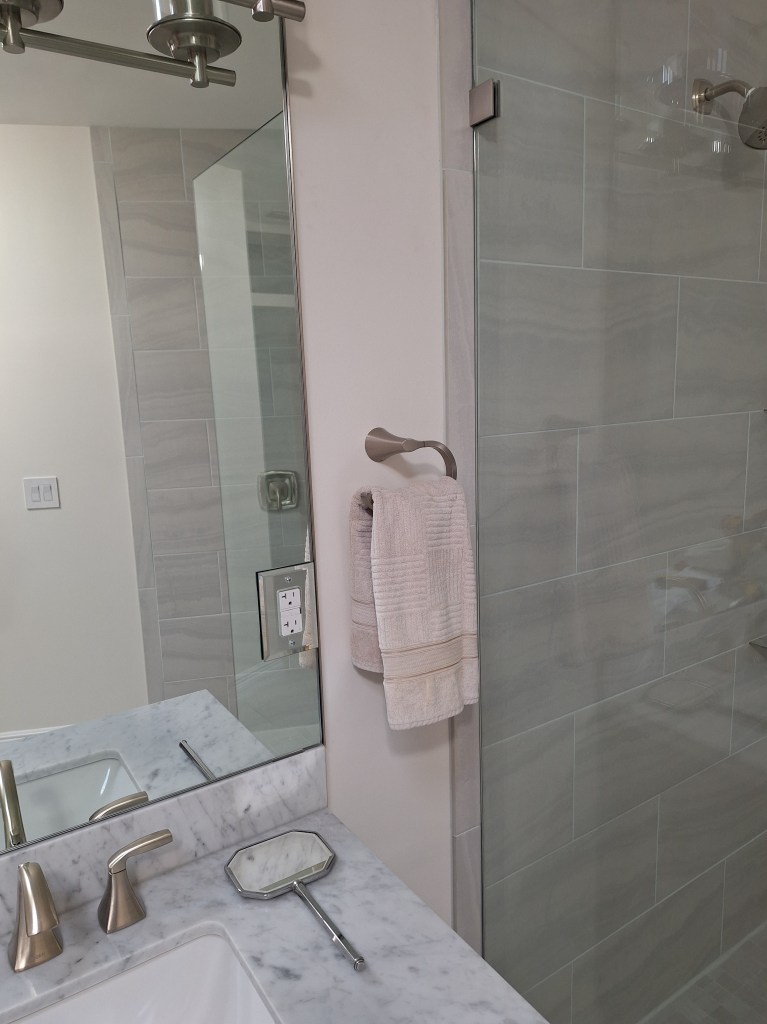
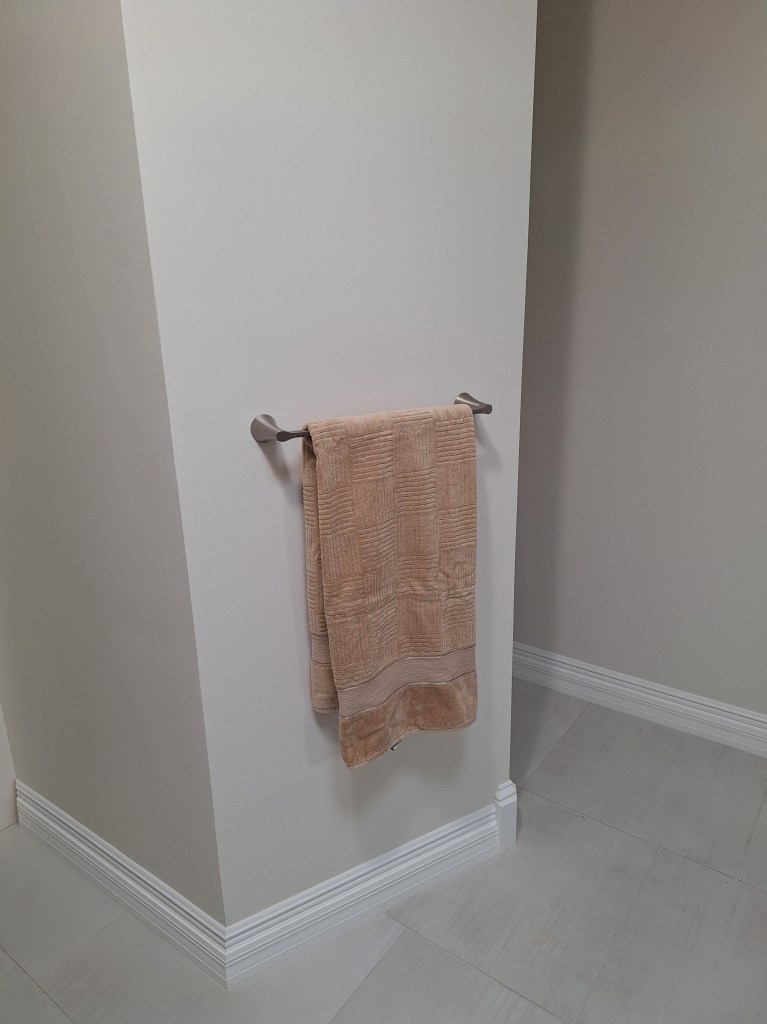

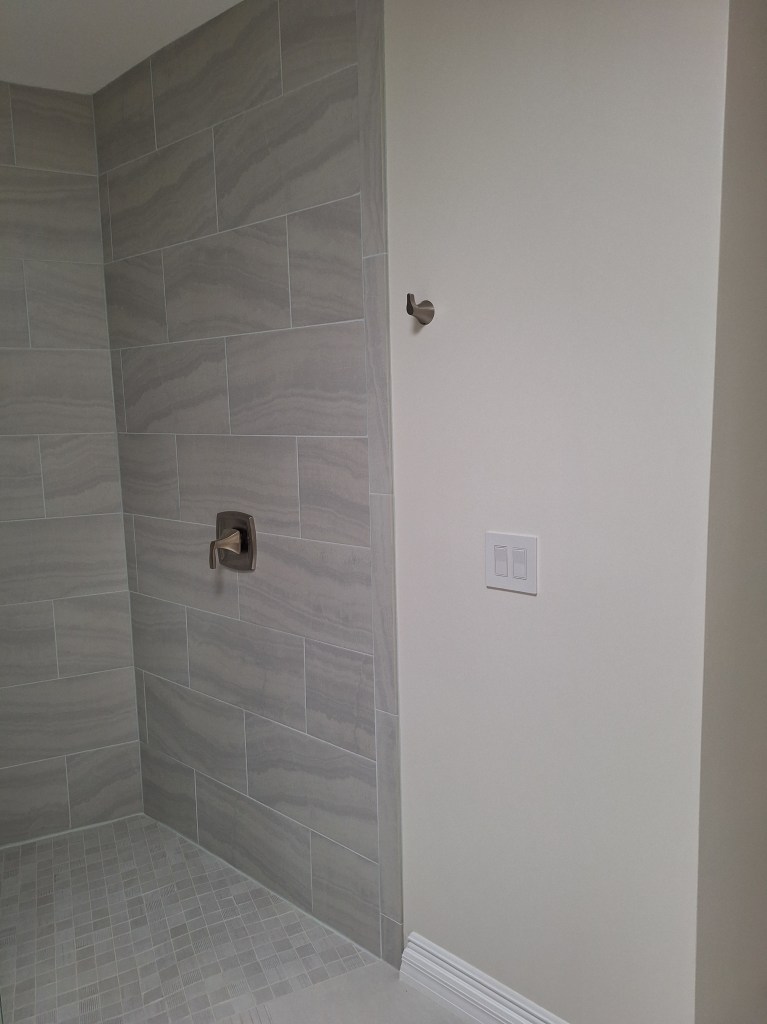

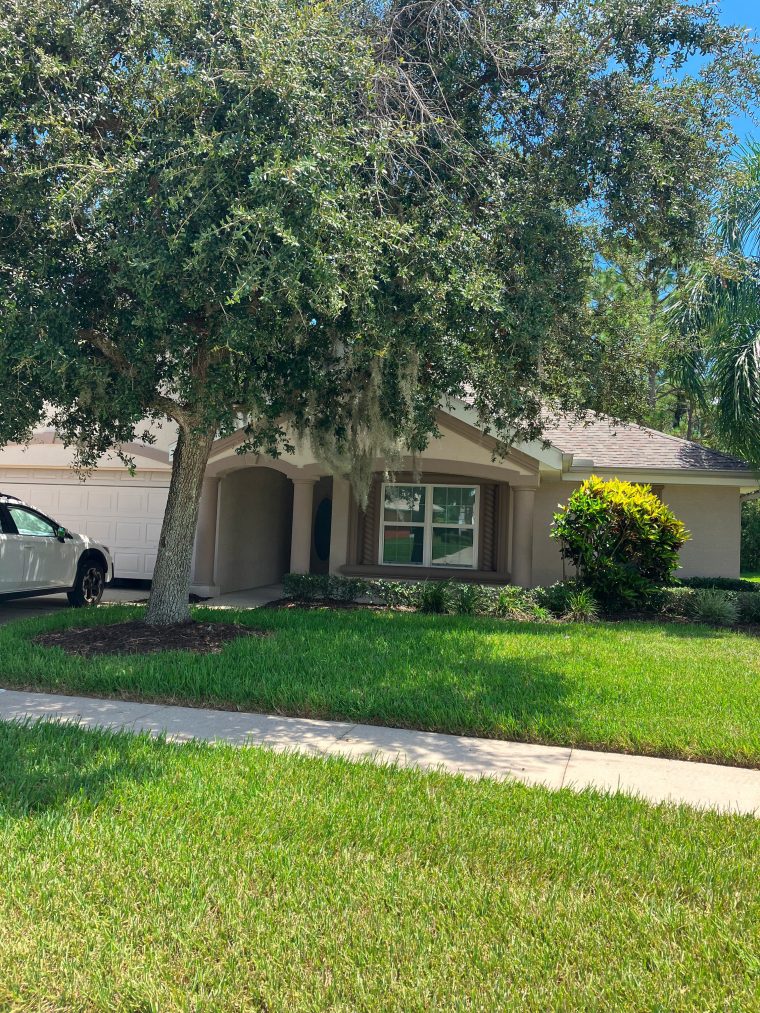
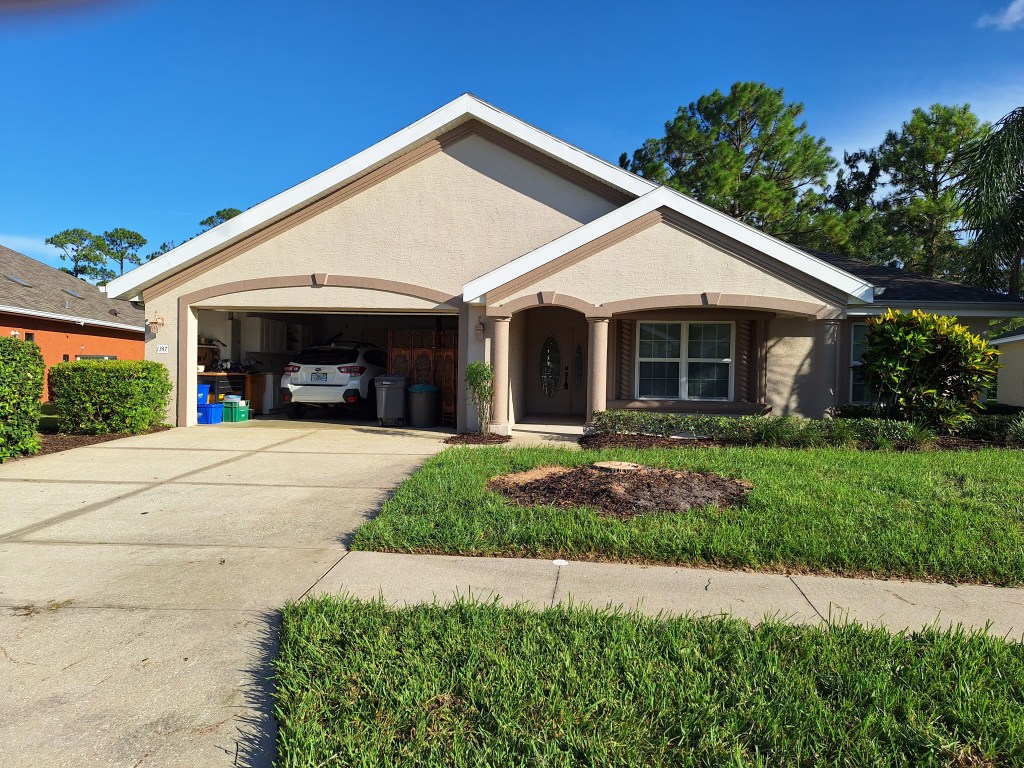
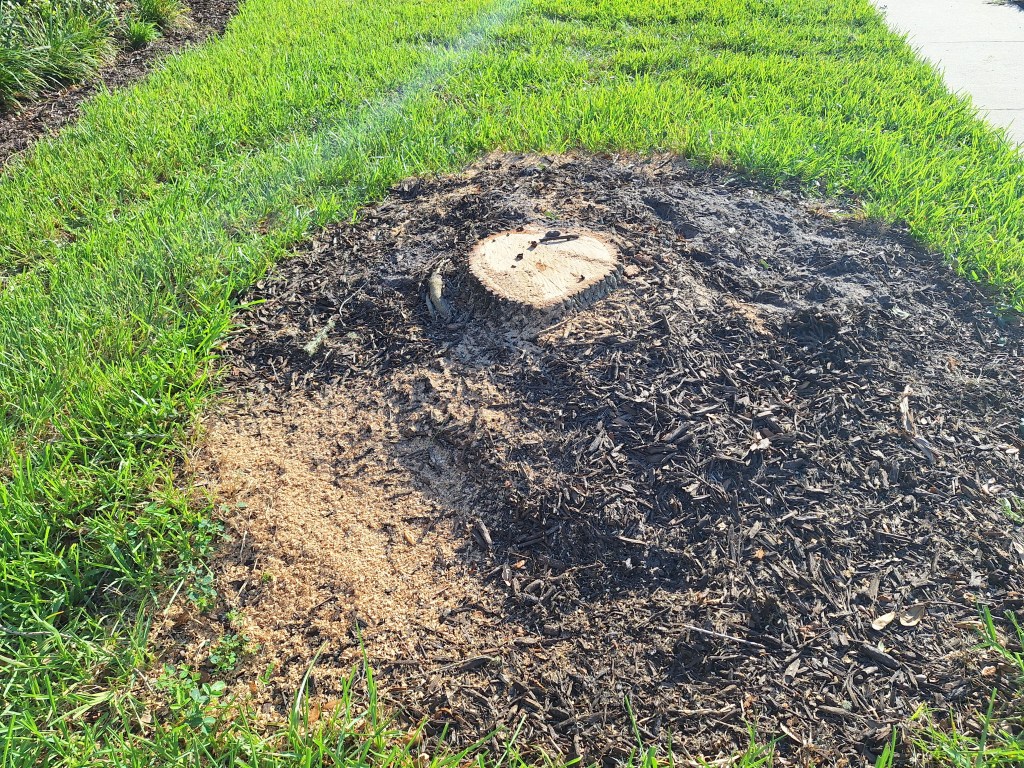
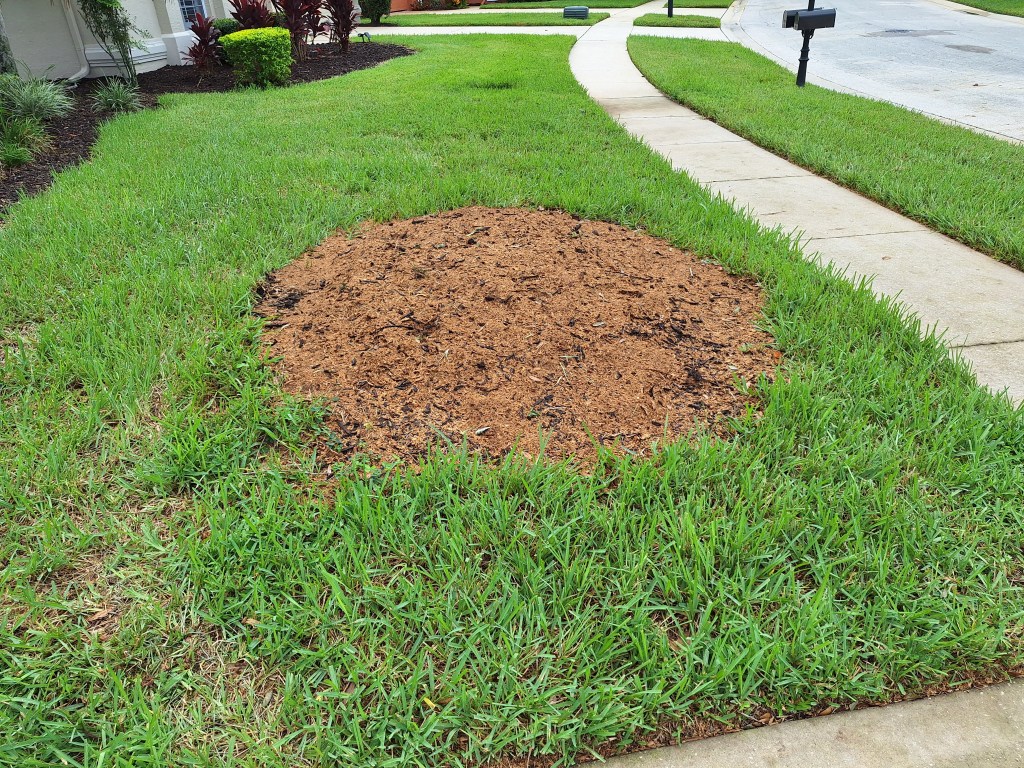
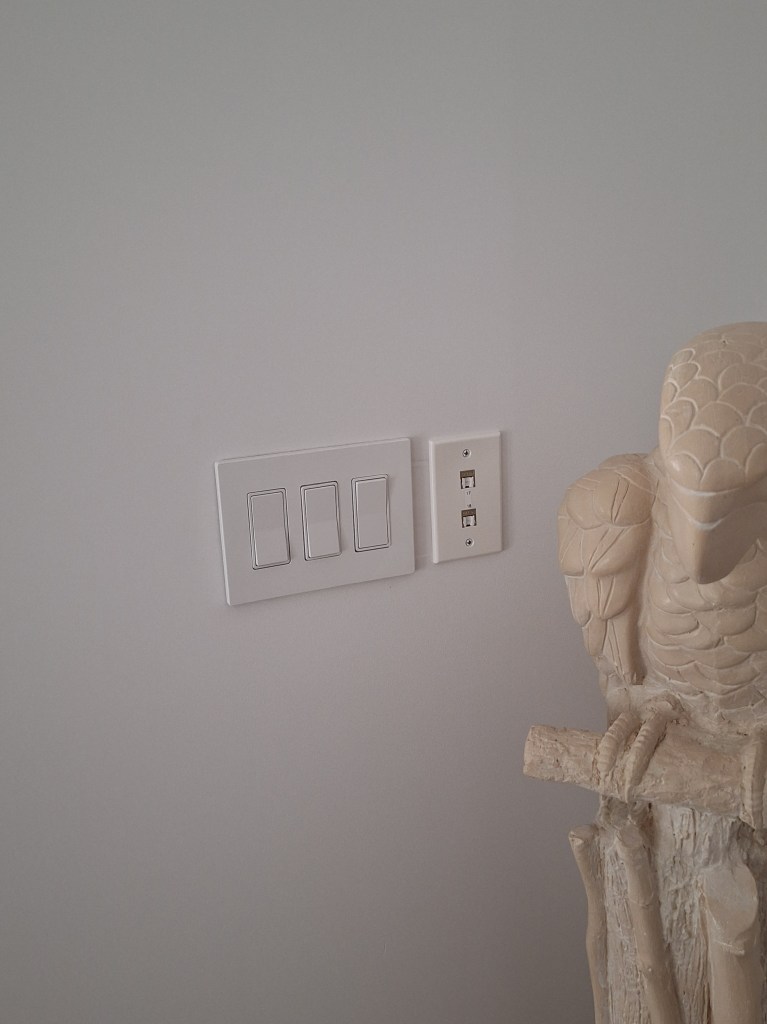

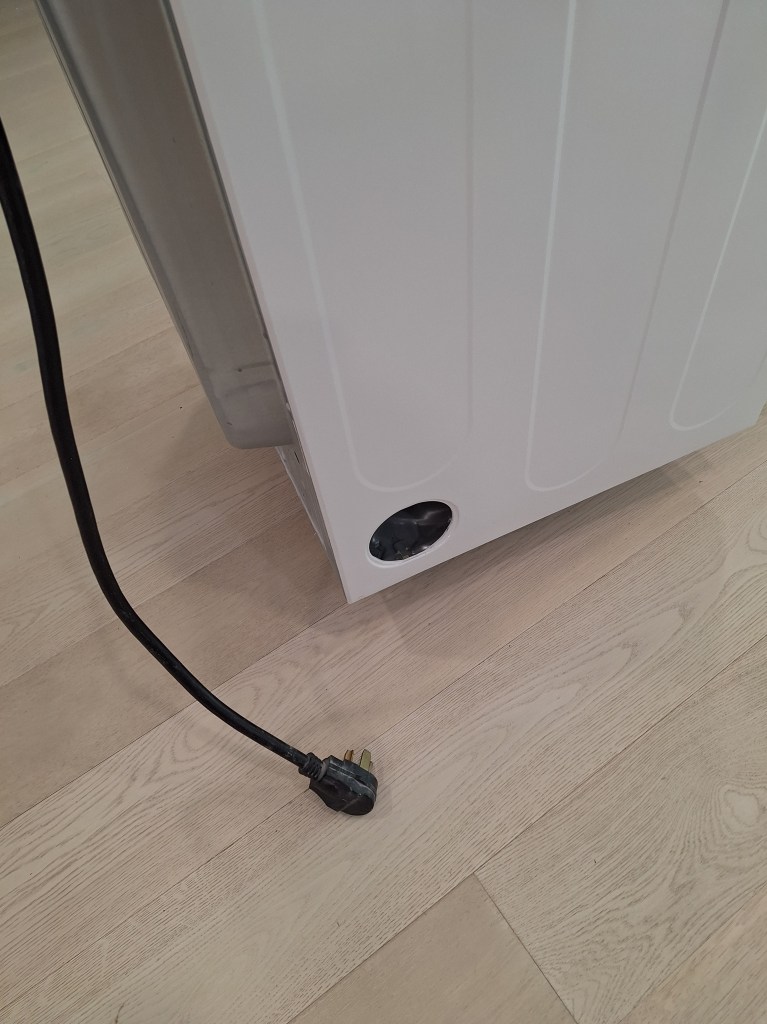
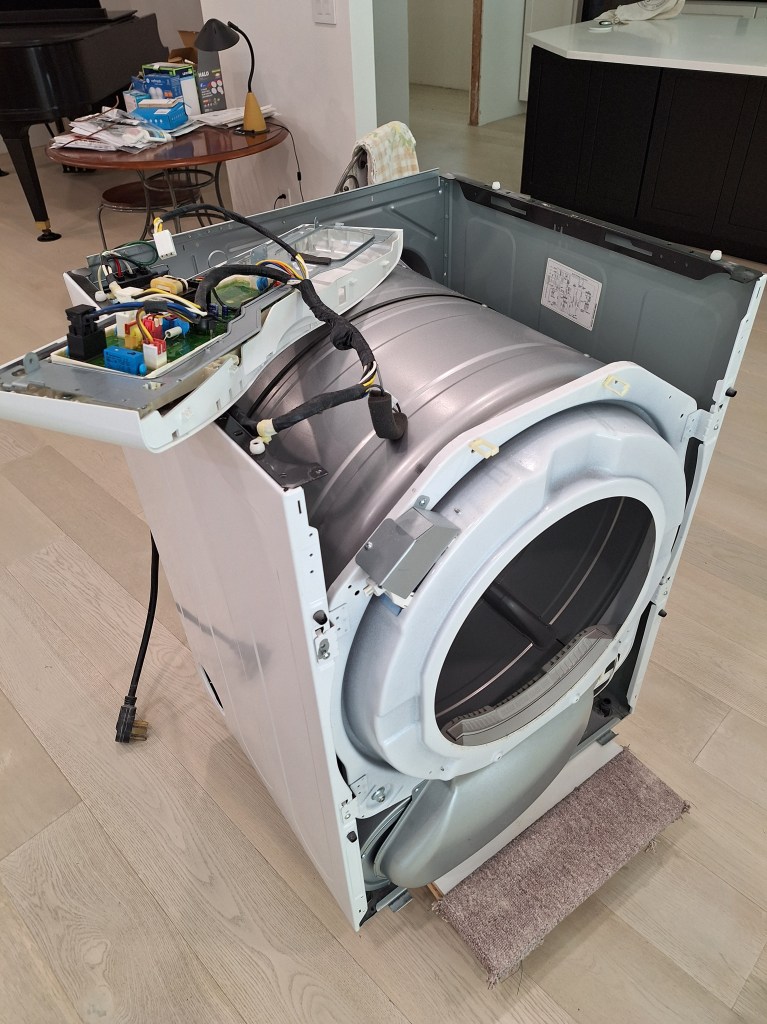
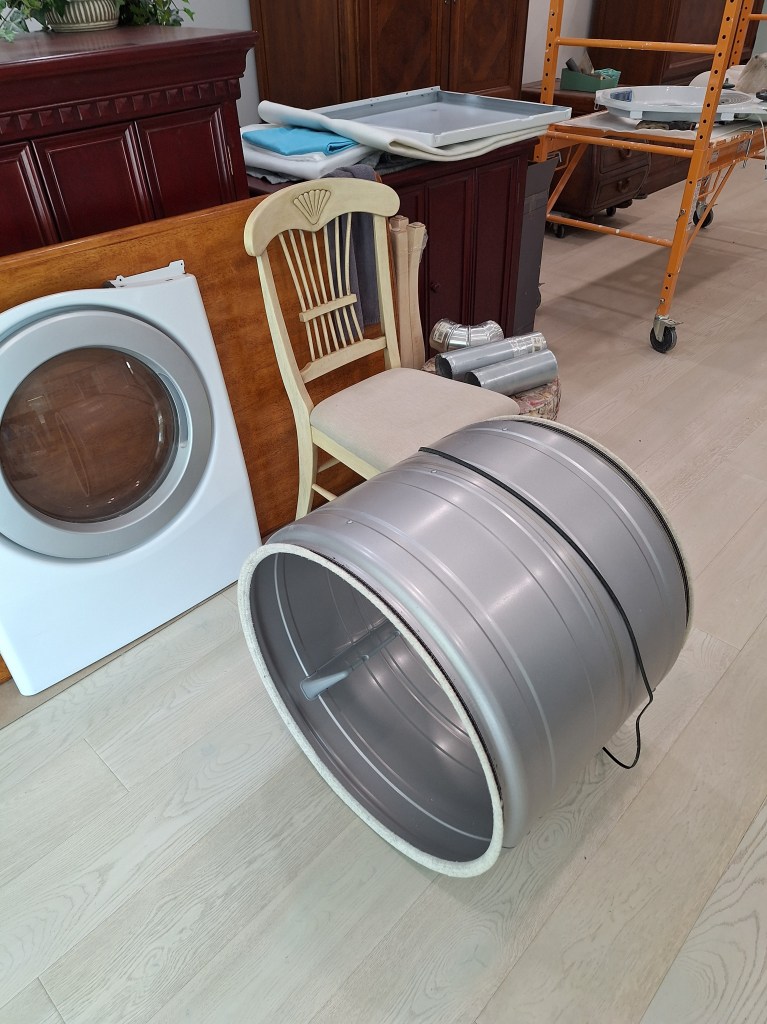
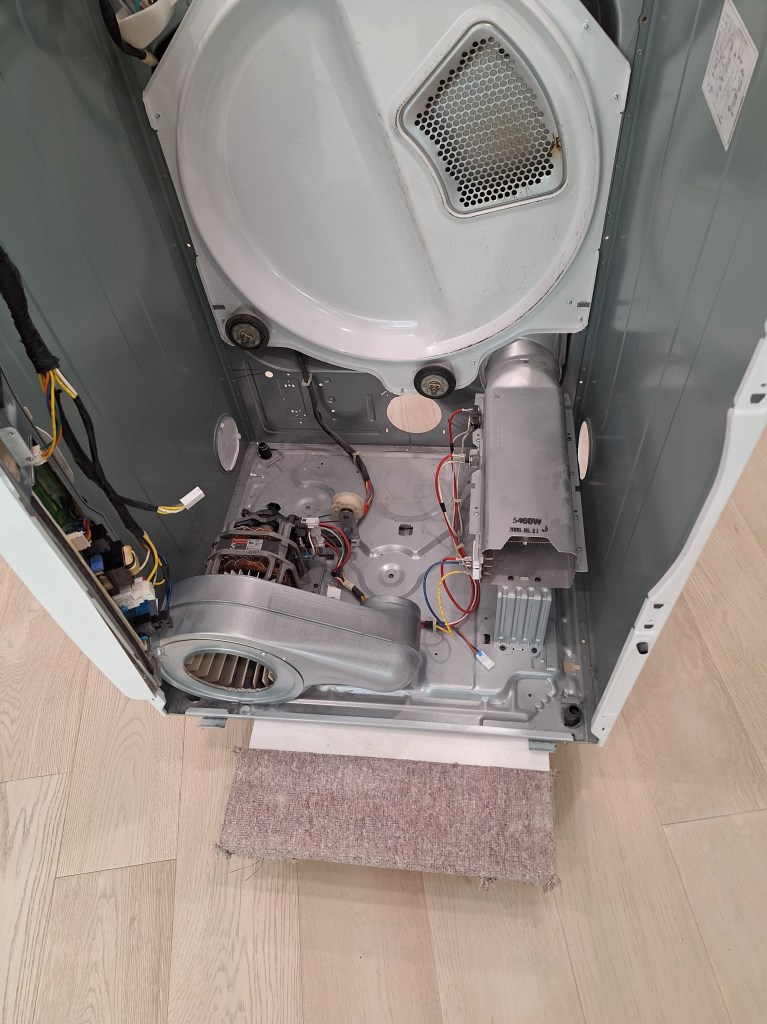
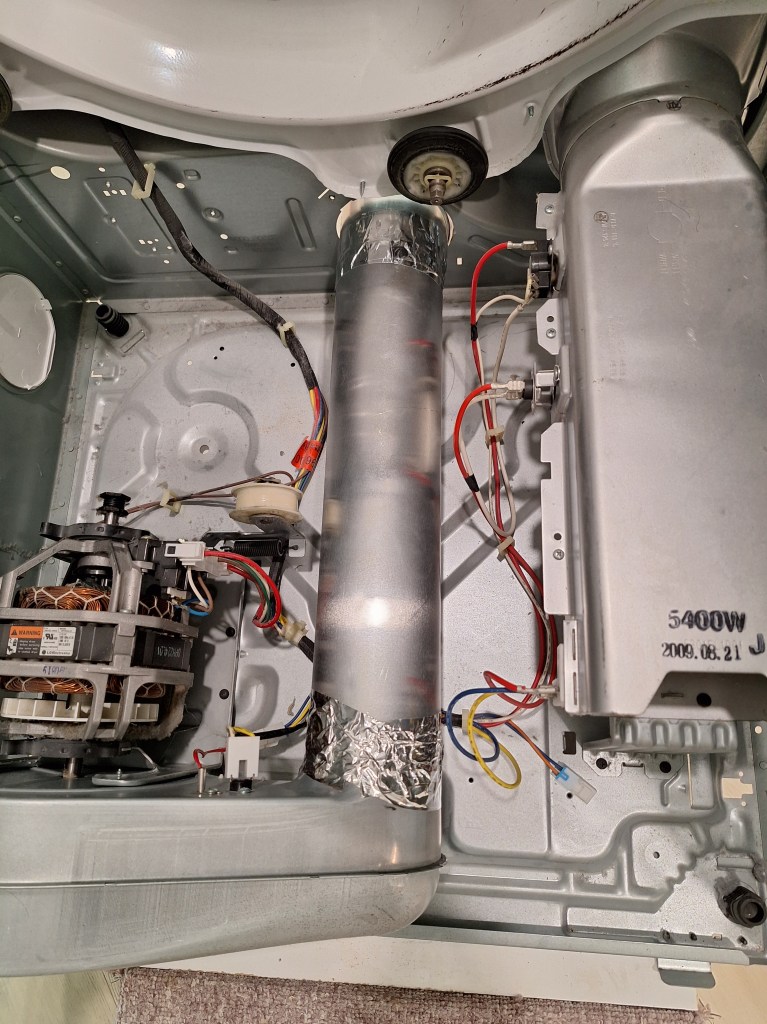

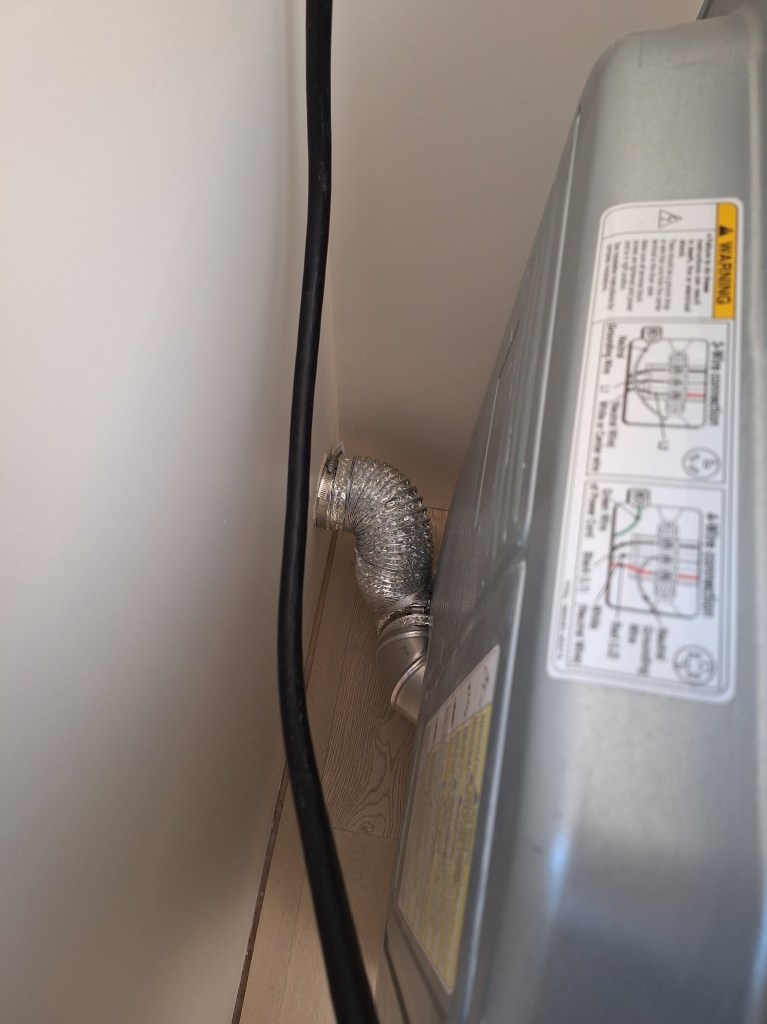
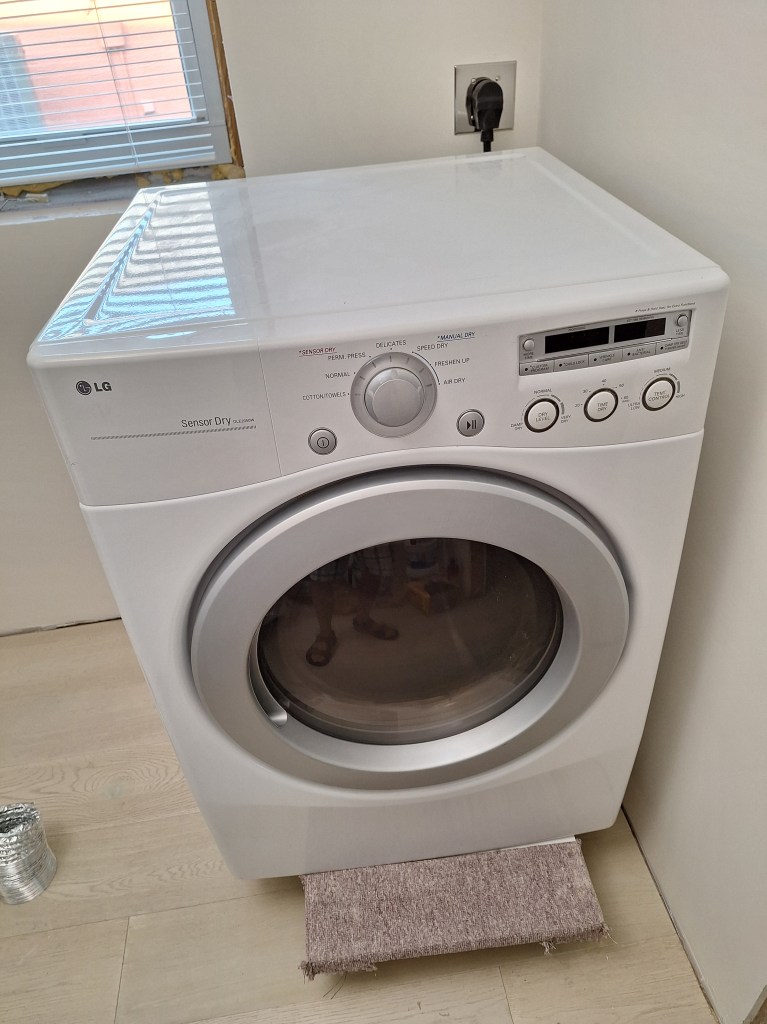

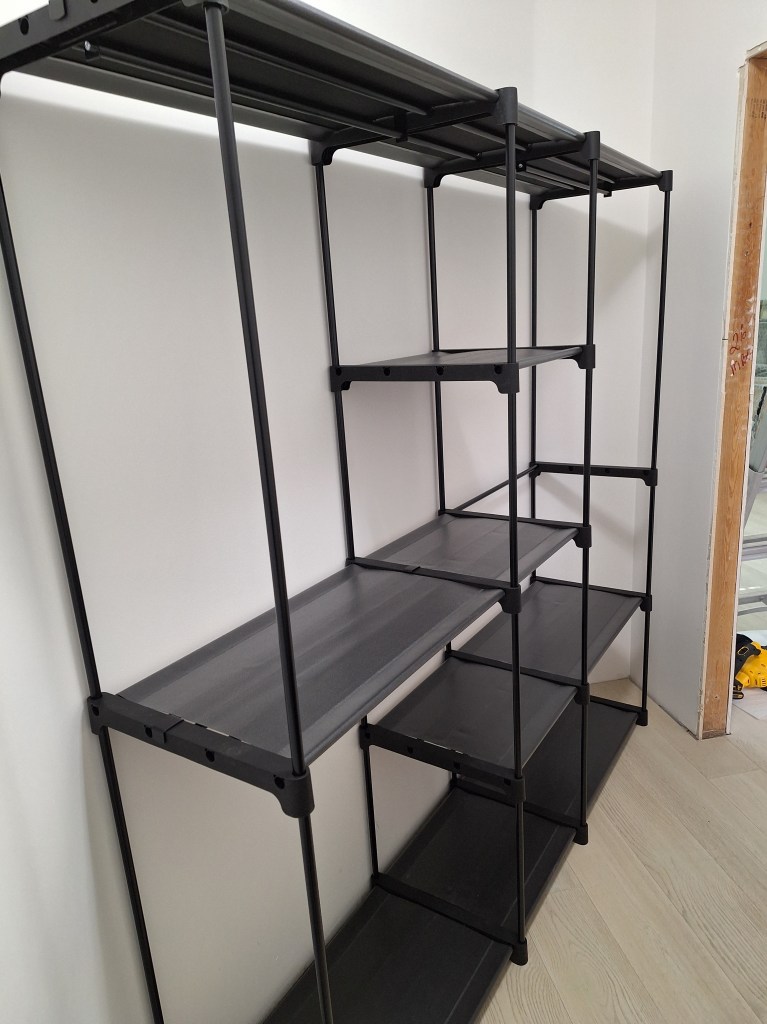


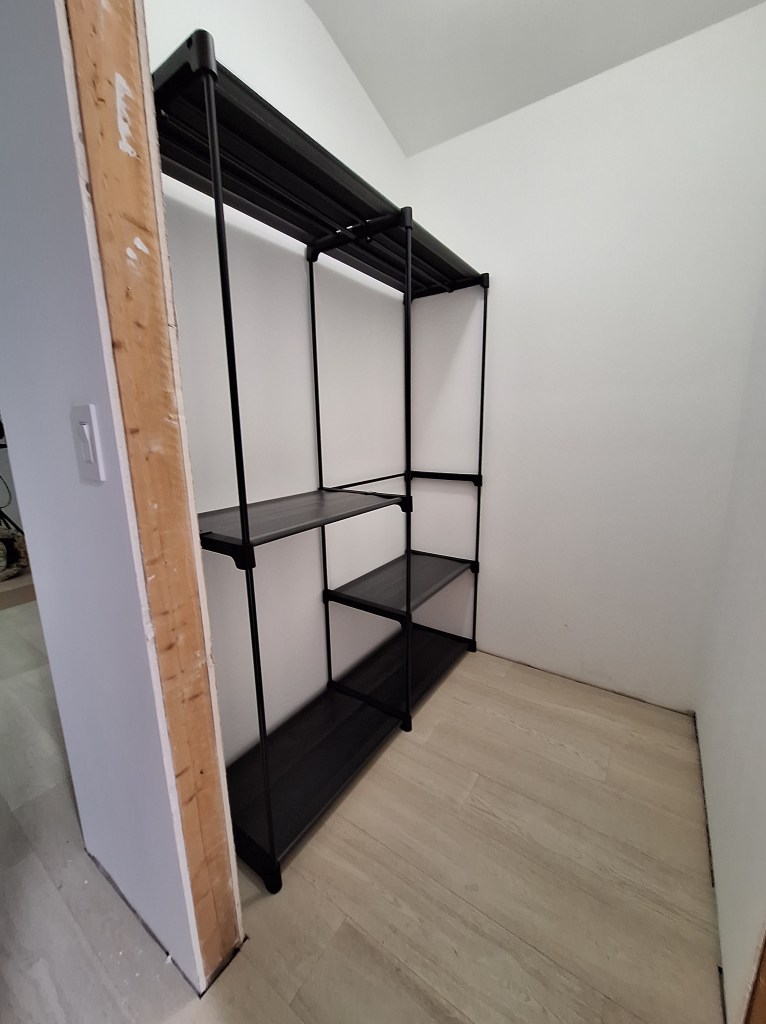
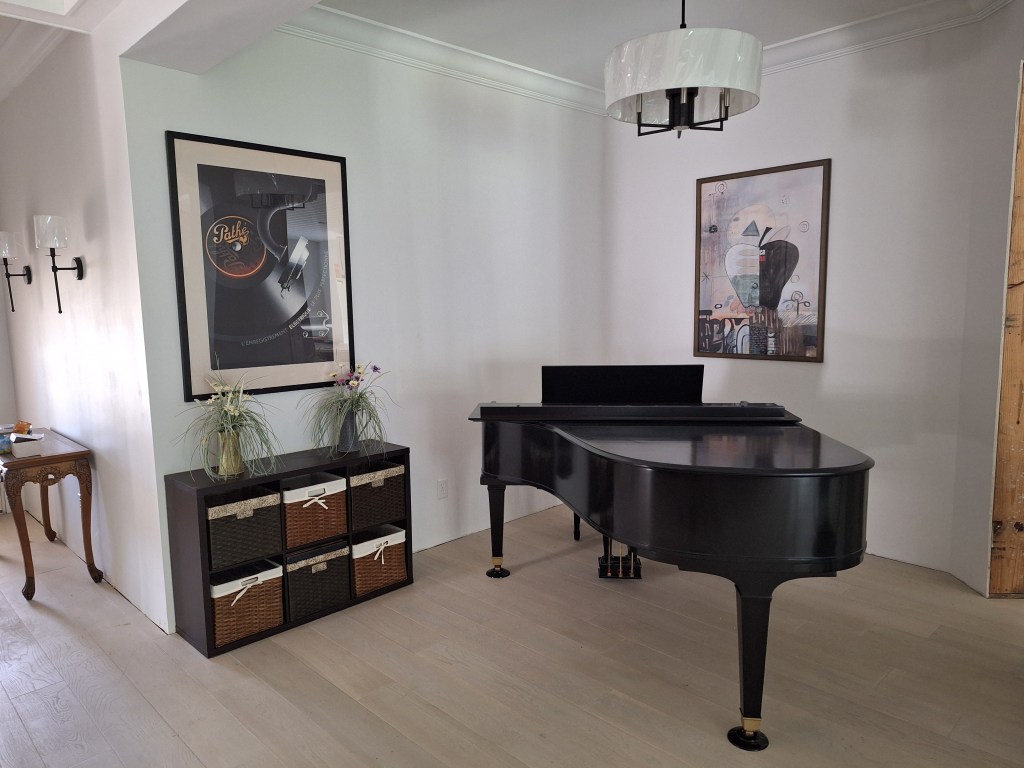
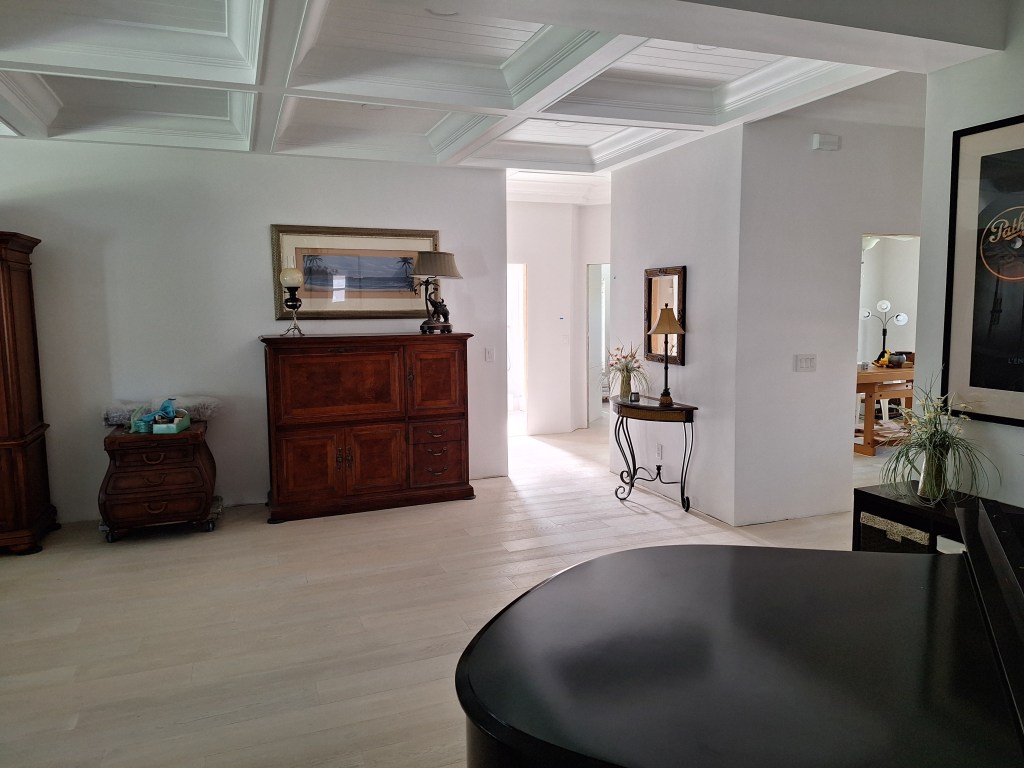
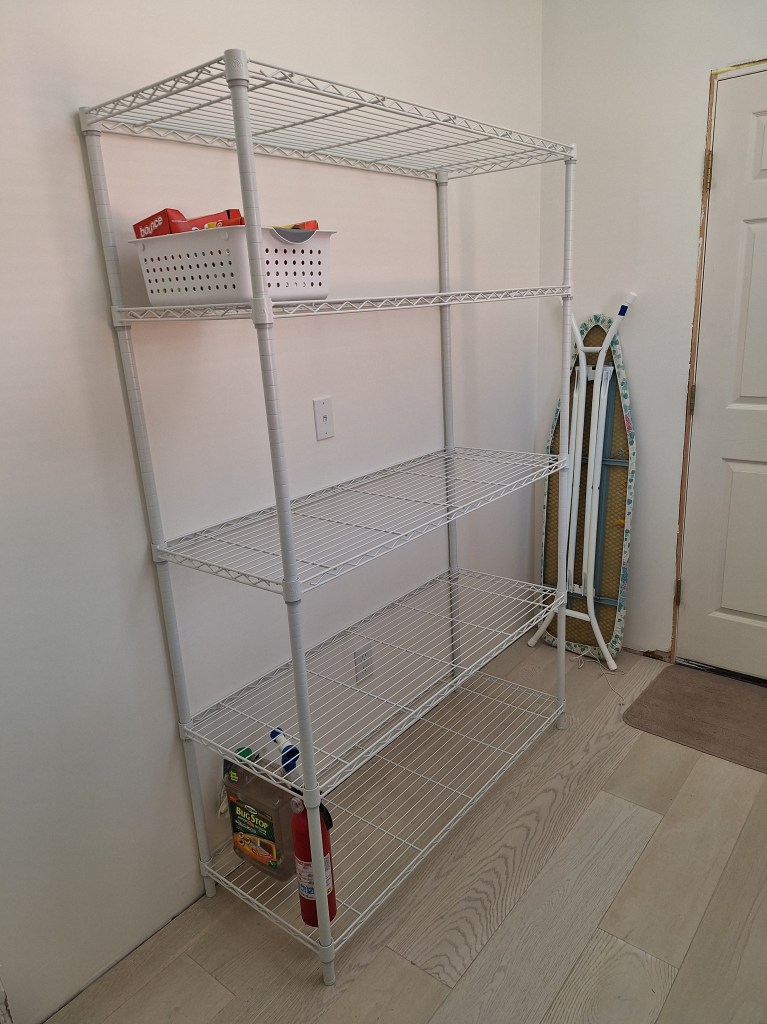


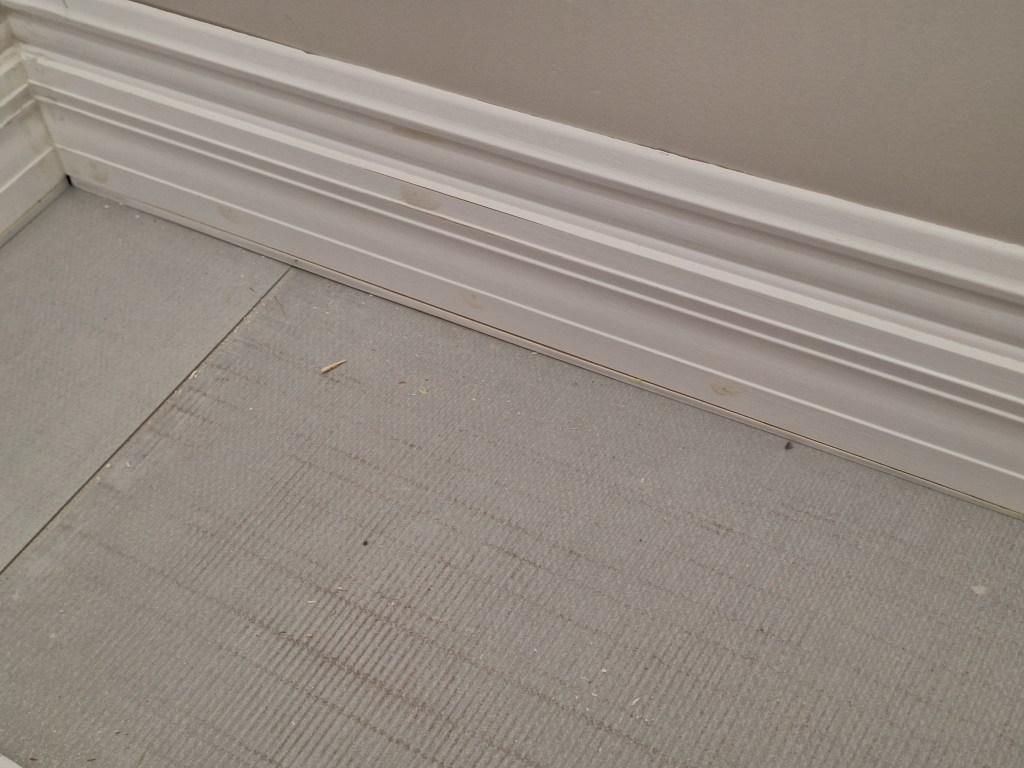

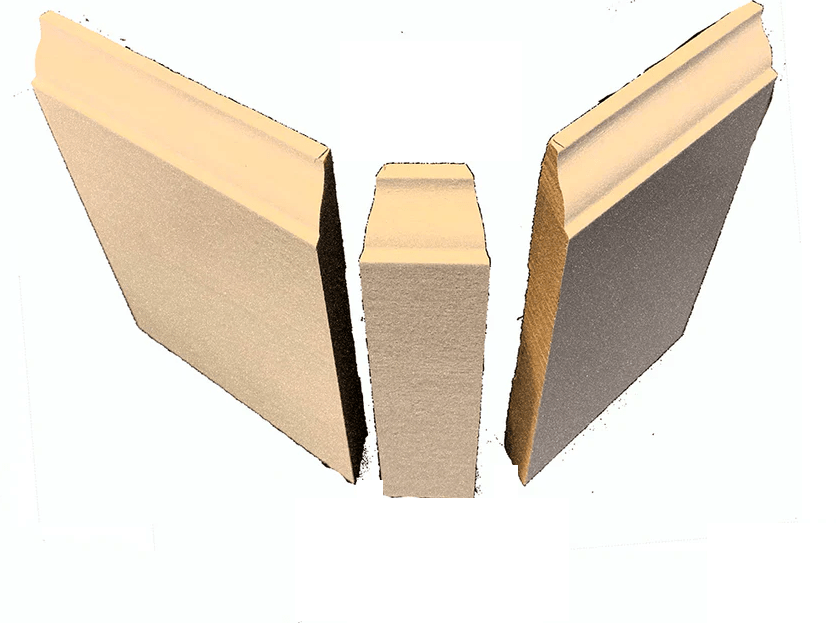


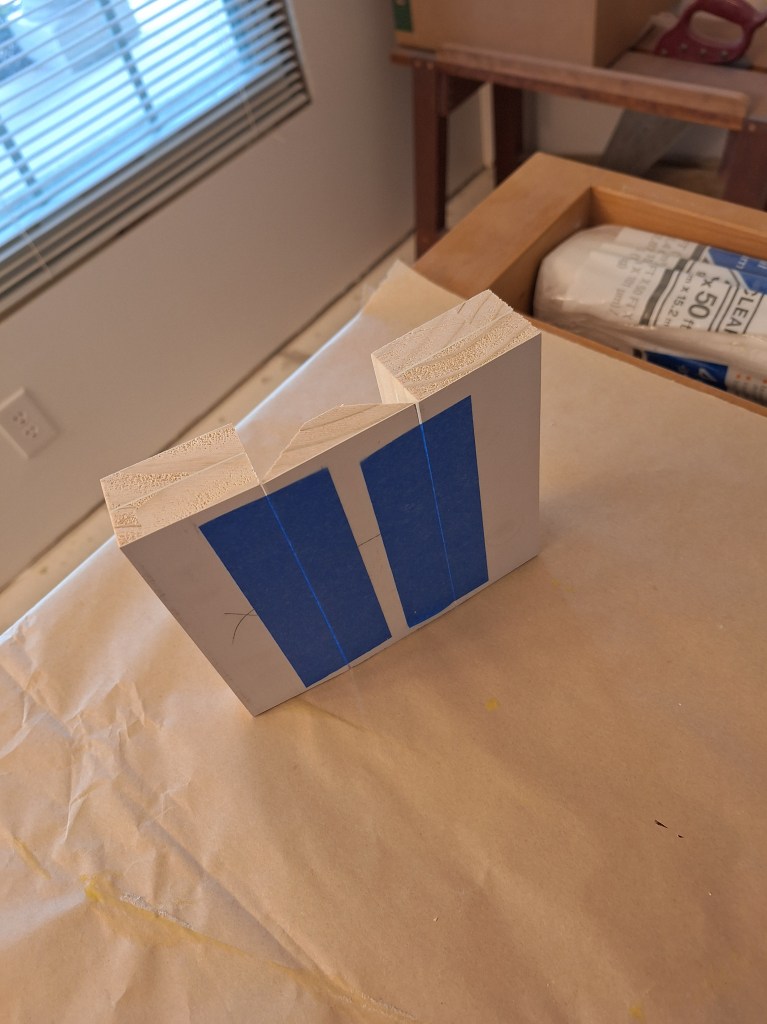

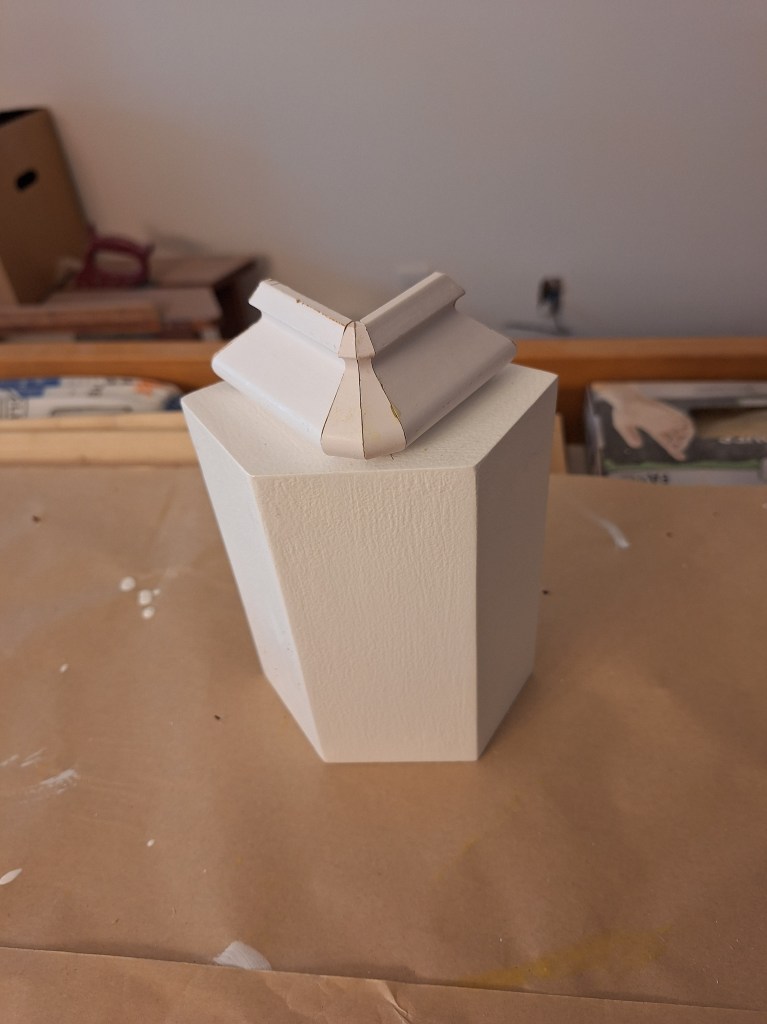
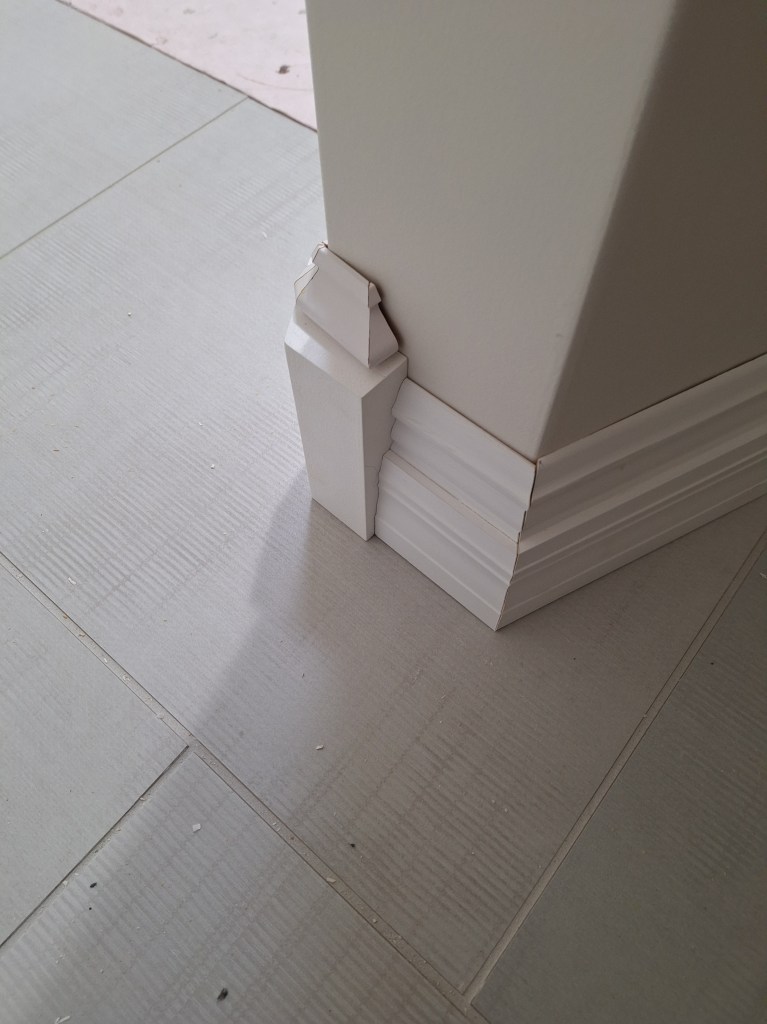
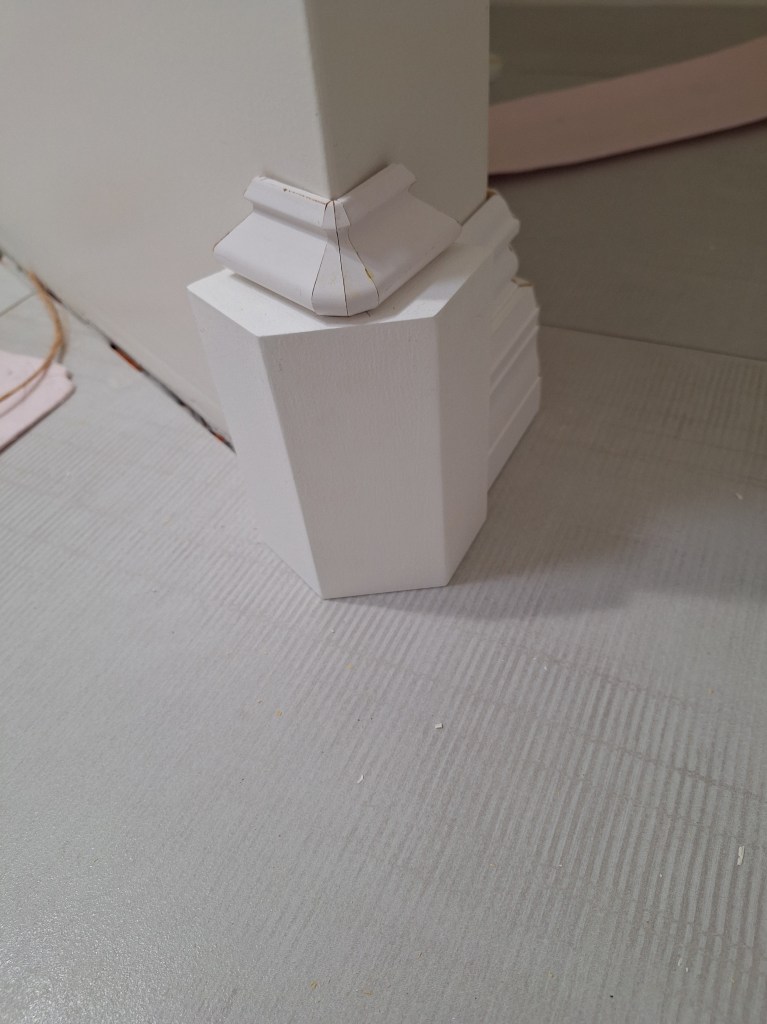
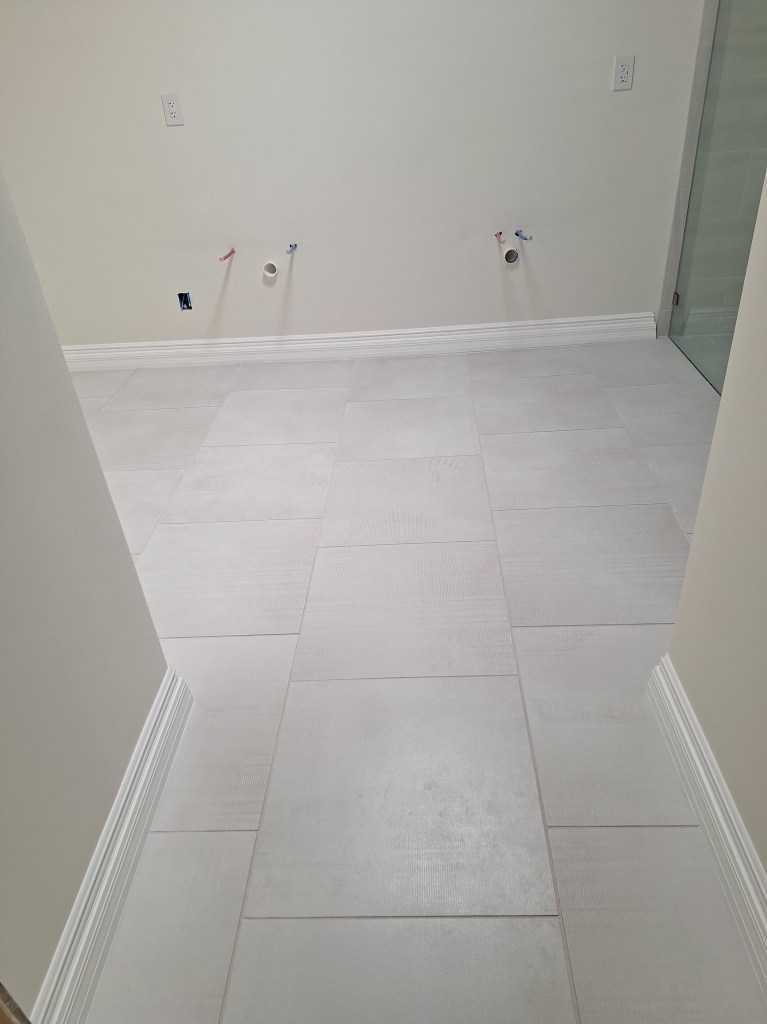

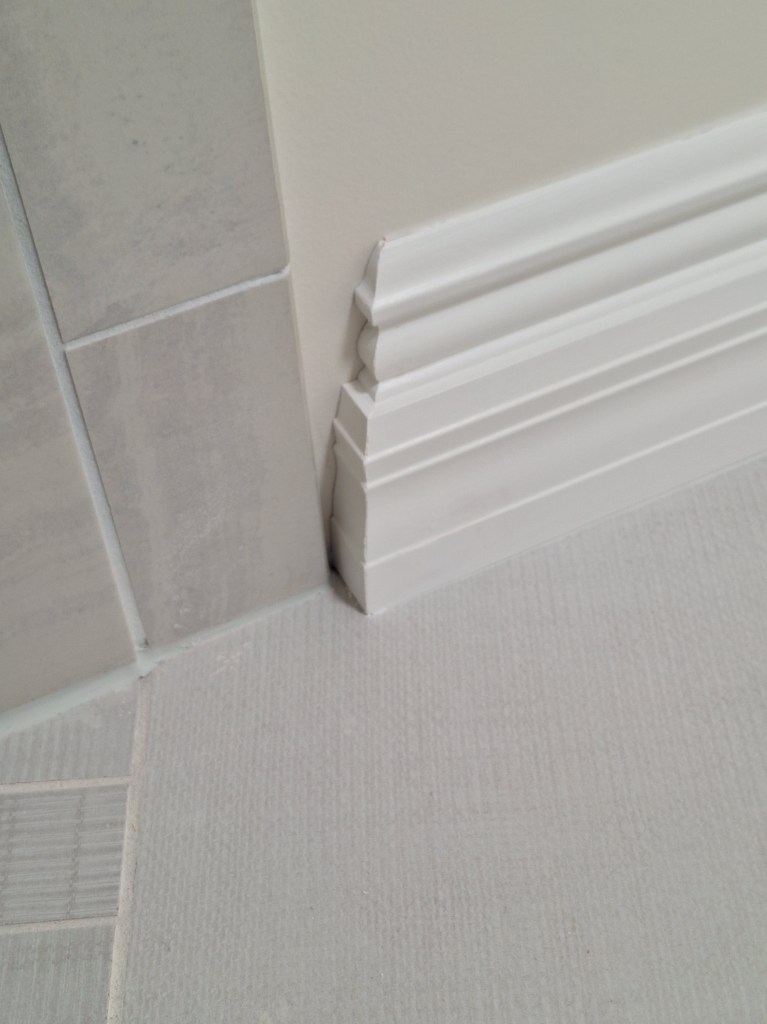

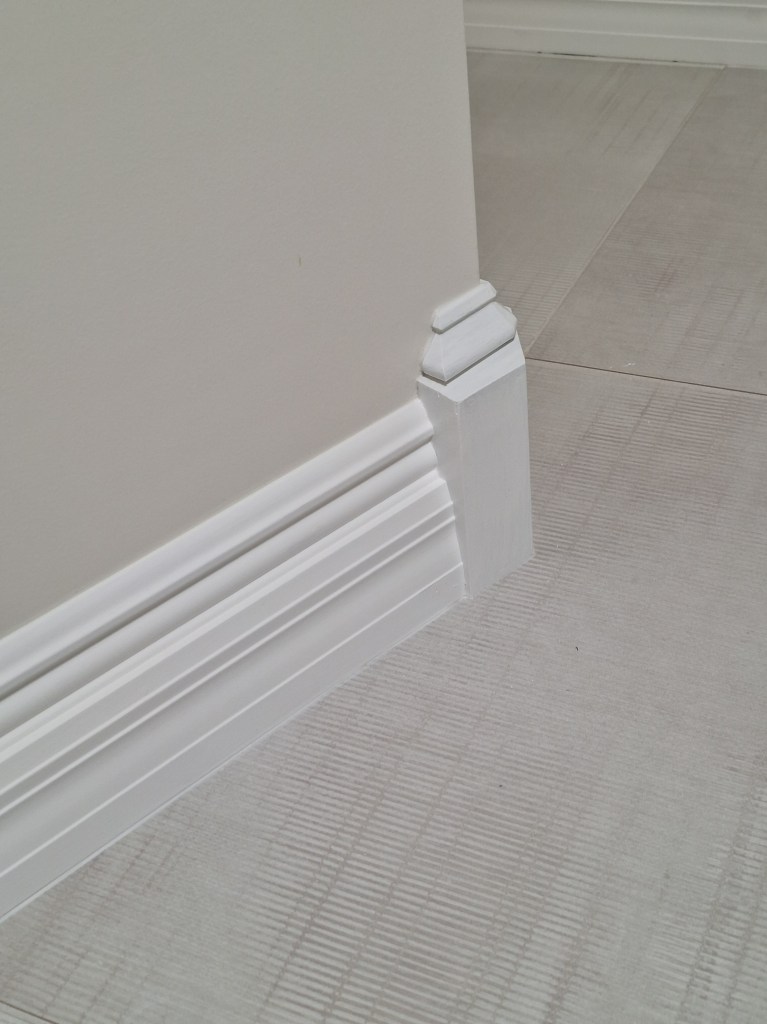

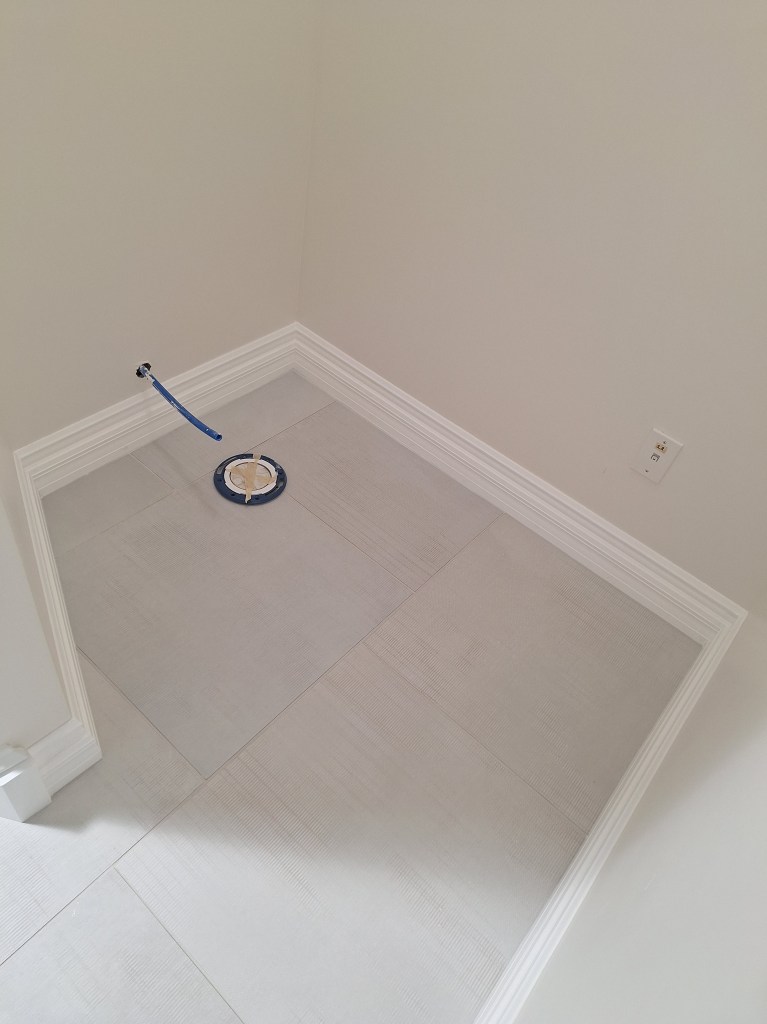
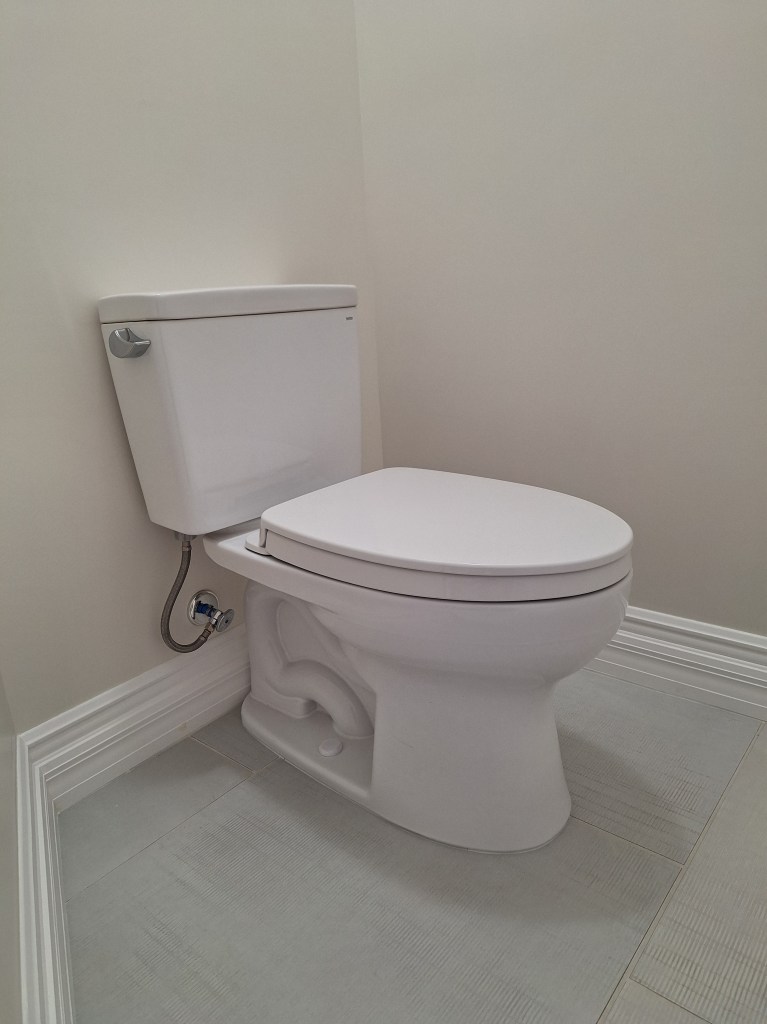
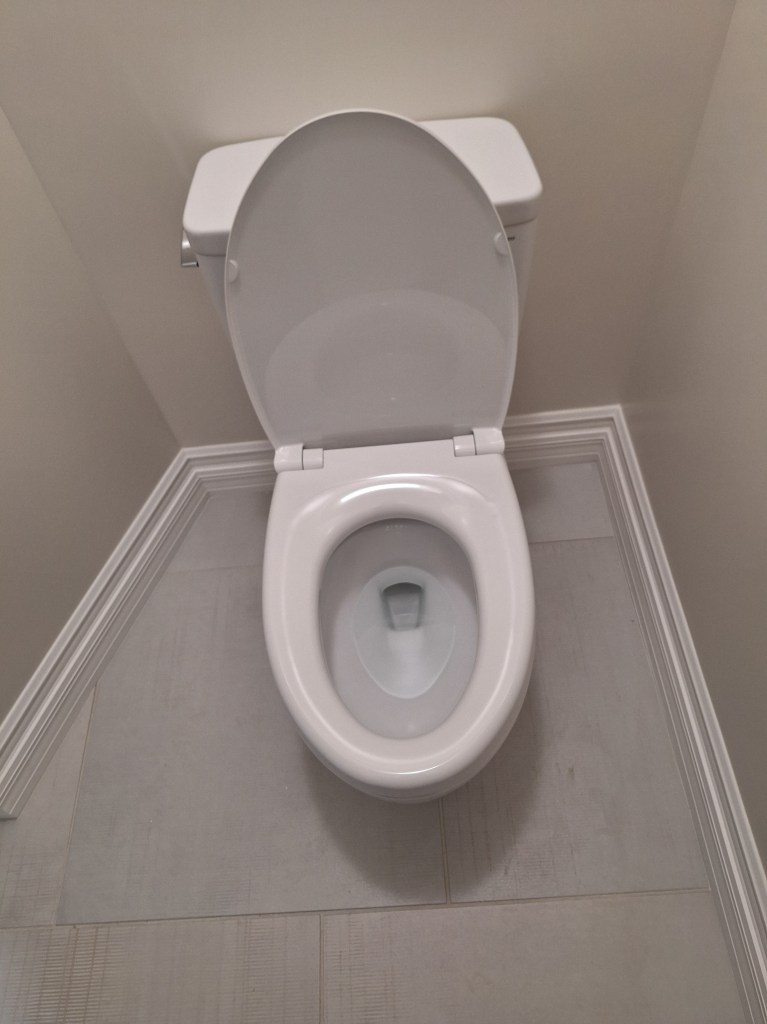
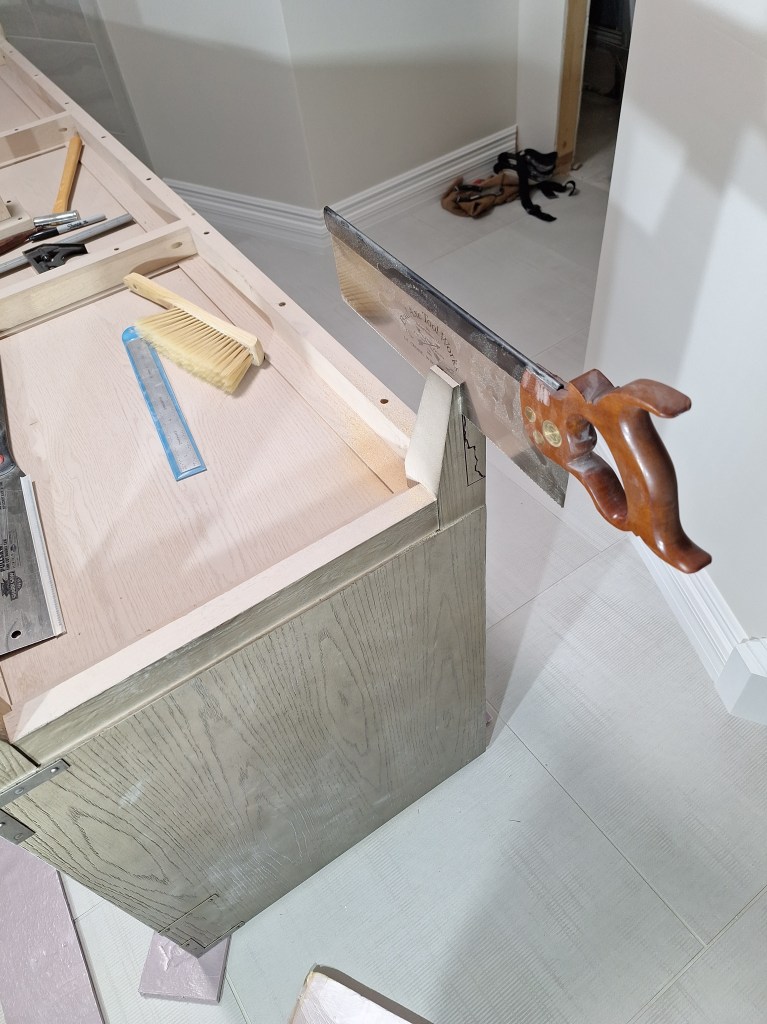
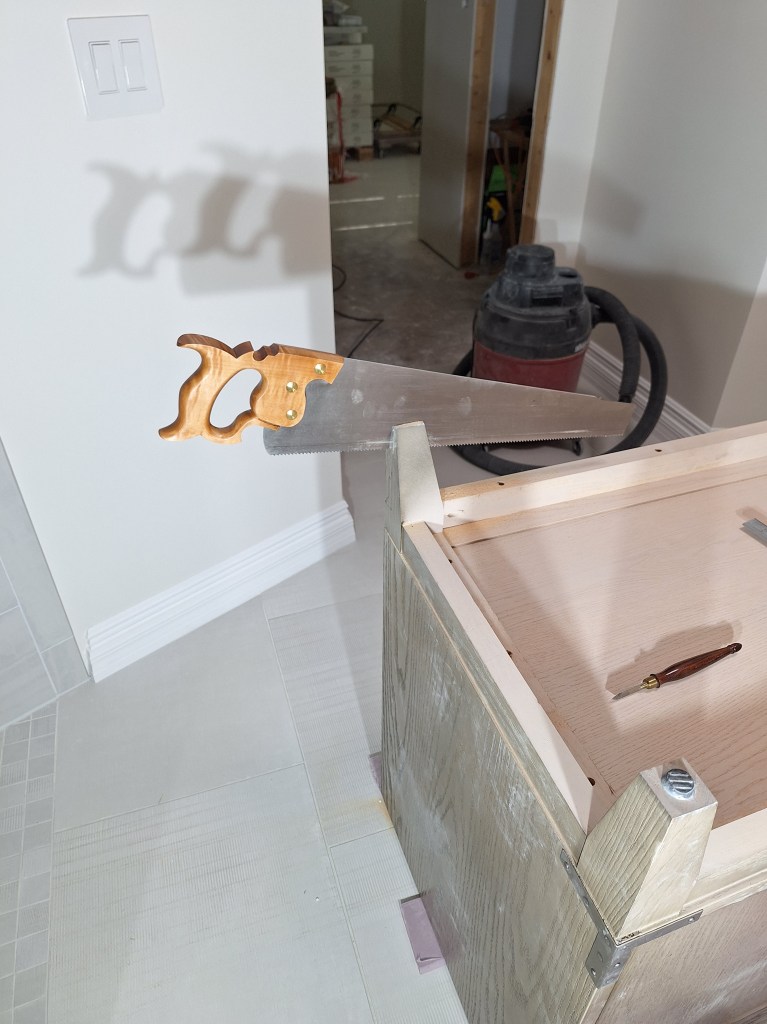
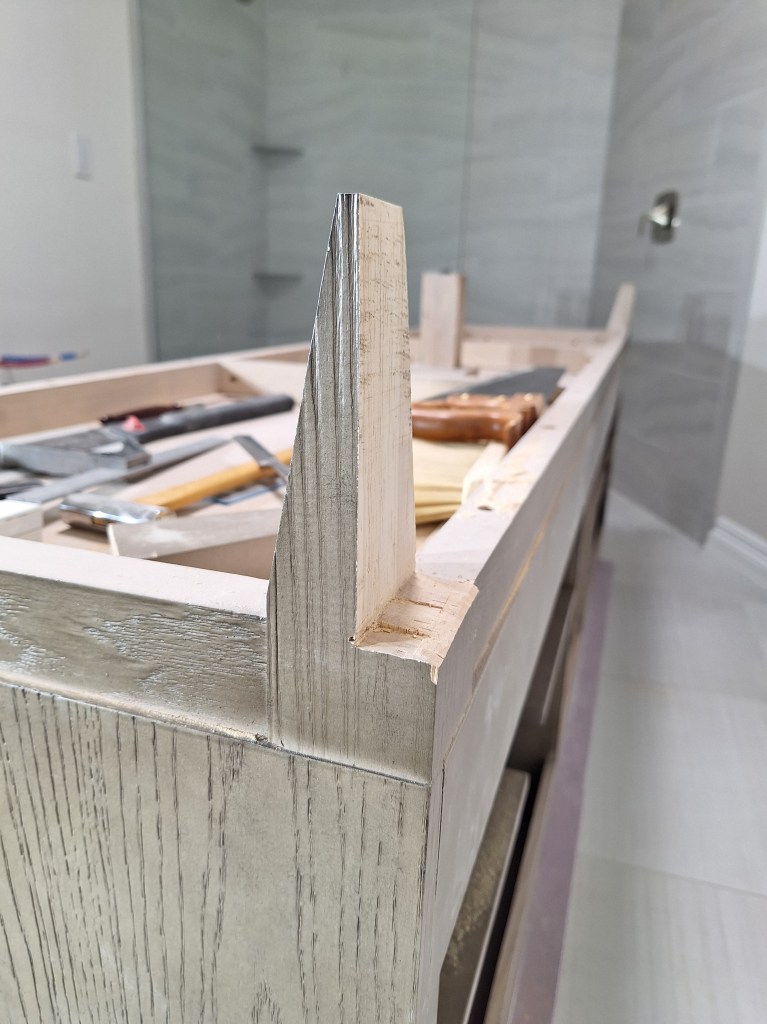

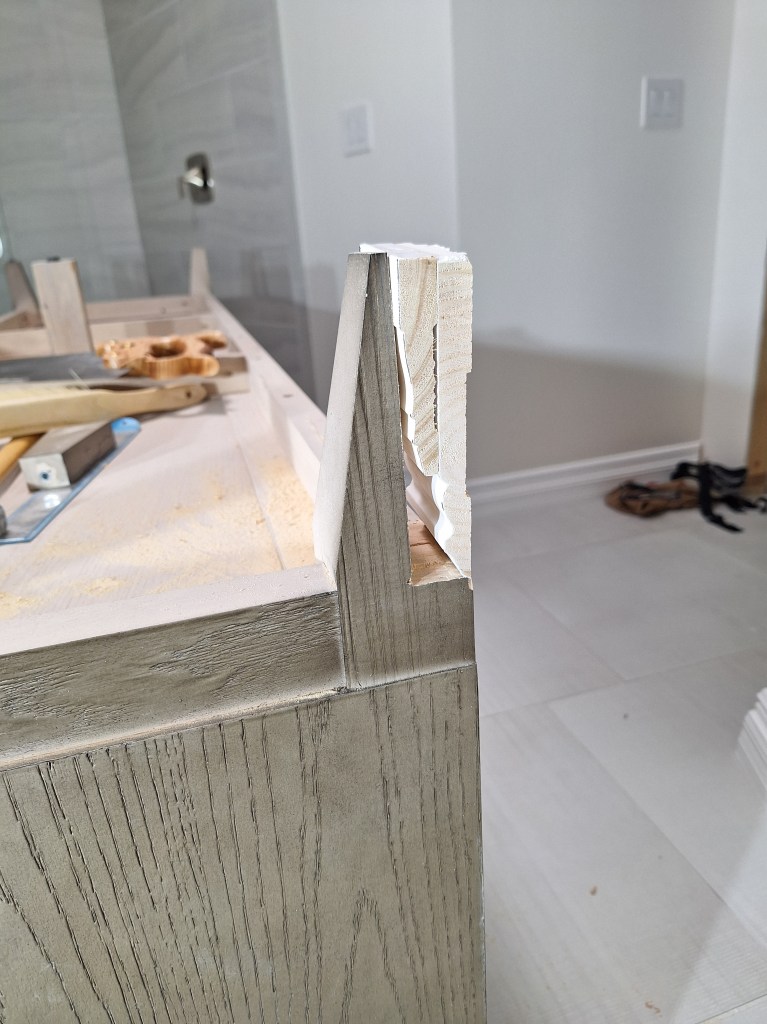
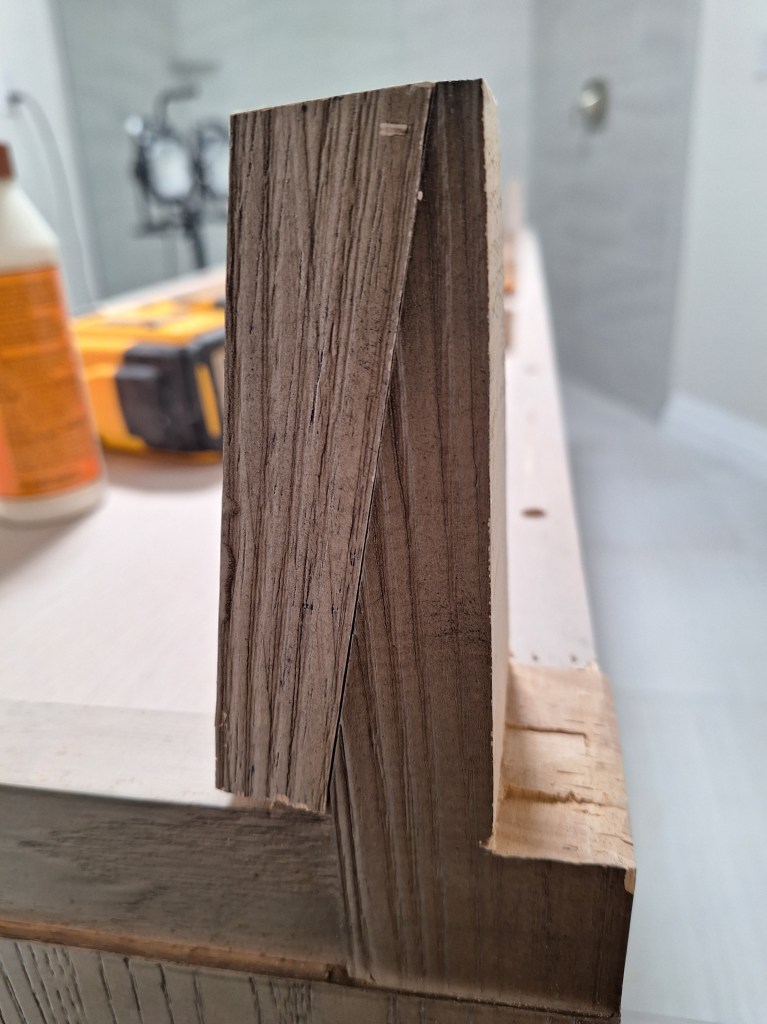


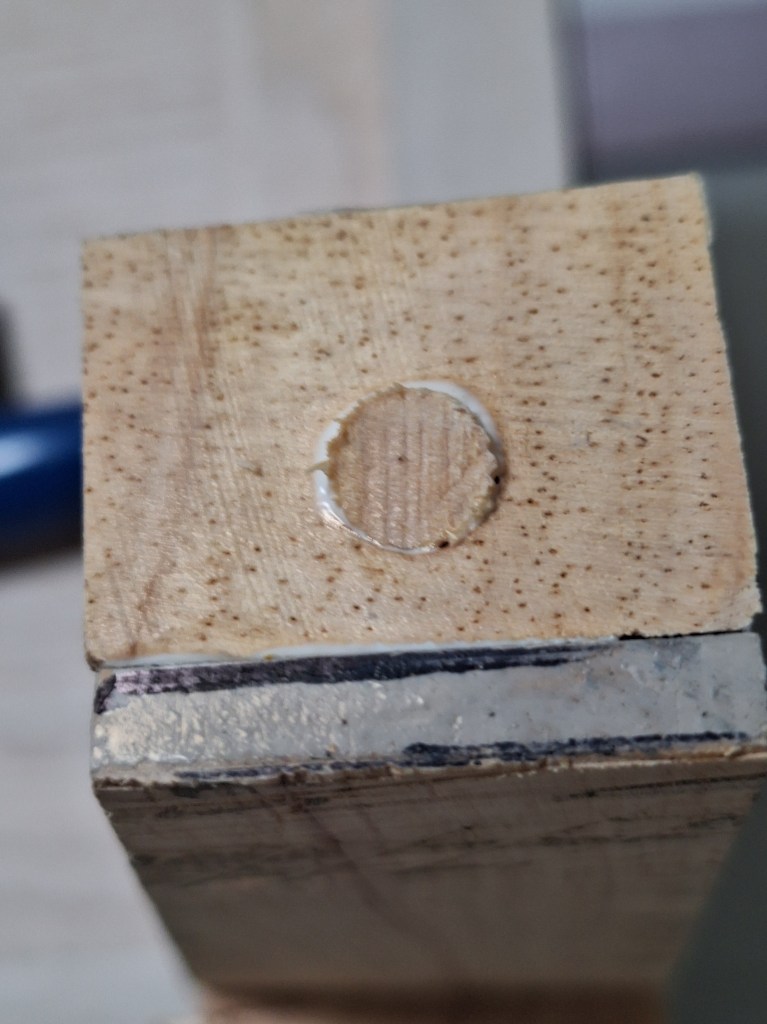
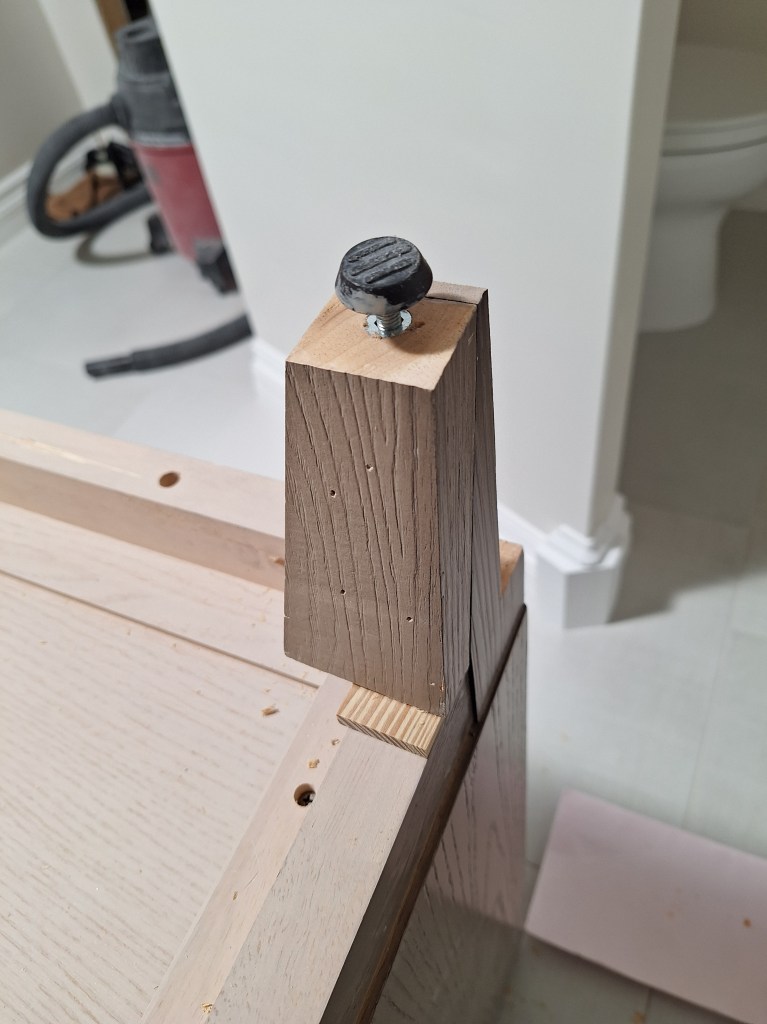
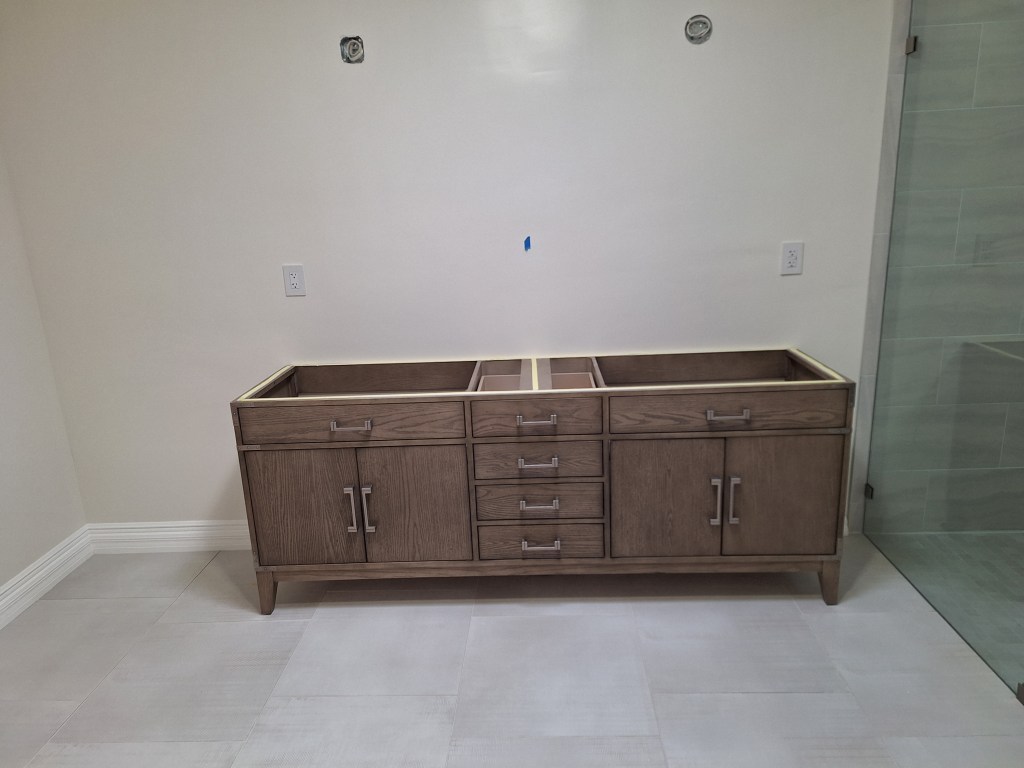
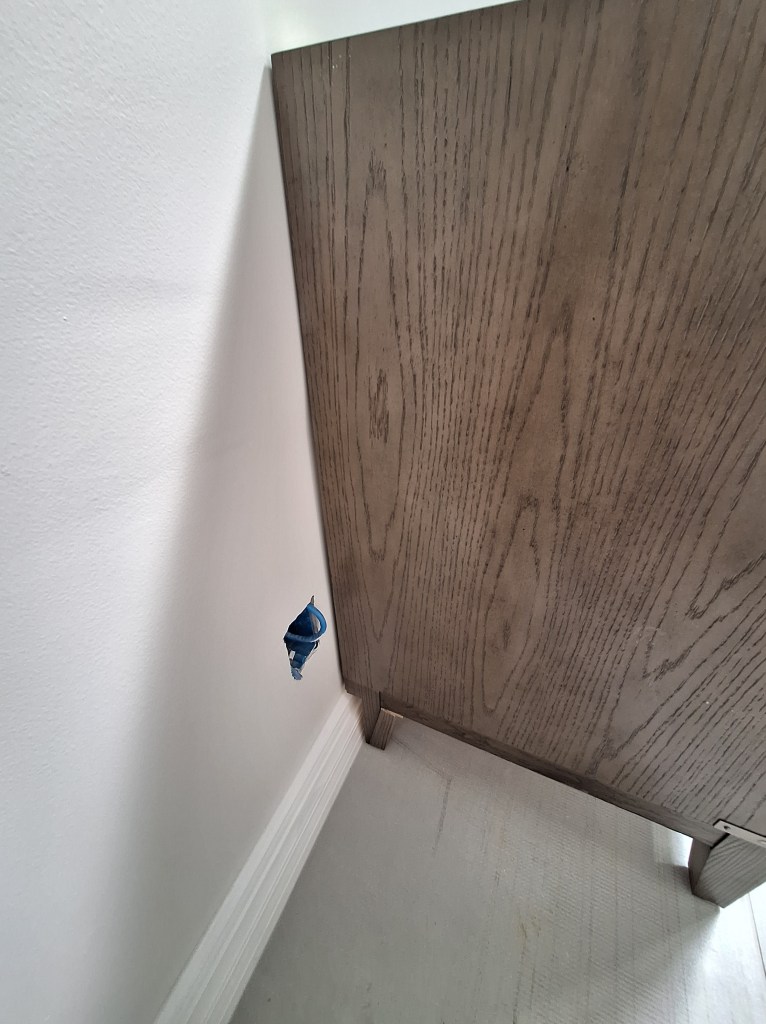
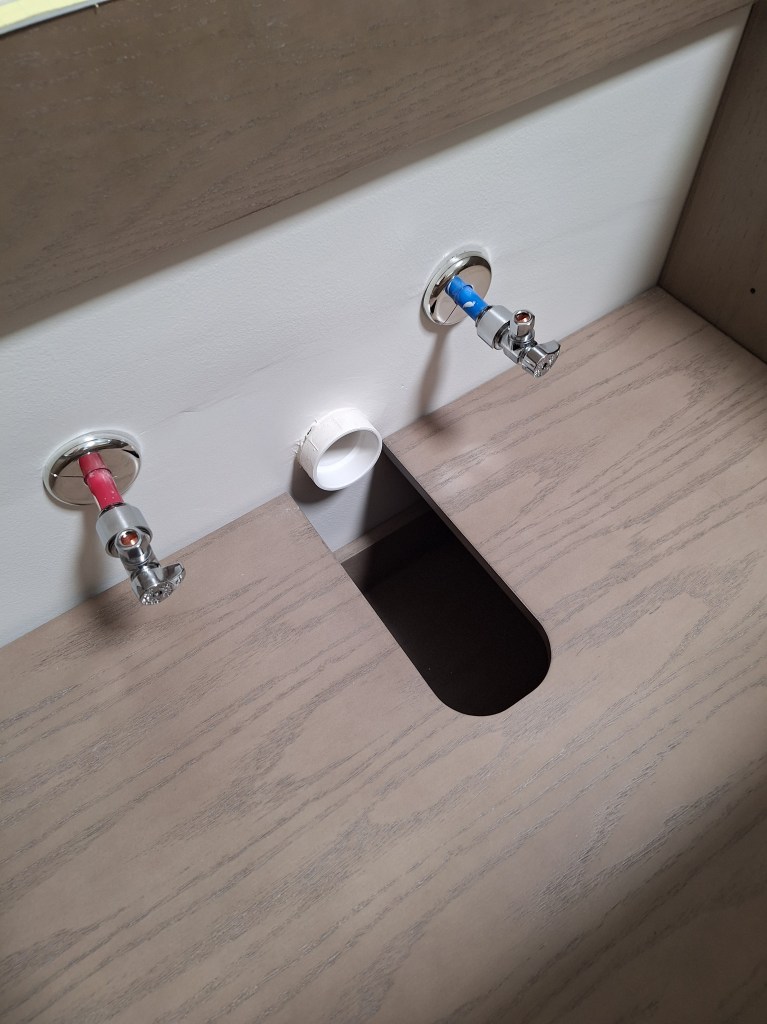
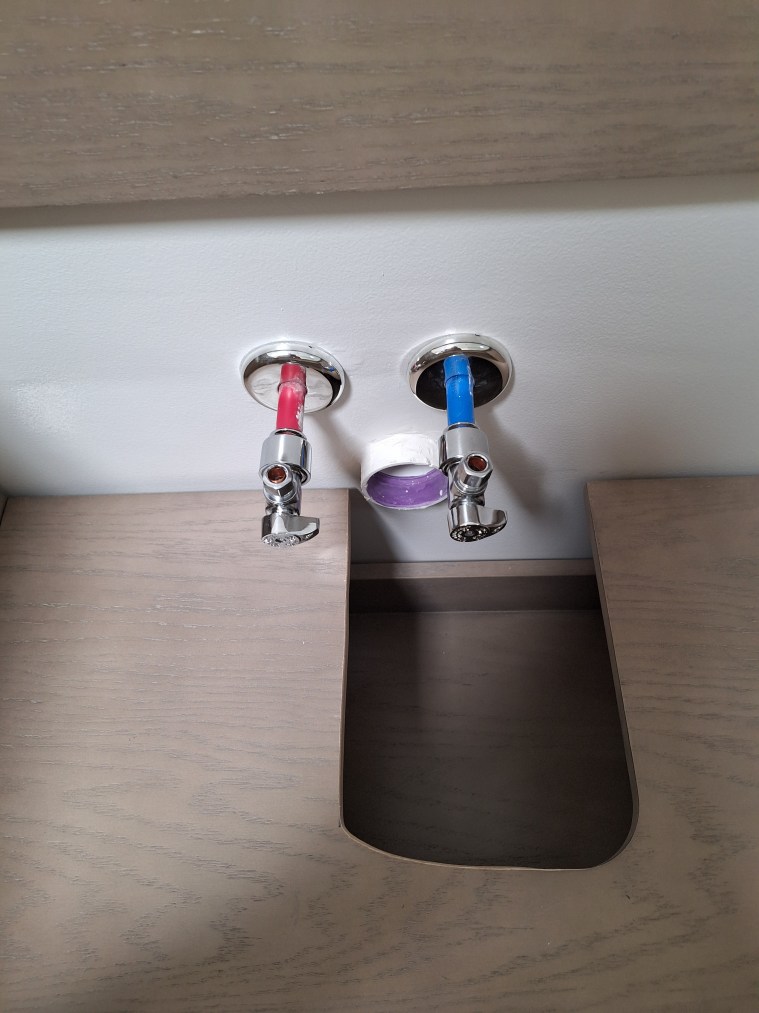
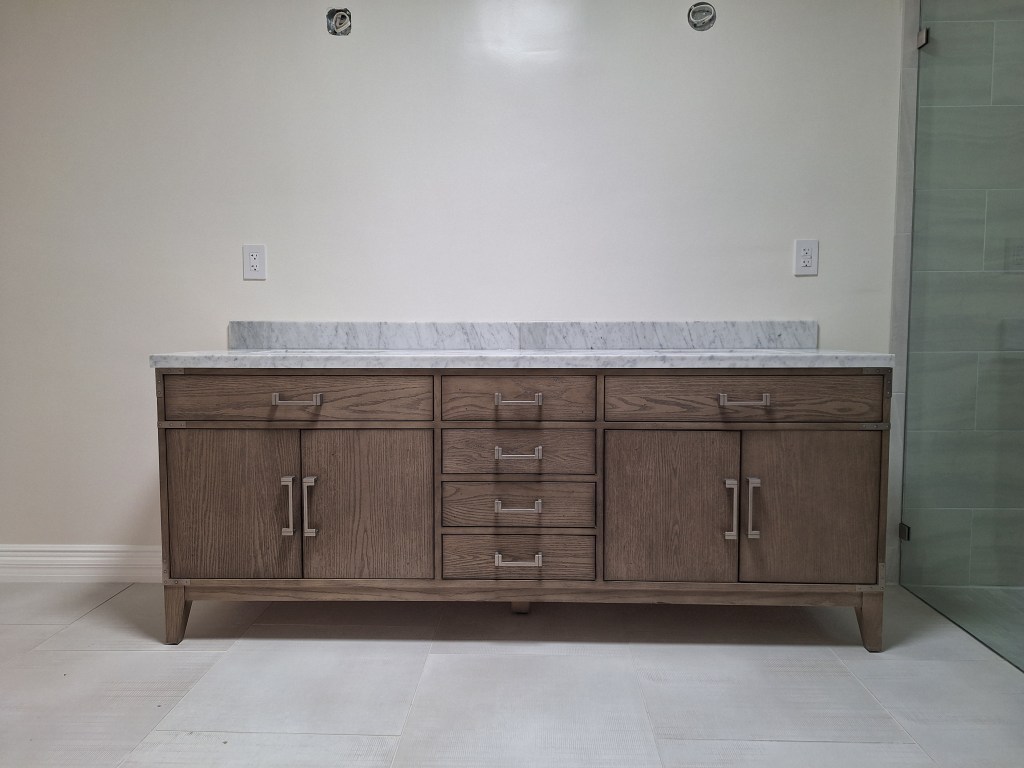
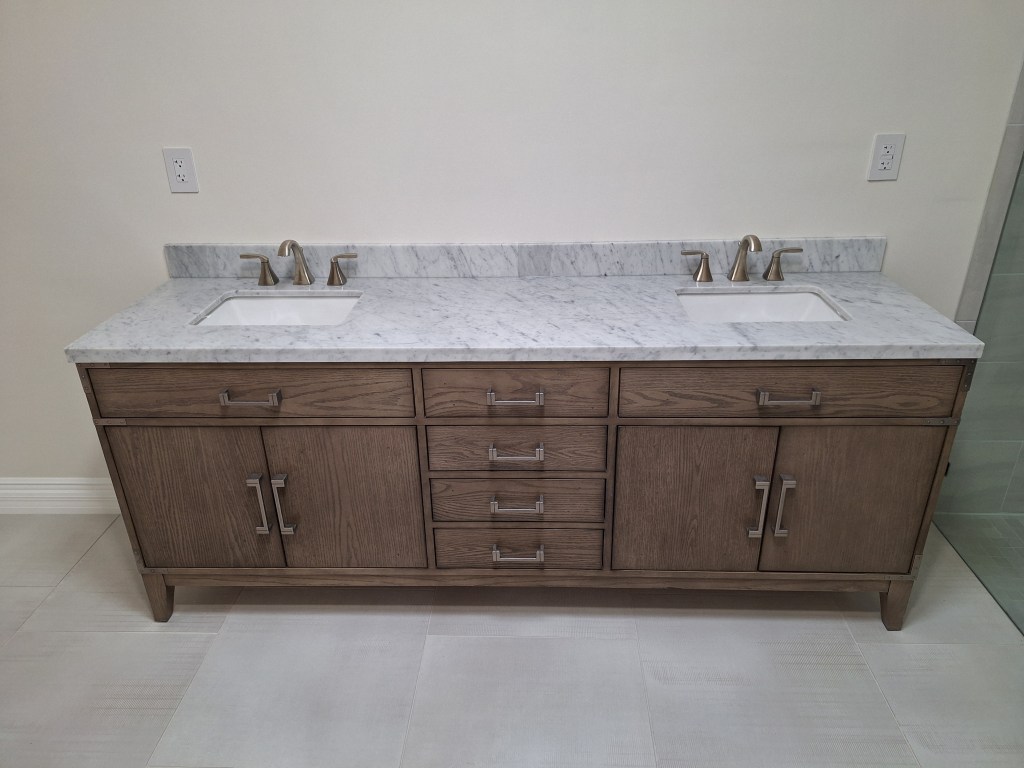
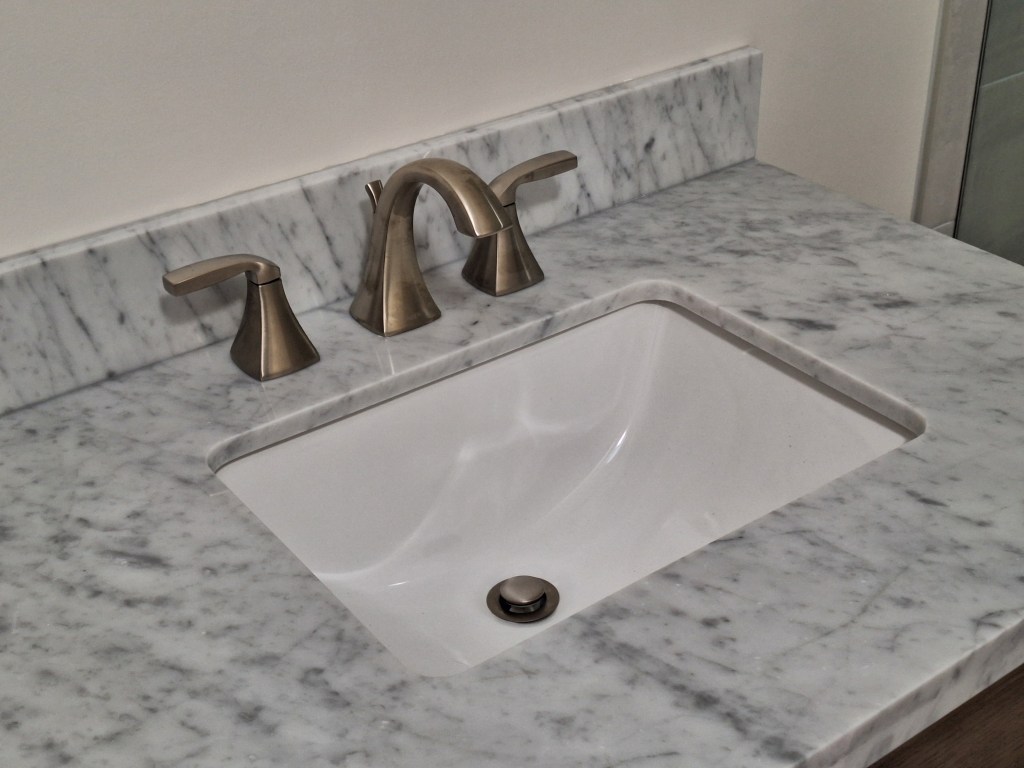

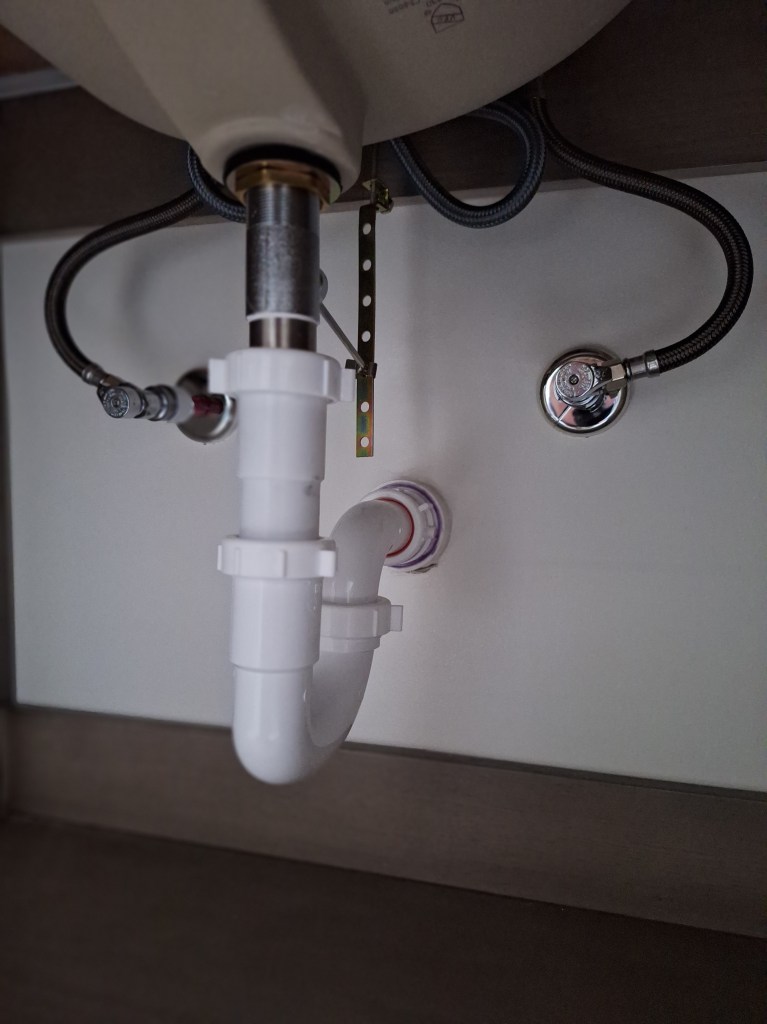
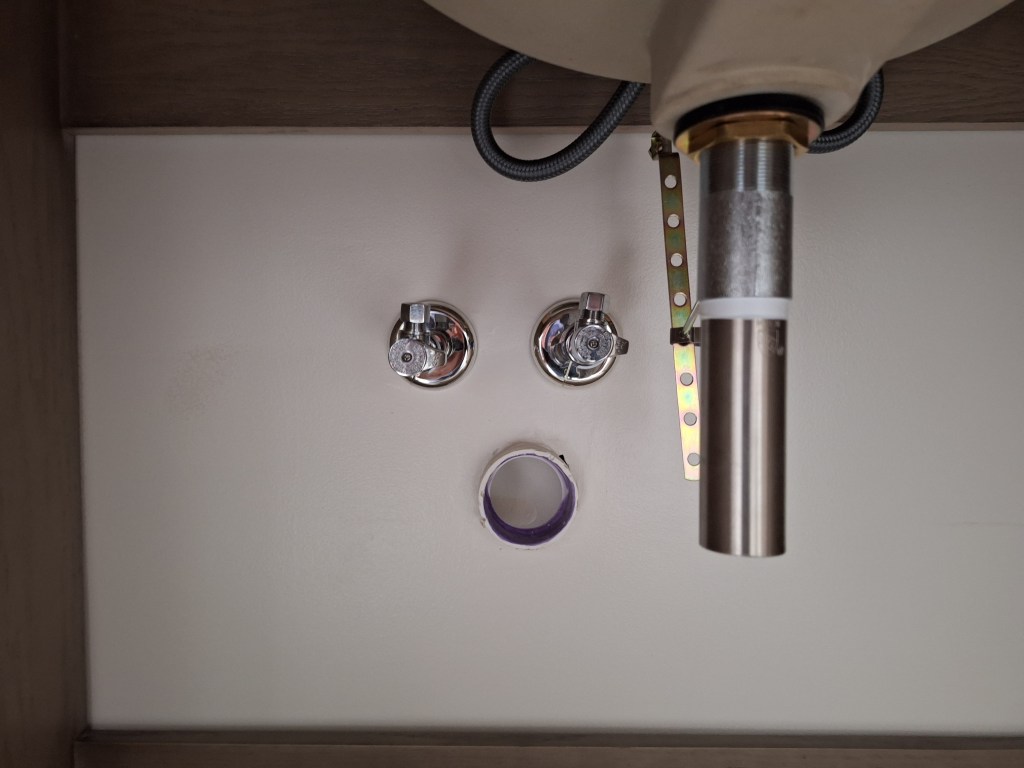
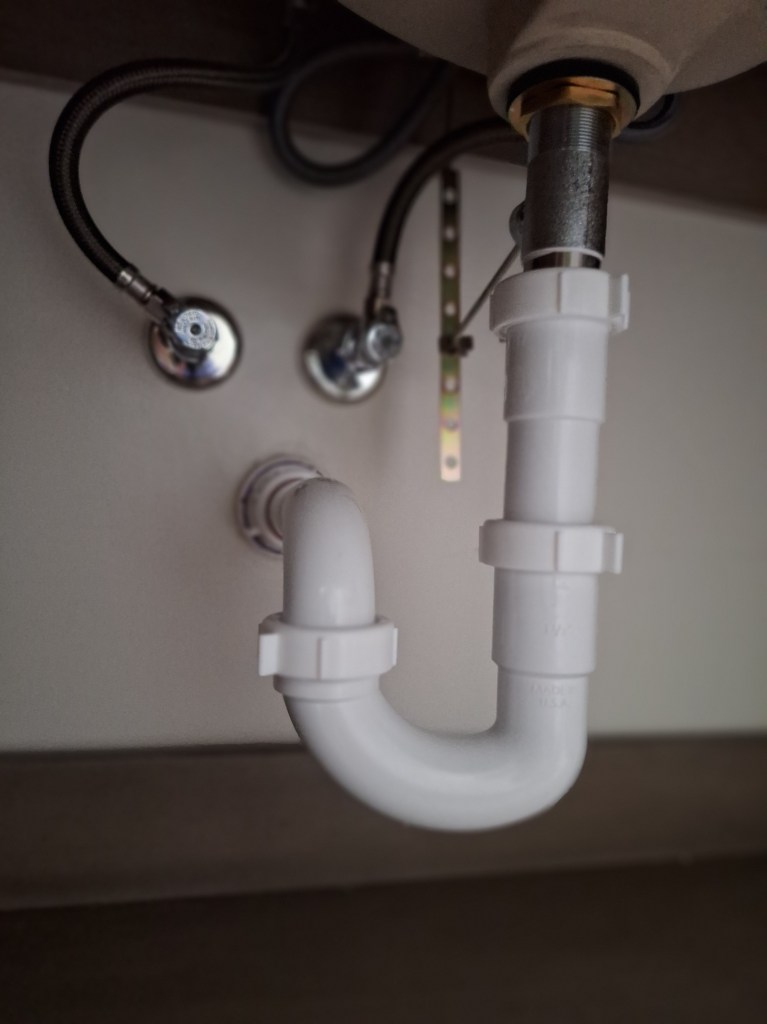
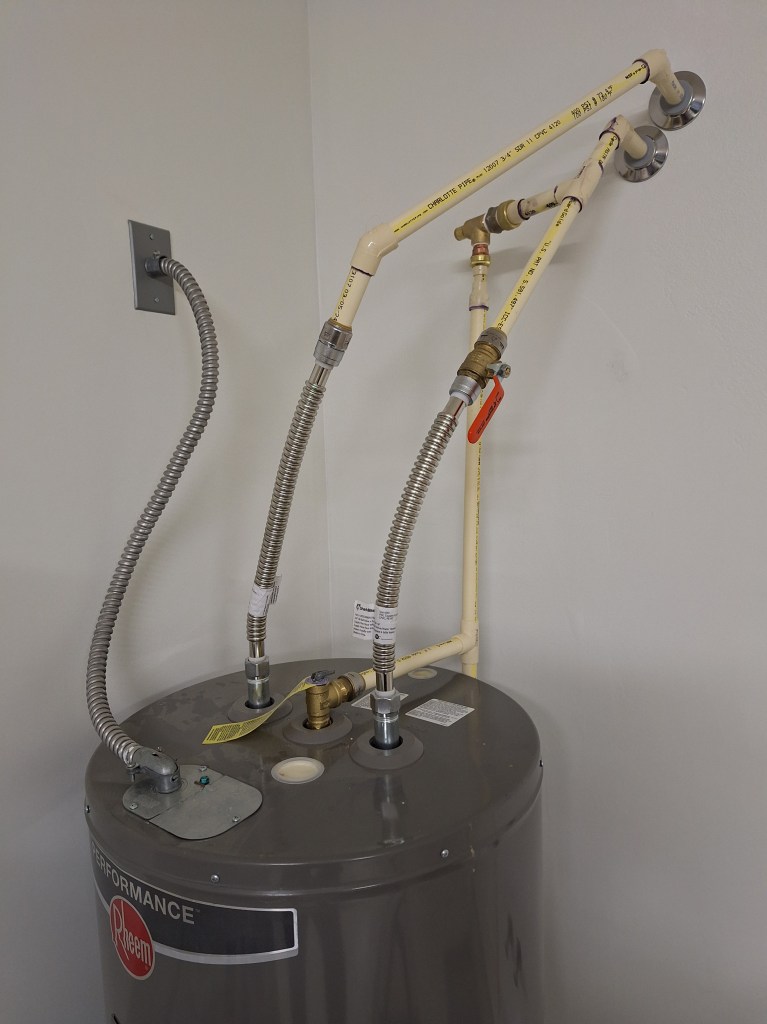
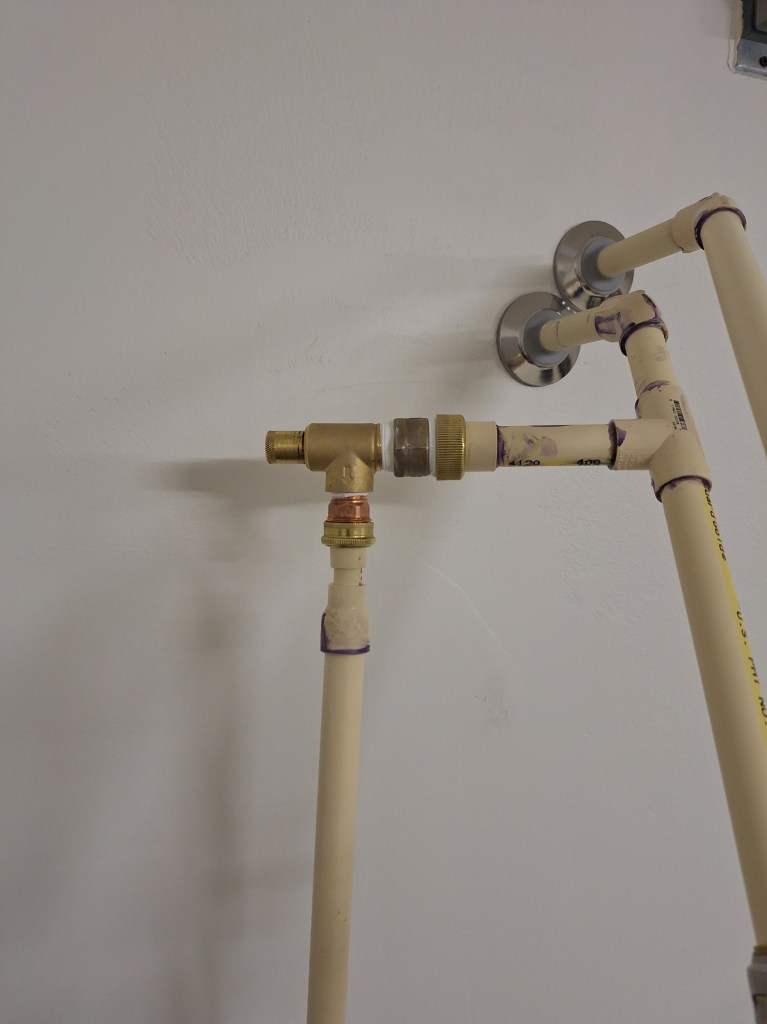
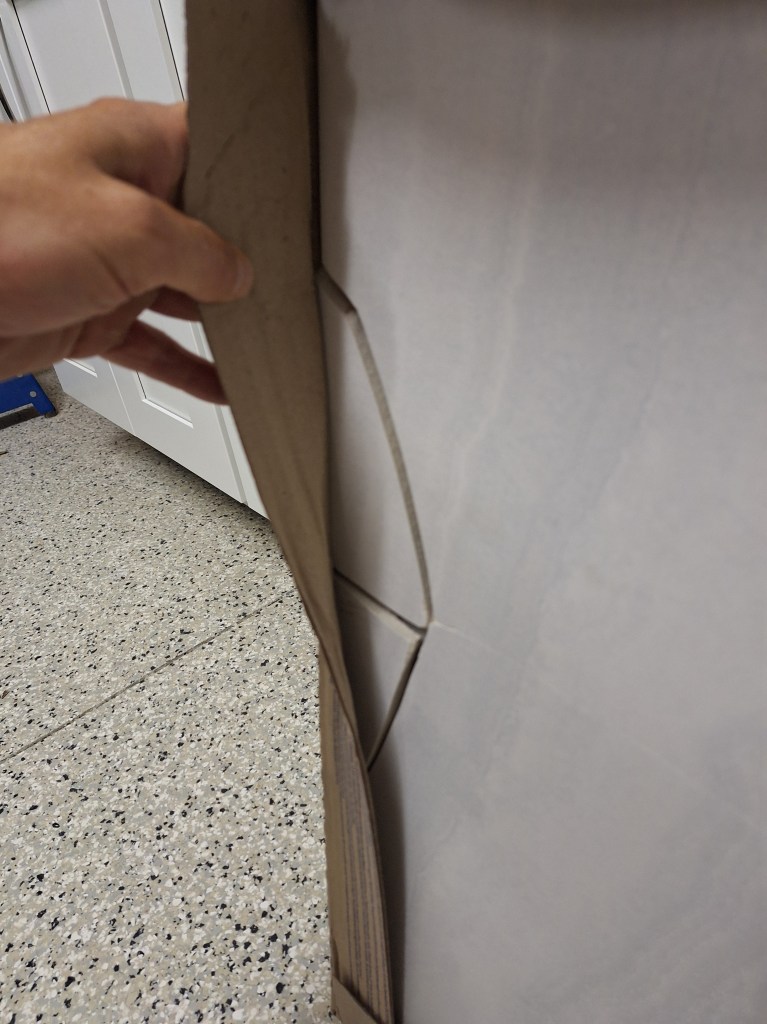
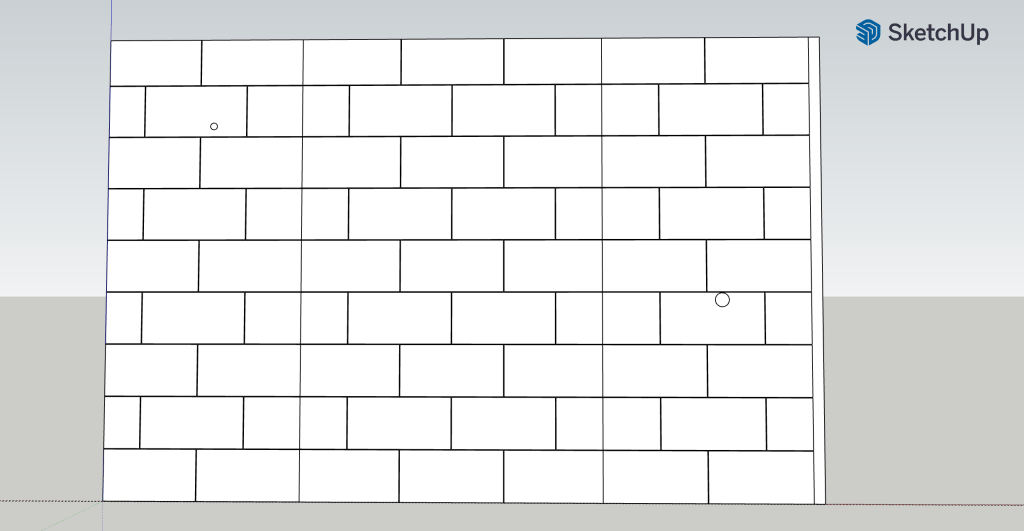


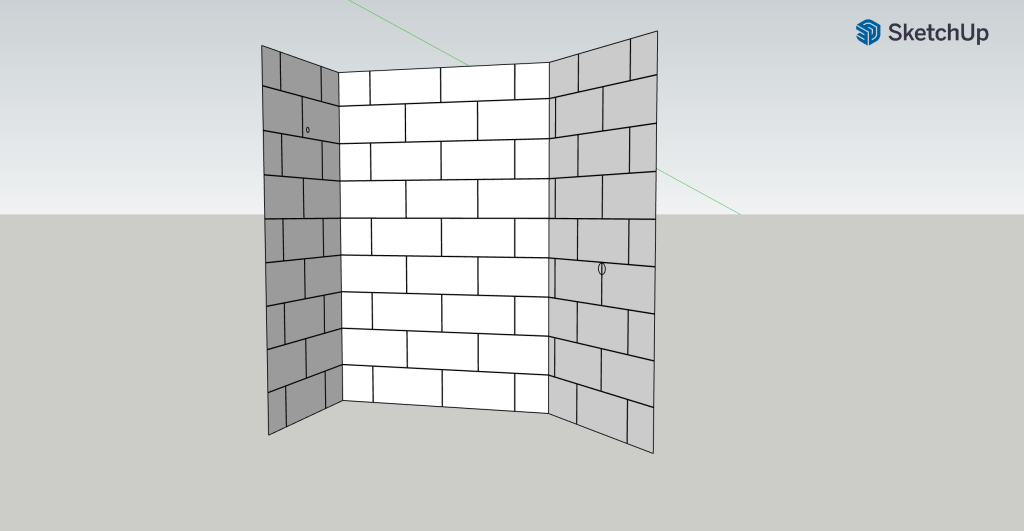
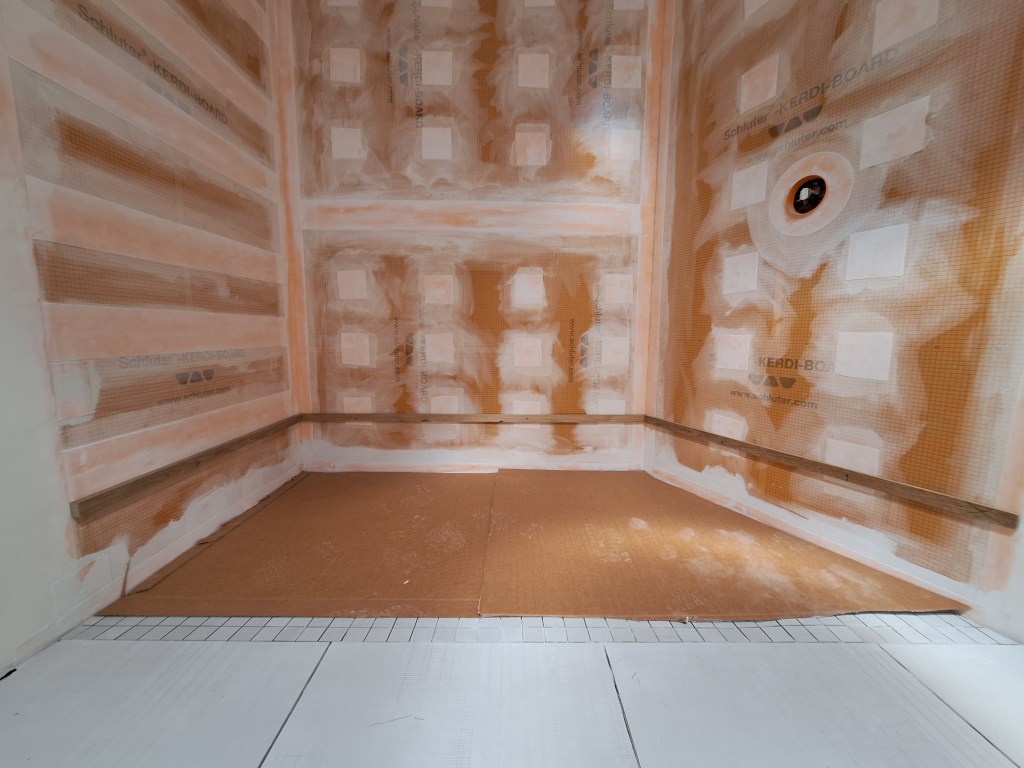

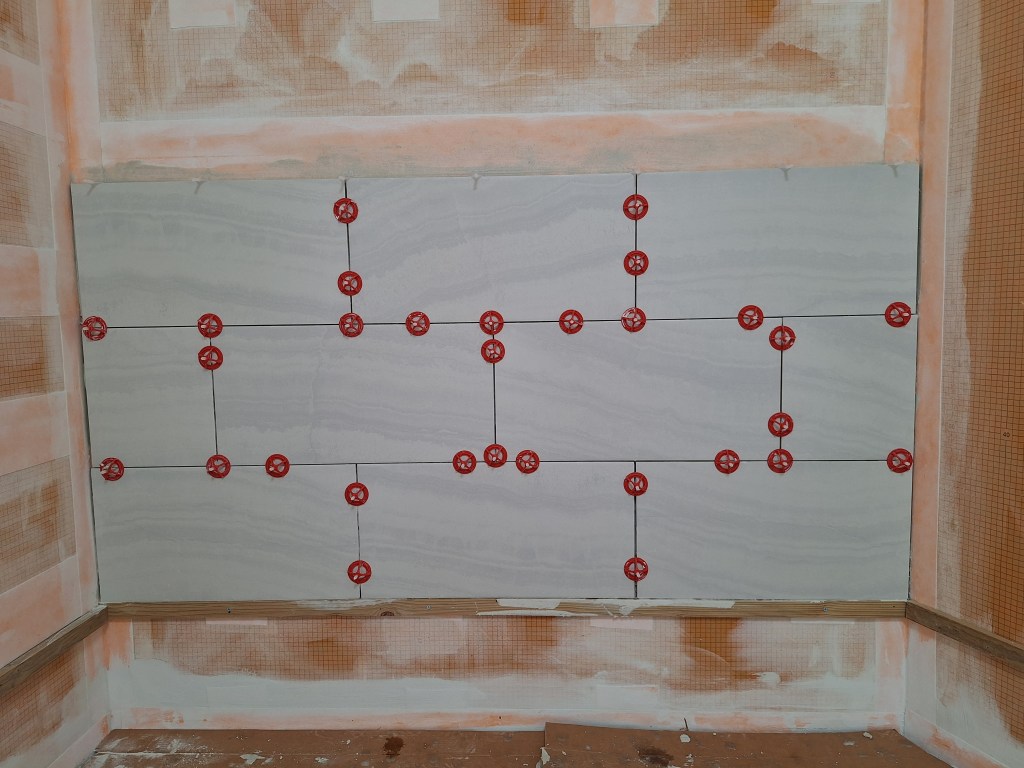
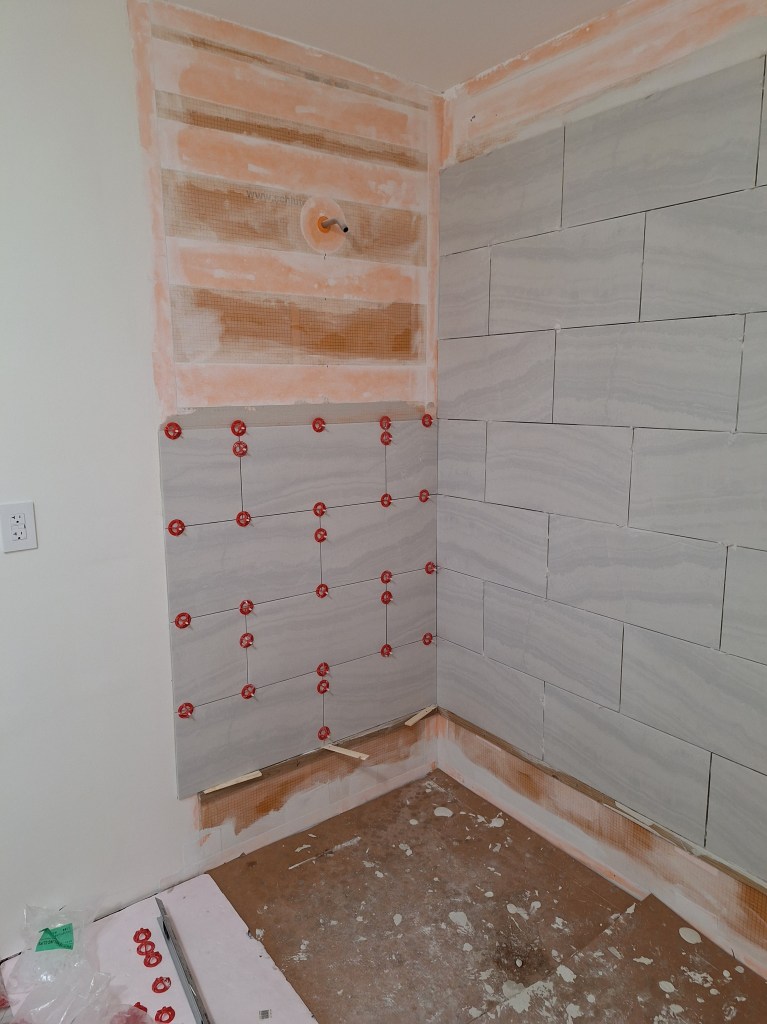

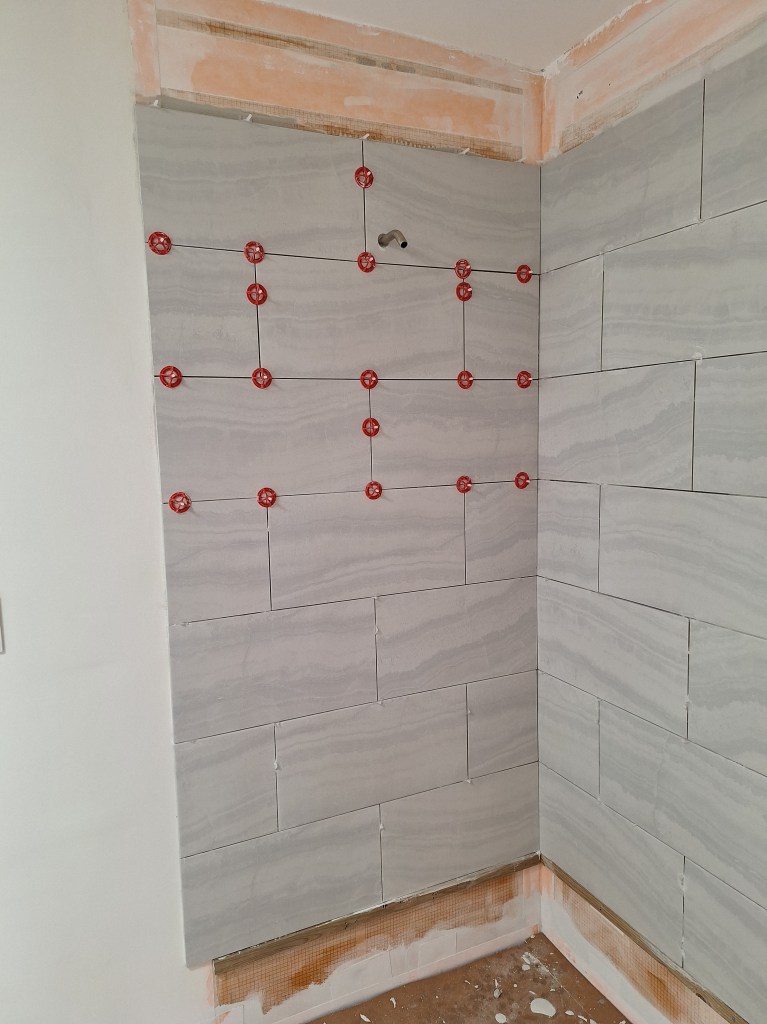
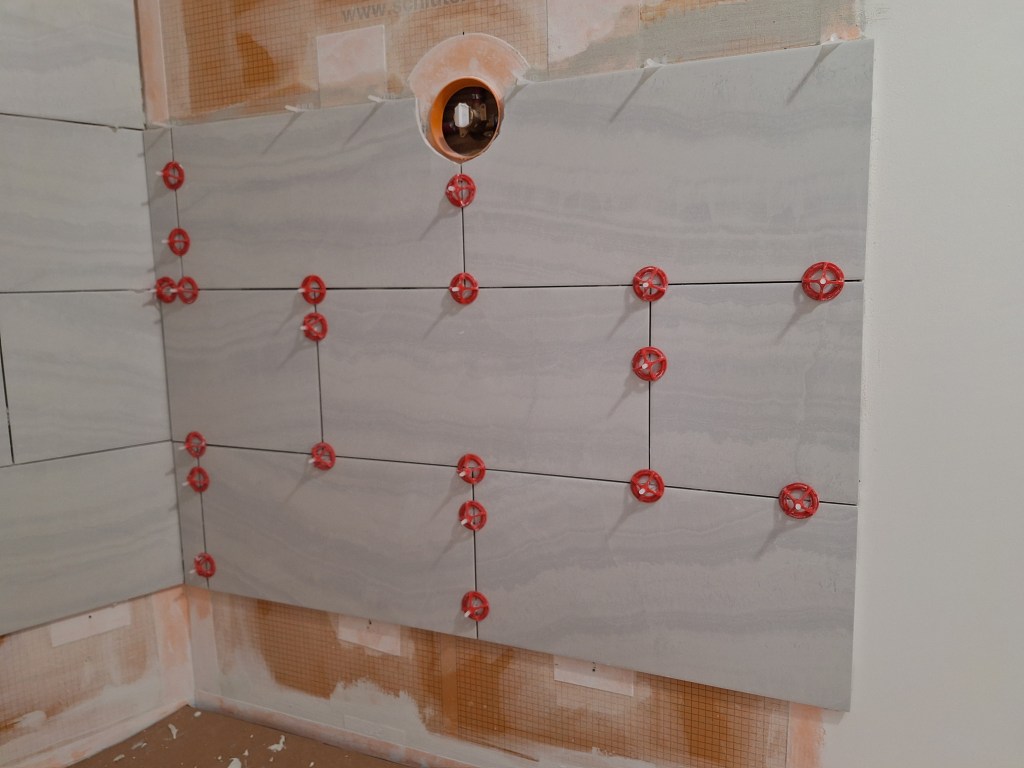

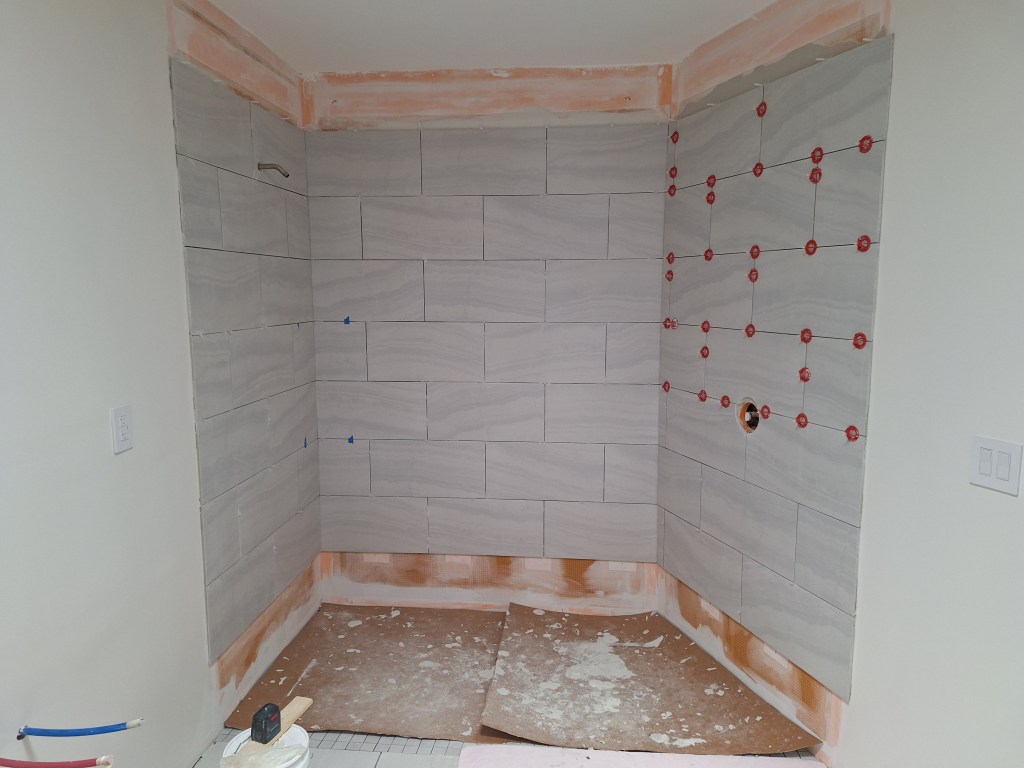


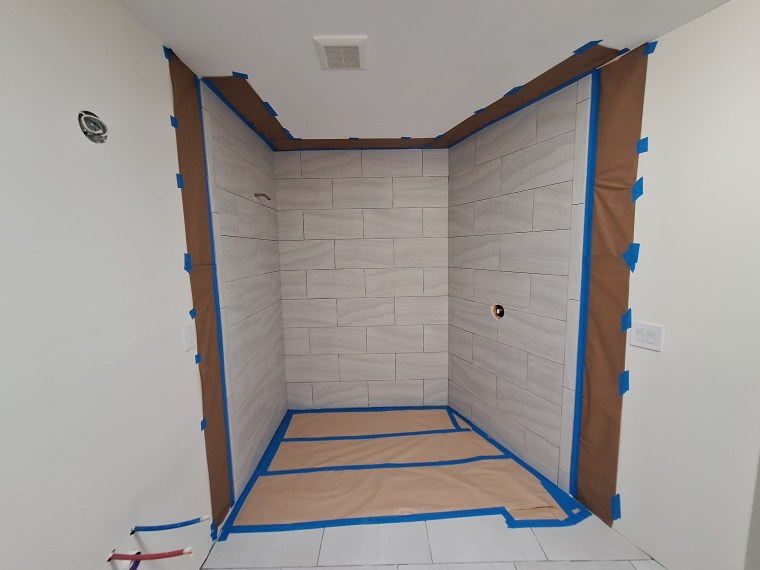


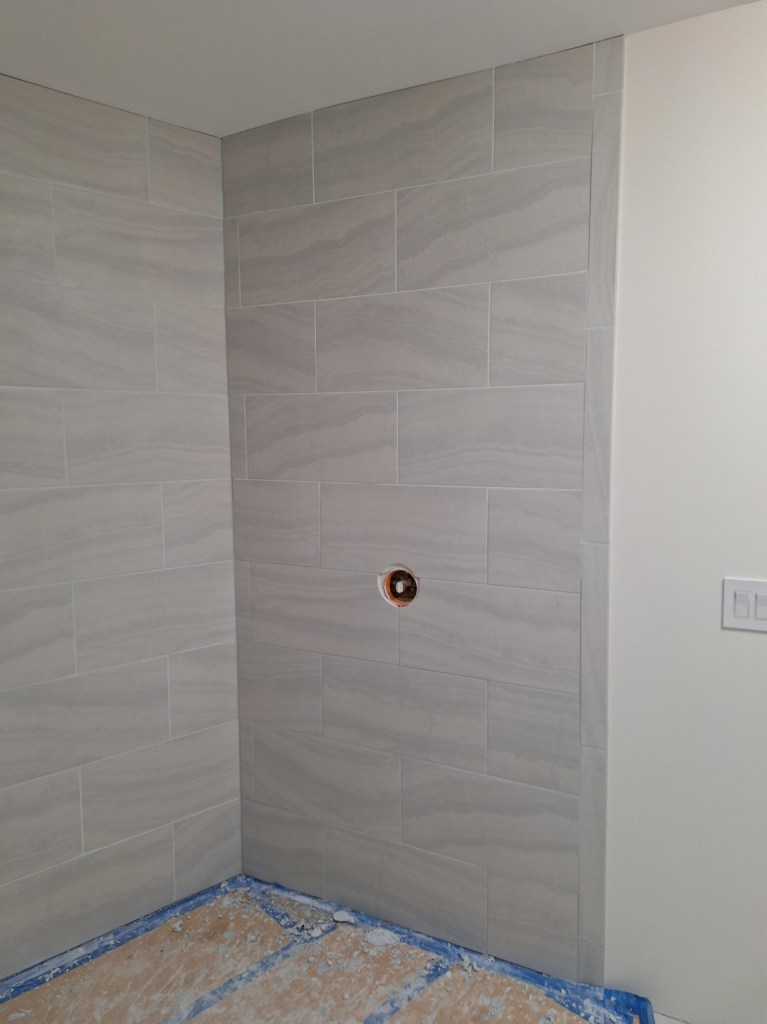
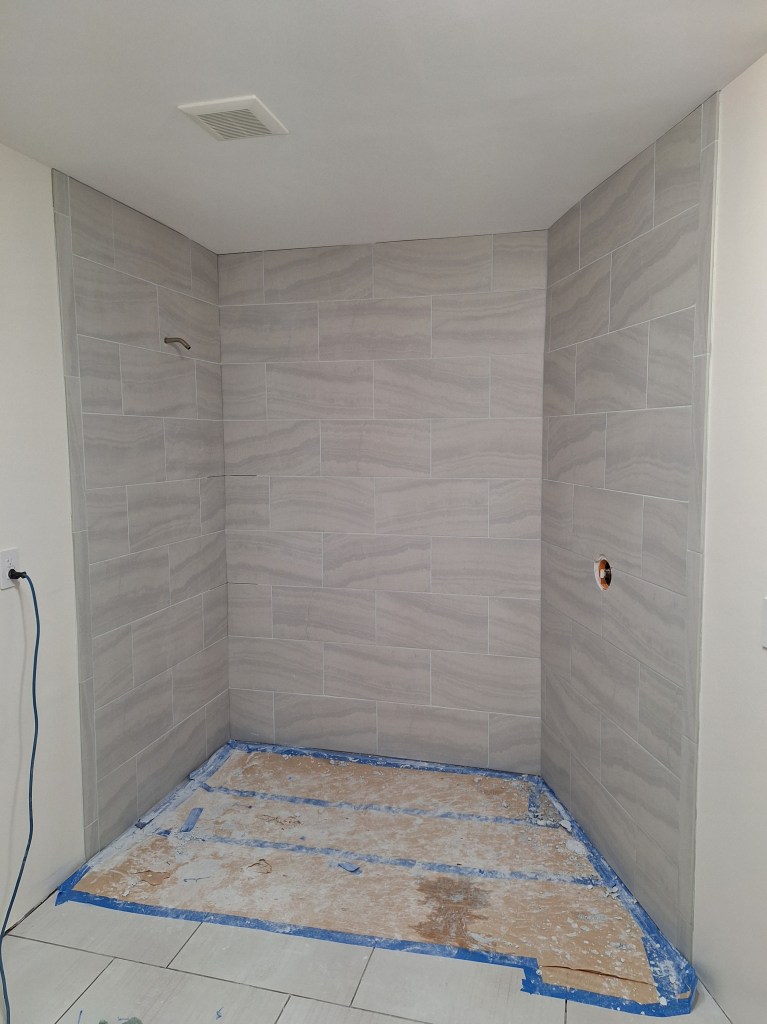
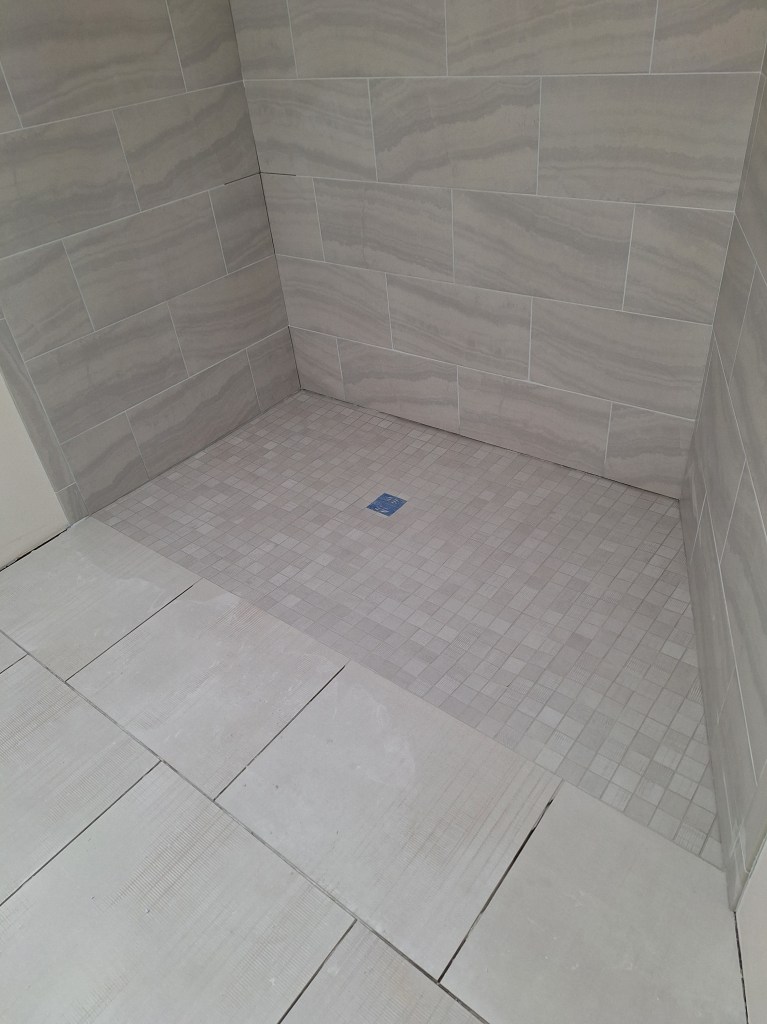
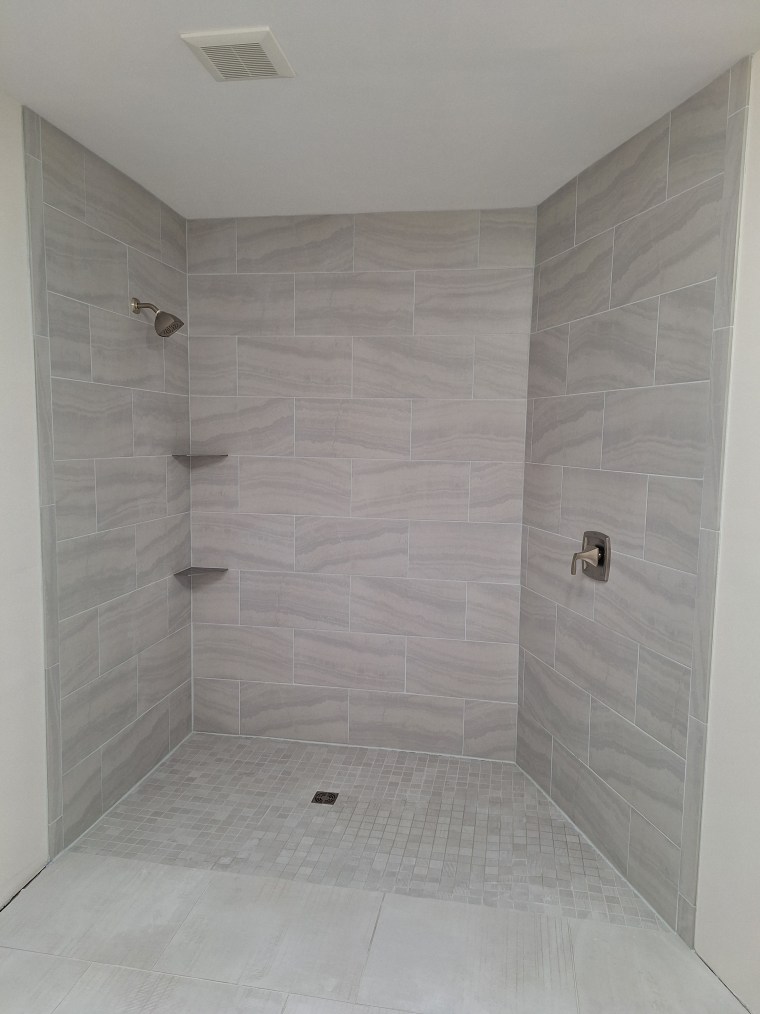
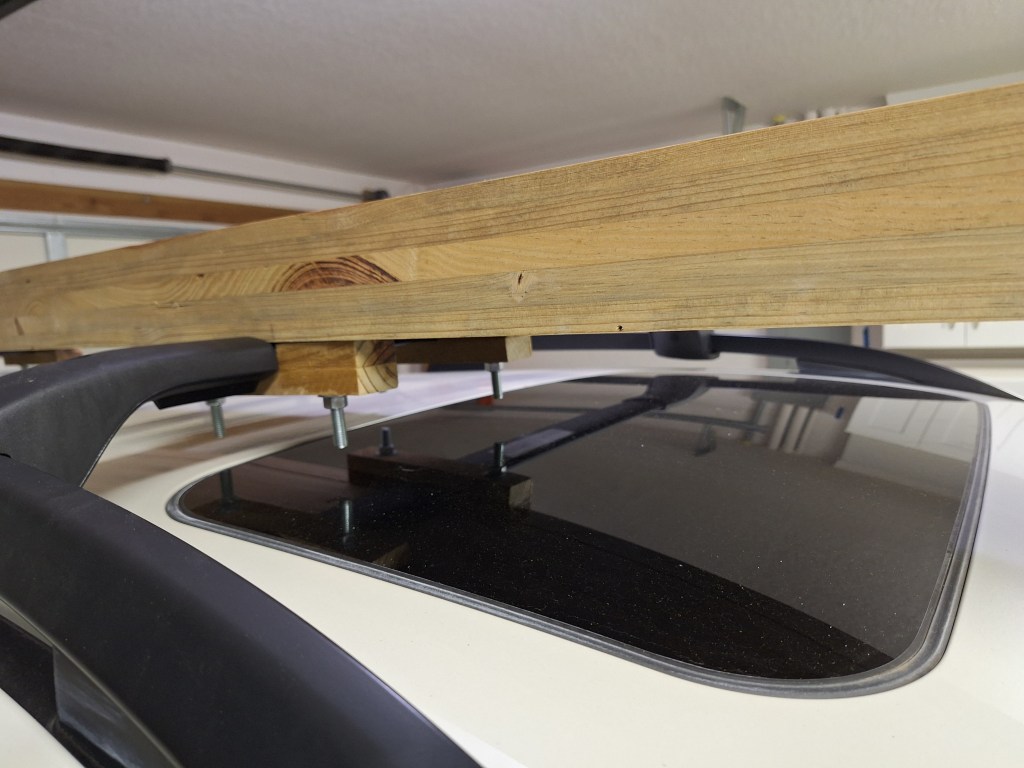
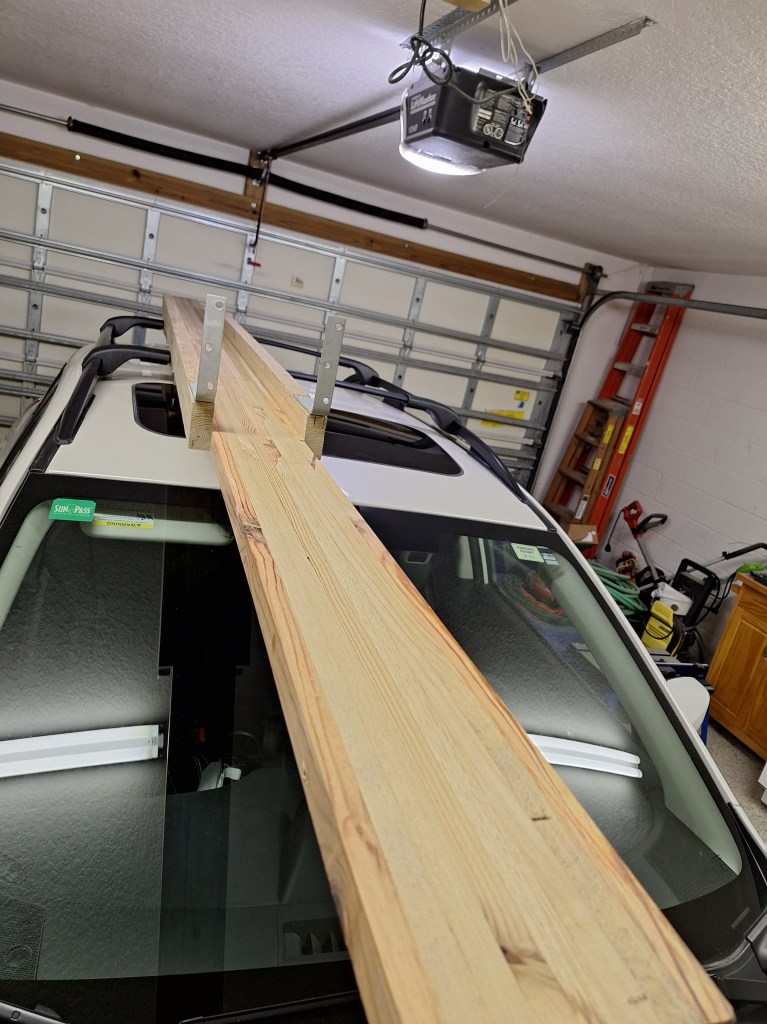
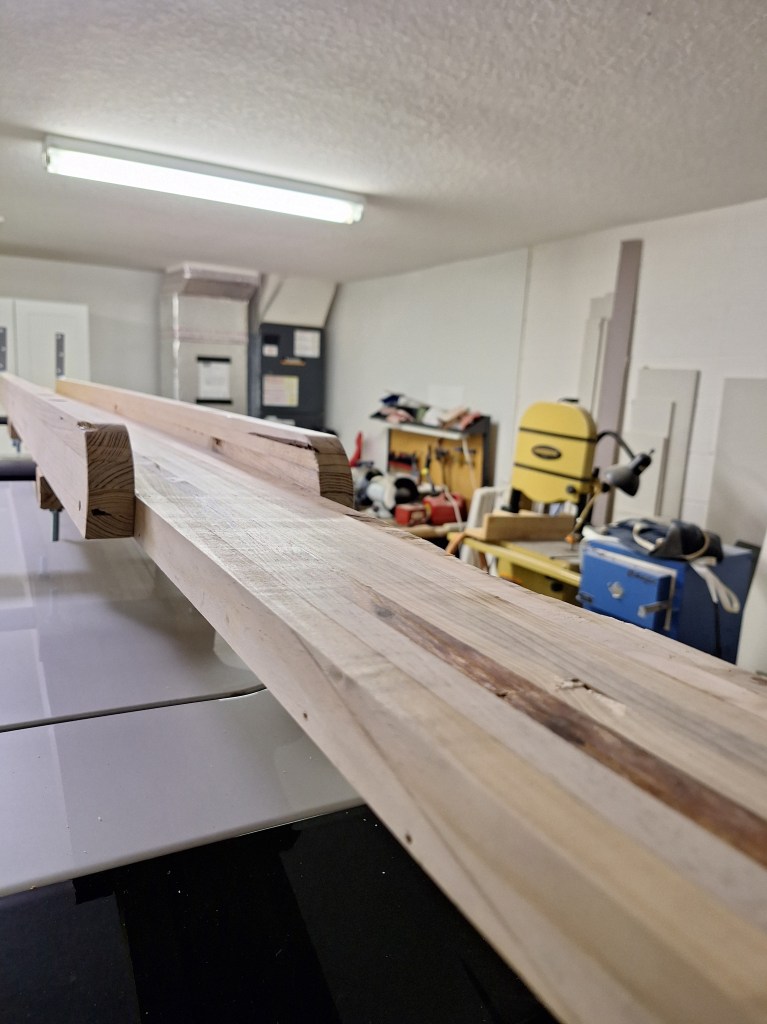


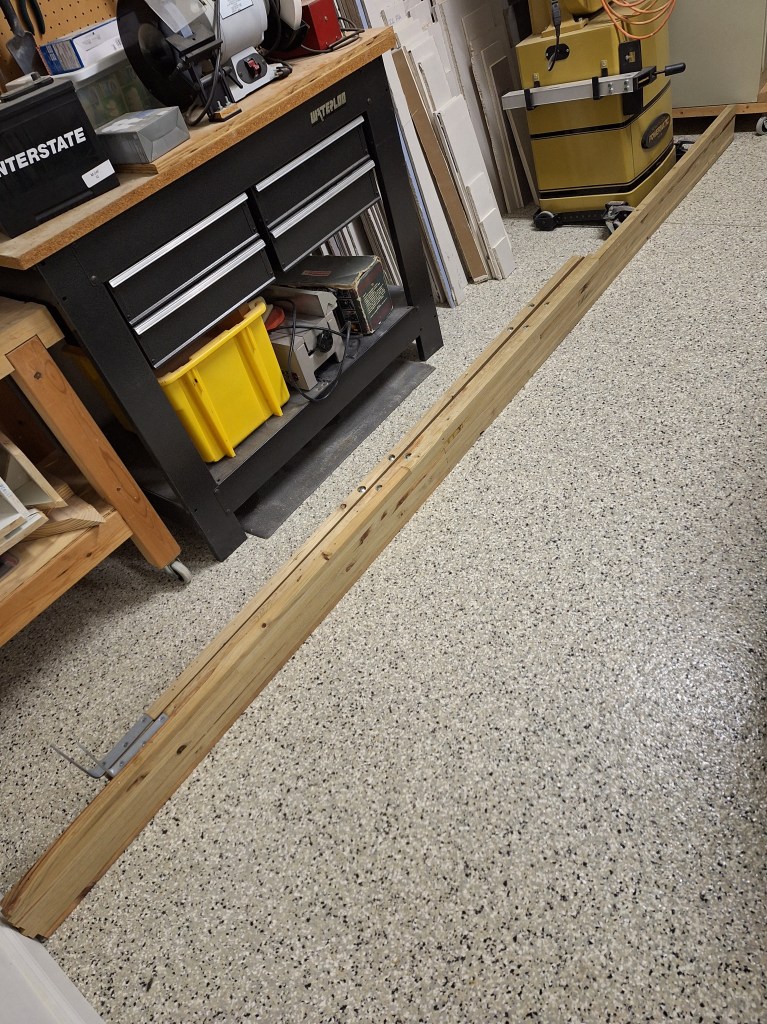
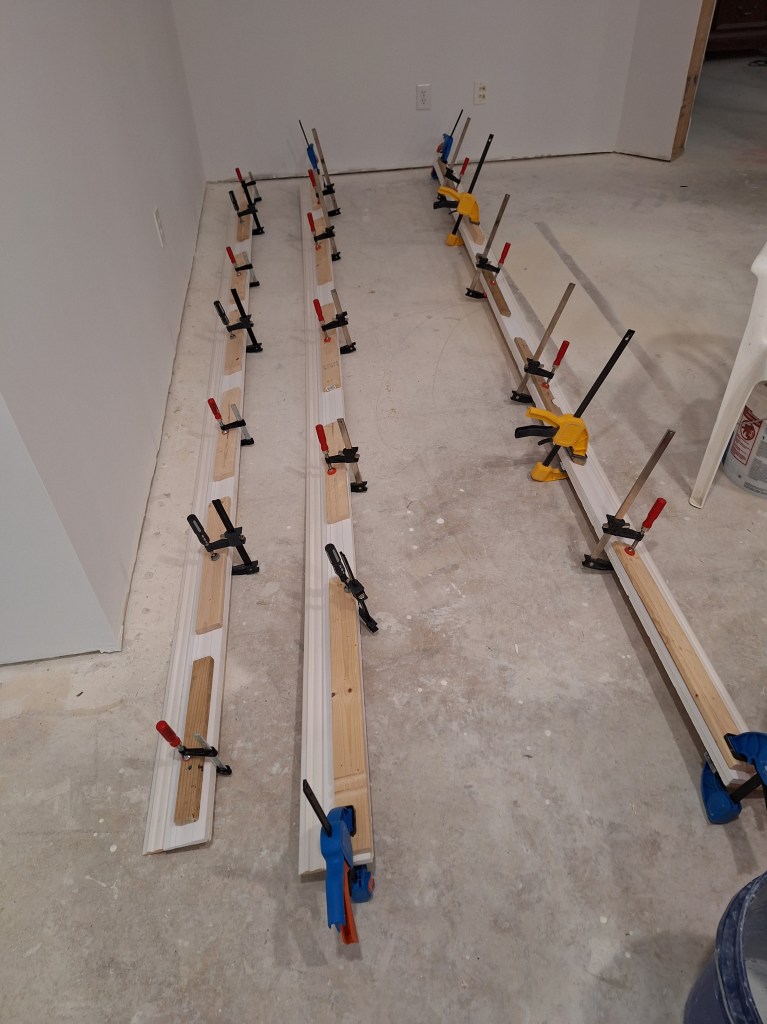


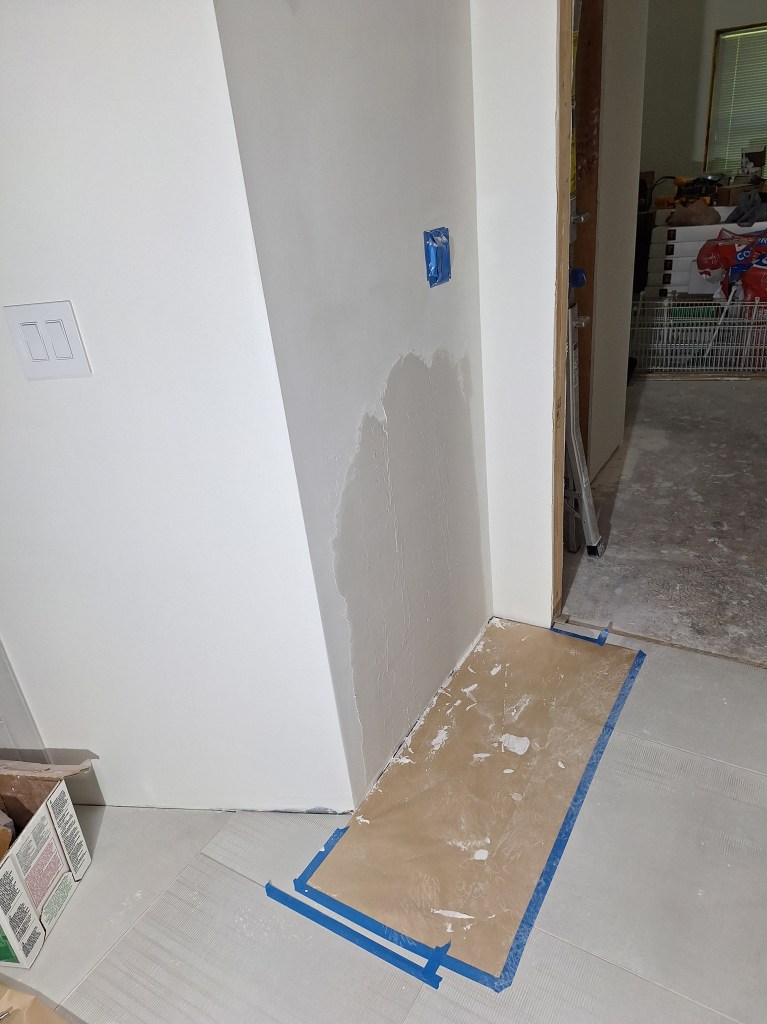
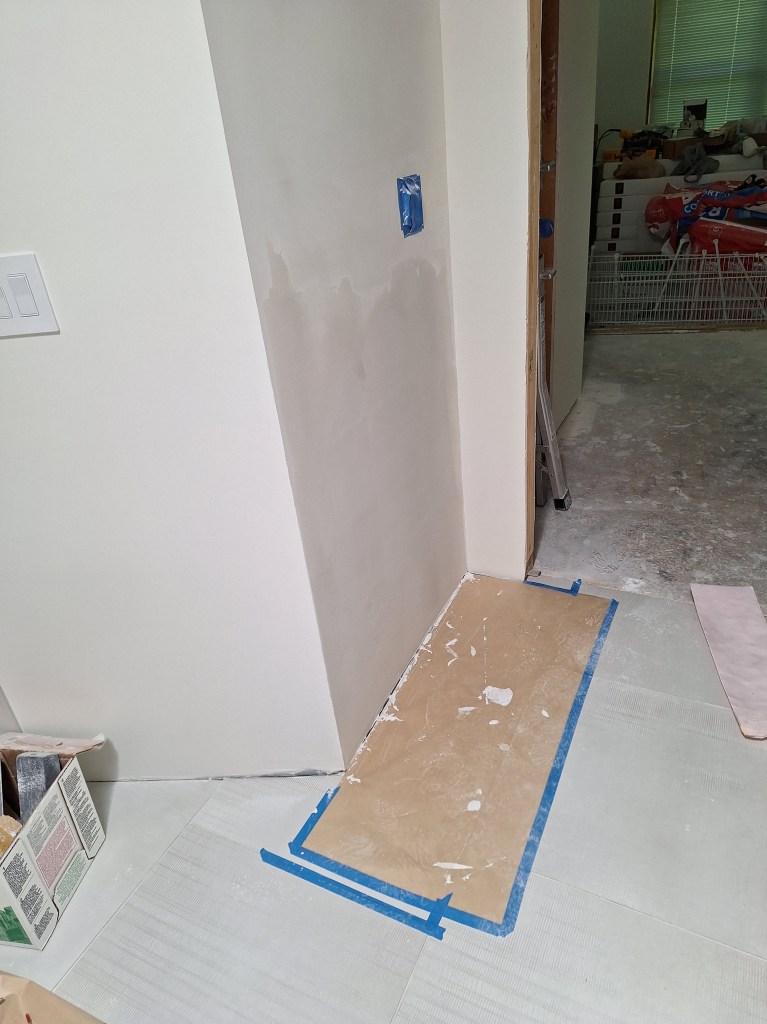
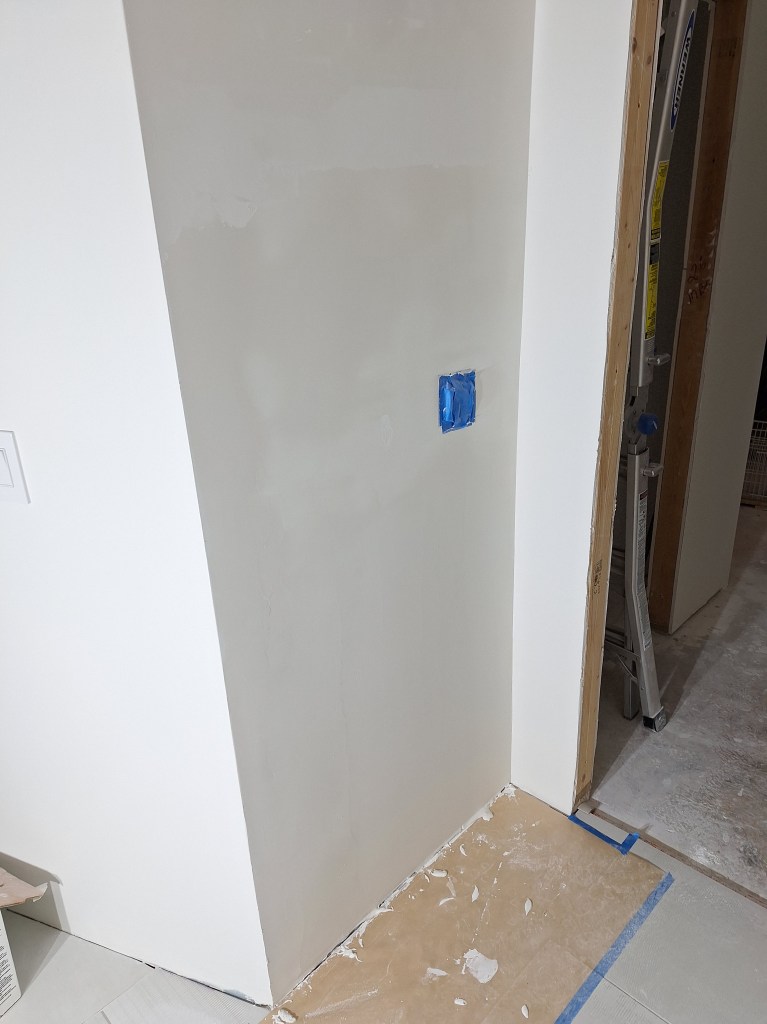
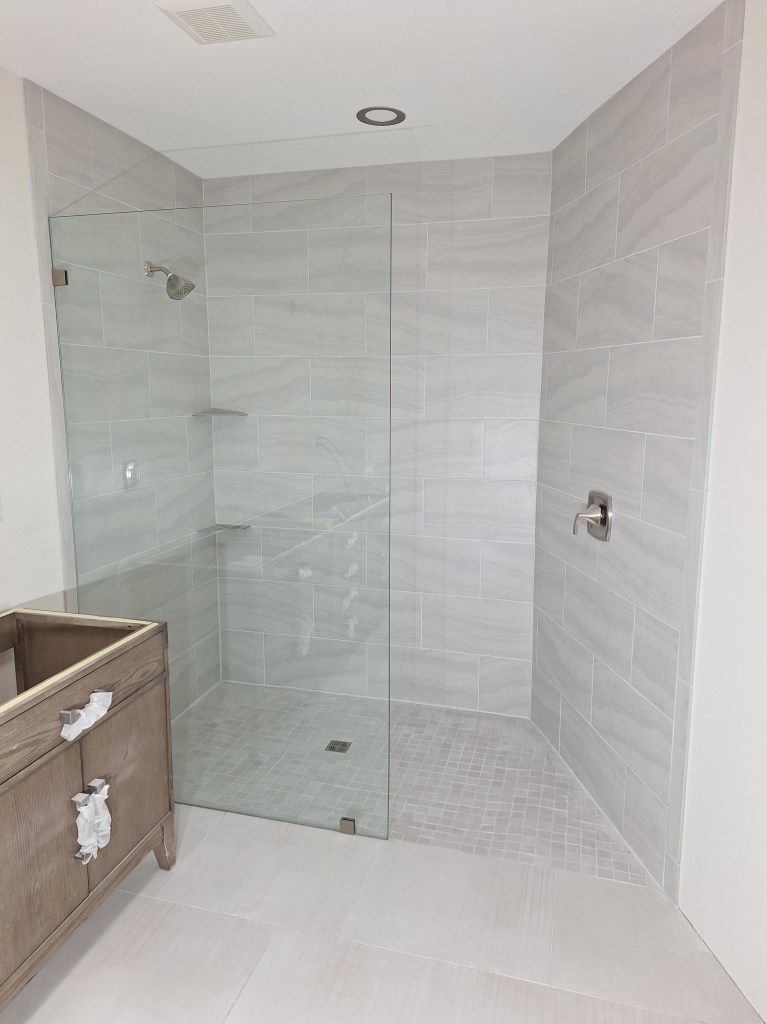

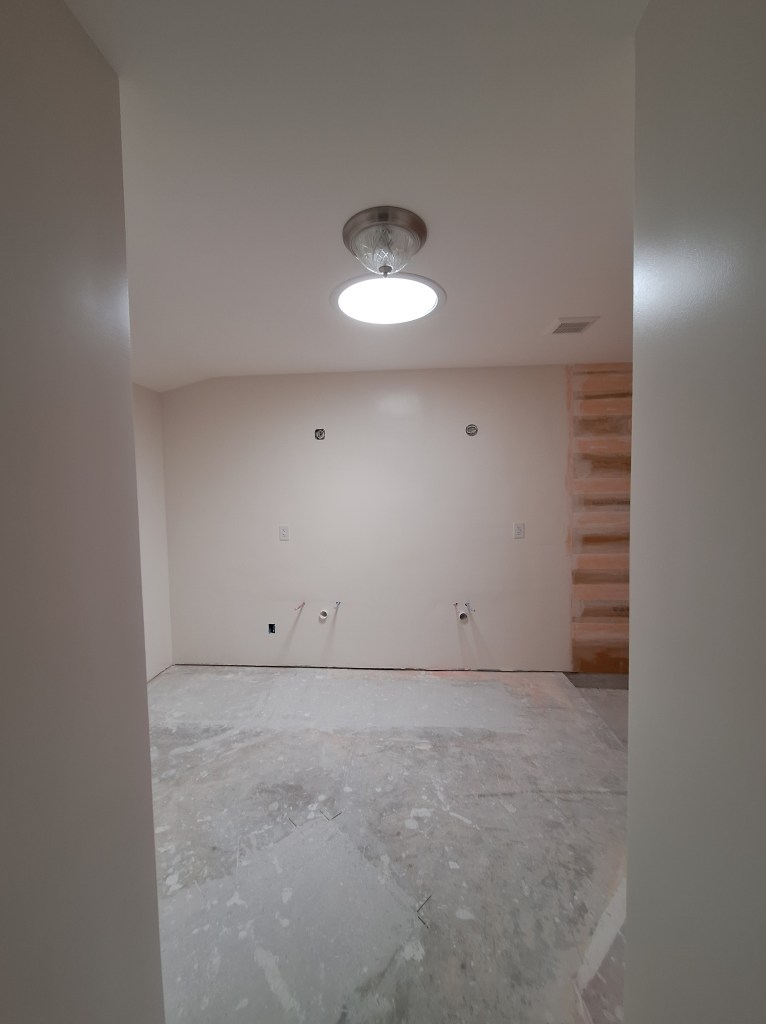


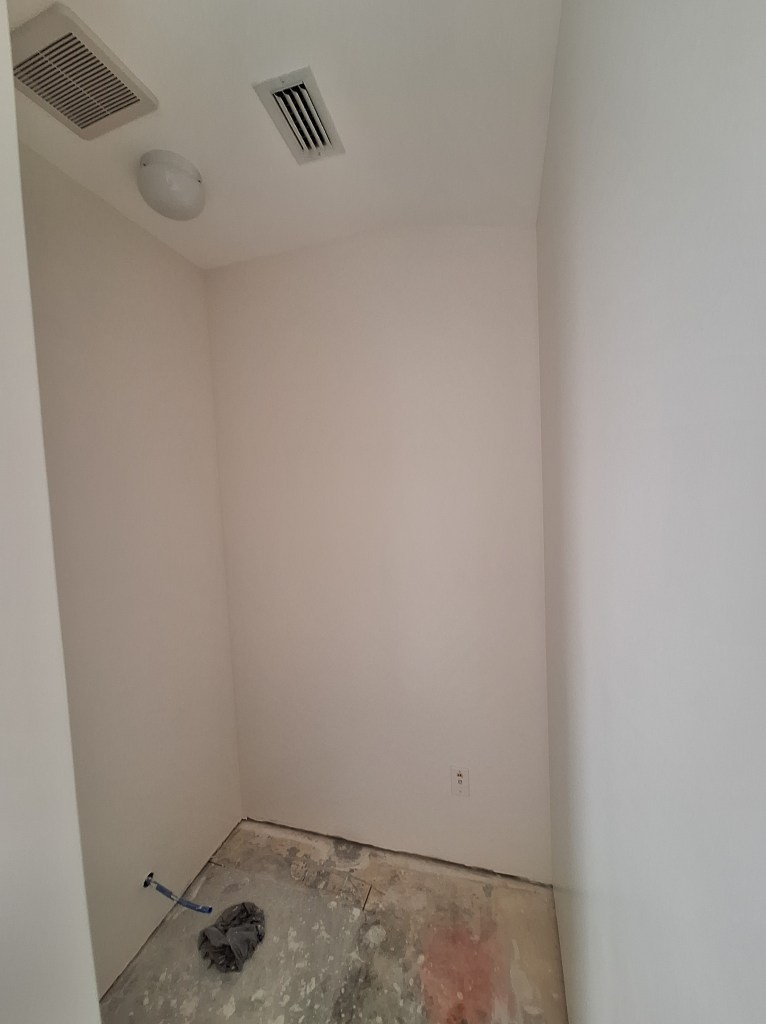
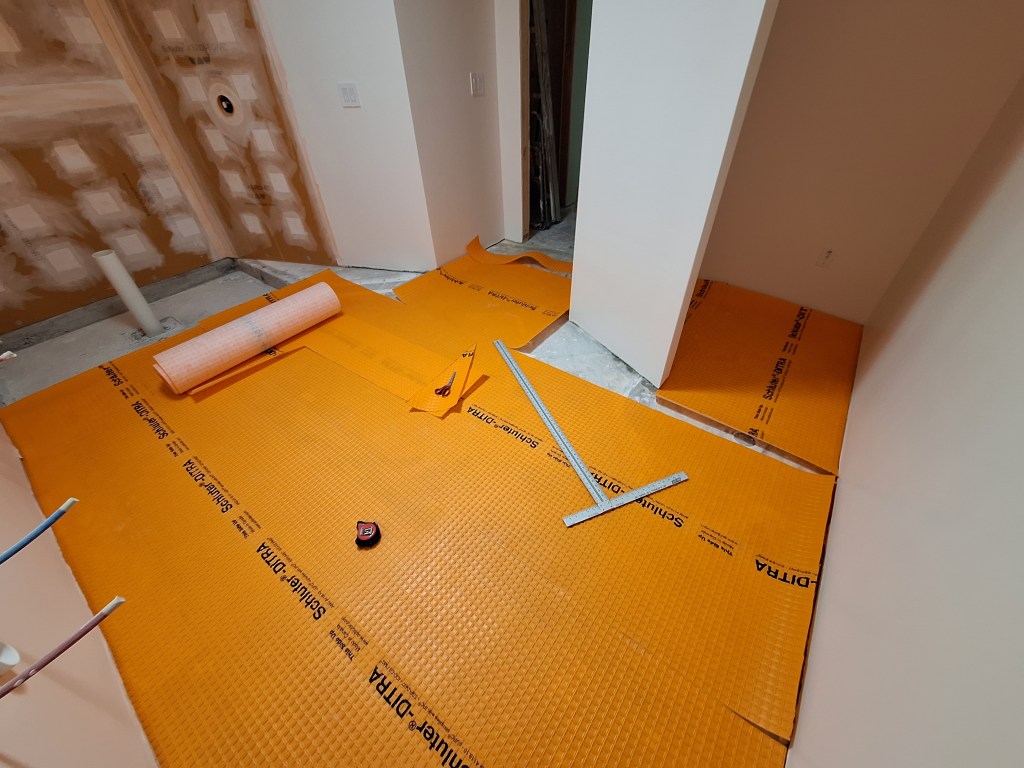
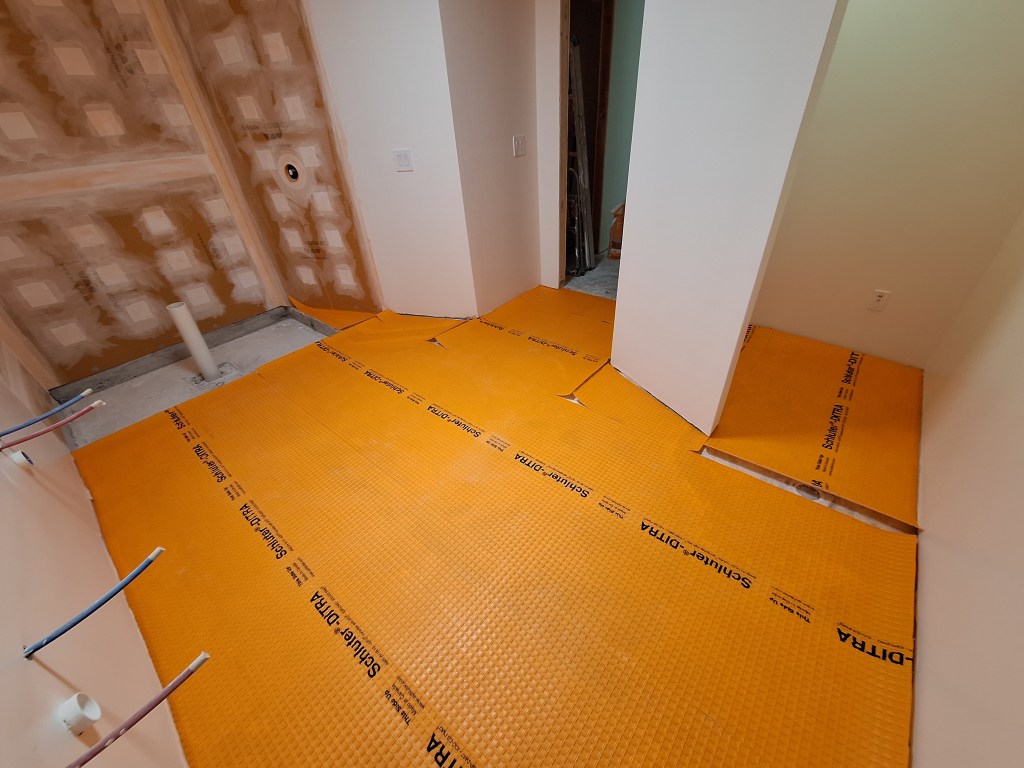

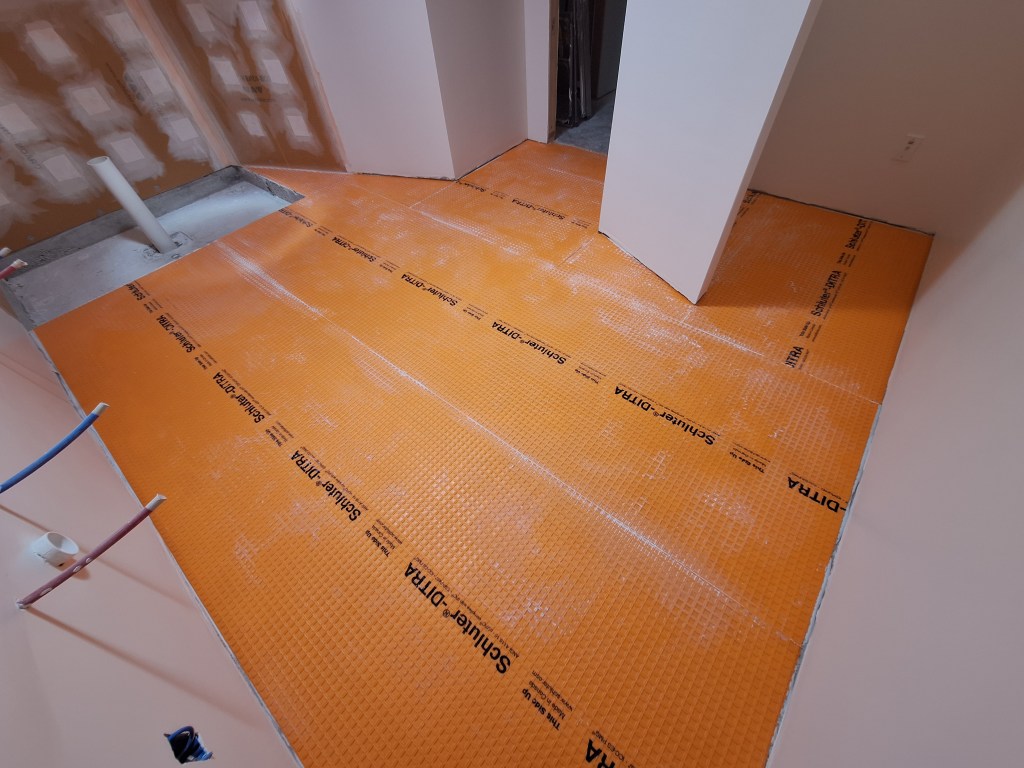

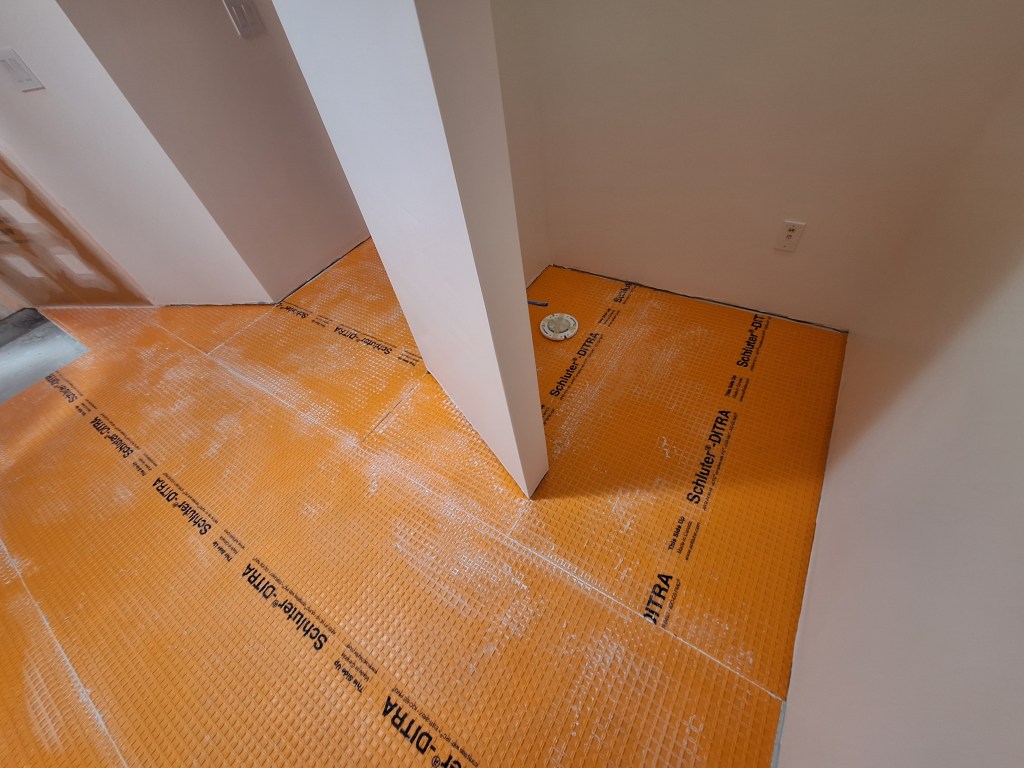
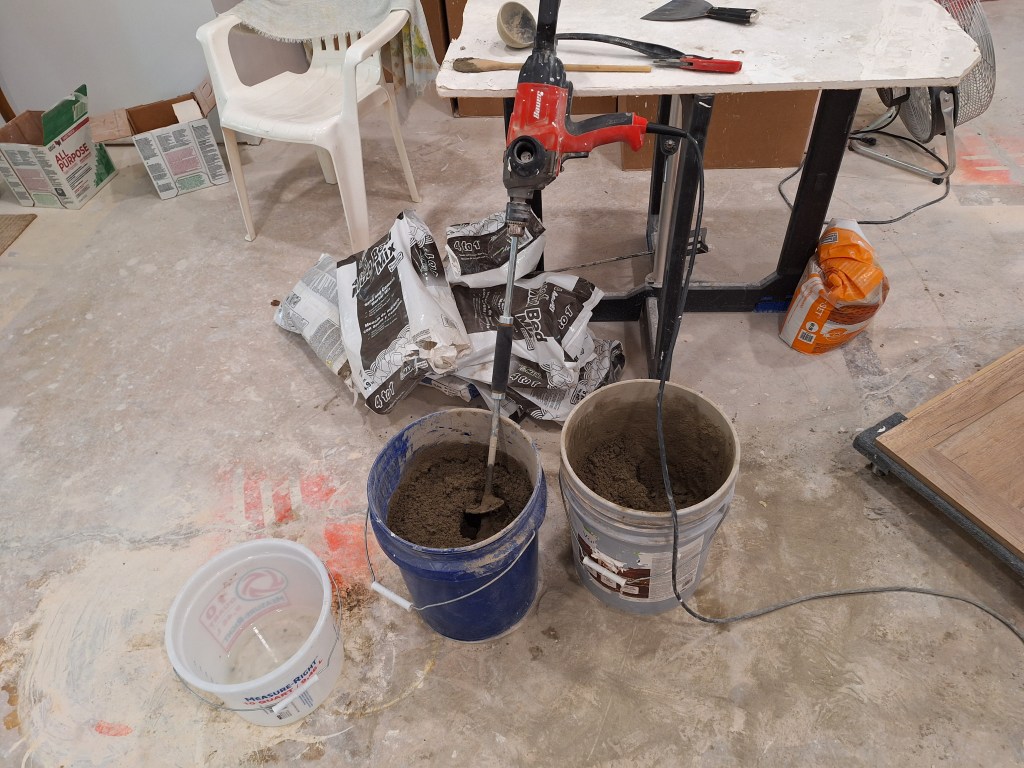

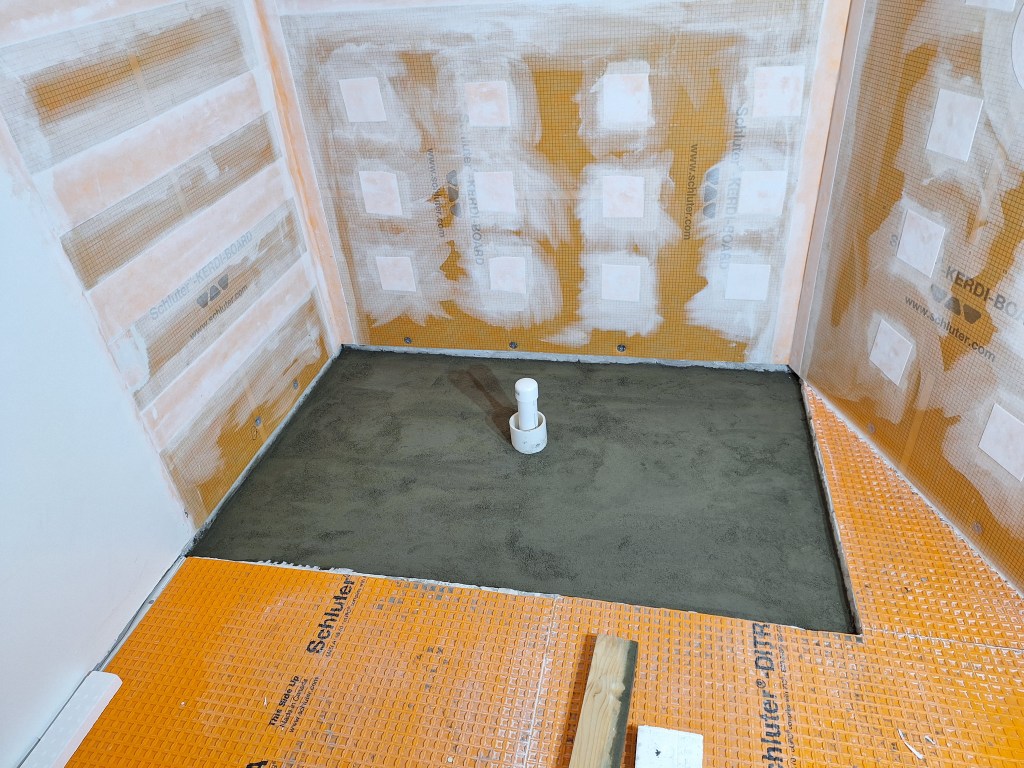
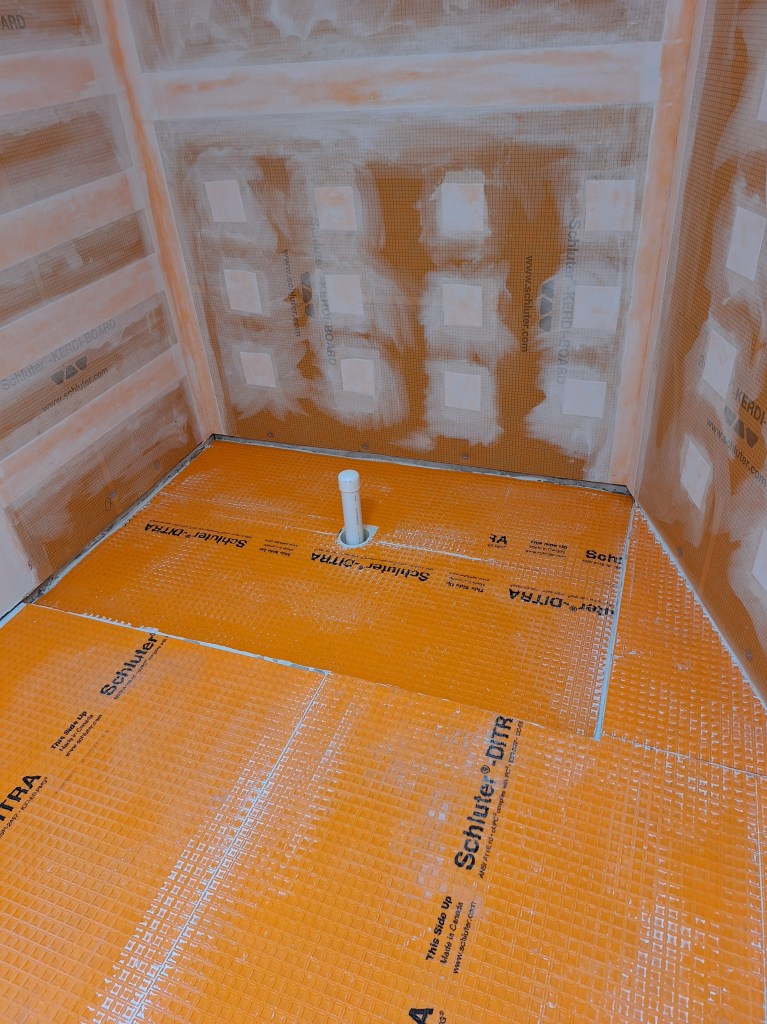
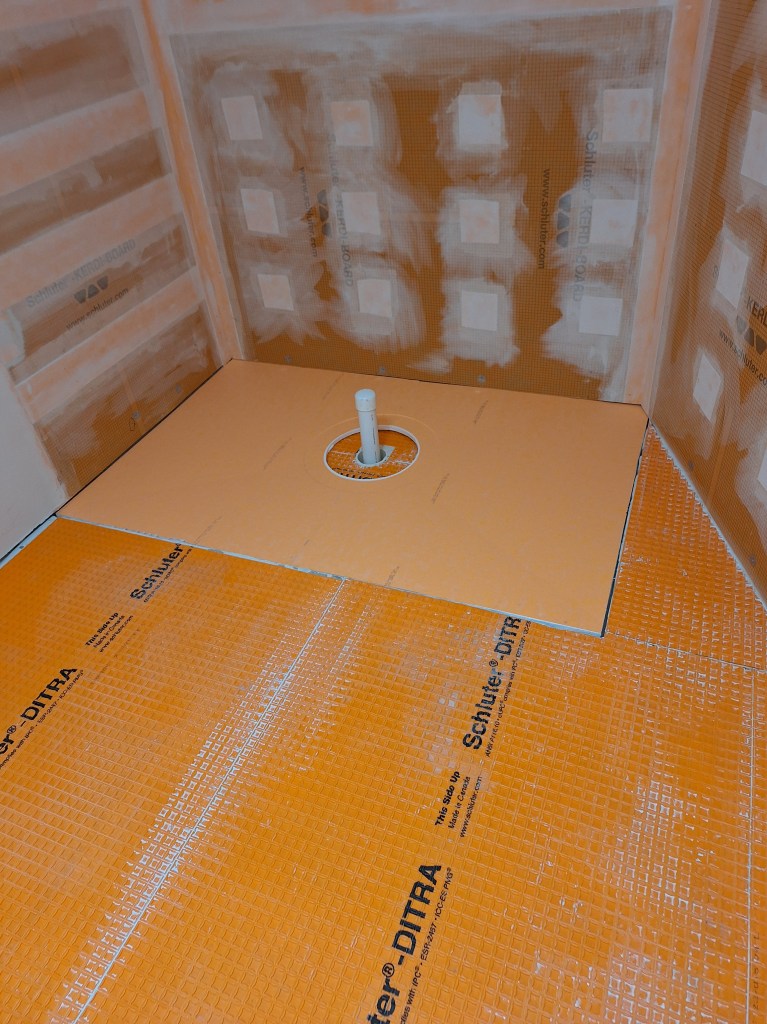
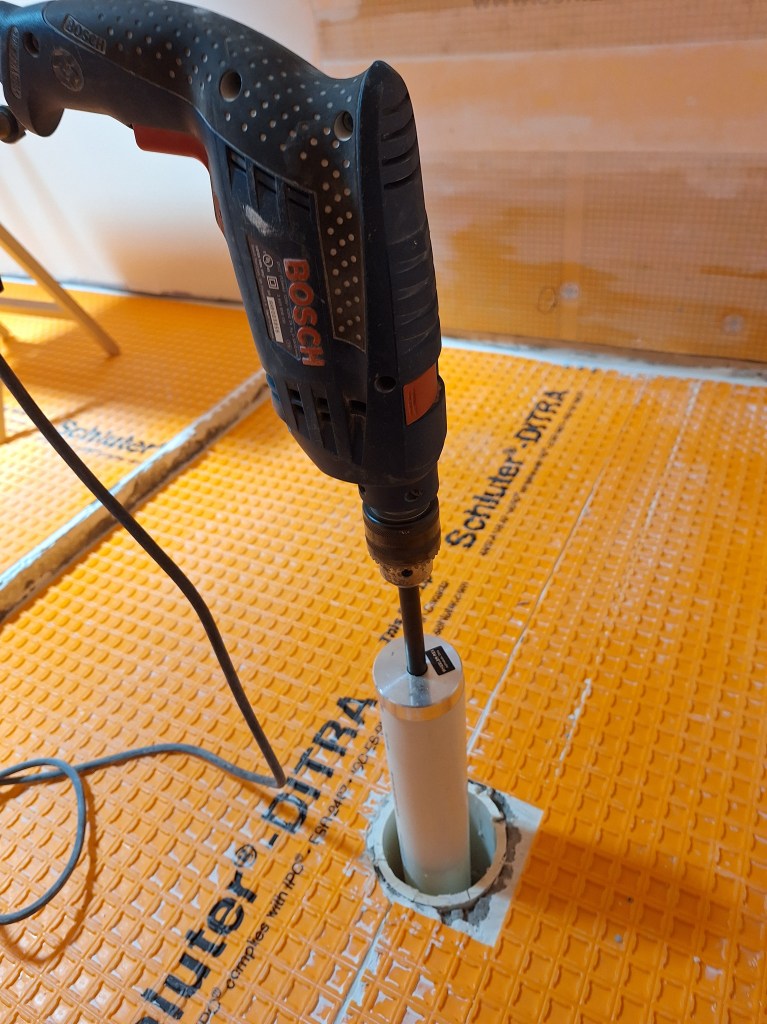
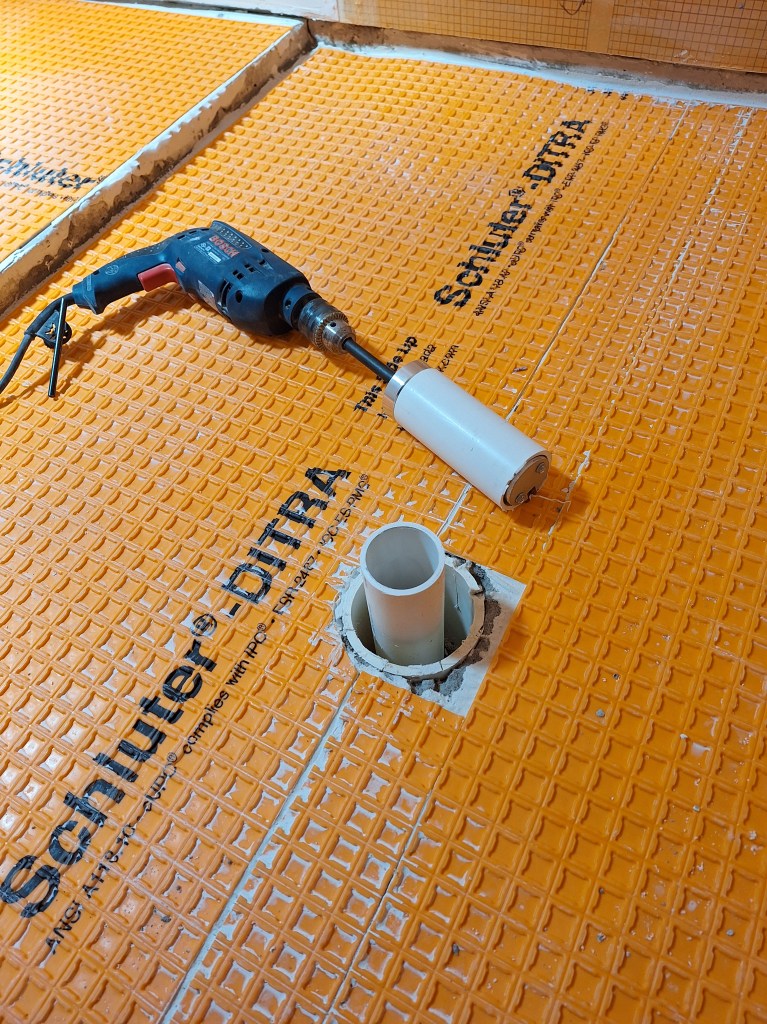
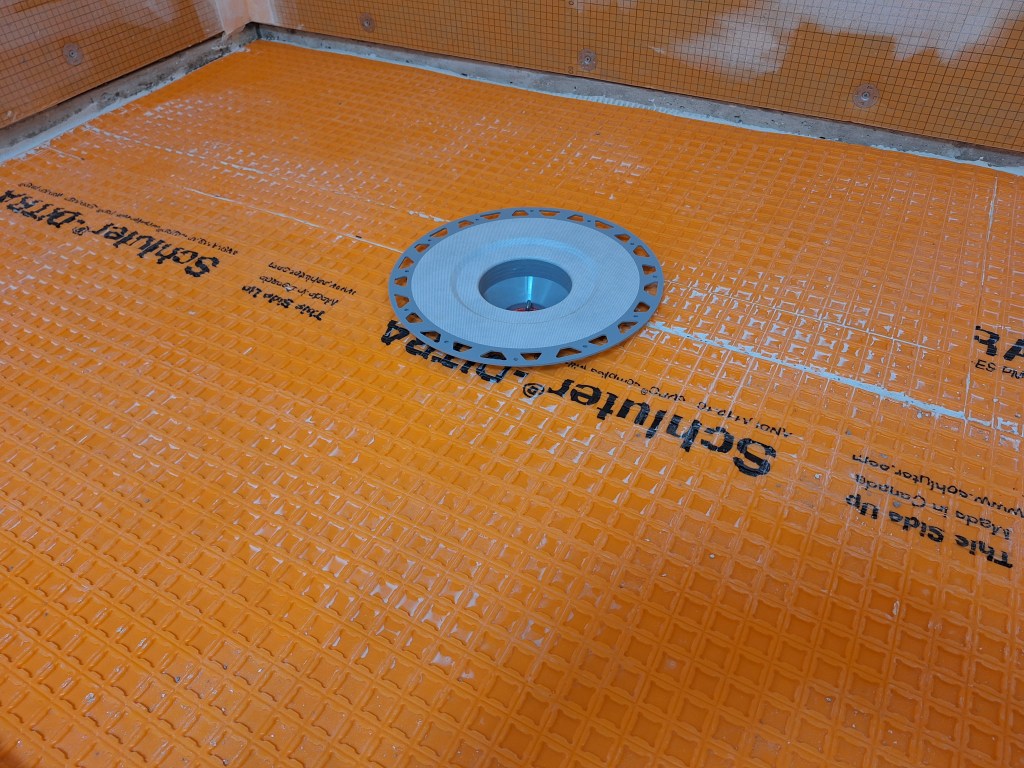

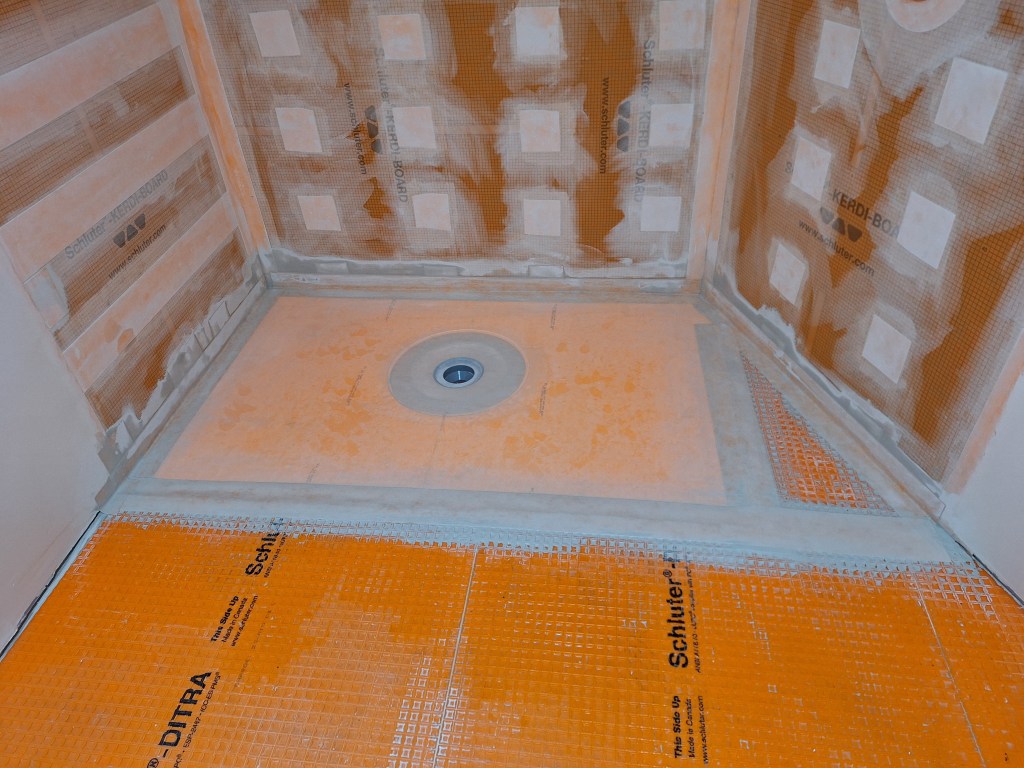
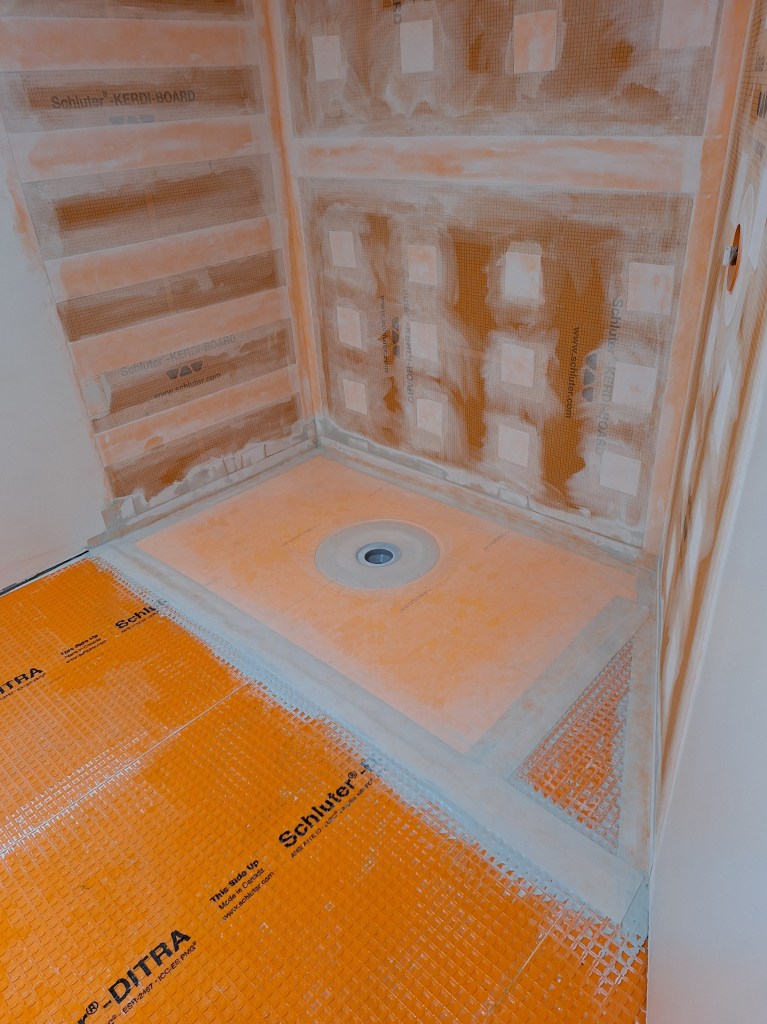
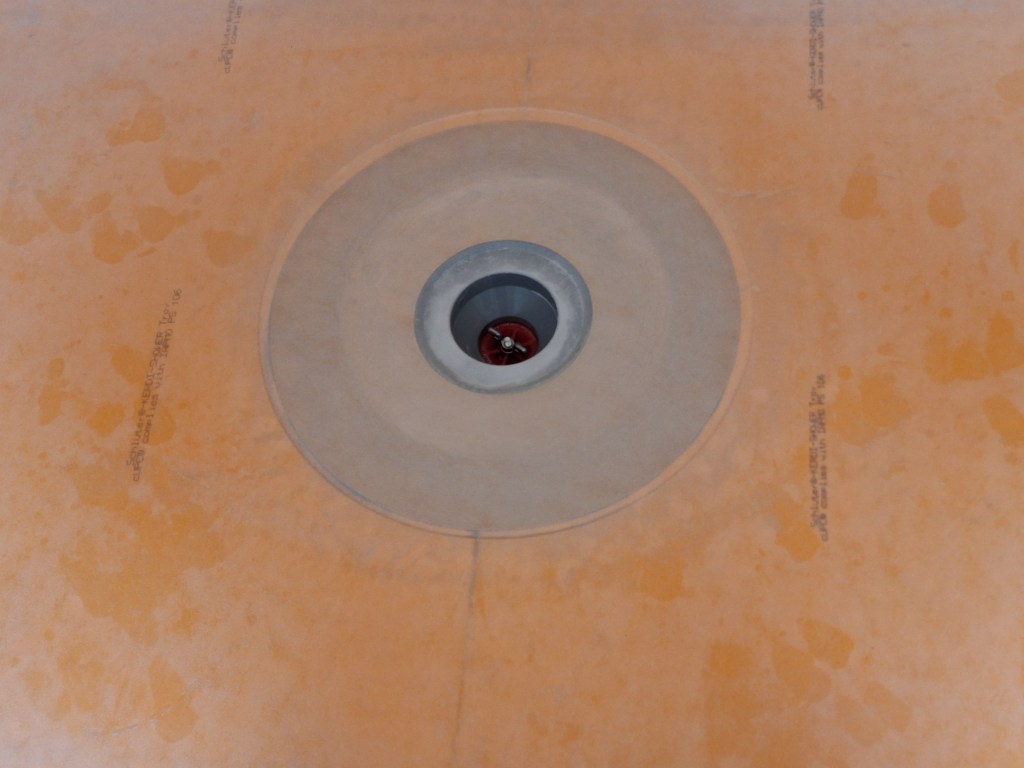
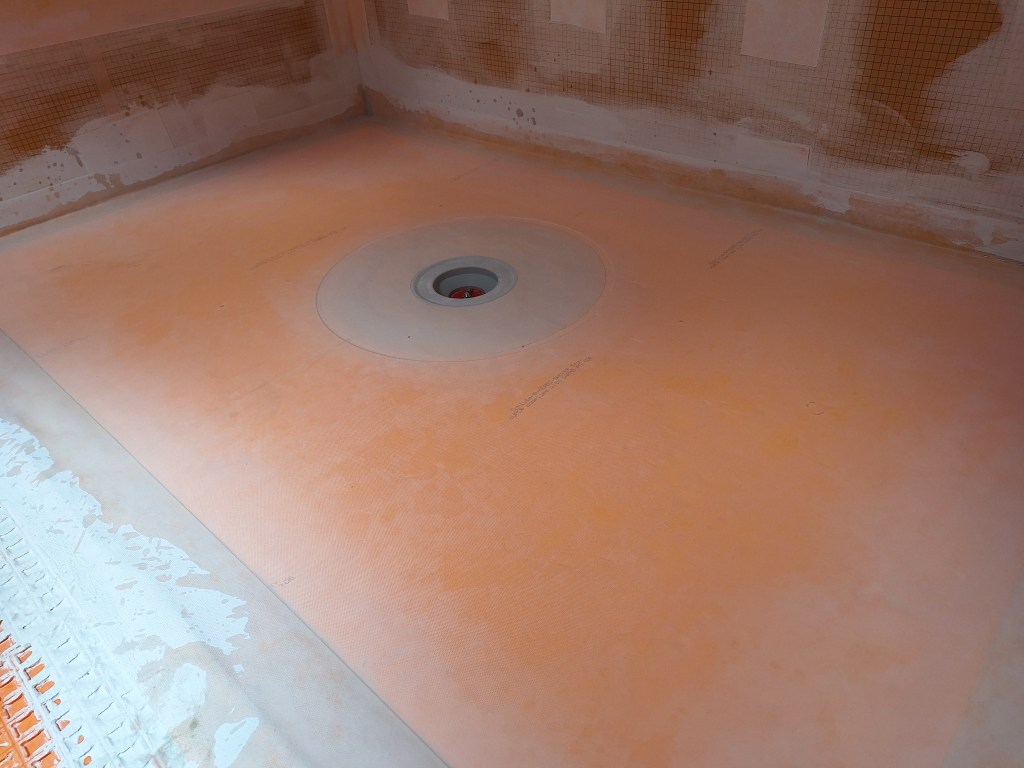


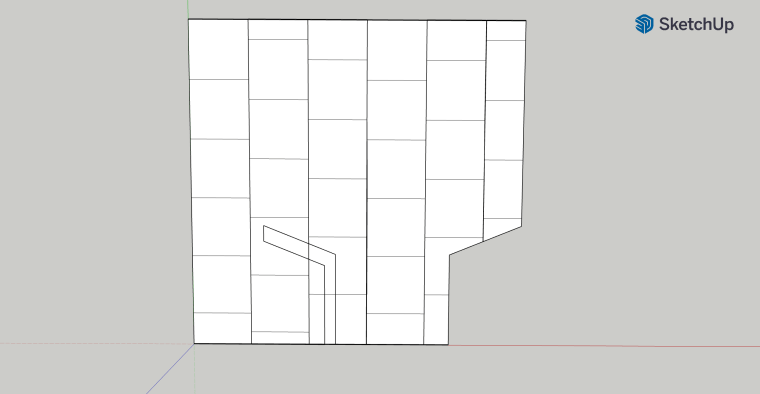
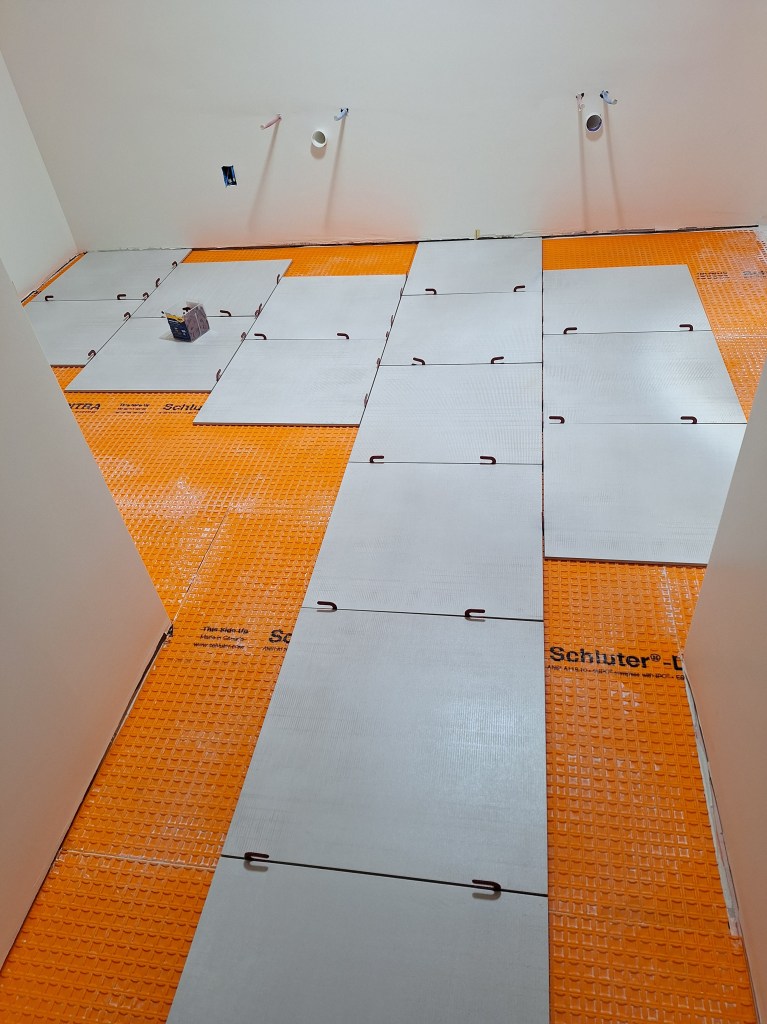

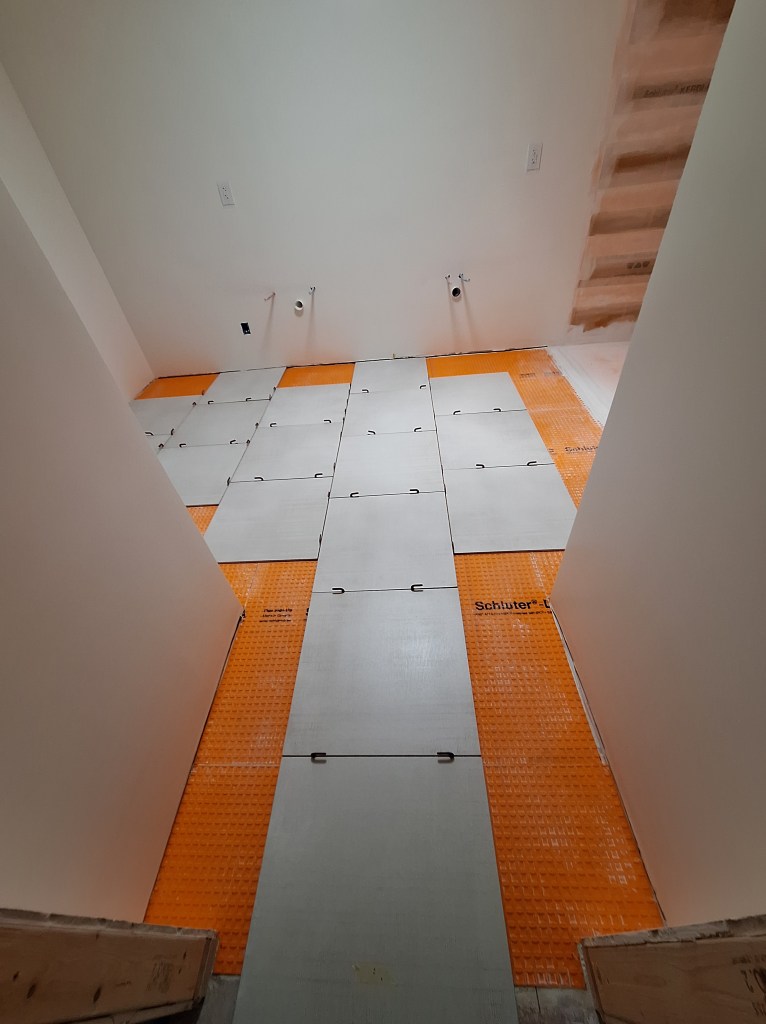

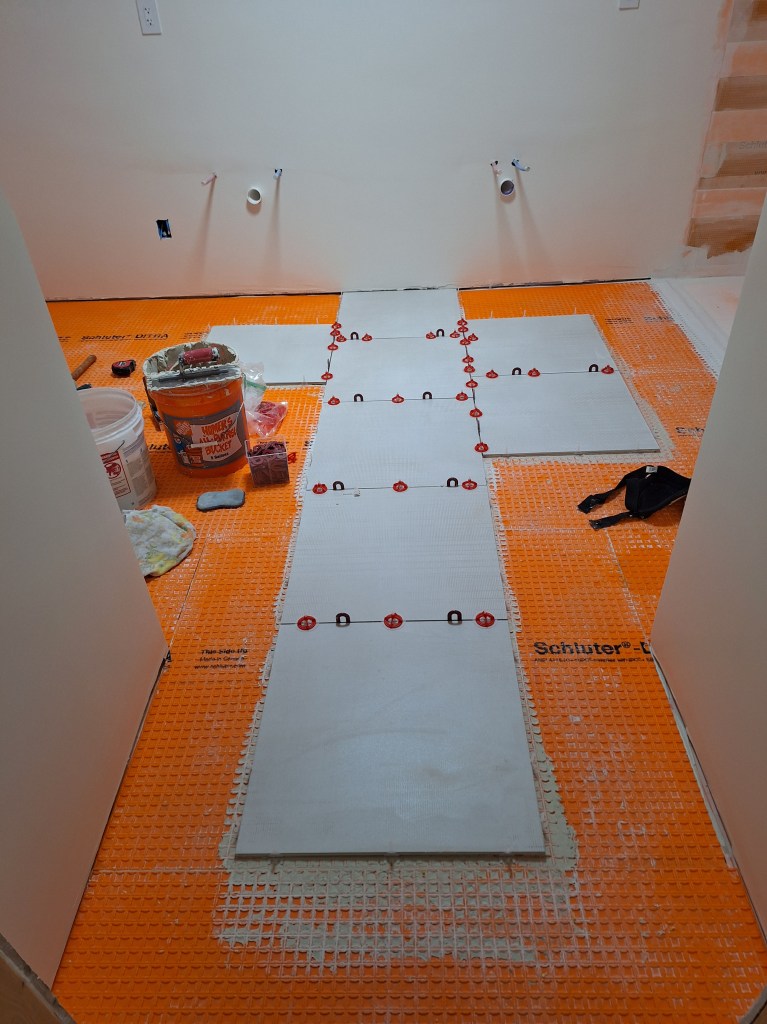

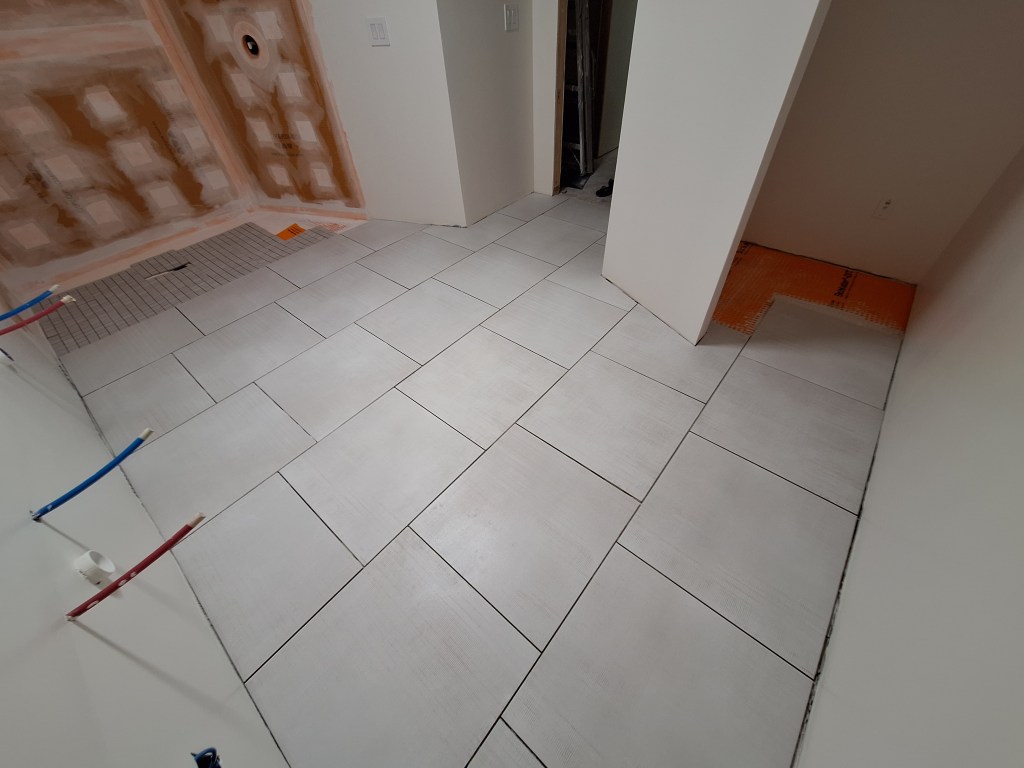
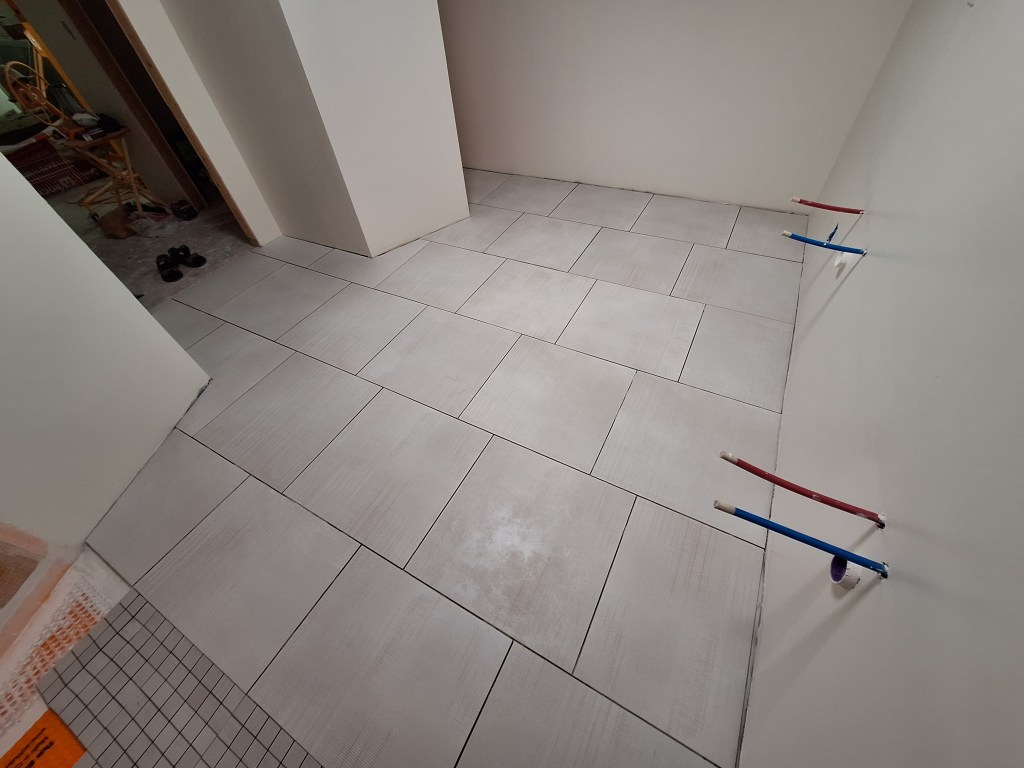
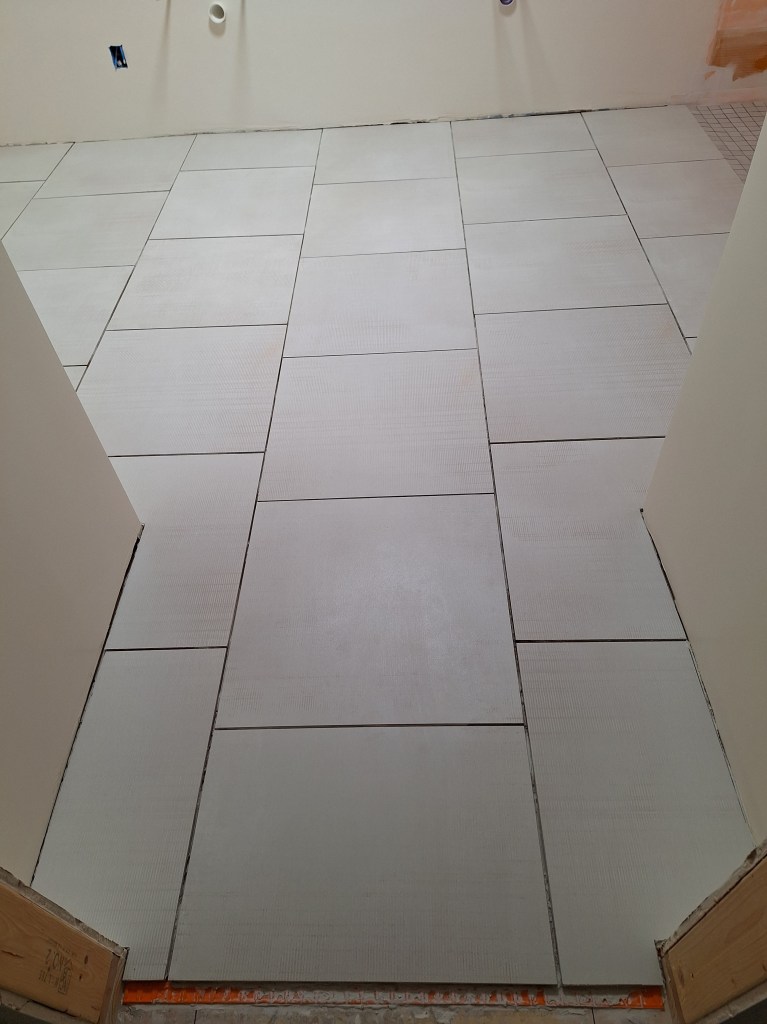

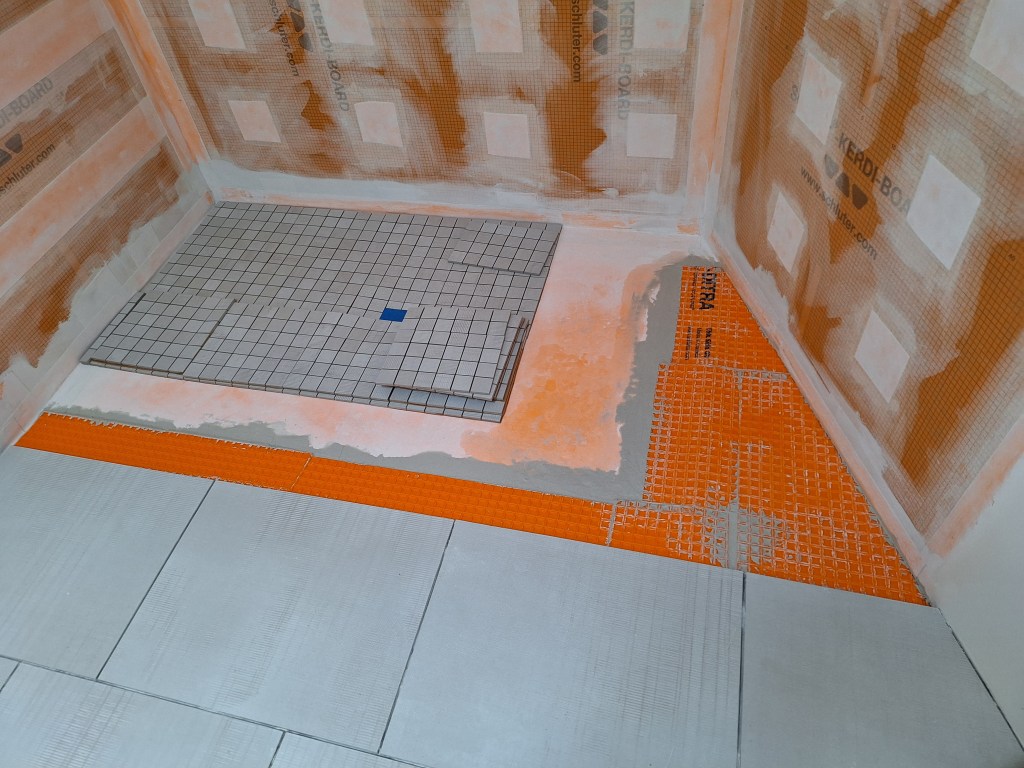
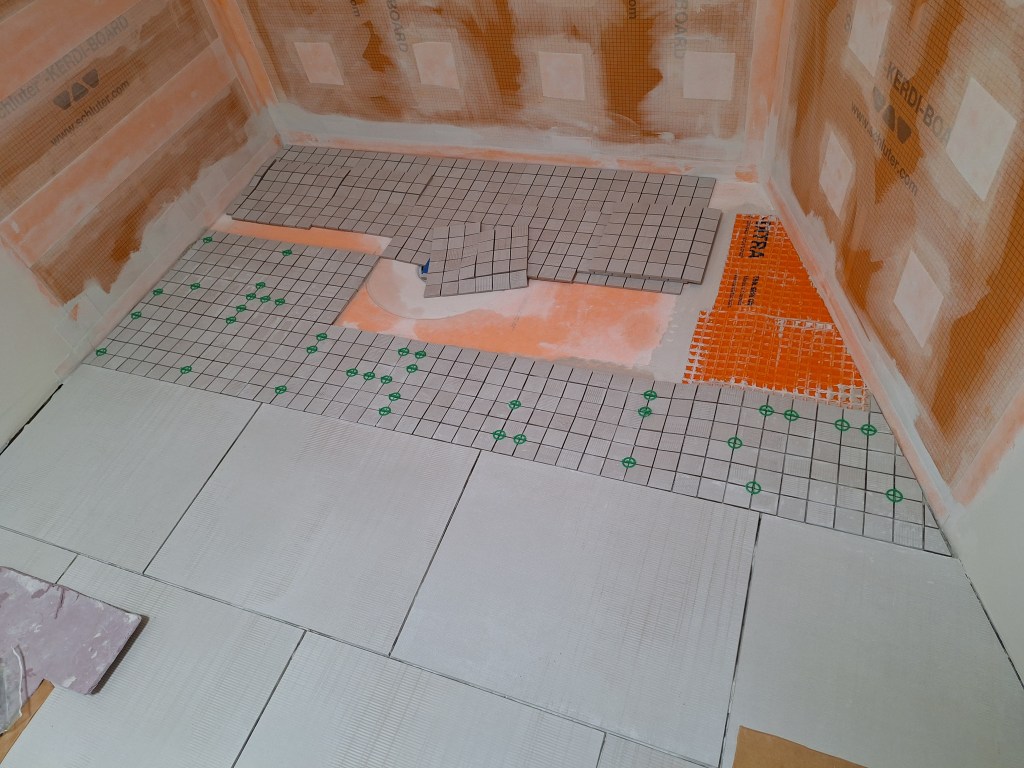
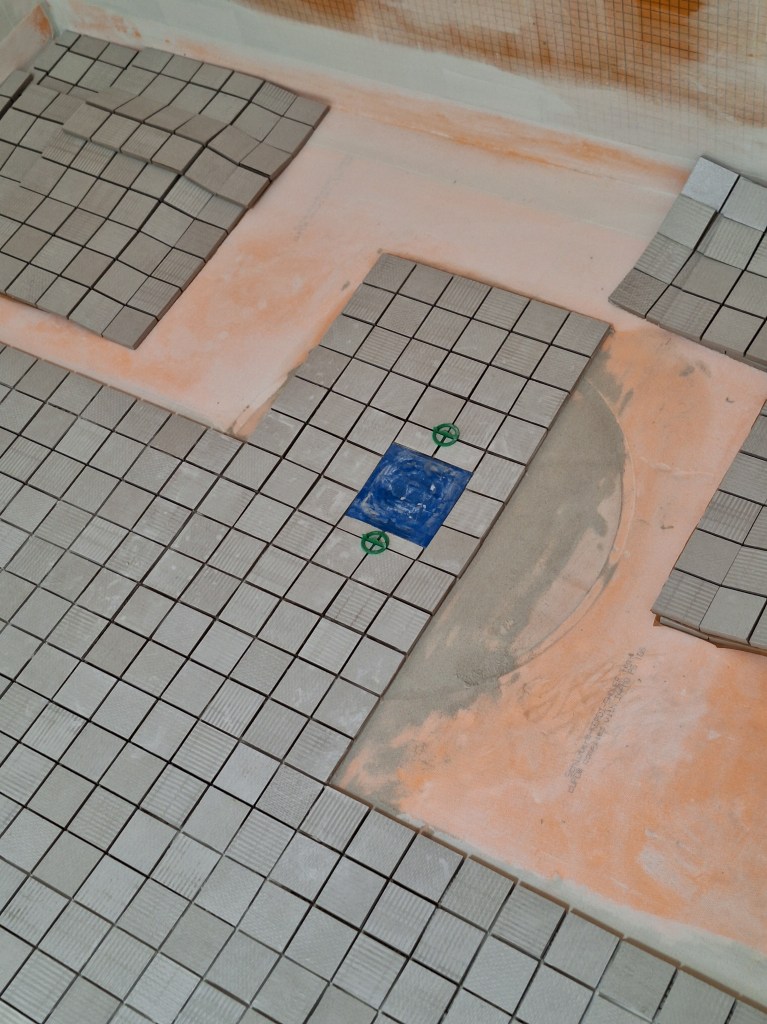

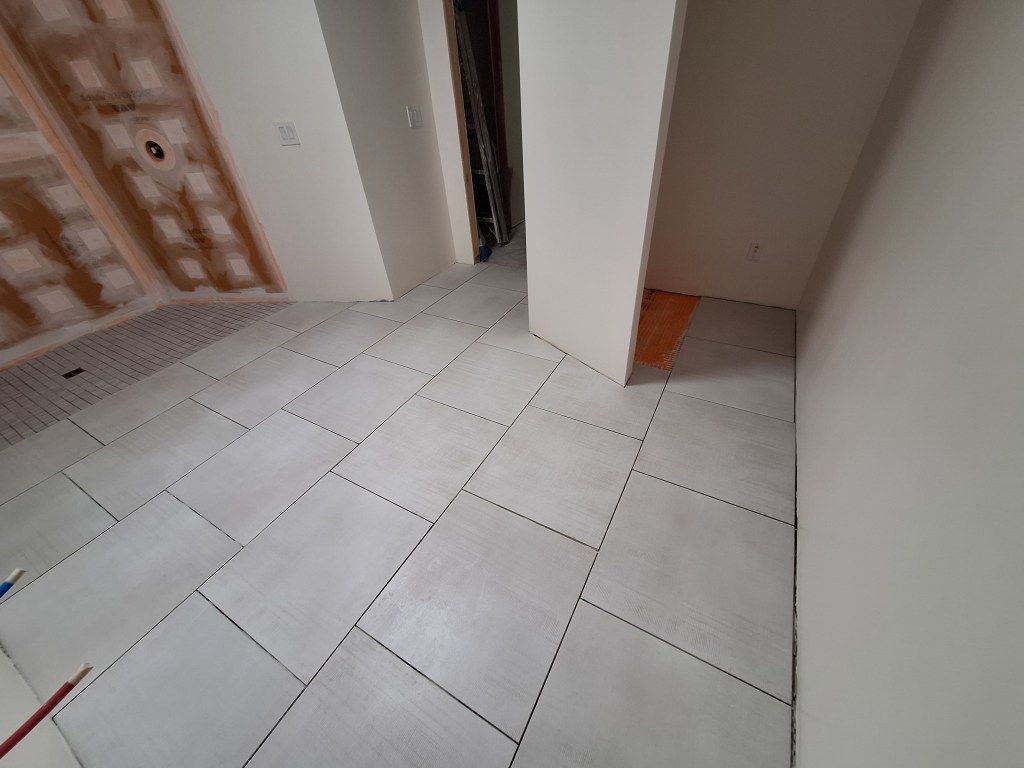
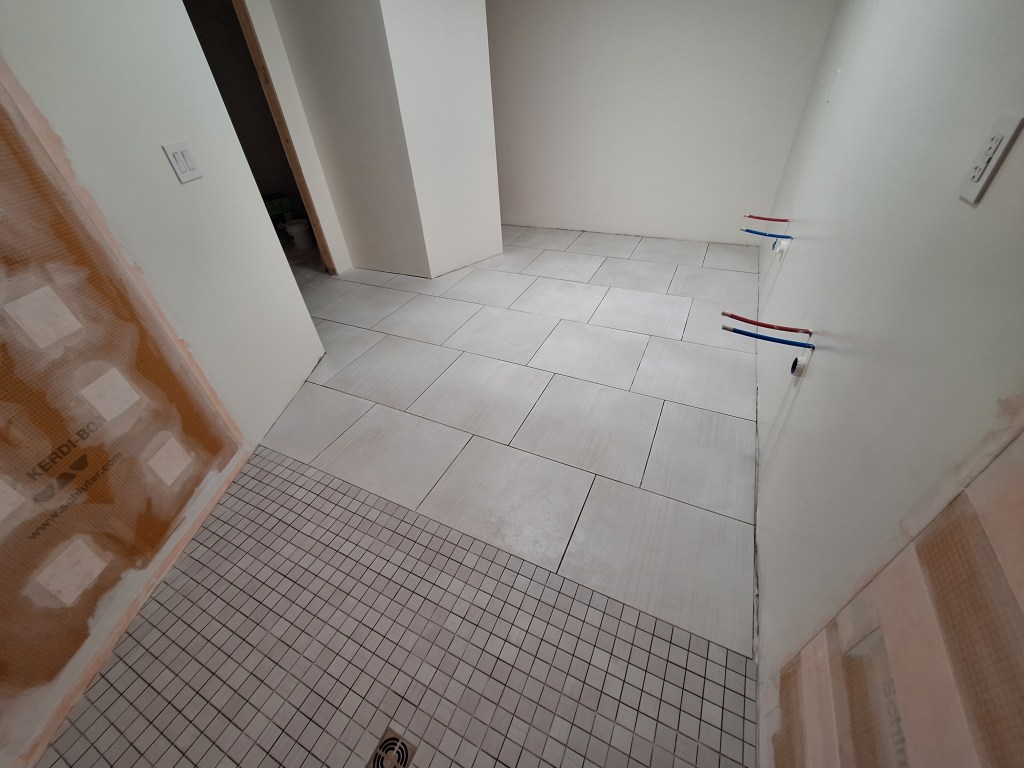
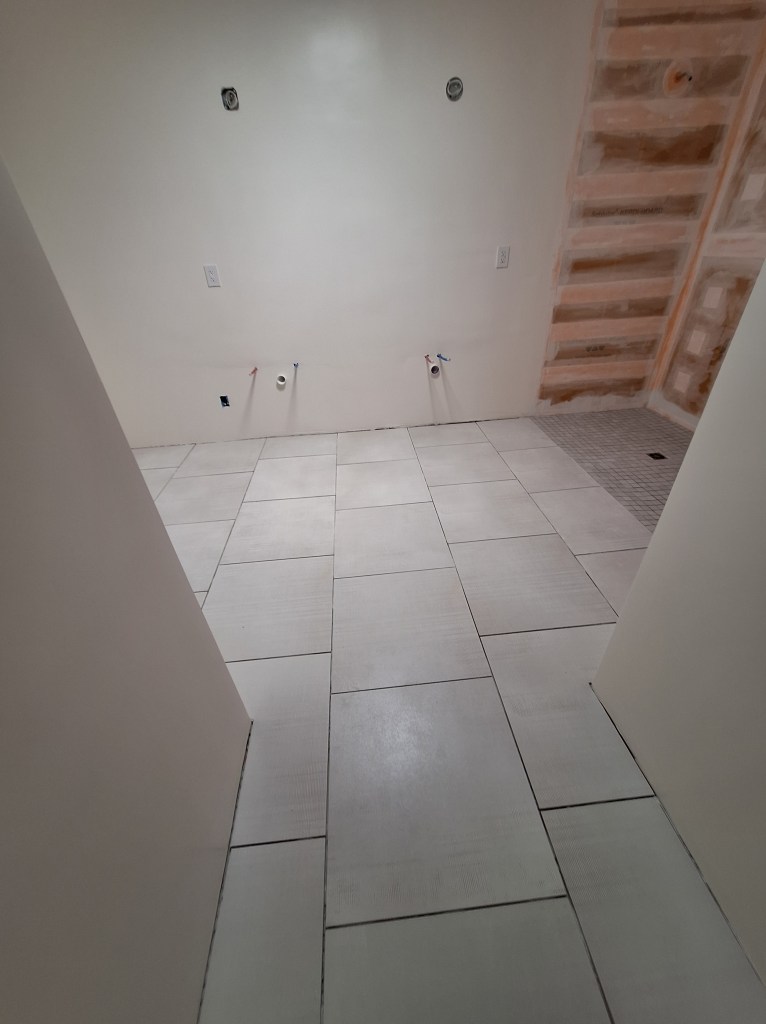

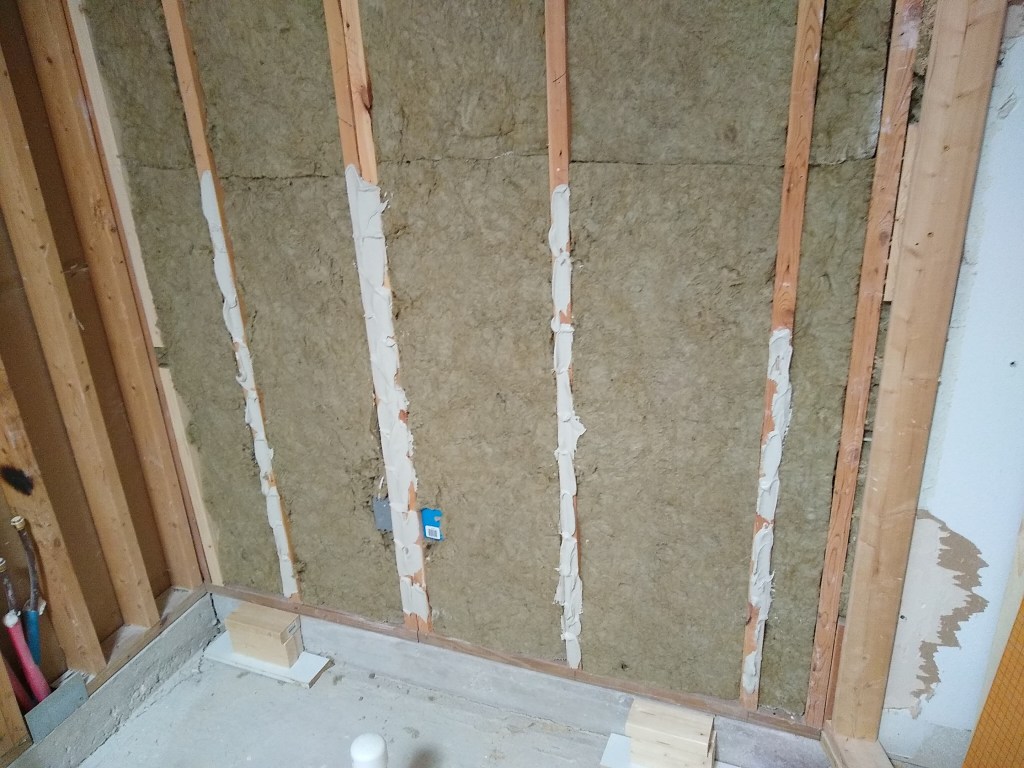
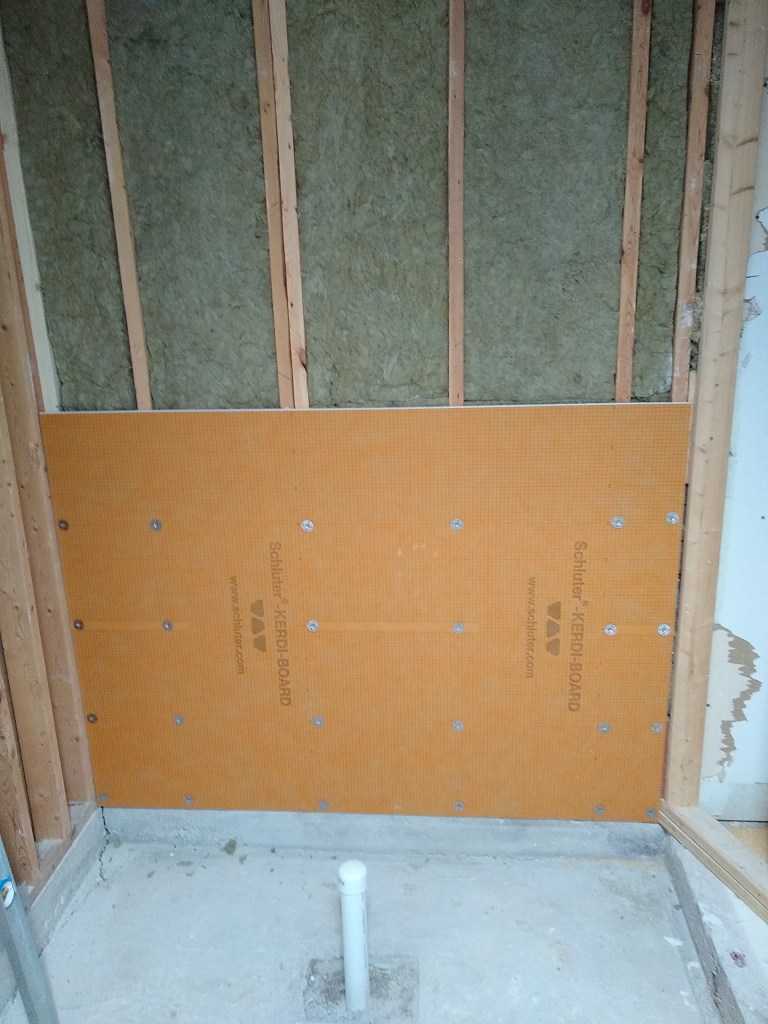


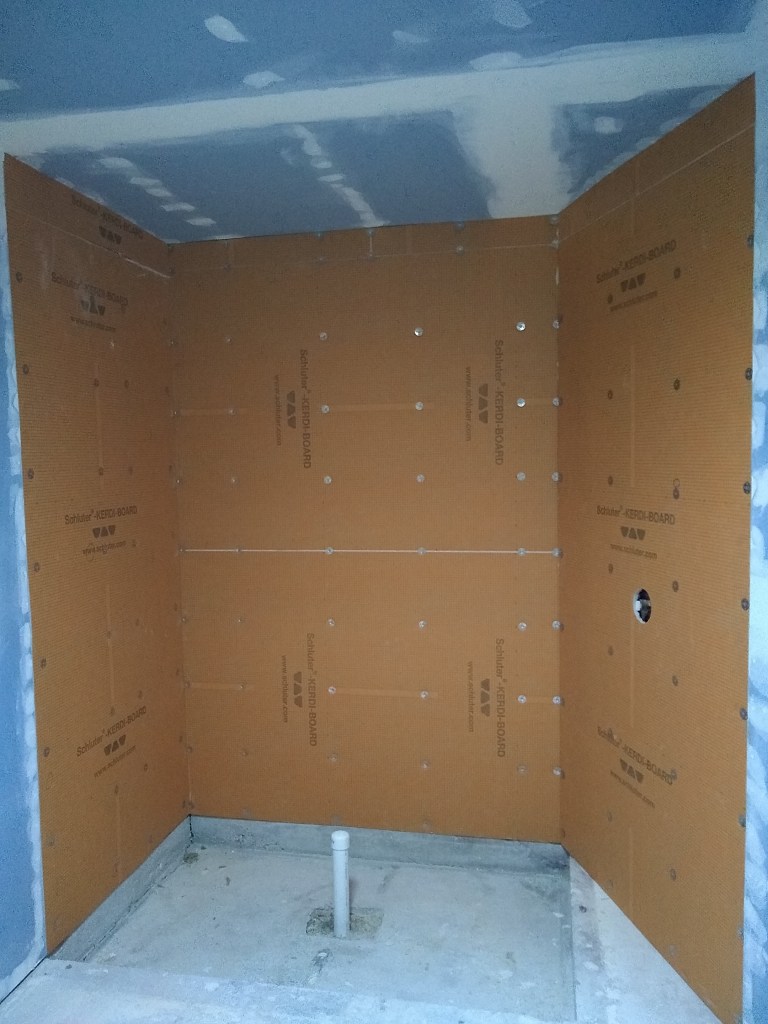

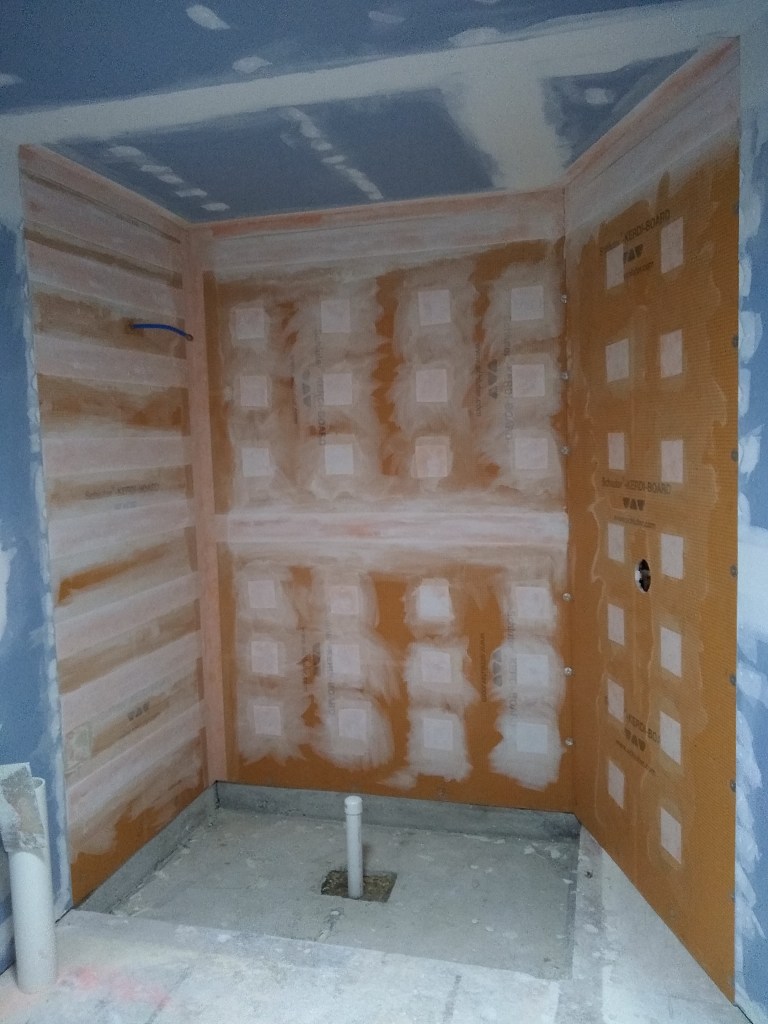


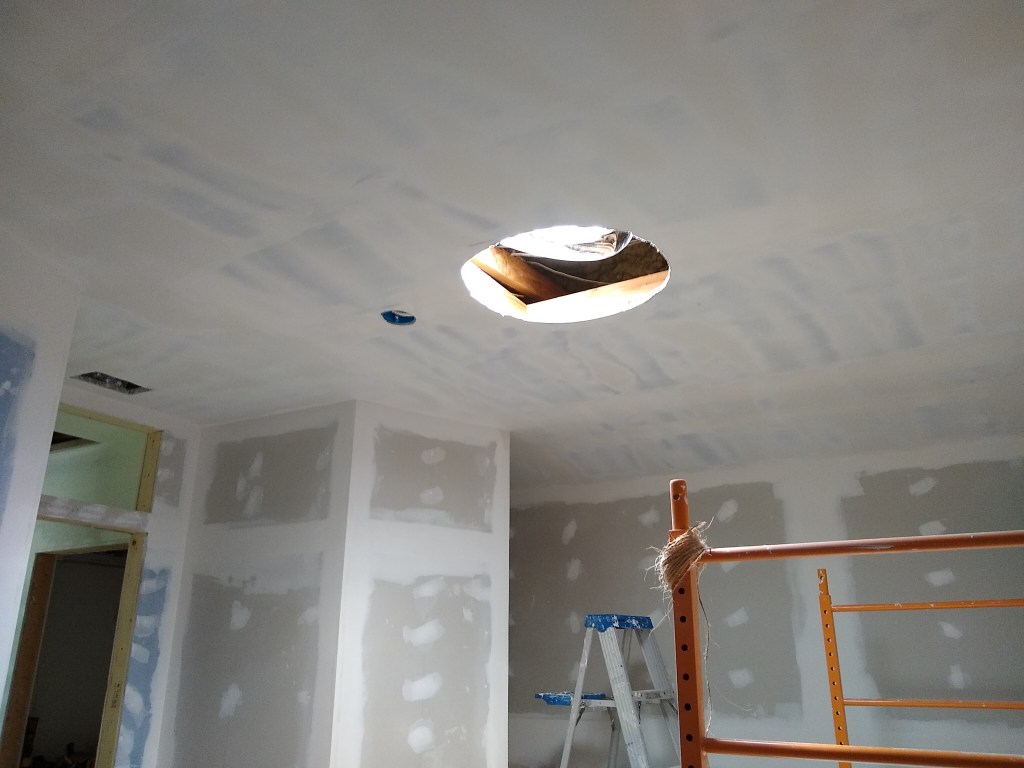
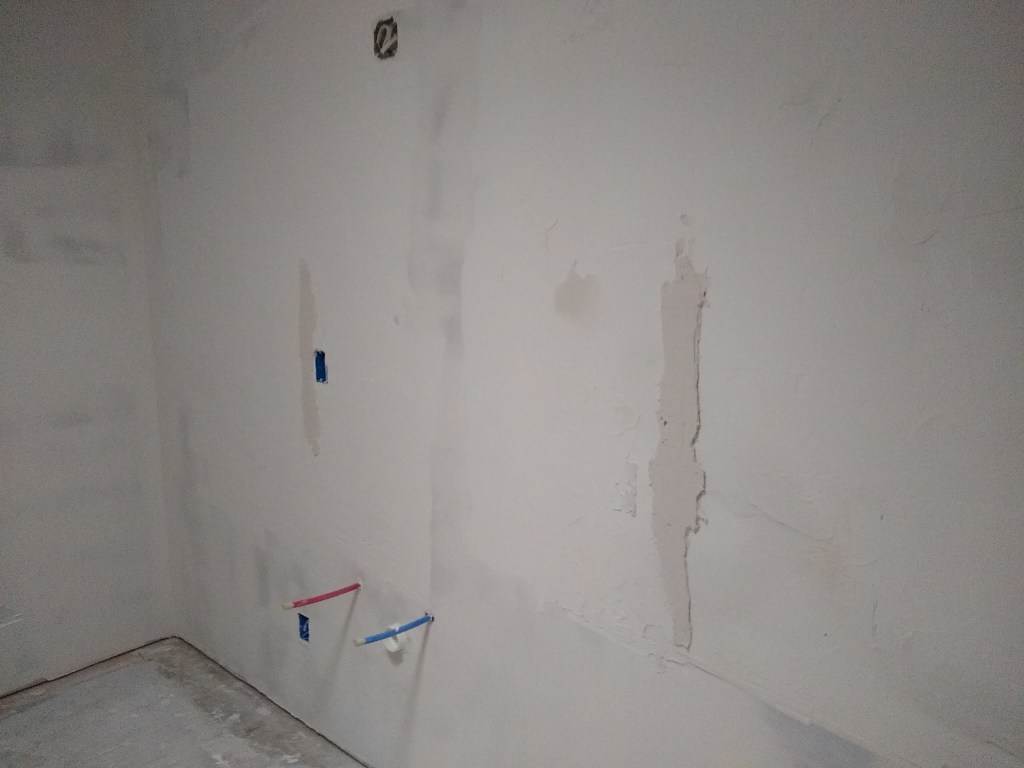
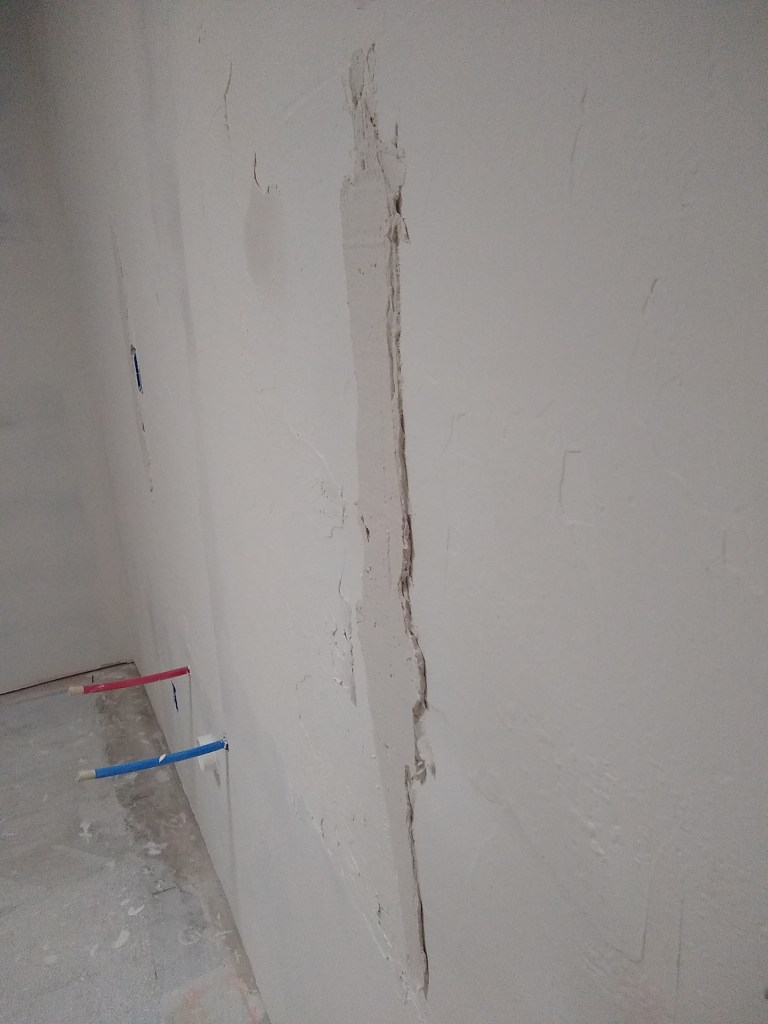
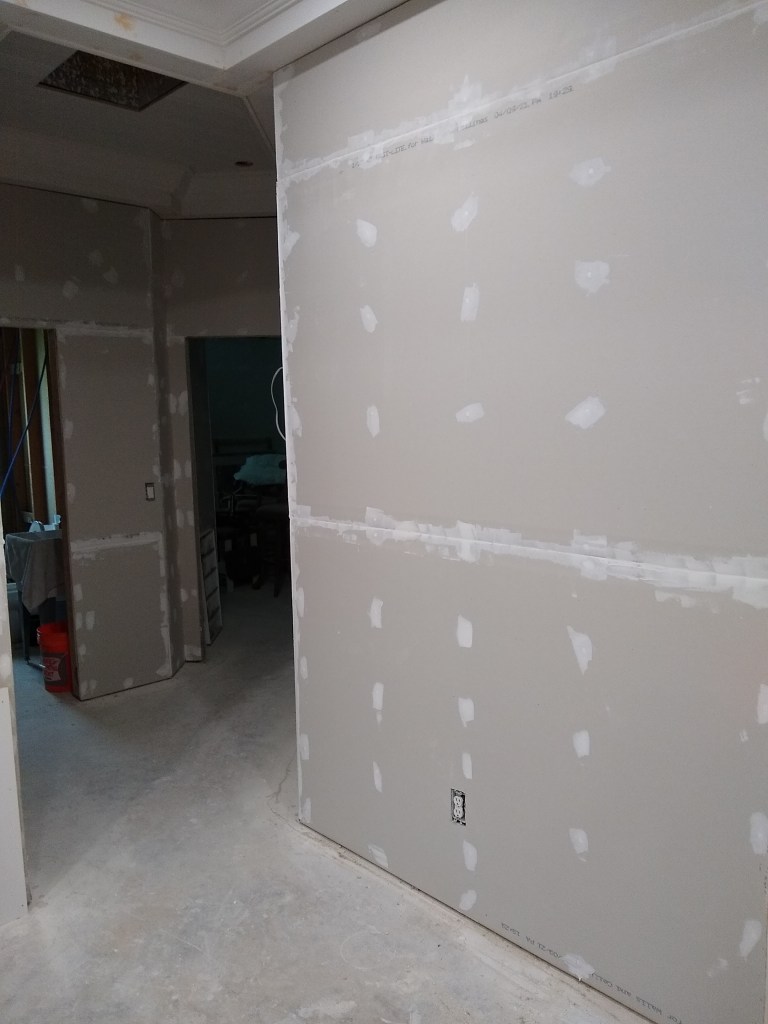
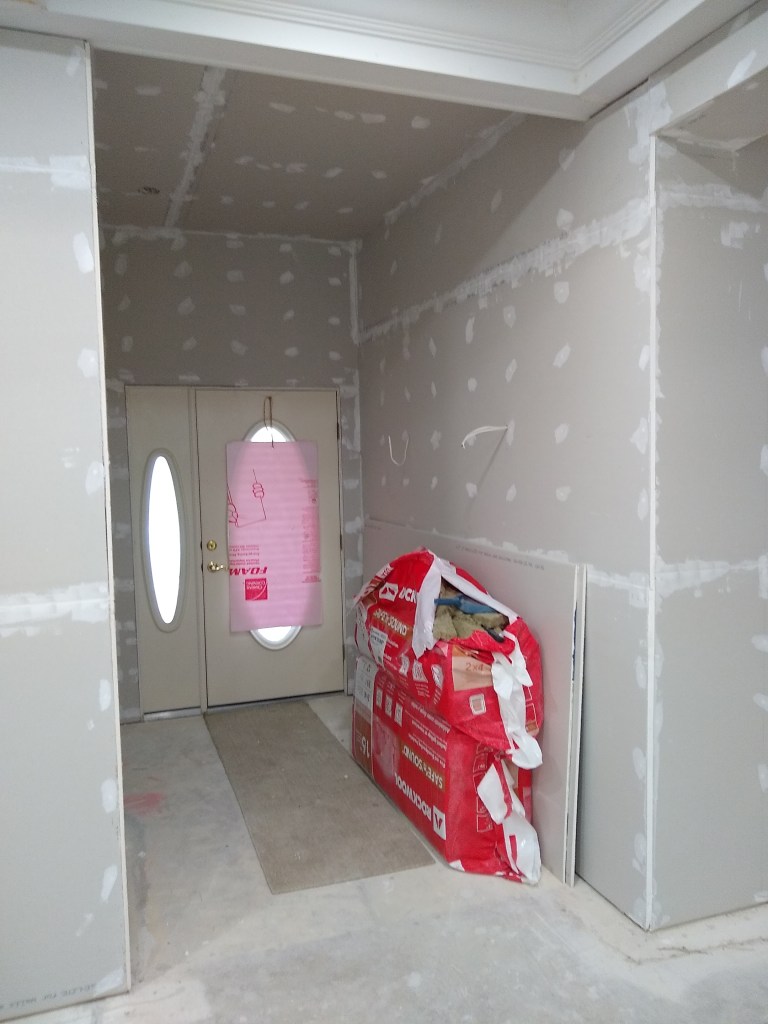
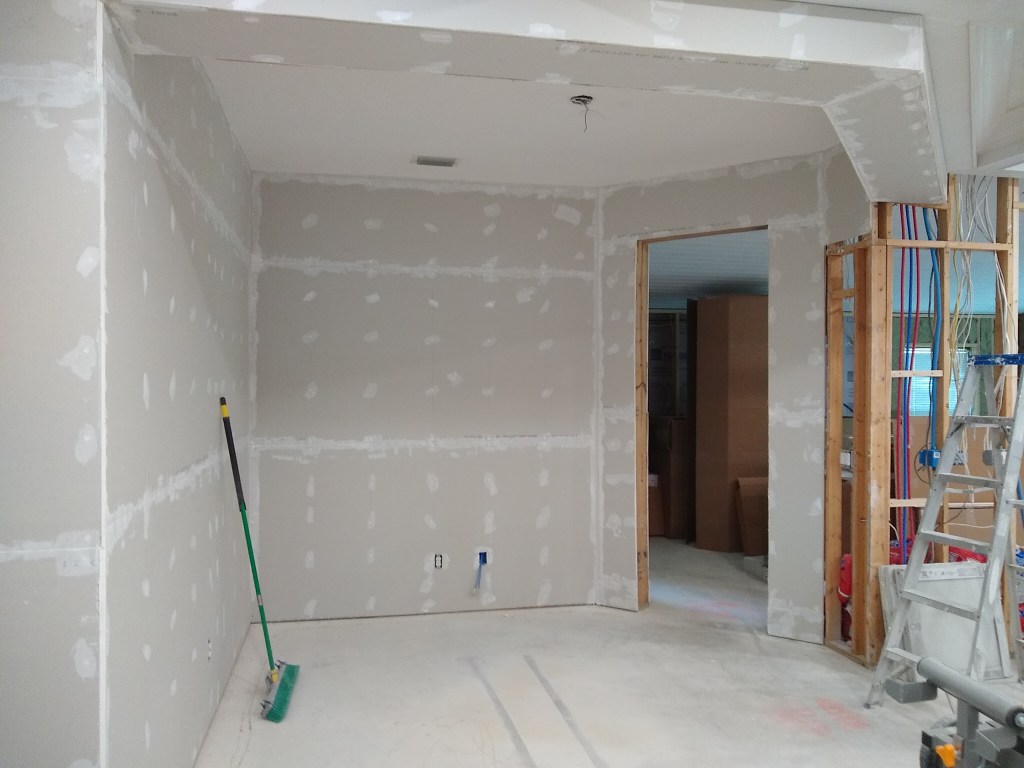
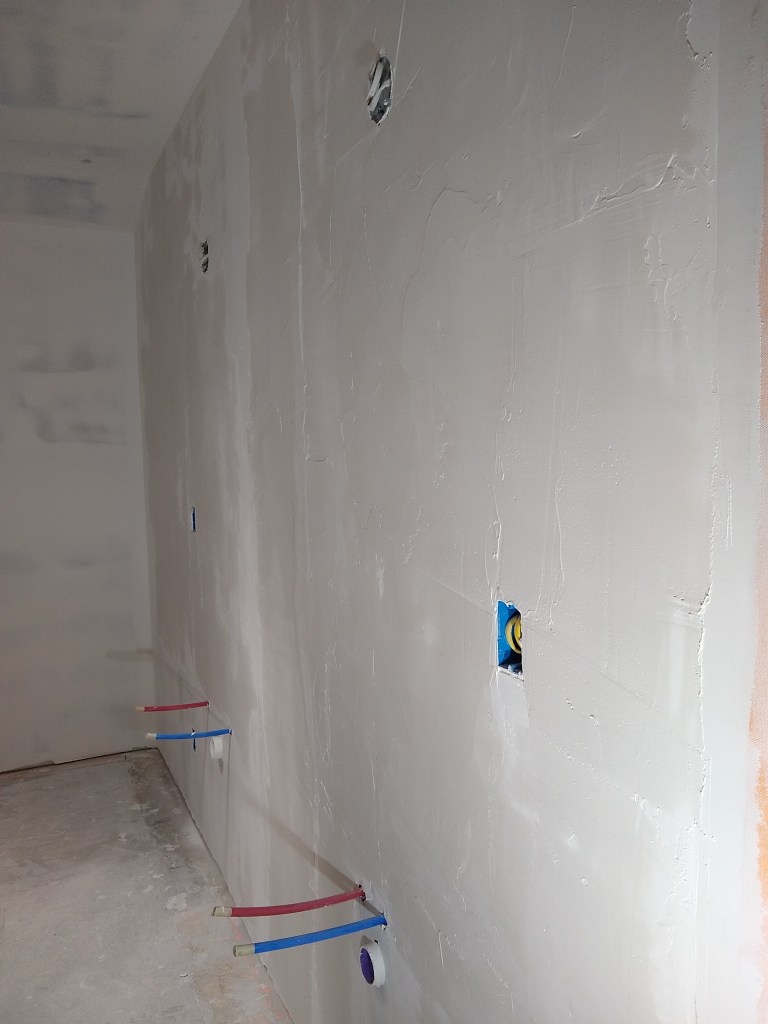

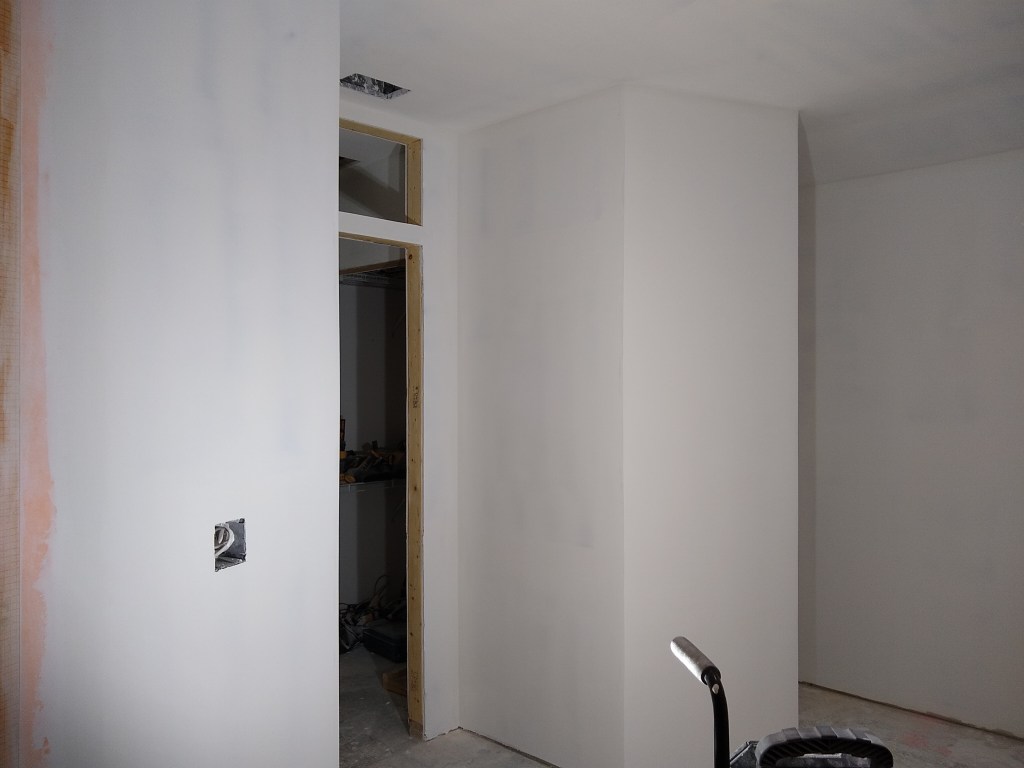

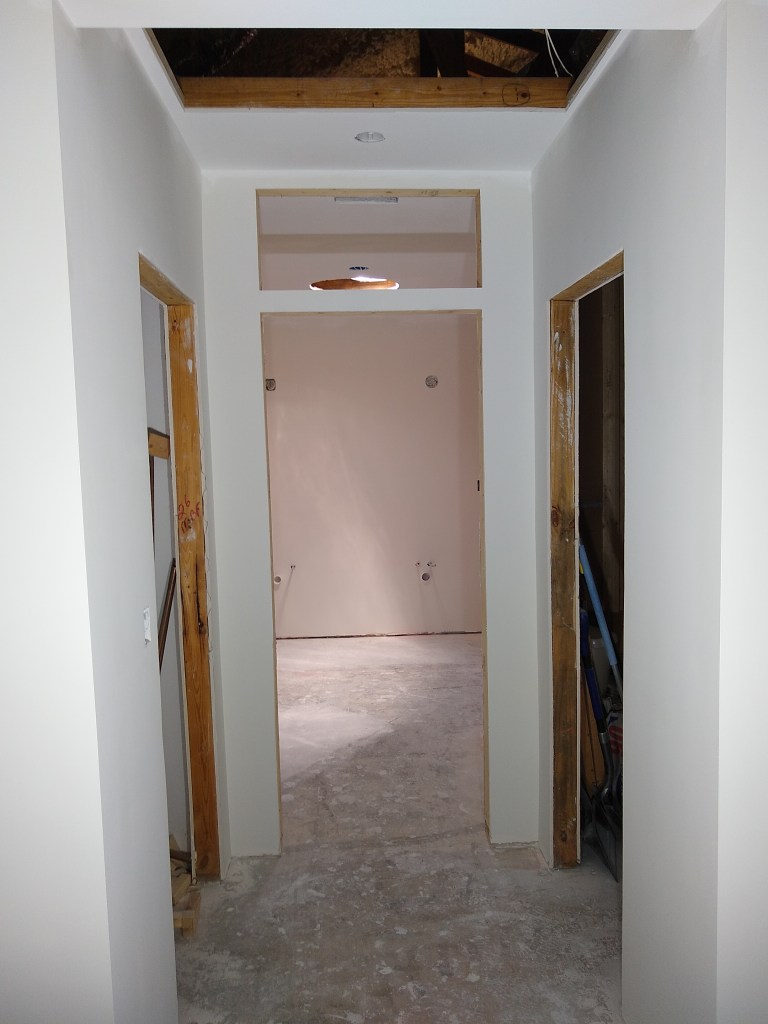
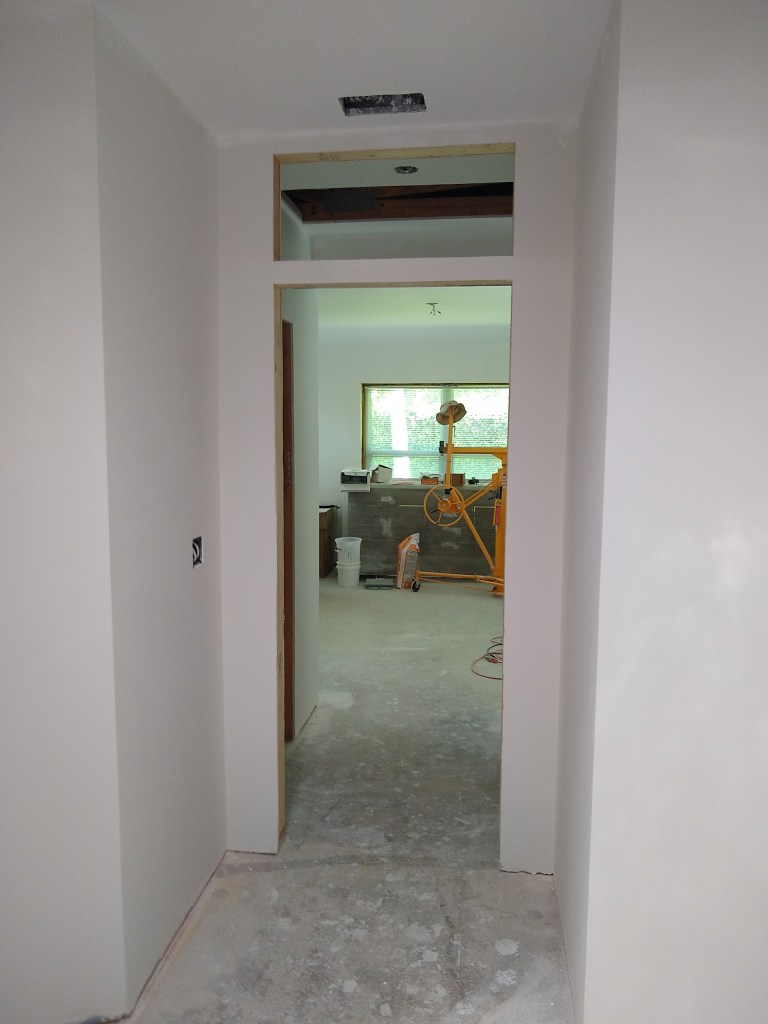
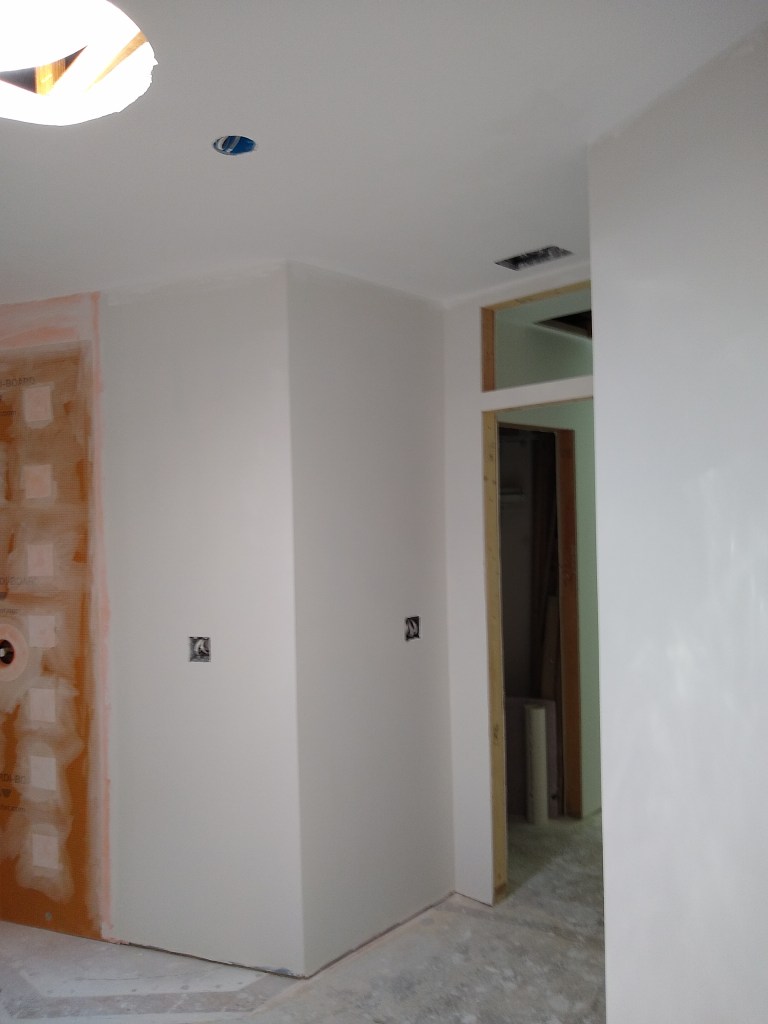

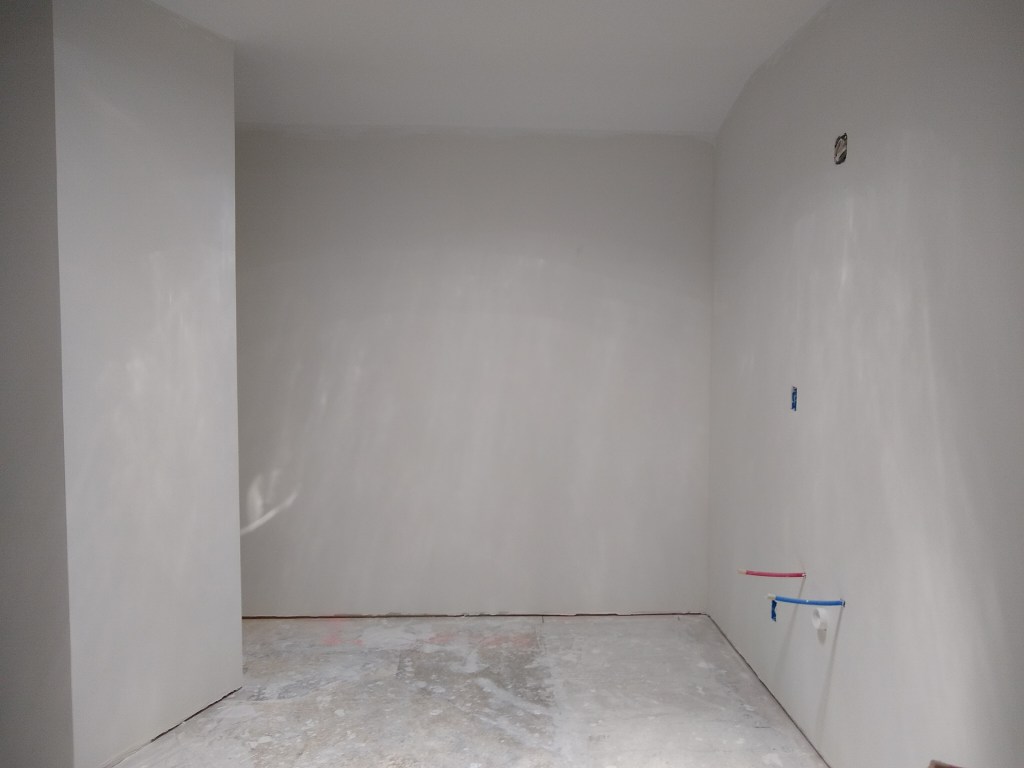
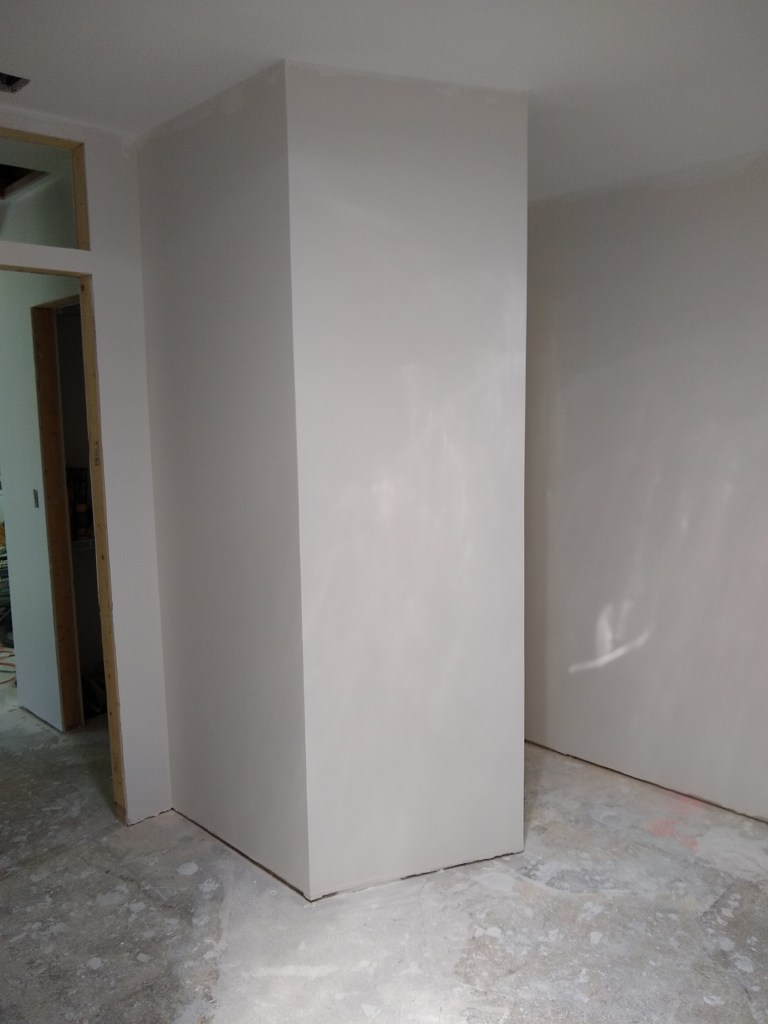
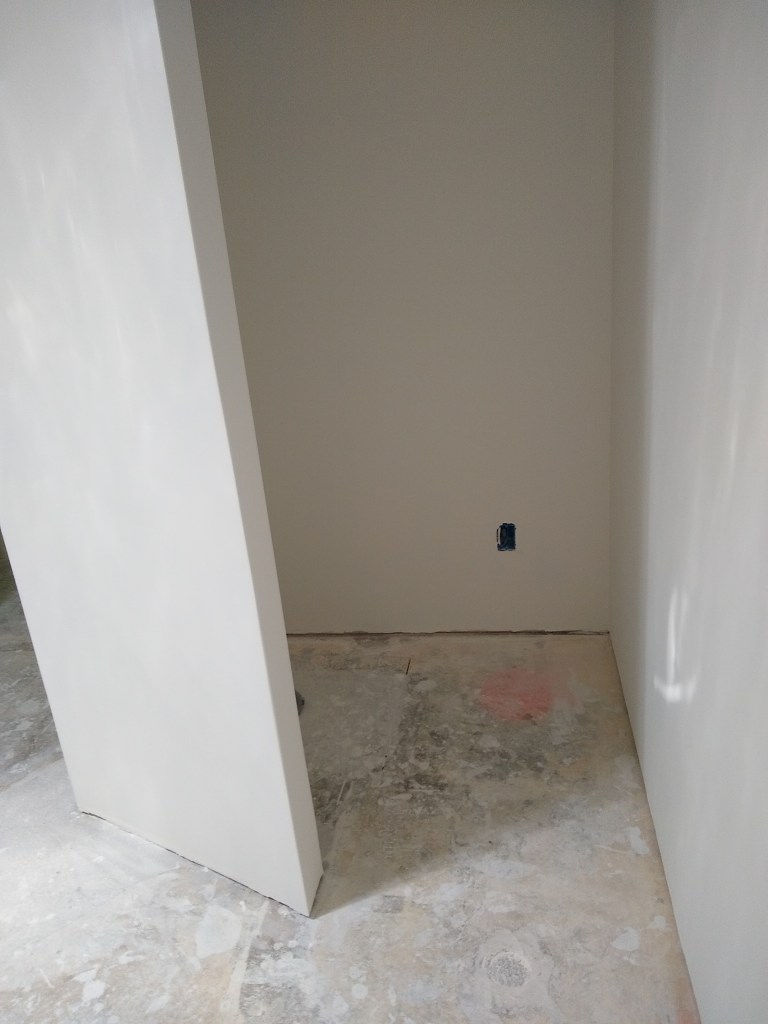

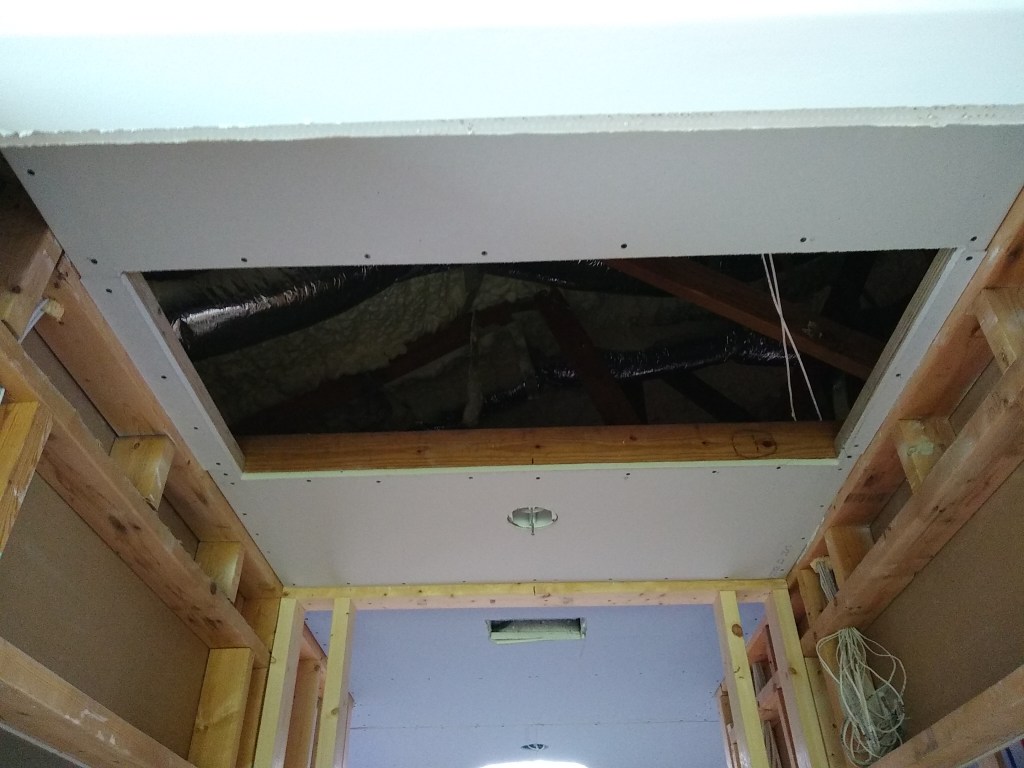
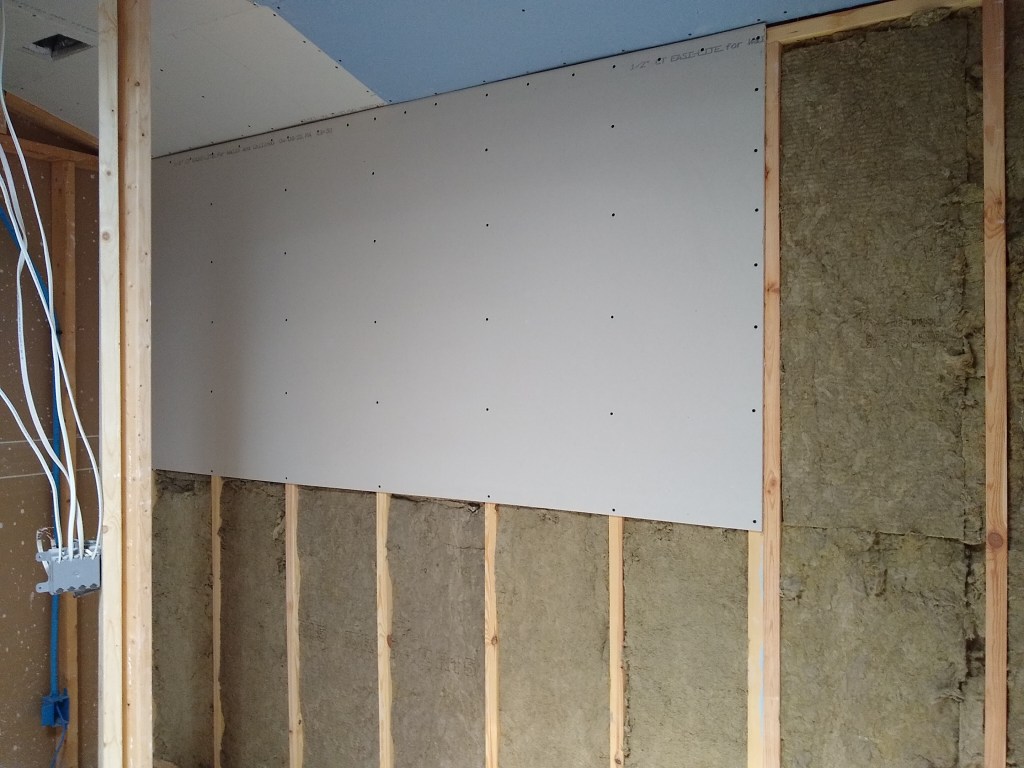

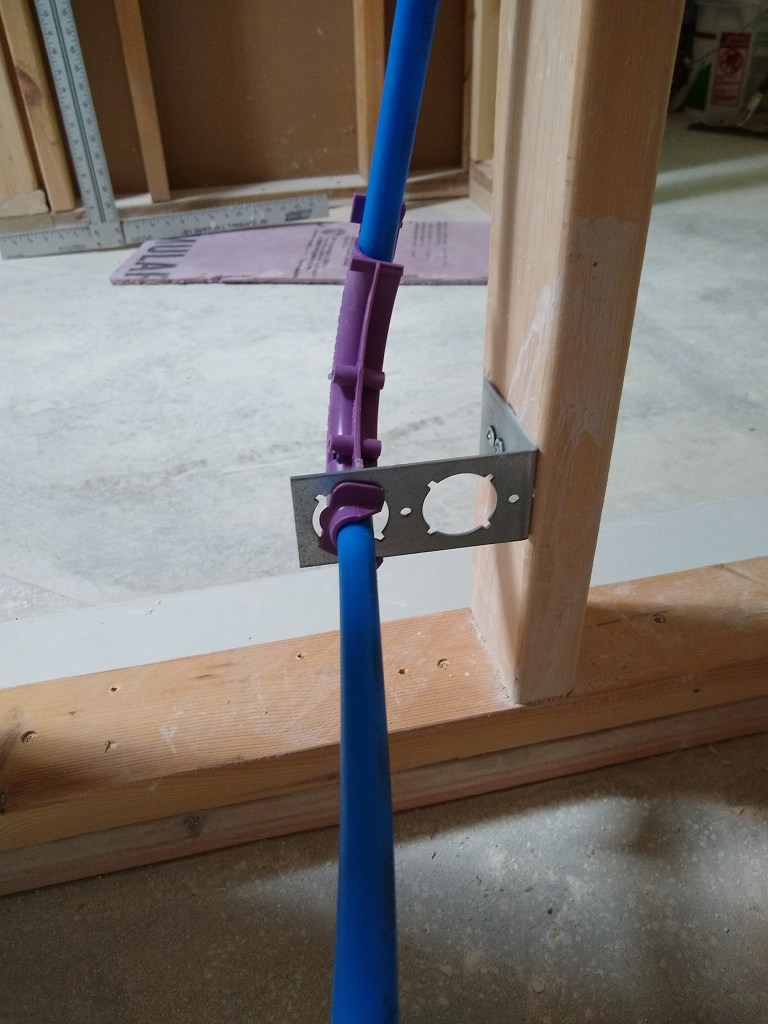
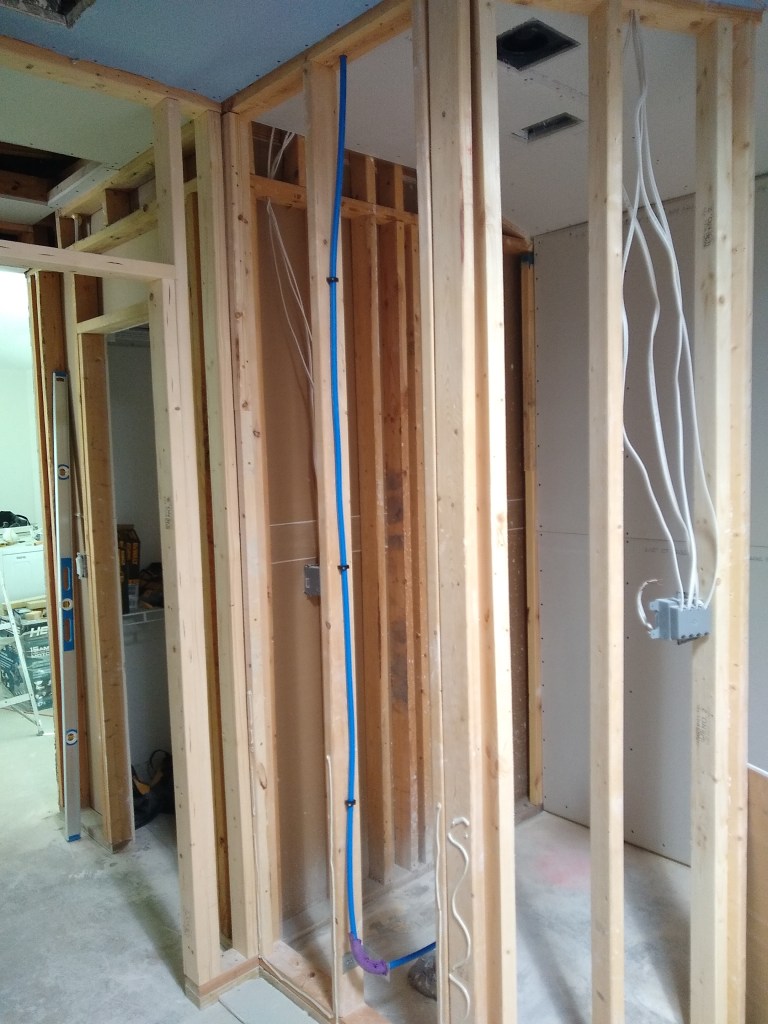
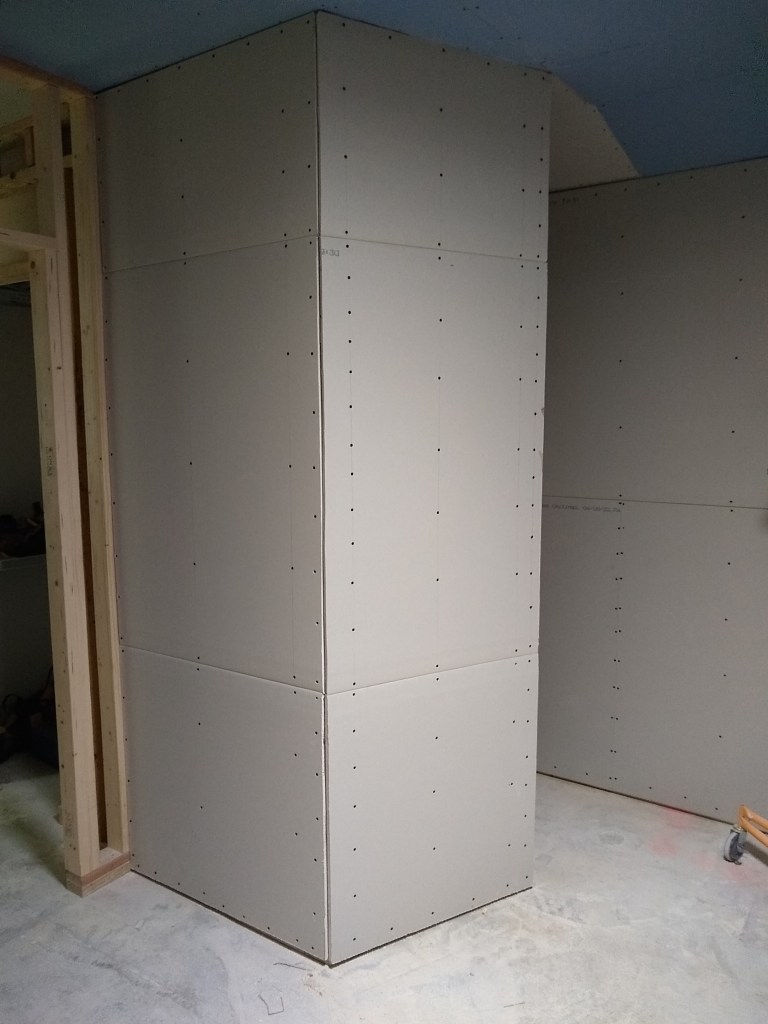
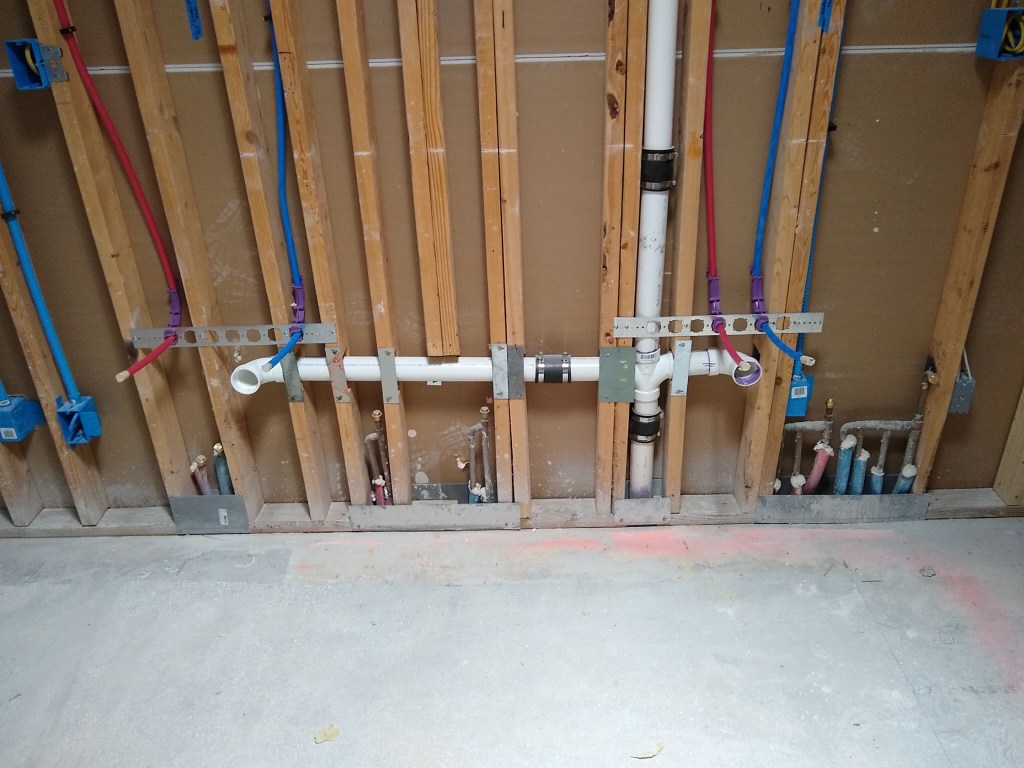

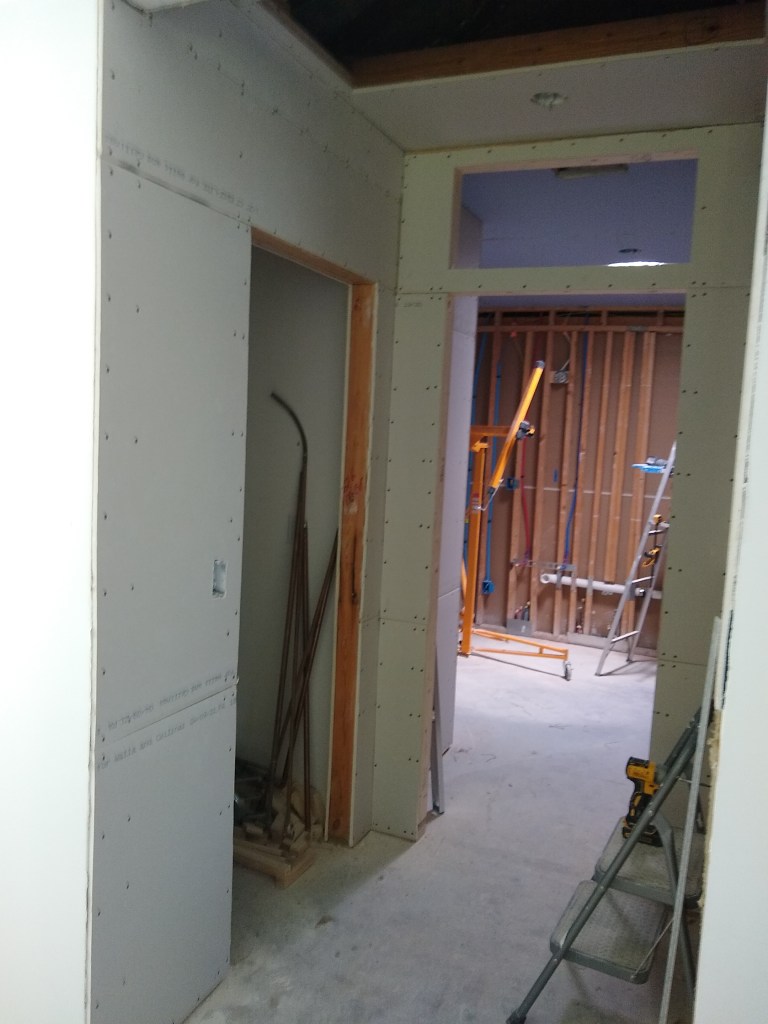
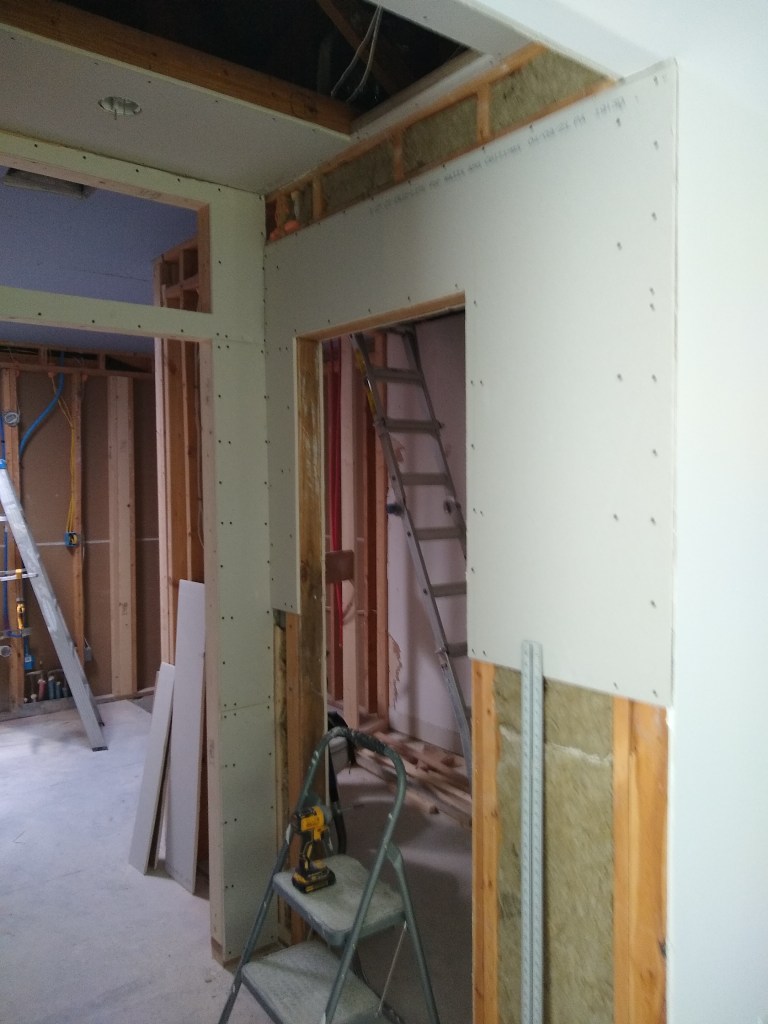
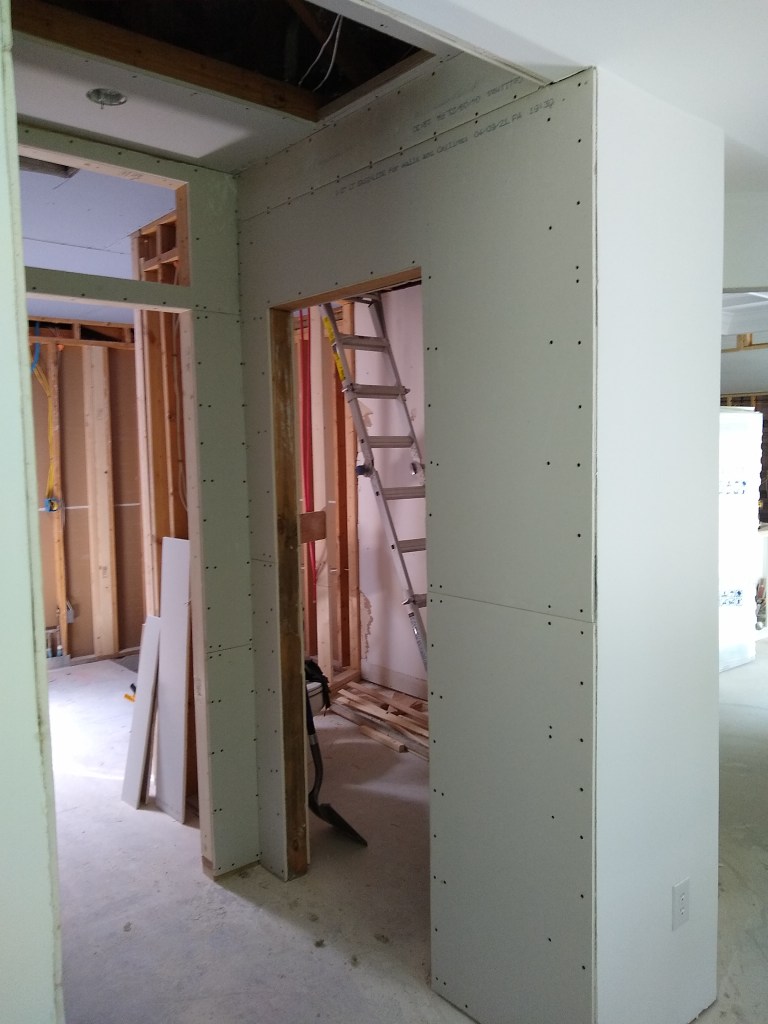

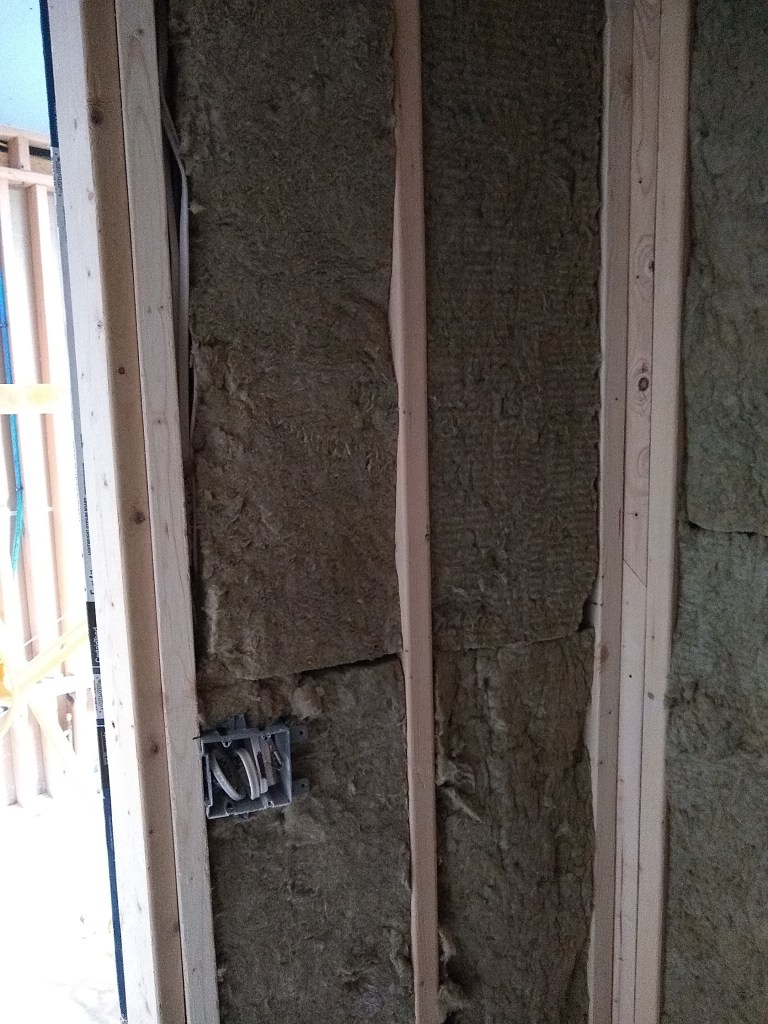

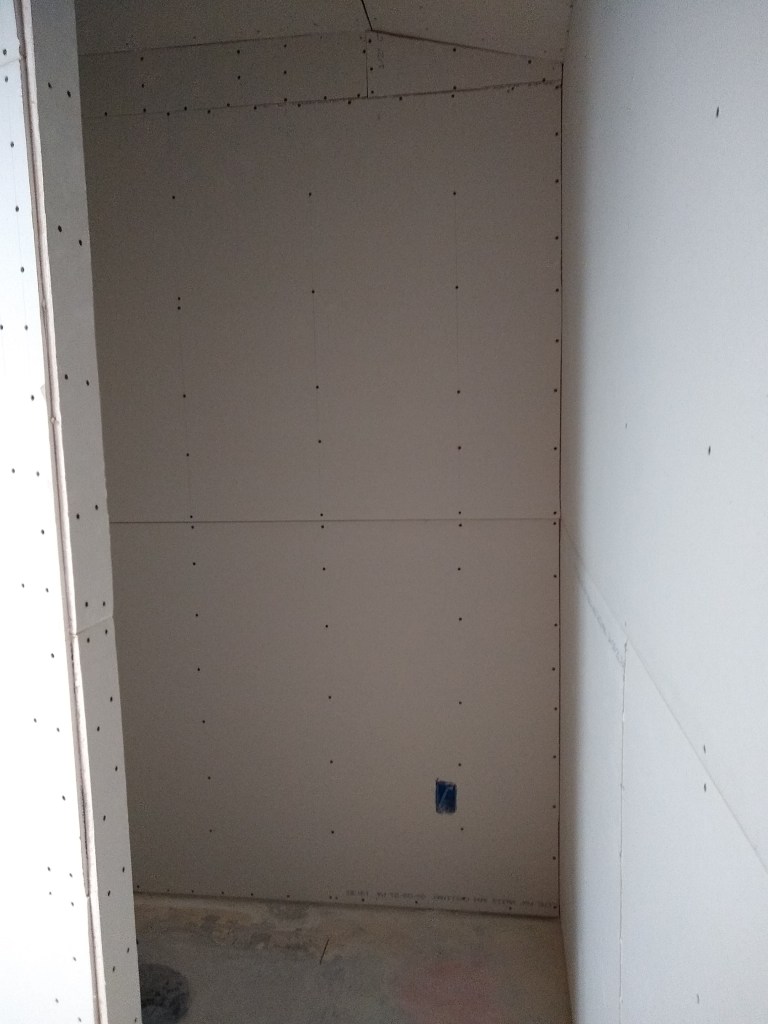
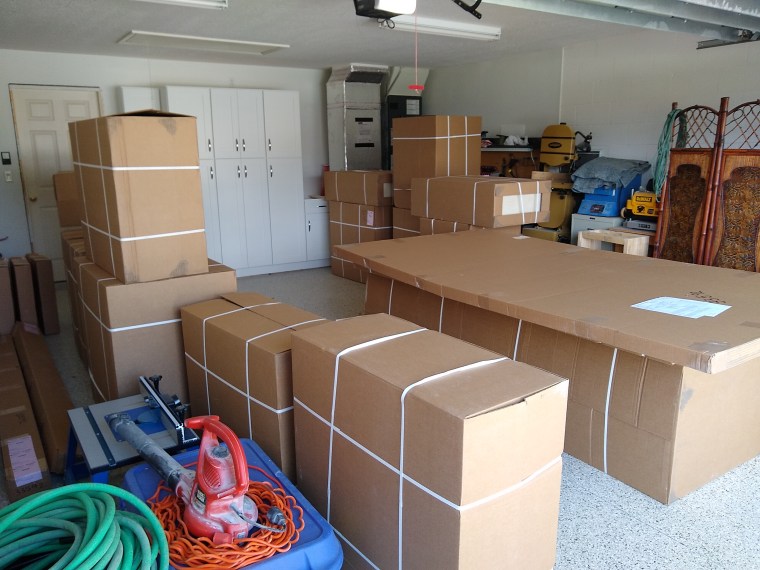
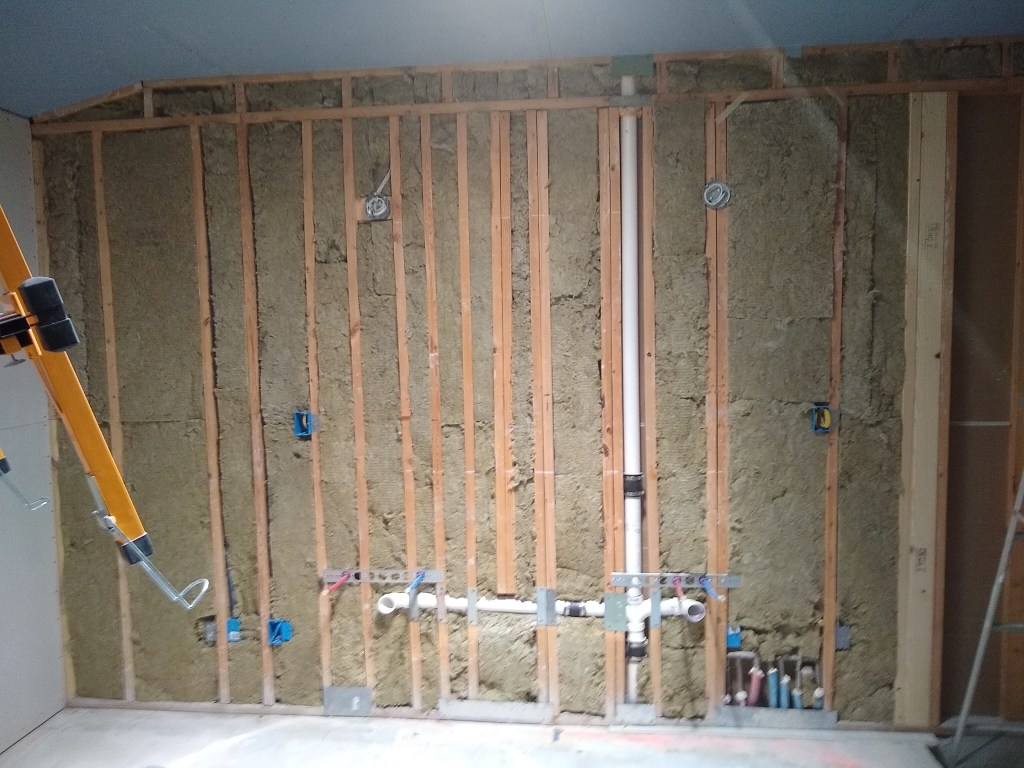
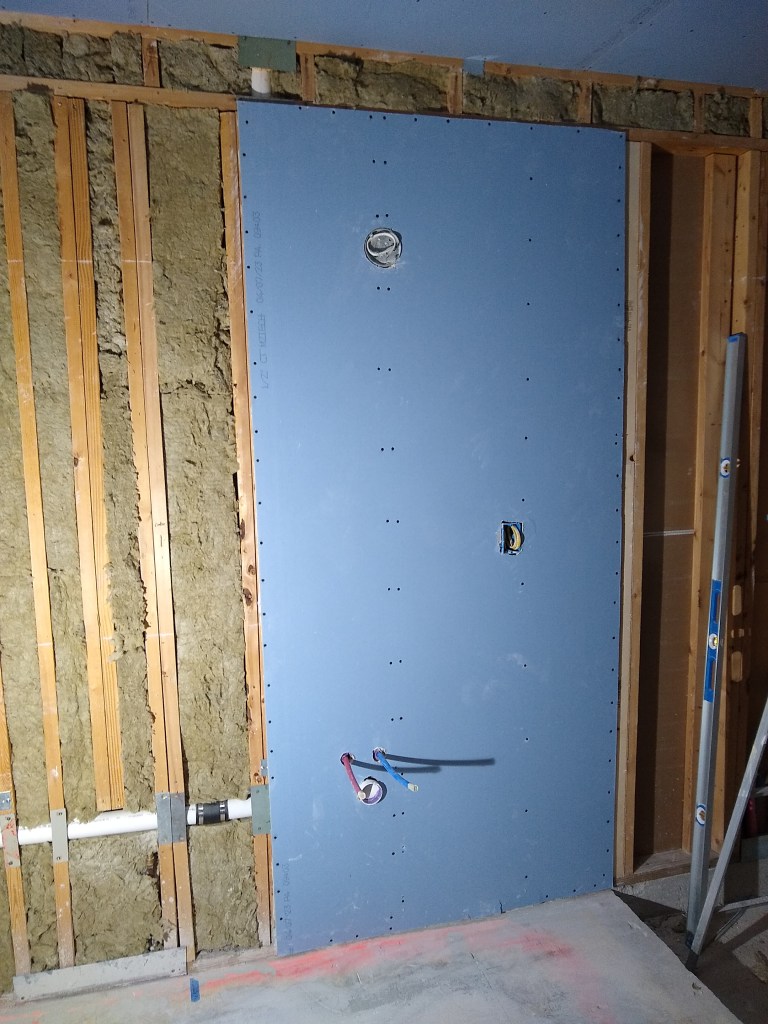
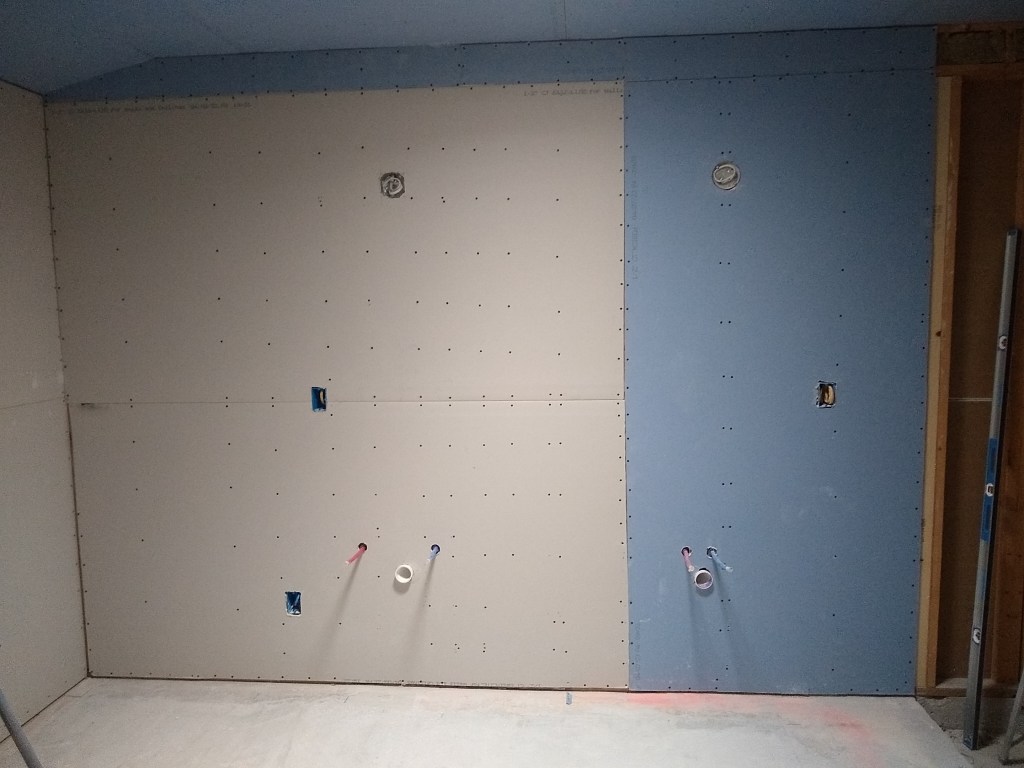

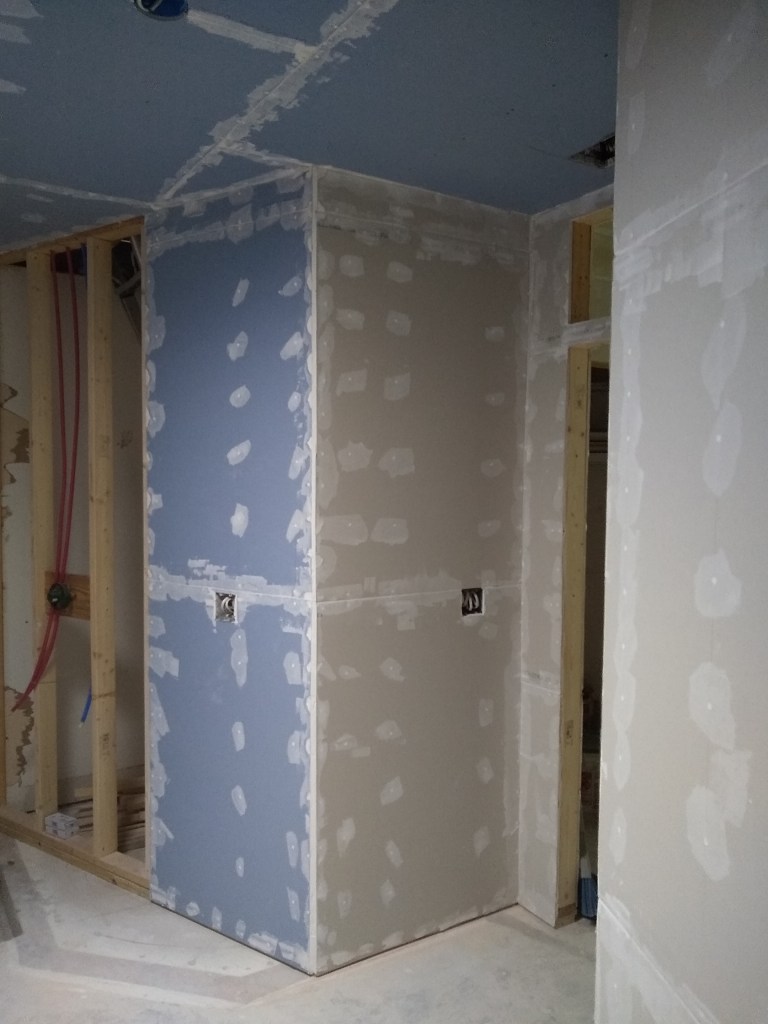
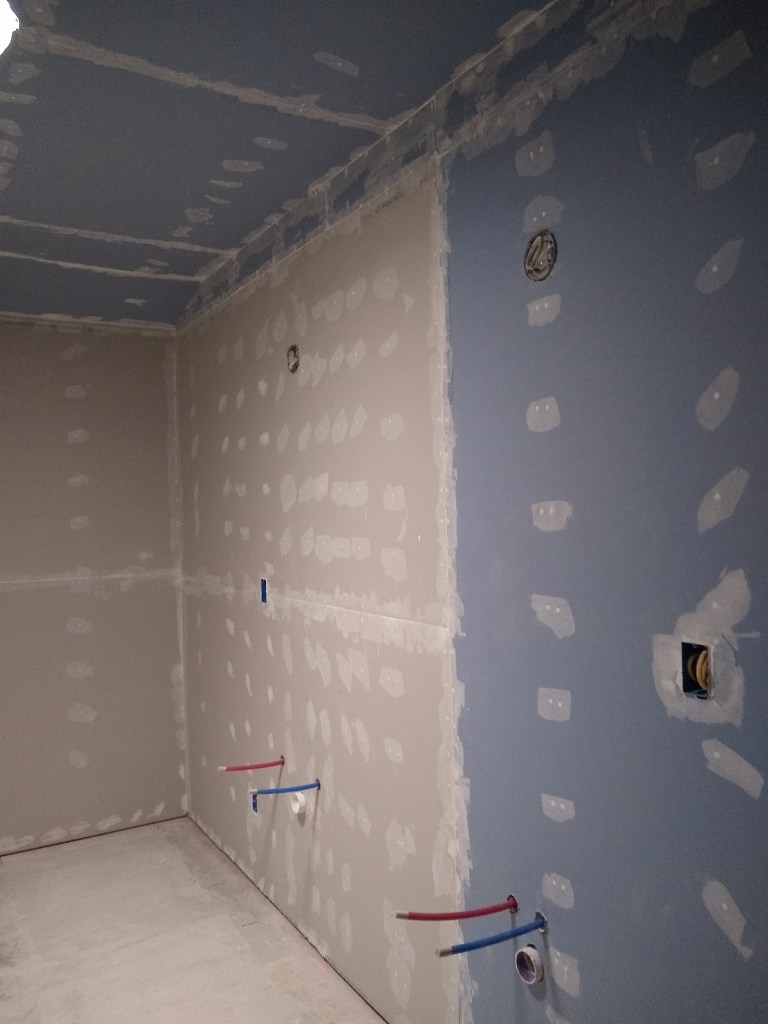
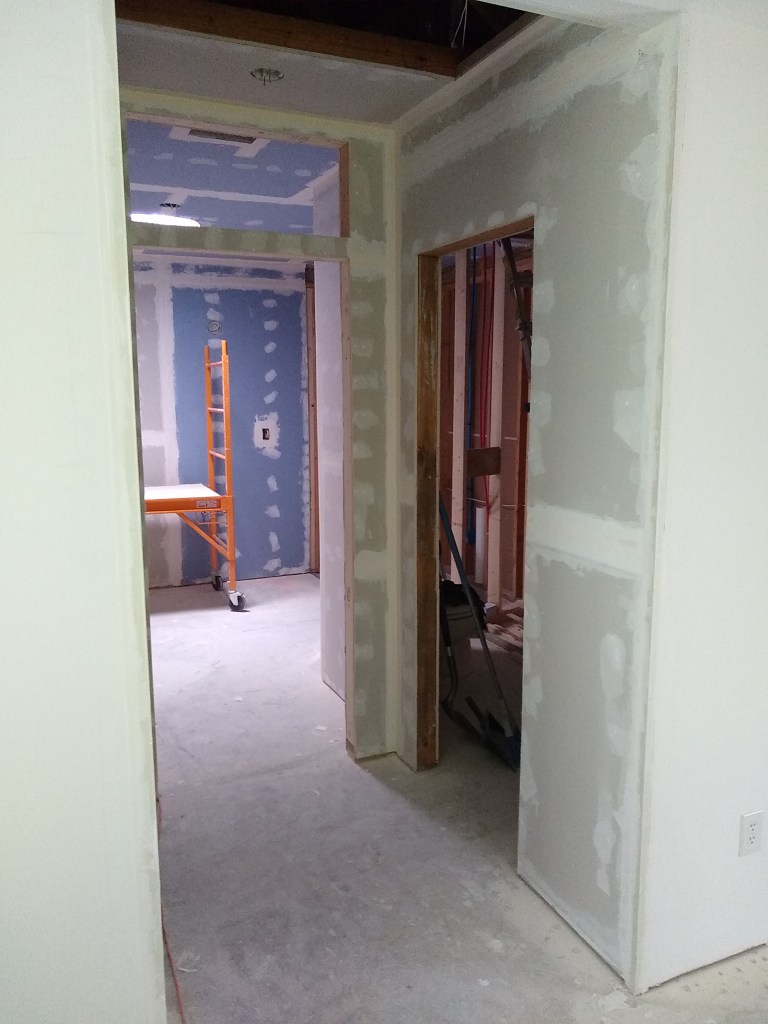
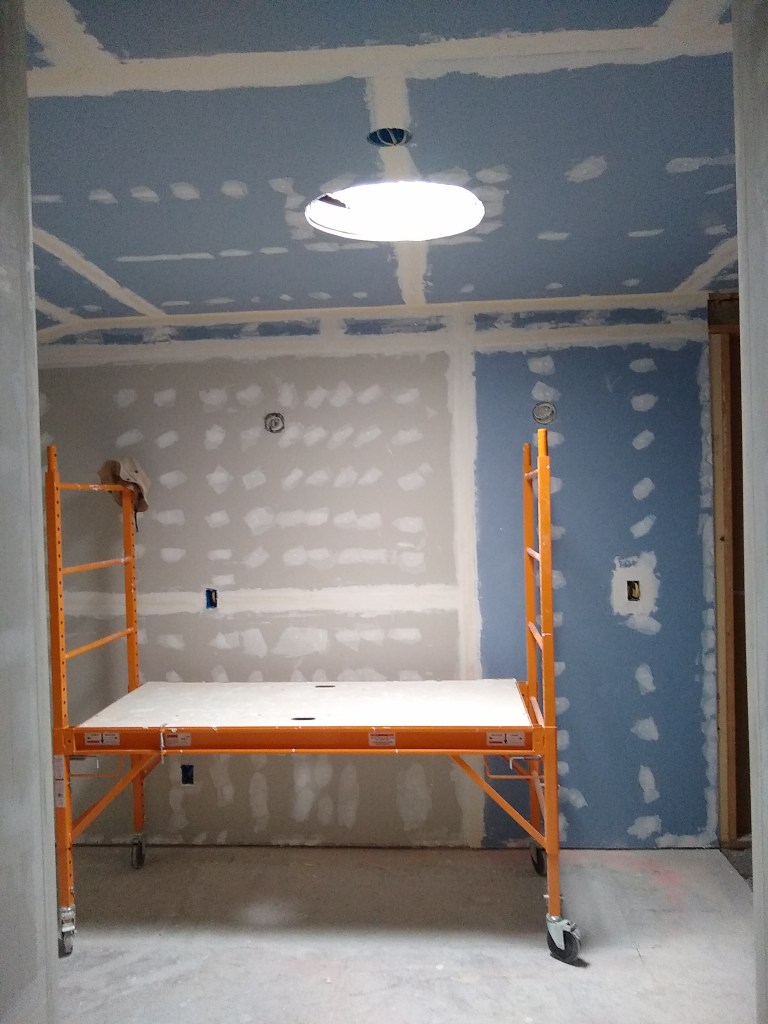

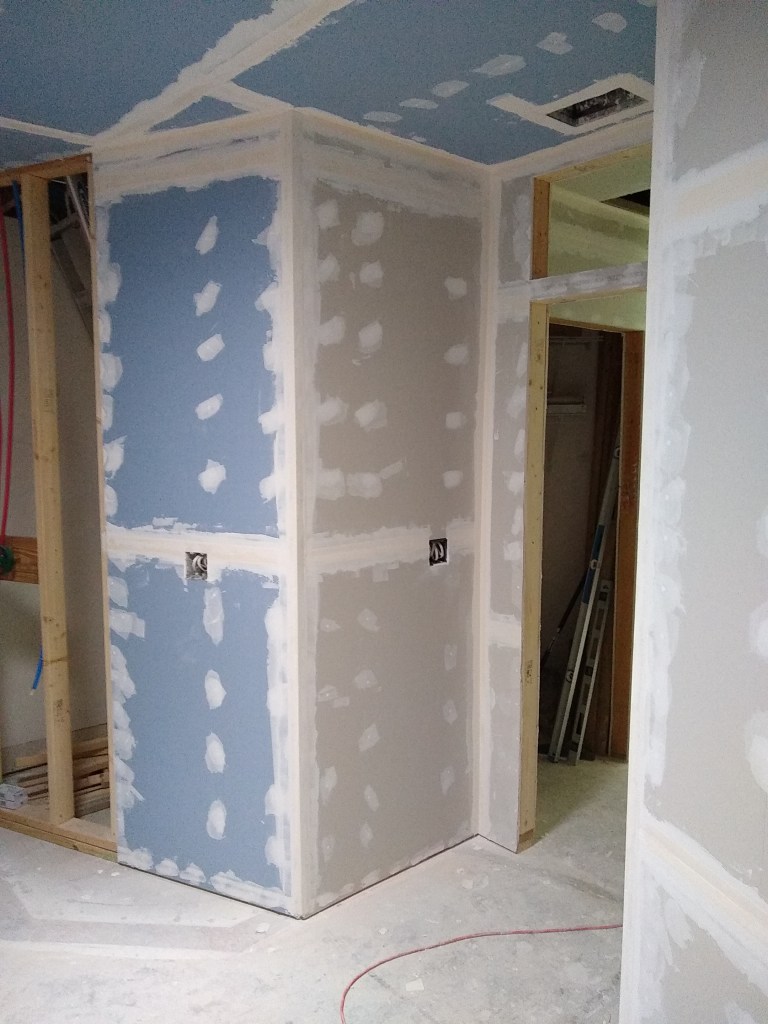


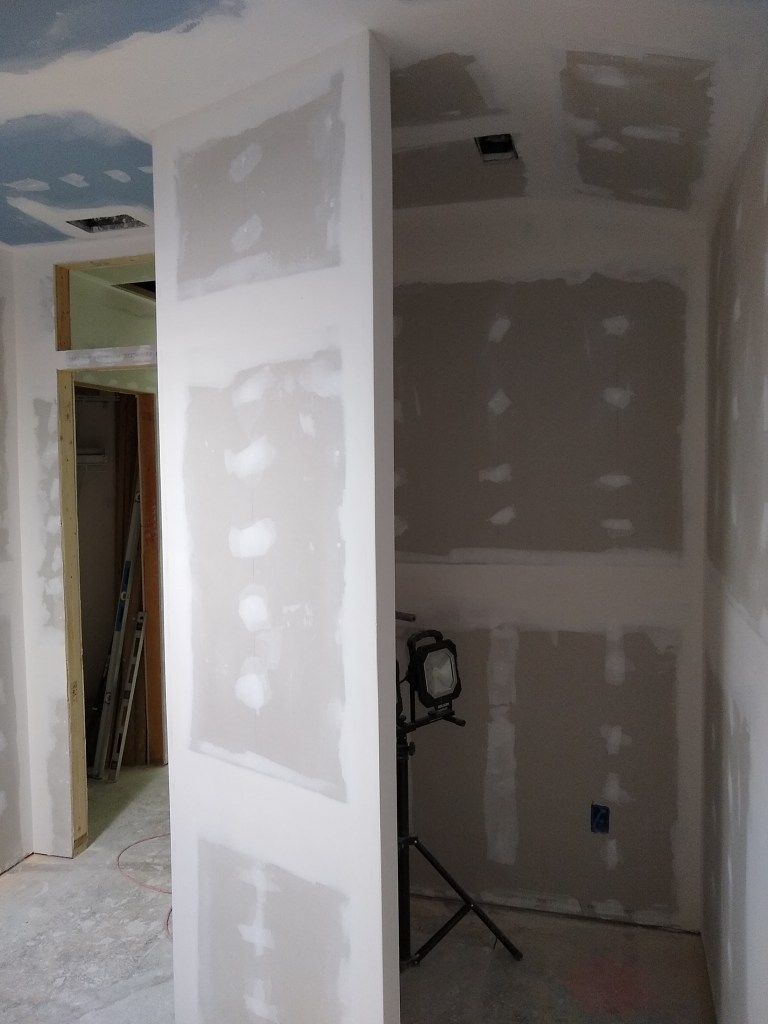
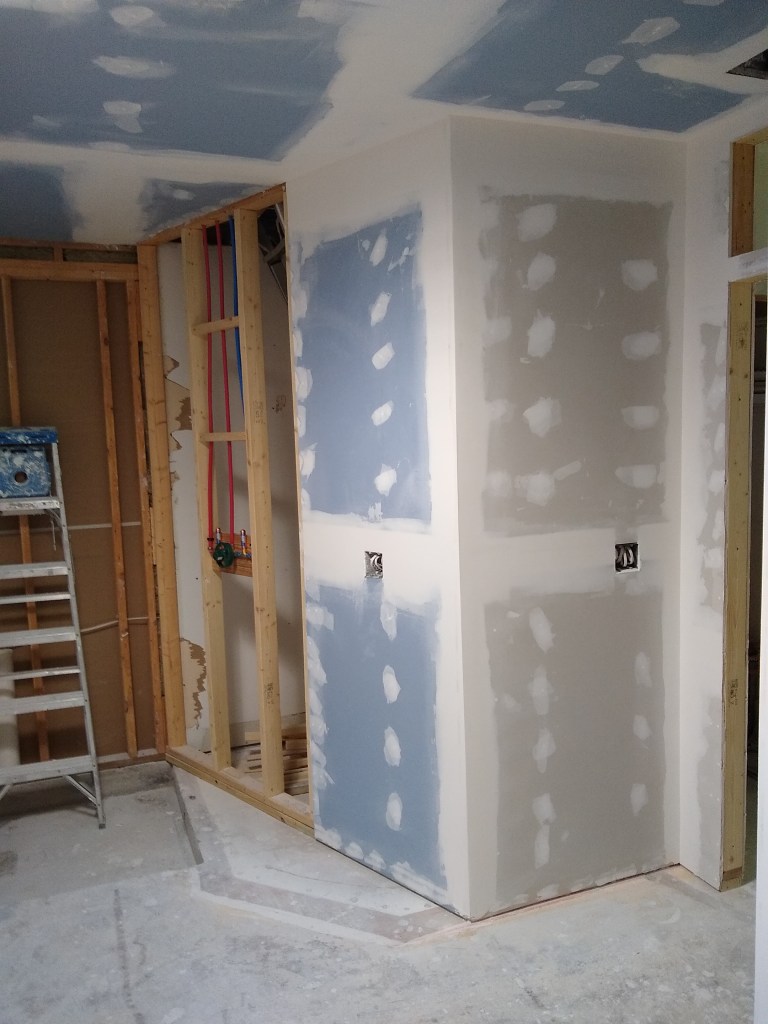

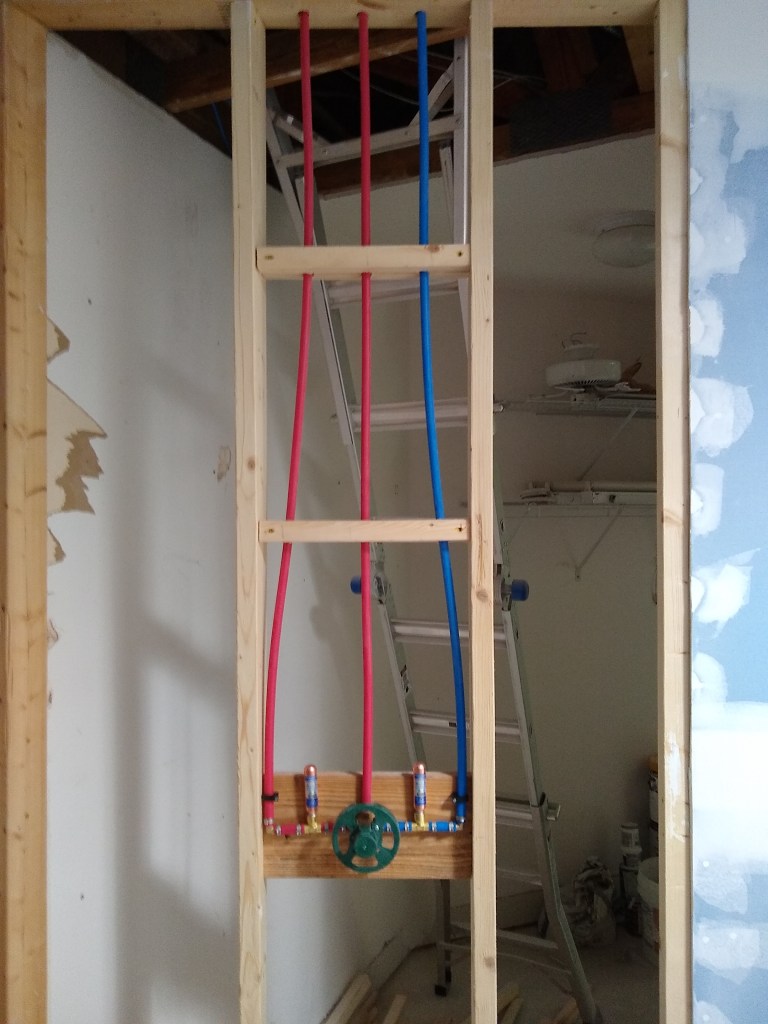
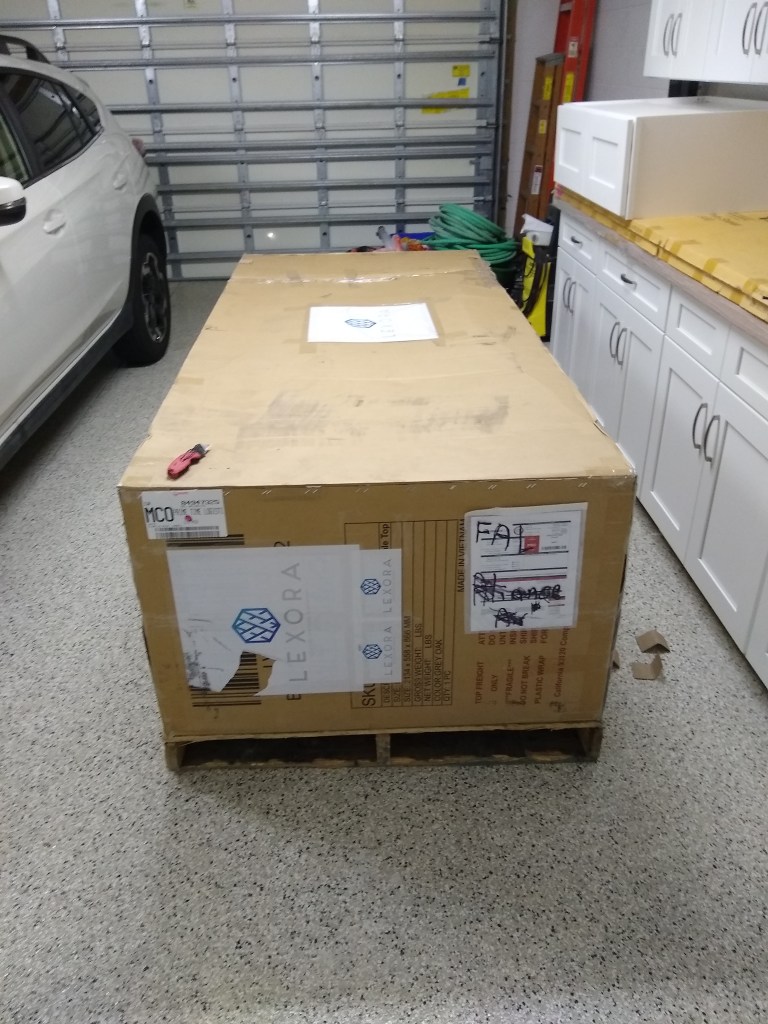
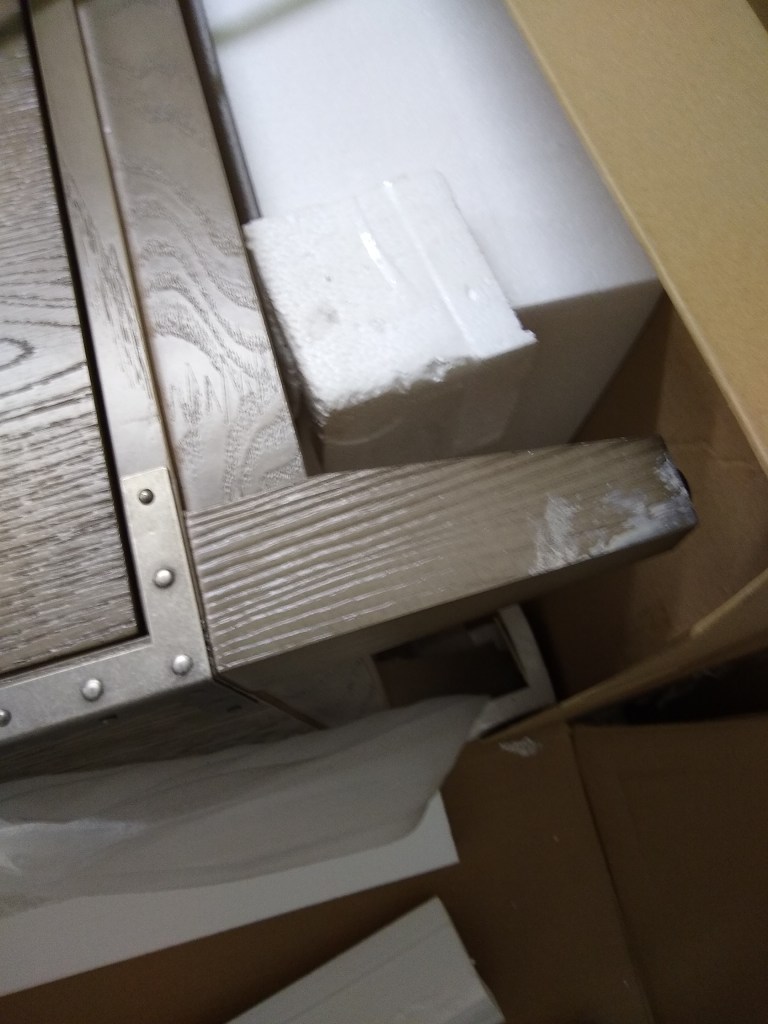
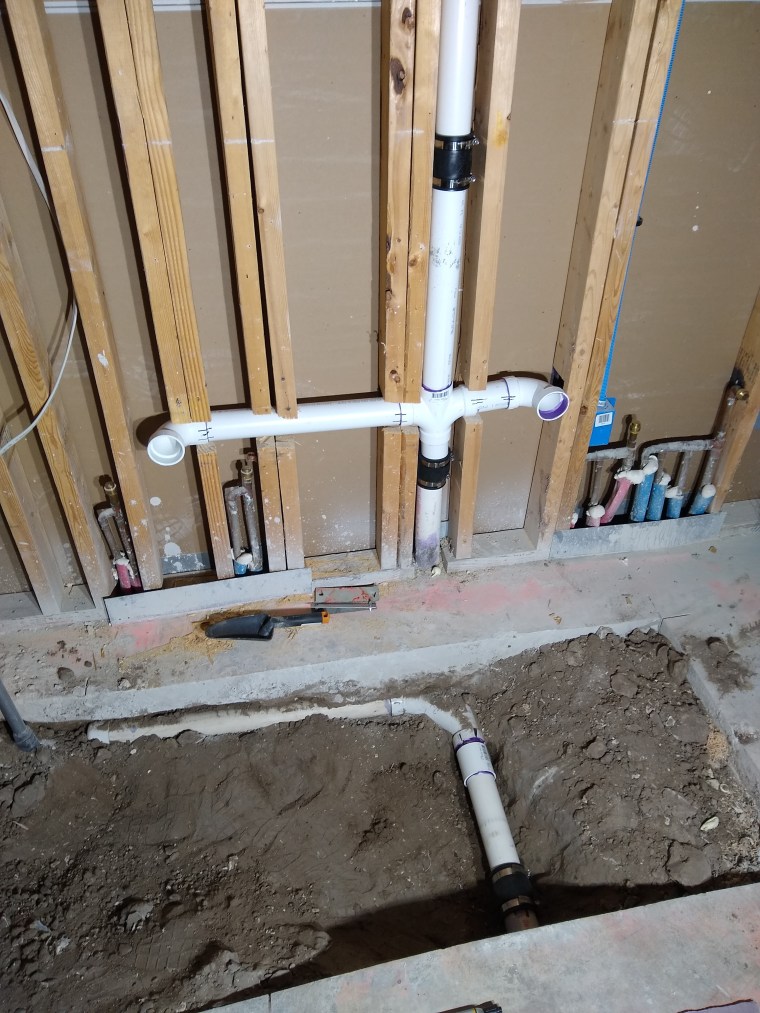



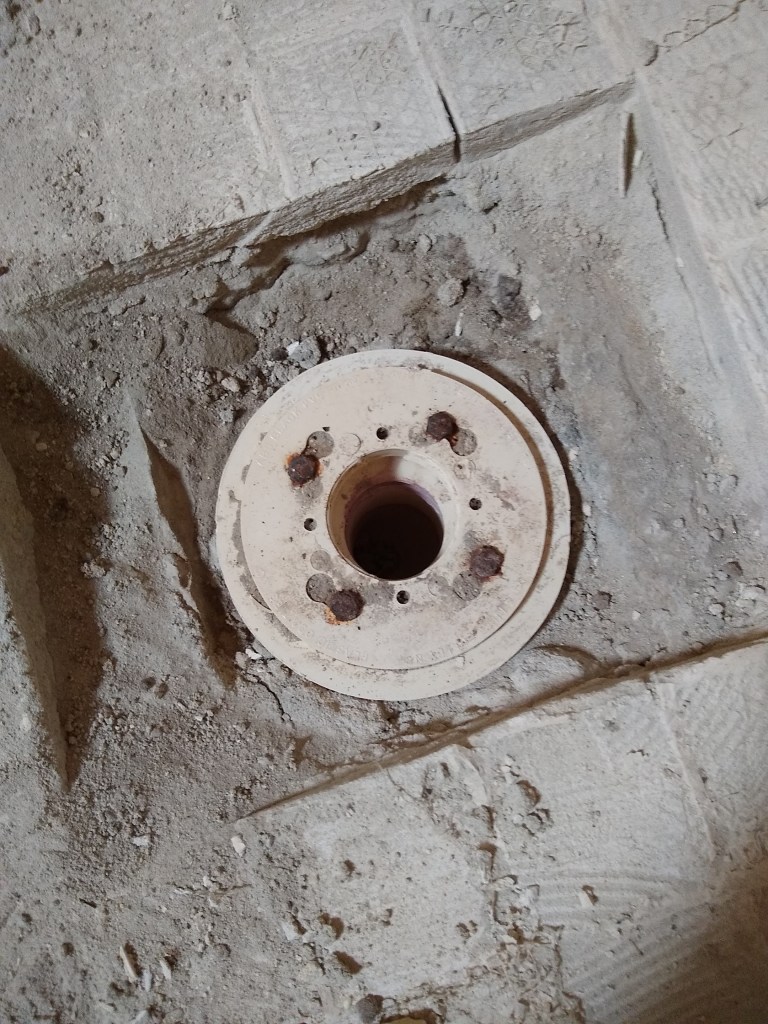
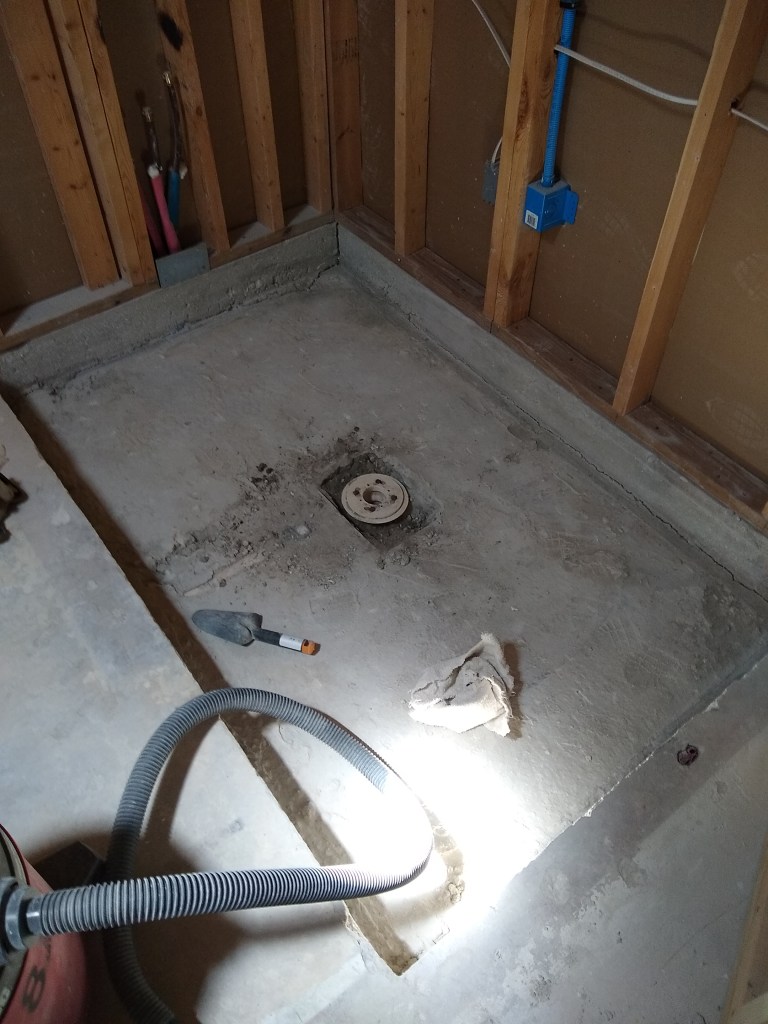




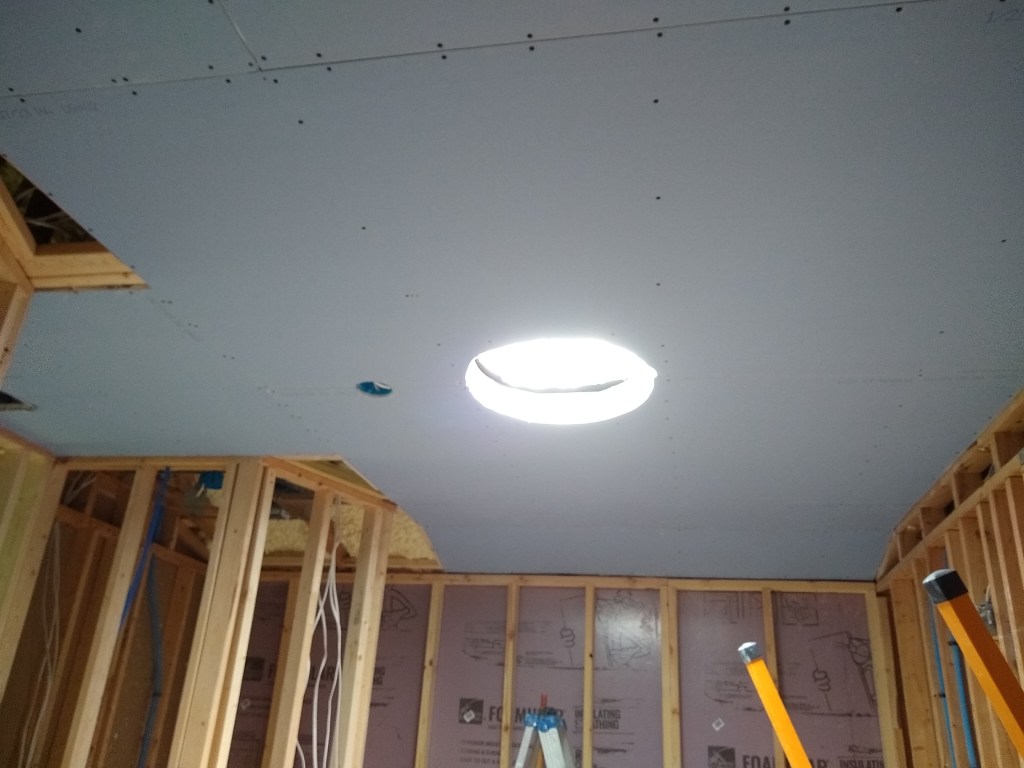
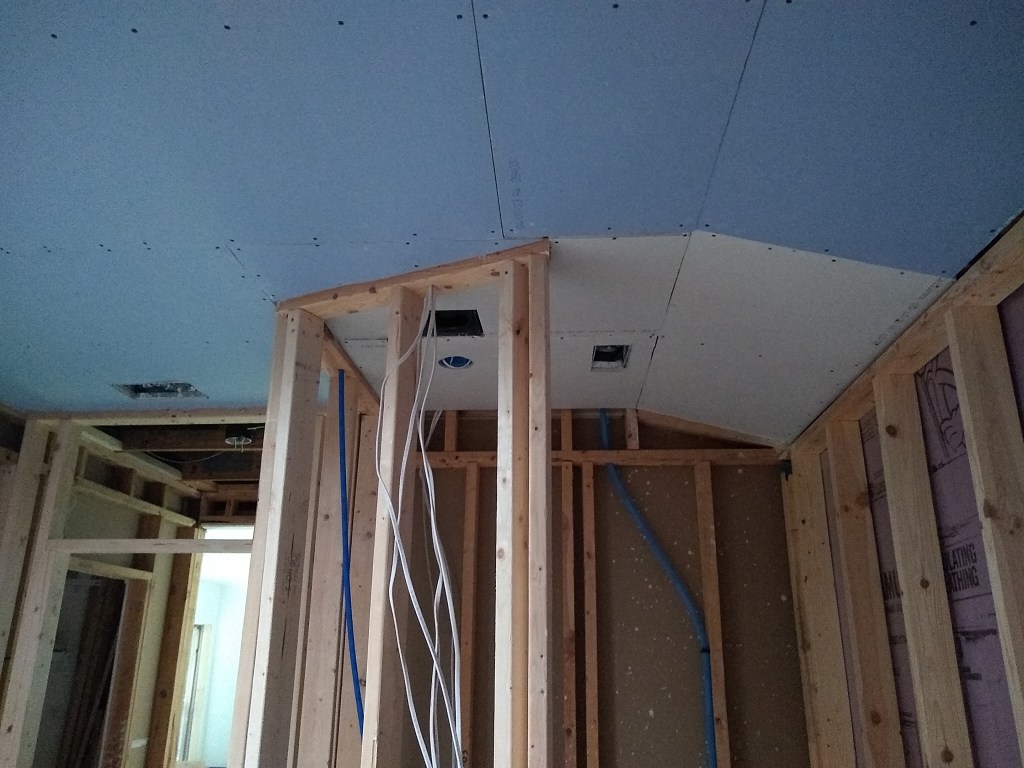
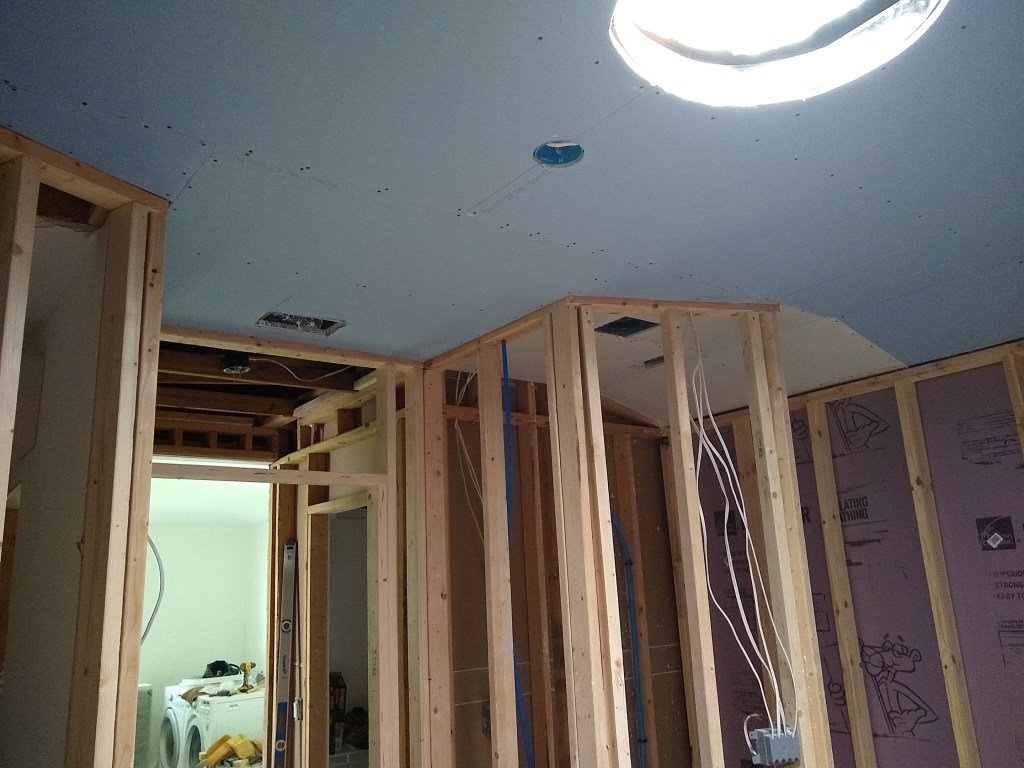
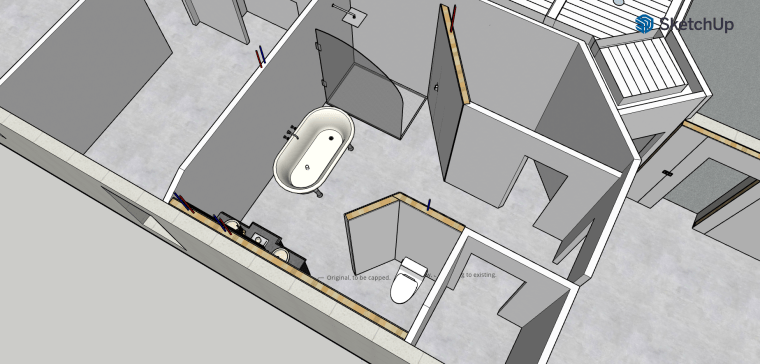

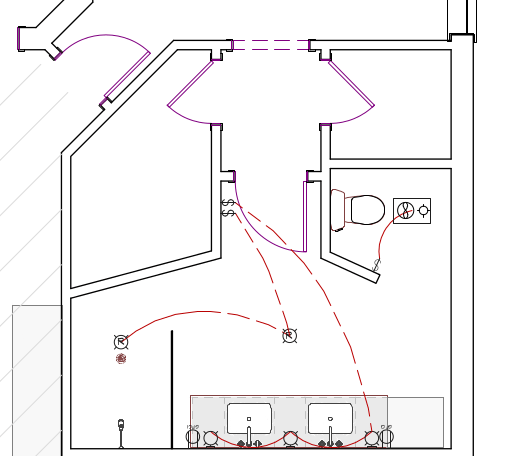


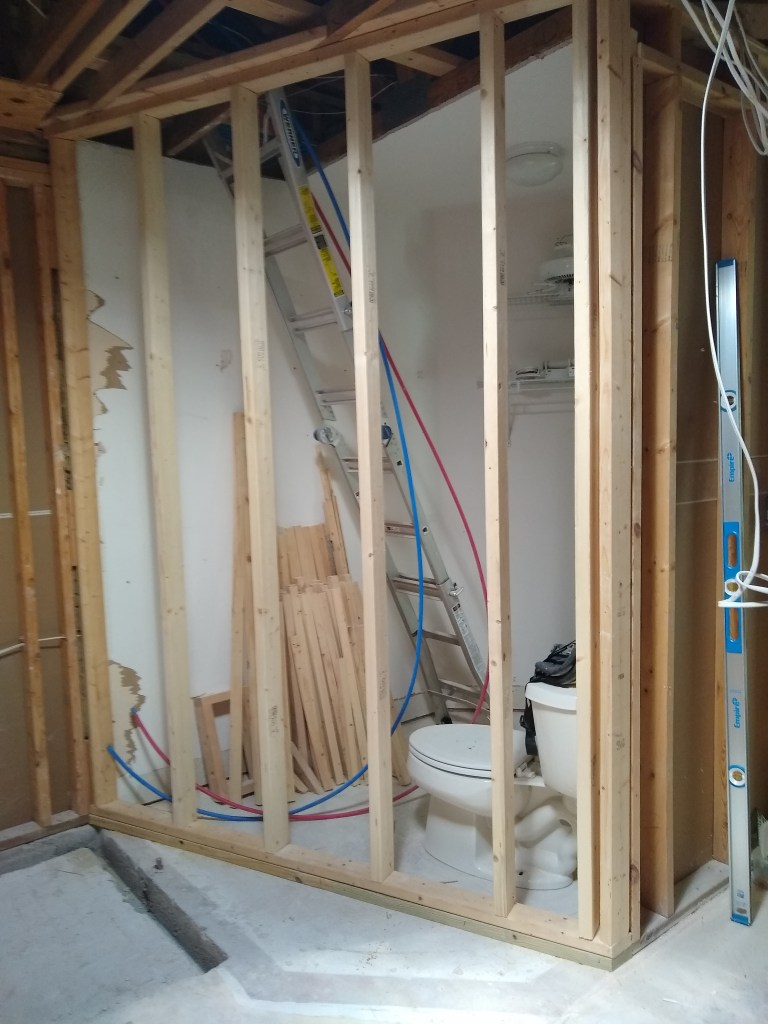
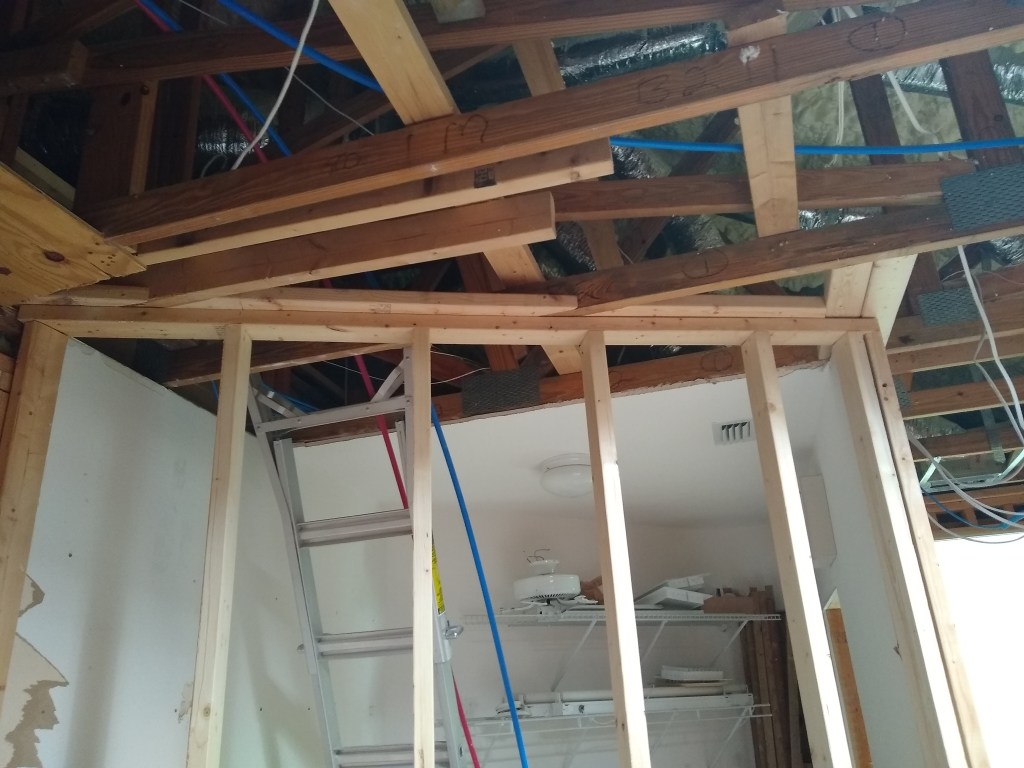
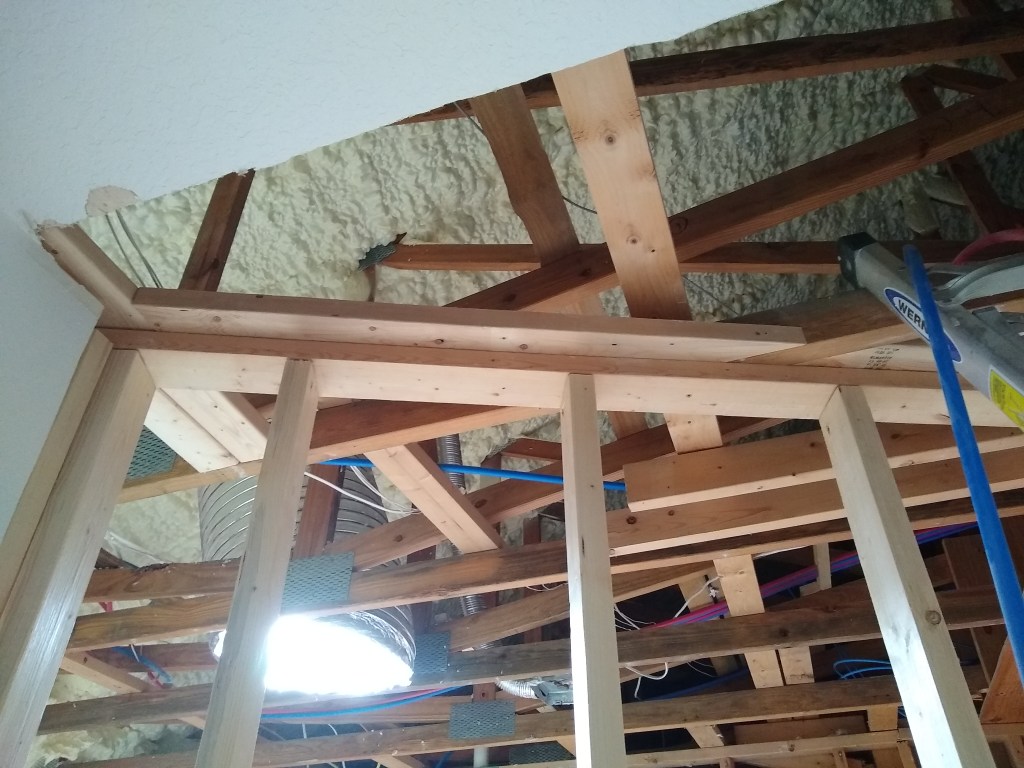
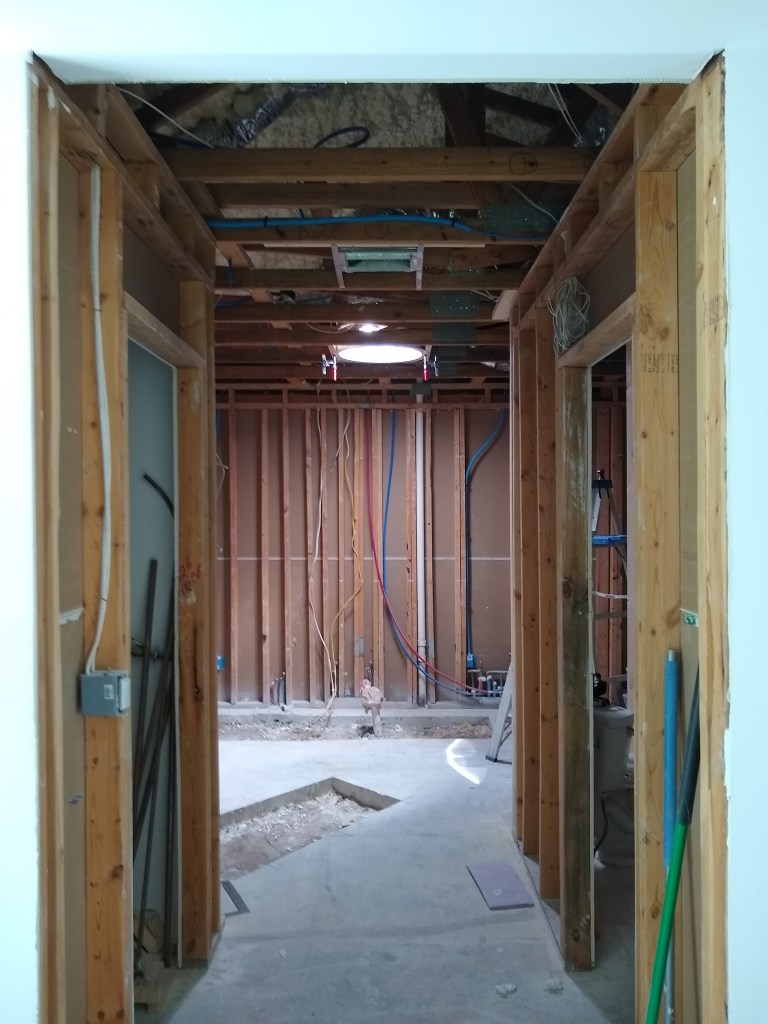



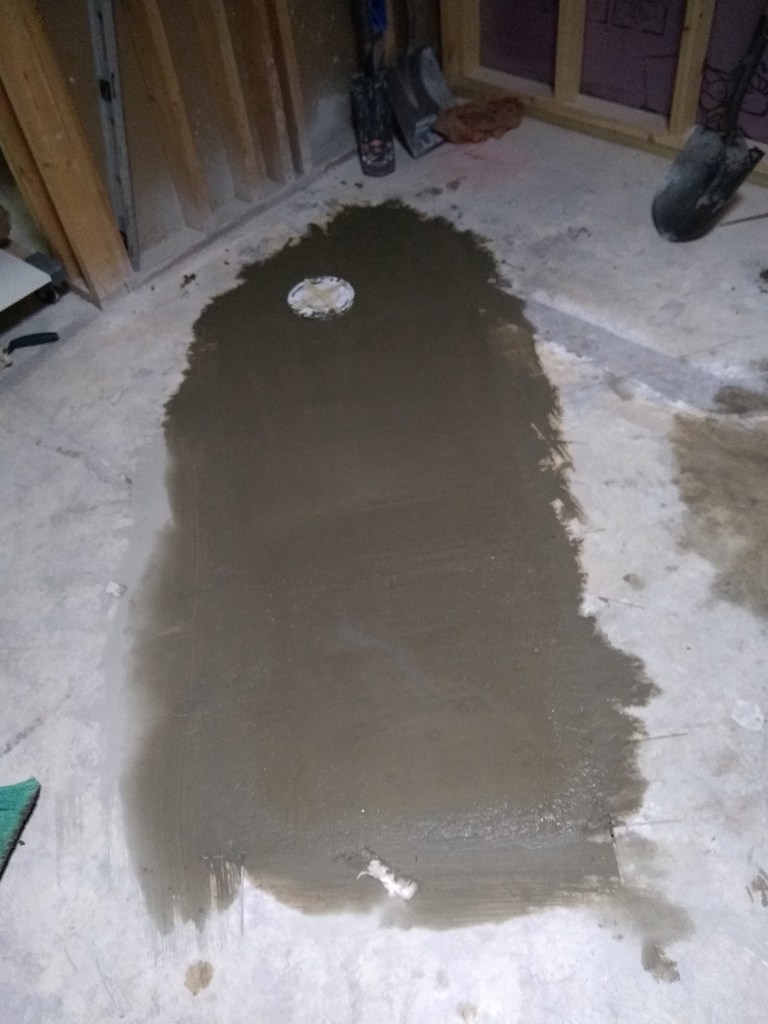
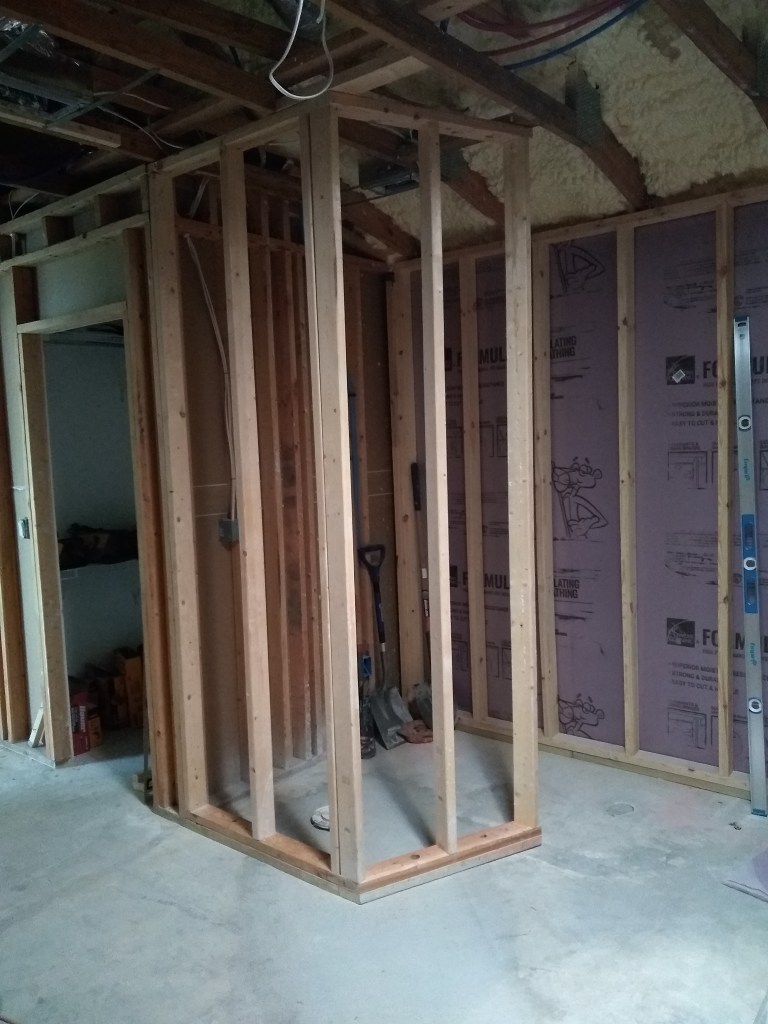


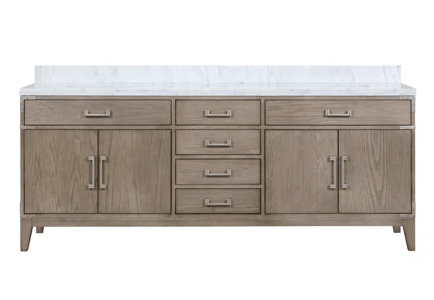
 nuntawob