Interior Doors – February through May 2026

After considerable time off for the holidays and beyond, I slowly got back to work starting in February. It’s funny the role momentum plays. Having not done any construction work on the house since moving in, getting back to it required a bit of a push.

My attention initially turned to interior doors. A lot of time was spent just thinking about what I wanted. I visited a local door supply company and was given some brochures. After identifying a style I liked, I initiated an email exchange with the contact I made while visiting. That went on for a bit, then the guy didn’t return my most recent email. Unfortunately, this is not uncommon in this industry. So I left that for a while, which turned out to be a good thing because during that time I came up with an idea for the interior doors I hadn’t initially considered. I’ll get to that later.

While all that thinking was going on, I was getting a bit frustrated with the lack of any tangible work. I had to do something – anything. So I decided to install the jambs for the two closets in the master bedroom.

Jamb for Small Closet
Jamb for Large Closet

I will not add doors to these closets because the entrances are in a small hallway, which provides enough separation. I would end up keeping the doors open all the time. Also, when open, they would limit access to some of the closet space. Without doors, the jambs could be simple. No need to accommodate a specific door size. These openings will eventually be trimmed out with casing and adjoining baseboard, but that will come only after my interior doors are installed.

I was holding off on continuing work in the guest bathroom because I needed the door to it to be installed first. Once the door was installed, I could install the door casing. Once the casing was installed, the baseboard would butt up to it. The baseboard needed to be installed before the toilet because the toilet would get in the way. So there is an order that these operations must follow. Since I was still in flux with respect to the doors, I realized there was a way for me to make some progress in the guest bathroom, even without the door in place.

I knew where the vanity was going to go, so all I needed to do was install the section of baseboard that goes behind the toilet and fits between the shower and vanity. So I got to work on that.

The only fiddly bit to this operation was adding a return to the end of the baseboard section that goes up against the shower tile. The other end simply butts up against the vanity.

Adding a Return to the Baseboard

To make a nice termination where the baseboard meets the shower tile, I cut a 45 degree angle and added a small piece that will butt up against the wall. I then used glue and tape to fasten it.

Return Glued to Baseboard
Tape Removed

After a bit of cleanup and painting, it looks like this:

Baseboard ready to Install

Here it is installed behind the toilet.

Baseboard Behind Toilet Installed

And here are a couple of pics of the toilet.

Toilet Installed
Toilet Installed – seat up.

Now I had to return to the interior door situation before I could continue with the bathroom. After reaching out again to the door supplier with no response, I decided I was going to make the doors myself. This has been common theme throughout this renovation. It is not uncommon for people in this industry to lack enthusiasm for new work. Perhaps they have so much of it that they can’t be bothered to follow up with new customers, or it is a cultural thing. I may never know, but it strikes me as very odd to engage with a potential customer and subsequently ghost them. Regardless of the reason, it has, and hopefully will continue to be, a blessing. Had the people in the various trades been more conscientious, I would not have taken on the things I have in this renovation. I have learned so much and have, in retrospect, been very happy that I was left with little choice but to do things myself.

Having decided that I would make the doors myself, I gained a significant degree of flexibility. I could make one door at a time, make them custom sizes, and if I desired, could make each door in a different style. As such, the plan for now is to make couple of “statement” doors: one for entrance to the master bedroom; and the other for the entrance to the workshop (in the foyer). Currently, my thinking is that these statement doors will be done in something dark, like walnut, while the other doors will be painted white to match the trim work. But I’ll figure that out later. In the interim I had to learn how to make my first door. So I did a lot of research and decided to use poplar. This is a relatively soft hardwood, is easy to work with, and paints well. It is commonly used for solid wood doors that will be painted. I hunted around for rough sawn 8/4 lumber (i.e., 2 inches thick) and learned that it would take a while before what I wanted would be in stock, so rather than waiting, I decided to get some 3/4″ boards from HomeDepot. What they offer there is not rough sawn (so it’s expensive) and does not come in 8/4 thickness, but I could use what they have to create an half scale prototype door to learn on.

I bought two 6 foot long boards that were 5 inches wide and 3/4 inches thick. I glued them together to get to the thickness I wanted (close enough). Although this would only be a half scale model, I wanted the thickness to be much like what I’d have for the end product.

Two Boards Glued Together

Once they were out of the clamps, I cut out the rail and stile pieces I’d need. This resulted in two stiles of about 42″ each, and 5 pieces for the rails.

Stiles and Rails rough cut and loosely positioned.

The door for the guest bathroom will be a two-panel door of height 81″, width 33″, and about 1-1/2″ thick. As such, it will have three rails. The stiles will be 6″ wide horizontally, the top rail will be 5″ wide vertically, the middle (or “lock”) rail will be 6″ wide vertically, and the bottom rail will be 10″ wide vertically. Since the prototype I’m building here is a half scale, these dimensions will be about half that – doesn’t have to be exact.

Each of the rail pieces I had after cutting up the board were about 2-1/2″ wide. This was fine for the top rail (2-1/2″ = 1/2 x 5), but the lock rail and bottom rail would need to be wider than that (3″ = 1/2 x 6″, and 5″ = 1/2 x 10″, respectively). So I glued up a couple of pieces to make up the difference. Rather than take them to the 3″ and 5″ they should be, I left them wider than that. Being a prototype, these dimensions aren’t critical. These will be close enough.

Since I didn’t have a jointer, I used my jointer hand plane to flatten the reference face and reference edge of each board. Here is the first stile I worked on.

First Stile Face and Edge Jointed

After establishing a reference face and edge, I took it into the garage and used my thickness planer to flatten the opposite face, then pushed it through my table saw to create a parallel edge. Here are the two stiles after both were squared in this manner.

Stiles Squared

I followed the same process for the rails. Below I am showing them in their approximate position. The width of this prototype door will be 16-1/2″, so I made the rails 14″ long. The rails will be joined to the stiles using mortise and tenon joinery, so the tenons will extend into the stiles, which is why they sit on top of the stiles as shown below. Also note that the stiles will have an extra inch at either end (top and bottom), which is needed to provide extra support as I cut the mortises at each end of the stiles. This extra length will be cut off after the rails area joined to the stiles.

Rails and Stiles Squared

These boards are now ready for the joinery phase. At this stage I hadn’t decided on the material nor type of panel I would make, but this would not impact the cutting of the grooves that will receive the panels. The edges of the panels will be inserted into 1/4″ wide grooves along the stiles and rails, each with a depth of 1/2″. I used a plough plane for this and started with the top rail.

Cutting the Groove for the Top Rail

Below I show the same rail being cut, but from the end, where the full depth has not yet been reached. The score lines you see on either side of the groove were the result of an experiment to help prevent tear-out. I won’t get into it, but it turned out not to be necessary, so this was the only place where you’ll see such lines.

Edge View of Top Rail Groove being Cut

Below I show the top rail with the groove cut to full depth.

Edge View of Top Rail Cut to Full Depth

I did the same for the remaining rails and the stiles. The lock rail (middle one) required a groove on both edges since it will receive a panel from above and below.

All Grooves Cut – bottom to top.
All Grooves Cut – top to bottom.
Closeup of the Bottom Rail meeting a Stile

The next step was to cut the mortises in the stiles that will receive the tenons (which will be cut in the rails). I’ve cut mortises by hand before and found it very labor intensive, but thought I’d give it another try. Although I was happy with the mortise I cut, it was just too impractical to be doing this by hand, especially given the number of doors I plan to make. So that operation, along with the many others, led me to abandon the idea of making the doors primarily with hand tools. Instead, would switch to using machines.

This change in approach meant that I had to purchase a number of tools that would make the job more manageable. It would be a significant investment, so a lot of time and thought went into what would make the most sense. For the joinery I would use the Festool Domino. It cuts a mortise in both pieces being joined and uses a “loose” tenon to bring them together. This will be seen later. I would also introduce a jointer for milling, and other machines that too will be revealed later.

After deciding what tools I would get and ordering them, it would take quite some time for a few of them to arrive. So the prototype door was put on hold as I began preparing my garage shop for the new equipment. One thing I was able to do in the meantime was pickup the 8/4 poplar that I would use for the real door.

8/4 Poplar Boards

The two boards shown above were actually part of one 16 foot board that was cut in half for me to fit in my car. They are 13 1/2″ wide, so pretty beefy. It took a bit of hunting to find a supplier for these boards, so I was happy to get them and bring them into my house where they acclimated for some time before I started working with them. They are kiln dried, but it’s always a good idea to let them settle in their destination environment for several weeks (if not more).

I took one of them into the garage and ripped it down the center with a hand saw. These two pieces will be the stiles.

Ripping the Stiles by hand.
Stiles Ripped

Hand cutting this board was actually quite enjoyable. I have a really good rip saw, so I took my time and let the saw do most of the work. I achieved a nice straight cut. In future I will probably do this with a track saw, but at the time of writing this, I hadn’t made that decision. These two pieces were returned to the workshop inside the house where they would sit for several weeks as I waited for the new equipment to arrive.

One of the new pieces of equipment would be an 8″ jointer, which requires a 240 volt outlet, so I had one added. I wimped out on this and simply hired an electrician to do it. He arrived the same day and knocked it out very quickly. Although expensive, I was happy to have that done.

240 Volt, 20 Amp Outlet

Along that same wall and under the cabinets are four 120 volt outlet boxes I added way back. I held off on installing the outlets because I intended to add some kind of backsplash first. These are connected to a 20 amp circuit. The other outlets in the garage are on a 15 amp circuit, so these will provide plenty of juice for some of the new equipment (e.g., the new dust collector will need one of these). Even though I hadn’t done anything about the backsplash, these outlets would be needed, so I decided to install them ahead of that.

Wiring the 20 amp Outlets
20 amp Outlets Installed

The wire you see hanging at the end is for the under-cabinet lighting. Here is a closeup of that situation.

20 amp Outlet and Switch

The switch you see in the image above will send current to the wire you see hanging. It will connect to a series of under-cabinet lights. I picked them up a few days later and installed them, as seen below.

Under Cabinet Lights Installed

I’m very happy with the under cabinet lights. I made use of them as I was read the instructions for how to assemble my new Jet DC-1100vx dust collector, which arrived during that time.

New Dust Collector

I also ordered a Jet Black 8″ helical head jointer. This is a big machine and would require some assistance getting it to my house and into the garage. It came in two pieces.

Jointer Head
Jointer Stand – after I set it on a Mobile Base

Since I always want to be able to pull my car into the garage, tools must be mobile, so the jointer base was placed on a mobile base, which I purchased separately. Then came the tricky part; getting the 300 lb head onto the base. My neighbor, Fred, came over to help with that. Below I show it after the head was mounted and the remaining bits and pieces were attached.

Jointer Assembled

To try it out, I hooked up the dust collector and ran a scrap piece of cherry through it. First I flattened a face, then used that face to register against the fence to produce a 90 degree edge.

Jointing Test Board Face
Jointing Test Board Edge

It worked beautifully, as did the dust collection. I was very happy with the results, so it was time to use it on the real thing.

Full Scale Stile Face and Edge Jointed

Except for the lack of proper infeed/outfeed support, jointing this 8 foot long 8/4 board was a breeze. I improvised an outfeed table, as shown above. Although it worked, it became clear that a couple of adjustable roller supports would be needed, which I subsequently purchased. With them, I was able to mill all the stiles and rails for the full size door.

Stiles and Rails Milled

I hadn’t abandoned the prototype door. Although I had cut the grooves by hand, I would be switching to using a router for the full size doors, and the motor I ordered would not be arriving for some time. Once it arrived, I intended to try it out on the prototype door, expanding the size of the groove to match that of the full sized door. That would mean that the prototype would no longer be strictly 1/2 scale. Although the dimensions would not be accurate, it would be more important for me to practice the joinery before committing to the real thing.

While waiting for the router motor I milled the wood that would make up the top and bottom panels. Once milled, they were glued together, as shown below. Although not strictly necessary, I used Dominos to join the panel pieces because they would aid with alignment. With such beefy pieces, the Dominos kept the pieces from sliding around as the clamps pulled them together.

Bottom Panel Glue Up
Top Panel Glue Up
Top Panel Glue Up

Once out of the clamps I used my No. 7 jointer plane to flatten both panels.

Bottom Panel Hand Planed
Top Panel Hand Planed

While still waiting on the router motor, I decided to use FreeCAD 3-D modeling software to create a 3-D model of the door. By creating a 3-D model I could get a sense of the size of the cove I wanted to use to raise the panels. FreeCAD is free software. It is very powerful, but has a steep learning curve. I wanted to become competent with this software so that I could use it to design all of the things I plan to build. Although not strictly required for the doors, I thought it would be a good place to start, since it is a relatively simple thing to model. When I become more capable with FreeCAD, it will be very useful when designing the closet layouts down the road.

3-D Model of Guest Bathroom Door

After completing this 3-D model, my router motor arrived. I mounted it to the router table and modified a mobile bench I had to set the router table on. It all looked very good.

Router Table on Mobile Base

Unfortunately, it became very clear that the router table was not going to be sufficient to do the job. The material, especially the panels, were just too large and beefy for my little router table. Pushing them over the router table would be very precarious, at best. So I started looking at shapers, also known as spindle molders. Shapers are kind of like router tables, but much bigger. Where router tables accept router bits (cutters attached to a shaft), shapers have spindles upon which cutters are installed. Router bits usually come with shaft diameters around 1/4″ to 1/2″. The shaper spindles are commonly 1-1/4″ diameter. I had explored the idea of getting a shaper before ordering my router motor, but thought I would first try using the router table before investing in such a large piece of equipment. After it became obvious that it would not work, I returned to the idea of getting a shaper. So I had already done quite a bit of research on shapers. Now that I was almost certainly going to buy one, I only had a bit more work to do to decide which one. I ultimately decided to buy a Powermatic 2700, as shown below.

PM 2700 Shaper
PM 2700 Shaper

This machine is very heavy, around 600 pounds, but under the cabinet are a set of retractable casters that are raised using a handle on the left side (same kind of handle as you see on the front of the machine). So I am able to move it into a location I made for it, allowing me to continue to pull my car into the garage.

Buying this machine required that I add yet another 240 volt outlet. The 240 volt outlet added for the jointer was wired for 20 amps. This machine required 30 amps, so another outlet was needed. This time I decided to install the outlet myself. The price tag for the first one was pretty hefty and I did not want to incur that cost again. Fortunately it was a pretty simple job and I had it done is a couple of hours.

240 Volt, 30 Amp Outlet

So now I have two 240 volt outlets sitting next to my breaker box.

The two 240 Volt Outlets

Because a machine like the PM 2700 is commonly purchased by a business, the electrical setup cannot be anticipated. That is, the business may have anything from a 30 amp outlet to a 50 amp outlet, or may even wish to hard wire the machine to a power source. As a result, the machine is not shipped with a power cord. So I had to make up my own power cord and wire it to the shaper.

Electrical Connection for the PM 2700

In the first image of the shaper shown above, you can see the power cord I made up sitting on the floor to the right side of it.

After ordering this machine, I had to wait about a week before it was delivered, so I used that time to clean up the floor of the lanai. I had it pressure washed, then added a couple of coats of paint to freshen it up. I’ve had several ideas of what I’d like to do with the lanai floor, but for now, I just wanted something more inviting since I will not attend to that project for a very long time.

Lanai – Looking East
Lanai – Looking South East
Lanai – Looking South

Once the PM 2700 had arrived, I had to decide on the cutters I would need. Like everything, this required some research. To raise the panels, I settled on a cove cutter that would provide a nice long but simple cove that would reflect what I modeled in FreeCAD. To cut the groove in the stiles and rails, into which the panels would slide, I ordered a 1/2 inch “groover”.

Once the cutters arrived, I got to work preparing the stiles and rails for cutting the grooves that will accept the panels. To start, I laid them out on the floor to establish where exactly I would position the rails.

Layout before cutting Stiles/Rails to Final Length

I set the panels on top of the stiles and rails to make sure they overlapped by about 3/8″ all the way around. The grooves I would cut into the stiles and rails would be 1/2″ deep, leaving 1/8″ for expansion. With the distances marked, I was able to cut the stiles and rails to final length then cut the mortises for the Domino joinery.

Mortises Cut using Festool Domino, ready for Dry Fit
Dry Fitting using Dominos
Dry Fit Complete

I was happy with the dry fit, so it was time for me to pull it apart and cut the grooves that would receive the raised panels. Having never used the shaper before, I would practice cutting the 1/2″ grooves on scrap pieces to get a feel for it. After experimenting with the shaper, I was really surprised at how well it worked. It produced the 1/2″ groove at 1/2″ depth easily and cleanly in one pass. I had intended to use my prototype door pieces at this stage, but after this I felt I was ready to go on the real thing. So, after all was said and done, I did end up abandoning the prototype door.

Cutting Groove in one of the Stiles
Shaper Output as I ran the Stile past the Groove Cutter.

I did the same with the rails, which were much easier given the shorter length. The key to getting the grooves to line up properly was to make sure the “reference” side of each board was face down as it ran through the shaper.

Showing how the Grooves Line Up
Dry Fit after Grooves cut

For reference, the door is 81″ tall, 32-5/8″ wide. The bottom rail is 10″ wide, the middle (lock) rail is 6″, and the top rail is 5″. The stiles are 6″ wide.

With the grooves cut and the door dry fit, the panel openings could be measured to provide the final dimensions for the panels before running them through the shaper to create the raised panel effect. To cut the panels to final dimensions and square them, I purchased another new tool, the Festool TS 60 track saw with guide rail. I knew this tool would be needed eventually. This was one of the jobs it would be needed for, so I got it.

Cutting Bottom Panel to Final Dimensions

With both panels square and at final dimensions, it was time to run them through the shaper. I installed the panel raising cutter in the shaper then ran some test pieces through to establish the height of the cutter. I would be raising the panel on both sides, so the remaining tongue needed to be able to fit into the grooves in the stiles and rails well, but not too tightly. If you look at the image above, you can see that I used the test piece I ran through the shaper to support the far end of the track saw rail. Below I show the cutter installed in the shaper.

Panel Raising Cutter

This was a critical operation because if I made a mistake, I’d have to remake the panels. That would be a big job and expensive because of the cost of the wood, so I was at full attention when doing this. My experience with the test piece gave me a sense that it would be fine, but I was still a bit nervous about this operation. Although I didn’t have to, I decided to run the panels through the shaper using two passes. For the first pass, I moved the fence forward so that I would take about 75% of the material off. After that I pushed the fence back to expose the full extent of the cutter and ran the panels through again for the final pass. This worked flawlessly and I was delighted with the results. This was definitely the tool for the job.

Bottom Panel Raised on Both Sides

Before raising the upper panel, I did a quick dry fit of the bottom panel in the frame to make sure there were no surprises. It fit well.

Dry Fitting Bottom Panel

I ran the top panel through next.

Top Panel Raised on Both Sides

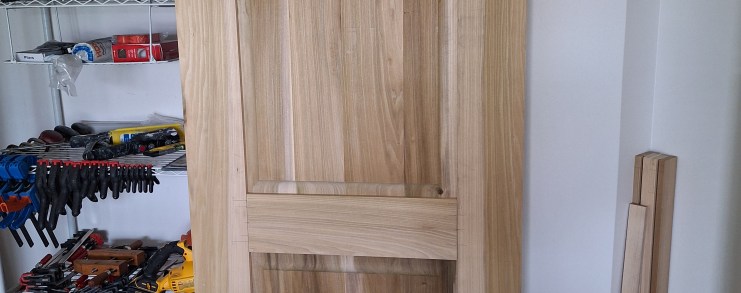
Again, I was pleased that the operation went smoothly. With both panels raised, I dry fitted them into the frame to reveal something that looks like a door.

Dry Fit of Both Panels

I was very pleased with that. Although there were still many stages to go (sanding, glue-up, painting, pre-hanging into the door jamb, hardware, etc.), I finally had something that I could visualize.

I intended to end this post with a finished and installed door, but before I can move on with this door I have other equipment I want to obtain to make the process easier. I have many doors to make, so I want to get a system in place to make them as well as I can. Besides, this post is already long enough, so I’ll end the it here and discuss the next steps in the following post.