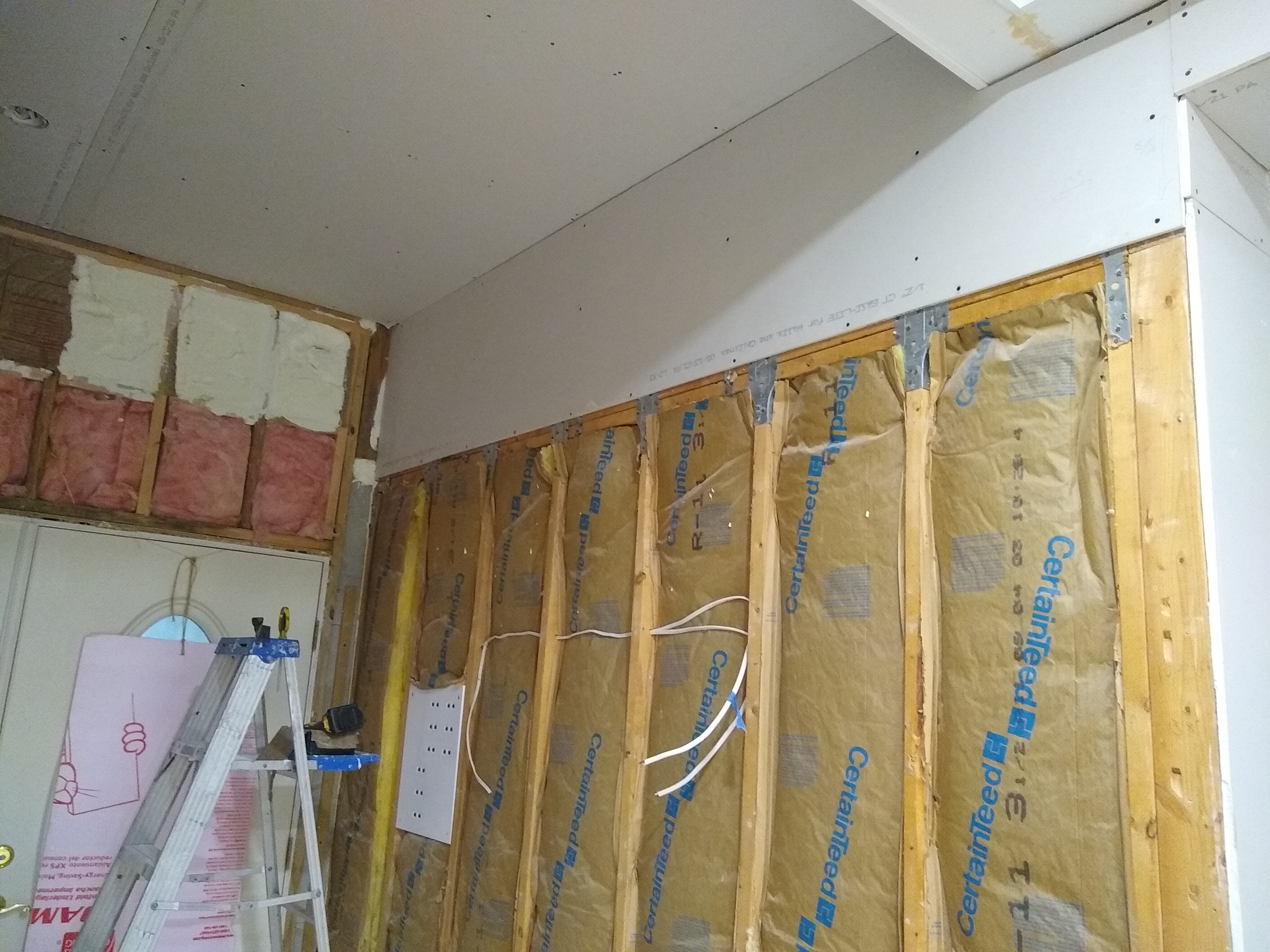
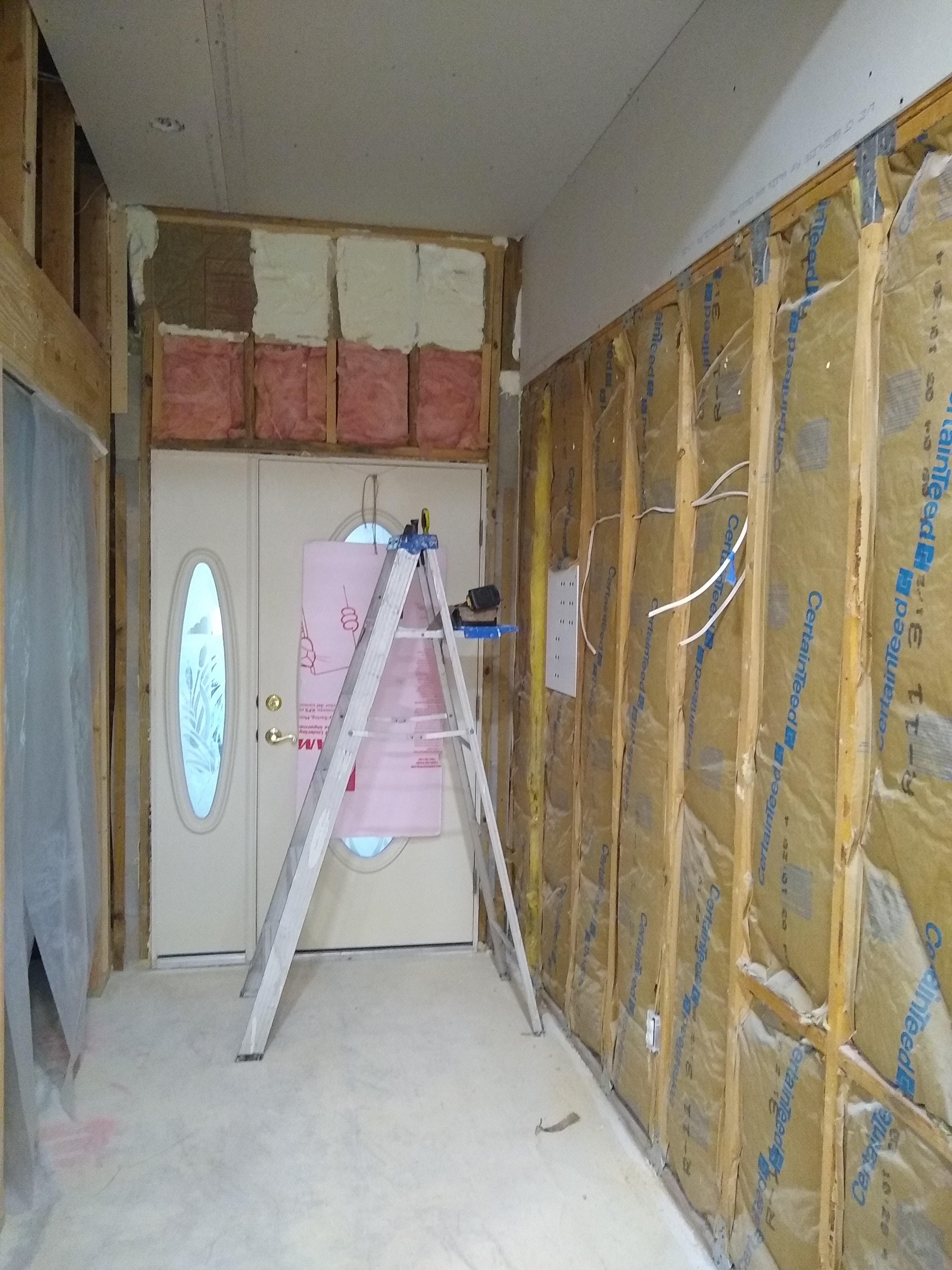
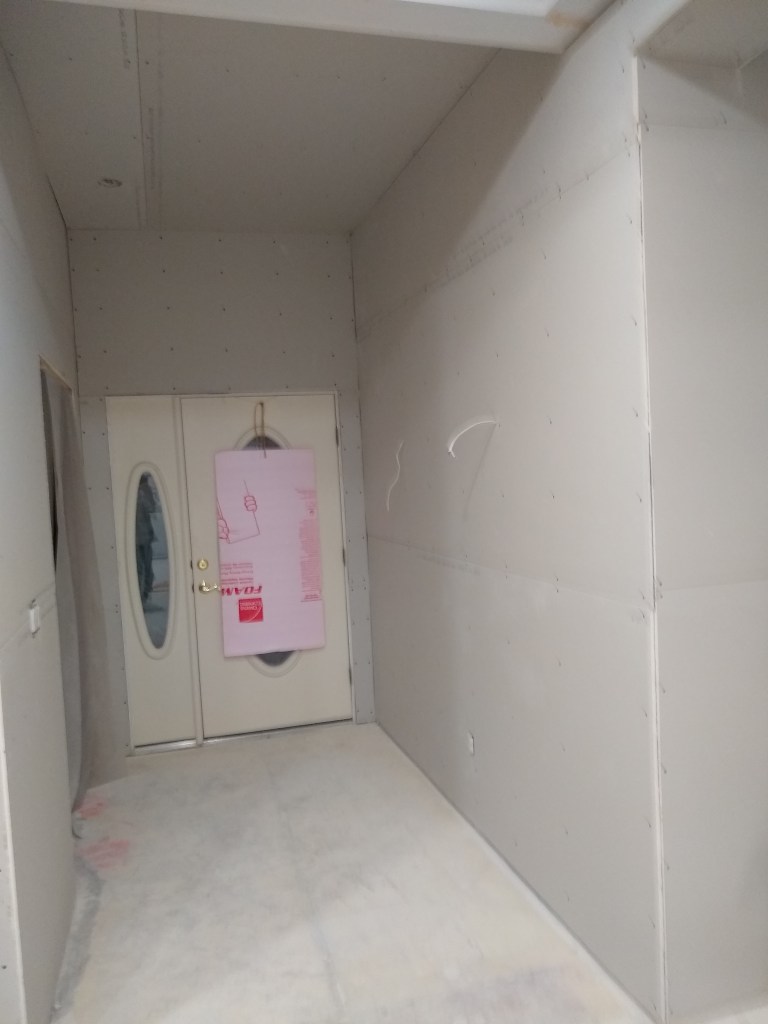
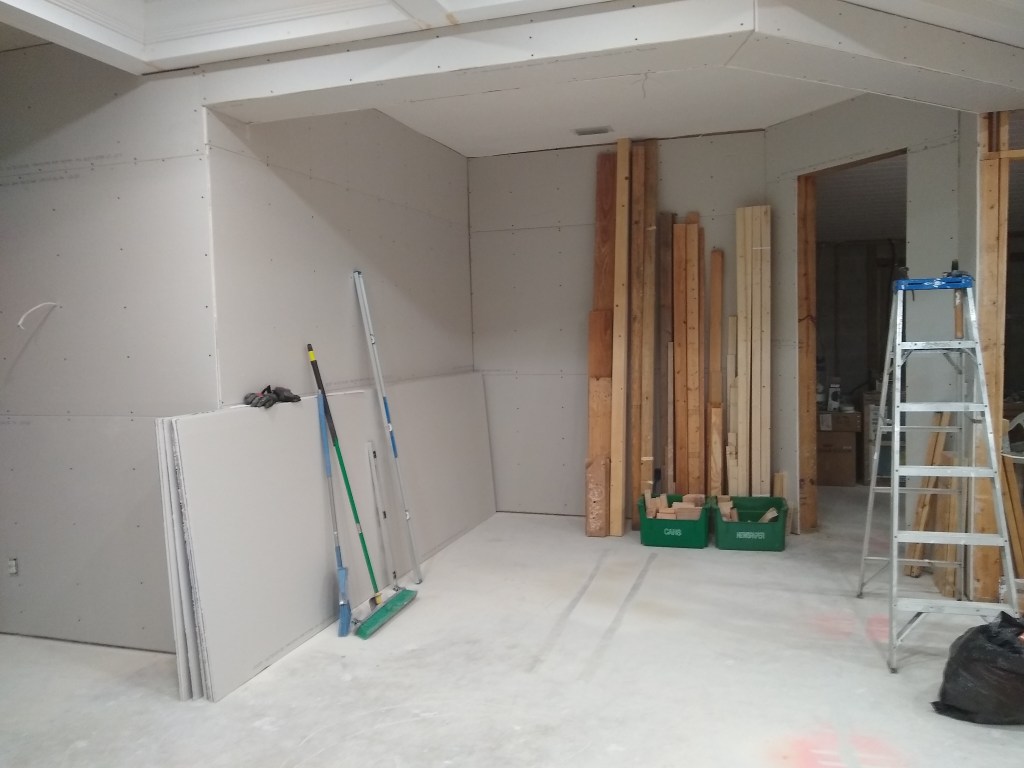
Page 2 of 2

Master Bedroom Drywall Finishing – March 2023

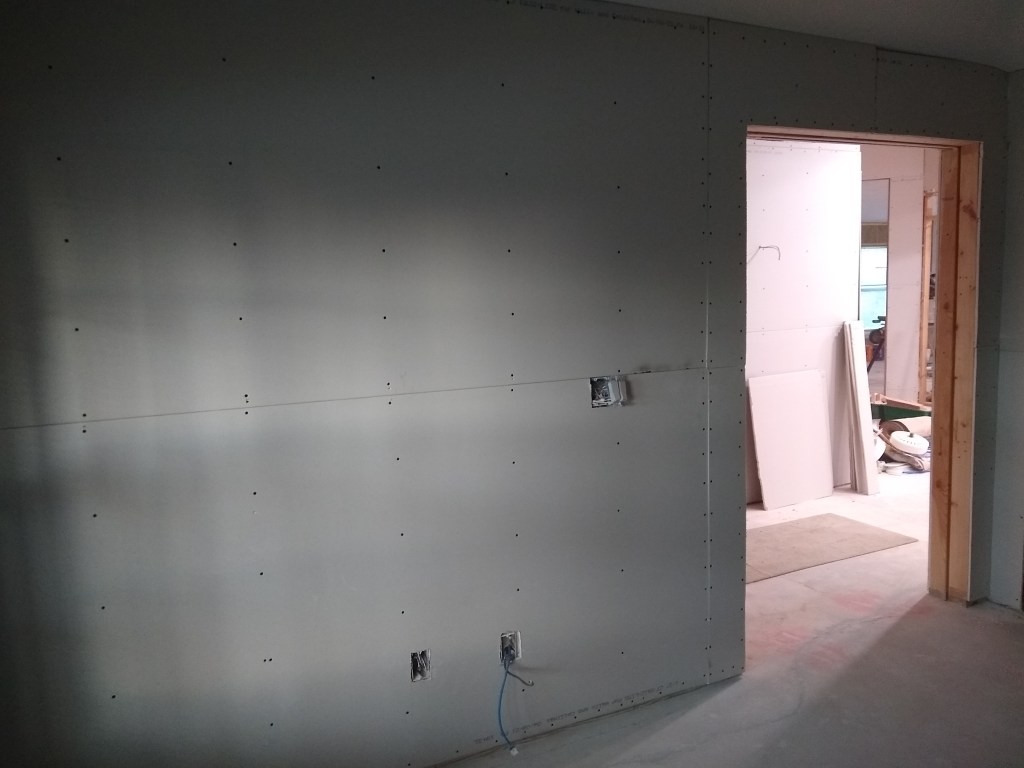
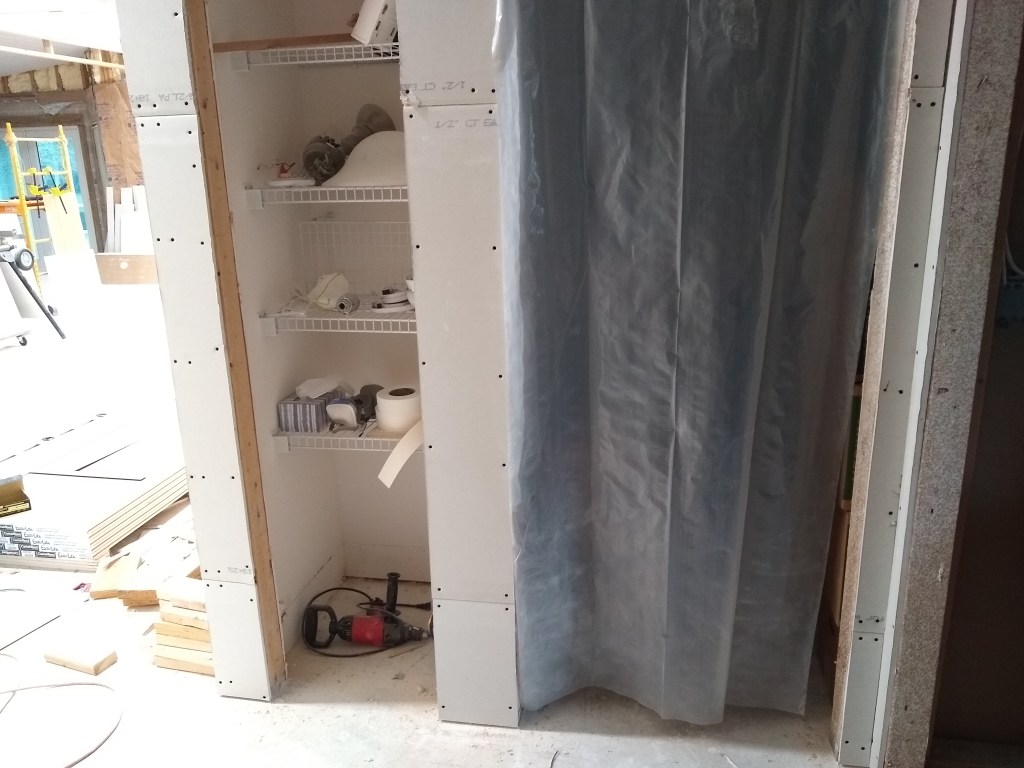
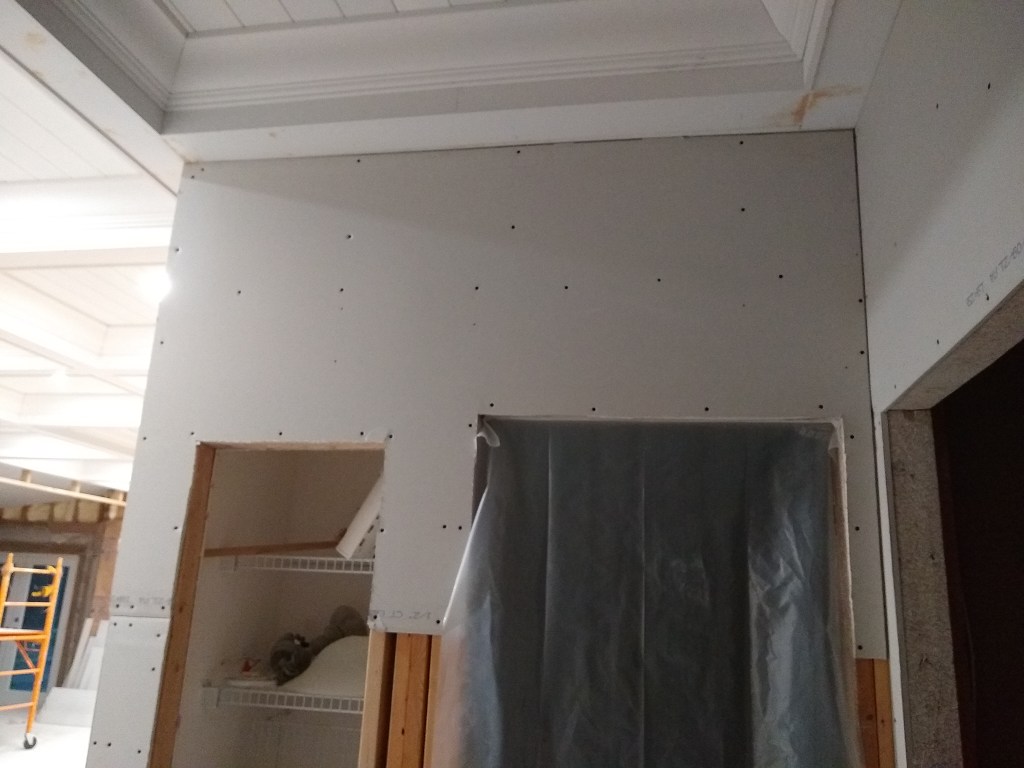
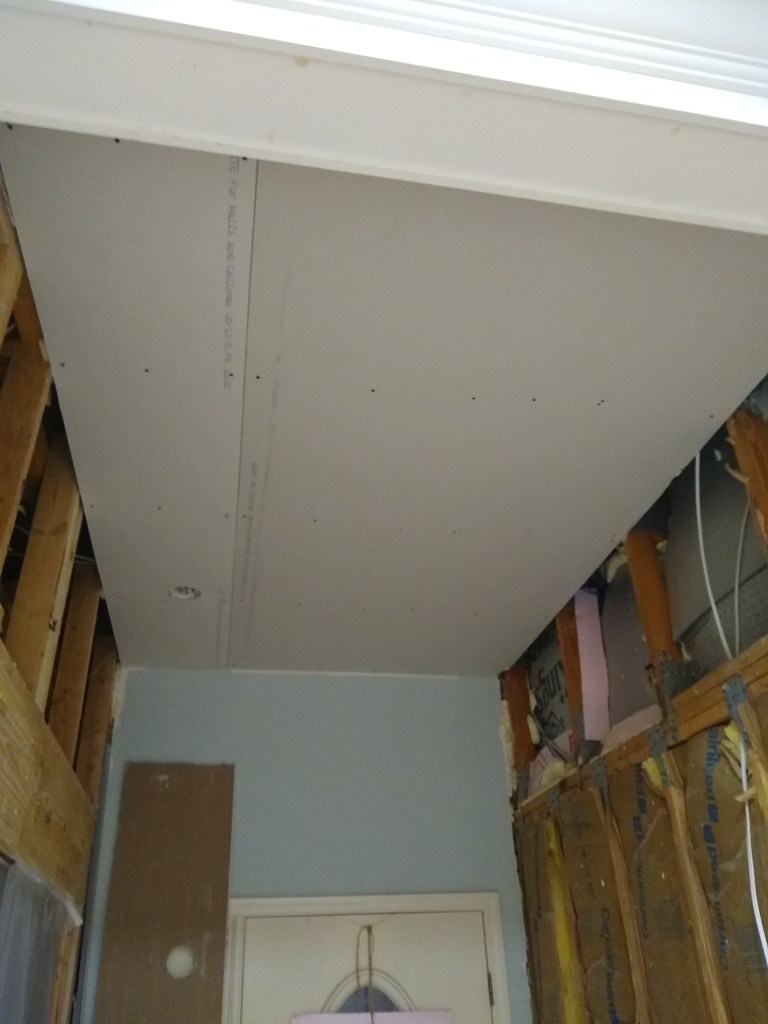
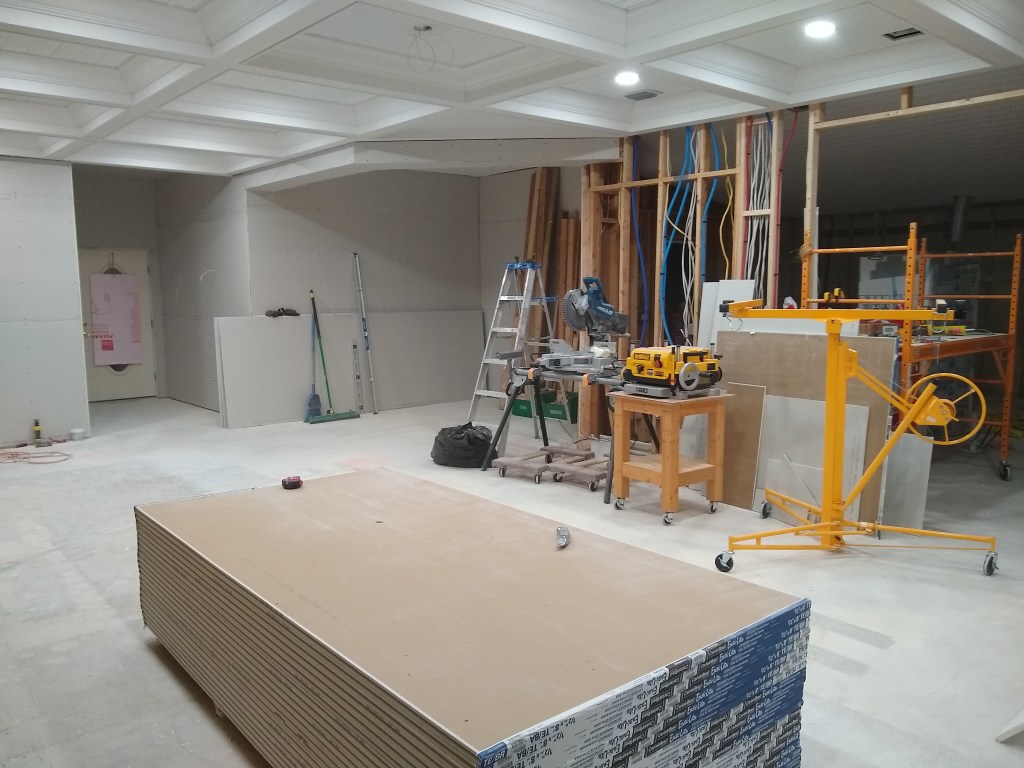
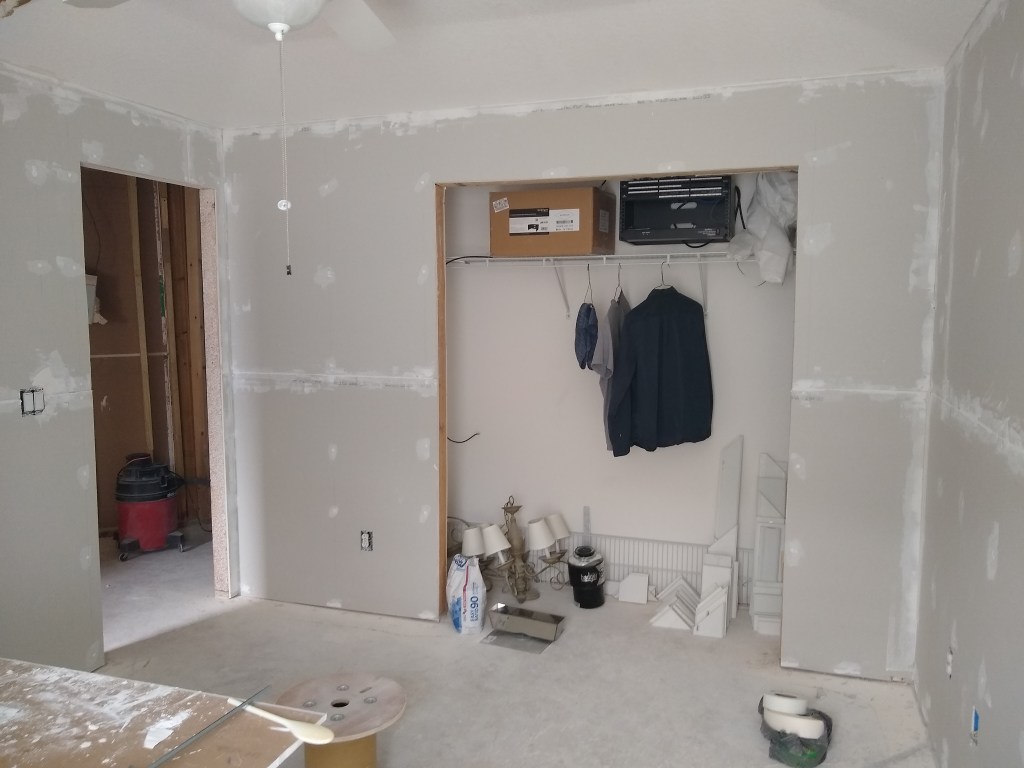
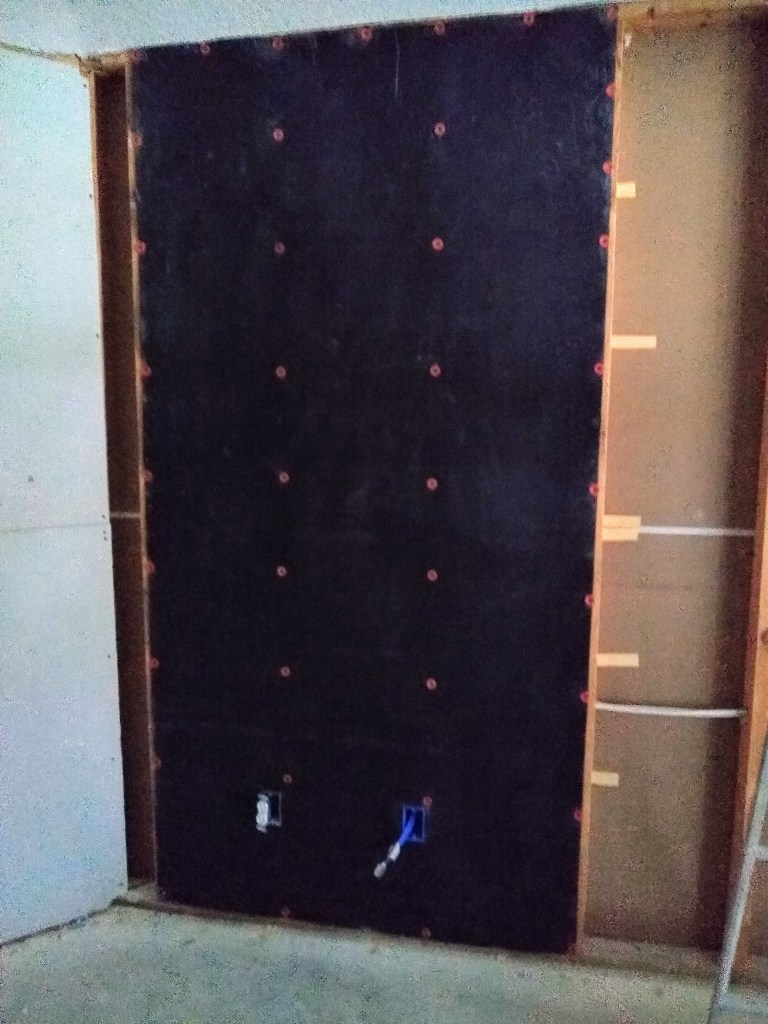
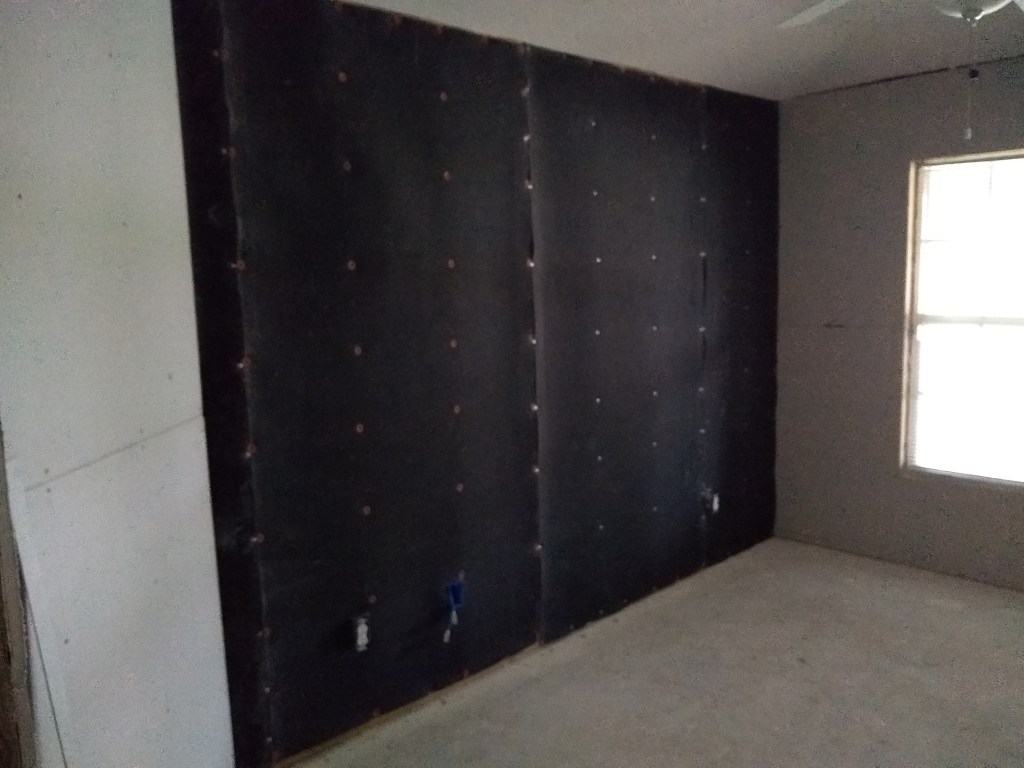
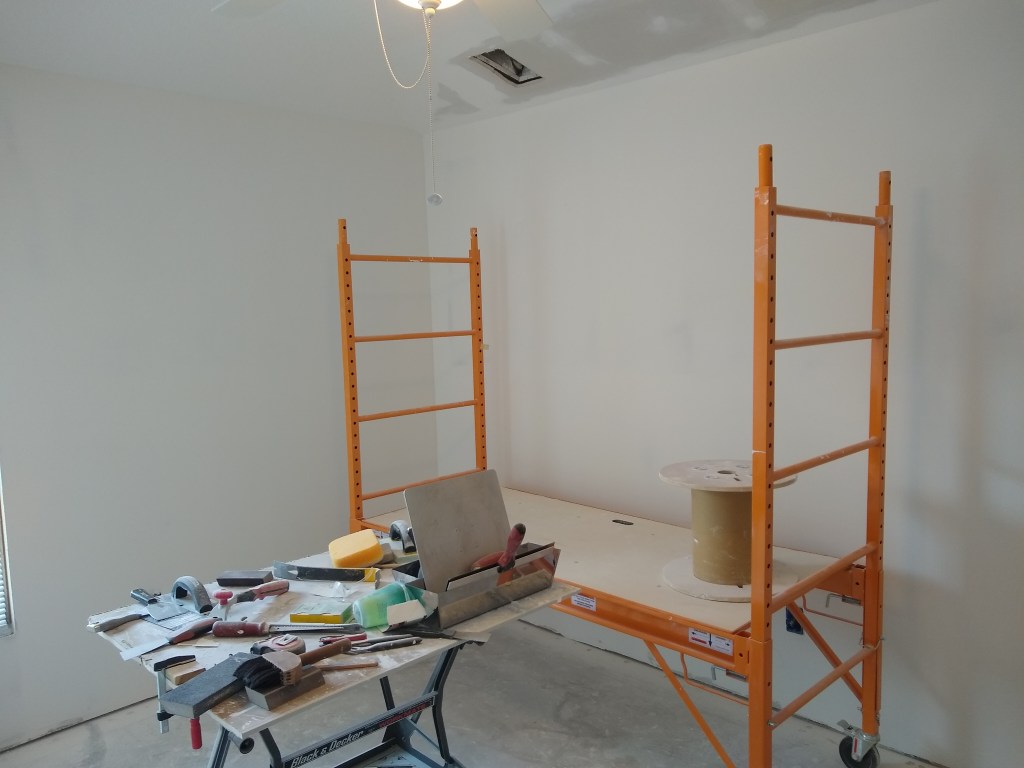
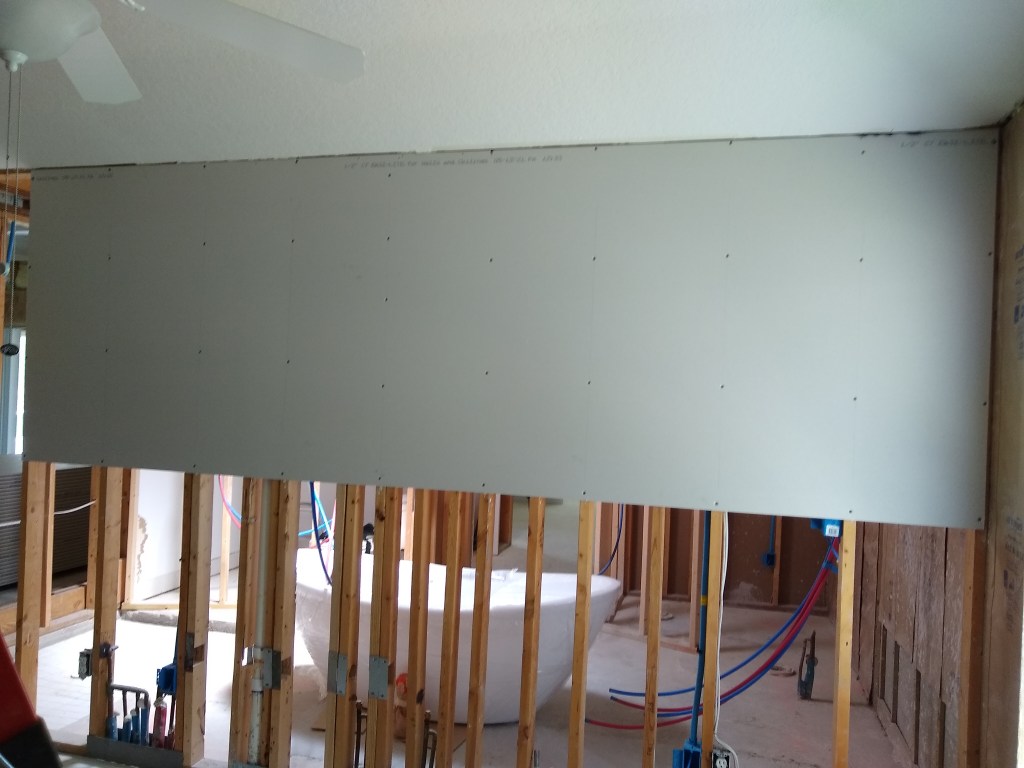
When I returned from a really fun mini-vacation in Mexico, I arranged to have an inspection of the drywall I recently hung in the master bedroom and workshop so I could move forward with those walls. The inspector not only approved them, but could see that I was doing a thorough job, so gave me a drywall final approval, meaning that all the drywall was approved, even though I had not hung all of it. This was really great because it means that I no longer need further inspections when it comes to drywall. Of course, there will be many other inspections to come, but I have a lot of drywall work ahead of me, so it’s nice that I don’t have to bring an inspector in for that part.

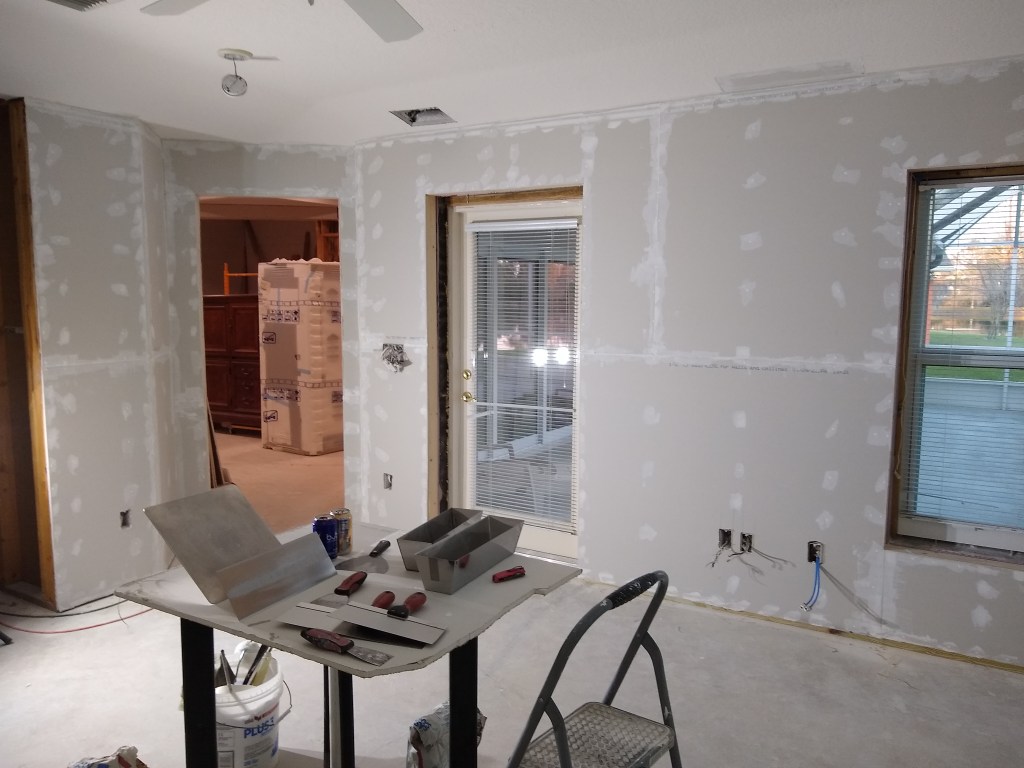
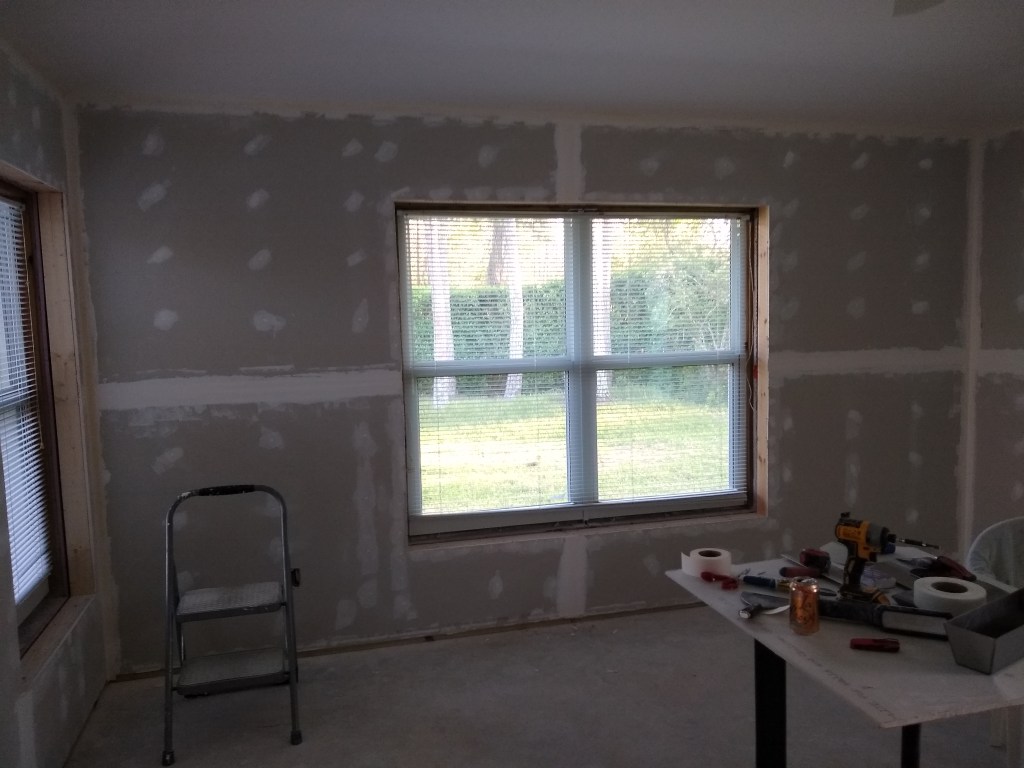
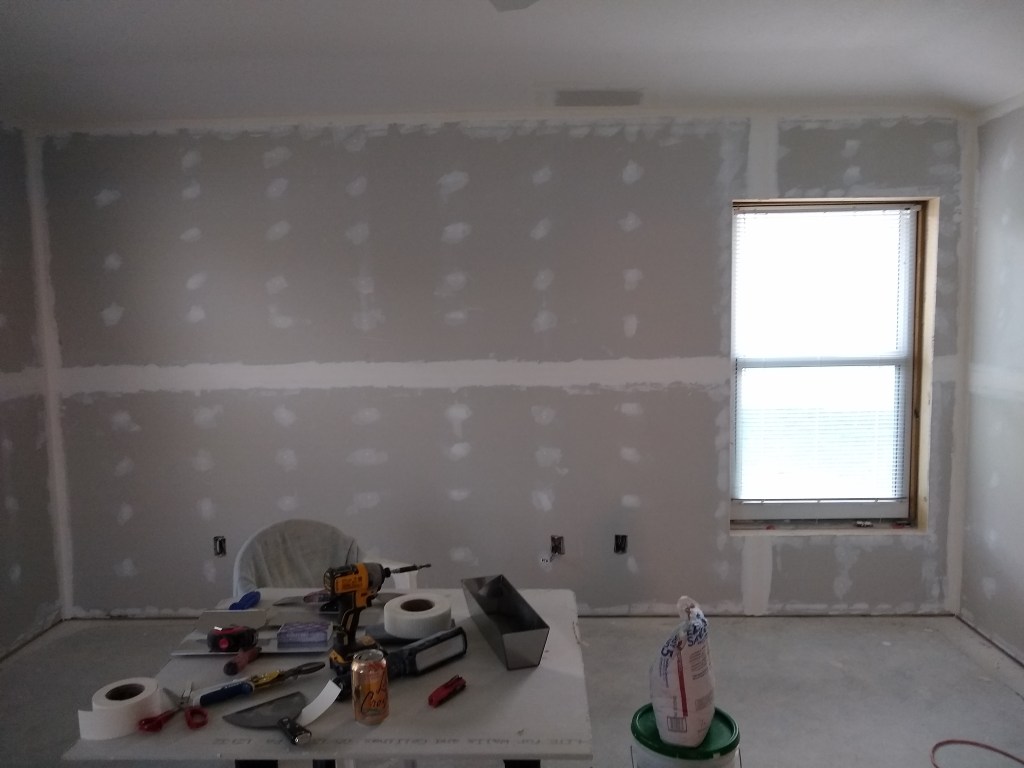
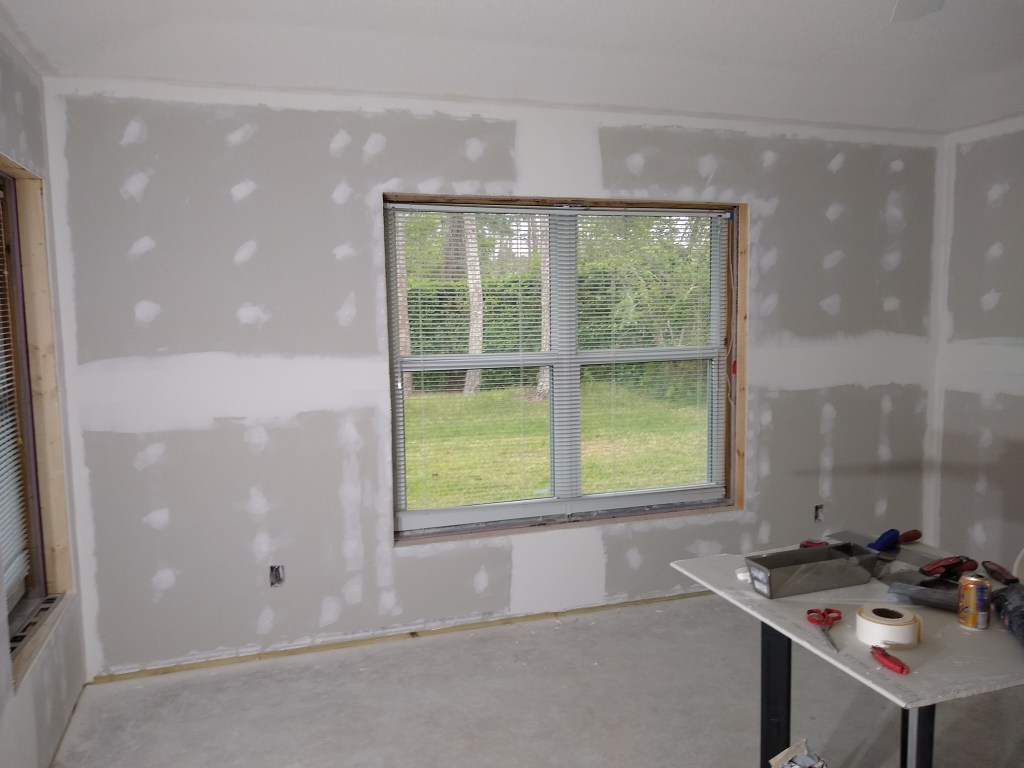
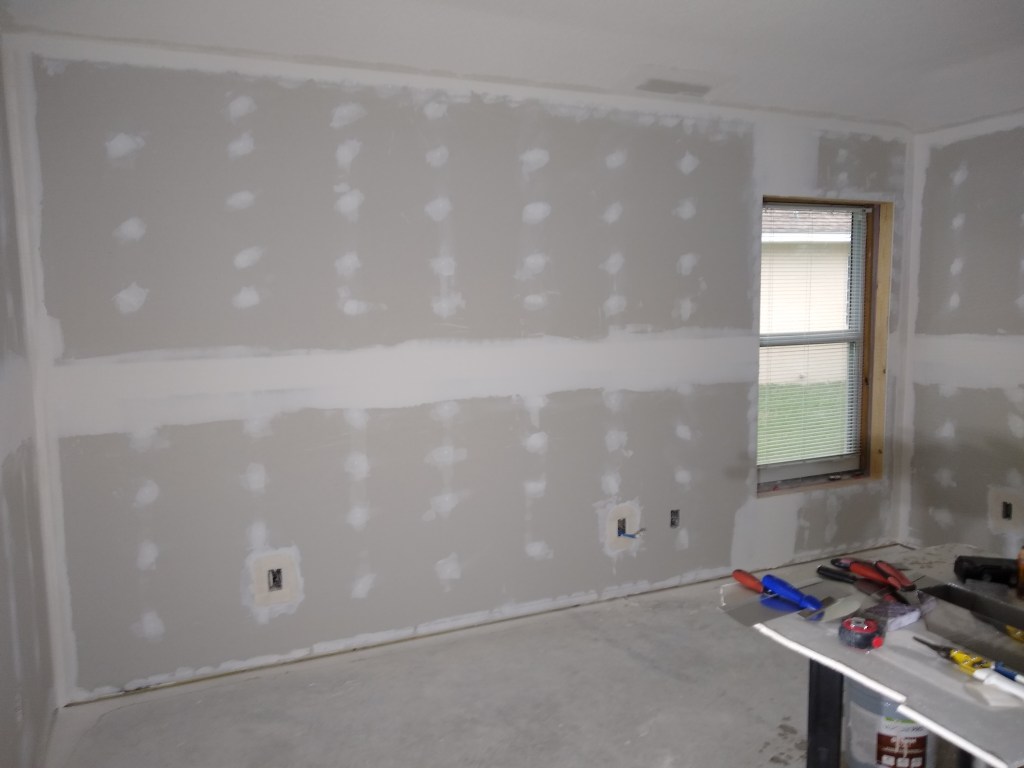
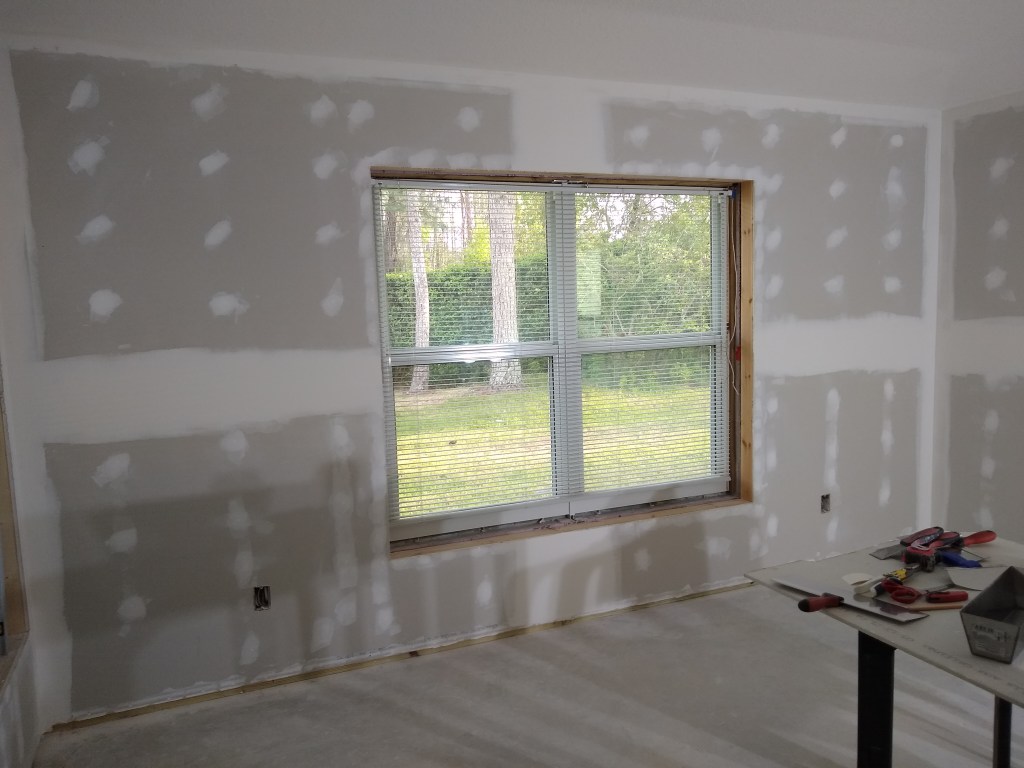
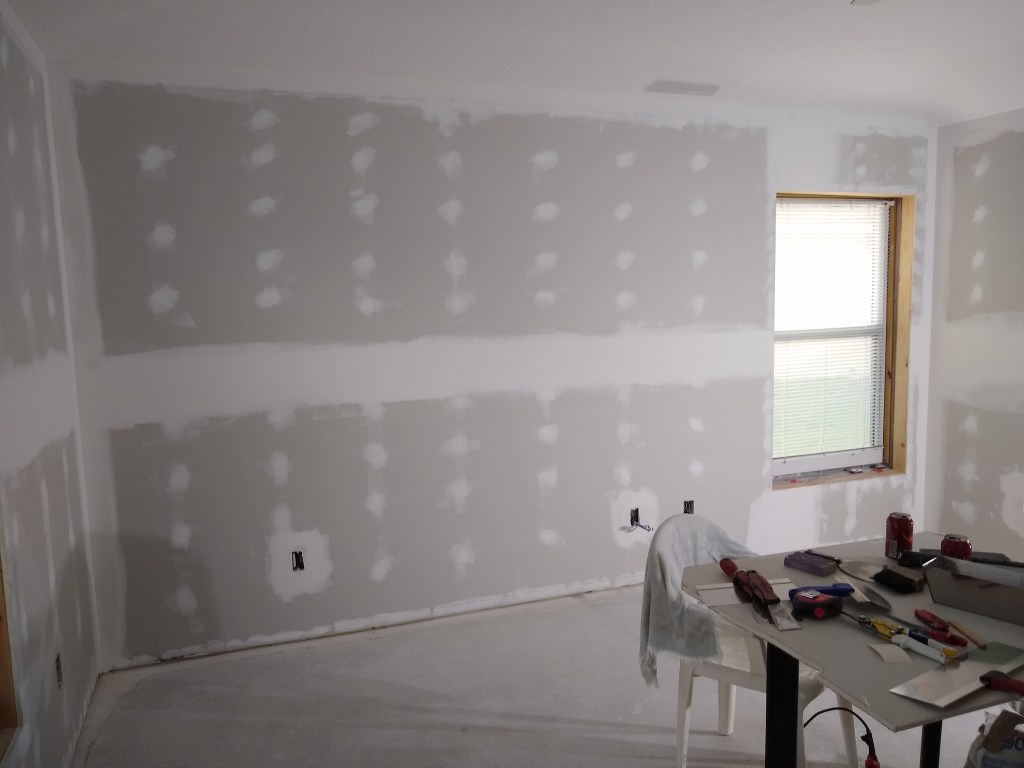
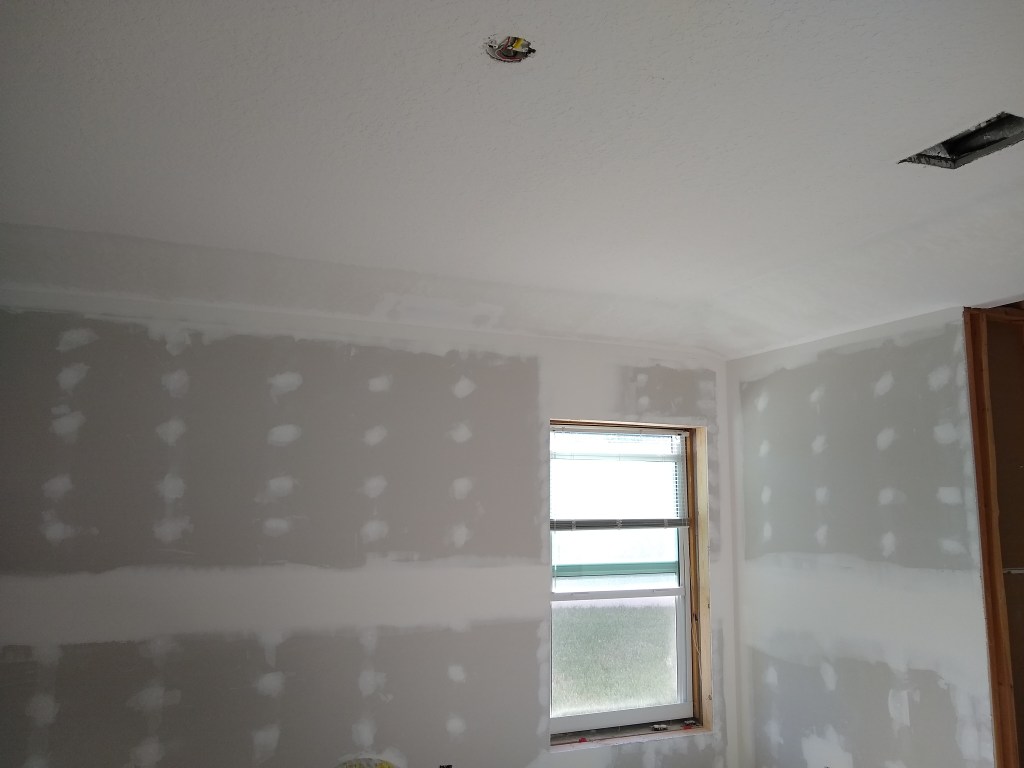
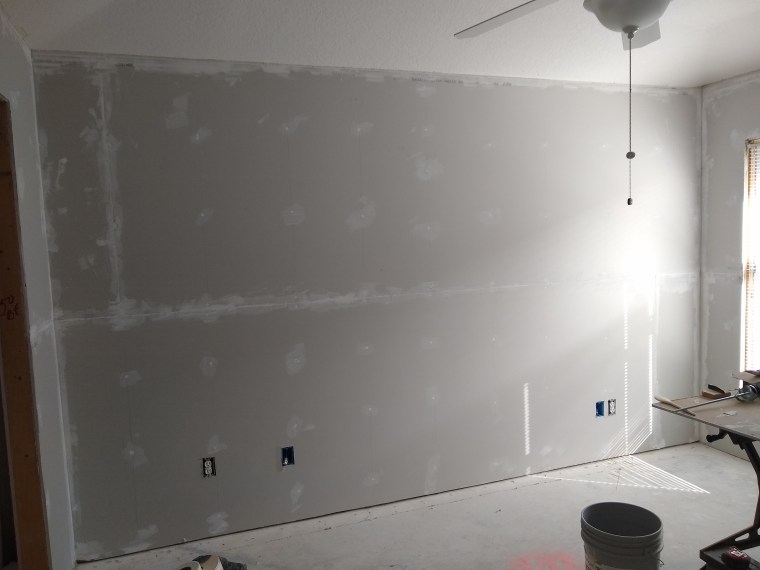
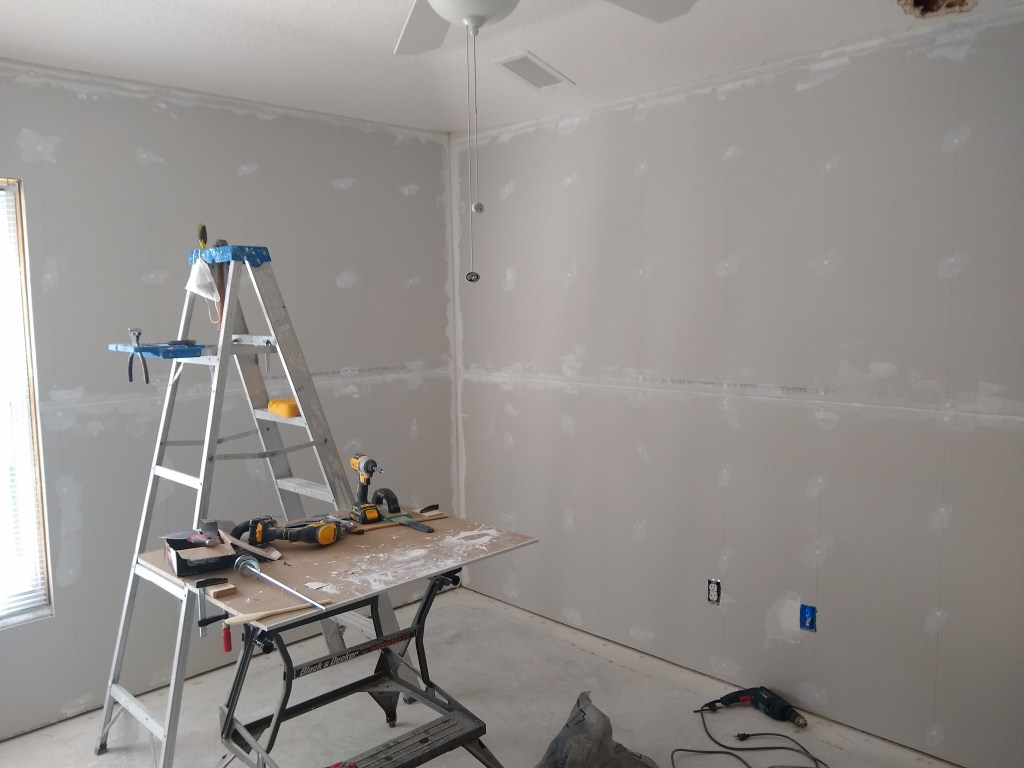
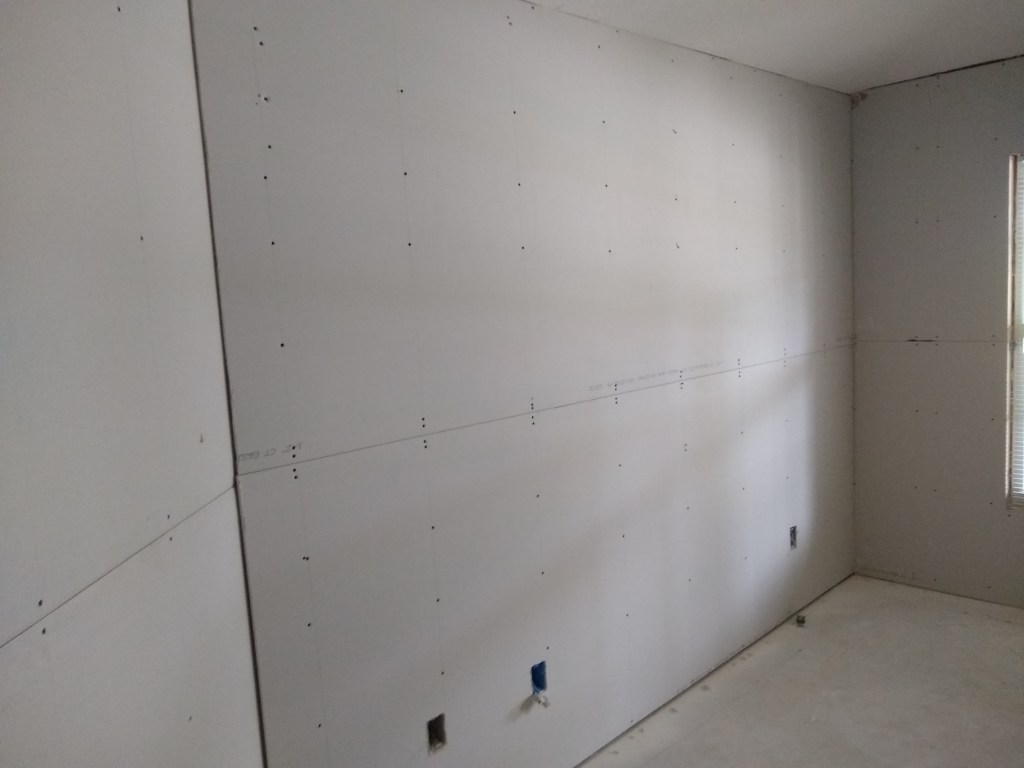
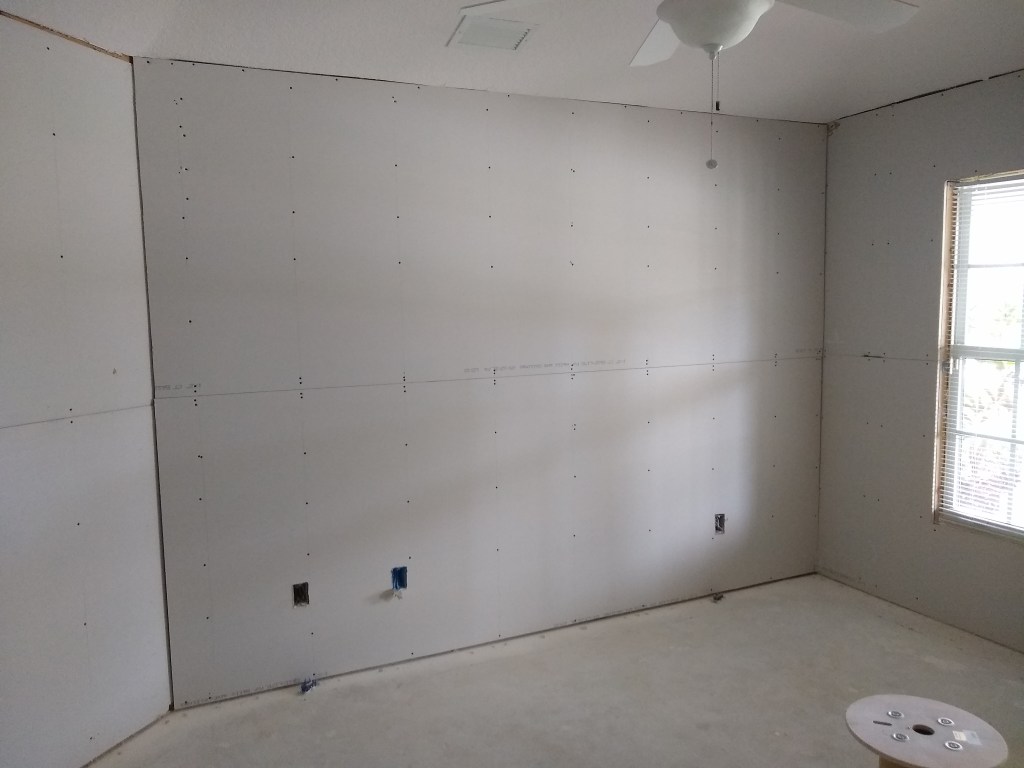
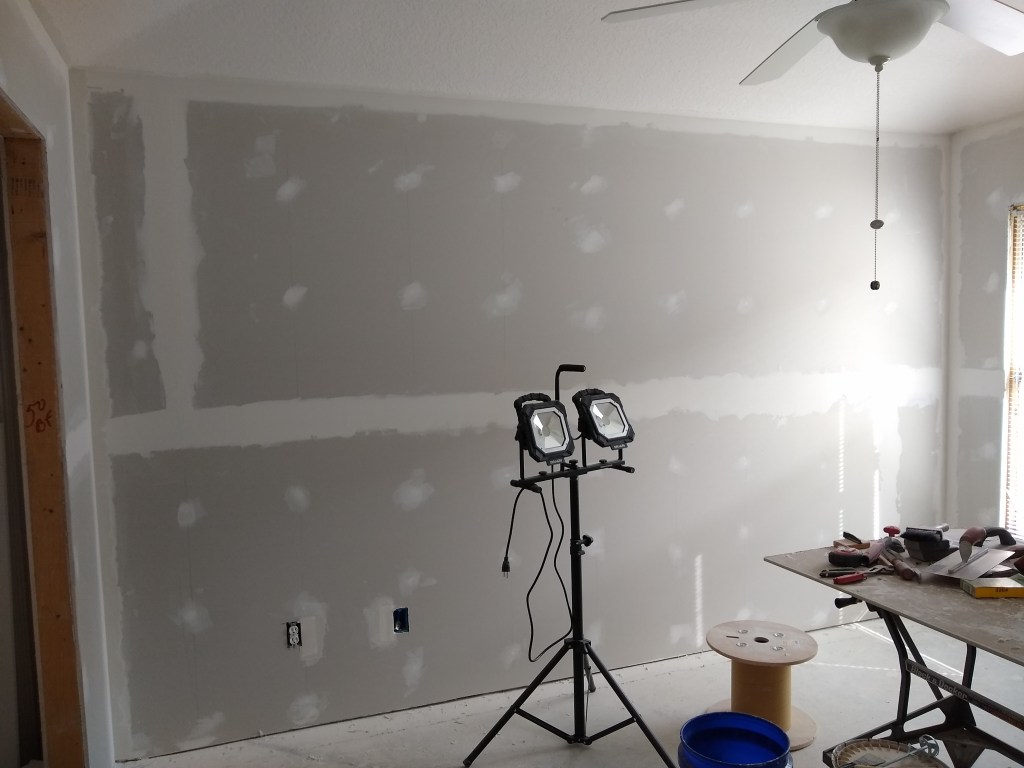
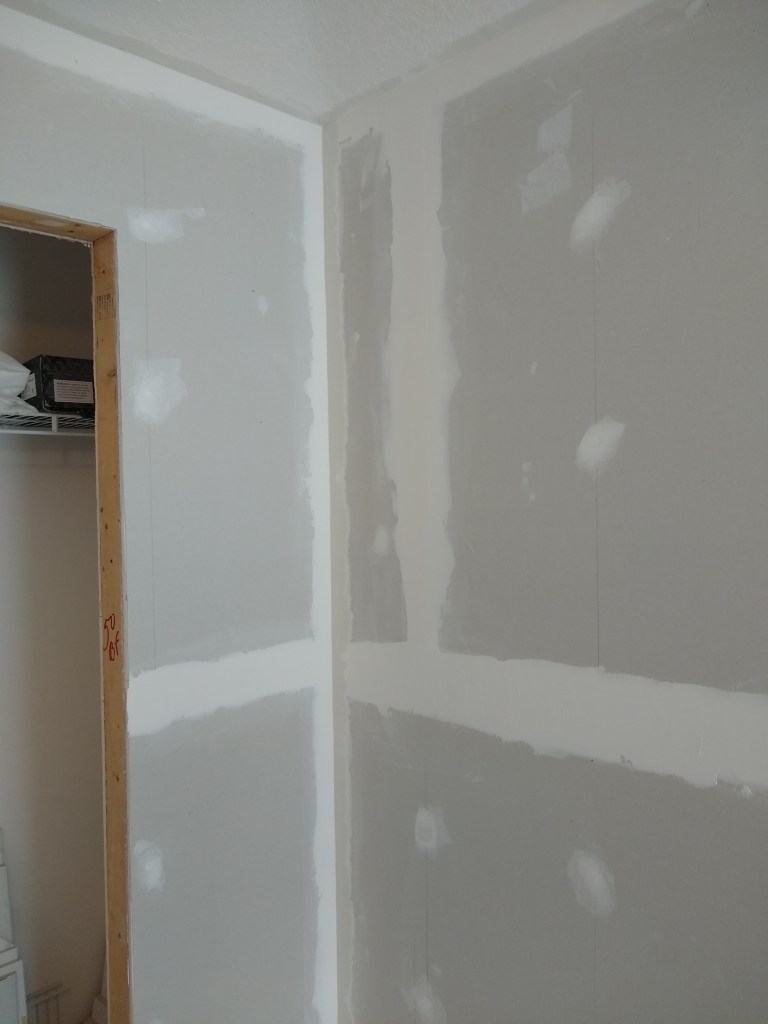
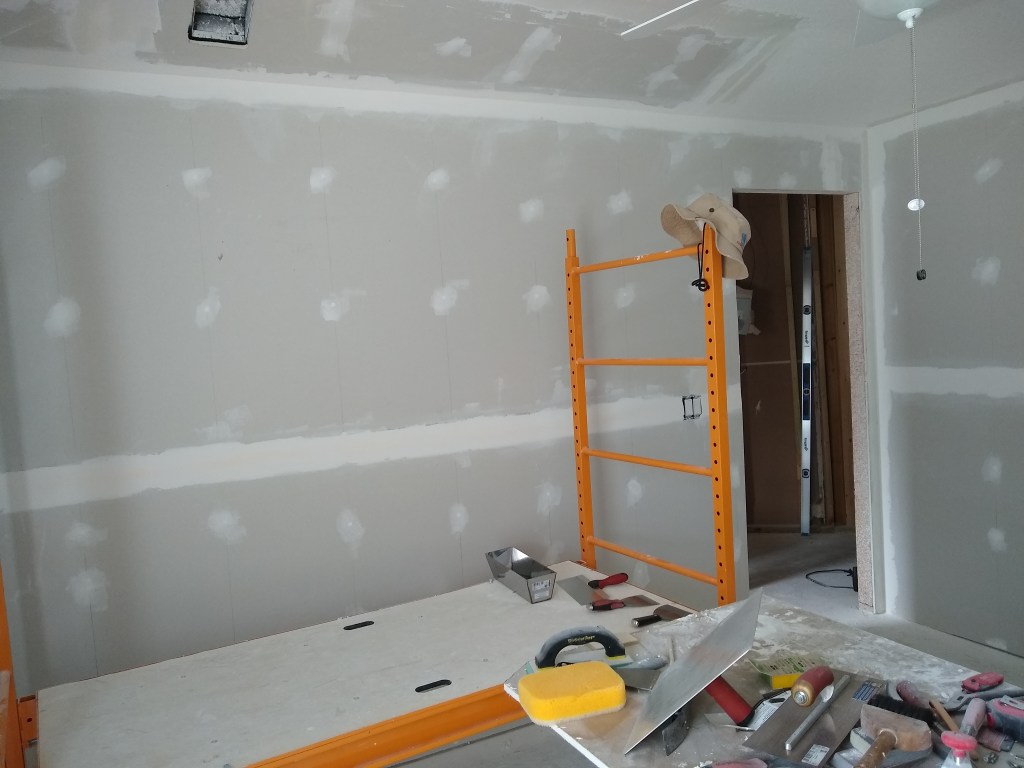
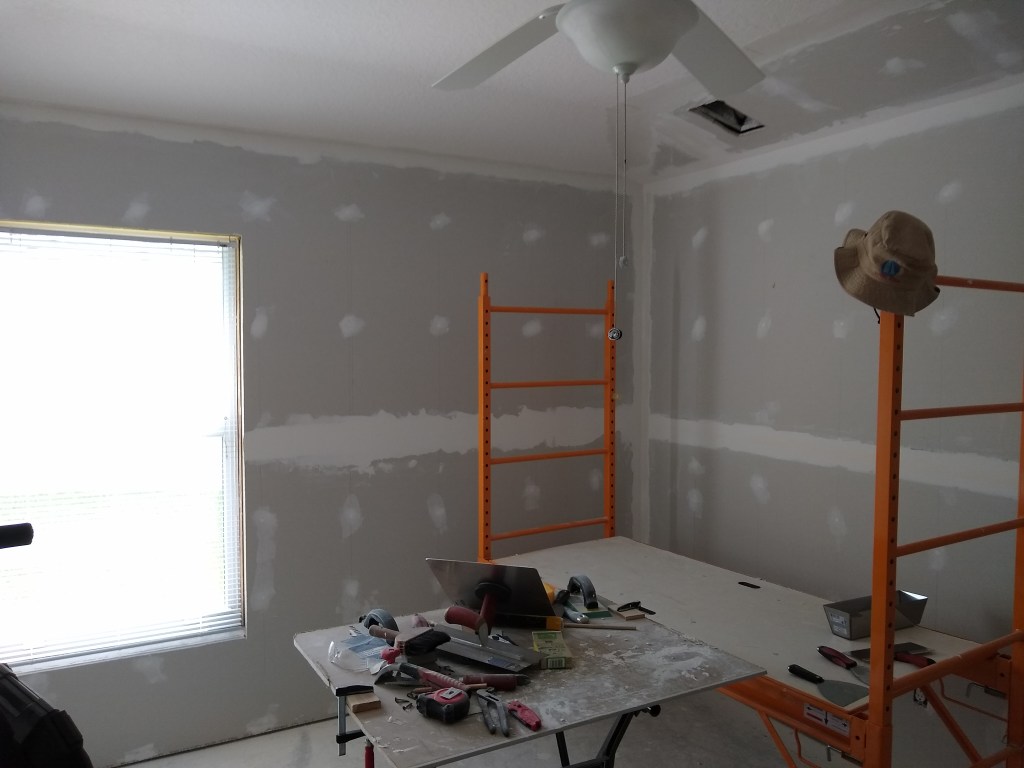
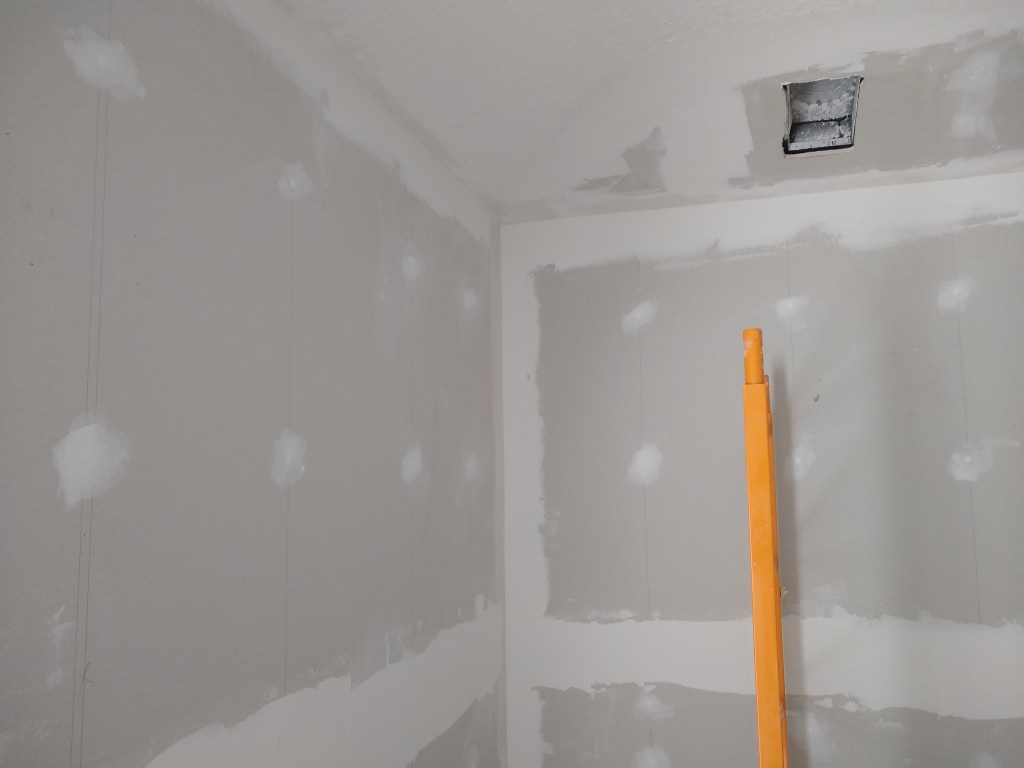
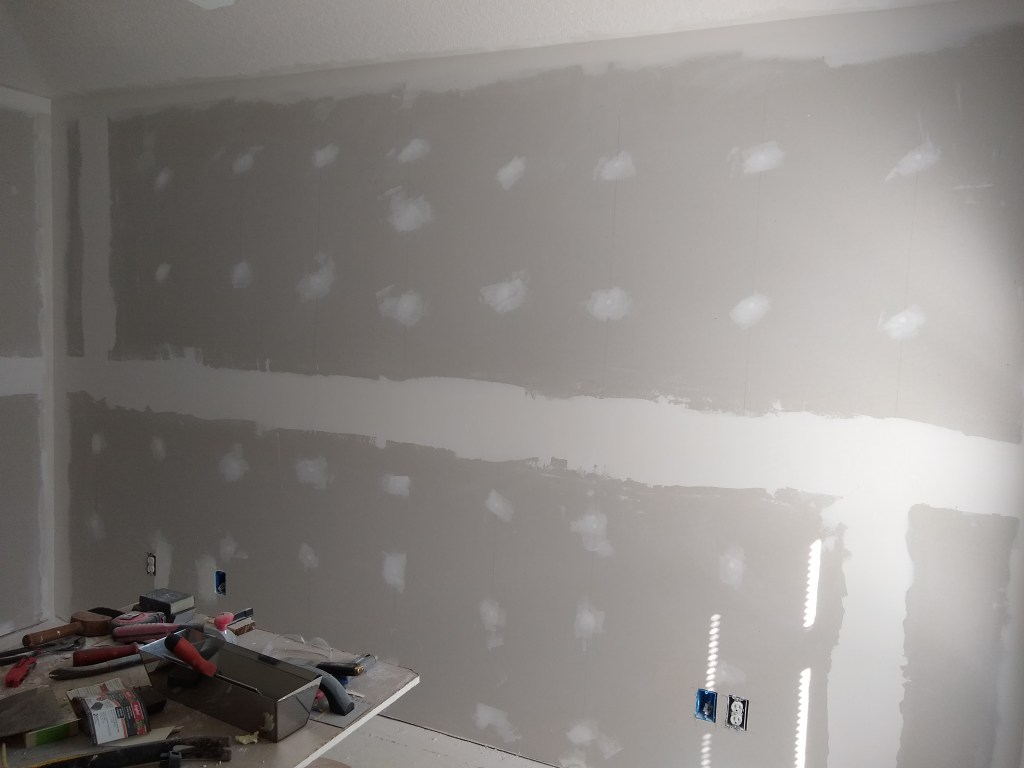
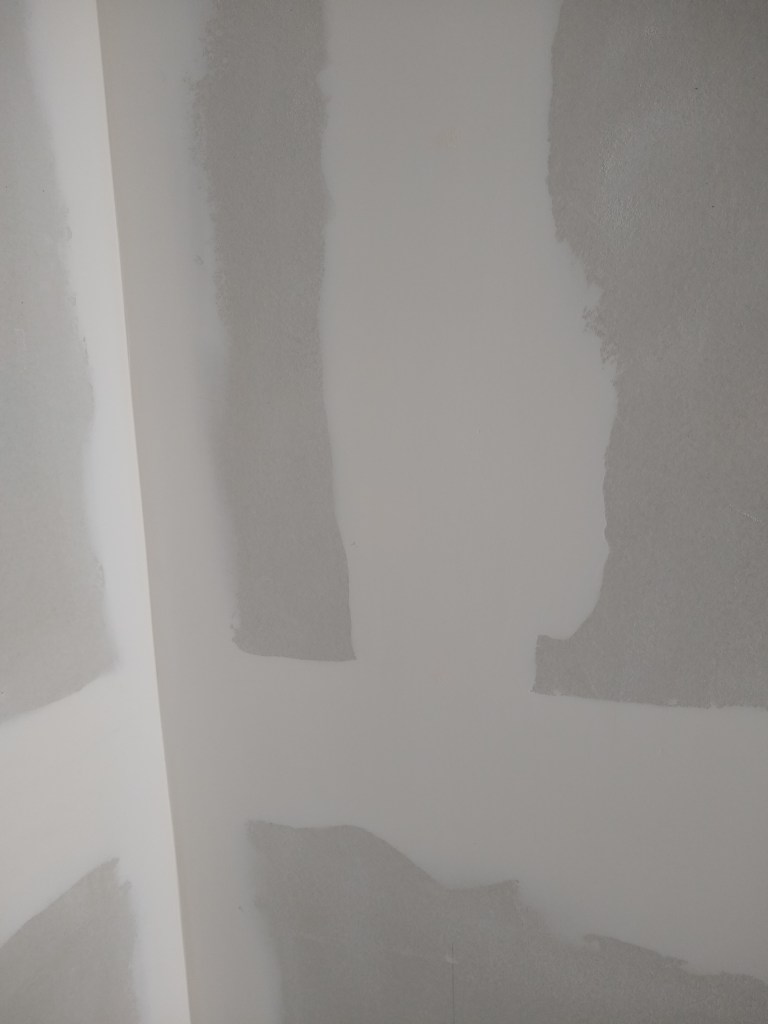
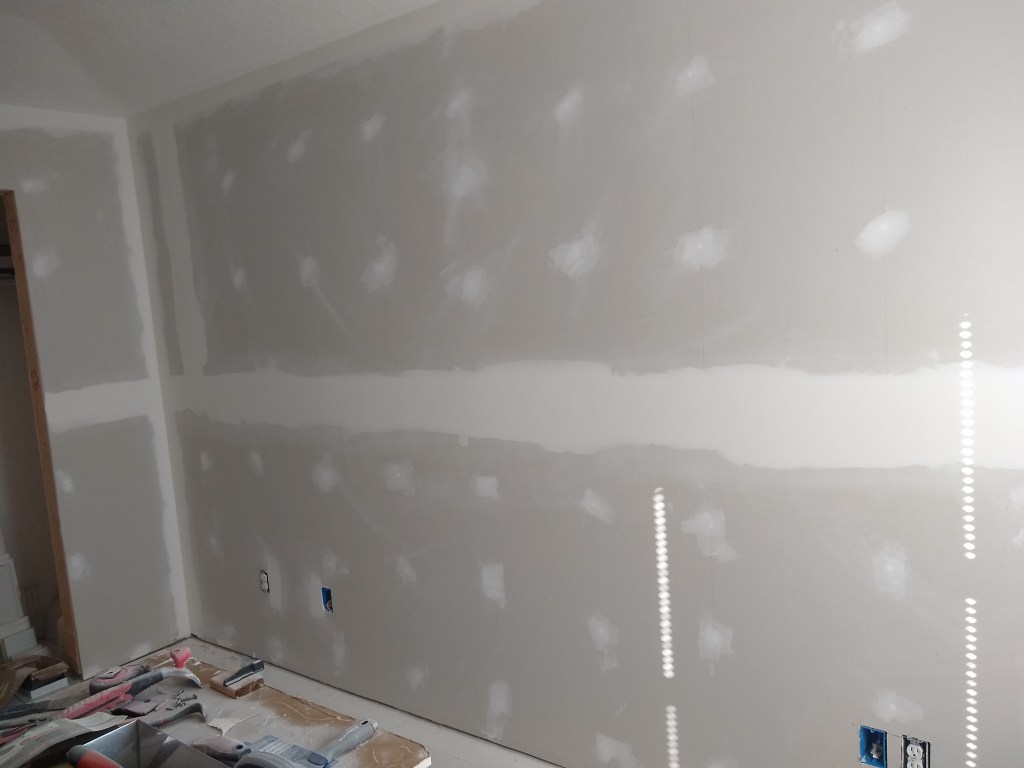
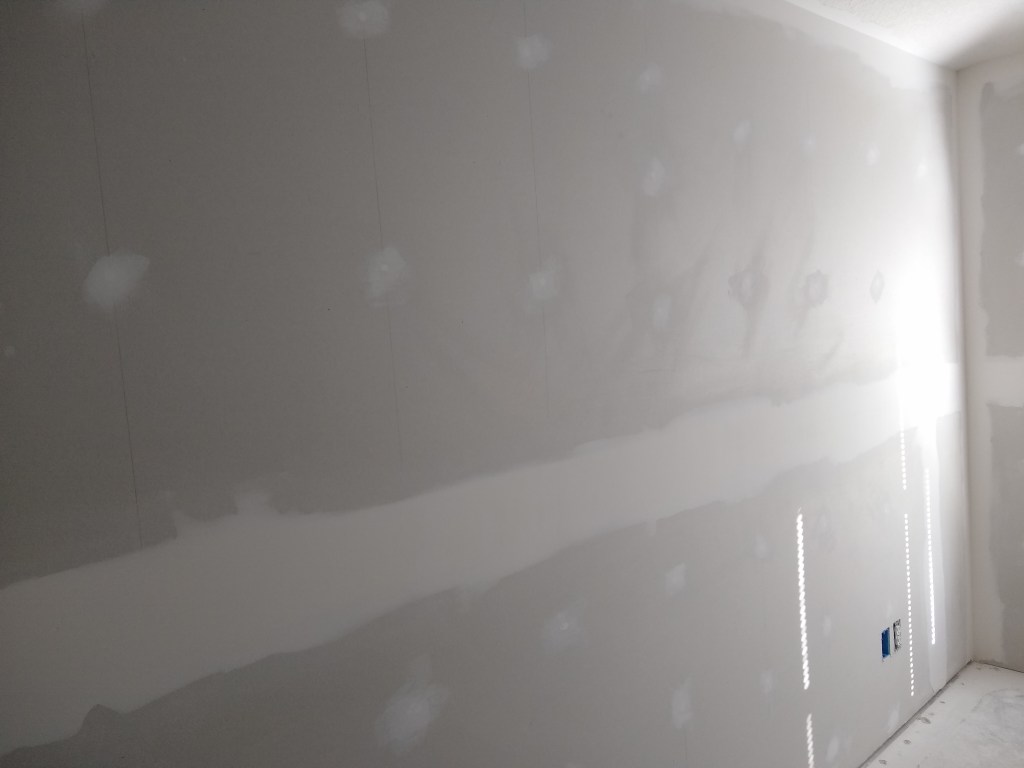
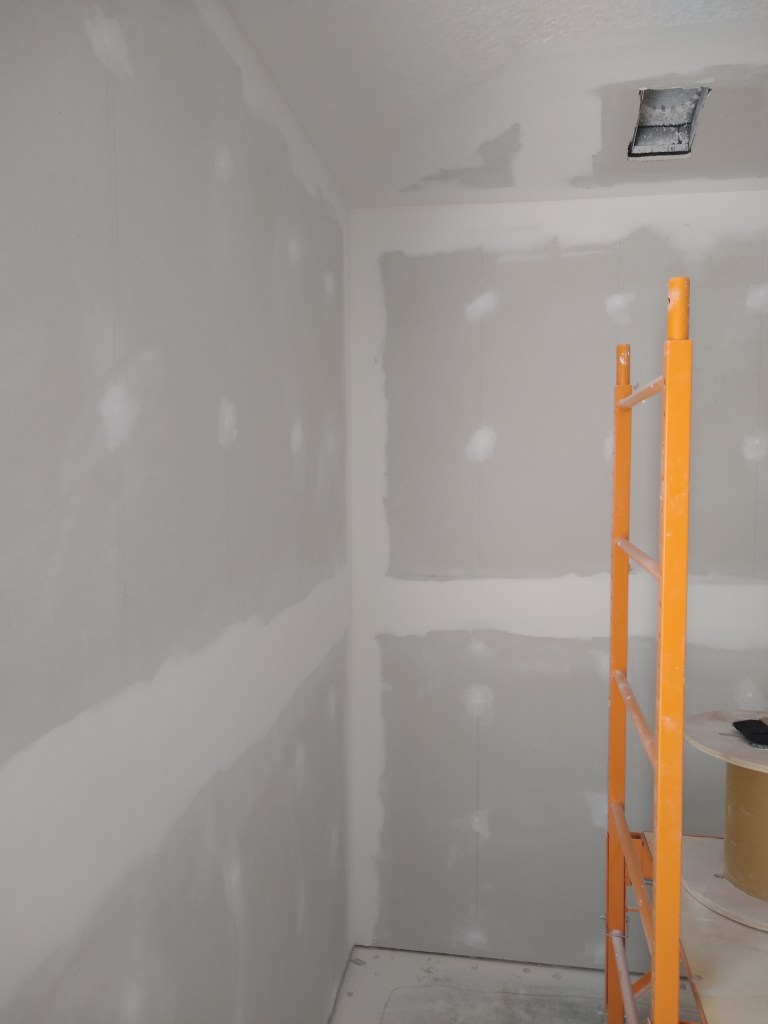
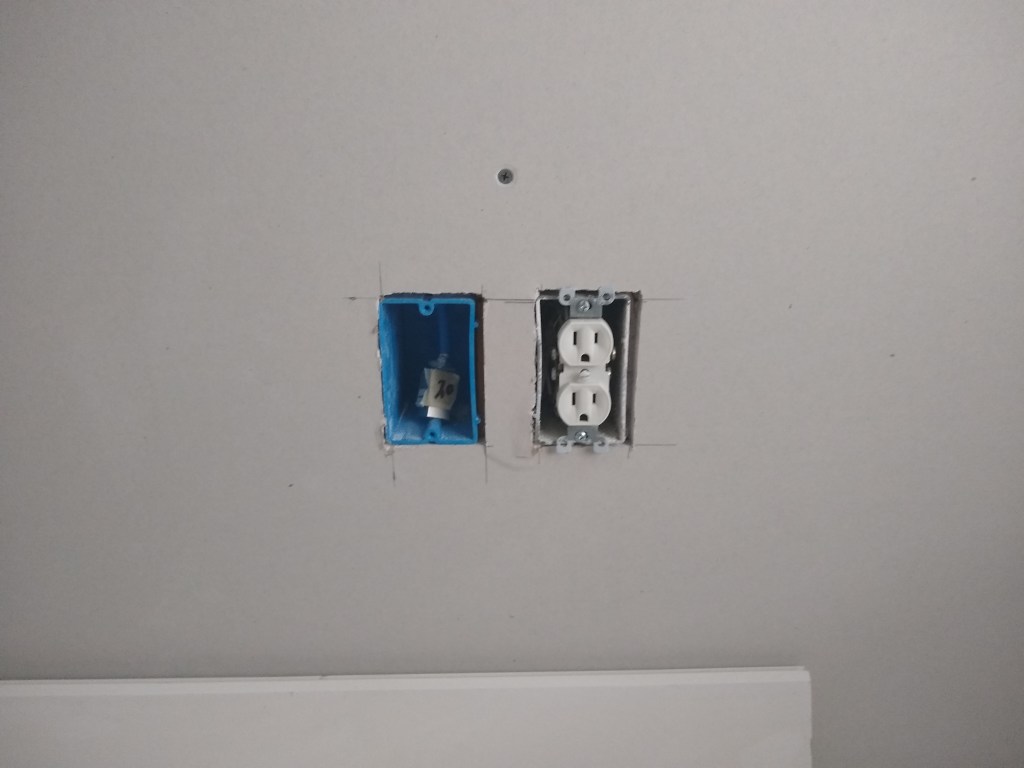
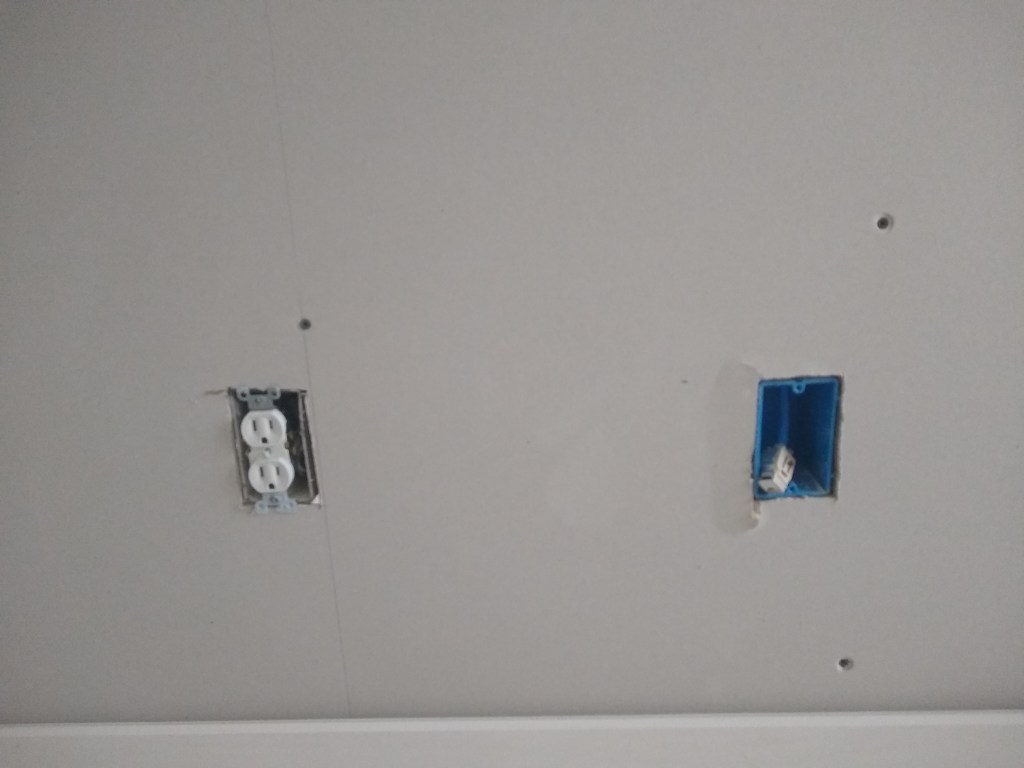
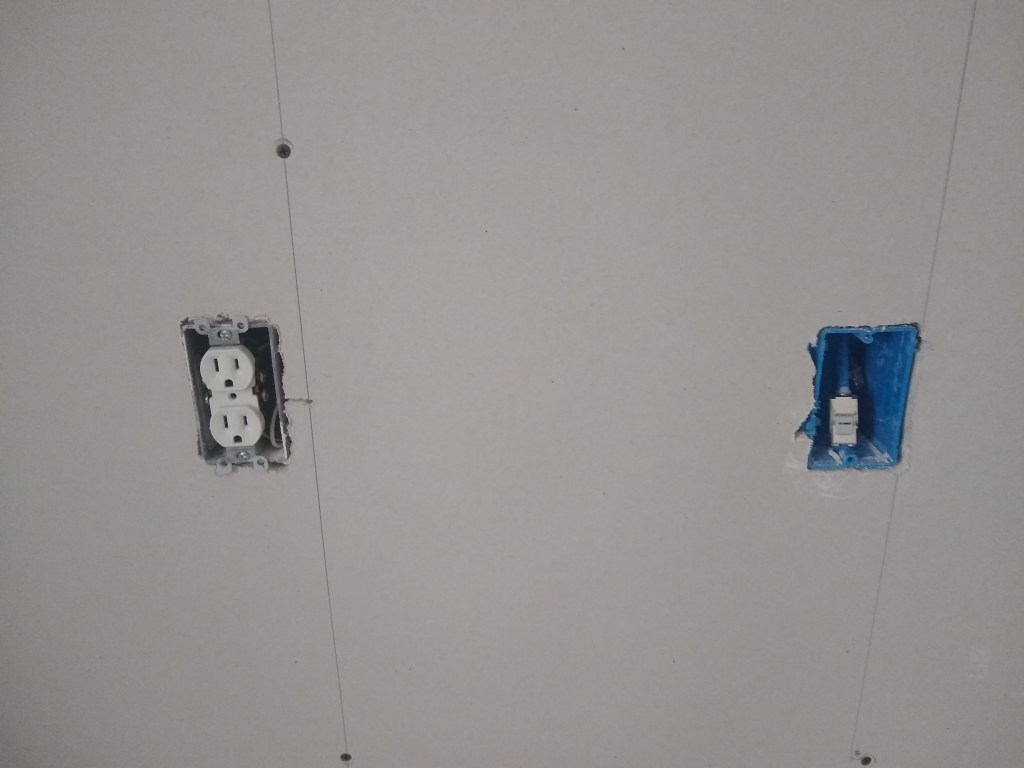
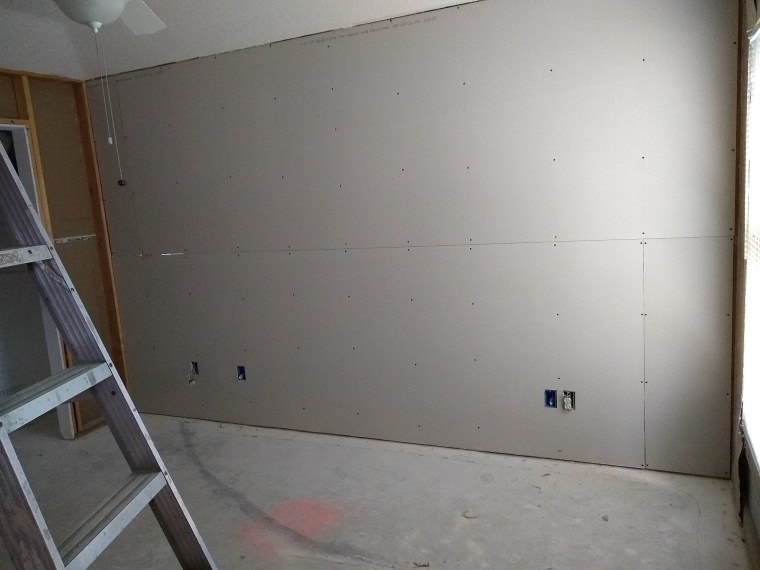
After the approval, I got right to prefilling the walls in the master bedroom, which involves adding a quick-set mud to all cracks and seems before taping. This mud has a hardening compound, so it dries very hard. I used a 90 minute quick-set mud, which means you get about 90 minutes to work with it before it becomes too stiff to manage. By prefilling, one hopes to reduce the likelihood of cracks developing down the road. In the interest of speed, the prefill phase is often skipped.

I also used the quick-set mud I had remaining after the prefill to cover the screws. The screws will receive several coats, but the first one will be with the quick-set mud. Subsequent coats will be with whatever mud I am using.

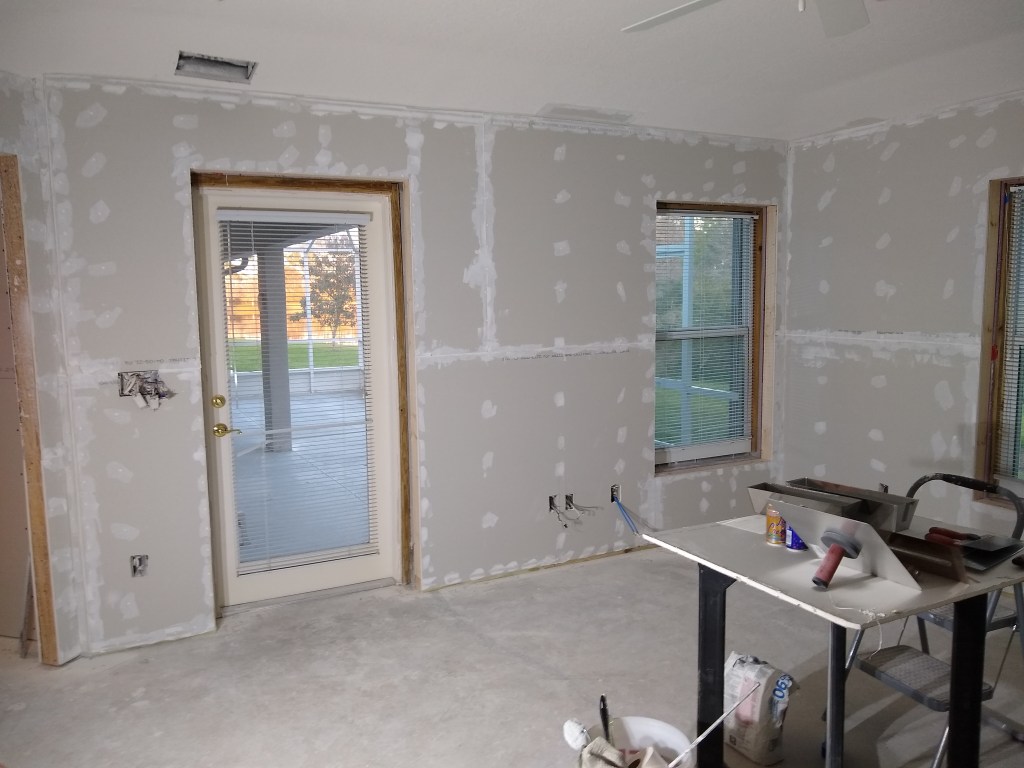
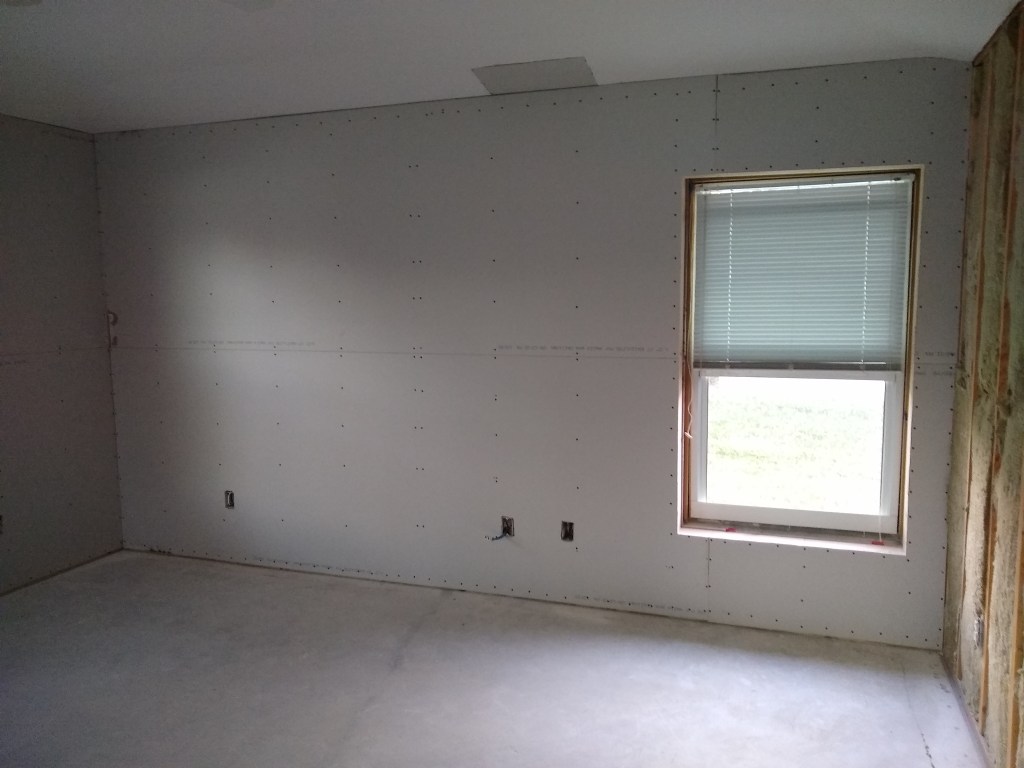
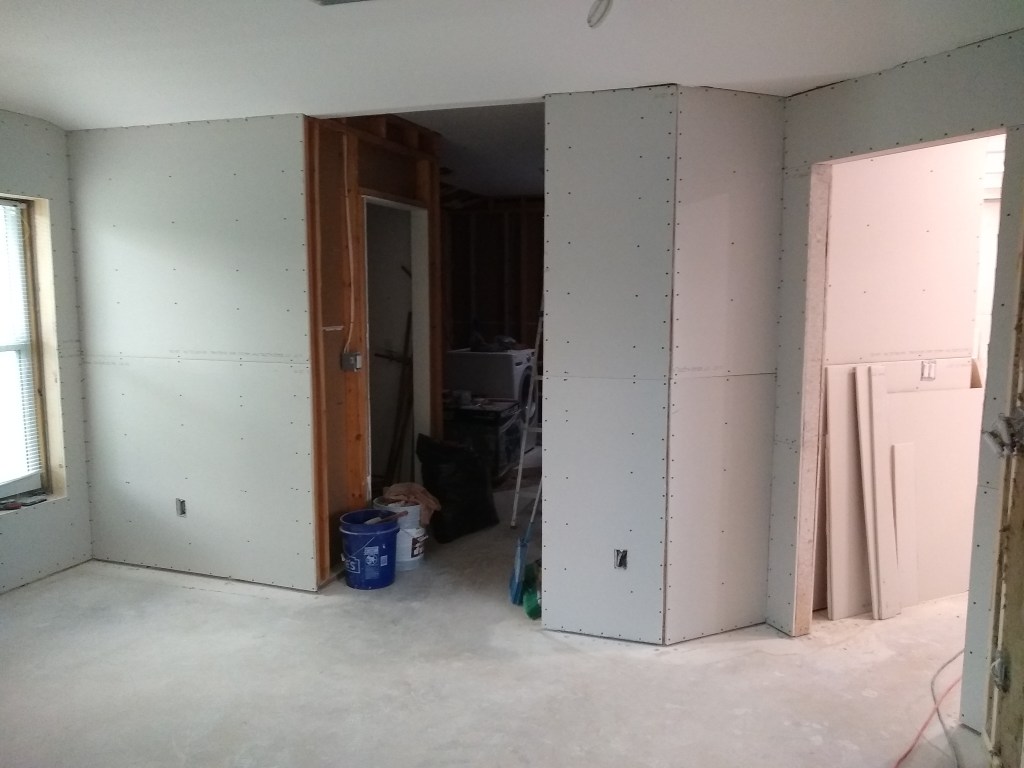
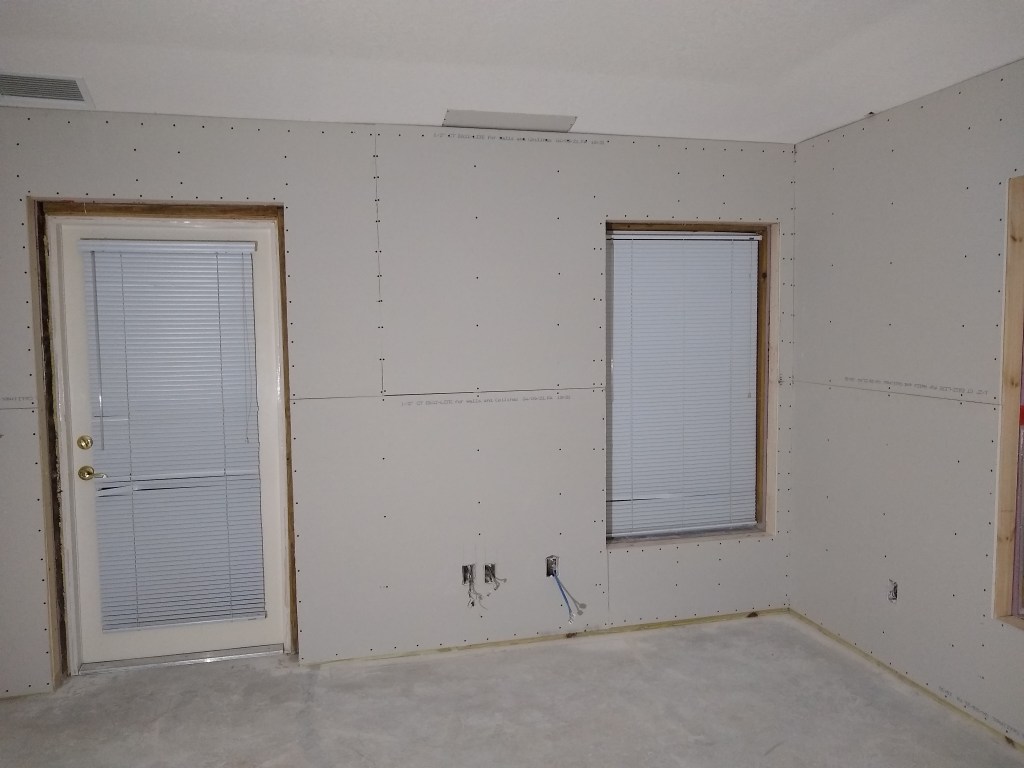
South Wall Prefilled
East Wall Prefilled

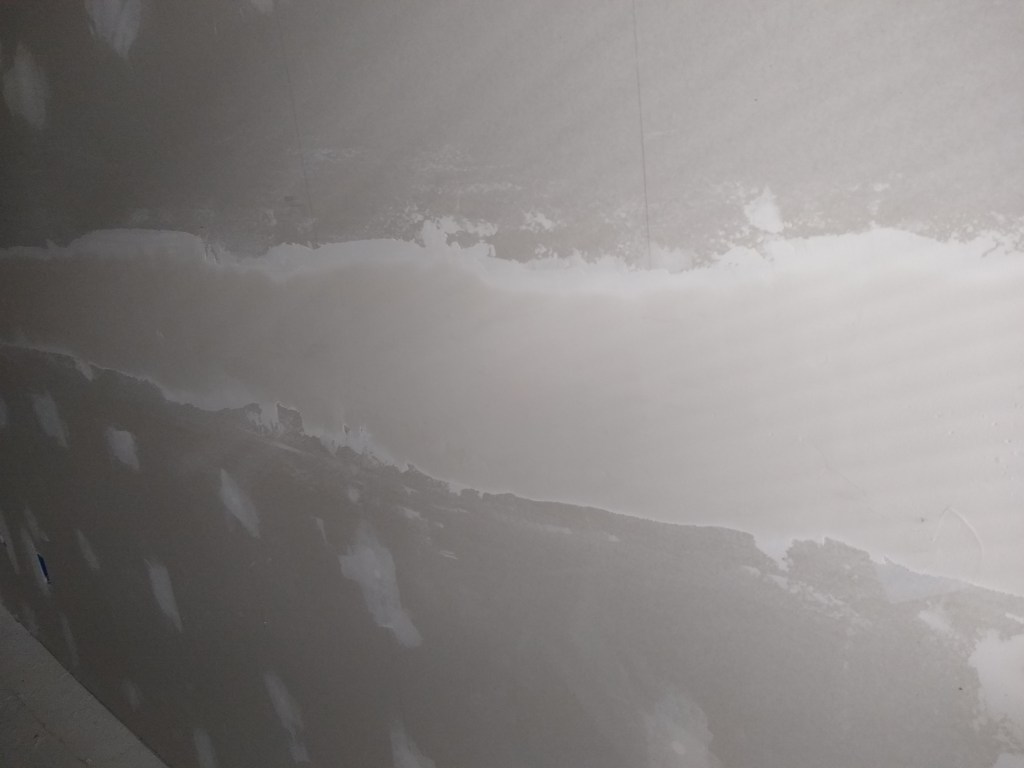
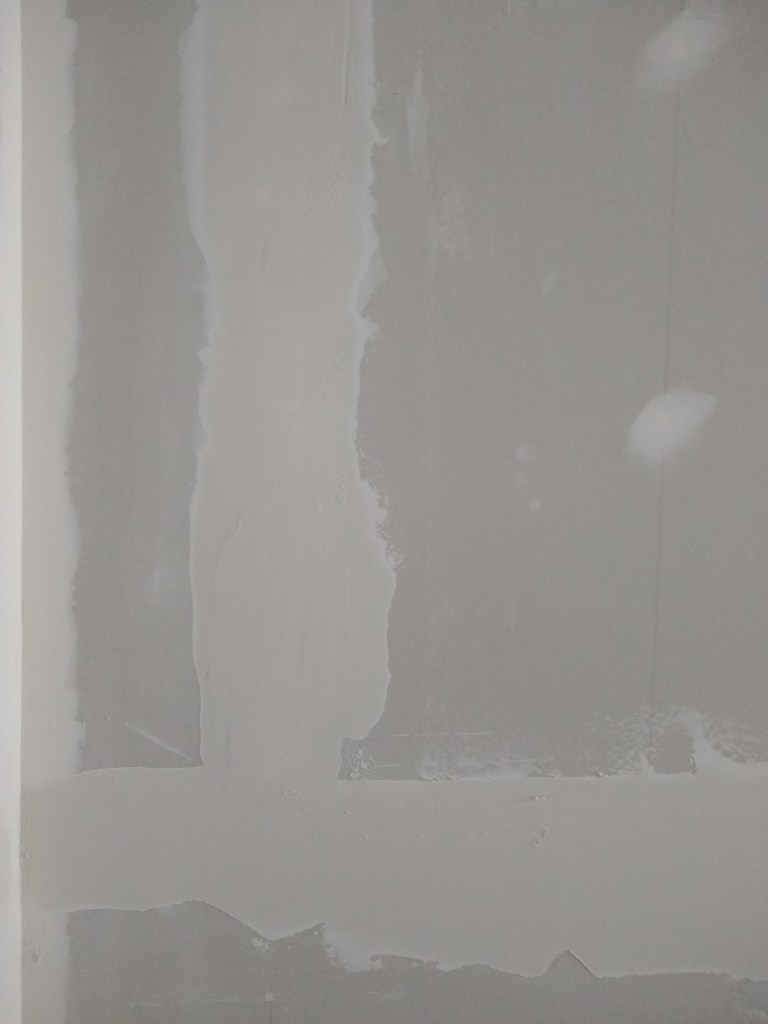
The next step was taping the joints, but first a bit of theory. Drywall is manufactured with beveled edges along the long sides of the board. The short sides are not beveled. When two beveled edges meet they create a tapered edge, which provides a place for the mud to go when taping and coating the joint. The mud will fill the recess, bringing it up to the level of the rest of the board. A butt joint is one that is missing this taper. Without the recess, the mud that is applied to the joint will create a small hump (think speed bump). To hide the speed bump, one must apply mud in such a way that extends the speed bump, making it very gradual. It will be there, but hopefully not visible. Because of the need for this extra effort, one strives to minimize the number of butt joints and, when unavoidable, place them in places that are less noticeable.

I put most of my butt joints above and below the windows. This way they are not very long and in places that are unlikely to show. My largest butt joint runs vertically between the door and window on the east wall. I also have a butt joint at the bottom edge of the window on that wall. So on the east wall I have two butt joints: one long and one short. Alternatively, I could have arranged it in a way where I had a butt joint above the door and one above and below the window, resulting in three short butt joints. In retrospect, I think I should have gone for the three short butt joints. I think it would have made finishing easier. I’ll keep that in mind in future.

I started by taping the flat joints, beginning with the butt joints (vertical joints). By doing that, I was able to avoid any “dangling” tape ends. That is, the ends of the tape of the butt joints would subsequently be covered by the tape used to cover the horizontal flat joints. The tape ends of the horizontal flat joints would be covered by either window/door casing or meet another wall, so they would not be dangling either.

After taping the flat joints, I did the inside corners where the walls meet. After that, I did the outside corners, then finally I taped the inside corners where the walls meet the ceiling. After that, the screws were coated again using the all-purpose mud I had remaining in the pan. Here is the result.
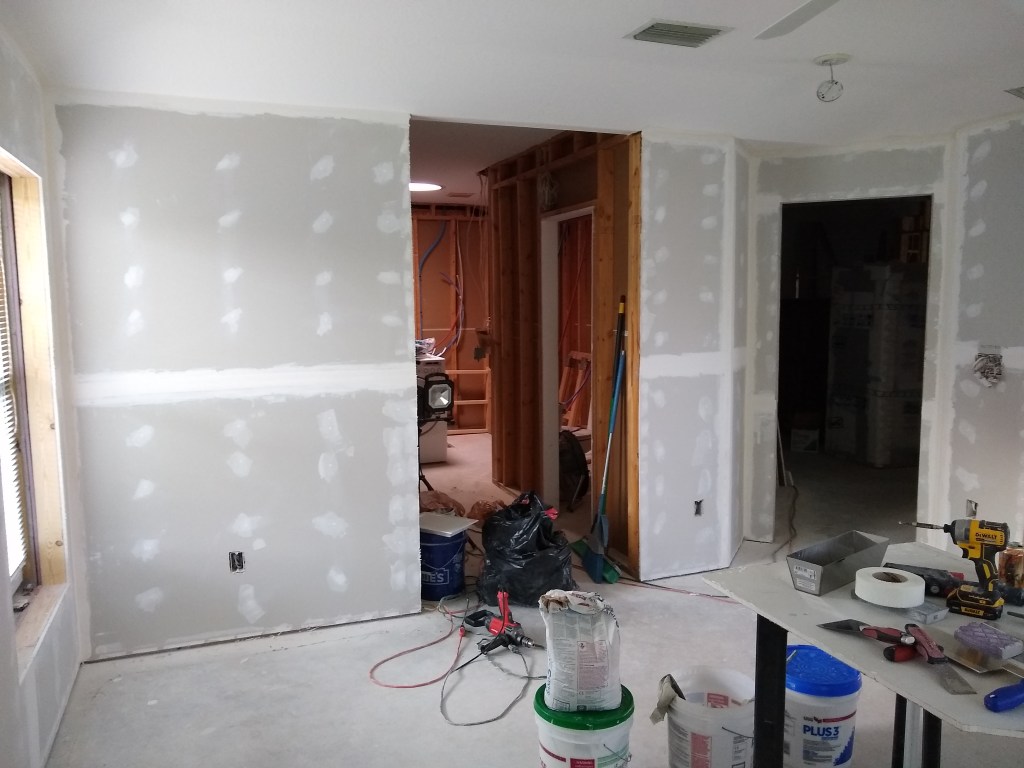
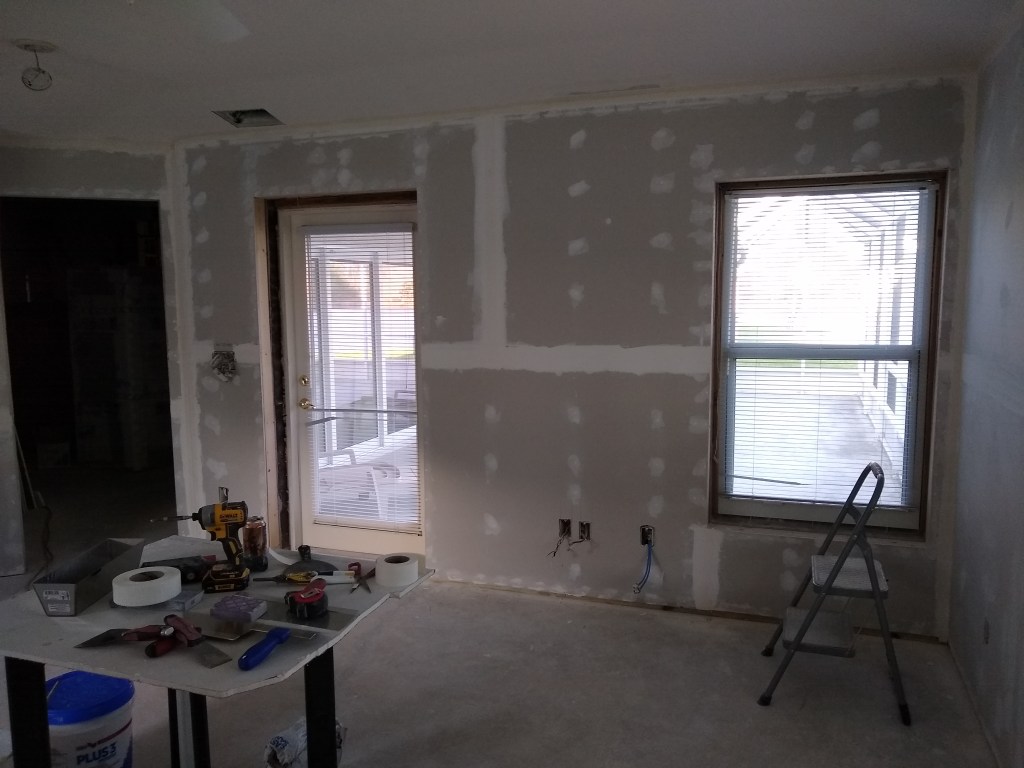
North Wall Taped
East Wall Taped
South Wall Taped
West Wall Taped

The next step is to coat the taped joints. I used an all-purpose mud to apply the tape. All-purpose mud is a heavier mud than the mud I use for coating. The all-purpose mud provides better adhesion, but is more difficult to work with and to sand, so once the taping is complete, I switch to the lighter and more friendly topping mud.

Cover coating the taped joints is done to make the joints flat (or appear flat). I’ll be doing two cover coats. The first one is to cover/hide the tape and, in the case of the flat beveled joints, bring the joint to, or near, the level of the rest of the wall (filling in the recess). For the butt joints, the objective is to taper the hump, consequently, butt joints have a wider coat.

For inside and outside edges, I coated only one side, waited for it to dry over night, then coated the other. As a result, it is a two day job. After finishing the first coat I taped around the outlet box openings where I did a poor job routing them out. I’m getting better at using the roto-zip tool to route out the box openings, but it’s still a “fingers crossed” operation. I had a few with significant gaps that required some attention to make them snug to the box. This was done with paper tape and quick-set mud. Here is the result after the first coat.

North Wall First Coat
East Wall First Coat
South Wall First Coat
West Wall First Coat

The second cover coat is used to provide a surface that is ready for paint (or primer). In my case I will be skimming the walls in order to get the best finish I can (level 5 – see https://nuntawob.com/2021/08/01/drywall-level-1-june-july-2021/ for definitions), so the second cover coat is more about flatness and getting the walls to a point where I could paint them. I will also be skimming the ceiling, changing it from knock-down texture to flat, so for the second coat I will not be touching the tape on the ceiling where the walls meet. That will be addressed when I skim the ceiling. Therefore, the second coat is only focused on the walls.

Prior to applying the second cover coat, I quickly and lightly sanded the first coat to remove any significant irregularities that the second coat could not cover. Not a lot of difference to see, but here are images of the walls after the second cover coat.
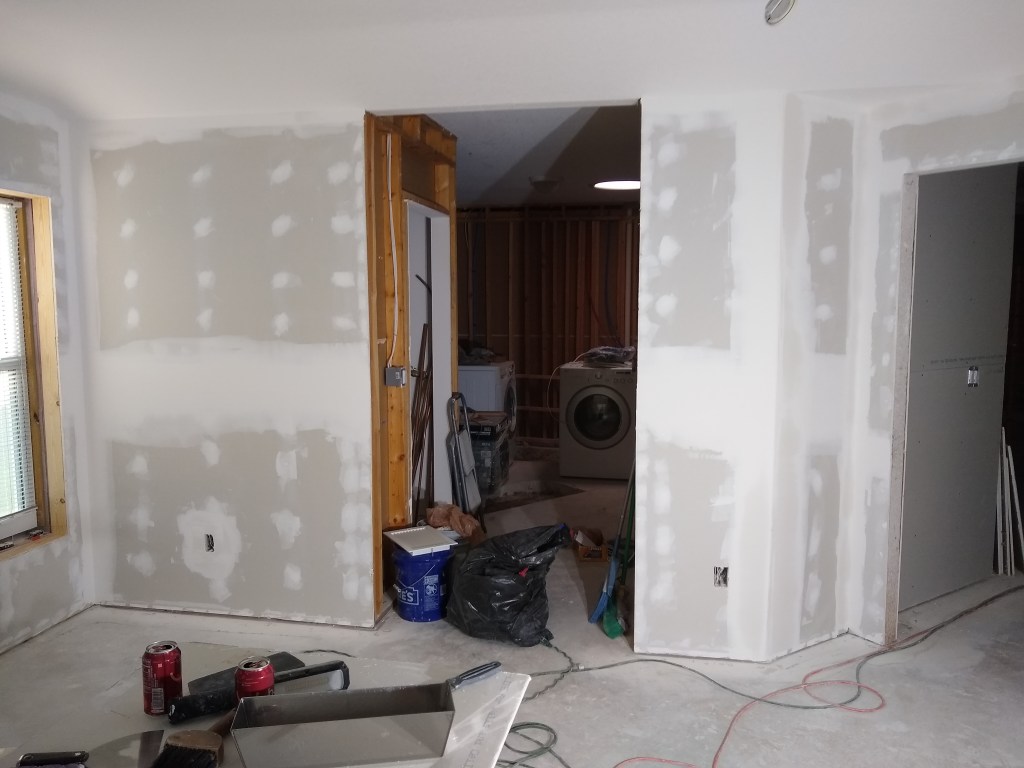
North Wall Second Coat
East Wall Second Coat
South Wall Second Coat
West Wall Second Coat

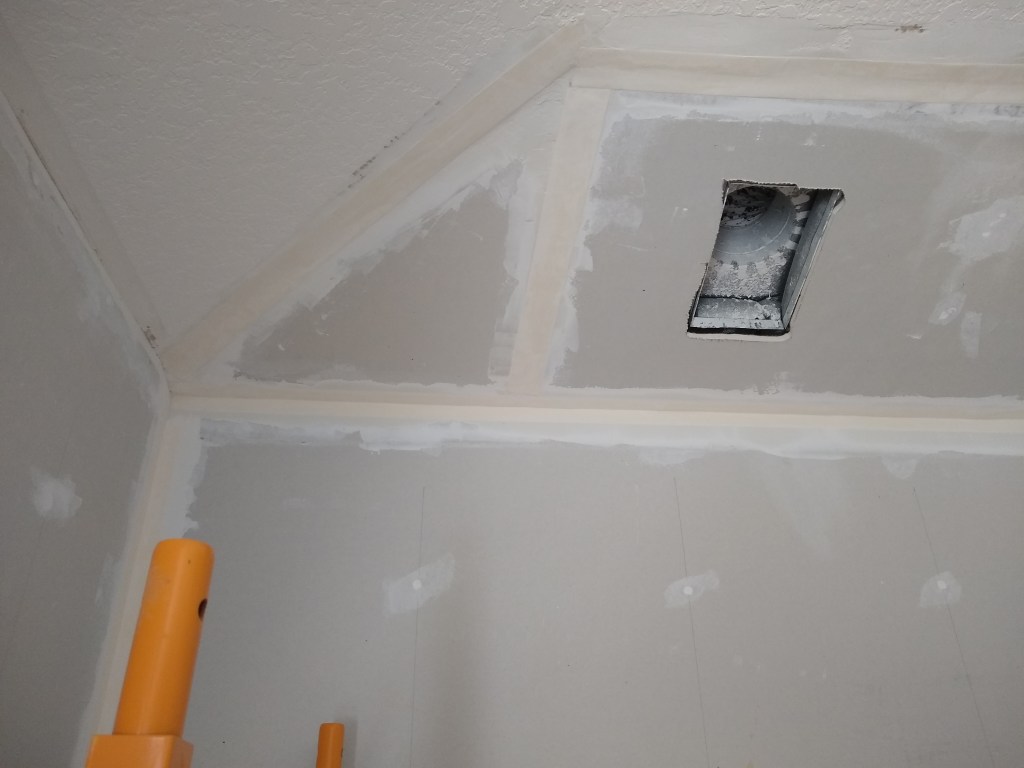
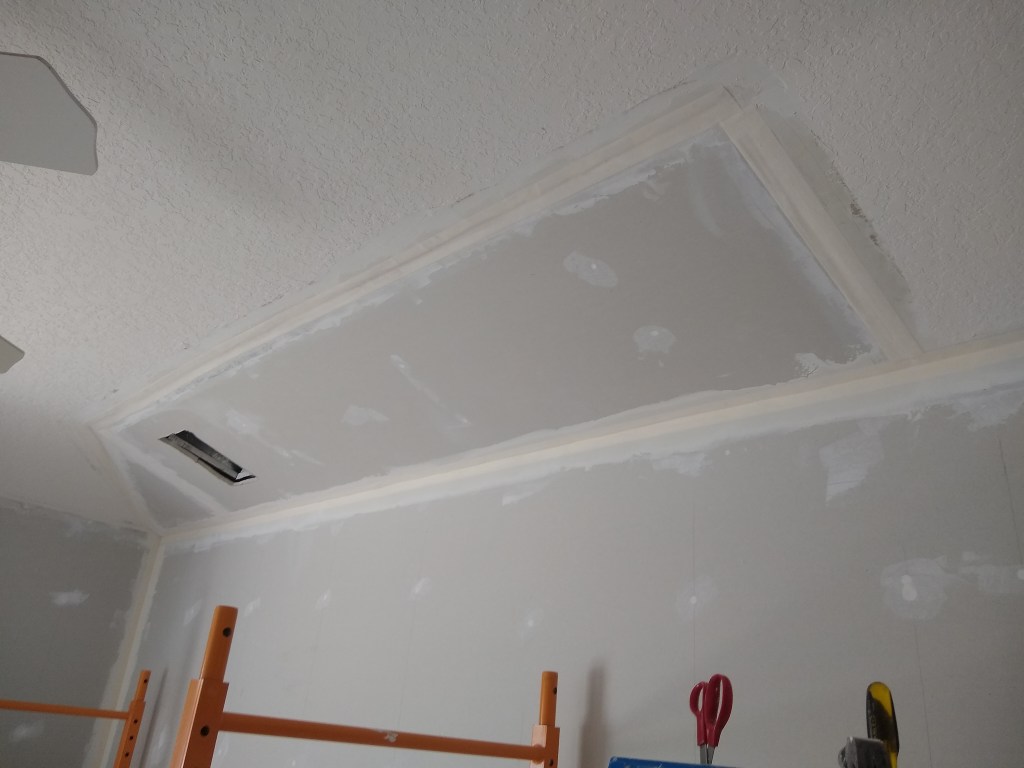
Rather than move on to skim coating the walls, I decided to work on the ceiling first. As previously mentioned, I will be skim coating the ceiling, changing it from knockdown texture to smooth. I did this in the guest bedroom and was happy with the result, so I will do it in the master too. I’m switching to the ceiling at this stage because it’s likely that while doing the ceiling, mud will drip onto the walls. I don’t want to be scraping mud off my newly skimmed walls. Once the ceiling is done (but before priming and painting), I will return to the walls and prepare them for skimming.

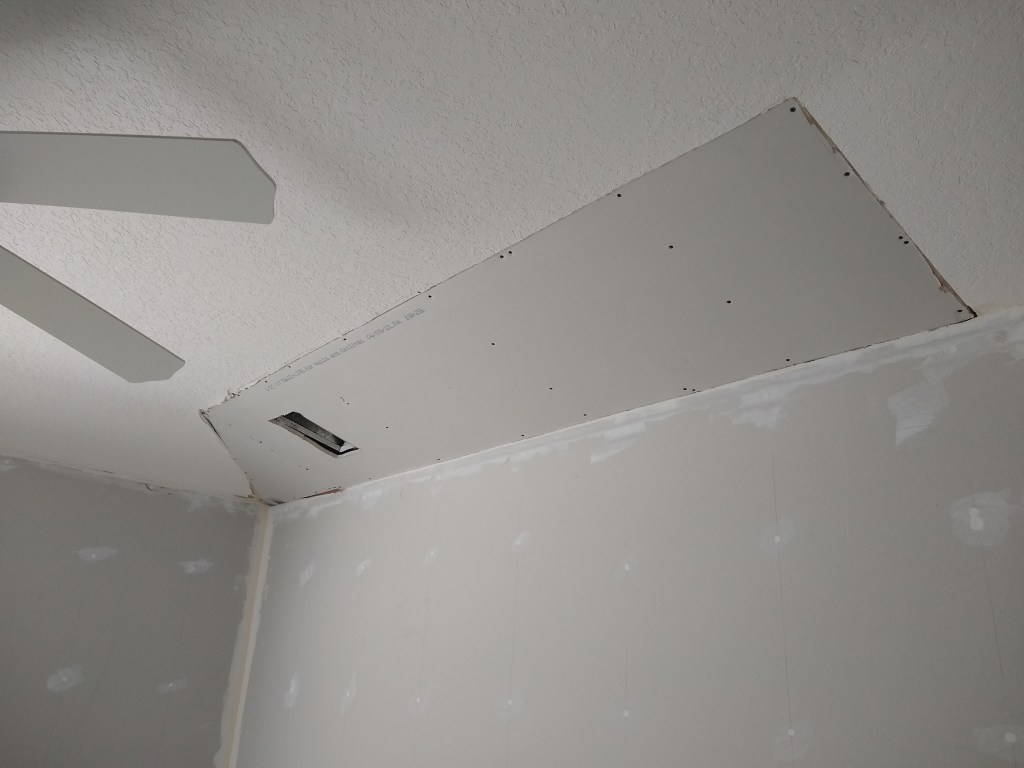
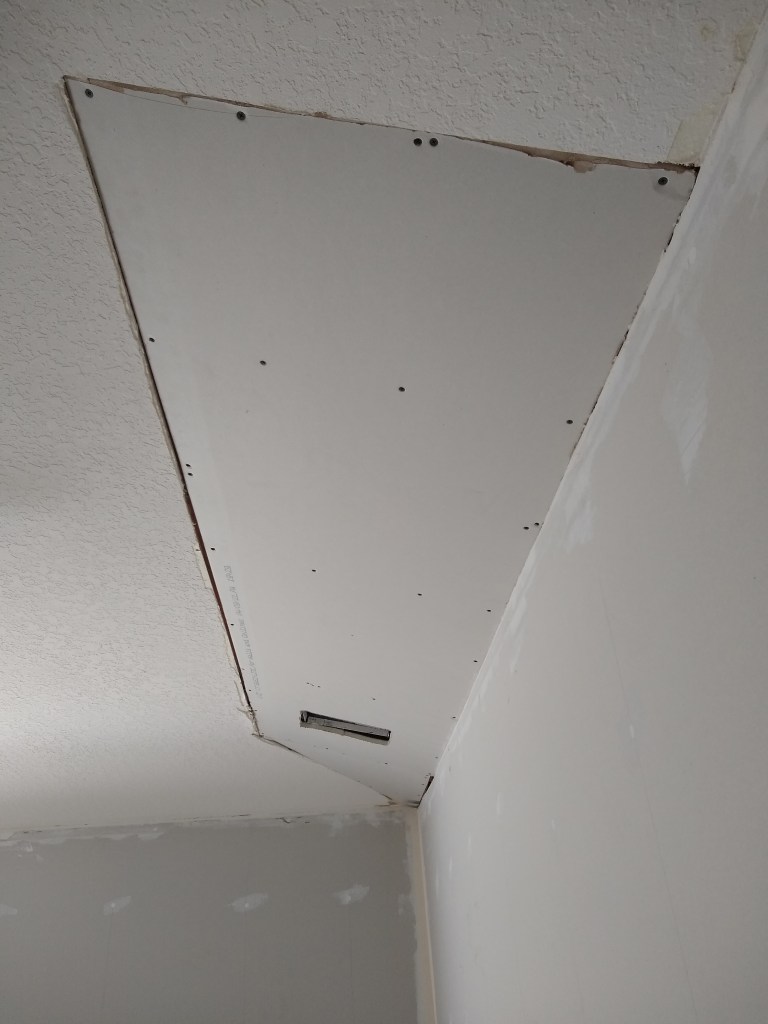
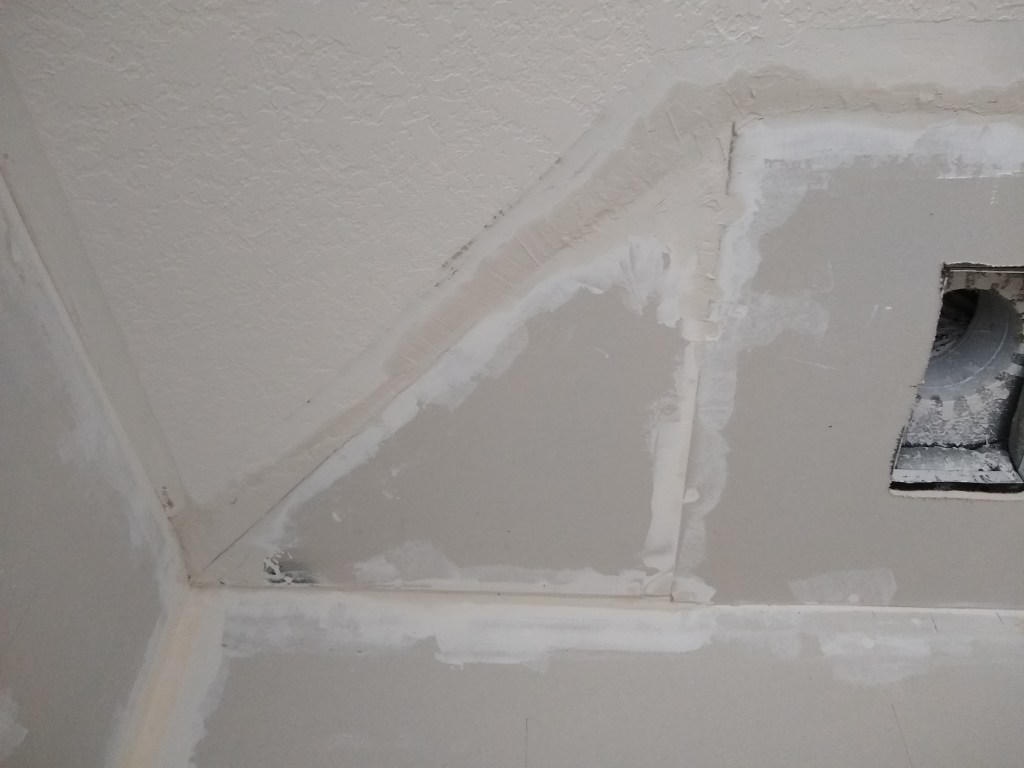
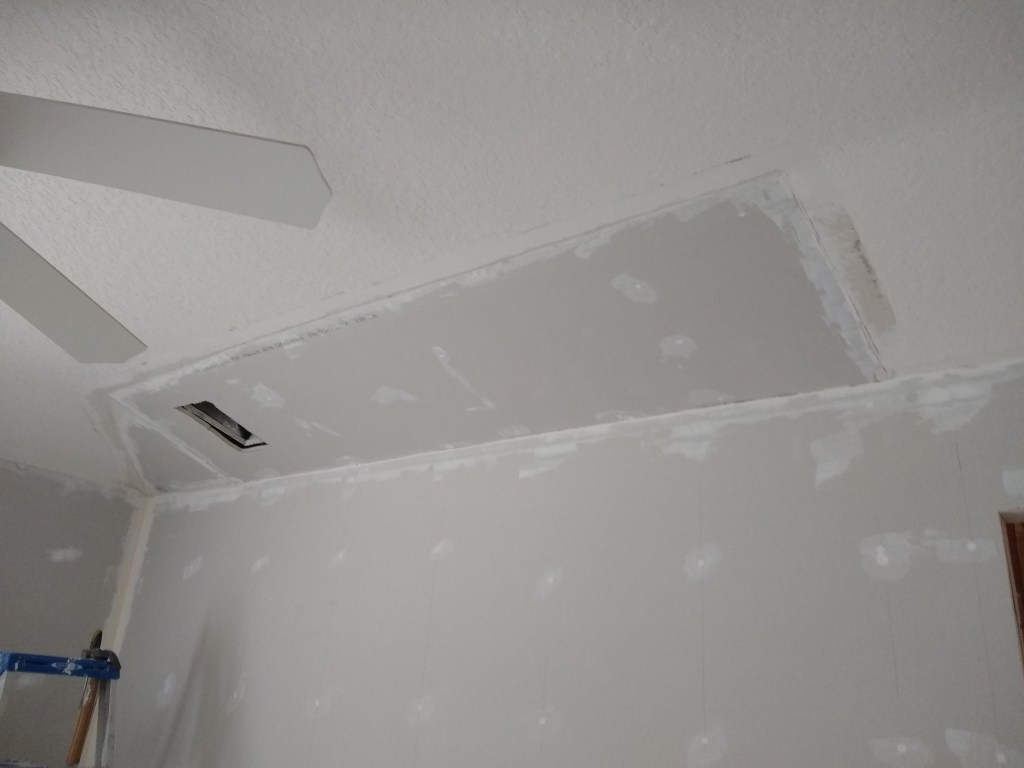
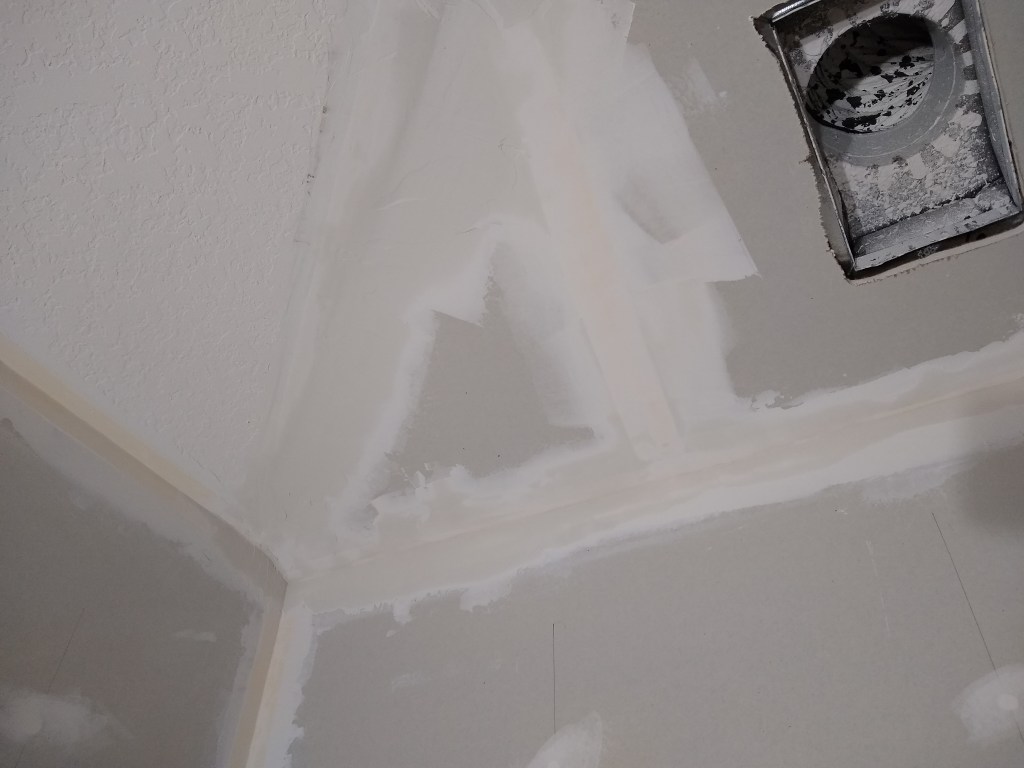
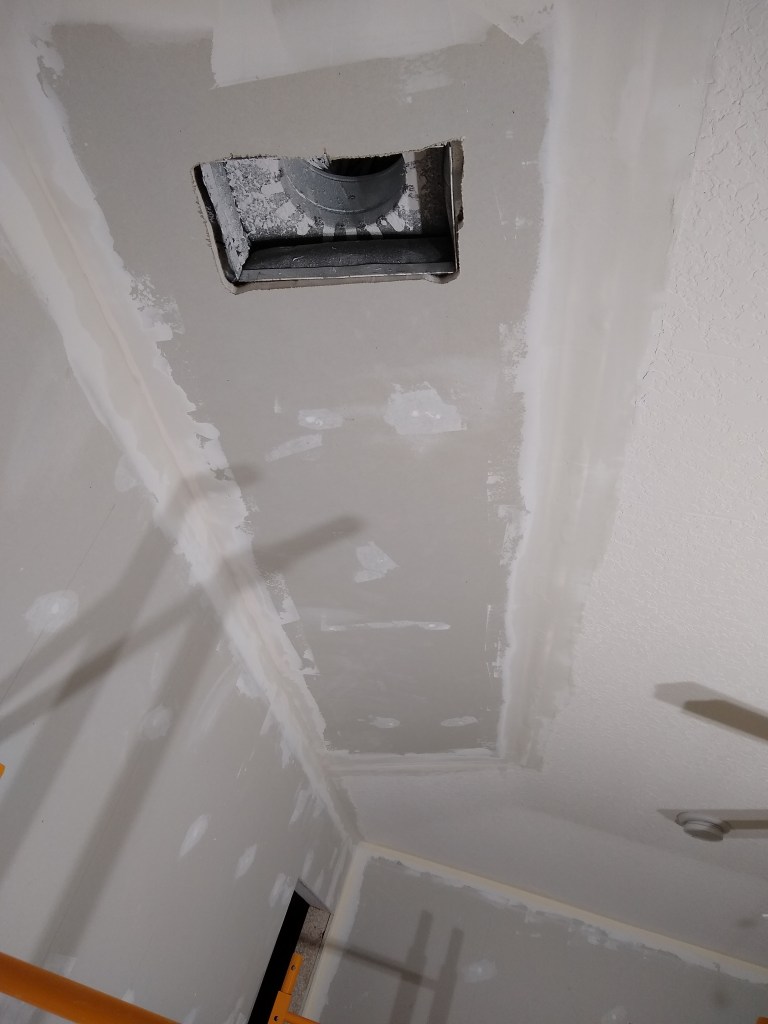
The first thing I have to do to address the ceiling is to coat it with all-purpose mud. As with the taping, I’ll use this first due to it’s superior adhesive qualities compared to the Plus 3 mud I’ll use to skim over top of it. The ceiling is a tray ceiling, so the perimeter meets the wall at an angle, so I started covering that first.

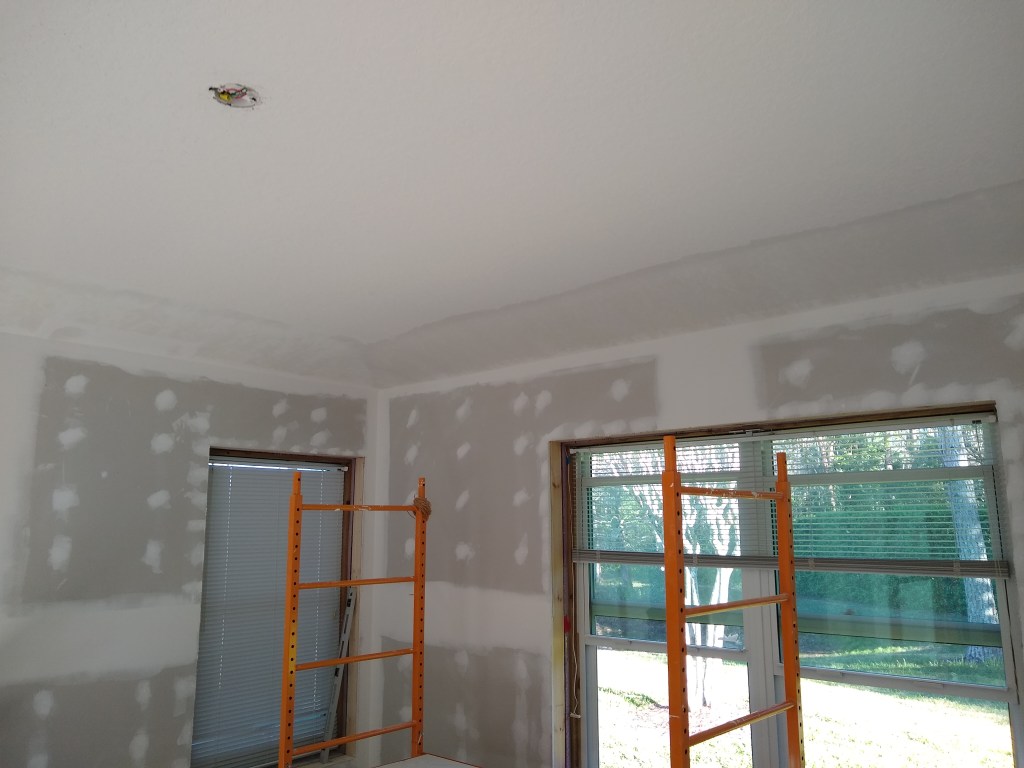
North East Perimeter Coated
South East Perimeter Coated
North West Perimeter Coated

I did not have enough all-purpose mud after finishing the perimeter to work on the main part of the ceiling, so I finished for the day. After I picked up another bucket of all-purpose mud I got to work on the rest of the ceiling.
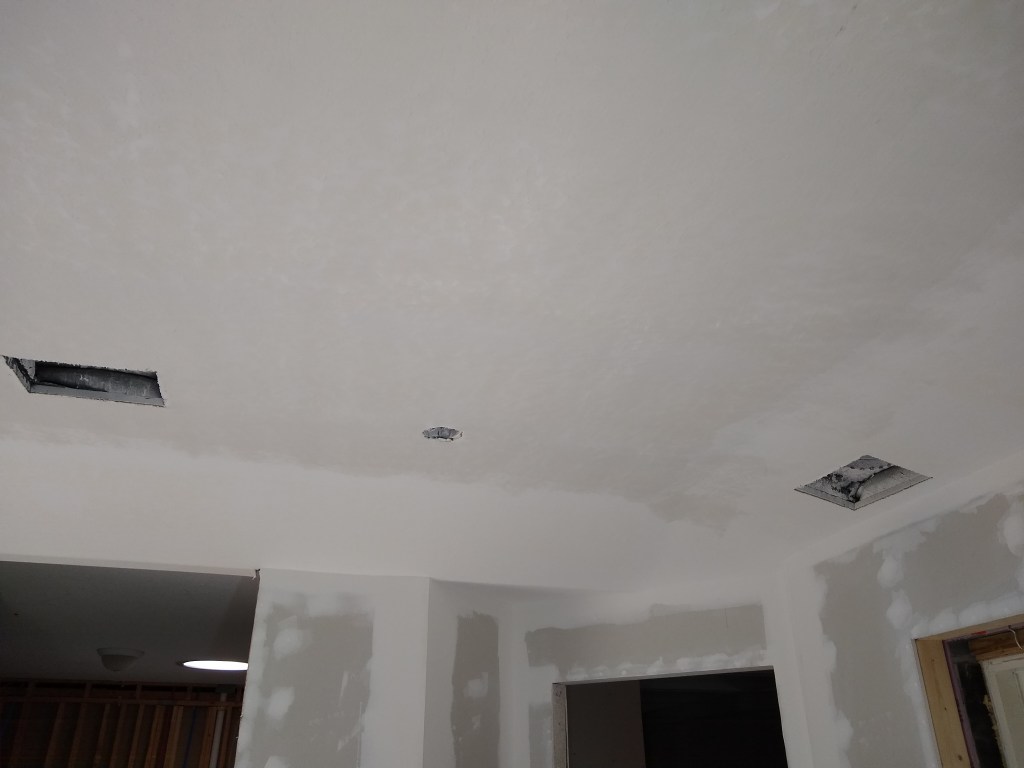
North East Corner

Since the perimeter has had time to dry, you can see how much lighter it is compared to the rest of the ceiling.

South East Corner
South West Corner
North West Corner

Here is a close up of the south west corner.

Close up

This image shows a relatively smooth surface compared to the original knockdown surface which, to remind you, looks like this.
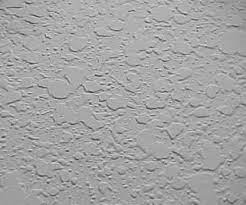
Knockdown Texture

The splotchiness you see in the closeup is due to the fact that part of the cover coat is still wet and that the cover coat has not completely concealed all evidence of the knockdown texture. The next coating will be with the lighter mud and should make all the difference.

Before starting the skim coat, a light sanding is required to remove any obvious lines or other types of irregularities. It doesn’t need to be completely smooth, just enough to make the job of slimming a bit easier. I did two skim coats of the ceiling and then did the same on the walls. By skim coating the walls I am creating a surface that is consistent, not a mix of joint compound and bare drywall. If I did not skim coat the bare drywall, which is optional, the texture difference might show through depending on the paint used and the lighting. Here is the result.
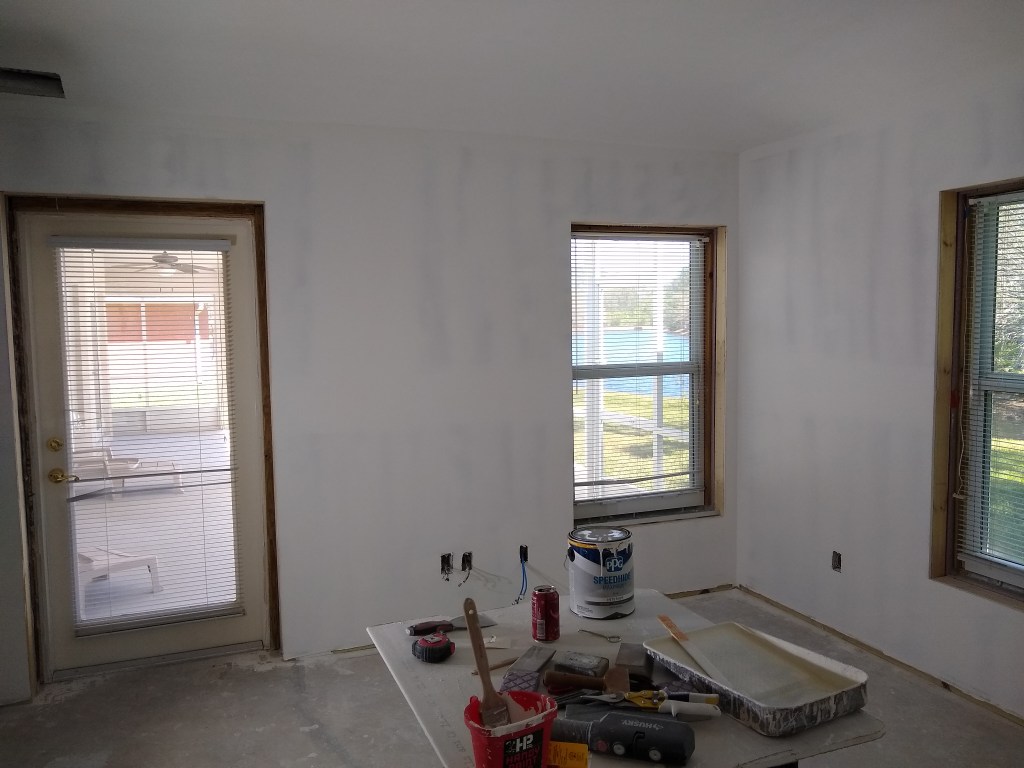
South East Corner – Walls and Ceiling Skimmed twice.
South West Corner – Walls and Ceiling Skimmed twice.

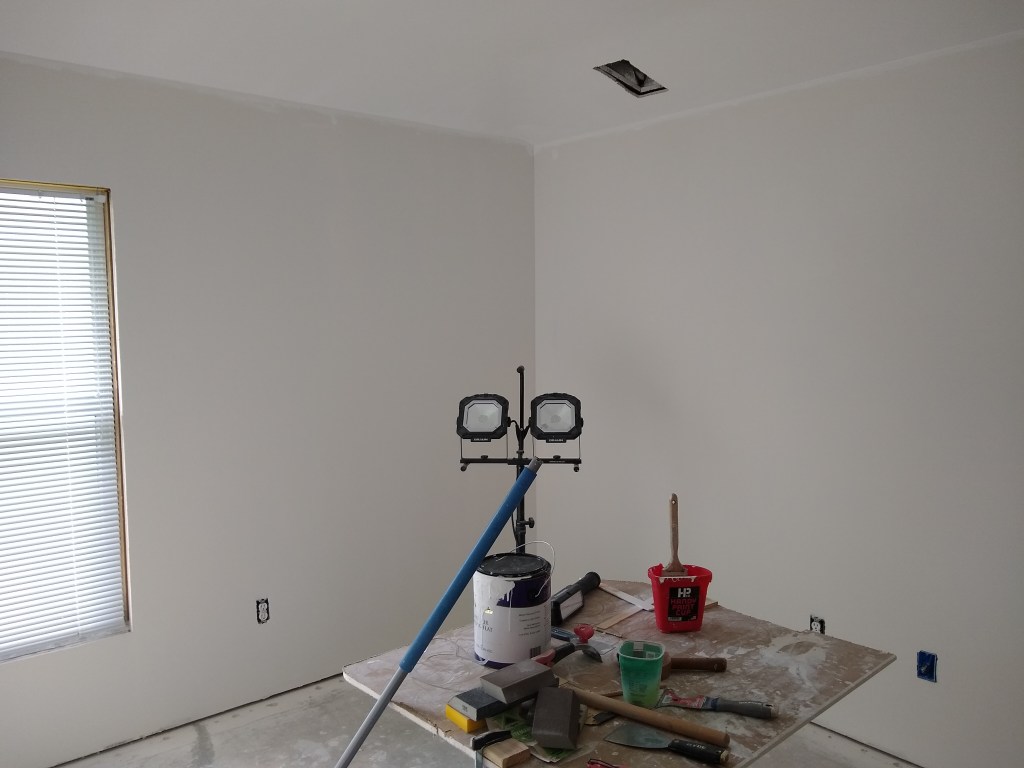
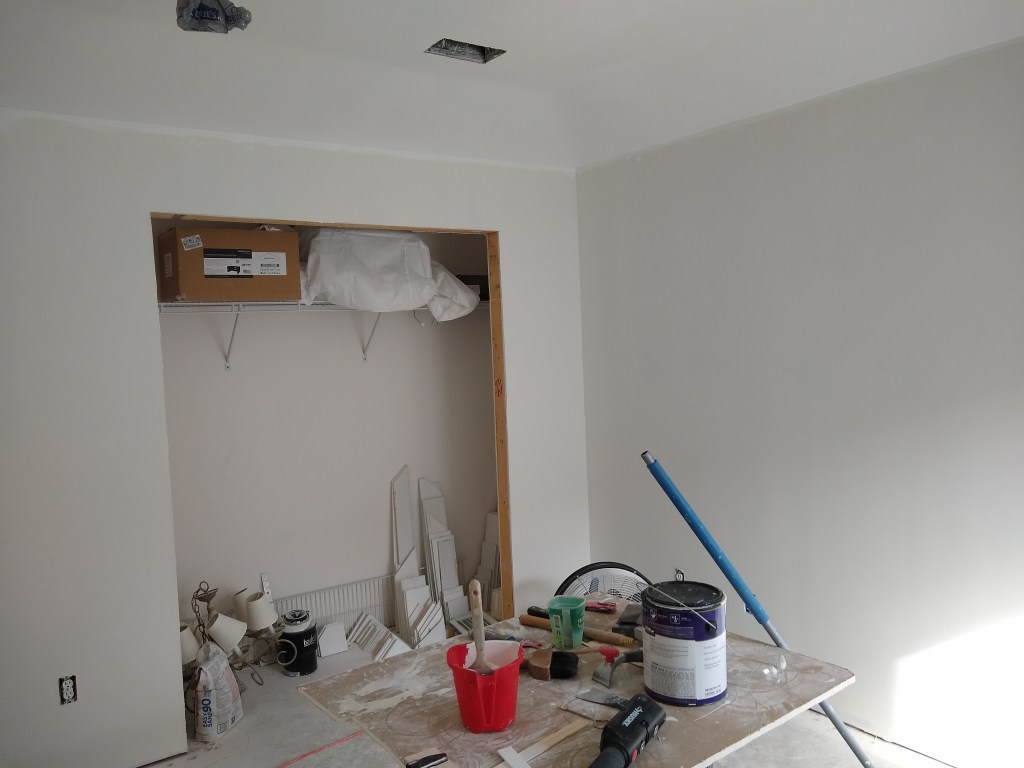
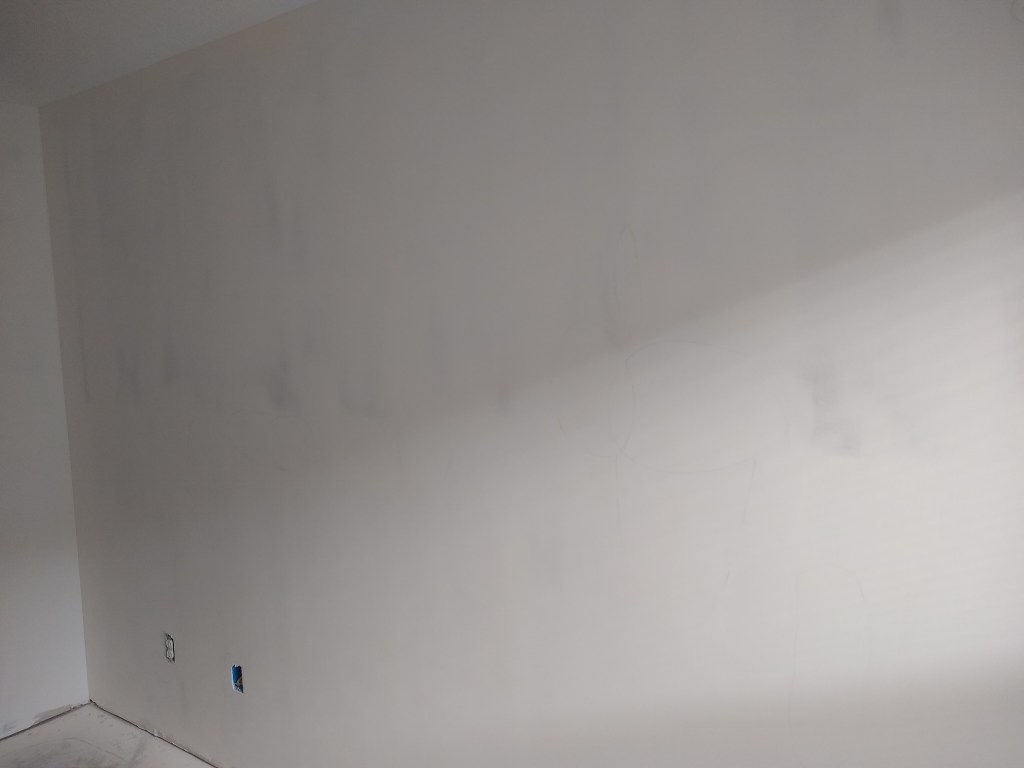
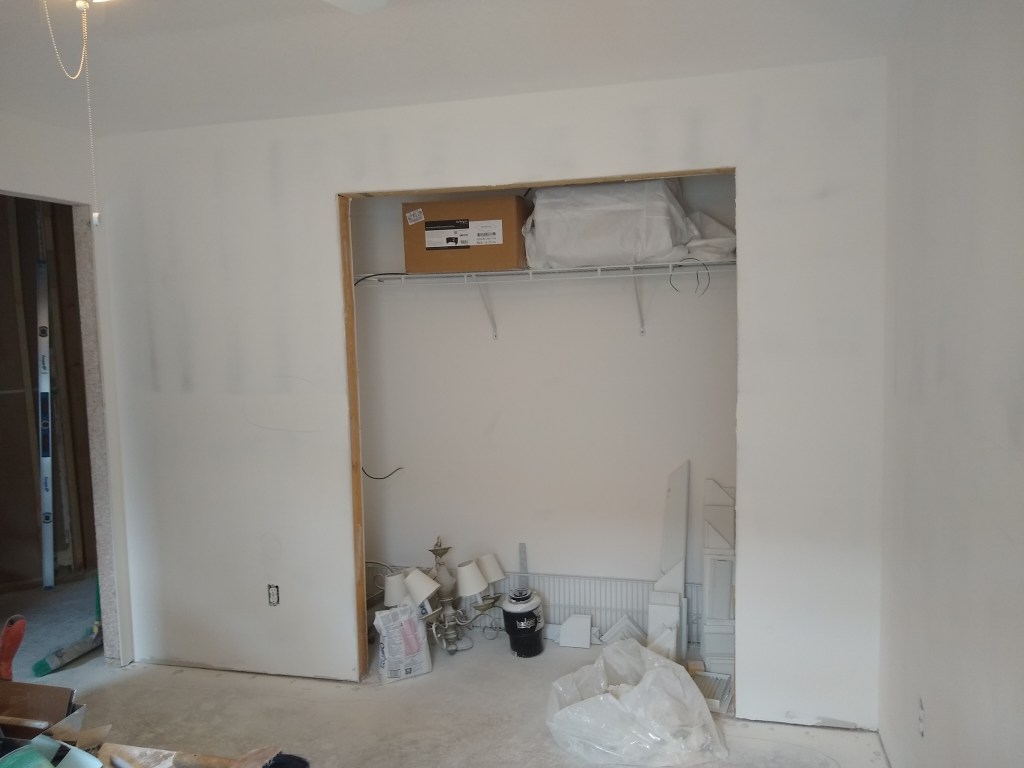
As you can see, the walls and ceiling are looking much better. They are now ready for priming and painting. The type of primer I used was “high build”. This type of primer is a bit thicker than the one I used in the guest bedroom and supposed to be better for filling in small scratches and such, so I thought I’d give it a try, even though I was happy with the regular primer (Kilz) I used before. It seemed to work well, but I can’t honestly say it was noticeably better than the Kilz. In the images I present below, the walls have been primed and the ceiling has been primed and also given two coats of paint. Both the primer and paint is white, so I didn’t see much point in showing images of the various coats, so what you see below is the final product, at least until I decide what color to paint the walls. For now, I am done with the walls and ceiling in the master bedroom.

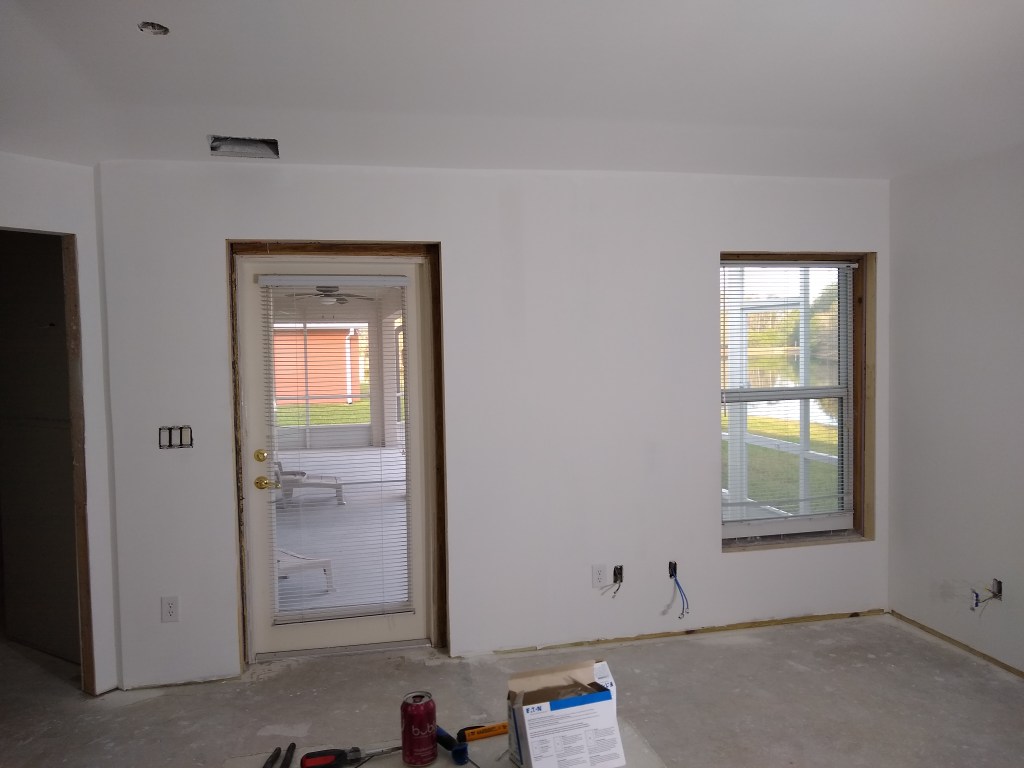
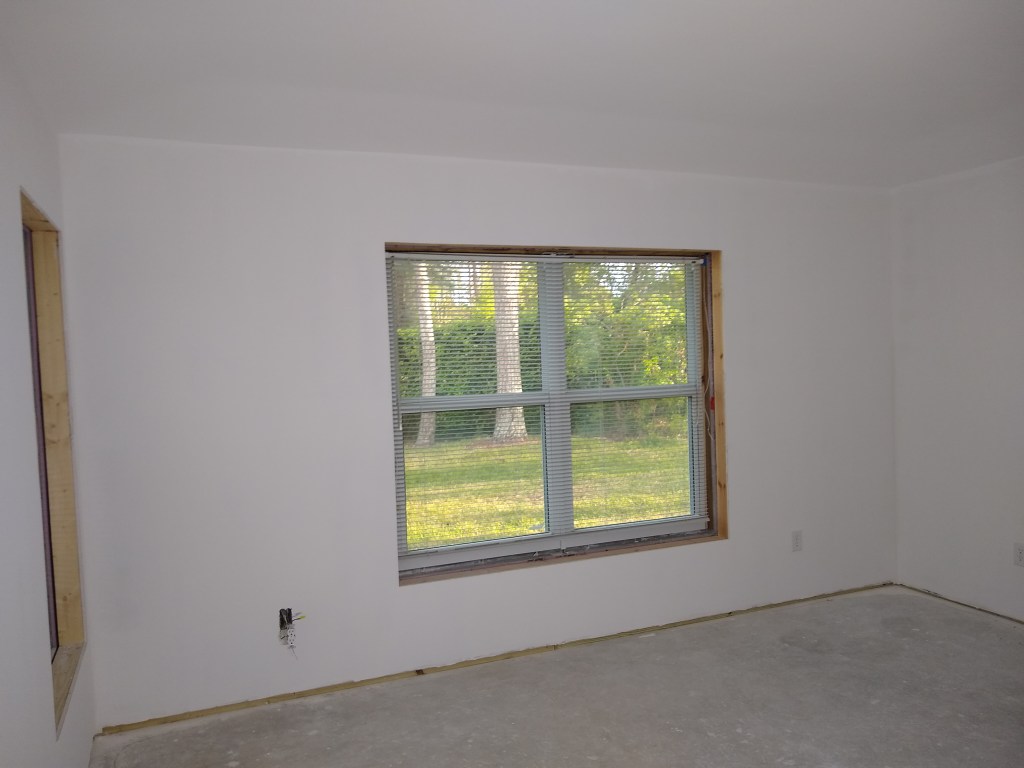
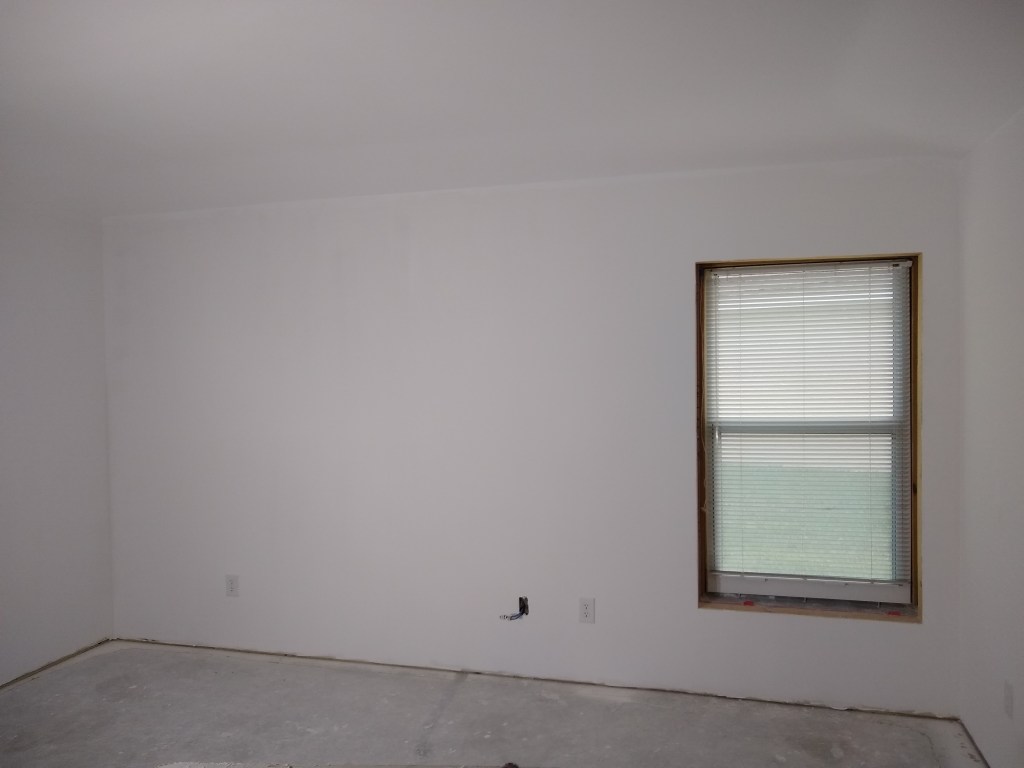
North Wall Primed, Ceiling Primed and Painted
East Wall Primed, Ceiling Primed and Painted
South Wall Primed, Ceiling Primed and Painted
West Wall Primed, Ceiling Primed and Painted
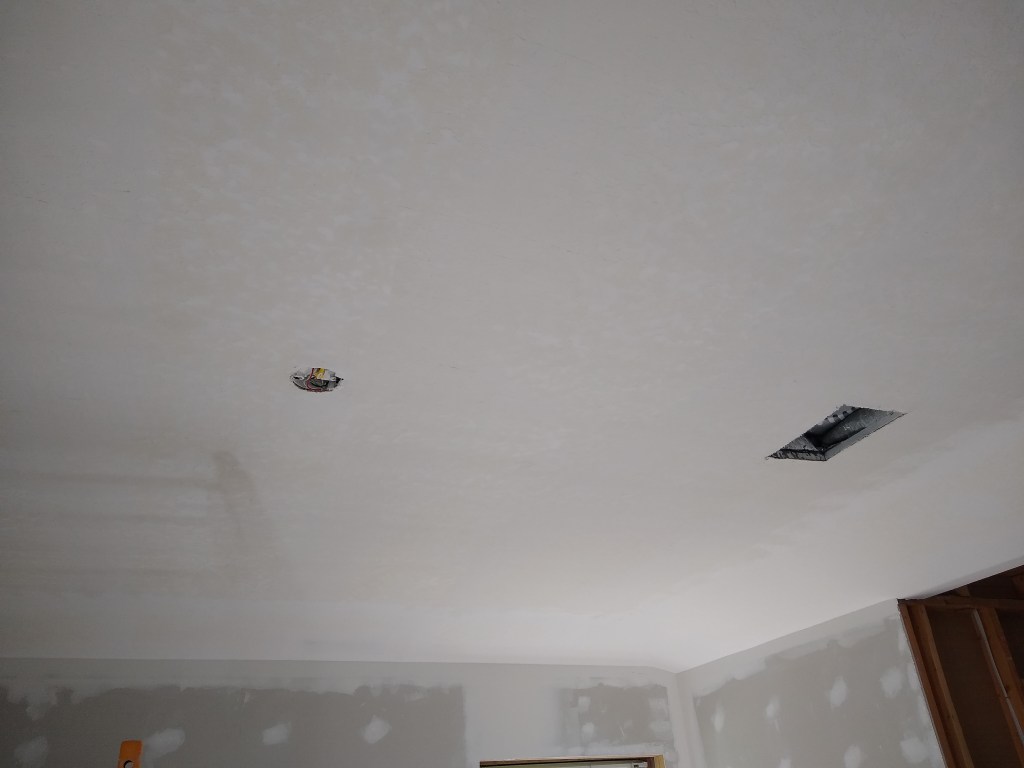
Ceiling Primed and Painted

I also added new outlets and face plates (except for one on the south wall because I was missing a wire nut). The outlets were installed so I could supply power to the master bedroom. I intend to start work on the master bathroom next, so I wanted to have a power source nearby. I’ll not bother adding face plates for the Ethernet and cable connectors until much further down the line.

I’m pretty happy with how this turned out. On to the master bathroom. Lot’s of unknowns to deal with there (I’m frightened Auntie Em, I’m frightened!).
Ceiling Prep, Garage Cabinets, and More Drywall Hanging – January/February 2023

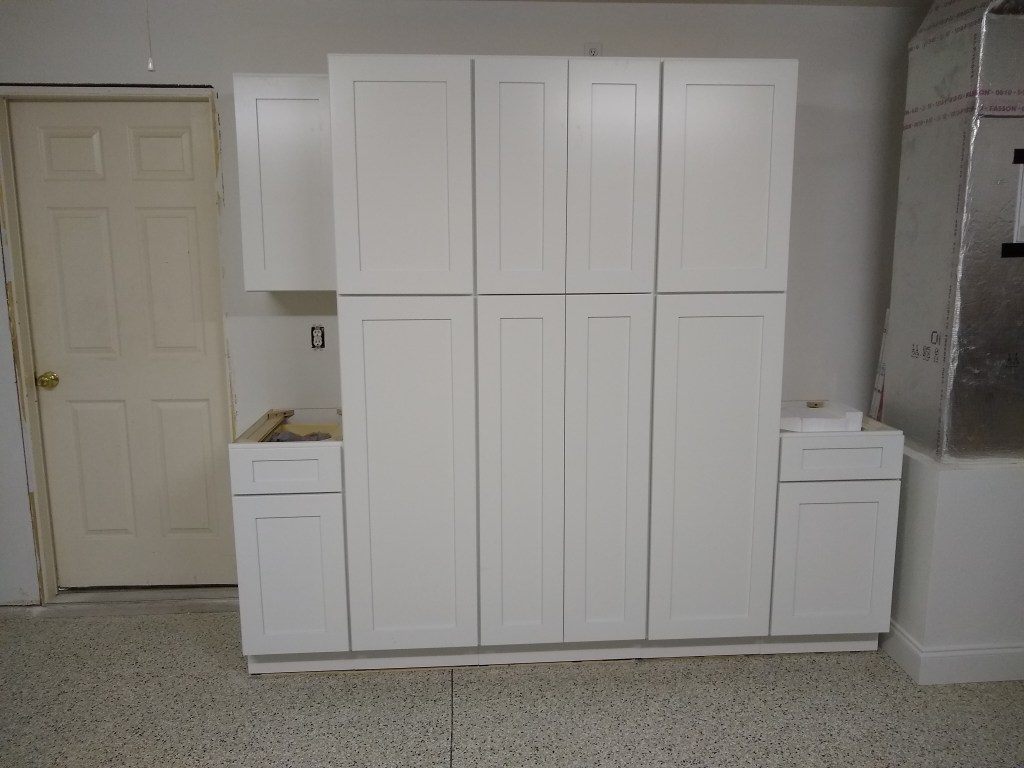
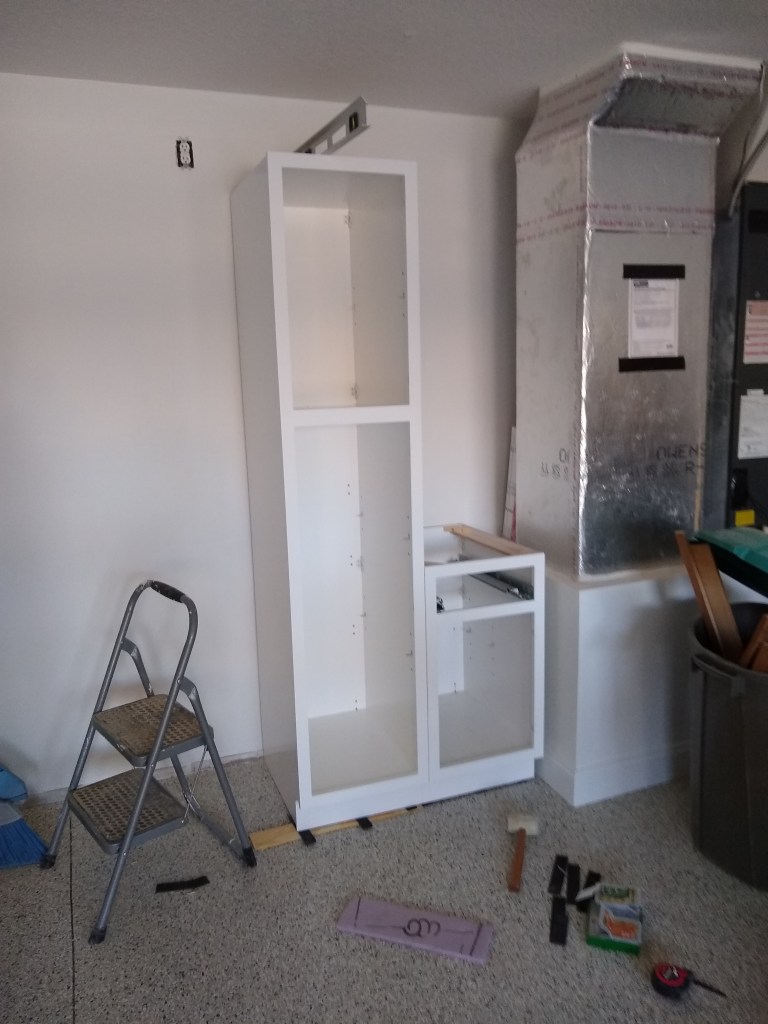
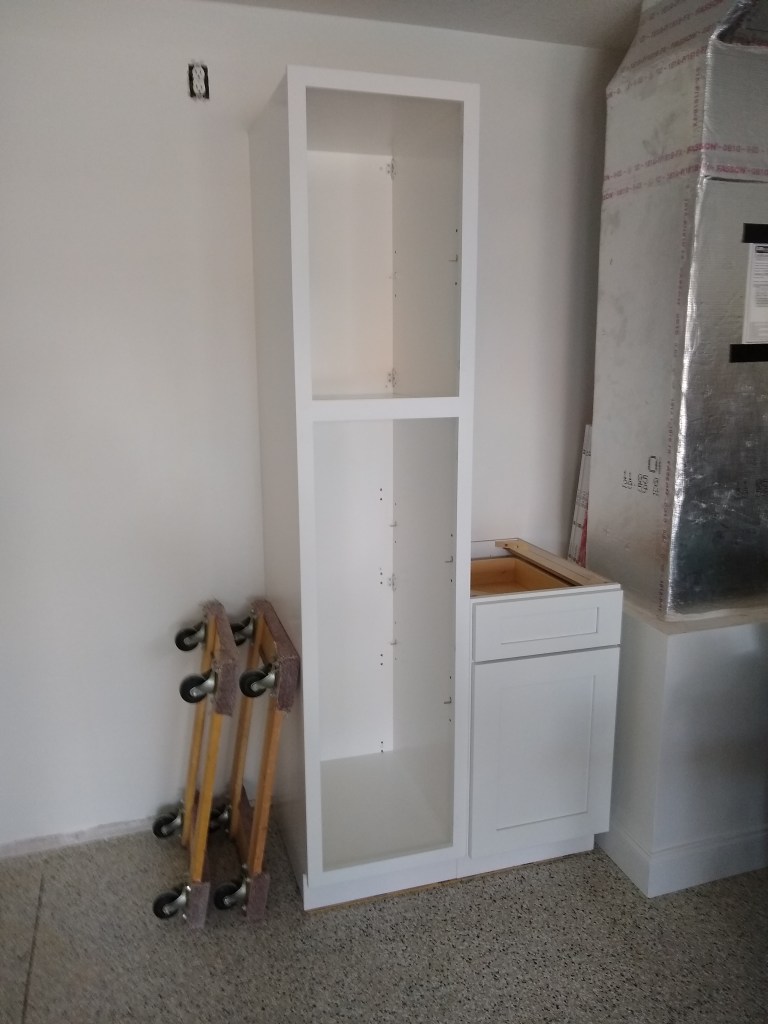
After returning from the holidays, I knew I would still be waiting for a while before I would have anything from Jennifer, so I decided to continue work in the garage as best I could. I was still missing a 24″ pantry cabinet that would be the center cabinet along the back wall of the garage, so I did as much as I could in the meantime. This meant adding baseboard, painting the walls, and installing two cabinets of the five cabinets that will go along that wall.

This was all I could do along the back wall since the next cabinet to go in was the missing 24″ pantry cabinet. Not wanting to be idle, I shifted my attention to a task I was not looking forward to; preparing the kitchen and great room ceilings for painting.

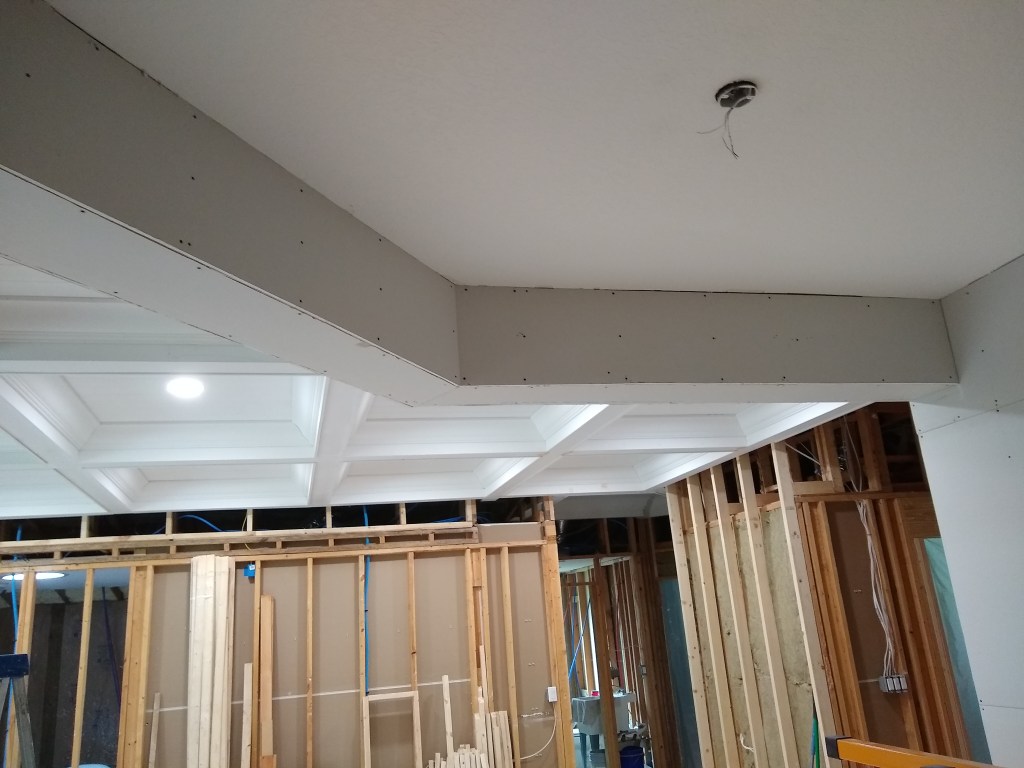
Prepping the ceilings meant filling all cracks with wood filler, sanding, then caulking. This would be a long, slow, and laborious task, and one that would require standing on a scaffold working above my head. However, it is a very important task, as it would mean the difference between a great looking ceiling and something less than that. So I got to it.

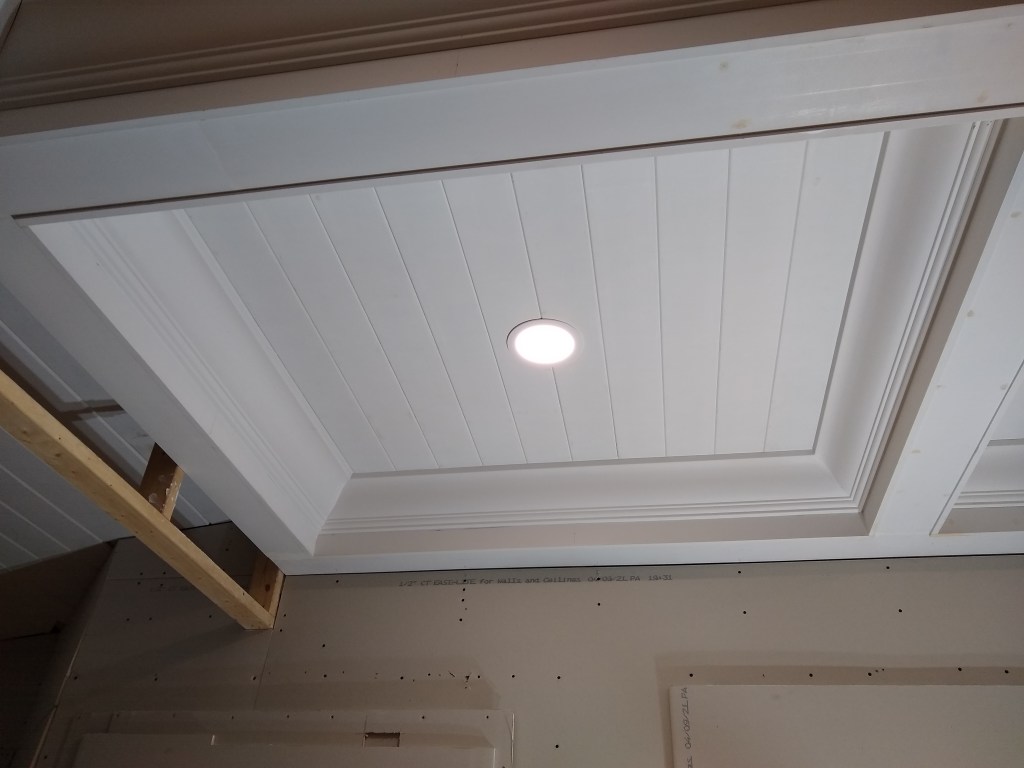
First Coffer Prepped
First Coffer Prepped, alternate angle.

I started with the kitchen ceiling and then moved on to the coffered ceiling. I didn’t take any pics of the kitchen ceiling because there wasn’t much to show other than sanding marks and such. You can kind of see it in the background of the images above. These images are the only ones I took of the coffer prep because once you’ve seen one, you’ll have seen them all. I had 17 coffers to prep and the images above are of the first one. It took about four weeks to complete both the kitchen ceiling and the coffered ceiling. It was hard work, but I am pleased with the results. Once the primer goes on, I’ll know if any further action is needed, but I suspect not (only very little if any). I don’t plan on priming/painting the ceiling until all the walls are ready to prime/paint, and that is a long way off.

I finished the ceiling prep work the day before the missing garage cabinet arrived, so I was able to return to the cabinet installation in the garage right away. I finished installing the cabinets along the back wall in a single day, resulting in this:

Back Wall Cabinets

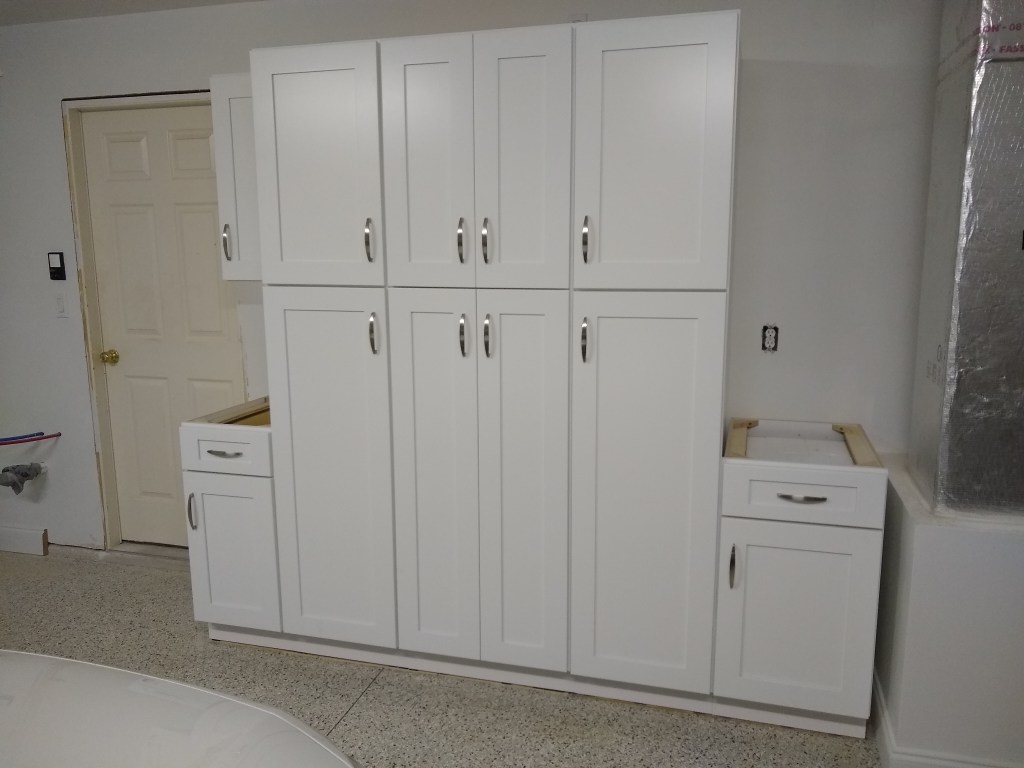
Note that above the base cabinet on the right, I will add open shelving, but not anytime soon. Here is a shot of all the garage cabinets before adding the hardware.

All Cabinets Installed

The next day I added the handles. Doesn’t that look nice!

Handles Added
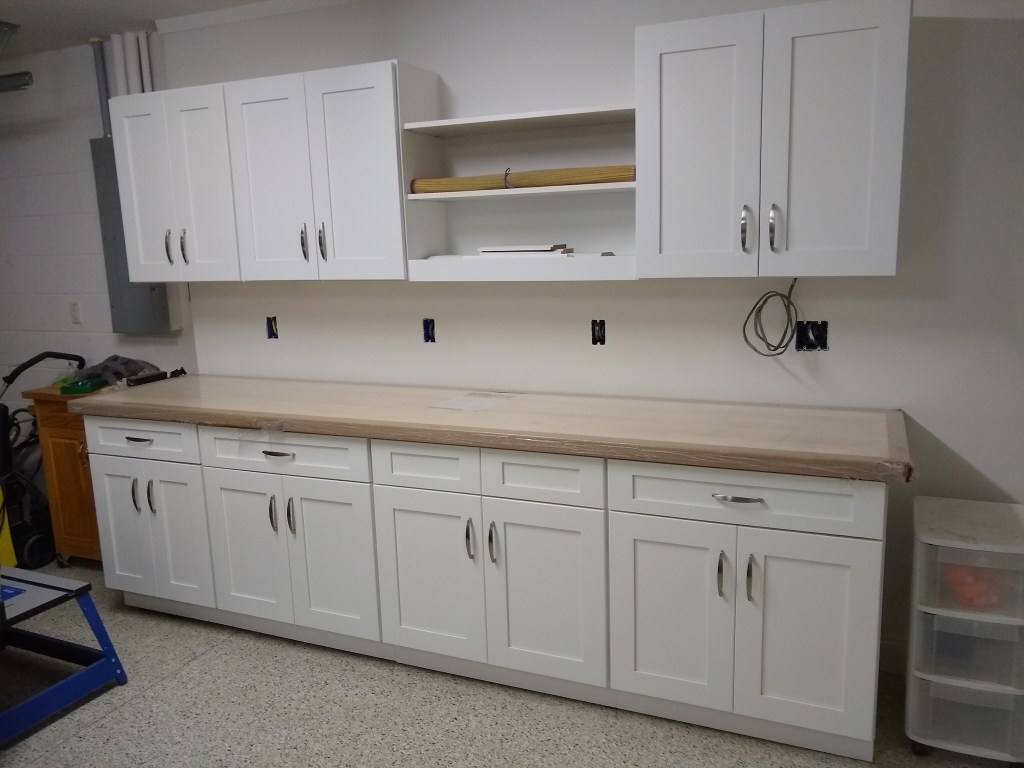
Handles and Butcher Block Countertop

You’ll also notice that the butcher block counter top is in place along the east wall, but not attached. It is still wrapped in plastic and I won’t remove the plastic and apply finish to it until I have moved in (or am at a stand still – heaven forbid), as it is of low priority. I’m still waiting on the corresponding countertops for the outside base cabinets on the back wall, but, again, no hurry.

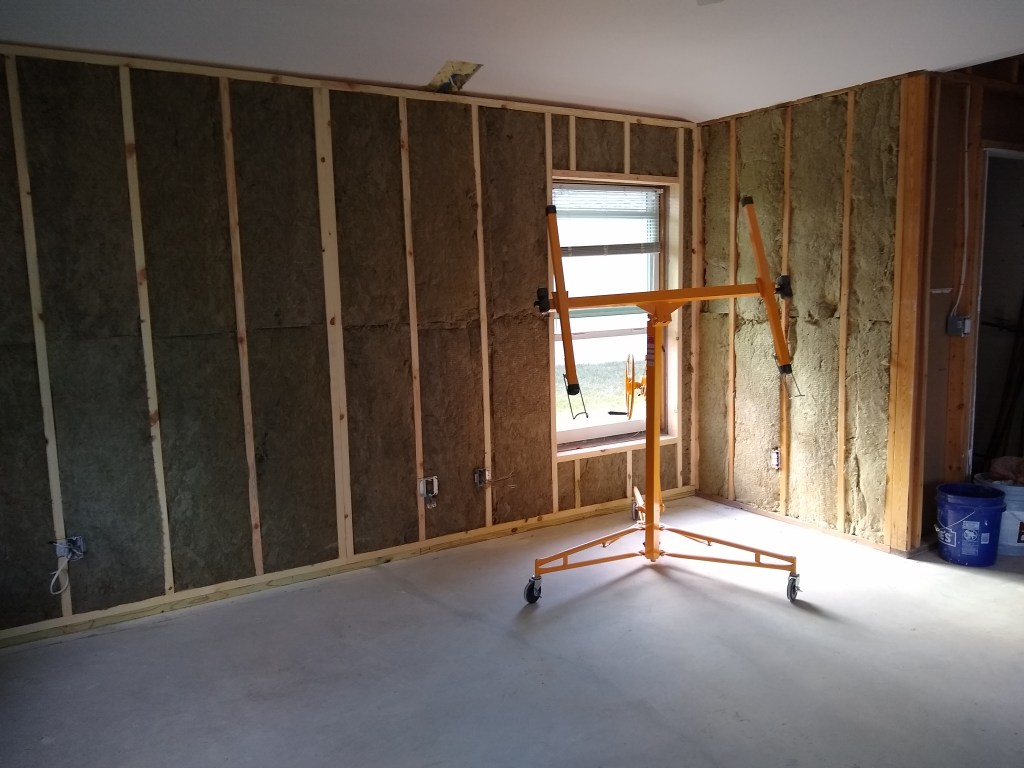
With the work in the garage done for now, I was ready to return to work on the inside of the house, but unfortunately and frustratingly, still no construction drawings from the designer. We had settled on the design changes to the kitchen and master bathroom, so she is supposed to produce construction drawings that I will submit to the permitting office to update my permit. Not wanting to wait, I scheduled an inspection of the master bedroom (framing and electrical) so I could push on. The inspection went without incident, so I resumed work in the master. The first job was to add insulation.

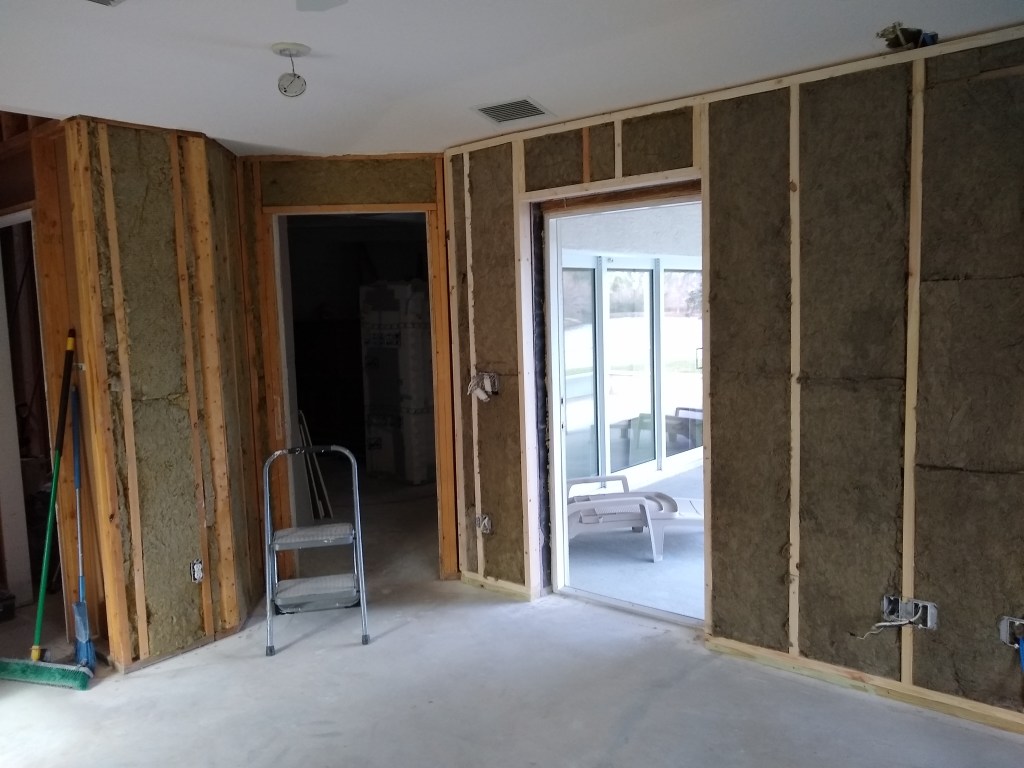
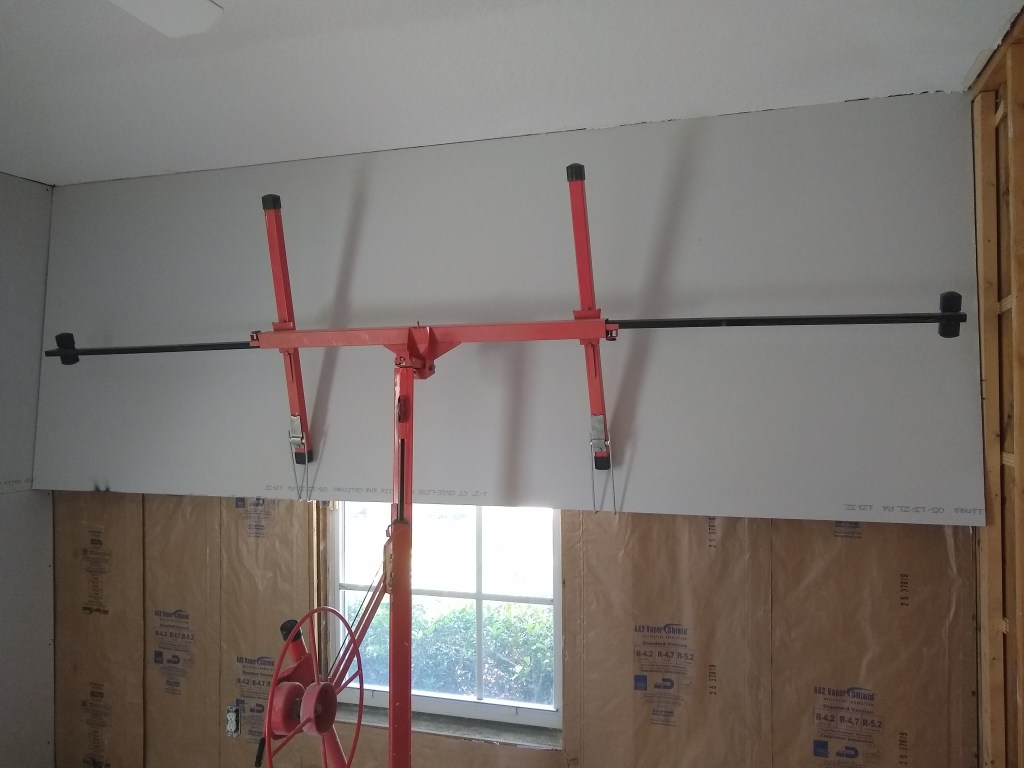
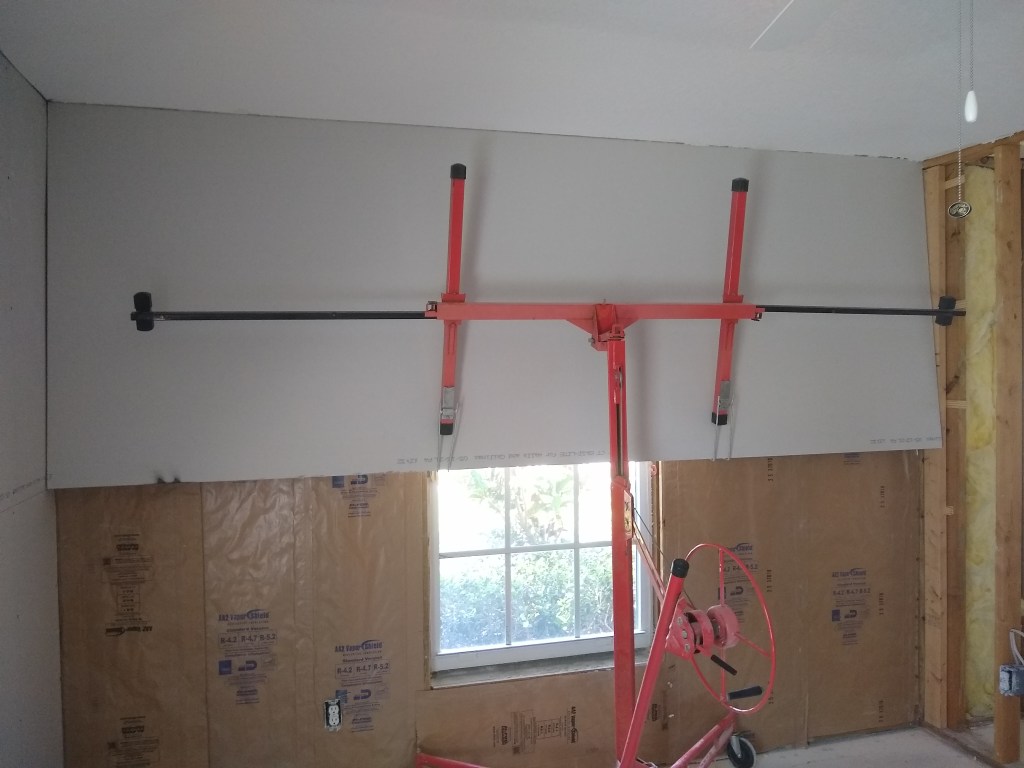
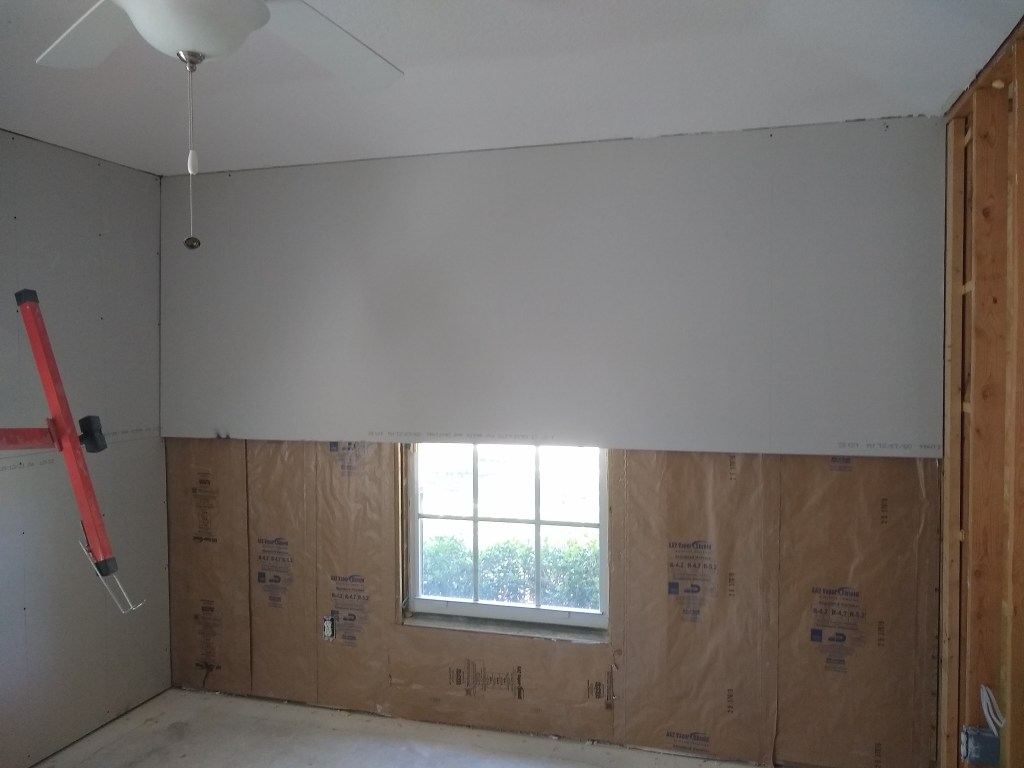
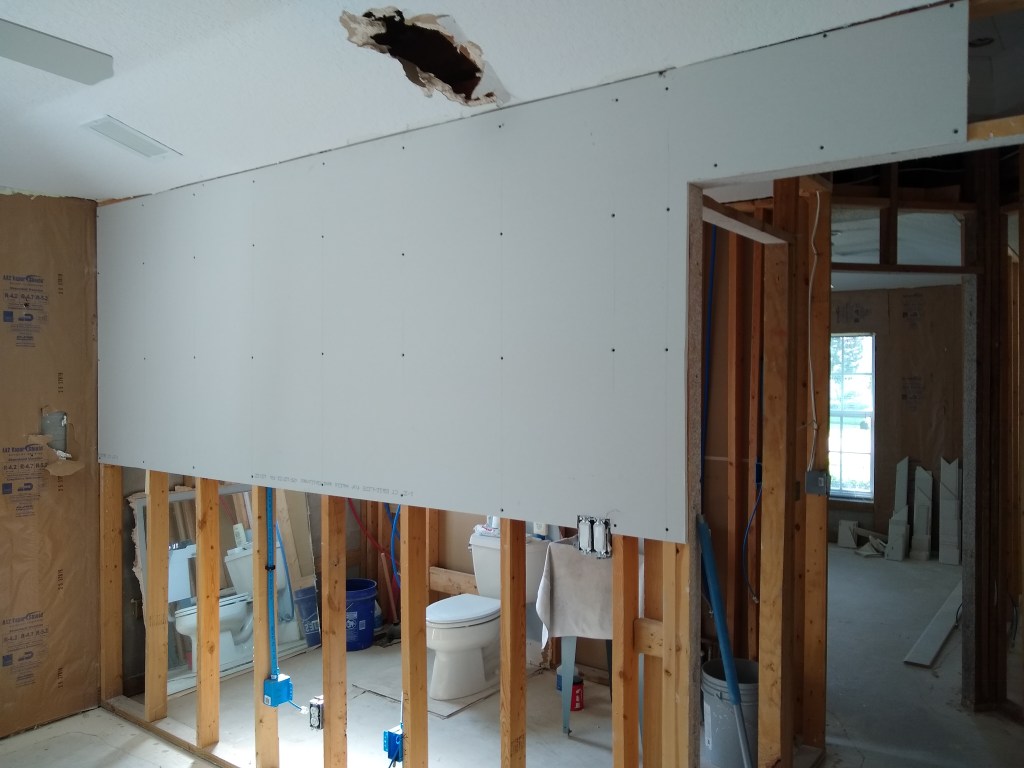
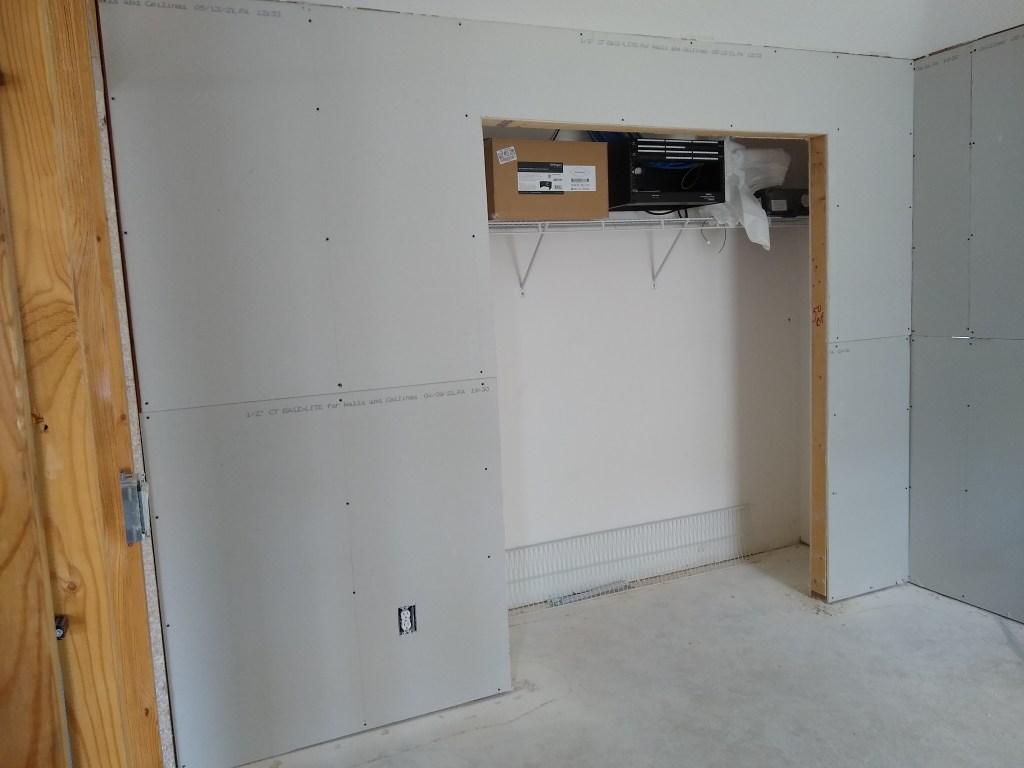
Once that was done I started hanging drywall. I started on the south wall.

South Wall

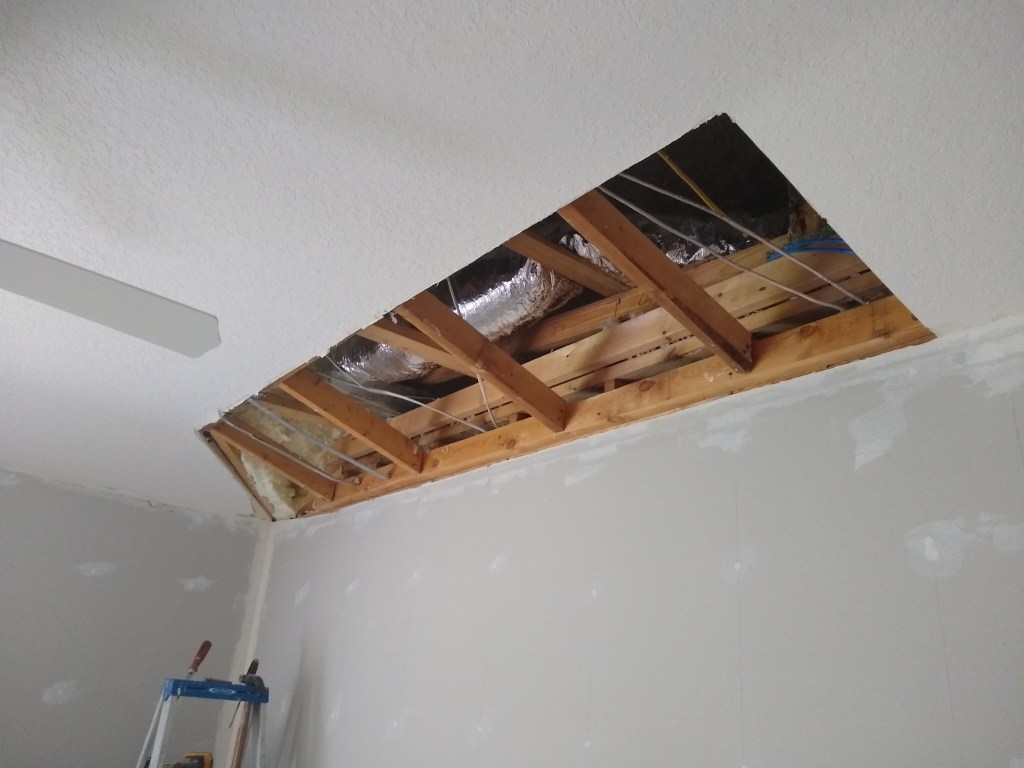
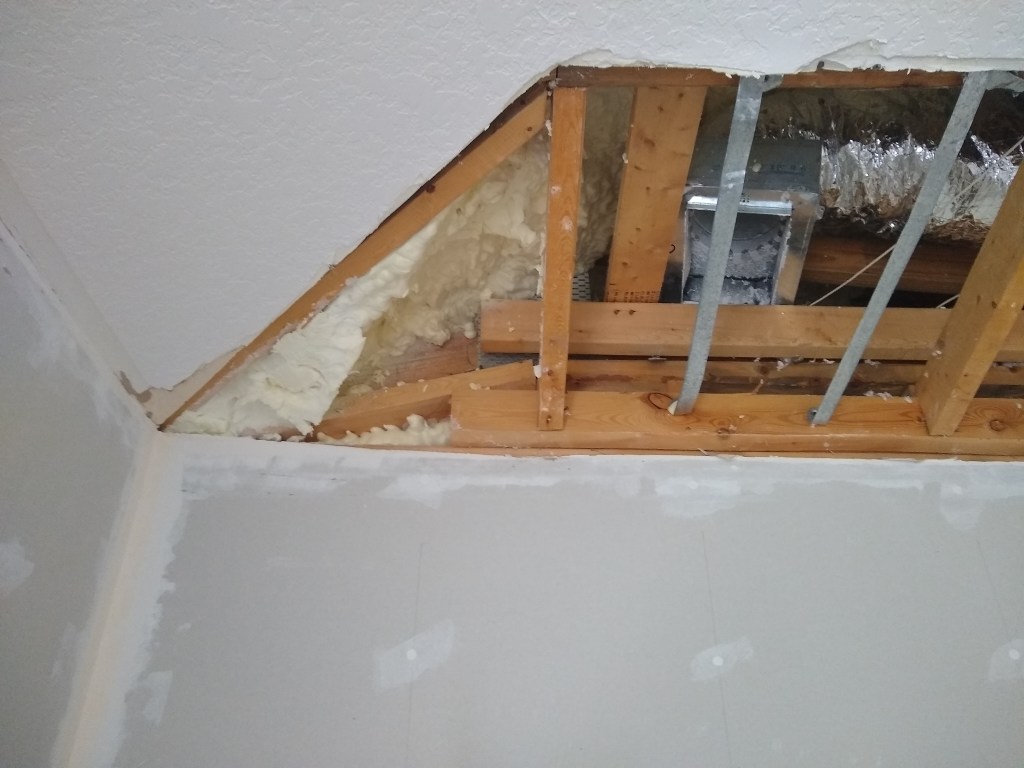
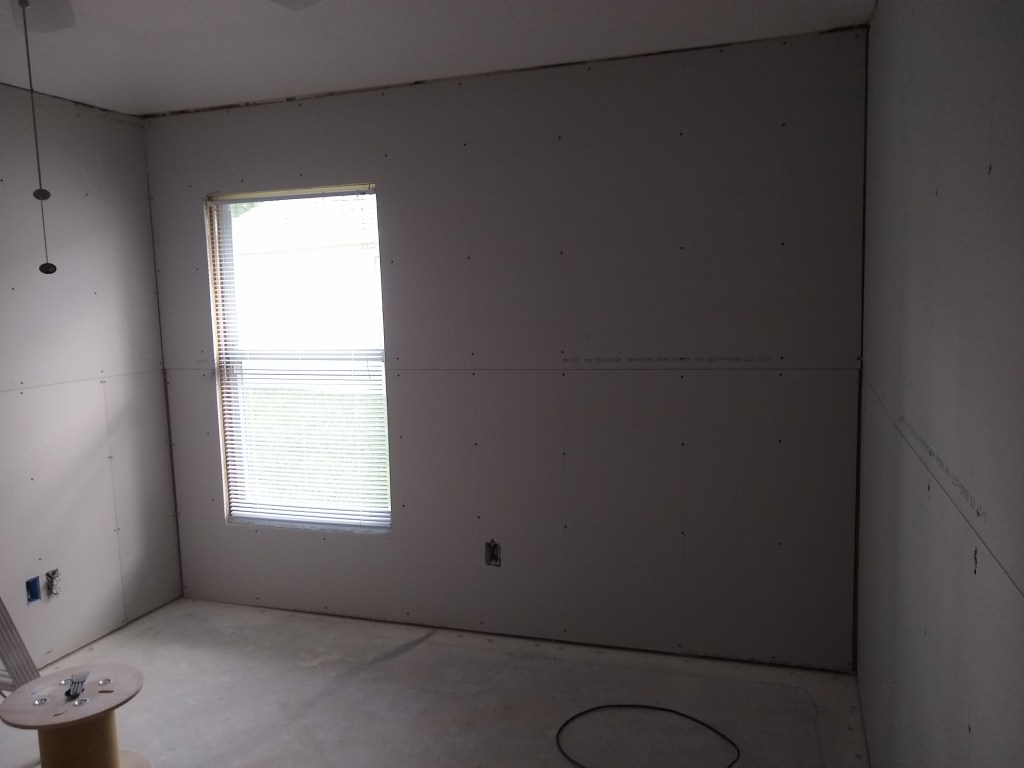
The next day I worked on the west wall, which required I first add a patch to the ceiling where I previously opened it up to feed the Ethernet cable.

West Wall

I used the two remaining 12 foot long sheets along the west wall so that I could limit the butt joints to above and below the window, so less work required when taping.

I continued in a clockwise manner to complete the room.

North Wall
Northeast Corner
East Wall

On the ceiling along the east wall I had to do another patch, again due to adding an Ethernet line.

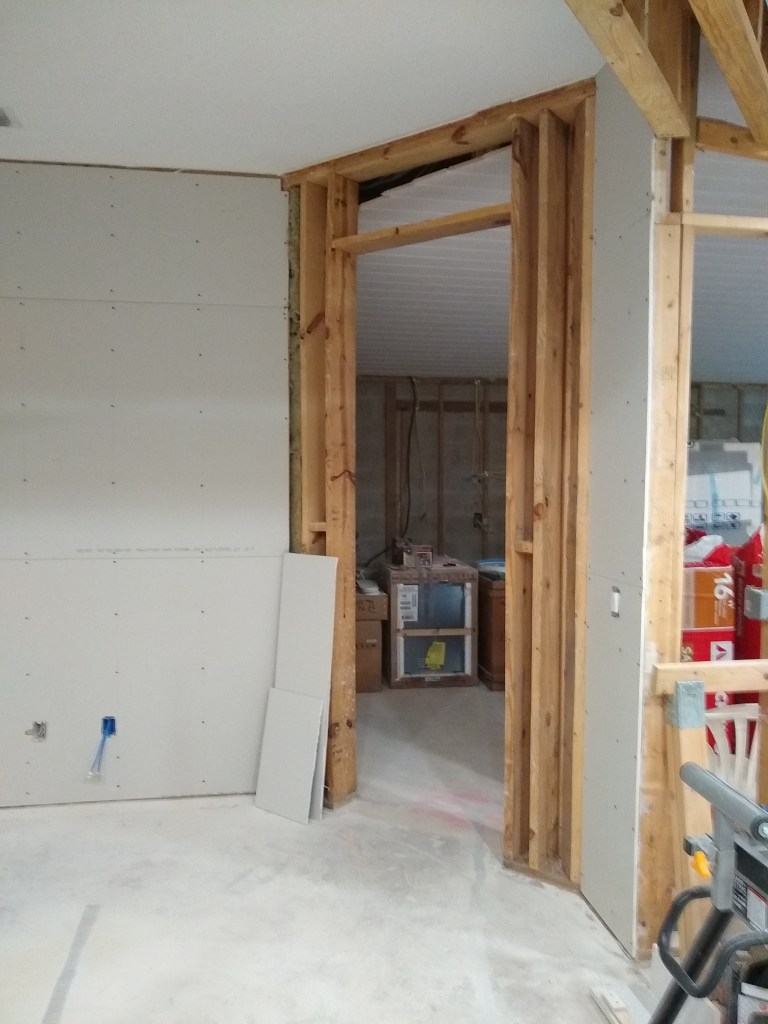
When the inspectors came to look at the master bedroom, I also had them look at the wall in the workshop that I framed. Recall that I originally hung drywall along the west wall of the workshop only to pull it down when I discovered that the entrance to that room was messed up. So I framed that wall as I did in the master and had the inspectors give me the okay on it too.

West Wall of Workshop Framed

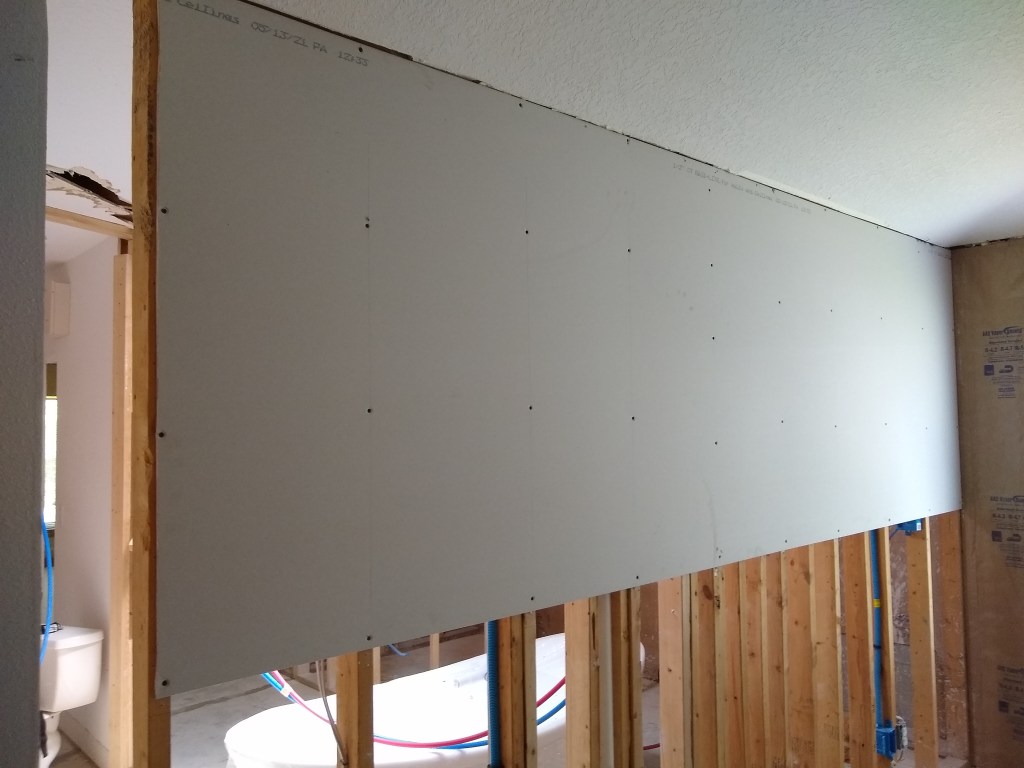
So I insulated and hung drywall along that wall next.

My next step will be to bring the inspectors in again to okay the drywall I just put up so I can begin taping and mudding. My preference was to call them in only after all the drywall was up, but with the poor response time from the designer, I am requesting inspections piecemeal so I can push on with the things I can control.

I will be off to Cancun for a few days to meet up with family and friends to celebrate a significant birthday of a family member, so I will resume work at the beginning of March.

Drywall Hanging Continued – November/December 2021

I was planning to post this only when I had finished hanging all the drywall, with the exception of the master bedroom and bath (haven’t decided what to do there yet), but I ran into a snag in the kitchen that will require the assistance of an electrician. This required me to stop for a bit, so I decided to use the time to catch up on this. I am writing this in early January of 2022, but the work I will be describing took place in November and only the first week of December. After that I took several weeks off and visited family and friends to celebrate my 60th birthday and the holiday season.

At the end of the last post, I had finished hanging the drywall in the dining room. From there I began with the hallway by the guest bathroom. Unfortunately, I only have a couple of pics from that.

I think I neglected to take more pictures because I ran into a problem along the way that took my attention away from picture taking. In the image above, the intersection between the drywall and the ceiling at the inside corner was not square. This left a gap (not shown here because this picture was taken after I fixed the problem). I was aware of the gap, but thought it was small enough to be covered up by the thickness of the drywall. I should have measured it to be sure, because I was wrong. So I had to come up with a solution. What I did was fashion an special piece of left over finger pine (the white wood used for the coffers) and glued it to the existing piece. I wasn’t concerned about the joint, as wood glue is very strong and more than sufficient for the job. I was concerned about how to clamp the new custom piece to the existing board. Fortunately there was a joist right next to where the new piece would be placed, and I was able to use wedges to maintain the pressure as the wood glue set. The tricky part was to get the butt joint lined up properly, but I managed it. With that in place, I moved to another area to resume drywall hanging so the glue could set up undisturbed.

Some time ago I hung the drywall on the ceiling of the foyer. I was not happy with the results because there was a dip in the center. The joists were not properly aligned. I thought I had addressed this problem a long time ago, but it was not sufficient. It was not really noticeable by eye, but it bothered me. So I pulled down the drywall and got busy creating furring strips to level the joists. With the aid of my thickness planer, this made all the difference. I rehung the drywall I pulled down and was happy with the result.

Foyer Ceiling – first attempt

I labelled the above picture “first attempt” because it is the only clear image I have of it. This is the uneven ceiling before I pulled it down. I included it because, as I mentioned above, you can’t tell that it is uneven from the picture (it dips down in the center), so it’s what you would see if I had a clear image of the correction.

After hanging the foyer ceiling, I returned to the hallway where the glue for the repair was fully set. I finished hanging the drywall there. The pics shown above of that hallway are all I have (sorry).

I then went back to the foyer and started on the walls.

I also ran a second wire from the first to accommodate two sconces. I completed hanging the drywall in the foyer over the next couple of days.

The next step was to work on the long wall in the great room. I’ll call it the Great Wall from now on. However, before doing this I had to do some reorganizing of the workplace as the drywall was stacked in front of the Great Wall.

I moved the many 2x4s that lay along the base of the Great Wall and stacked them in the dining room as shown. I also moved the 12 foot sheets of drywall to the dining room. I left the 8 foot sheets where they were (as shown above) for the time being, as they were not in the way to start the hanging. Once I completed part of the Great Wall, I would move them.

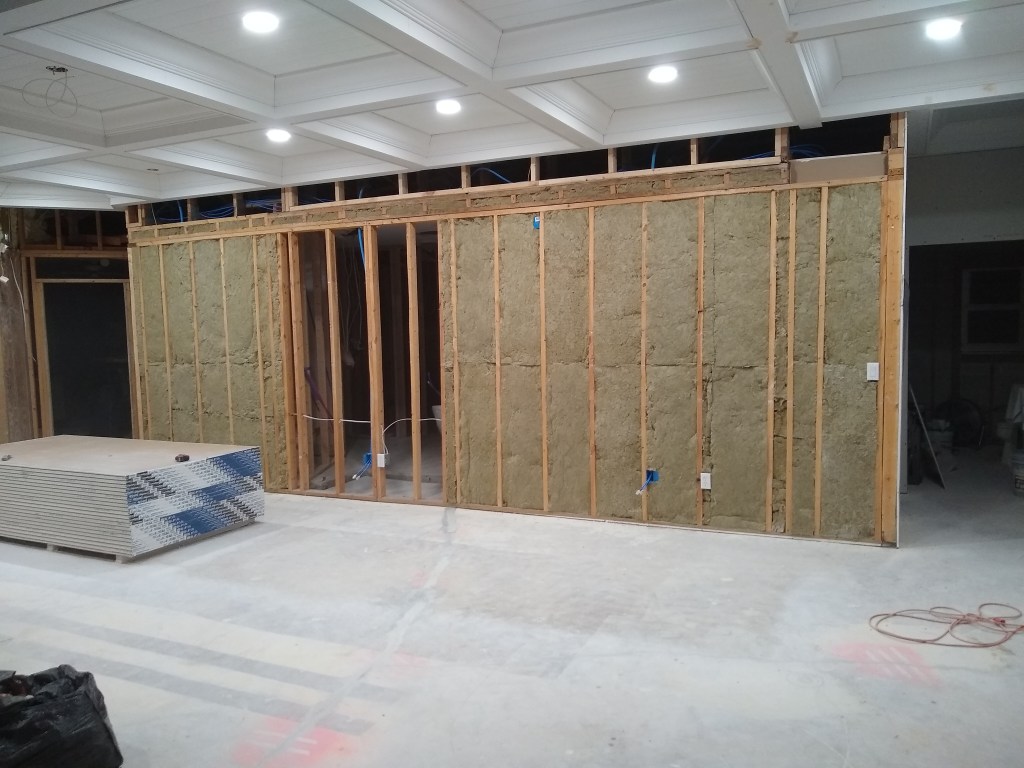
Before I could hang any drywall along the Great Wall, I had to put up the sound insulation.

Great Wall Sound Insulation.

The section missing sound insulation looks through to the master shower area. That will be filled in before I put the board up on that side.

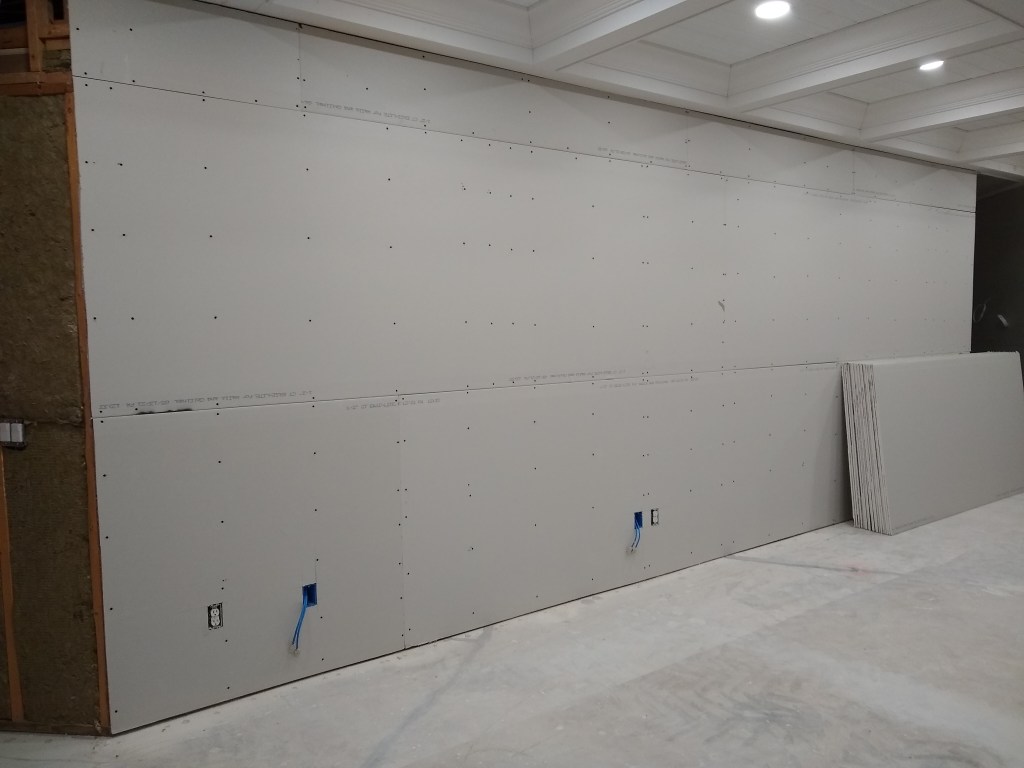
I started hanging drywall along the Great Wall by doing the top section first (approximately a 2 foot strip). I then added the first 12 foot sheet.

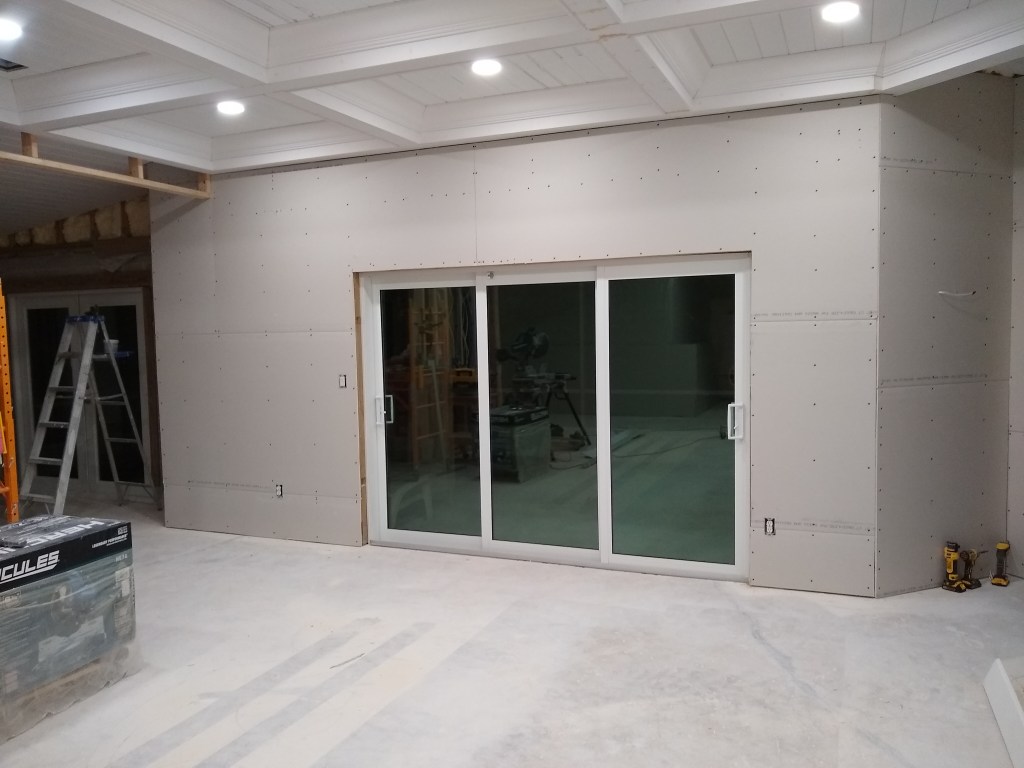
Started Hanging Great Wall.

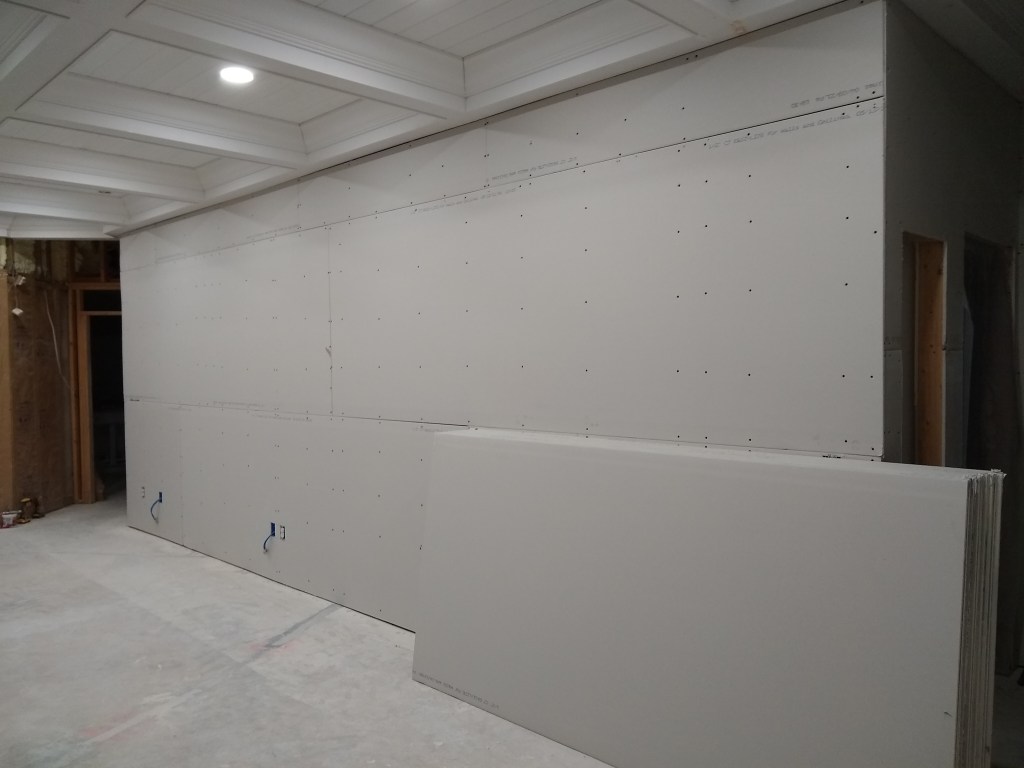
The next day I completed the Great Wall and in the process relocated the 8 foot drywall sheets so that they were out of the way.

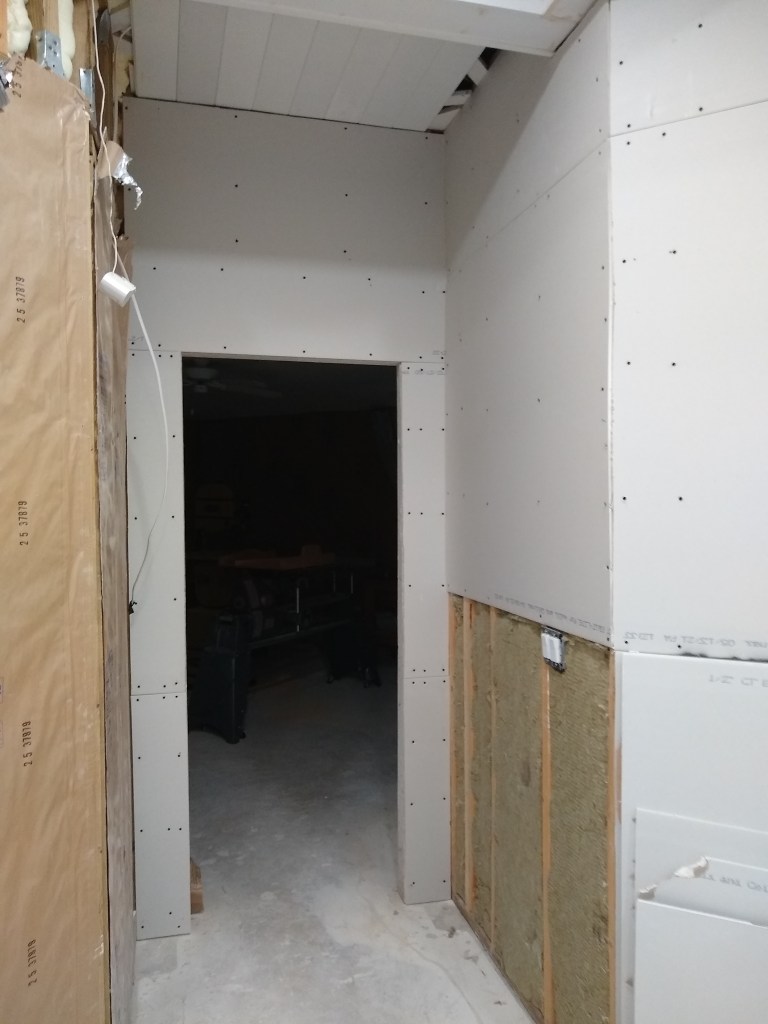
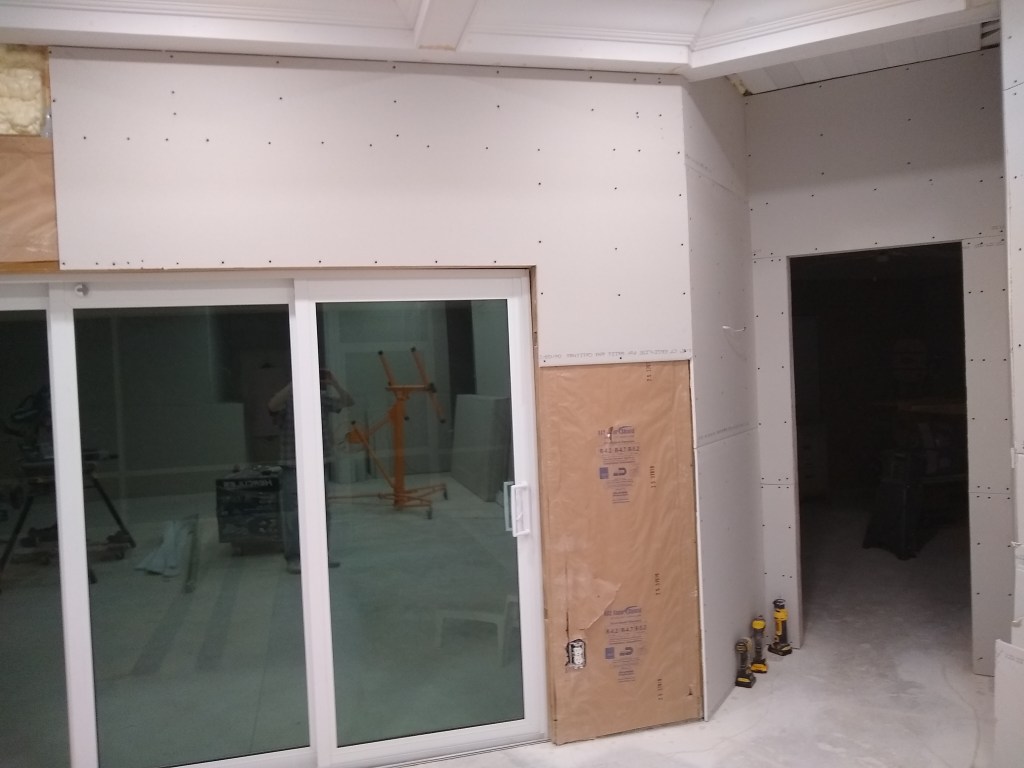
I moved onto to the entrance to the master bedroom and then to the south wall of the great room.

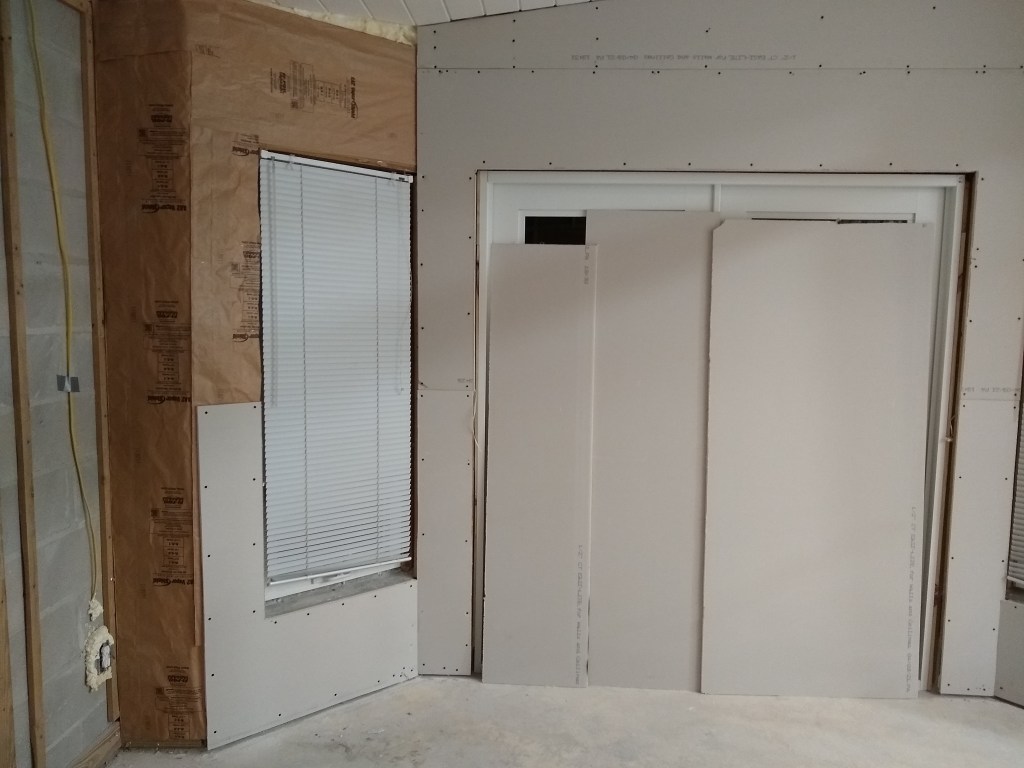
Next up was the area around the french doors. To accommodate the french door installation, I had to remove most of the vapor barrier, so that had to be replaced before hanging the drywall. That’s the brown paper you see on the third image.

When the french doors were installed, I no longer had any window covering to provide privacy, so I am using a few drywall off-cuts to do the job. Although it is pretty private in the back, I have a lot of valuable tools strewn about the place, so I don’t want to advertise.

Before hanging any drywall on to the east kitchen wall, I had some more vapor barrier to install.

The next section of the east kitchen wall required a bit of thought because it is where most of the appliances and cabinets will be, so I decided to forego that for now and tackle the north wall of the kitchen because it would be easier. I added sound insulation and started hanging.

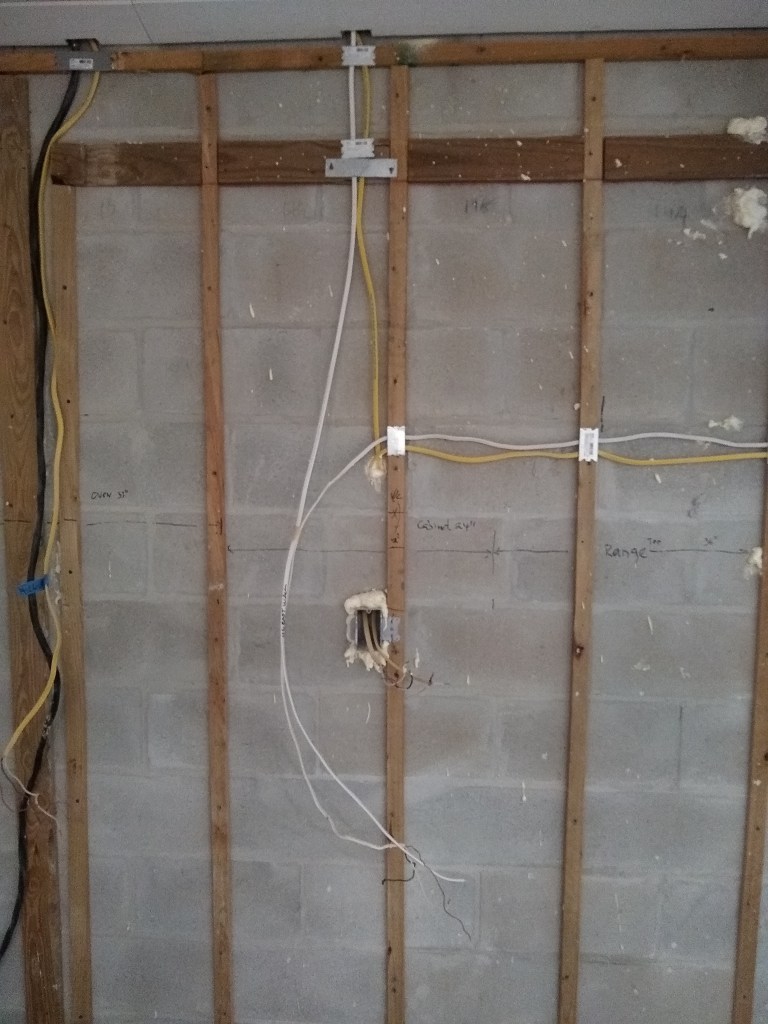
It was time to prepare the east kitchen wall. This involved verifying I had the wiring I needed and adding nail plates to protect them from errant drywall screws and such.

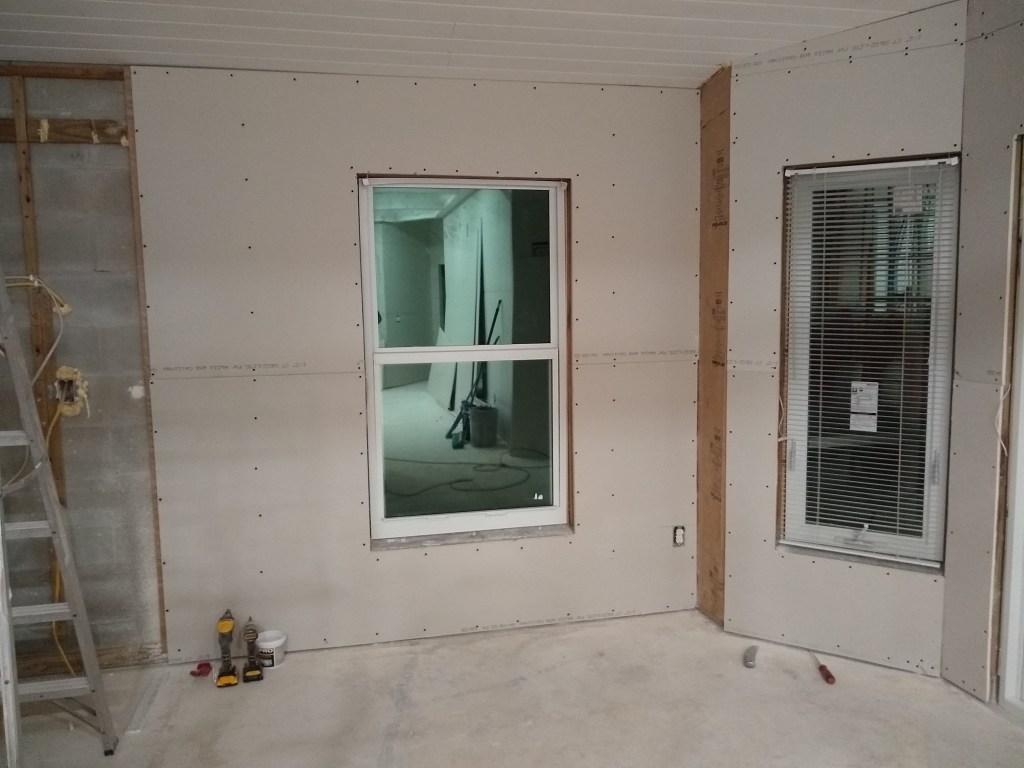
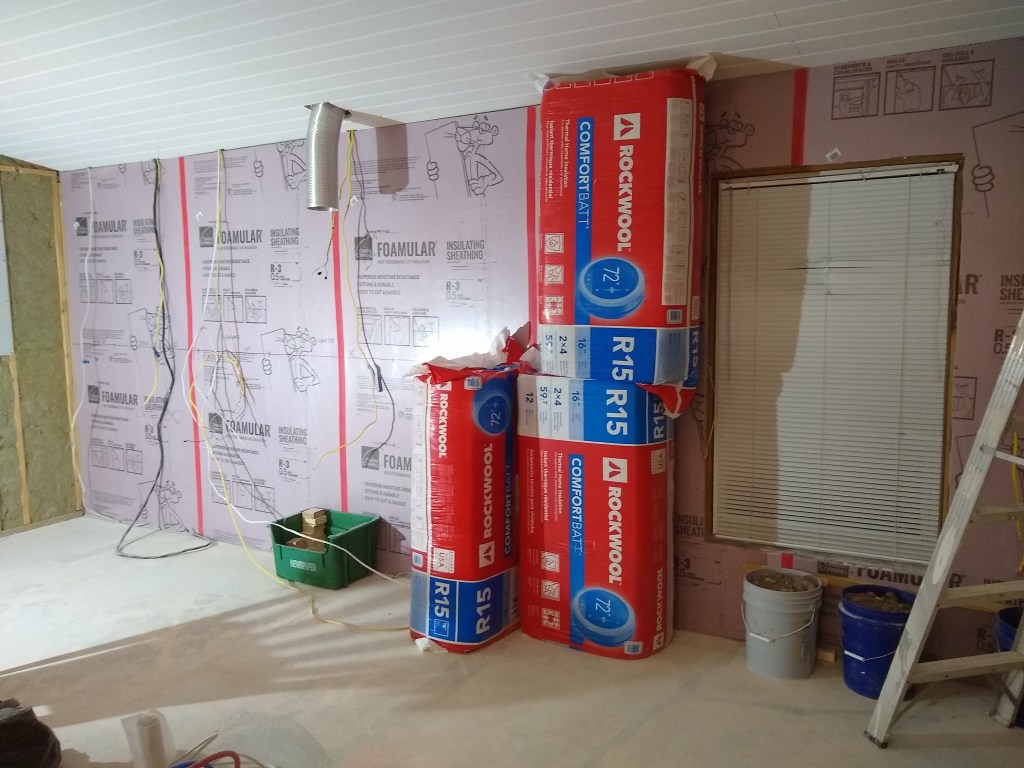
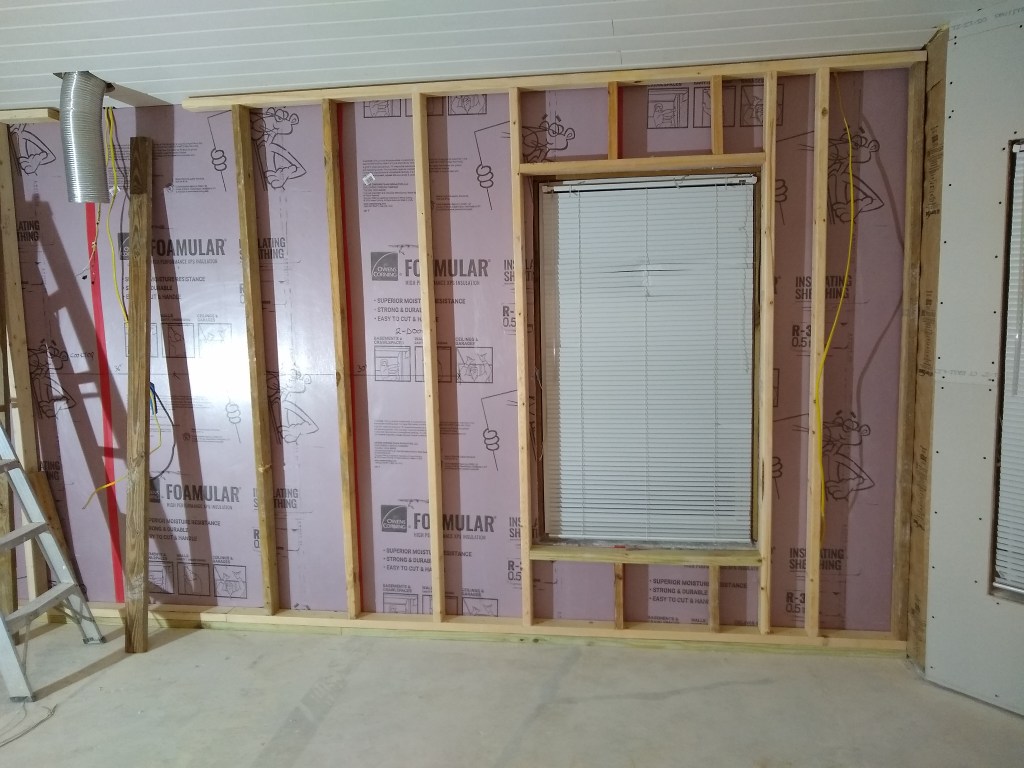
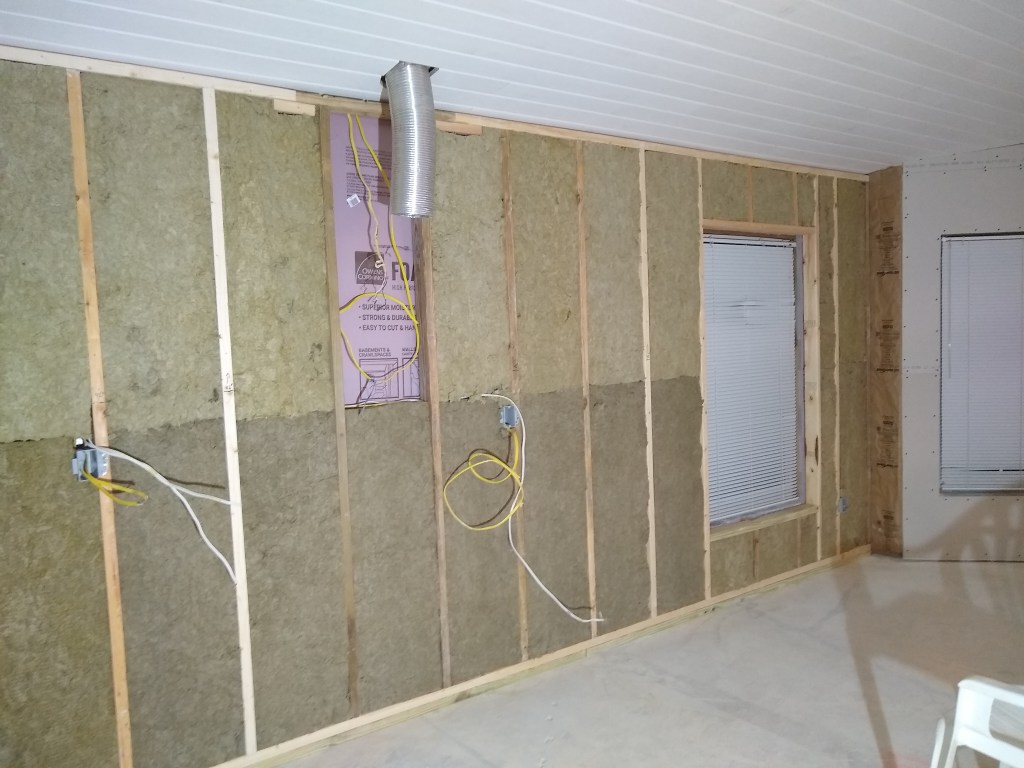
Even while prepping the wall, I was not entirely comfortable with the arrangement. The wooden strips you see anchored to the concrete block are only 3/4 of an inch thick. That is probably sufficient for hanging the drywall and cabinets, but is very limiting in terms of adding outlets and running wire. You’ll notice that the two outlets shown above are actually recessed into the concrete block. That is, sections of the block had to be broken to make room for the outlet boxes. So I toyed with the idea of re-framing the wall using 2x4s. The 2x4s would reduce the kitchen area by 2-3/4 inches along the length of the wall, but would provide a much stronger wall and provide ample room for running wire. I could even add some proper insulation. The loss of space was negligible, so it didn’t really factor into my decision. The effort (and cost) versus benefit was the main consideration. After some serious deliberation, I decided to do it.

The first job was to remove the drywall I had already put up around the window and all the furring strips and outlet boxes.

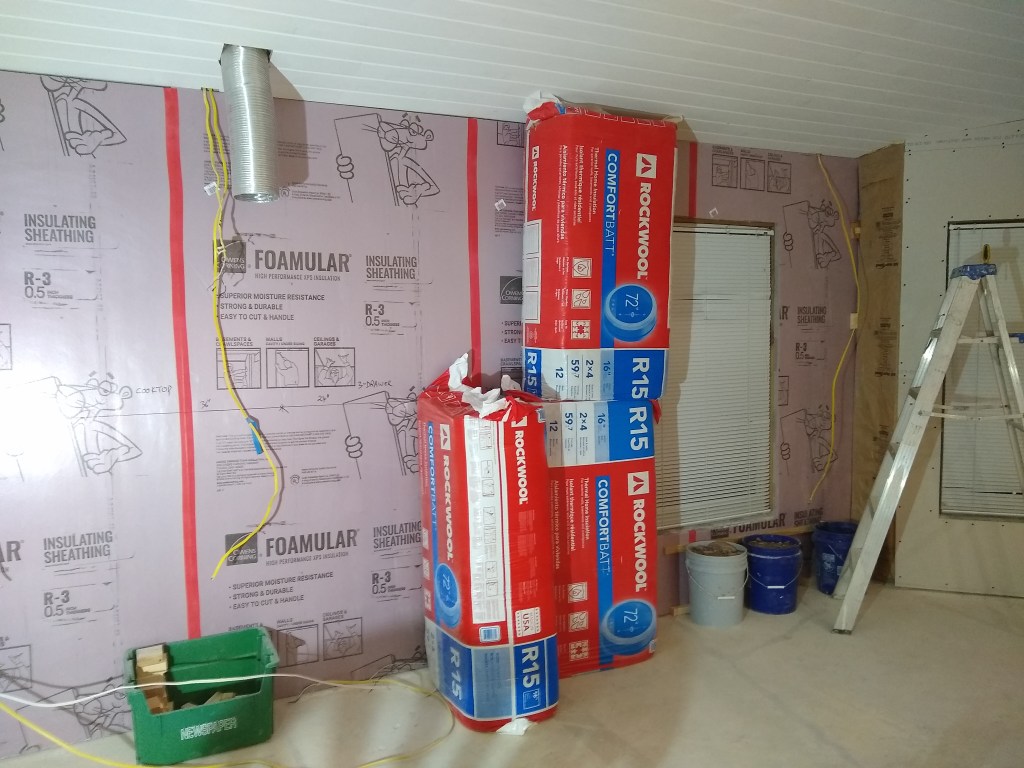
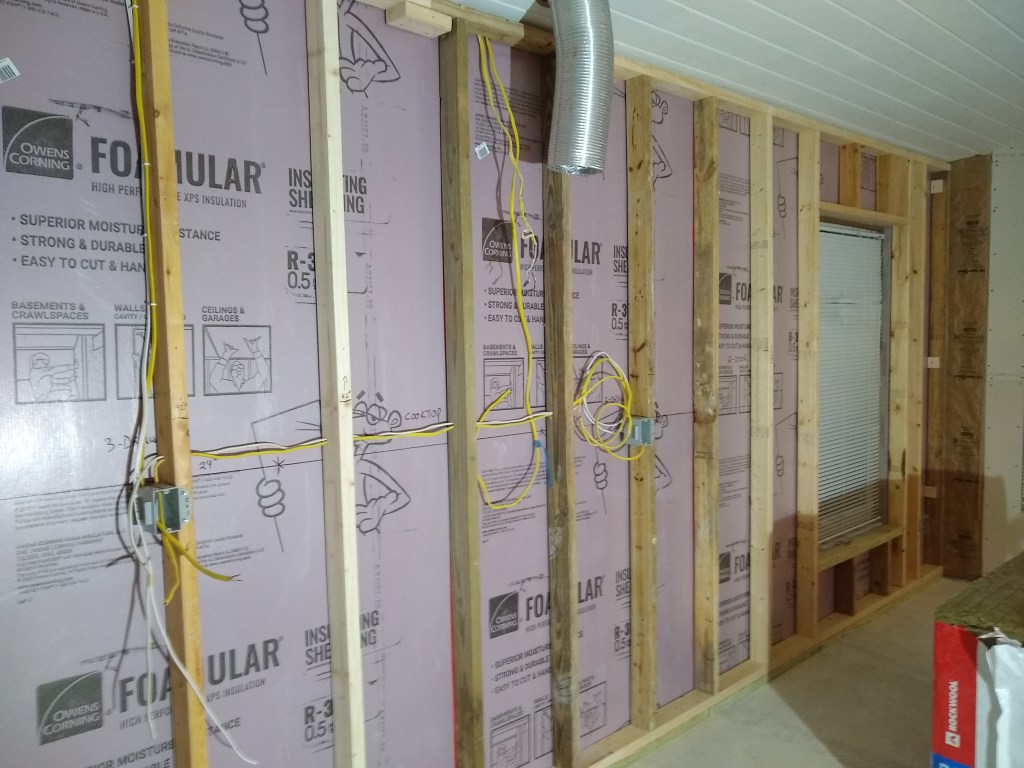
In the images above, you can more easily see the openings in the block to accommodate the outlet boxes. These openings will be covered by sheets of foam-board that I would glue to the concrete block before framing the wall. They provide minimal insulation, but serve well as a vapor barrier.

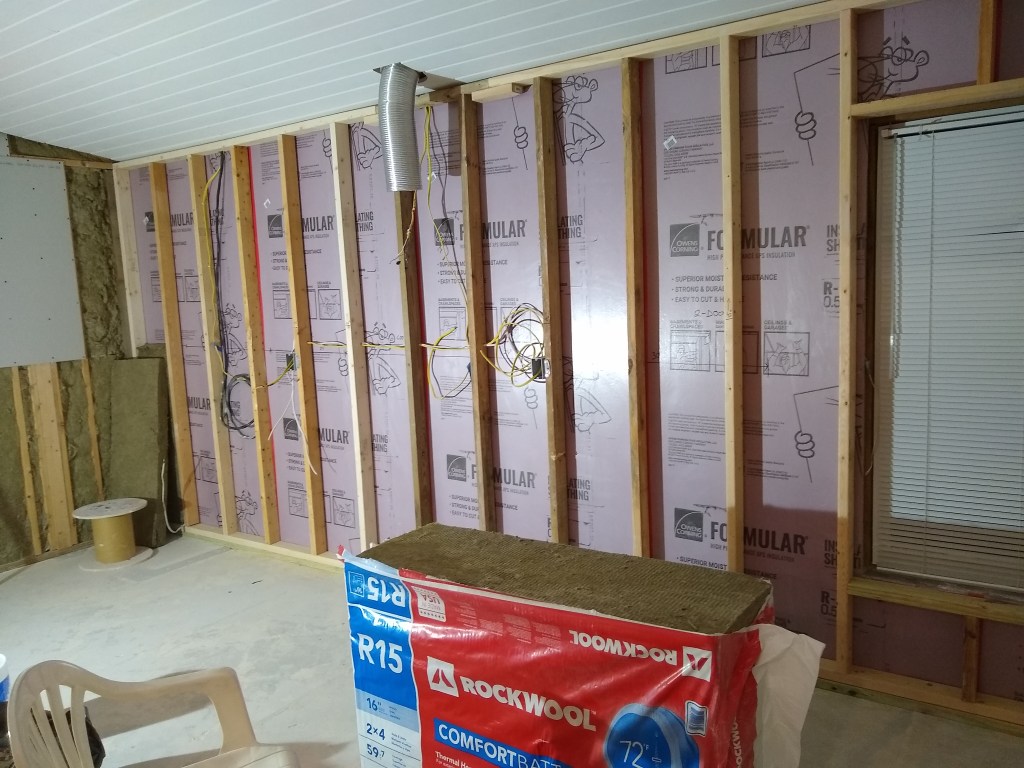
The red bags of R15 insulation shown above will provide the real insulation along that wall. In the images above, I’m leaning them against the foam-board to apply pressure while the glue sets.

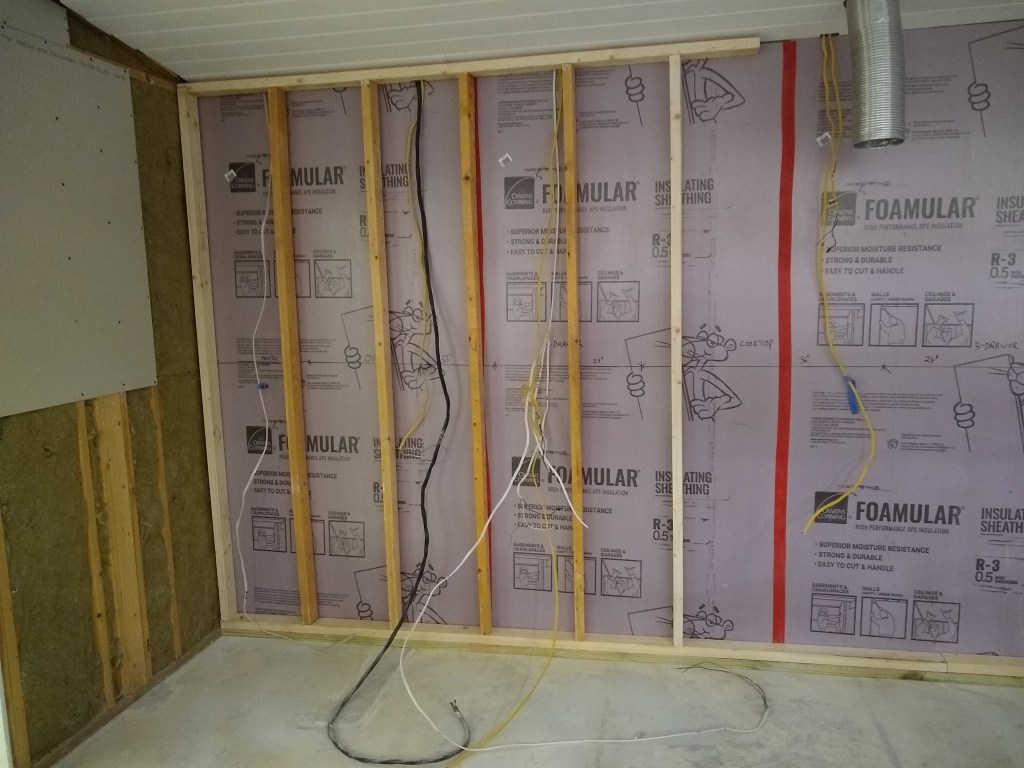
The next day I started framing the wall. I started by putting down a base plate of pressure treated 2x4s, which I secured to the concrete slab using TapCon screws. The rest of the framing built upon it.

Start of Framing.

Notice that I did not complete the drywall hanging on the part of the north wall adjacent to the east wall. This was because I needed to have the east wall figured out before I would know how far to place the drywall. So that part will be completed only after drywall is hung on the east wall.

After completing this section, I moved to the opposite end and continued from there.

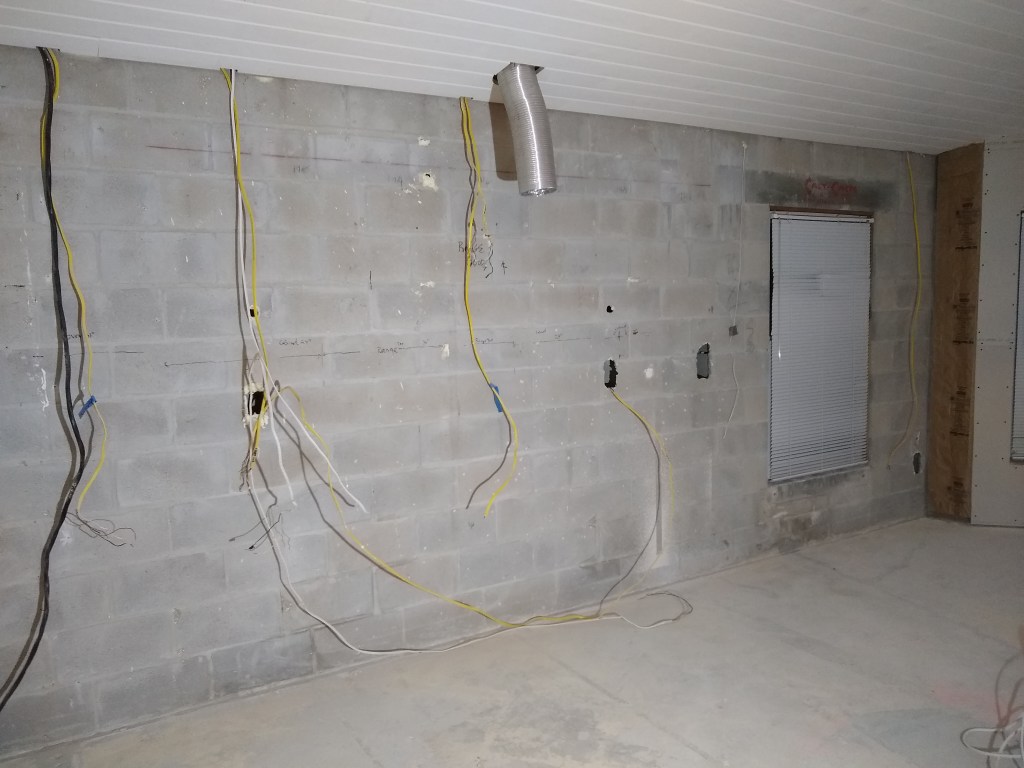
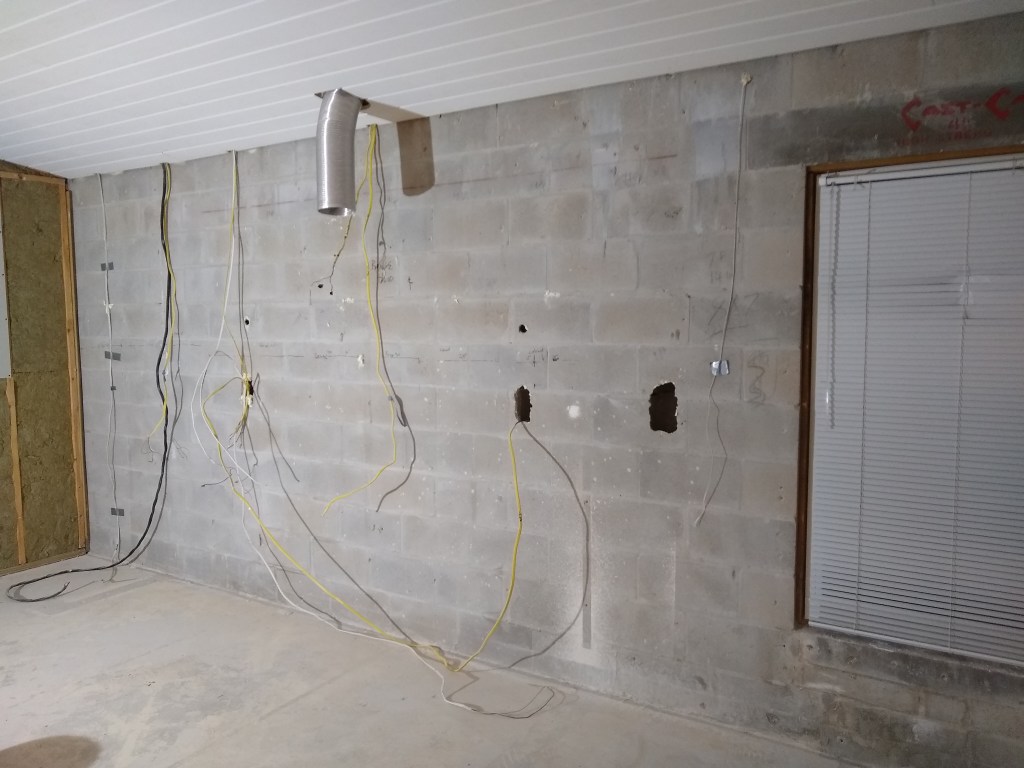
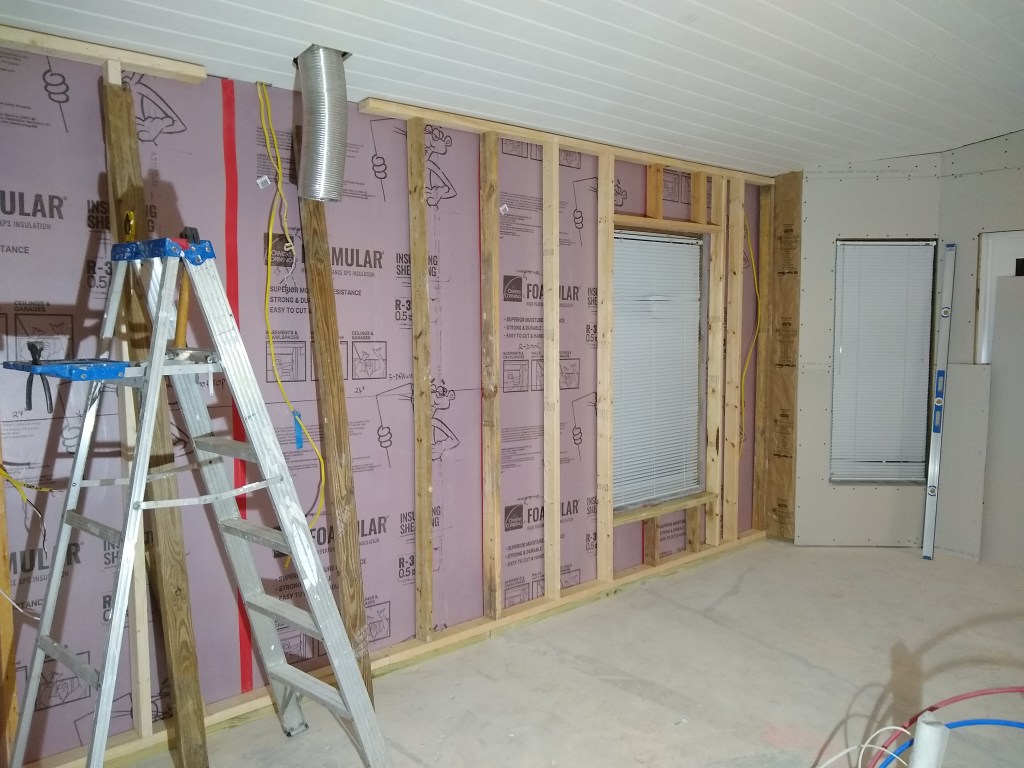
Because of the vent hanging down in the middle, I could not frame the entire wall at once. I had to do it in three sections, leaving a small section for last that I could slip around the vent. I had quite a few 2x4s left over from demolition long back. I was able to make use of almost all of them here. You can see that in the different colors of the vertical pieces.

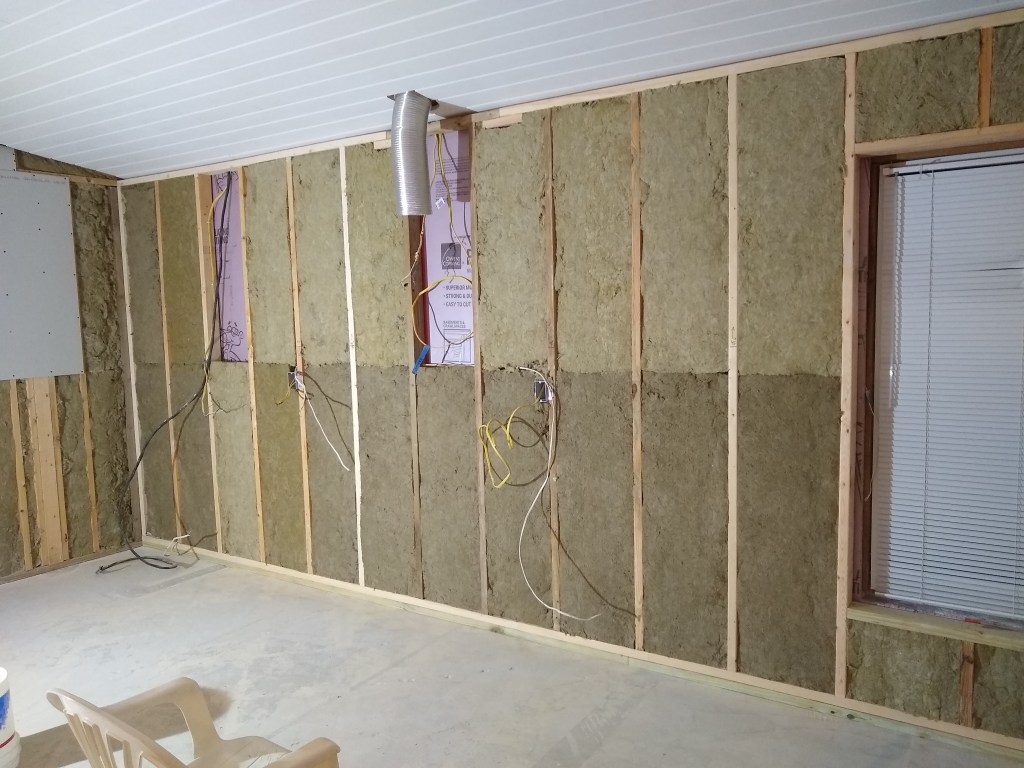
With the wall framed, I added new outlet boxes and drilled holes in the vertical members to accommodate the wires. I also added the insulation.

I left a couple of sections bare because I still had to figure out exactly where the wiring for the oven, microwave, cook-top, and vent hood would have to emerge from the drywall. But that would have to be figured out in the new year, because I was about to stop work for the holidays.

When I returned from vacation, I thought I would get right back to it, which I did until I hit a snag. I discovered that the cook-top required a 240 volt line, not the 120 volt I had assumed. Silly of me not to notice. When speaking on the phone with an electrician, I learned that it would have to be a separate line from the one feeding the oven. I was prepared to run the new line from the existing one, but was not comfortable introducing a new line from the breaker box. For that I will get an expert, whom I will meet tomorrow. In the next post I will describe what transpired and hopefully will show more drywall in place.

Windows, Move, and Resuming Drywall Hanging – September/October 2021

It’s been a while since I put up a post. This was mostly due to the work involved in getting ready to sell my primary residence. In preparation for showing the house, I removed the wallpaper in the kitchen and painted it. That took about a week and was no small task. But it was worth it. I was happy with the result and it lead to a very good showing (I’m not going to post pictures – sorry). The house received above asking offers immediately. I accepted the highest one and set a closing date of October 26th (which I later moved up to October 19th).

While that was going on I was looking for a place to live near the renovation. I wanted to buy another house rather than rent so that I did not have to worry about the time I spent working on the reno. That is, if I rented an apartment, I would have a lease and therefore a feel the pressure to get the reno completed before the lease expired. Unfortunately, I was unable to find a suitable house to buy and ended up renting a one bedroom apartment. The good part was that the apartment complex was right next to the reno, so it would only take a couple of minutes to travel between places.

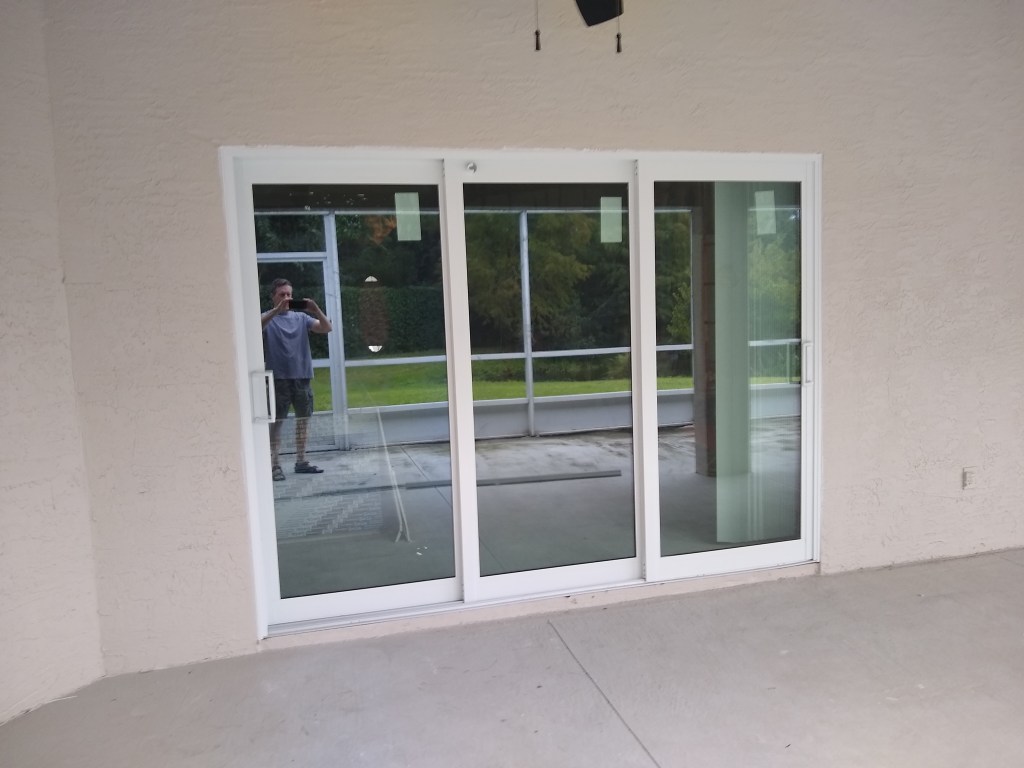
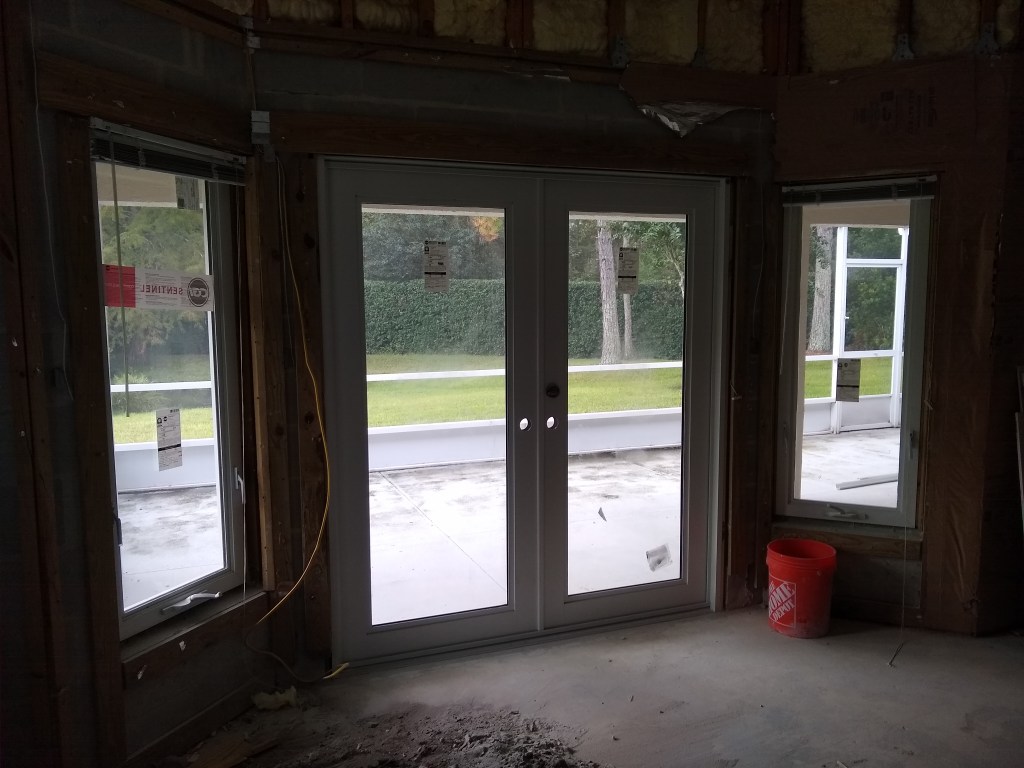
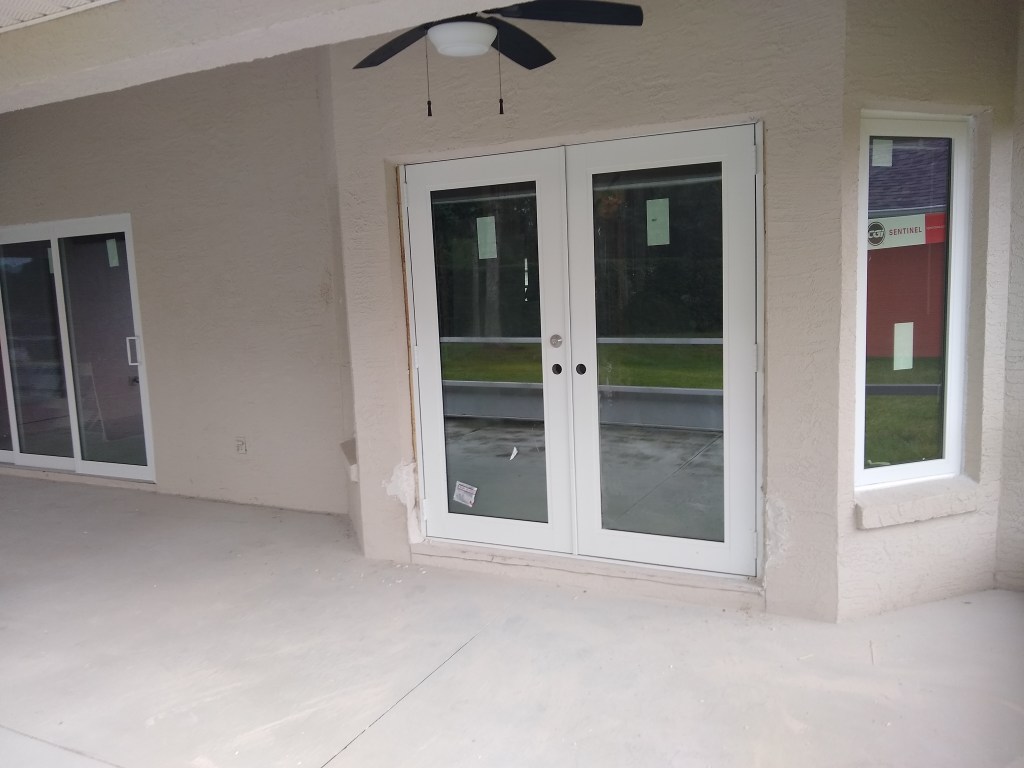
Also during that time (end of September), the windows were installed. That took a few days before it was complete, but I was happy with the results. Here are a few images.

I took these pictures before the work was finished, which is why you see no handle on the french doors and stickers on the windows, but you get the idea. Since these are impact/hurricane windows, they are quite substantial. As a result, there is a noticeable reduction in outside noise, which is very nice.

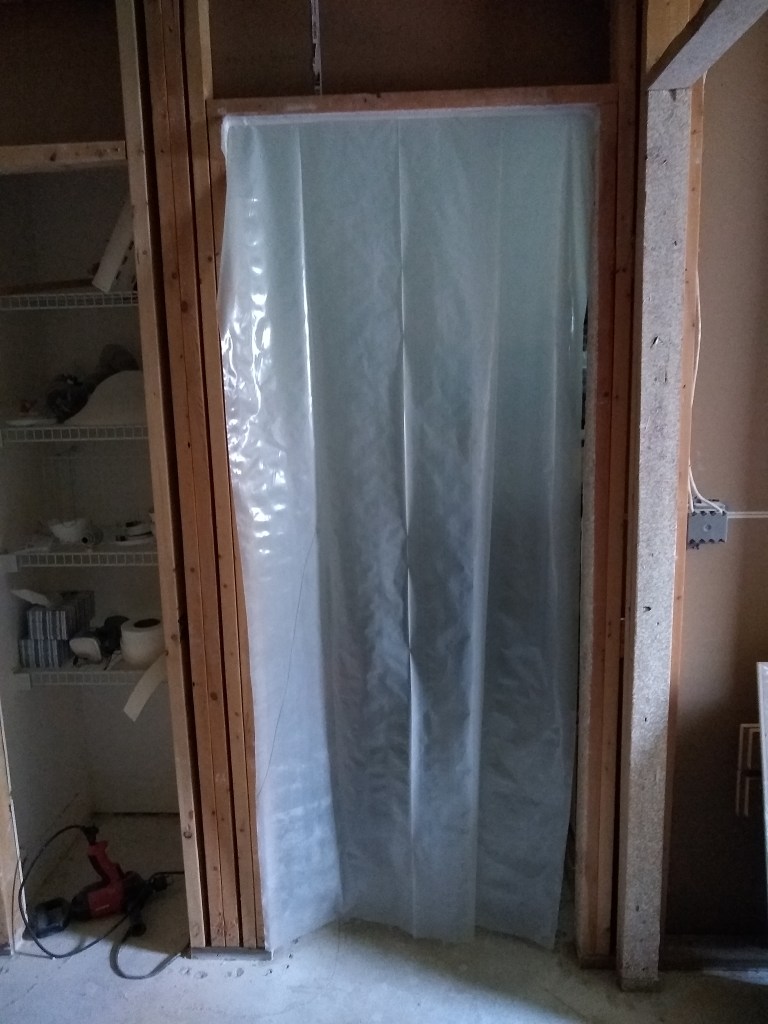
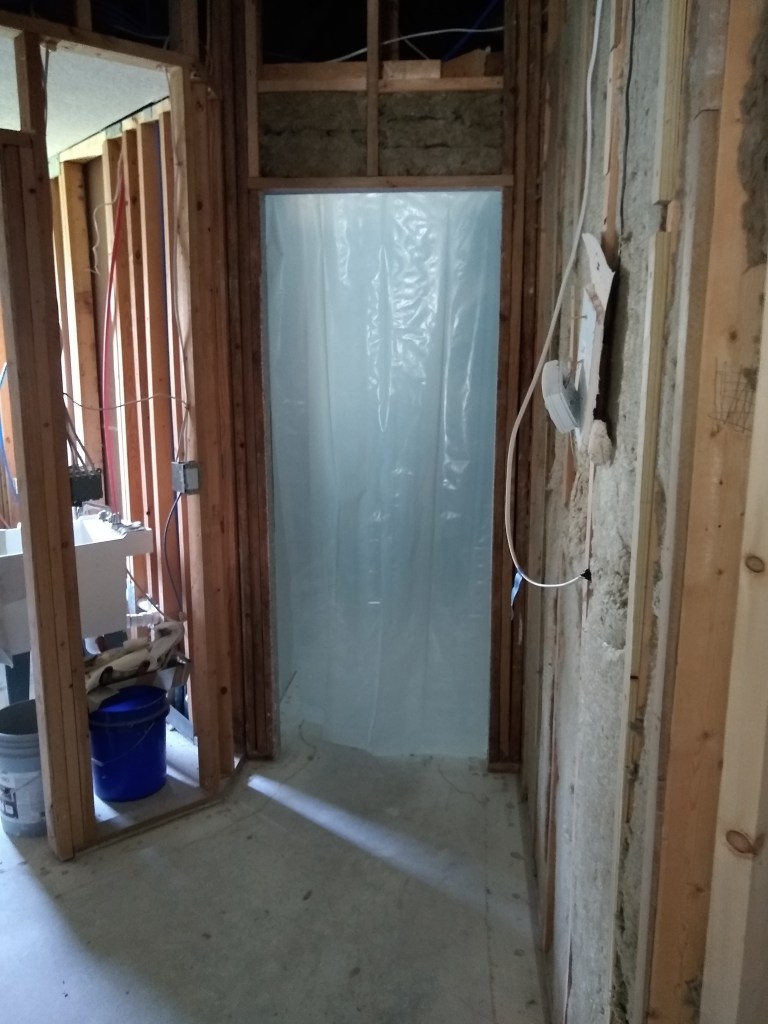
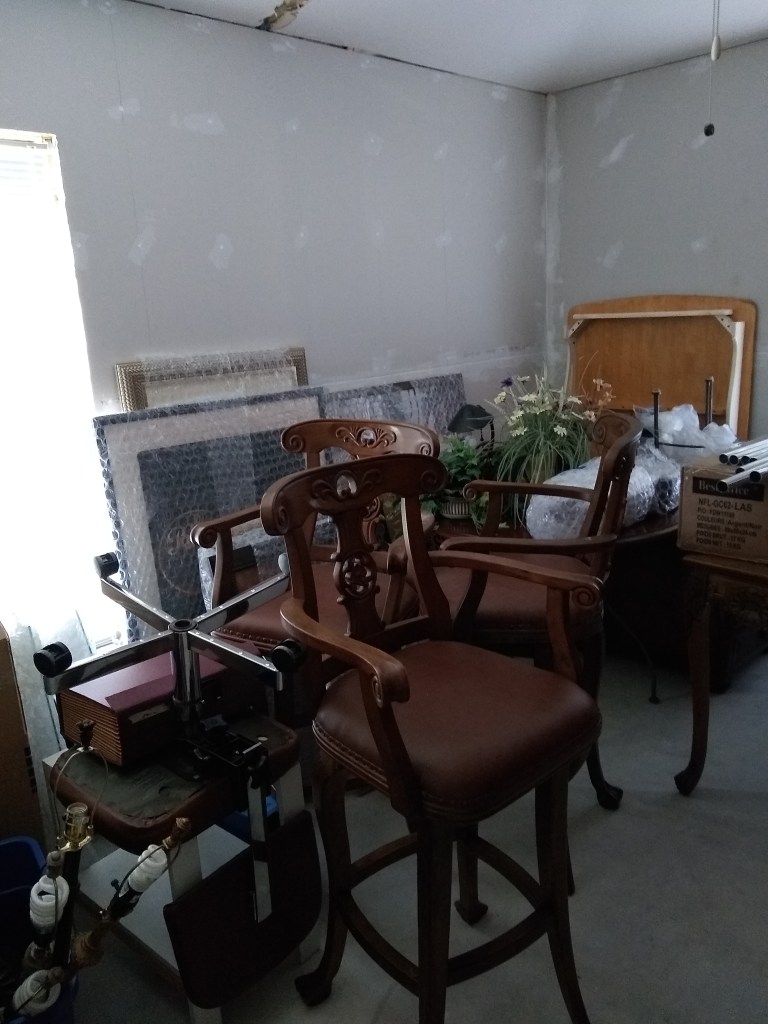
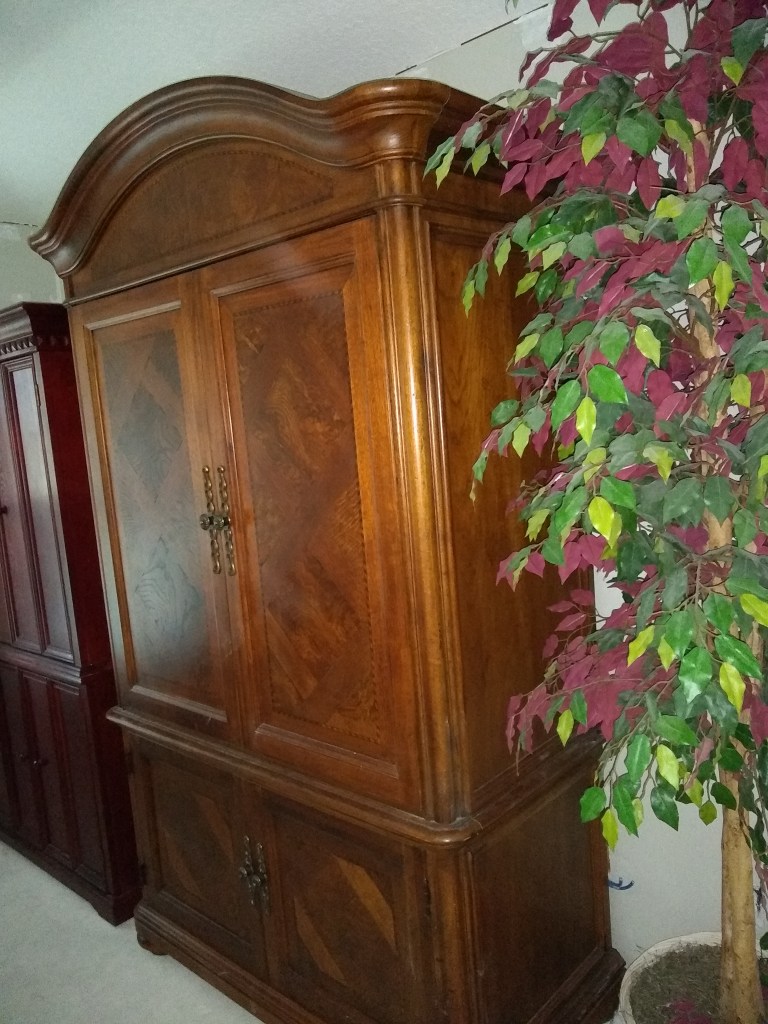
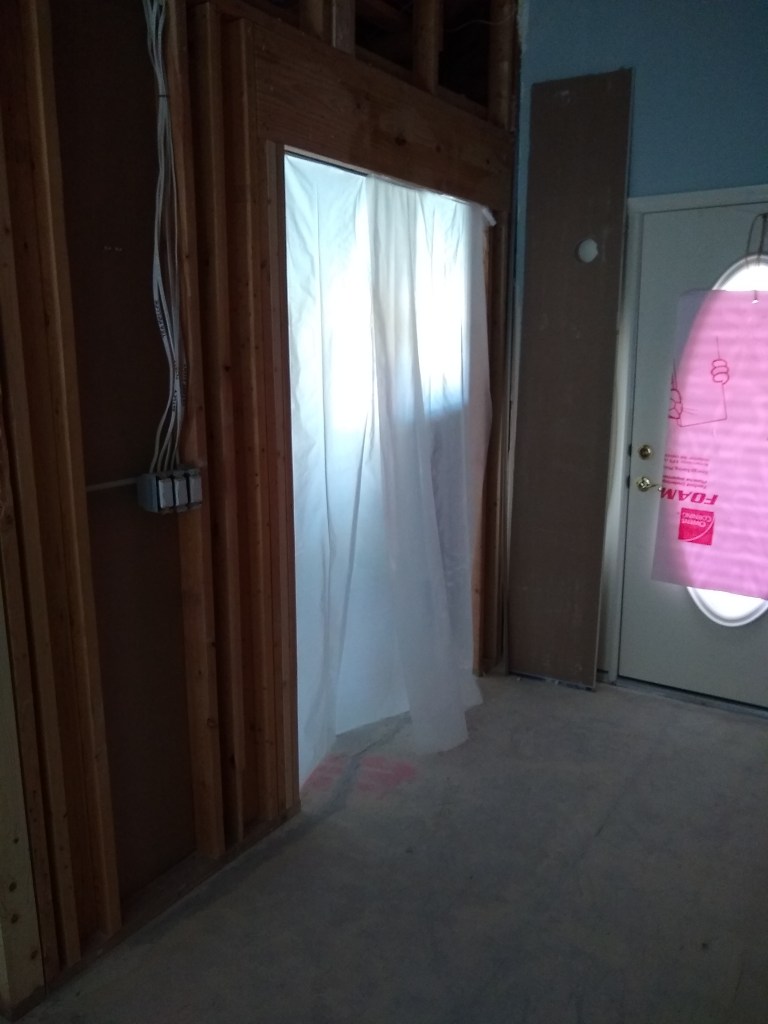
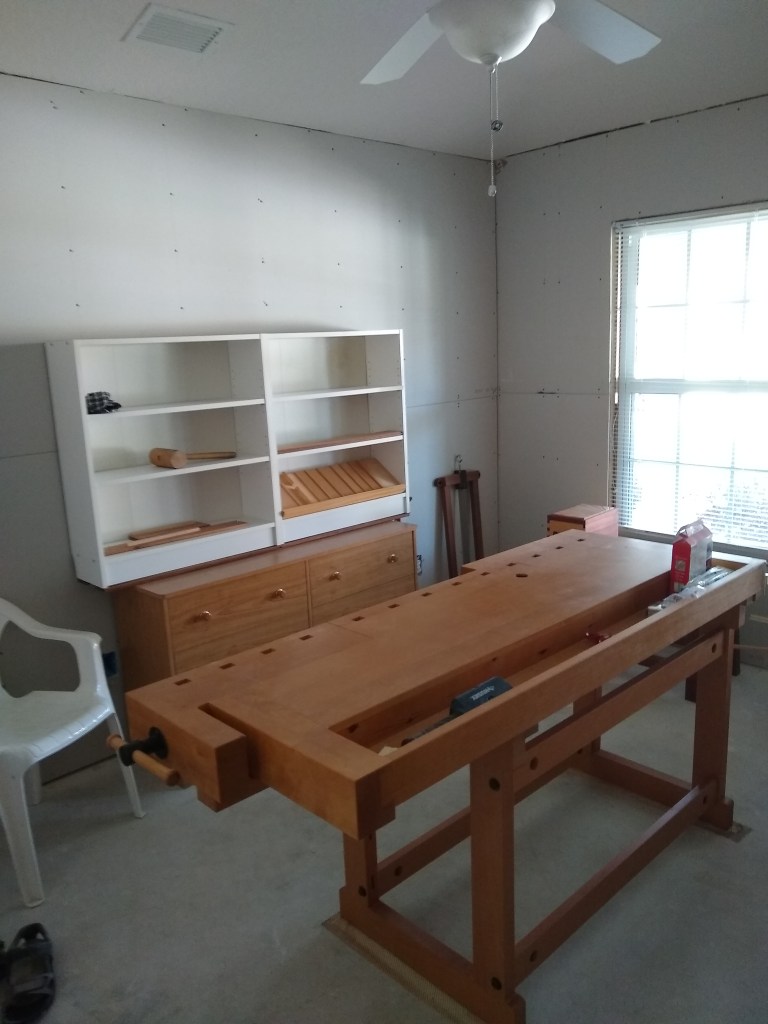
I was in the new apartment on October 16th and required a bit of time to settle in, but I got back to work on the house not long after. With most of my stuff from the move stored in three of the four bedrooms, my first job was to hang barriers to protect it from the dust. Below are some pics of the three rooms I used for storage and the barriers I put up.

I attached the plastic using Velcro, so they can be easily removed or adjusted.

With the move complete, the plan was to get back to hanging drywall. However, I was now without a drywall lift. I had been using a lift I borrowed from Chris, but he needed it, so I had to buy my own. This delayed my return to work by a few days as I awaited its arrival. Once it showed up, I started work in the foyer, beginning with the ceiling, but another problem arose that forced me to work elsewhere. I was in the process of planing down furring strips to even the ceiling joists when my thickness planer belt broke. I had to order another, which will take weeks, so I decided to move onto to the dining room.

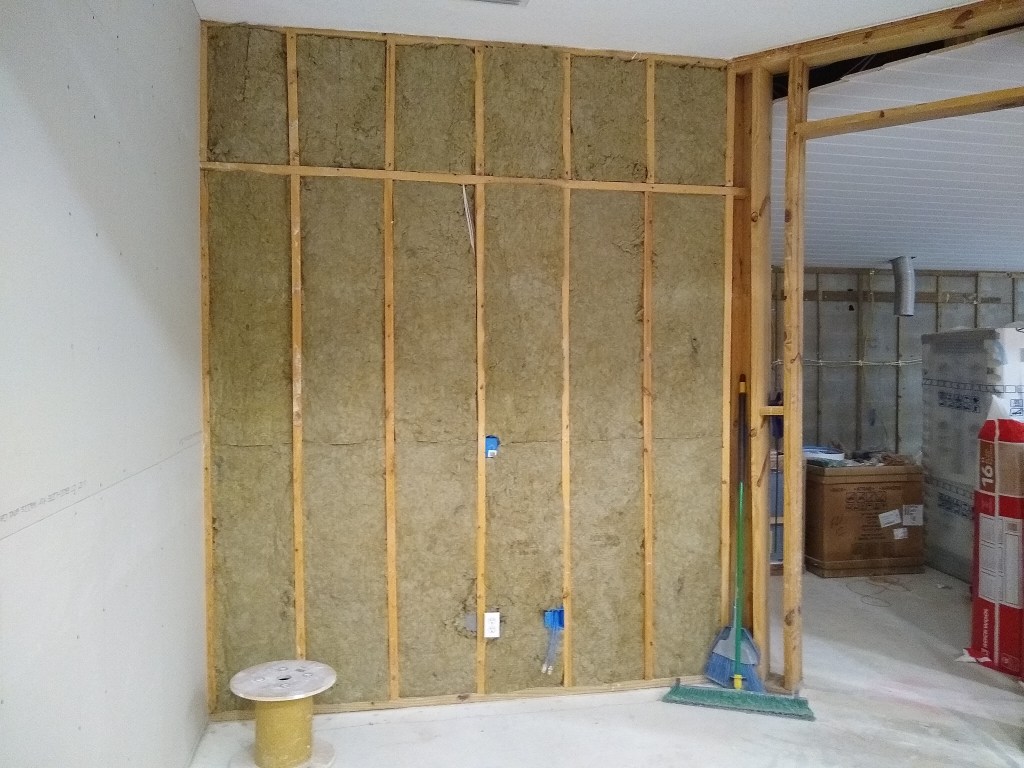
This wall is about 10 feet high, so it required two and a half sheets of drywall (notice my new lift!). That wall borders the garage, which is insulated with the usual batt insulation. The next wall I tackled was the adjacent wall (east), however, before doing that I had to make a decision about sound insulation for interior walls. As mentioned in a previous post, I was not really impressed with the sound dampening effects of the MLV I used between the workshop and office, so I decided to try a product called Safe and Sound, which is a stone wool batt insulation that has sound deadening properties.

I placed it between the studs in the wall, as shown below.

Sound Insulation in Dining Room

Unlike the MLV, I noticed a difference with this almost right away. It seemed to really quiet the room. So picked up another 12 bundles for the remainder of the inside walls I plan to address. Although this room is open to the great room, it is where the piano will go, so I want the surrounding walls to dampen the sound as much as I can. Also, on the other side of this wall will be the laundry room, so it should help dampen the sound of the washer/dryer too.

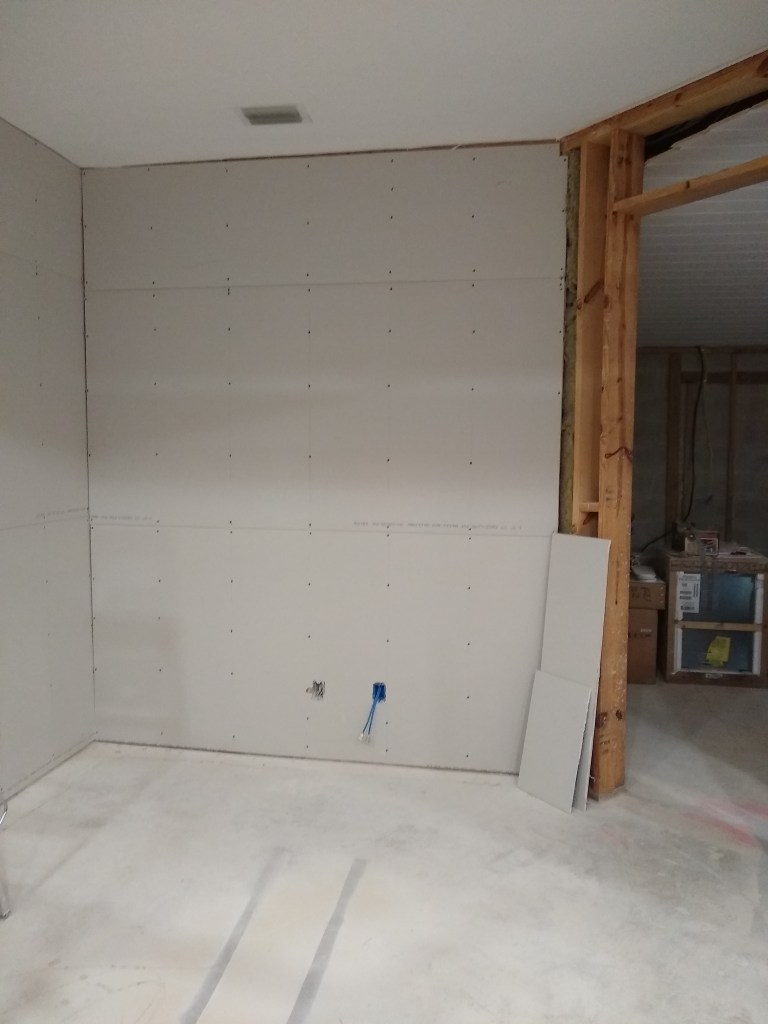
With that decision made I proceeded hanging drywall.

I then moved on to the bulkhead that separates the dining room space from the great room.

Over the next several weeks, it will be all about hanging drywall. I think I have all the sound insulation and drywall I will need to do the rest of the house except the master bedroom and master bath, so I will report on my progress in the next post.

Drywall, Ceiling – August 2021

In this post I describe the work I did on the ceiling of the guest bedroom.

All ceilings in the house were knockdown textured, which looks like this:

Knockdown Texture

Since the guest bedroom ceiling required a repair (shown in previous posts) I was faced with how to make the patch match the existing ceiling texture. I decided that rather than attempt that, I would skim coat the entire ceiling (existing knockdown) and re-texture it. By doing this I wouldn’t have any issues with matching, and I might even be able to avoid texturing altogether if the skim coated resulted in a really nice smooth ceiling. So that was what I did.

Because I would be skimming over a painted surface, I needed to use an all-purpose premixed mud rather than the lighter variety I had been using for the walls. The all-purpose mud contains some adhesive elements that make it bond better to painted surfaces. The skimming process will require two passes. For the first pass, I used the mud straight out of the bucket.

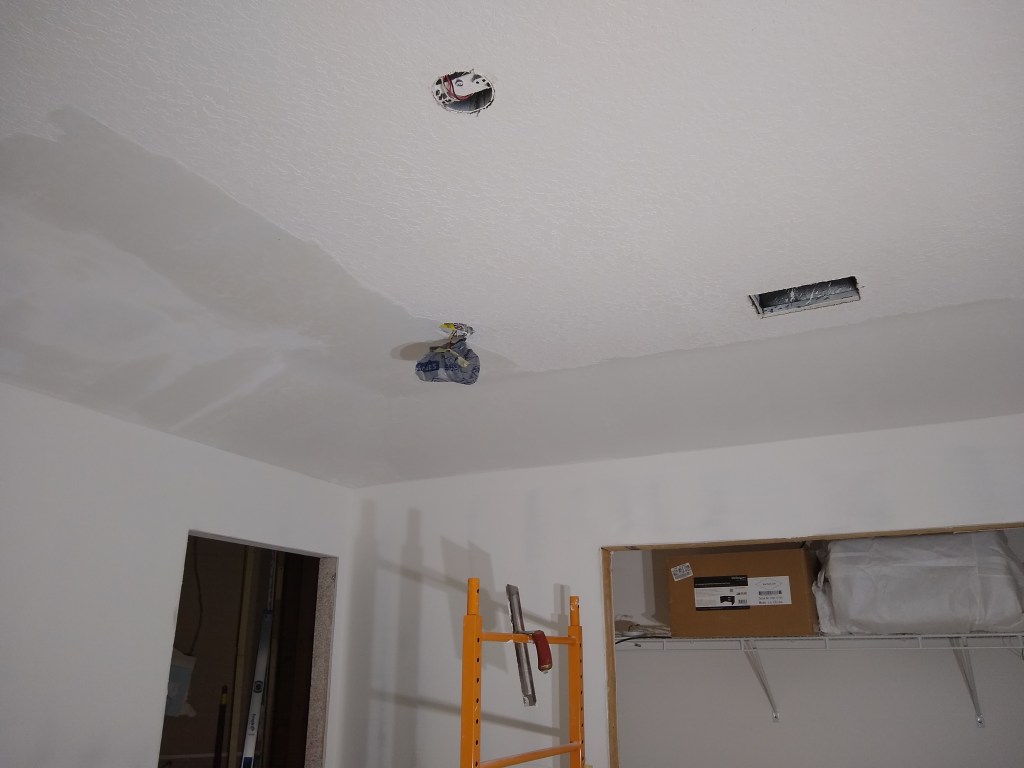
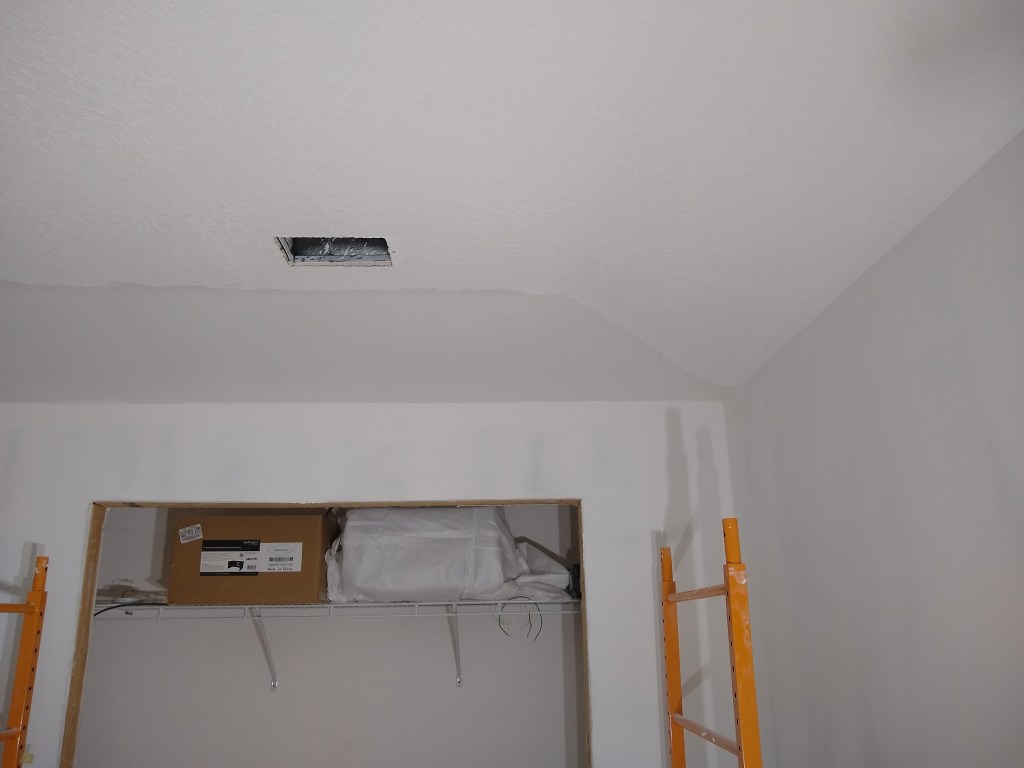
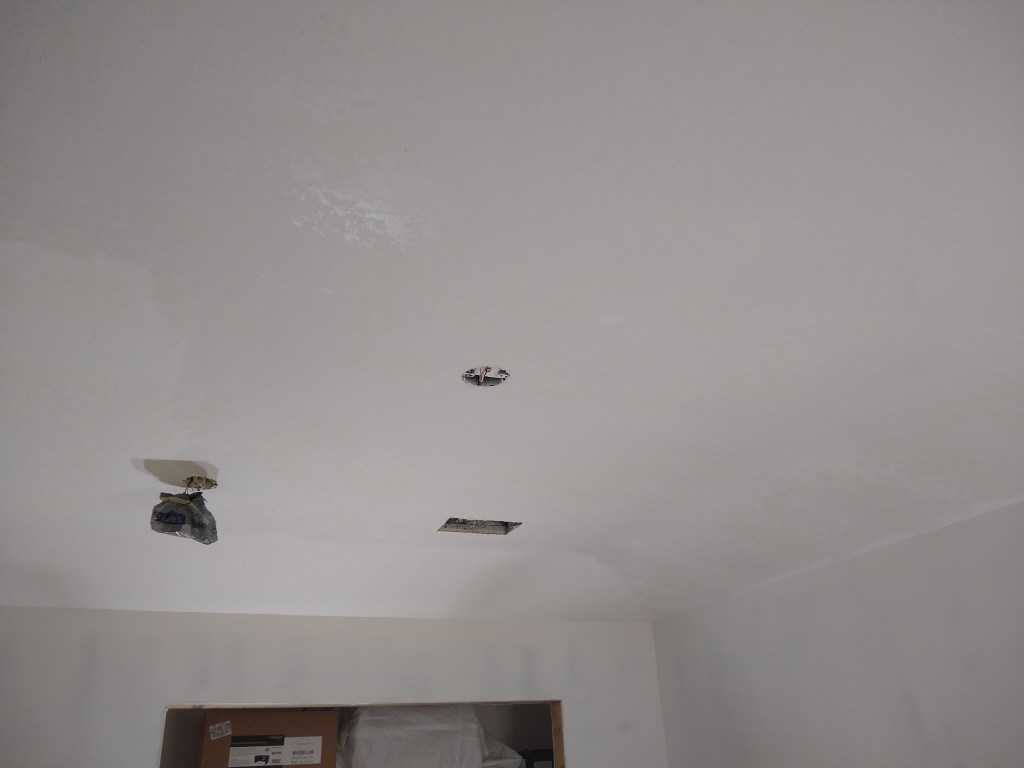
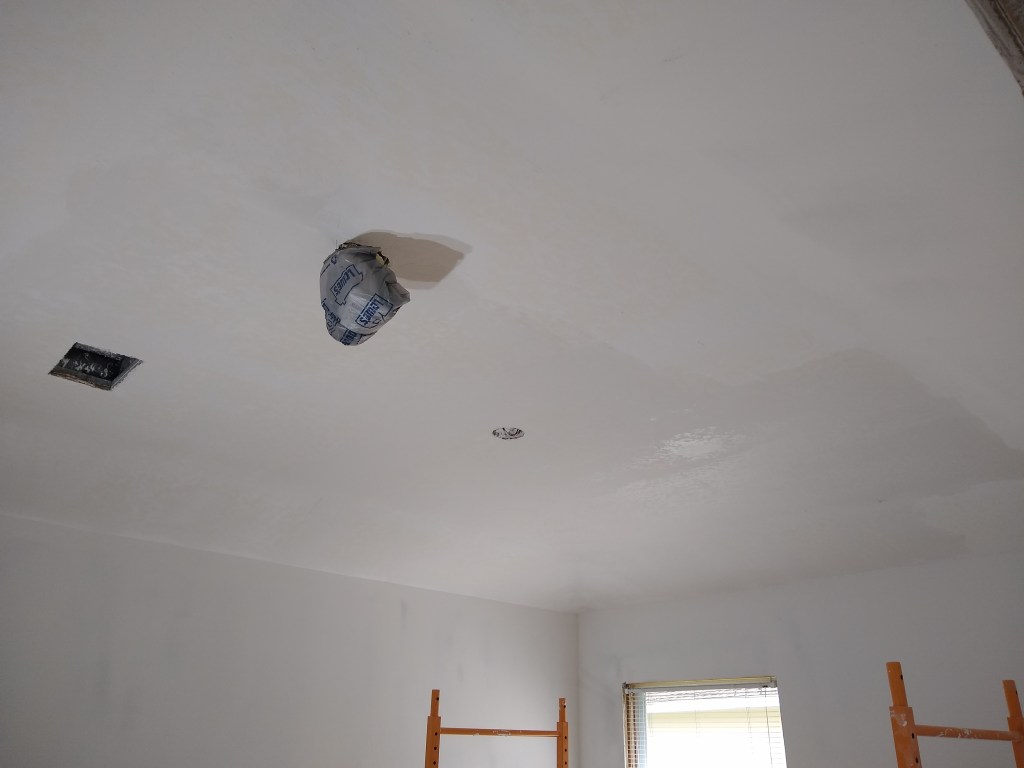
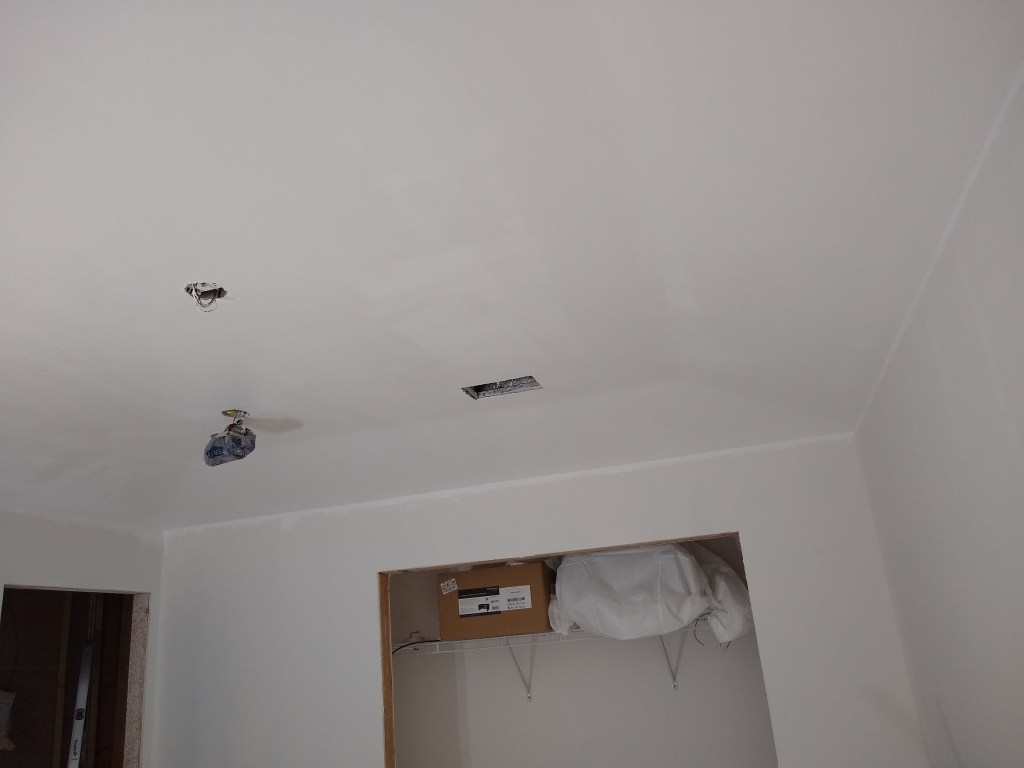
The guest bedroom (all bedrooms) have a tray ceiling, so after removing the light, A/C grill, and smoke detector (I wrapped the bit hanging down in a plastic bag) I began by skimming the angled perimeter first.

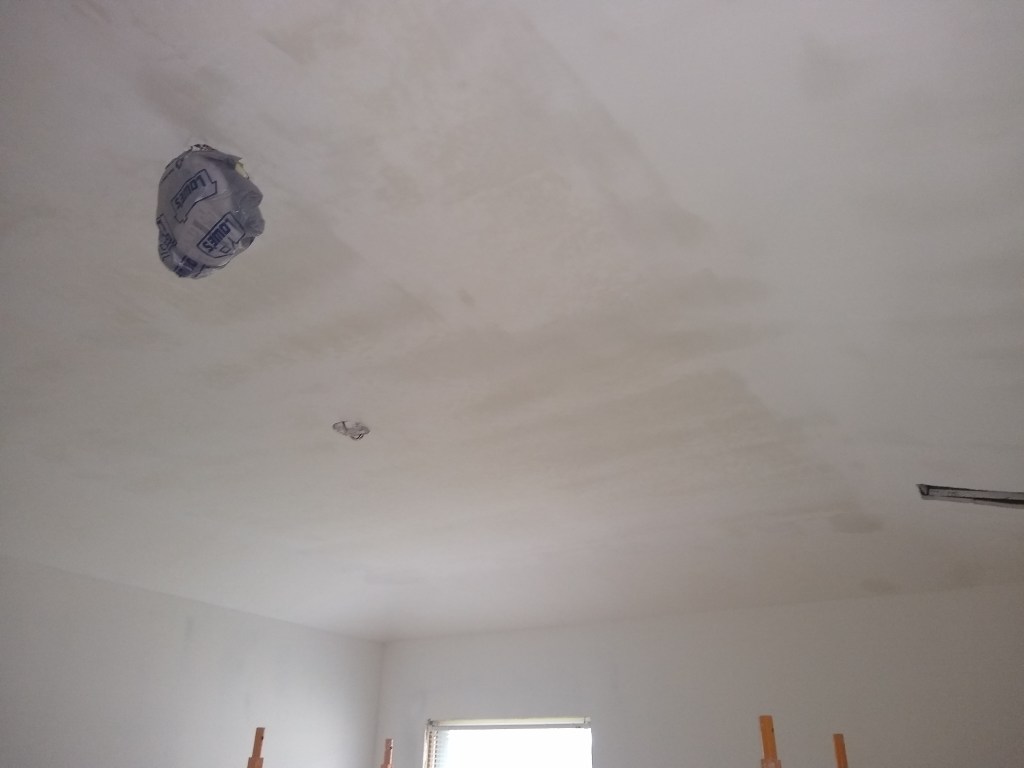
I was pretty pleased with the result. It seemed to smooth out the texture easily. I wasn’t expecting it to look so smooth right away. I finished the first coat the next day. The images below were captured while most of the mud was still wet, so it looks kind of splotchy, but it is pretty smooth.

First Skim Coat Complete

The next day, when the first skim coat was dry, I got up close to scrape and sand the really rough bits (no need for a full sanding). There were definitely some rough areas that were not obvious when viewed from a distance. I did not attempt to smooth them out completely. I only cleaned them up a bit in preparation for the second skim coat, which I expected would cover or fill them in. I decided to use the Plus 3 mud for the second, and hopefully final, skim coat. I was already familiar with it since I used it on the walls, and it would be much easier to sand than the thicker all-purpose mud.
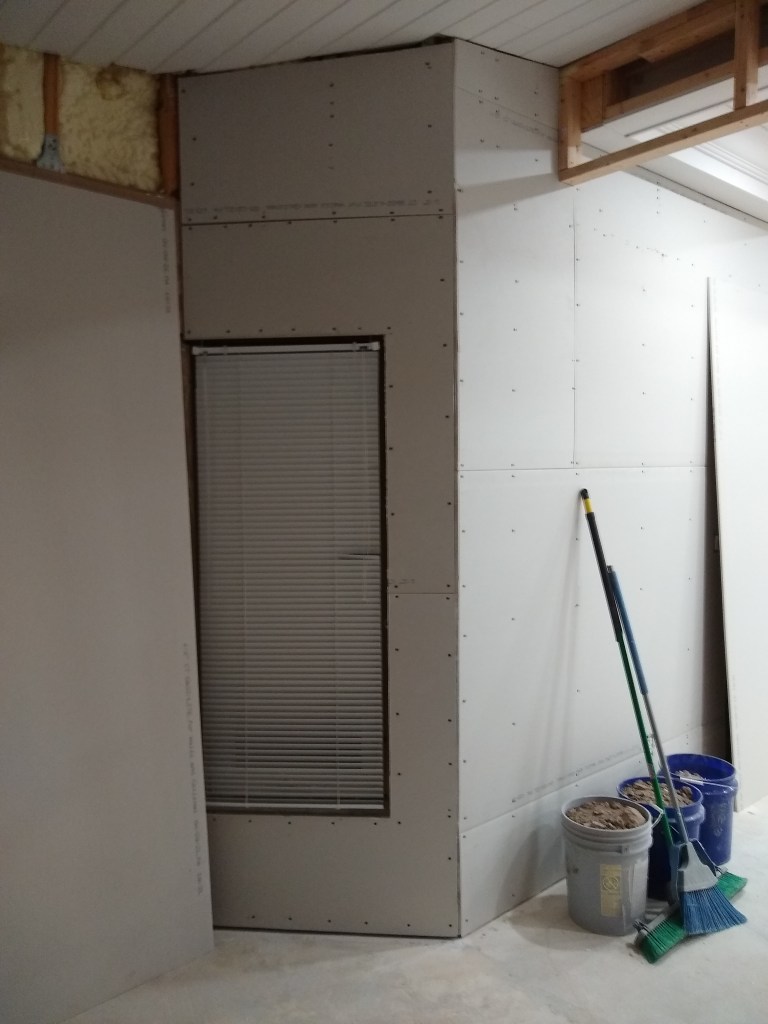
I watered down the Plus 3 mud to a thick yogurt consistency and applied it to the angled areas first, just like the first coat. Being the finish coat, I did my best to limit the lines between pulls of the 14″ knife, keeping pressure mostly on the leading edge. This worked well for the flat areas. The corners of the tray were a different matter since I could not get any of my knives to smooth them out. So I resorted to a sponge. I put enough mud over the area, then used a wet sponge to smooth them out. I left a little bit mud in those corners to sand to get the result I wanted. Here are some pics of the second skim coat before I left for the evening.

Second Skim Coat Complete

The next time up, I sanded the ceiling and touched up a few places. After that, the room was ready for primer (ceiling and walls). I picked up a gallon of KILZ original primer and applied it to all inside corners of the walls and ceiling before applying it to the ceiling. With the primer I had left, I applied it to the west wall. The next day I picked up another gallon of primer to finish the priming of the remaining walls, but also picked up a gallon of ceiling paint. It was my intention to prime all surfaces, but only paint the ceiling, since I knew it would be white. When I figure out what colors I will paint the walls, they will be ready.
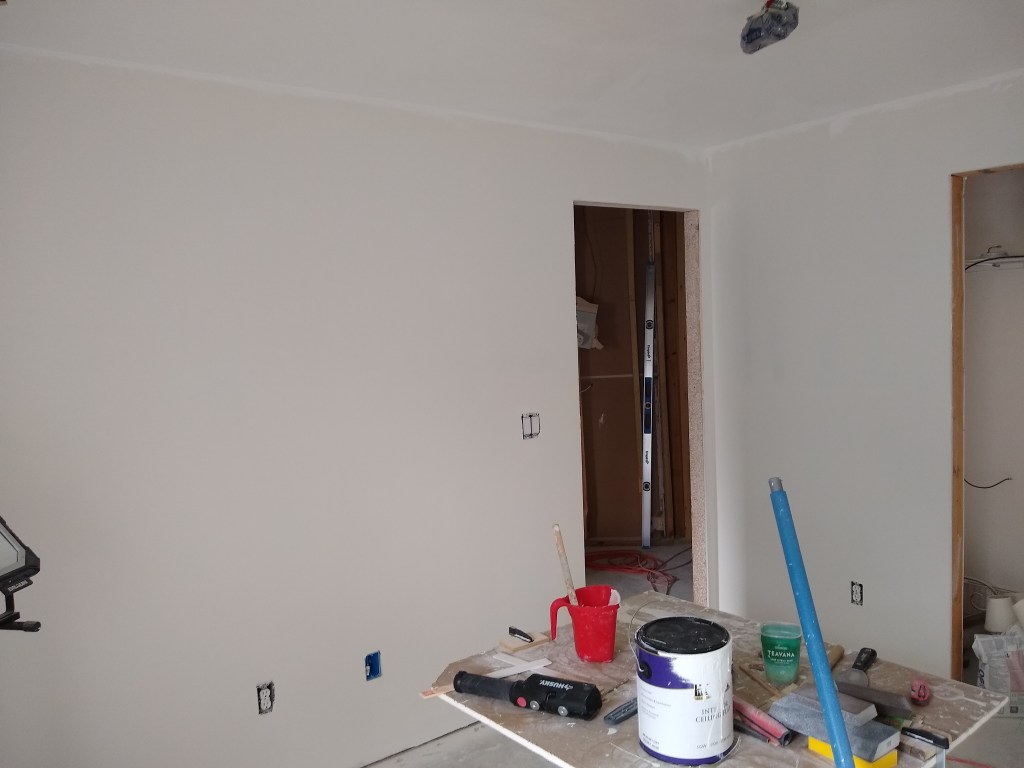
After the primer was dry on the ceiling and west wall, I used my 4″ drywall knife and a sanding sponge to scrape and smooth out any obvious lines from the priming. During this process I found some areas on the unprimed walls that were not well sanded. This was missed because it is not easy to see them due to all surfaces being white. So I purchased a hand held light wand to help me direct the light more easily and identify defects. It worked really well and helped me sand out small patches I missed the first time. Following that, I primed the remaining three walls.

The next day, I sanded/scraped what I’d primed and then painted the ceiling with the first coat. That was followed up with the second and final coat the next day. I’m only showing pictures of the final result rather than between coats because there’s not much to see. So here is the final result.

Ceiling after Second Coat (still a bit wet by the door).
Walls Primed, Ceiling Painted

You can see that I was not concerned about the ceiling paint getting onto the walls where they meet. When I eventually paint the walls, I will cut in properly to make a nice edge.

I’m happy with how the ceiling and walls turned out. That I did not have to texture the ceiling was very pleasing. I was hoping I could have a smooth ceiling, and now I do.

With the walls primed and ceiling painted, as far as drywall is concerned this room is done. My objective was to learn all the lessons I could in this room before proceeding any further with the other rooms. So I will resume hanging drywall in the rest of the house.

However, before doing that, I will suspend work on this house for a while and turn my attention to the house where I reside. My primary residence is about an hour and fifteen minute drive from the house I am renovating. I am getting tired of the drive up and back each day. I spend about two and a half hours driving and only around three hours working. My personal circumstances are such that I no longer need to remain where I am, so I intend to sell my primary residence and get a place very close to the reno. That will save a lot of wear and tear on my car and allow me to spend more time working on the reno. To prepare for this I have to do some minor work on my primary residence to have it ready to show. I’m not sure how long this will take, but it will take my attention for the next few weeks. During this time I expect the windows and doors will be replaced, so I will need to drive up for that. So unless that is delayed, I think the next post will be about the that.

Drywall, Level 1 to 5 – June/July 2021

In the first post about drywall, I neglected to explain what “Level 0” meant in the post title. I could go back and update that post, but now that I will be discussing level 1, I’ll just do that here. There are five levels of drywall finishing. For most of the walls, I will strive to achieve a level 5 finish. The levels are as follows:

  • Level 0: Simply hanging the drywall itself. No finishing at all.
  • Level 1: All joints and interior angles have tape embedded in joint compound. Excess joint compound, tool marks and ridges are acceptable.
  • Level 2: All joints and interior angles have tape embedded in joint compound and wiped with a joint knife leaving a thin coating of joint compound over all joints and interior angles. Only a single coating is required. Also, all screw heads have been covered with joint compound. Tool marks and ridges are acceptable. Achieving this level is good enough for the surface to receive tile or for a garage.
  • Level 3: Same as level 2, but an additional covering of screw heads, and tool marks and ridges must be removed. Achieving this level is sufficient when the surface is to be covered with a heavy textured finish, which will hide any imperfections. In my case, reaching this level on a ceiling intended to have a “knockdown” texture, is acceptable.
  • Level 4: Same as level 3, but an additional coat of joint compound is required to cover flat joints. Screw heads and accessories require three coats (an extra from level 3). This level of finish is sufficient for walls that will take a mat paint finish or will be lightly textured.
  • Level 5: Same as level 4, but a light skim coat is required to cover the entire surface. This level of finish is required when a smooth wall finish is desired and a non-flat paint is to be used.

In this post I will describe the work I do in the guest bedroom. As mentioned in the last post, I decided to stop hanging drywall after getting three of the rooms hung (almost – more on that later in this post). I decided to circle back to the guest bedroom and move forward through the levels so that I can gain experience that I can use when I move on to the other rooms.

I found a great YouTube channel called Vancouver Carpenter, which has helped me a lot That guy is a really good instructor. In one of his videos he discussed the need to prefill all joints before attempting to tape. Prefilling involves using a setting compound (as opposed to a joint compound) to fill all gaps. The idea is to have a surface that is ready to accept tape, where the tape will not get sucked into the gap. The setting compound contains a hardener and has minimal shrinking after drying, so it will be a pretty strong surface upon which to tape. Here is a before and after of the first wall I hung in the guest bedroom.

Notice that the setting compound is applied to all seems. The gaps between the wall and the ceiling are all filled. Even the factory edges (horizontal edges with bevels) are prefilled. For the vertical butt joints (non-factory edges), I use a utility knife to cut a small v-groove into which the setting compound will go. The claim is that by prefilling even the non-gappy seems, you will reduce the likelihood of cracks appearing later on.

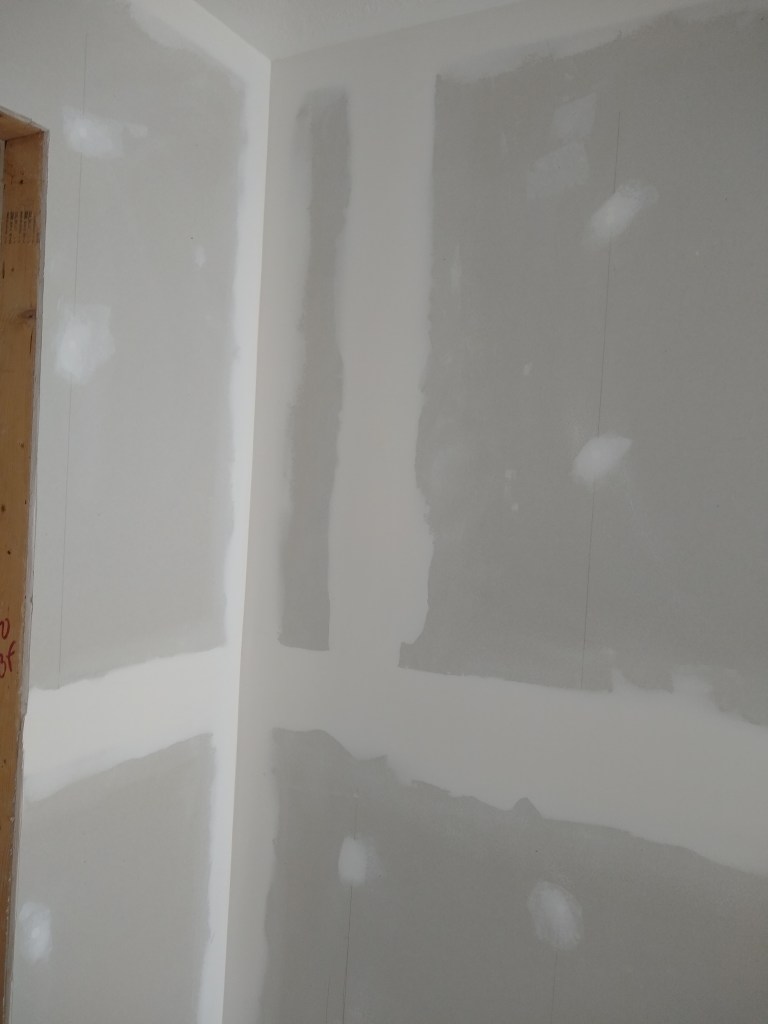
Here are more images of the other walls. Although not required for level 1, I also covered the screw heads. It’s not pretty, but the gaps are filled.

Following this work, my order for 100 feet of mass loaded vinyl (MLV) for sound insulation arrived, so I set about putting it up on the remaining wall in the workshop; the one that borders the office.

First Portion of MLV in Place

I attached this using drywall screws and plastic caps from roofing nails. It worked well enough, but I switched to a screw with wafer heads for the remaining portions.

Next, I covered the MLV with drywall to finish the drywall hanging for the workshop. As alluded to in the beginning of this post, this was the true last bit of drywall I would hang before circling back to finish the drywall in the guest bedroom

After doing all this, it was time to determine if the MLV provided some level of sound insulation. To do this, I played a song on my phone and placed the phone behind the wall (in the office). I then compared what I heard with what I heard when the I moved the phone where no sound insulation was in place. Unfortunately, I did not notice any difference, which surprised me. So I will try using a different material next time and see if it improves things. MLV is expensive and hanging it is difficult because it is so heavy, so I am happy to try another material. But that will have to wait until I am ready to continue hanging drywall. For now, it is back to the guest bedroom.

I decided to address the opening in the ceiling of the guest bedroom first. We opened that area long ago to see why the ceiling and the wall in the corner were not straight. It didn’t really reveal anything obvious, so I decided to open it up further.

I discovered that the corner was poorly aligned due to some makeshift framing. To improve it, I added a few nailers (sorry, forgot to take pics) then patched it with drywall that would bring it closer into alignment.

Ceiling Patch, corner piece

By straightening the ceiling (it no longer swoops up to meet the adjacent part), the corner piece is a bit lower that the adjacent part of the ceiling it meets. I could not improve upon that without major surgery, so I will make the adjustments using mud (what they call “mud framing”). The patch looks kind of ugly right now, but it will be fine when I tape, mud, and finish it. You can already get a sense of it after prefilling the gaps.

After that dried, I started taping it.

After taping I applied my first cover coat.

One of the advantages of addressing the ceiling patch first, was that it gave me an opportunity to try taping and mudding in an area that will likely be covered by a texture (knockdown or skip trowel) and therefore more forgiving. After doing this I felt ready to start taping and mudding the rest of the seams in the guest bedroom, which will be less forgiving. Here are several shots of the result after applying my first cover coat. Note that while doing this I continued to add additional coats to the ceiling patch as I went along to smooth it out (more required, though).

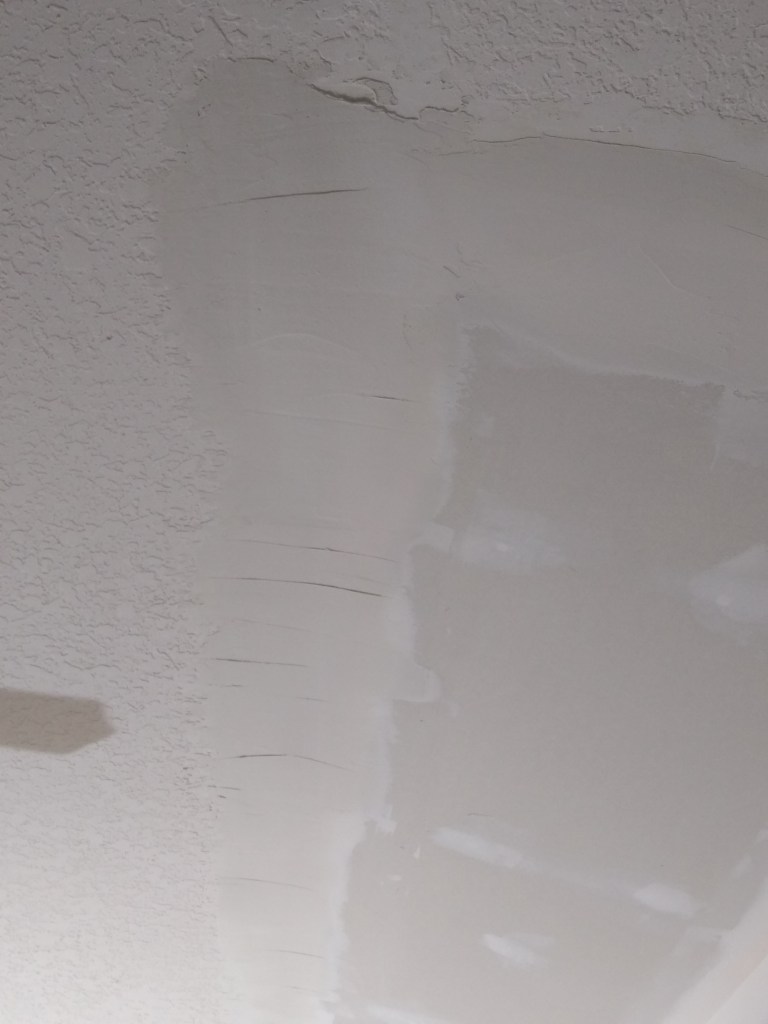
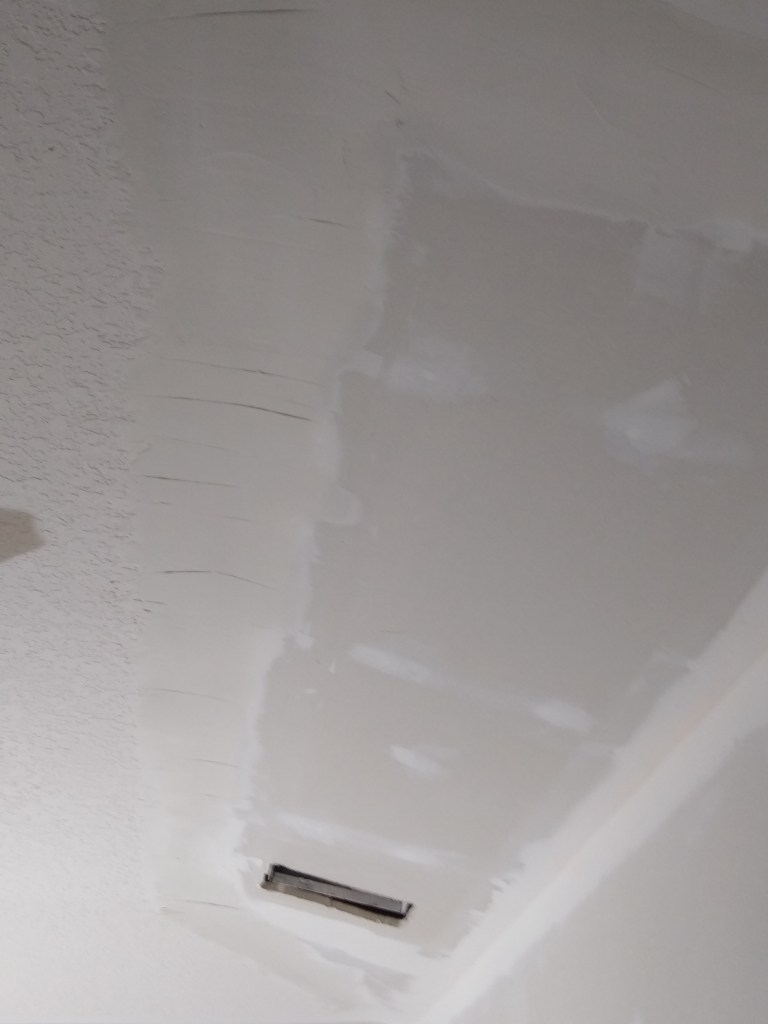
One of the most difficult parts of this was the work required to tape the corners between the new drywall and the ceiling. This required that I scrape and remove the tape that was under the finished surface of the ceiling to make room for the new tape. I used a wet sponge to soften the dry knockdown texture covering the tape on the ceiling, then started picking away at it. Sometimes I would get a nice long strip to come off, but mostly it involved pulling bits and pieces. In the end I was successful and was able to apply new tape to the corners. It turned out well, but I’m not looking forward to doing this in the other rooms. I’ll search for a more efficient method when I get to that again.

To bring the walls to level 4, I required a second coat of mud. I did this in stages, applying the mud to one side of the inside corners first, then the other side the next day. I did some light sanding in between to get rid of any obvious imperfections and tool marks.

As usual, I added more coats to the ceiling patch. It’s just about where I want it now.

After applying the second coat and allowing ample time to dry, it was time to give it a good sanding in preparation for the skim coat (which would take it to level 5). To do this I used a pole sander and a hand held sanding sponge.

Here are some images of the result after sanding (level 4).

For skim coating, I tried a few different methods. I found another YouTube channel I liked (Paul Peck Drywall) that showed how he used a paint roller to apply the mud before using a 14″ knife to remove it. So I experimented a bit. I first tried using the trowel to both apply and remove the mud. Then I tried the paint roller and the 14″ knife. I did a bit of back and forth between the two before finally settling on the roller/knife approach. You can only use the paint roller when skim coating, because the mud is thinned down enough to make the roller work. When cover coating, you will not thin the mud (or only slightly), so applying it with a roller is not practical. I found that applying the mud for skim coating with the roller was faster and easier, so that became my preferred method. Perhaps I’ll change my mind some day, but at my current skill level, this works well.

North Wall first Skim Coat

I did this for all walls over several days, then started on a second skim coat for all walls. Between coats I did a bit of sanding, but after the second skim coat, I paid more attention to the sanding and finish. The second skim coat would be the final one before paint primer, so I spent a lot of time looking for imperfections and sanded them as needed. I also identified areas that needed a bit more mud and touched them up before the final sanding. Here is the result.

South Wall second Skim Coat Sanded
West and North Walls second Skim Coat Sanded
East Wall second Skim Coat Sanded

I’m happy with this. The real test will be how the walls look after the primer and paint are applied, but that won’t happen until I get the ceiling done, which is my next task and the topic of the next post. So until then…

Drywall, Level 0 – June 2021

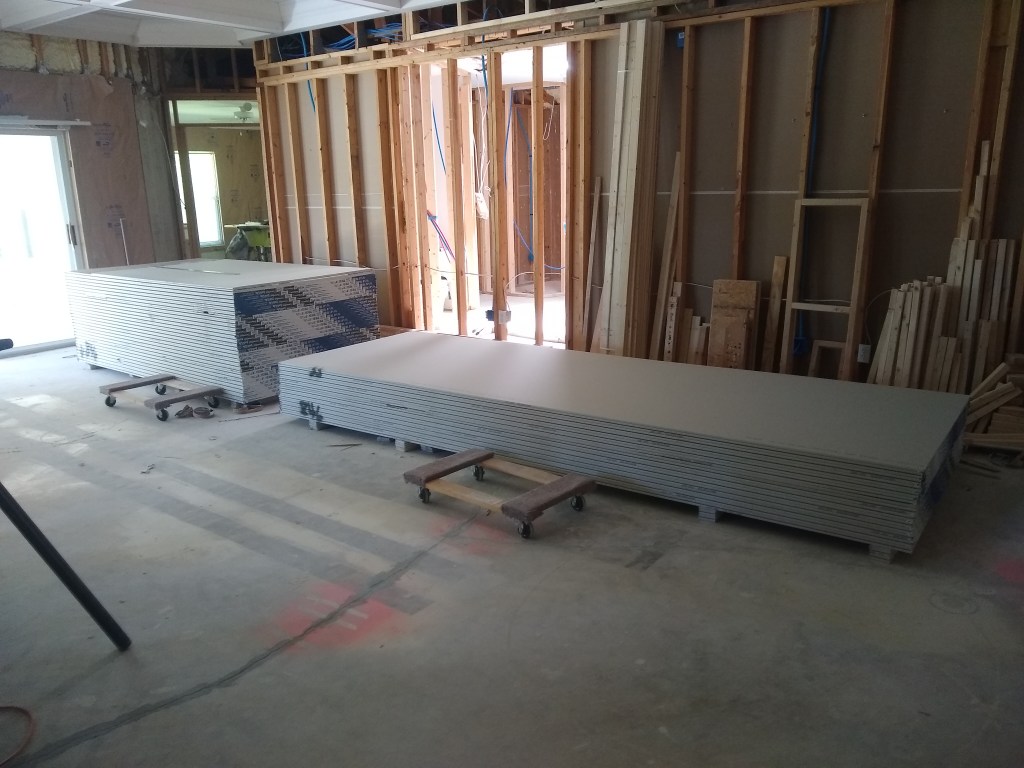
I took an unplanned hiatus through most of May, initially due to a cold. Once recovered from that, I was further delayed by my own hesitation about pulling the trigger on the drywall. I wanted to make sure that was the next step before I made the purchase. After convincing myself that it was, I took the measurements to establish how many sheets I would need, excluding the master bathroom (not sure what I’ll do there yet), My objective was to use as large a sheet as I could where possible to reduce the seems that would subsequently require taping. My measurements revealed that I would need 35 sheets of 12’x4′ and 60 sheets of 8’x4′.

I first visited Lowe’s intent on making a purchase and arranging delivery. Unfortunately, Lowe’s would only deliver the drywall to my garage. I wanted it placed inside the house. I would be hanging it by myself, so moving it from the garage into the work space would be a major chore by myself. So I went to Home Depot next and, fortunately, for an extra charge they would carry it into the house. I didn’t make the purchase that day. Instead I went home and looked online for other options before I committed to it. I didn’t find anything, so I called Home Depot and made the arrangements over the phone. We set a date and a time window .

I drove up to meet the delivery crew on Wednesday, May 19th at the designated time. When the driver arrived he was by himself, which surprised me because moving all the drywall into the house would be a big job for one person. I mentioned this when he approached me only to learn that he was not planning to carry it into the house; only put it in the garage. So, he got on the phone with the store for about half an hour with little result. In the end he left without unloading the drywall. So I drove to the store to discuss it with them. They made arrangements for another attempt on the Monday, May 24th, this time with additional labor. I drove up again on the Friday and waited. I stopped in at the store to make sure all was in order and was told it was. Nearing the end of the delivery window I got a call informing me that they’d have to do something else because the usual delivery service did not carry into the house. So we set it up for the following Friday. The third attempt was successful. My drywall was placed where I asked.

Note that the above pictures were taken after I had already finished hanging the drywall in the guest bedroom, so if you looked really closely, you’ll see that there are less than 35 sheets of the 12′.

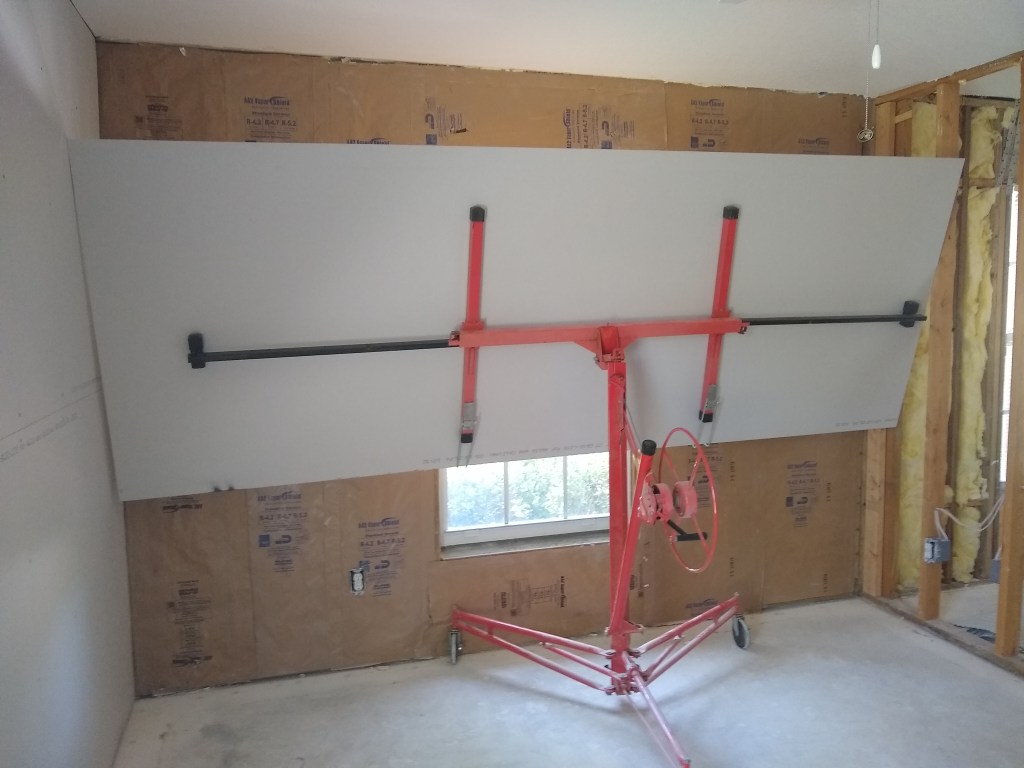
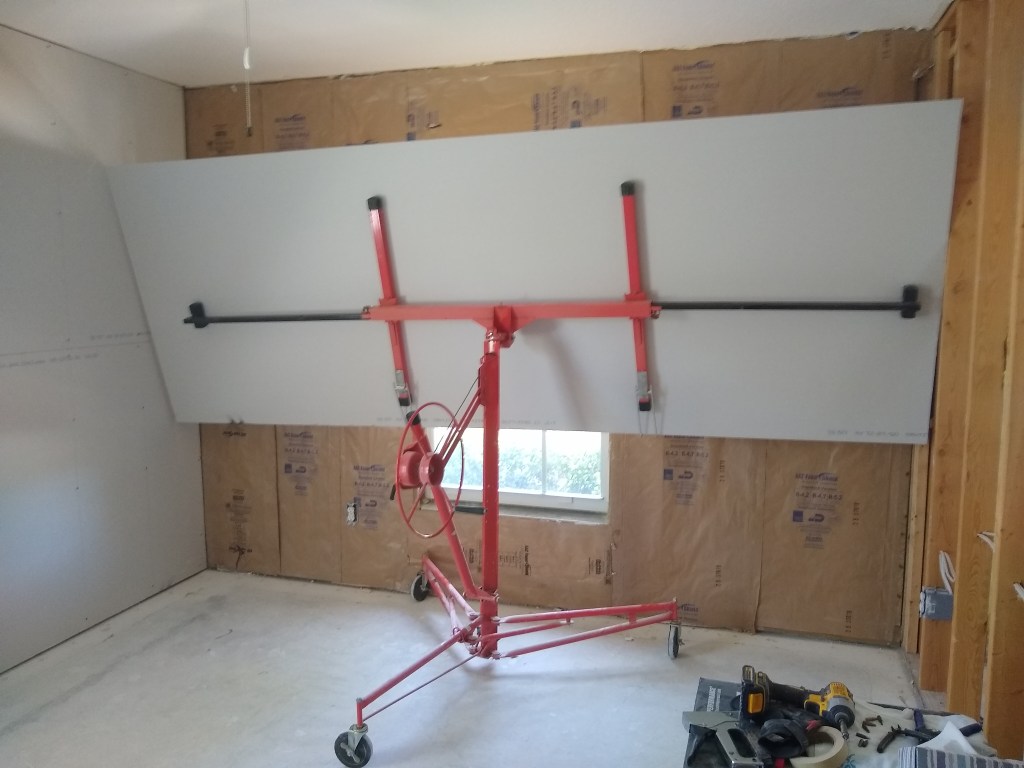
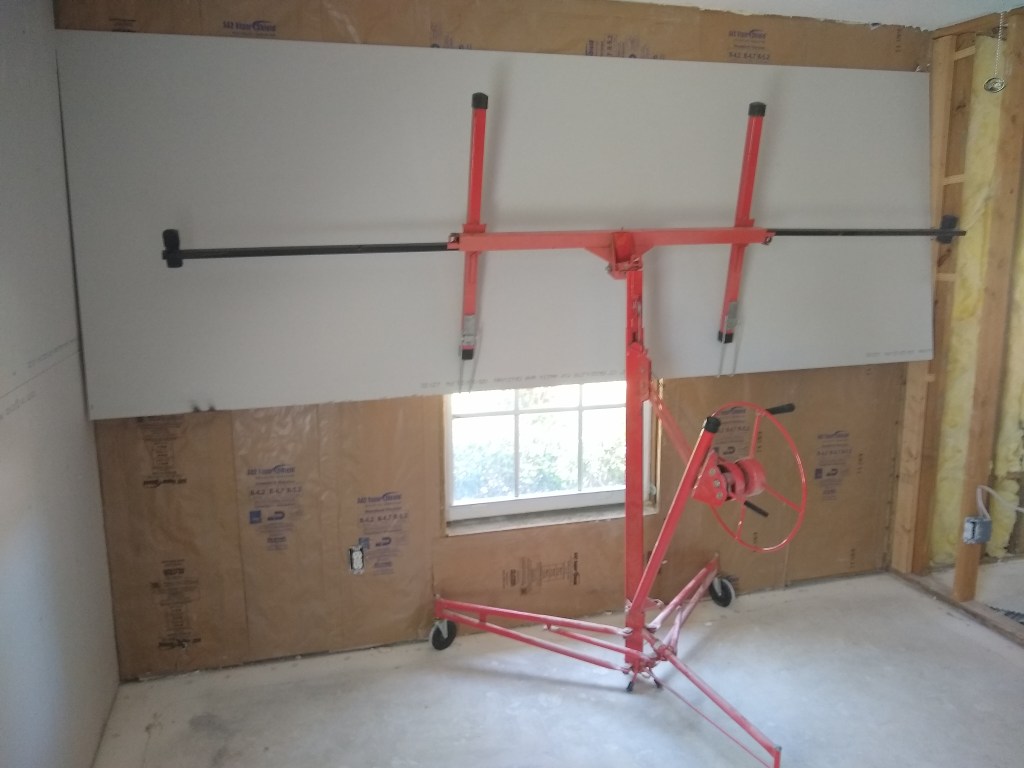
The next day I hung my first ever sheet of drywall! I had several reservations about doing this myself, especially with the 12′ sheets. My biggest concern was how I was going to mount a 12′ sheet on the upper section of the wall up to the ceiling. I did some research on YouTube and learned that I could do it using the lift I had. Until viewing that video, I’d only used the lift for raising things up to the ceiling and was unaware that it had features to assist with hanging drywall on high walls. That was my first and biggest problem solved. I would not have to rely on another person. A big relief.

Another concern I had was how I would maneuver the sheets from one room to another. I was pretty sure I could use a couple of dollies I had, and that turned out to be the case. At first I used both dollies. It worked, but was little tricky steering. I then discovered that using one was sufficient and much more maneuverable. So another problem solved. Below I show a big 12′ sheet on the single dolly.

Moving Drywall Sheets

Now that I’ve shown how I move the sheets by myself, let me show the process of hanging a 12′ sheet. Using the dolly, I move the sheet into the room I am working on and get it close to the lift. I then have to physically pick up the sheet and place it onto the lift. That is not easy, but after trying several techniques I figured out how to do it without too much effort.

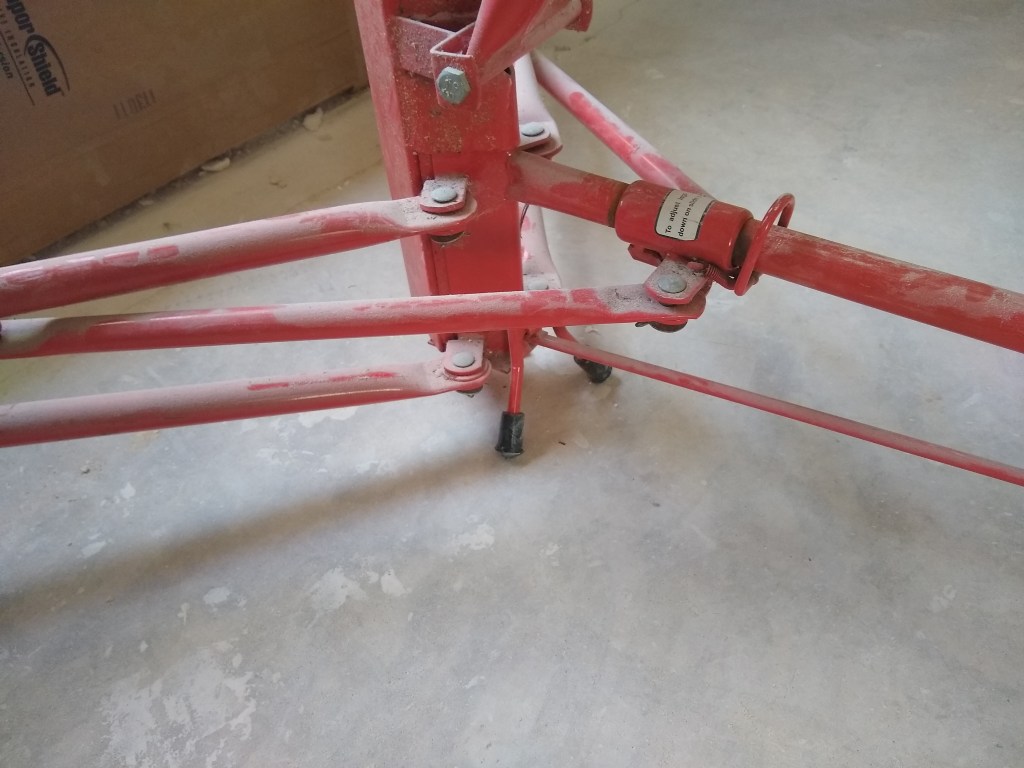
The pics above are of the sheet on the lift positioned to go on the north wall of what will be the office. I had already finished hanging the guest bedroom and the west wall in the office before I started writing this post. It was only when I started describing the process that I realized that pictures were required. So what you’re seeing is not my first attempt. The pics show the lift moved close to the wall. This is the first step. Next I must tip the top of the sheet so that it rests against the wall. In the image below, you can see that the bottom edge of the sheet is still supported by the lift, but the top edge is not. It is now leaning against the wall. For this to work without the lift rolling away, it has a set of brakes with rubber ends to prevent the lift from moving.

On Lift, Against the Wall

Here is a closeup of the brakes deployed.

Lift Brakes

Now I just raise the sheet into position. It simply rides up against the wall as I turn the handle.

Actually, with a tight fit like this one, it takes a bit of maneuvering. I turn the crank, adjust the sheet, turn the crank, etc. But it is pretty straight forward. Once in position I pull out the ladder and drill a few screws into place at the top. Three screws are enough. Then I can roll the lift away and it will hang by itself.

Sheet tacked and Lift removed.

After that it is just a matter of adding enough screws to firmly fix it in place. Before I place the bottom sheet which, of course, does not require the lift, I cut out the window opening. But I will discuss those details later. Now that I have explained the process of hanging sheets, I will describe what I experienced as I began the process.

Being new to this, I decided it would be a good idea to gain experience (i.e., make beginner mistakes) in a room that would be the least used. So I started in the guest bedroom. I figured out how to move and lift the sheets by myself, as described above, but there were still several other firsts I had to face.

The first sheet I hung was a full 12’x4′ sheet, requiring no cuts. Here it is below.

The next sheet, however, would require cutting to fill the relatively small area adjacent to my first sheet. Cutting a sheet seemed pretty simple, so I just followed the directions I found online. Sure enough, it was simply a matter of cutting a line through the paper with a utility knife, then snapping it. The sheet broke easily on the scored line. I then used the same knife to reach under and cut the paper on the other side. Voila, another mystery solved. It also required one more step; using a rasp to smooth the freshly cut edge, but that was very simple using the following tool.

Drywall Rasp Lifter

This tool has two uses. It can be used to raise the bottom of a sheet of drywall using your foot and a lever action to meet the sheet already in place above it. The idea is to create a tight butt joint. The other use comes from the part in the middle of the tool that is a rasp you can run along the edge of a freshly cut sheet to smooth it out. It works really well.

So I fastened that piece to the end of my first sheet to finish the top of my first wall. The bottom part was a bit more involved, since it required some cuts for outlets, as shown below.

First Wall Hung

To cut the openings for the outlets, I started using the manual approach whereby you simply measure the distances and then cut with a drywall saw.

Drywall Saw

This worked fairly well, but it was very time consuming. It also had the disadvantage of not always lining up how you expect. You measure as best you can, but when you actually fit the sheet, there will inevitably be some variance. Here is what it looks like close up.

These are not bad and will be easily covered by the face places, so no patching will be required. However, the measuring and cutting before putting the sheet up really interrupts ones momentum, so I decided to try my hand at using a cutting tool with a RotoZip bit. Here is what I bought.

Notice that the RotoZip Bit has a smooth tip. This is the part the will guide the bit along a surface without cutting it, as I describe in a moment.

My research revealed that a cutting tool and RotoZip bit seemed to be the preferred method used by professionals. The concern for me was that it was going to take some practice to learn how to use it without making a mess. The way it works, is that you first remove the outlet and push the wired to the back of the box. You make a note of where the center of the box is then place the sheet over the outlet and fasten it loosely using screws that are not really close to the outlet itself. You measure to where you noted the center of the box to be and plunge in with the cutting bit. You then move the bit (i.e., cut) over to the edge of the box. You’ll feel the bit stop when it touches the inside edge of the box. Then you pull the bit out a little and move the bit over to the outside edge of the box and trace around it, cutting away the drywall. This is the tricky part for the inexperienced. You have to get a feel for it, which takes a bit of time. Here are my first three attempts.

As you can see, these are pretty ugly, especially the third one, and will require patching. For a professional, patching mistakes like this is a real nuisance, costing time/money. However, for me, I am not time constrained, so I will “embrace the suck” and view this as part of the process. I did get better and expect I will continue to. Here are my fourth and fifth attempts. They are not perfect, but are acceptable and will require no patching.

Fourth and Fifth RotoZip Attempts

I also use the cutting tool for other openings, like doors and windows. Here is the second wall I started in the guest bedroom. The 12′ sheet covered the doorway, so I used the cutting tool to open it up after the sheet was in place. It works nicely for this and is a much simpler process as one simply follows the door frame (no need to pull out and plunge in). As a side note, the hole in the ceiling was done a long time ago as we explored the framing. It will be patched in due course.

Cutting the Opening for the Door

Here are a few shots of the guest room after I finished hanging the drywall.

During the process of hanging the drywall in the guest bedroom, I found that setting the screws was a bit erratic with the impact driver, even using drywall screw setter bits to limit the likelihood that I would drive the screws too deeply into the drywall. You’re supposed to sink them below the surface without breaking the paper. So I decided to purchase a drywall screw gun; a tool specifically designed for this.

Drywall Screw Gun

With this tool, when you pull the trigger, the motor spins, but the bit does not turn until you press the screw into the drywall. It is the pressure that causes the clutch to engage, and then it drives it in quickly. You can adjust the depth to sink the screw head to your desire depth. I found this was a very worthwhile purchase and made the process much more consistent. I’m very happy with it.

In addition to screws, I am also using construction adhesive to glue the sheets to the studs, where possible. Although many were split on the need for it, it appeared that most felt it was worth while and that it would reduce the likelihood of screw pops in future. The idea is that as the framing naturally moves (slightly) over time, the extra adhesion will prevent the drywall from pushing and pulling against the screws. The extra cost for the adhesive is not much and it takes very little time to apply, so I figured I’d do it. Unfortunately, it can only be done on interior walls, since the furring strips you screw to on the exterior walls are covered with an insulating material, so I’m not getting 100% coverage.

Some other lessons I learned while hanging the drywall in the guest bedroom was that it is a good idea to look for opportunities to do some prep work. Many walls are not straight and will require shimming. Also, in some places, especially in the corners, there is not always a lot of wood available to screw the sheet to, so it can be beneficial to add nailers.

As of the time of this posting, I have hung two bedrooms (guest bedroom and office) and am half way through the third bedroom (workshop). I have ordered 100 feet of mass loaded vinyl to use as sound insulation between the workshop and office, which will arrive this weekend. I will put it up and see how it works before purchasing more for the other interior walls to which I intend to add sound insulation. Where it makes sense, I want to reduce the sound that can travel between rooms (i.e., bathrooms and bedrooms). But I’ll talk about that in another post. Once the drywall in the workshop is hung, I think I will return to the guest bedroom and try my hand at mudding and taping so I can get some experience with that before continuing with the hanging. It is likely that the lessons learned from that experience will impact how I hang the remaining drywall. Since there is so much more drywall to hang, now’s the time to discover them. So stay tuned.